Panty Liner Product Specification Guide 2026 | Welldone

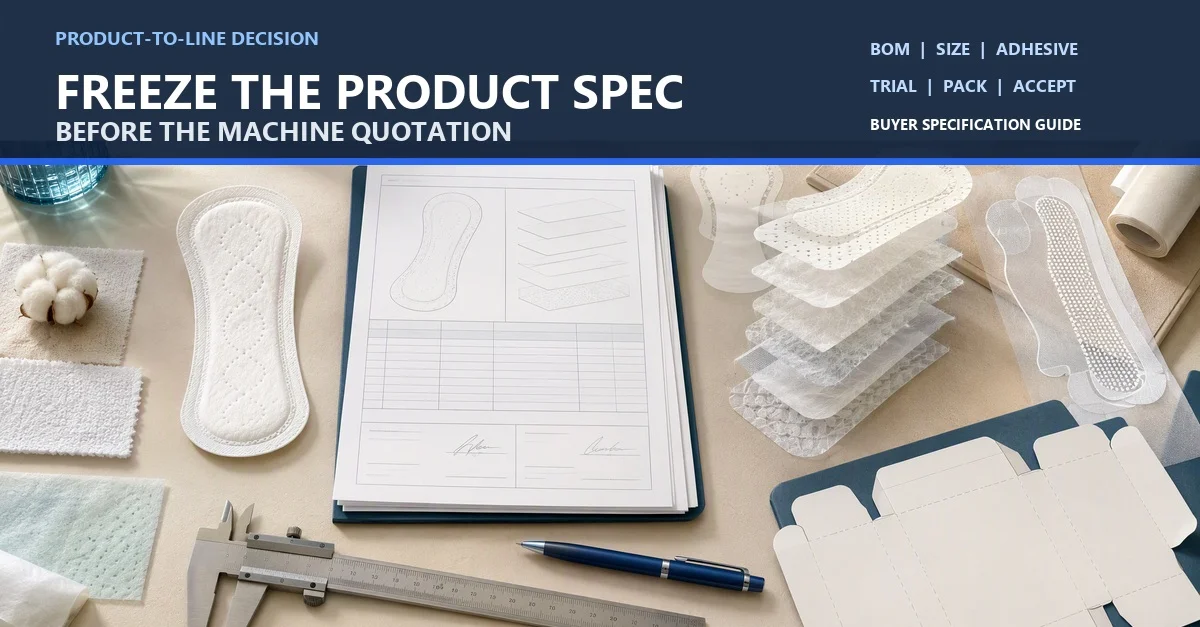
Why a New Panty Liner Needs a Signed Product Specification
A brand owner places a new liner sample on the meeting table and asks for a production-line quotation. The product story sounds complete: organic cotton, no plastic, a cooling ingredient, light everyday protection and discreet comfort. The machine team still cannot see the actual product.
They need the layer stack, finished dimensions, adhesive area, release format, pack count and measurable acceptance conditions. Without those decisions, a fast quotation is only a list of assumptions.
A new menopause liner exposes an old quotation problem
On October 20, 2026, Nonwovens Industry reported that Skimpies launched a Menopause Liner positioned for women navigating perimenopause and menopause. The report describes 100% organic, unbleached cotton, no plastic, bleach, chlorine or fragrance, an extra absorbent cotton layer and a cotton topsheet infused with organic mint essential oil.
The official product page confirms the product name, 30-count box, organic-cotton positioning, heat-activated adhesive and everyday light-protection concept. Those are useful product intentions. They are not yet a signed manufacturing specification.
Source & Date
Primary: Nonwovens Industry, October 20, 2026
Secondary: Skimpies official product page, read October 23, 2026
Primary: Nonwovens Industry, October 20, 2026
Secondary: Skimpies official product page, read October 23, 2026
News Data Conflict Found: the public language does not define one BOM
The industry report says an extra thick absorbent organic-cotton layer provides everyday protection. The upper part of the official page uses similar language and refers to an organic-cotton core.
A later FAQ on the same official page says there is no absorption layer and "no absorption, just protection." The page also alternates between organic mint essential oil and mint tea essential oil. These statements cannot be merged into one guessed construction.
Fact boundary: This article reports the conflicting language as published. It does not decide which statement is correct, infer a hidden layer, or assign a material performance that the sources do not confirm.
The real question is what the factory is expected to build and prove. If the signed specification says "absorbent core," the process and acceptance plan differ from a thin protective cotton layer with no declared absorption function.
A physical sample answers shape questions, not all production questions
A sample lets the engineering team measure length, width, contour and apparent thickness. It can reveal where the release paper sits and whether the product uses one continuous adhesive zone or several separated zones.
It cannot reliably identify fiber composition, basis weight, ingredient loading, adhesive grade or allowable tolerances. Reverse engineering is especially risky when a product claim depends on an infused or treated material.
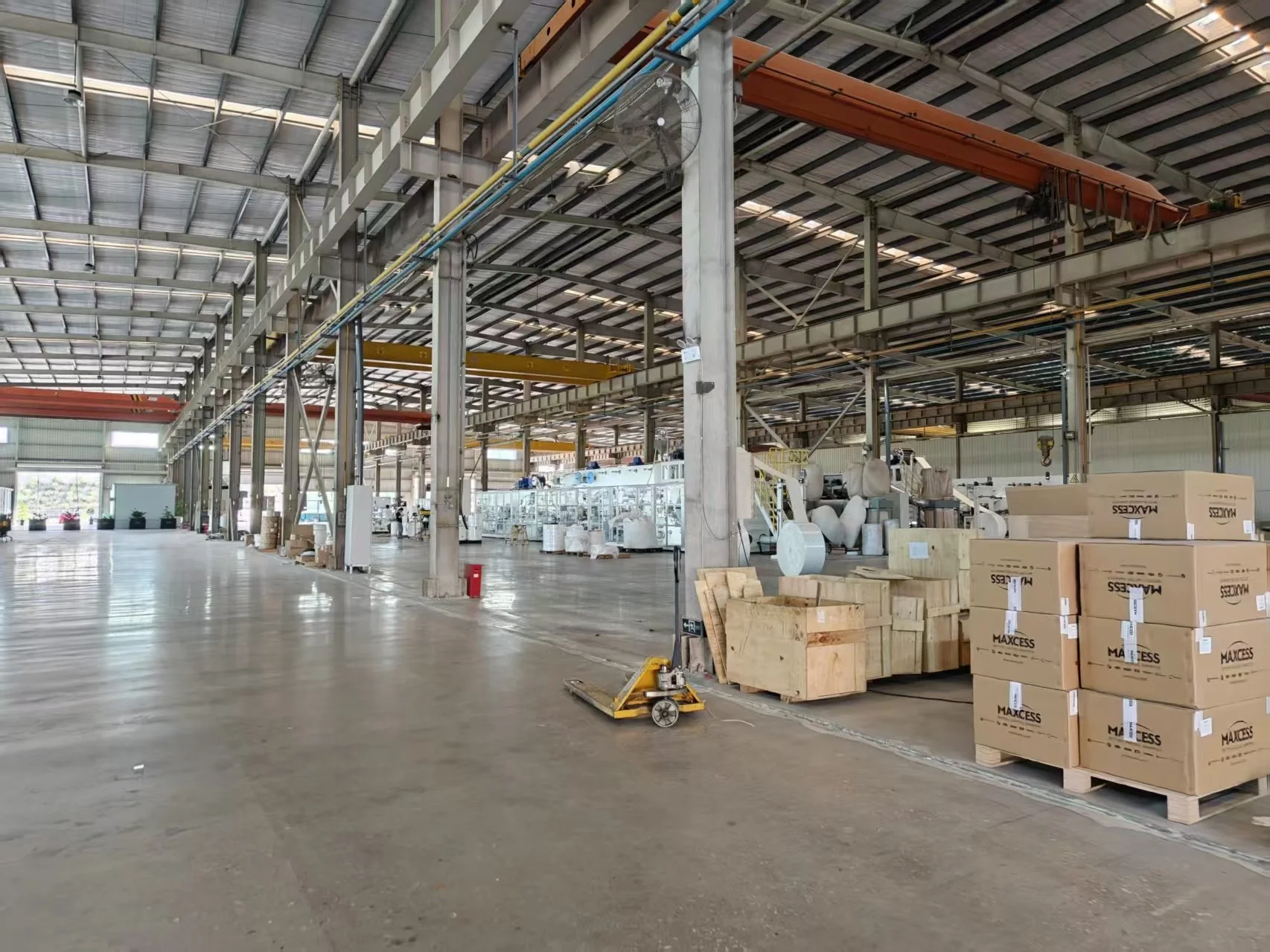
A common mistake is to treat a prototype as if it were the master specification. The correct reference package combines the approved physical sample with a controlled drawing and material table.
Freeze the layer stack before discussing machine modules
Start with a cross-section that names every functional layer in sequence. For this type of concept, questions may include whether the cotton component is one layer or several, whether a separate acquisition or distribution layer exists, and whether a barrier or structural carrier is required.
Do not use "plastic-free" as a substitute for the BOM. That claim needs its own evidence boundary, while the machine still needs to know the web form, roll width, splice method and tension behavior of every supplied material.
| Specification field | Brand owner must freeze | Machine/line implication | Acceptance evidence |
|---|---|---|---|
| Layer sequence | Signed cross-section and material names | Number and order of unwind/application stations | Approved sample and controlled drawing |
| Material supply form | Roll, sheet, pre-laminated web or treated substrate | Web path, guiding and tension boundary | Supplier specification and incoming-roll identity |
| Finished contour | Length, width, shape and tolerance | Cutting/forming tooling and registration | Dimension inspection plan |
| Functional ingredient | Location, supply format and approved claim | Pre-treated material versus inline application decision | Material identity and claim-support documents |
Convert every consumer claim into a measurable release condition
"Cooling," "breathable," "invisible" and "everyday protection" are marketing expressions until the brand owner defines how each one will be verified. The machine supplier should not invent those methods.
For example, a cooling claim may depend on a pre-treated topsheet supplied by a material partner. If so, the line qualification should verify web handling, bonding and ingredient traceability—not assume an inline dosing system is needed. If the ingredient is applied inline, the equipment scope changes and requires a separately defined process.
- Define the approved claim wording and the document owner.
- State whether the function comes from the supplied material or an inline process.
- Identify the test method, sampling frequency and release authority.
- Connect each failed result to hold, rework or rejection rules.
Adhesive and release paper are product architecture, not accessories
The official page mentions a heat-activated adhesive. That phrase does not tell the production team the adhesive coverage, activation condition, substrate interface or release-paper construction. Those fields must be clarified before the line quotation is fixed.
An adhesive zone that is too narrow may not support the intended placement. A zone that is too wide can change flexibility or contaminate tooling. The release material must separate cleanly without pulling or distorting the liner.
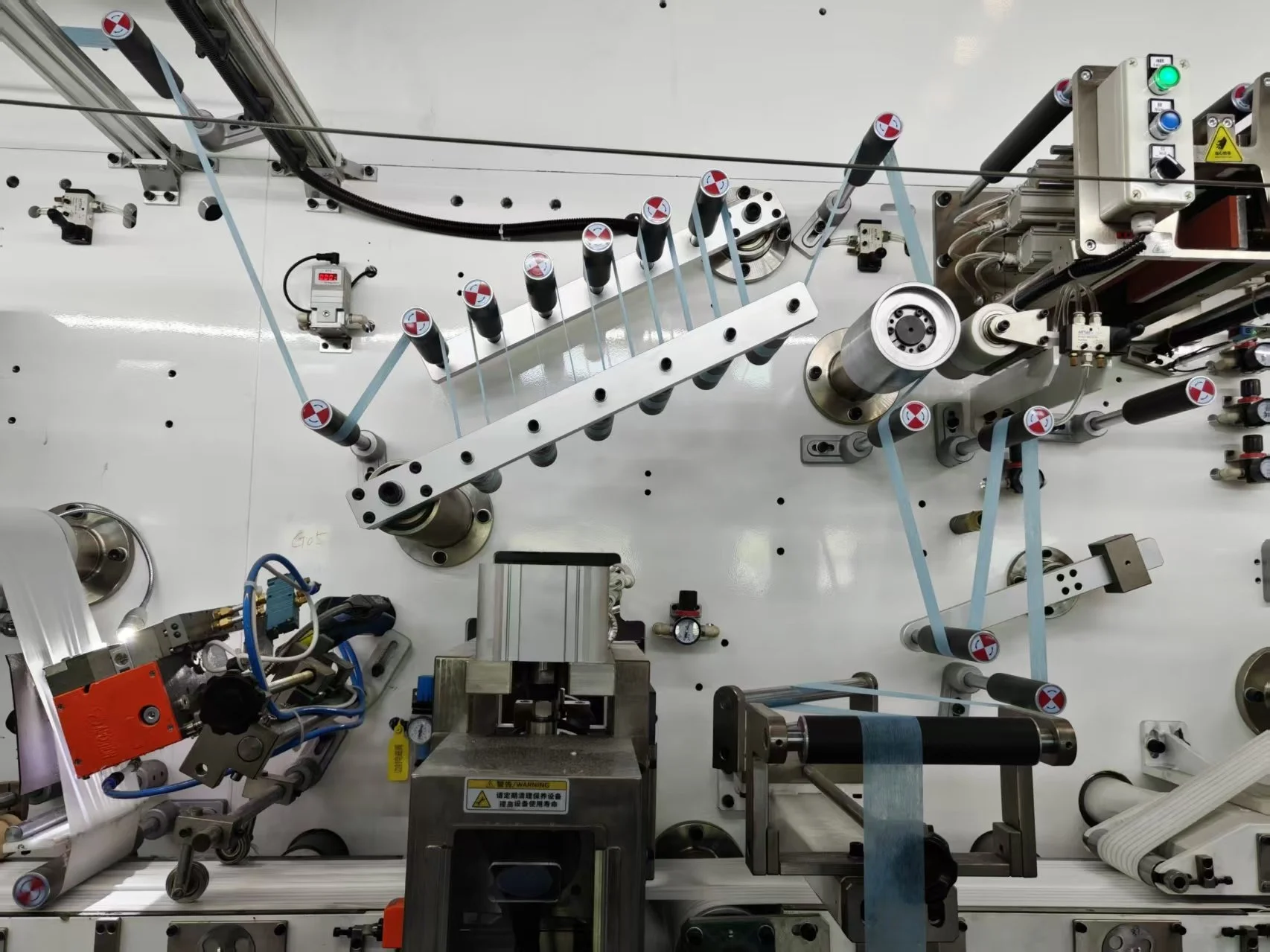
The exact station name and material identity in this photo remain subject to engineering confirmation. The image is used only to show that multiple webs require controlled paths, not to claim a specific Skimpies production method.
The trial matrix must separate material risk from machine risk
A short run that produces visually acceptable pieces is not enough. Trials should show whether the materials unwind, guide, bond, form, cut and release consistently through starts, stops, splices and planned operating windows.
In most cases, the first trial exposes several variables at once. If the cotton web wrinkles while adhesive transfer also drifts, changing speed, tension and adhesive settings together destroys the evidence trail.
| Trial stage | Evidence to collect | Decision |
|---|---|---|
| Incoming materials | Roll identity, width, visible condition and supplier documents | Release or hold for line trial |
| Low-speed threading | Web path, tracking, wrinkles, splice and initial bond | Correct setup before speed increase |
| Planned operating window | Registration, contour, adhesive transfer and release behavior | Define controlled settings by SKU |
| Finished-product review | Dimensions, appearance, placement, pack count and approved function tests | Approve, conditionally approve or reject |
| Restart and roll change | First-good-piece point and rejected quantity by reason | Freeze restart and splice procedure |
Illustrative framework only. The table is not a Skimpies manufacturing specification, customer case or equipment guarantee. Replace every field with the signed product requirements and approved test methods for the actual project.
Freeze packaging before treating the line as complete
The news report and official page confirm a 30-count box. The factory still needs the approved product orientation, stack arrangement, primary wrap if any, carton dimensions, coding content and batch-traceability rule.
A different pack format can change counting, stacking and handover requirements even when the liner itself is unchanged. The packaging brief belongs in the same revision-controlled package as the product drawing.
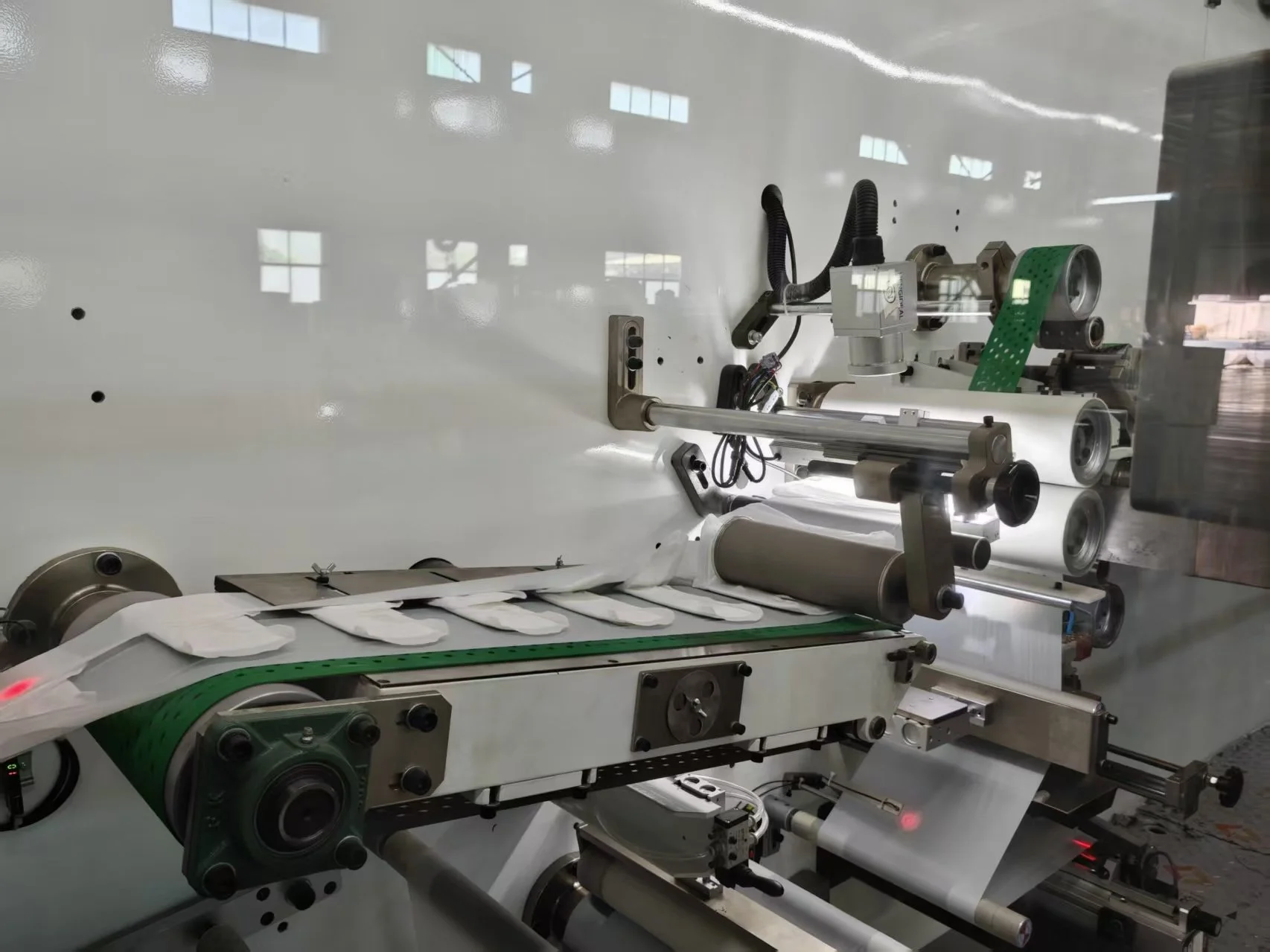
The exact DaoPu station must be confirmed by the engineering team before a station-specific caption is published.
A quotation package should remove assumptions, not hide them
The machine supplier should receive one controlled request package, not separate messages from marketing, purchasing and product development. When two documents conflict, the supplier should stop and request resolution.
- Approved finished-product sample and dimensioned drawing.
- Signed layer stack, BOM and supplier material specifications.
- Adhesive map, release-paper format and functional-ingredient boundary.
- Target SKUs, pack formats and coding requirements.
- Approved quality tests, tolerances and sampling plan.
- Trial materials and rules for FAT/SAT evidence.
- Open-item register showing every field not yet frozen.
This package does not make the project slower. It prevents the quotation from becoming a silent collection of supplier assumptions.
Why Welldone starts with boundaries before machine configuration
Welldone's reviewed female-care machinery category covers sanitary napkin and panty-liner project routes, while its production-line planning guide explains how the main machine, feeding, forming and packaging decisions connect. That does not mean one generic configuration fits every new product claim.
Product boundaryTranslate the sample and claims into a signed layer stack, dimensions and SKU table.
Process boundaryMap each layer, adhesive zone and converting step to a real module or supplied-material responsibility.
Acceptance boundaryDefine what the materials, line and finished packs must prove before commercial release.
Buyer checklist before requesting a panty-liner line quotation
- Resolve every contradiction between the product page, sample and internal brief.
- Sign one product cross-section and BOM revision.
- Specify whether each function comes from material supply or inline processing.
- Freeze finished dimensions, contour tolerances and SKU range.
- Approve the adhesive map and release-paper construction.
- Freeze the 30-count or other packaging format and traceability rules.
- Define material-trial and finished-product acceptance evidence.
- List open decisions separately; do not bury them inside the quotation.
If two teams cannot describe the same liner with one controlled drawing, the factory is not ready to price the production line.
Conclusion: freeze the product before freezing the machine
A new market segment can justify a new liner concept. It does not remove the need for engineering definition.
The published Skimpies information shows exactly why this matters: attractive product claims coexist with conflicting absorption language. A responsible buyer should preserve that conflict, resolve it with the product owner and only then ask the equipment and material teams to commit.
I believe the most useful first deliverable is not a machine quotation. It is a signed product specification that every party can quote, trial and accept against.
Frequently Asked Questions
Can a sanitary napkin line also make this type of panty liner?
Possibly, but the answer depends on the signed layer stack, finished contour, material widths, adhesive/release arrangement and packaging boundary. The product name alone is not enough.
Can organic cotton replace a standard nonwoven without trials?
No compatibility conclusion should be made from the material name alone. Trial the actual supplied web through unwinding, guiding, bonding, forming and finished-product inspection.
Does a cooling ingredient require inline dosing equipment?
Not necessarily. The function may come from a pre-treated supplied material. The brand owner and material supplier must define the supply format before equipment scope is selected.
What should be resolved when the public product page conflicts with itself?
Create a controlled open-item record, obtain a signed answer from the product owner and update the master drawing/BOM. Do not let the machine supplier choose which marketing sentence to follow.
What should be sent with the inquiry?
Send the approved sample, drawings, BOM, material specifications, adhesive map, SKU/pack table and expected acceptance evidence through the Welldone project inquiry.
Turn the concept into a controlled project brief
Discuss the production line, material/BOM matching, trials or finished-product sourcing requirements. Specific materials, products, MOQ, certification, price and delivery conditions require inquiry confirmation.
Website: www.cnwelldone.com | Email: welldone@cnwelldone.com
Discuss your feminine-care project