
Phased Hygiene Factory Line Planning Guide 2026 | Welldone

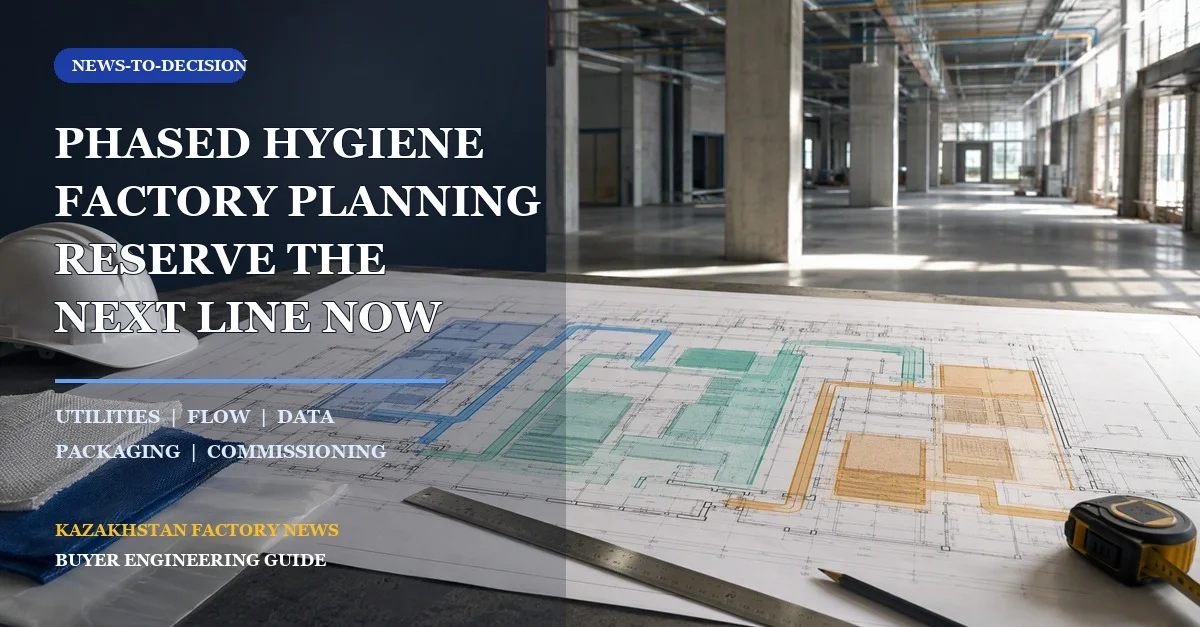
How Should a Phased Hygiene Factory Reserve Future Production Lines?
Steel columns are already standing. The contractor is ready to close the building envelope. On the drawing, one rectangle is labelled “future lines,” but nobody has frozen its power route, dust-extraction boundary, raw-material traffic or commissioning isolation.
That gap matters because a phased hygiene factory is not one flexible production hall. It is several different process systems arriving on different dates and sharing a site without being forced to share the wrong interfaces.
News-to-Decision Brief · 20 October 2026
News event: Megasoft is constructing a hygiene-products plant in Shymkent, Kazakhstan, with baby care planned first and other hygiene categories in later phases.
Buyer decision: which future interfaces must be frozen before phase-one equipment is ordered?
News event: Megasoft is constructing a hygiene-products plant in Shymkent, Kazakhstan, with baby care planned first and other hygiene categories in later phases.
Buyer decision: which future interfaces must be frozen before phase-one equipment is ordered?
A 50,000 m² plant is a planning signal, not a machine specification
Nonwovens Industry reported on 17 October 2026 that Megasoft is constructing a 50,000 square metre hygiene-products plant in Shymkent. The report says the facility is scheduled to open in early 2027, initially producing baby diapers and pants, then expanding into feminine care and adult incontinence products in 2027 and wet wipes in 2028.
Megasoft’s own website confirms a wider portfolio across baby care, adult care, feminine care, pet care and wipes, along with seven existing manufacturing bases and exports to 81 countries and regions. It does not publish the Shymkent project details on the page reviewed for this article, so the plant size and phase dates remain attributed to the industry report.
The machinery implication is clear even without a vendor list. Multiple product families will enter the same site in stages. Their process routes, dust loads, raw materials, packaging units and quality records are not interchangeable.
A blank “future area” reserves floor space. It does not reserve a functioning production interface.
Define each phase by sellable product and operating boundary
The first phase should be written as an operating system: finished product, SKU family, material set, packaging format, quality release point, warehouse route and planned commissioning date. The later phases need the same definition, even when their machine suppliers have not been selected.
A common mistake is to group all absorbent products under one heading because they share nonwovens, SAP or adhesive. Baby pants, sanitary pads, adult pull-ons and wet wipes use different converting sequences. They also create different utility peaks, dust-control needs, change-parts inventories, inspection logic and packaging flows.
| Phase question | Freeze now | Leave flexible | Evidence |
|---|---|---|---|
| What will be sold? | Product family, SKU envelope, release unit | Final brand artwork | Product brief and market plan |
| What enters the line? | Material classes, roll handling, dust route | Approved supplier list | Preliminary BOM and roll matrix |
| What leaves the line? | Pack unit, pallet route, quarantine point | Final case graphics | Packaging concept and logistics map |
Freeze utility corridors before concrete and walls make the decision permanent
Reserve connected load, transformer space, cable trays, compressed-air ring capacity, vacuum and dust-extraction paths, ventilation, drainage and maintenance access by future zone. Do not size the phase-one branch as if it were the final plant, then assume every later line can tap into it.
Future capacity is often lost outside the reserved production rectangle. An electrical room may have no physical space for another cabinet. A dust duct may cross a fire compartment incorrectly. A compressor header may reach the new hall but not hold pressure during simultaneous demand.
The correct RFQ does not ask a machine supplier for a generic utility list. It asks for connected load, normal load, startup condition, air demand profile, extraction points, heat release, cable entry, service clearances and isolation requirements at every module boundary.
Protect material flow from category expansion conflicts
Map receiving, sampling, quarantine, conditioned storage, roll preparation, line feeding, waste removal and finished-goods movement for each product family. The objective is not to create four separate warehouses. It is to prevent later phases from crossing clean and dirty routes or turning forklifts into the production constraint.
In most cases, the critical future reservation is a route rather than a room. Large rolls need turning radius and lifting access. Fluff pulp and SAP require controlled movement toward core-forming areas. Wet-wipe liquids introduce storage, dosing and drainage questions that do not belong inside a diaper material route.
- Mark every roll direction and maximum handling envelope.
- Separate incoming inspection from released material storage.
- Keep waste removal away from finished-product dispatch.
- Reserve vertical routes for ducts, pipes and cable trays—not only floor lanes.
Build one quality data spine without forcing one defect dictionary
A multi-category site needs common rules for lot identity, user access, time synchronization, record retention, alarm ownership and release authority. It does not need one universal defect code list. A baby pant waistband defect, a sanitary pad sealing defect and a wet-wipe liquid-dose deviation are different events.
The real question is whether the factory can trace a released pack back through product identity, machine recipe, material lots, inspection results and reject history. That data model must be planned before separate suppliers create incompatible naming conventions.
Define a shared plant-level data header, then allow each line to retain its process-specific defect dictionary. This supports expansion without flattening meaningful quality differences.
Give every phase an explicit packaging and warehouse boundary
Primary packs, bundles, cases, pallets and dispatch units must be distinguished in the layout. If a baby line releases bags while a future femcare line releases cartons, their conveyor, buffer and warehouse interfaces cannot be represented by one arrow labelled “packing.”
Freeze the handover unit between production and warehouse for each phase. Then reserve the buffer, inspection and rework space around that unit. This prevents later packaging automation from being squeezed into a corridor that was designed only for phase-one manual handling.
| Boundary | Phase-one decision | Future-phase reservation |
|---|---|---|
| Main line to packer | Product count and transfer state | Independent connection and bypass zone |
| Packer to warehouse | Released pack unit | Buffer and inspection footprint |
| Warehouse to dispatch | Pallet and quarantine rules | Additional lanes without cross-traffic |
Design later commissioning without stopping the operating phase
Future equipment will arrive while phase one is producing. Reserve unloading access, laydown area, lifting paths, temporary power, contractor entry, hot-work controls and test-material routes. The construction team must be able to install and energize a new line without opening the operating hygiene zone to uncontrolled traffic.
Commissioning isolation also needs a data boundary. A test machine should not write trial records into live production dashboards or trigger warehouse transactions. Mechanical completion, dry test, material trial, quality qualification and commercial release should remain distinct gates.
I believe this is the part most often omitted from a future-area drawing. Space is reserved for the machine, but no space is reserved for bringing it to life.
Use an interface freeze checklist before issuing the first RFQ
| Interface | Minimum phase-one freeze | Document | Owner |
|---|---|---|---|
| Building | Column grid, floor load, openings, service clearances | Coordinated layout | Project engineering |
| Utilities | Main corridors, spare capacity policy, isolation points | Utility load schedule | MEP team |
| Materials | Receiving, quarantine, roll route, waste route | Material-flow map | Operations |
| Quality data | Lot identity, time, user, release and retention fields | Data dictionary | Quality/IT |
| Packaging | Handover unit, buffer, inspection and warehouse route | Packaging boundary sheet | Production/logistics |
| Commissioning | Access, laydown, temporary utilities and test isolation | Phase commissioning plan | Project manager |
Illustrative framework only. This checklist is not Megasoft project data, a Welldone quotation or a universal utility specification. Replace every field with the requirements of your product roadmap, site and selected equipment.
Why Welldone starts with boundaries before machine configuration
Welldone’s reviewed category pages cover separate baby care, female care and adult care equipment families. That supports a category-by-category planning discussion; it does not mean one machine can be converted across all those products.
Product roadmapTranslate target products and SKUs into separate process boundaries.
Factory interfaceCoordinate layout, utility, material, packaging and data handovers.
Acceptance packageDefine what each line must prove before commercial release.
Related project routes
Source & date
- Main news source: Nonwovens Industry, “Megasoft Establishing Production in Kazakhstan,” 17 October 2026. Plant size, location, phased product plan and opening schedule are attributed to this report.
- Company profile source: Megasoft corporate website, accessed 20 October 2026. Used only to confirm company history, current manufacturing-base count, portfolio categories and export reach.
- Market context: Kazakhstan Newsline, “Personal hygiene goods production develops in Kazakhstan,” 13 October 2026. Only the visible summary was reviewed; paywalled figures were not used.
Source limitation: No Megasoft corporate release confirming the Shymkent project details was found in the public pages reviewed. Therefore, project-specific facts remain attributed to the industry report rather than presented as a Megasoft official announcement.
Conclusion: reserve interfaces, not empty promises
A phased factory should leave room for decisions that are not yet final, but it must freeze the boundaries that become expensive to change after production starts. Those boundaries include utility corridors, material routes, quality data, packaging handovers and commissioning isolation.
Before approving the phase-one layout, ask one practical question: could a second product family be installed, tested and released without shutting down or contaminating the first?
FAQ
Can baby diaper and feminine-care lines share one utility system?
They may share plant-level infrastructure when capacity, isolation and hygiene zoning are engineered correctly. Do not assume identical branch loads or extraction requirements.
Should future equipment models be selected during phase one?
Not necessarily. Freeze the product envelope and interface ranges first. Exact models can remain open until the later RFQ if the building boundary can accommodate them.
What is the most important future-line document?
A coordinated interface register linking the layout, utilities, material flow, data, packaging and commissioning assumptions. A floor plan alone is insufficient.
Can one quality system cover all product categories?
Use one plant-level identity and record structure, but keep product-specific defect dictionaries and release checks for each line.
When should machine suppliers join the layout process?
Before building interfaces are frozen. Supplier data should validate service clearances, utility points, module deliveries, material entry and product exit—not merely the nominal footprint.
Turn your product roadmap into a factory interface plan
Website: www.cnwelldone.com | Email: welldone@cnwelldone.com
Discuss your phased hygiene factory