Why Packaging Machines Are Becoming More Important in Feminine Care Manufacturing

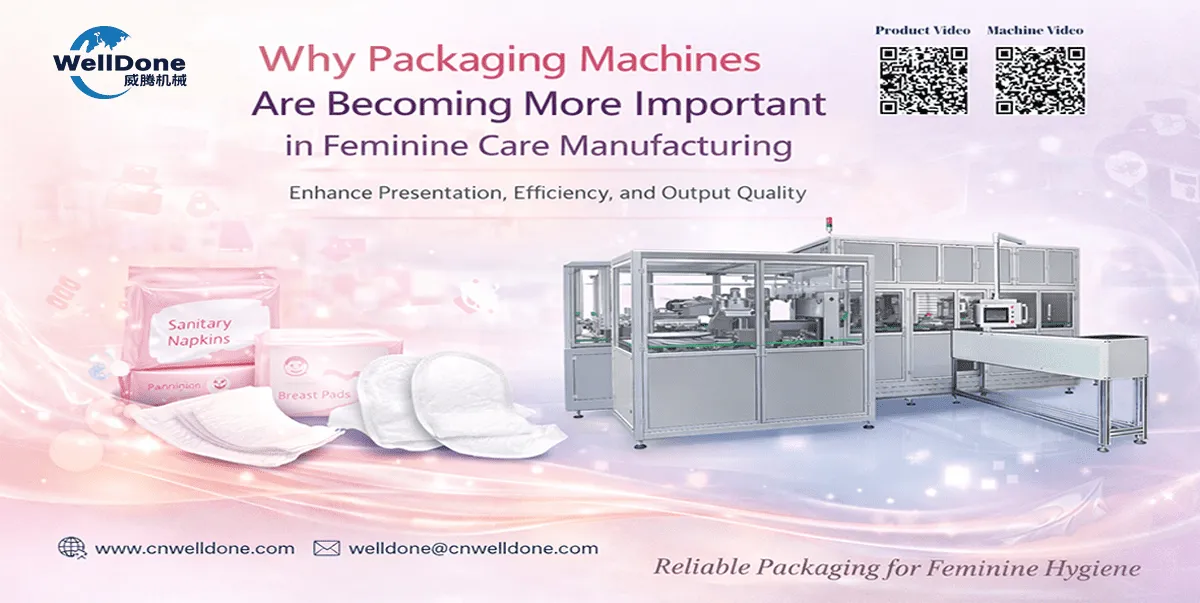
Table of Contents
- Introduction
- Why Packaging Is No Longer Just the Final Step
- The Feminine Care Market Now Demands Better Packaging
- Why Packaging Machines Matter More to Factory Efficiency
- How Good Packaging Supports Product Value and Brand Trust
- The Role of Packaging Machines in Cost Control
- What to Look for in a Feminine Care Packing Machine
- Building a More Complete Hygiene Production Line
- FAQ
- Related Machines
Introduction
In feminine care manufacturing, most people pay attention first to the main production machine. They focus on whether the sanitary napkin machine runs stably, whether the panty liner line can keep up with output targets, or whether the final product quality is consistent enough for the market.
But as the industry becomes more competitive, one thing is becoming increasingly clear: packaging is no longer just the final step after production. It is now part of product value, factory efficiency, and brand competitiveness.
A finished sanitary product does not reach the market as a loose product on the workshop floor. It reaches the customer through packaging. That packaging affects how the product is protected, how it looks on the shelf, how efficiently it can be transported, and how professionally the brand is perceived. In other words, even if the product itself is good, weak packaging can still reduce the product’s overall market performance.
That is why packaging machines are becoming more important in feminine care manufacturing.
For factories planning to enter the hygiene sector, expand product categories, or upgrade from older equipment, the packing system should no longer be treated as an afterthought. It should be treated as a key part of the overall production plan. A good packing machine helps connect product quality with final market presentation. It also helps manufacturers improve efficiency, reduce manual labor, and create a cleaner, more reliable output flow.
In today’s feminine care business, packaging is not only about wrapping products. It is about supporting a stronger factory system from production to shipment.
Why Packaging Is No Longer Just the Final Step
In the past, some manufacturers treated packaging as a separate and relatively simple process. The main focus was on producing the hygiene product itself, while packaging was viewed mainly as a basic operation needed to prepare items for delivery.
That way of thinking is changing.
In modern feminine care manufacturing, packaging has become closely connected to production efficiency, hygiene standards, retail appearance, and cost control. It is no longer something that happens after quality is created. It is part of how quality is delivered.
This shift is happening because the market has changed. Buyers now expect more than just functional products. They also expect products to arrive in well-organized, well-sealed, clean-looking packs. Retail channels want better presentation. Distributors want stable packing quality for transport and storage. Brand owners want packaging that supports consistent visual identity. End users often make judgments about the quality of a product based partly on its packaging.
That means the packing process is no longer only operational. It is commercial.
For factories, this creates a more important role for packaging machines. A reliable system helps standardize output, reduce handling problems, and make the final product more market-ready. Without that stability, even a well-produced item may lose value at the last stage.
This is especially true in feminine care, where consumers tend to associate neatness, softness, order, and hygiene with trust. Packaging becomes part of that trust.
That is why a packaging machine should not be viewed as just an accessory to the main line. It is part of the complete manufacturing solution, especially for companies building more professional Female Care Machines production systems.
The Feminine Care Market Now Demands Better Packaging
The feminine care market has become more sophisticated. Products are no longer competing only on absorbency, softness, or price. They are also competing on presentation, convenience, and perceived quality.
This is visible across many product types, including sanitary napkins, panty liners, breast pads, and other disposable care products. In many markets, packaging now helps communicate whether a product is premium, practical, hygienic, affordable, travel-friendly, or retail-ready.
That creates more pressure on manufacturers.
A product that is packed neatly and consistently has a better chance of being accepted by distributors, retailers, and end users. It looks easier to trust. It feels more complete. It is easier to transport, easier to stack, and easier to display. For private label buyers and OEM customers, stable packaging quality is also important because they need the product to fit into their own sales channels without extra risk.
This means packaging performance now influences much more than appearance. It affects:
- product protection during transport
- pack consistency across batches
- retail display quality
- warehouse handling efficiency
- buyer confidence
- end-user perception
For a growing manufacturer, that matters a lot. The more professional the packaging, the easier it becomes to move from simple production into stronger brand and export opportunities.
This is one reason many factories no longer evaluate only the main line. They also look at how packaging fits into the entire production strategy. A factory producing pads, liners, or other feminine care products needs the end of the line to be as stable as the beginning of the line.
Without that, the system remains incomplete.
Why Packaging Machines Matter More to Factory Efficiency
A good packaging machine does more than make products look better. It improves how the factory works every day.
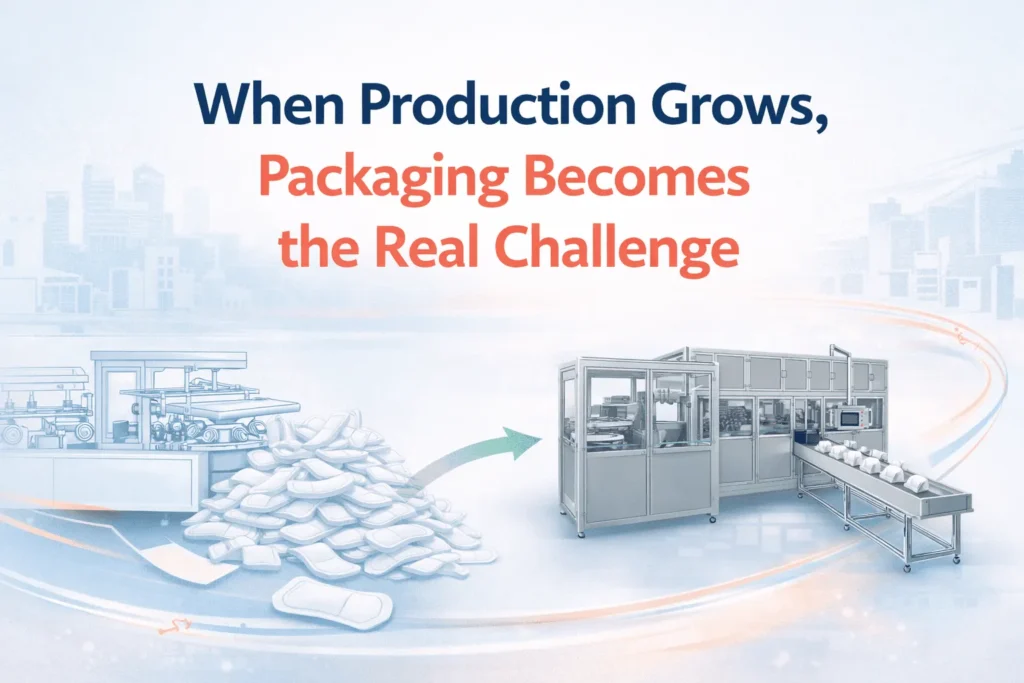
This is important because production efficiency is not determined only by the speed of the main converting machine. A factory is truly efficient when the whole process runs smoothly, from material feeding to finished product packaging. If the main machine runs fast but the packing system is unstable, the factory still loses time, labor, and money.
A reliable packing machine helps solve that problem.
It supports better workflow by reducing dependence on manual packing, improving output rhythm, and making downstream handling more predictable. When finished products arrive at the packing stage in a stable way and the machine can process them smoothly, the whole line feels more controlled.
This creates several practical advantages.
1. Better production flow
A stable packaging machine keeps the end of the line moving. That reduces backup pressure and helps the workshop stay organized.
2. Lower labor dependence
More automation means fewer manual packing steps, less repetitive labor, and more consistent daily operation.
3. Better output consistency
Automatic packing helps standardize pack quantity, sealing quality, and finished presentation.
4. Easier production planning
When the packing stage is stable, managers can plan output, shift work, and order delivery more accurately.
5. Reduced handling errors
Manual packing often introduces variation. An automated system reduces the chance of inconsistent counting, poor sealing, or irregular pack arrangement.
These benefits are especially important in feminine care factories where the main production lines may already be operating at higher standards. A weak packing process can quickly become the point where efficiency breaks down.
That is why packaging machines are becoming a more serious investment topic rather than just a supporting purchase.
How Good Packaging Supports Product Value and Brand Trust
In feminine care, product trust is built through details.
The final user may not see the production line, the control system, or the material feeding process. But they do see the packaging. That packaging influences their first impression before they ever use the product itself.
If the pack looks untidy, inconsistent, damaged, or poorly sealed, it weakens confidence immediately. Even if the internal product is acceptable, the perceived value goes down. On the other hand, when the packaging looks neat, consistent, and professionally finished, the product appears more reliable.
That is why packaging contributes directly to product value.
For manufacturers serving distributors, supermarkets, pharmacies, e-commerce sellers, or private label buyers, this is especially important. A buyer comparing two similar products may judge one as more professional simply because the packaging looks cleaner and more organized.
Good packaging helps communicate:
- better hygiene discipline
- stronger brand consistency
- improved shelf appeal
- greater transport reliability
- higher perceived quality
This matters even more in feminine care because the category is linked closely to personal comfort, cleanliness, and trust. Consumers tend to expect more visual reassurance in these products than in many other disposable goods.
A stable packing machine helps create that reassurance by making packs look more uniform and more market-ready. It also supports brands that want to move beyond low-price competition. Better presentation makes it easier to justify stronger positioning.
In this sense, a packing machine is not only part of production. It is also part of product communication.
The Role of Packaging Machines in Cost Control
Cost control is one of the strongest reasons why packaging machines matter.
At first glance, some manufacturers may think manual or semi-manual packaging is enough, especially in the early stage of a project. But over time, the hidden costs of inefficient packaging become more obvious.
Manual packing often creates problems such as:
- inconsistent pack quality
- higher labor cost
- lower speed
- more handling damage
- inaccurate counting
- more material waste
- weaker sealing consistency
A good packaging machine helps reduce these problems. By automating more of the process, the factory gains better control over pack structure, sealing quality, and handling flow. That improves both efficiency and predictability.
Cost control improves in several ways.
Lower labor cost
Fewer manual steps mean less dependence on repetitive packing work.
Reduced waste
More accurate counting, cleaner sealing, and better pack handling help reduce unnecessary losses.
Lower rejection and rework
When the machine packs more consistently, fewer finished packs need correction or replacement.
Better transport protection
Products that are packed properly are less likely to be damaged during storage and shipping.
Stronger use of main-line output
A stable packing machine helps the factory make full use of what the main production line produces, instead of creating a bottleneck at the end.
This is especially important when the factory is planning to grow. As output increases, packaging inefficiency becomes more expensive. What seems manageable at a small scale becomes a serious cost problem at larger scale.
That is why many manufacturers eventually realize that the packing system is not a minor expense. It is part of protecting margin.
What to Look for in a Feminine Care Packing Machine
Choosing a good packaging machine should be based on real factory needs, not only on price or catalog appearance.
Several points are especially important.
Machine stability
The machine should run smoothly over long production periods, not just perform well during a short demonstration.
Compatibility with product type
Different products require different packaging logic. Sanitary napkins, panty liners, breast pads, and underpads may each need different handling and pack arrangements.
Packing speed
The packing speed should match the output of the main line. A mismatch creates inefficiency.
Sealing and counting accuracy
Accurate pack quantity and clean sealing are essential for a professional finished product.
Ease of operation
A machine that is easier to adjust and manage helps reduce training pressure and operational mistakes.
Automation level
A more automated machine usually supports better consistency and lower labor dependency, especially in larger-scale operations.
After-sales support
Technical support, spare parts, installation guidance, and service matter greatly in actual factory use.
The best packaging solution is one that fits the whole production system. It should not be selected in isolation. It needs to work well with the main machinery and with the factory’s long-term plan.
For manufacturers expanding across hygiene categories, this often means considering packing as part of a wider production layout, whether for feminine care, Baby Care Machines, or Adult Care Machines.
A strong machine is one that supports the business beyond today’s order volume.
Building a More Complete Hygiene Production Line
A professional hygiene factory should be built as a connected system.
That system includes the main production machine, material handling, quality control, packing flow, and final output organization. If one part is weak, the whole factory feels less efficient. This is why more manufacturers now plan packaging earlier, rather than treating it as something to add later.
In feminine care manufacturing, this is especially important because product quality and final presentation are closely linked. A pad or liner that is produced well but packed poorly loses value. A product that is well packed but produced inconsistently also creates problems. The real goal is coordination.
That is why packaging machines are becoming more important. They help complete the line.
For factories that want to grow, this matters strategically. A complete production line is easier to scale, easier to manage, and easier to present to buyers as a professional manufacturing solution. It also helps reduce the friction between workshop output and market delivery.
In many cases, buyers trust a supplier more when the supplier shows a full production logic instead of only a single machine. Packaging helps communicate that maturity. It shows that the factory understands not only how to make the product, but also how to deliver it properly.
For businesses planning long-term development in feminine care manufacturing, investing in the right packaging machine is therefore not just a technical decision. It is part of building a stronger production model and a more competitive brand foundation.
FAQ
1. Why is a packaging machine important in feminine care manufacturing?
A packaging machine helps improve final product presentation, reduce manual labor, protect product hygiene, and support more stable factory efficiency.
2. Can a packaging machine improve product value?
Yes. Better packaging improves appearance, consistency, and brand perception, which can strengthen product value in the market.
3. What products can a feminine care packing machine handle?
It can be used for products such as sanitary napkins, panty liners, breast pads, and other related disposable care items, depending on machine design.
4. Why is packaging linked to cost control?
Because a stable machine helps reduce labor cost, material waste, handling errors, and rework, while also improving throughput.
5. Should I choose a packing machine based only on speed?
No. Speed matters, but stability, compatibility, sealing quality, ease of use, and after-sales support are equally important.
6. Can packaging machines be integrated with other hygiene production lines?
Yes. They are often used alongside feminine care, baby care, adult care, and other hygiene product manufacturing systems.
7. What happens if the packing stage is weaker than the main production line?
It can create a bottleneck, reduce factory efficiency, increase labor pressure, and weaken the final product presentation.
8. Is a packaging machine necessary for a growing factory?
Yes. As production volume grows, a stable packing system becomes much more important for efficiency, professionalism, and margin protection.
Related Machines
- Sanitary Pad Machine
- Panty Liner Machine
- Breast Pad Making Machine
- Underarm Pad Making Machine
- Packing Machine
CTA
Looking for a reliable packaging machine for your feminine care factory or hygiene product production line?
Welldone provides professional hygiene machinery solutions for feminine care manufacturing, including packing machines, sanitary pad machines, panty liner machines, breast pad machines, and related support systems.
Email: welldone@cnwelldone.com
Website: www.cnwelldone.com