Full Servo Sanitary Napkin Machines: Advance Your Sanitary Pad Production

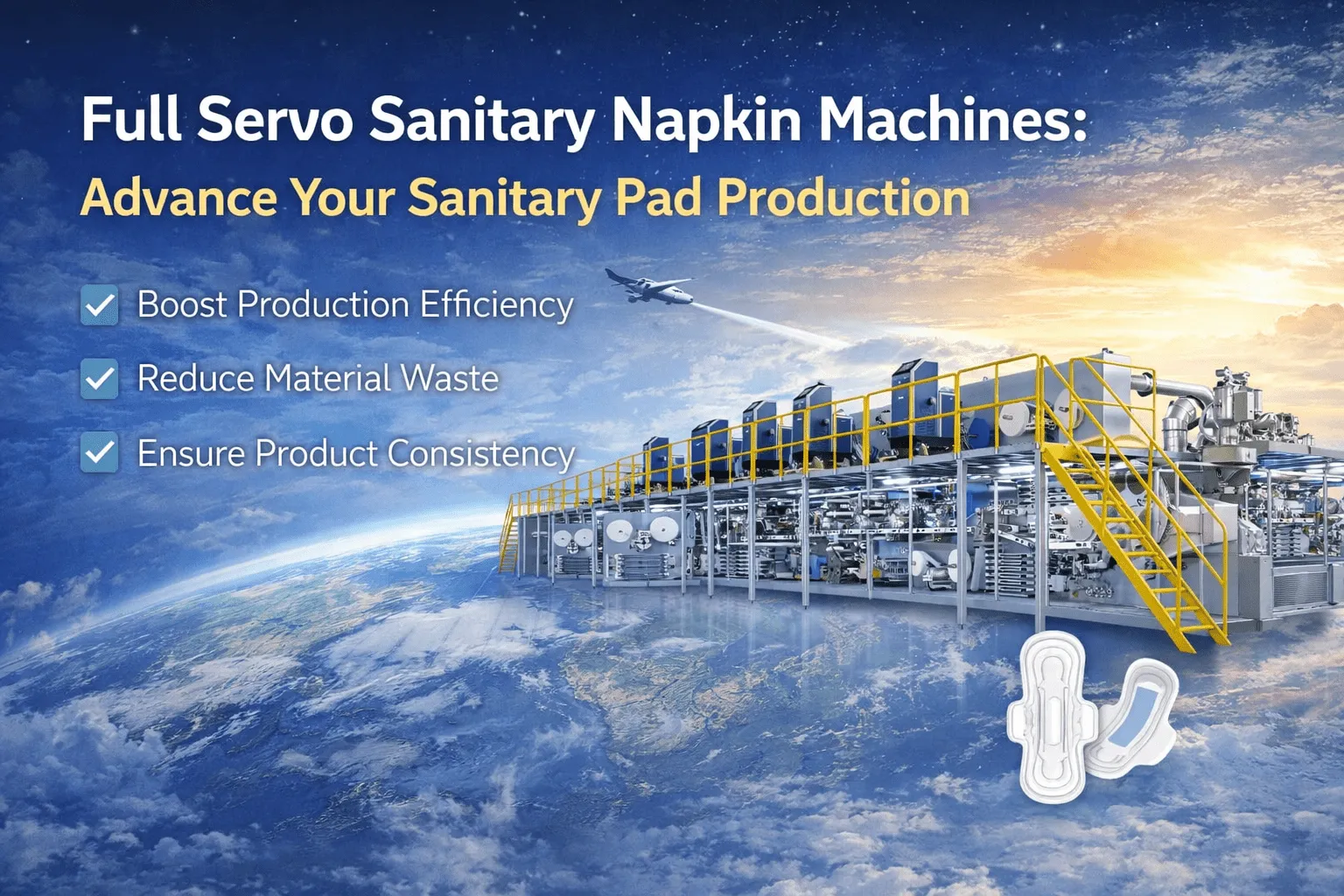
Table of Contents
-
Introduction
-
Why the Sanitary Napkin Market Is Becoming More Competitive
-
Why Full Servo Technology Matters in Modern Sanitary Pad Production
-
How Better Production Efficiency Creates More Business Value
-
Reducing Material Waste Without Sacrificing Product Quality
-
Product Consistency Is Now a Competitive Advantage
-
What to Look for in a Full Servo Sanitary Napkin Machine
-
Building a More Future-Ready Feminine Care Factory
-
FAQ
-
Related Machines
Introduction
The sanitary napkin industry is changing faster than many manufacturers expected. In the past, the main goal of a production line was simple: keep the machine running, reach a good output, and control basic product quality. Today, that is no longer enough.
Modern sanitary pad manufacturers are facing a different market reality. Buyers want better consistency. Brand owners want more control over product quality. Distributors want stable supply. End users expect comfort, reliability, cleaner packaging, and more transparent product standards. At the same time, producers are under pressure to improve efficiency, reduce waste, and maintain competitive costs.
That is why full servo sanitary napkin machines are attracting more attention.
A full servo production line is not only about speed. It is about smarter control, more stable operation, better material use, and stronger product consistency. For manufacturers planning to enter the feminine hygiene market, expand product capacity, or upgrade older equipment, this type of machine can offer a much more practical long-term advantage.
In a competitive hygiene products market, the right production line can influence almost everything, from daily efficiency to customer satisfaction. A reliable full servo sanitary napkin machine helps manufacturers produce better products with fewer interruptions and stronger control across the entire manufacturing process.
Why the Sanitary Napkin Market Is Becoming More Competitive
The feminine hygiene market continues to grow, but growth does not automatically mean easier business. In many countries, the sanitary napkin sector is becoming more crowded, more segmented, and more quality-driven.
There are several reasons for this change.
First, more local brands are entering the market. Instead of relying only on imported products, many companies now want to build their own sanitary pad brands, develop private label business, or create region-specific product lines. This means factories need machines that can deliver stable production while also supporting different product formats.
Second, consumers have become more selective. They are paying closer attention to comfort, absorbency, softness, dryness, pad shape, and skin-friendly materials. Even in price-sensitive markets, user experience matters more than before. A product that looks acceptable but performs inconsistently can quickly lose market trust.
Third, product development is becoming more flexible. A manufacturer may not only produce one standard sanitary napkin. The same factory may also need to produce different lengths, different absorbency levels, different wing structures, and different packaging styles for multiple customers.
That is why more buyers are no longer choosing a machine based only on the highest speed on paper. They want a production line that can help them balance output, cost, quality, and future flexibility. Many investors begin by reviewing complete female care machine solutions rather than comparing a single machine in isolation, because long-term factory planning matters more than ever.
Why Full Servo Technology Matters in Modern Sanitary Pad Production
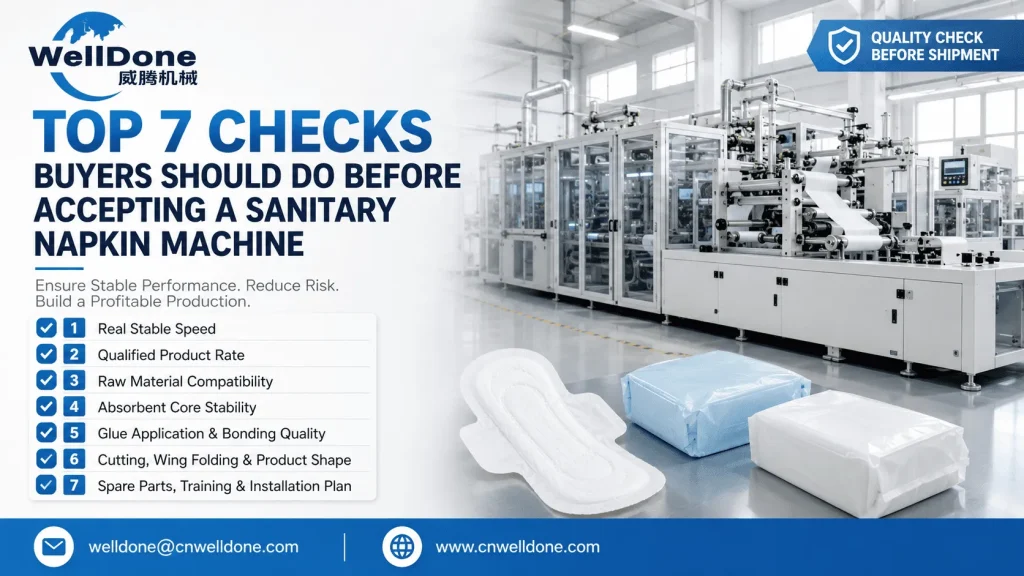
A full servo sanitary napkin machine gives manufacturers much better control over the production process. This matters because sanitary pad production is not a simple one-step conversion job. It involves multiple synchronized actions, including raw material unwinding, core forming, SAP distribution, tissue wrapping, topsheet and backsheet placement, wing alignment, embossing, sealing, cutting, and final output.
If these steps are not coordinated accurately, problems appear very quickly.
You may see unstable dimensions, material deviation, poor sealing, inconsistent weight, or higher reject rates. Even if the machine continues running, the final product may not meet the standard that customers expect.
This is where full servo control offers clear value.
Compared with older mechanical or less advanced systems, a full servo sanitary napkin machine can improve synchronization between different machine sections. That means more precise feeding, better timing, cleaner positioning, and smoother adjustment during production. It also helps operators manage size changes and specification changes more efficiently.
In practical terms, this gives the factory several important benefits:
-
more stable machine running
-
better control over key product dimensions
-
lower risk of material misalignment
-
easier adjustment and specification changes
-
reduced downtime caused by manual correction
-
stronger consistency from batch to batch
For factories that want to produce higher-quality sanitary pads or serve more demanding buyers, this level of control is no longer just a technical upgrade. It is becoming part of the business strategy.
How Better Production Efficiency Creates More Business Value
Production efficiency is often misunderstood. Many people think it only means machine speed. In reality, true efficiency is much broader.
A factory is efficient when the machine runs smoothly, changeovers are manageable, waste stays under control, operators can handle the line with confidence, and the output remains consistent enough to support downstream packing and delivery. In other words, efficiency is not just about producing more pieces per minute. It is about producing usable, saleable products with less disruption.
A full servo sanitary napkin machine can support this in several ways.
1. Smoother operation over long runs
Stable coordination between machine sections helps the line operate more smoothly over extended production periods. This reduces interruptions and improves daily output reliability.
2. Faster response to product adjustments
If a customer requests different sizes, absorbency structures, or pad configurations, the factory needs a machine that can adapt without creating excessive setup delays. Full servo control makes this easier.
3. More predictable production planning
When a machine runs consistently, factory managers can plan output, packing schedules, labor allocation, and delivery timelines with greater confidence.
4. Lower hidden operating cost
An unstable machine often looks cheaper only at the beginning. Over time, frequent adjustments, extra labor, rework, and downtime create much higher operational cost. A better machine can protect margin over the long term.
That is why serious manufacturers increasingly focus on the total value of the line, not just the purchase price. A good sanitary pad production line should help the business run better every day, not just look good in a quotation.
Reducing Material Waste Without Sacrificing Product Quality
Material waste is one of the most important cost factors in sanitary napkin manufacturing. Even small losses add up quickly, especially when the line runs at high speed and uses multiple layers of functional materials.
A sanitary napkin product may include nonwoven topsheet, acquisition layer, absorbent core materials, tissue, backsheet film, release paper, wing materials, glue application, and other components. If material tension is unstable or the placement is inaccurate, the waste can rise faster than many factories expect.
This is one reason full servo systems are so valuable. Better control helps the machine use materials more precisely. That means fewer feeding errors, fewer alignment problems, fewer defective pads, and less waste during size changes or long continuous production.
Reducing waste does not mean cutting quality. In fact, the opposite is usually true. Better material control often leads to better product quality because each component is placed more accurately and more consistently.
This helps manufacturers in several ways:
-
improve raw material utilization
-
reduce unnecessary product rejection
-
keep pad dimensions more stable
-
improve weight consistency
-
lower cost per finished piece
-
protect profit in price-competitive markets
For factories competing in markets where affordability matters, efficient material use becomes a real commercial advantage. A manufacturer that can produce a stable, comfortable, and well-finished product with less waste is in a much stronger position than one that constantly loses margin during production.
Product Consistency Is Now a Competitive Advantage
In hygiene product manufacturing, consistency is often what separates a growing factory from a struggling one.
A sanitary napkin may look simple, but repeat purchase depends heavily on stable user experience. If the first order performs differently from the second, or if the shape and finish vary from one batch to another, brand credibility is damaged very quickly. That is especially risky for new local brands, OEM projects, and export business.
A full servo sanitary napkin machine supports consistency by helping control the details that matter most:
-
absorbent core placement
-
pad shape and symmetry
-
wing positioning
-
embossing accuracy
-
sealing quality
-
cutting accuracy
-
overall product finish
When these details are stable, the final product looks more professional and performs more reliably. That helps factories win trust from distributors, retailers, and private label clients.
Consistency also helps internally. A factory with more stable output usually sees fewer complaints, fewer returns, easier packing, and smoother warehouse management. It reduces pressure on the quality team and improves confidence throughout the operation.
This is why many investors do not see a sanitary napkin machine as only a production asset. They see it as the foundation of product reputation. If the machine cannot produce consistent pads, the brand will always struggle.
Manufacturers that want to expand across different hygiene product categories often follow the same thinking when they explore broader female care machines or other hygiene converting lines. Stable production is not a small detail. It is the basis of sustainable growth.
What to Look for in a Full Servo Sanitary Napkin Machine
Choosing the right machine requires more than comparing speed and price. A professional buyer should evaluate the line from both a technical and business perspective.
Here are some of the most important points to consider.
Machine stability
A machine should maintain stable performance during long production runs, not only during demonstration.
Control accuracy
Better servo control supports better material placement, cleaner sealing, and more consistent final products.
Product flexibility
A good line should allow future expansion into different pad sizes, structures, or market-oriented formats.
Ease of operation
Operators should be able to understand, adjust, and manage the machine efficiently. A complicated machine can become expensive very quickly.
Waste control
The line should help reduce unnecessary material loss and maintain more predictable raw material use.
Maintenance and after-sales support
Even a strong machine needs technical support, spare parts access, and guidance during installation and operation. Reliable supplier support matters.
Fit with factory planning
The right machine must match your actual workshop space, labor arrangement, product direction, and investment goals.
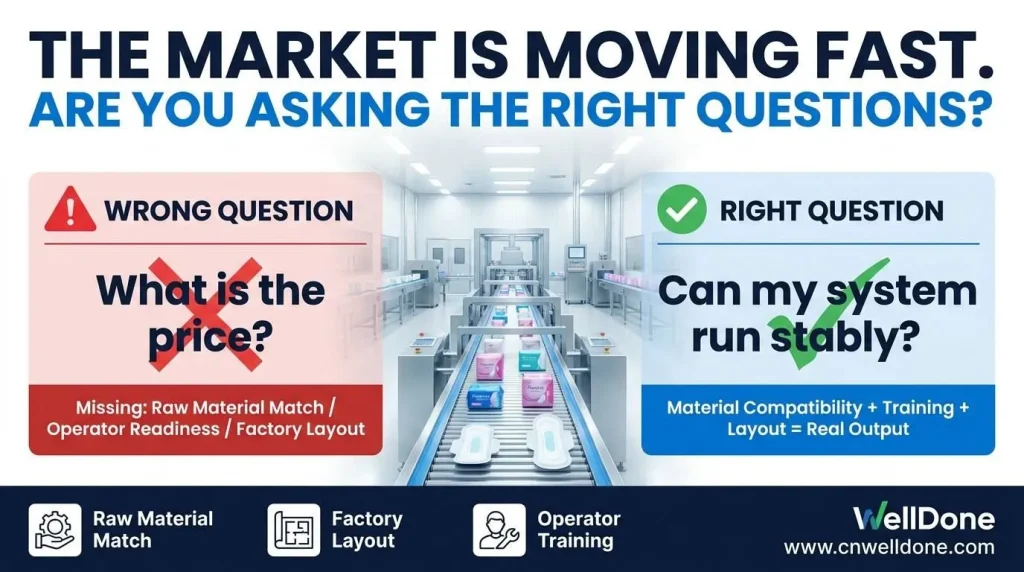
For many factories, the best choice is not the cheapest line or the one with the most aggressive catalog speed. It is the one that supports a stronger production system and a more competitive business in real factory conditions.
Building a More Future-Ready Feminine Care Factory
A modern sanitary napkin factory needs more than equipment. It needs a production system that can support quality, efficiency, and future development.
That is why full servo sanitary napkin machines are becoming more important. They help manufacturers improve output quality, reduce avoidable waste, simplify operation, and build stronger consistency into every stage of the process.
For factories planning long-term growth, this matters a lot. Market competition will continue to increase. Product expectations will continue to rise. Customers will continue to compare not only price, but also quality and reliability. A factory built on unstable equipment will always face more pressure.
A better machine cannot solve every business challenge, but it can remove many of the production problems that limit growth. It gives the manufacturer a stronger starting point for building a more competitive feminine hygiene business.
If your goal is to produce sanitary pads more efficiently, reduce material waste, and improve product consistency, investing in a well-designed full servo sanitary napkin machine is not just an equipment decision. It is a long-term manufacturing decision.
FAQ
1. What is a full servo sanitary napkin machine?
A full servo sanitary napkin machine is a production line that uses servo-driven control throughout the manufacturing process to improve synchronization, accuracy, stability, and flexibility.
2. Why is full servo technology important for sanitary pad production?
It helps improve production stability, reduce waste, and maintain better product consistency. It also supports easier machine adjustment when changing product specifications.
3. How does a full servo sanitary napkin machine reduce material waste?
Better control over feeding, alignment, timing, and cutting helps reduce misplacement, defective output, and unnecessary raw material loss during production.
4. Can a full servo sanitary napkin machine improve product quality?
Yes. It helps maintain more stable dimensions, cleaner sealing, better wing positioning, and more consistent overall product structure.
5. Is machine speed the most important factor when choosing a sanitary napkin machine?
No. Speed matters, but real production value also depends on stability, waste control, flexibility, ease of operation, and long-term maintenance support.
6. Who should consider investing in a full servo sanitary pad production line?
It is suitable for new investors entering feminine hygiene production, existing factories upgrading old equipment, and manufacturers planning to expand product quality or capacity.
7. What other products can be added to a feminine hygiene factory?
Many factories also expand into panty liners, breast pads, underarm pads, and related packing systems to create a more complete product range.
8. How do I choose the right supplier for a sanitary napkin machine?
Look for a supplier with machine manufacturing experience, practical technical support, customization ability, and a clear understanding of hygiene product production requirements.
Related Machines
If you are planning to expand your feminine hygiene production line, you may also be interested in:
-
Bar-Type Winged Pad Machine
For manufacturers exploring broader hygiene factory planning, it is also worth reviewing complete baby care, adult care, and tissue converting solutions alongside feminine care equipment.
CTA
Looking for a reliable full servo sanitary napkin machine for your factory project or product upgrade?
Welldone provides complete hygiene machinery solutions for feminine care manufacturing, including sanitary napkin machines, panty liner machines, packing systems, and related production support. We help customers improve efficiency, reduce waste, and build stable long-term manufacturing capacity.
Email: welldone@cnwelldone.com
Website: www.cnwelldone.com