

4-Layer vs. 5-Layer Underpad Line & BOM Guide | Welldone

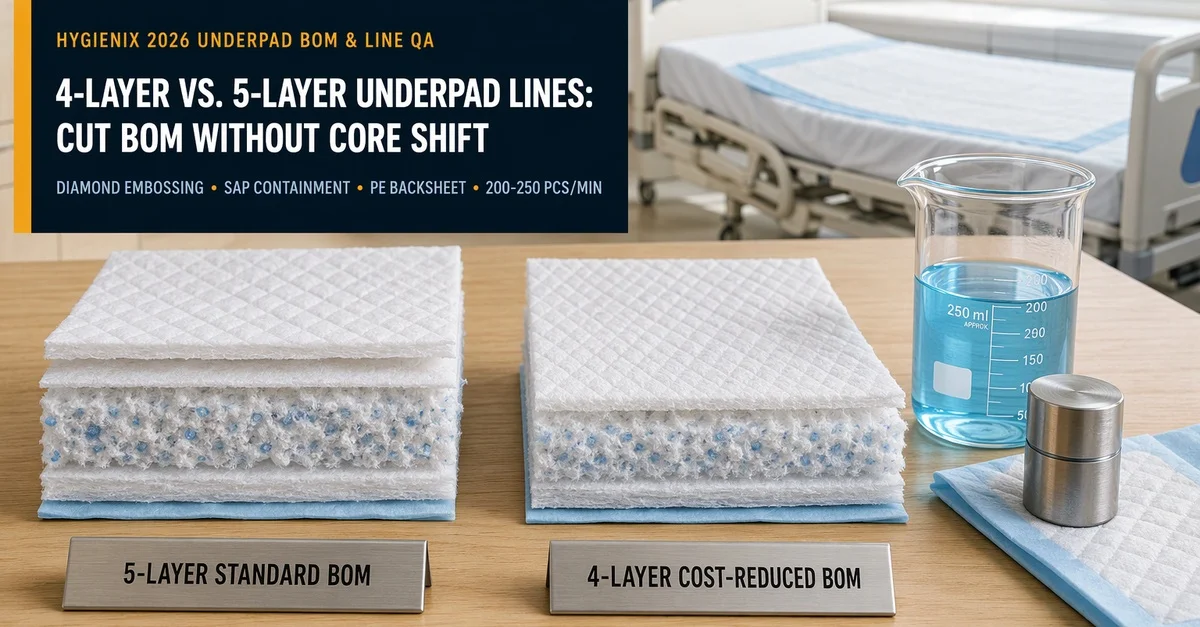
4-Layer vs. 5-Layer Disposable Underpad Lines: Cut BOM Without Core Shift
When a medical underpad or pet pad factory targets a 4% to 7% reduction in Bill of Materials (BOM) cost, removing the upper carrier tissue to convert a 5-layer pad into a 4-layer structure is often the first proposal. Yet as converting showcases at INDA Hygienix 2026 (opening November 16, 2026 in Houston, Texas) highlight, running a 4-layer underpad at 200 to 250 pcs/min is not as simple as turning off one unwinder spindle. Without zoned vacuum SAP embedding, temperature-stabilized diamond embossing, and low-jitter polyethylene (PE) backsheet tension control, removing the upper tissue wrapper triggers hot-roller SAP crusting, core shifting, and backsheet pinholes.
1. November 2026 Signal: Hygienix 2026 & the Shift to 4-Layer Underpad Converting
From November 16 to November 19, 2026, global hygiene manufacturers, material suppliers, and machinery engineers are convening at the Hyatt Regency Houston in Houston, Texas, USA for INDA’s Hygienix™ 2026 conference. Today’s opening workshops (November 16, 2026)—including “Inside the Absorbent Core: A Hands-On Systems Approach to Fluid Control” led by Jim Robinson—and the November 18 panel on “ABHYG Construction with Non-Traditional Inputs” reflect an industry push to re-engineer core architectures for cost discipline.
At Hygienix 2026 (Booth 401+402), the IMA Tissue & Nonwoven Hub (IMA Teknoweb and IMA TMC) is highlighting its OCEAN converting platform for disposable underpads, featuring a four-layer product design engineered to deliver the same clinical performance as five-layer underpads while reducing raw-material consumption and production costs. Alongside OCEAN, the hub presents EXIGE cross-folding wet wipes machinery (up to 3,000 wipes/min in three lanes), W-PACK roll-fed stacker-wrappers for feminine care and light incontinence, and D-NAMIC stacker-baggers for baby and adult diapers.
The real question is what this industry move from 5-layer to 4-layer underpad architectures means for B2B buyers evaluating a 5 layers under pad machine, a 3 layers under pad machine, or a high-speed disposable pet pee pad machine. Eliminating an internal carrier tissue layer changes the mechanical boundary between defibrated fluff pulp, superabsorbent polymer (SAP) granules, heated embossing teeth, and thin polyethylene barrier films.
2. Source-Verified Facts, Cross-Source Conflicts & Engineering Boundaries
To keep equipment evaluation and raw-material sourcing grounded in verifiable evidence, the summary below separates facts confirmed by November 2026 official announcements from Welldone’s converting analysis, and discloses cross-source discrepancies verbatim:
- Source-Confirmed Event & Machinery Facts (Hygienix Official Program & IMA Group Release, November 16, 2026): INDA Hygienix 2026 runs November 16–19, 2026 in Houston, Texas. IMA Tissue & Nonwoven (Booth 401+402) presents the OCEAN disposable underpad platform featuring a 4-layer design matching 5-layer performance while lowering material consumption; the EXIGE 3-lane cross-folding wet wipes system (up to 3,000 wipes/min); the W-PACK feminine care wrapper; and the D-NAMIC diaper stacker-bagger.
- Source-Confirmed Upstream Substrate Investments (November 12–13, 2026): Finland’s Suominen Corporation reported (covered by Nonwovens Industry and Nonwovens News on November 12, 2026) that commercial deliveries started from its EUR 20 million Card-Pulp-Card (CPC) line in Alicante, Spain, with ramp-up continuing through 2026–2027 (Q3 2026 net sales rose 1.3% to EUR 101.1 million; comparable EBITDA reached EUR 5.1 million). On November 13, 2026, Sweden’s Essity announced a SEK 850 million investment (~USD 85 million in Nonwovens Industry) in a new tissue machine in Lilla Edet, Sweden (~400 employees) for Tork Professional Hygiene, scheduled for Q4 2028 startup (+50% capacity, virgin and recycled fiber compatible).
- Source-Confirmed Welldone Machine Specifications (Verified on cnwelldone.com): Welldone manufactures full-servo 3-layer underpad machines and 5-layer underpad machines (Models
WD-CD-300-SV,WD-UPM012,WD-CD250-HSV) with 300 pcs/min design speed and 200–250 pcs/min stable speed (or 250 m/min design speed and 200–240 m/min stable speed on continuous web tables), passing rate≥98%, waste rate<2%, 380V 50Hz power,0.6–0.8 MPacompressed air, Mitsubishi/Siemens PLC servo control, Nordson/domestic hot-melt systems, and BST/domestic web guides. - Welldone Converting Analysis & Illustrative Targets: Operational thresholds—carrier tissue basis weights (
14–18 g/m²), hydrophilic spunbond topsheet ranges (15–22 g/m²), PE backsheet gauges (18–28 g/m²), and embossing temperatures (85–115 °C)—are FAT benchmarks and marked as Illustrative example only where cost savings are modeled.
⚠ News Data Conflict Found (Disclosed Without Merging):
- Conflict 1 — Essity Lilla Edet Investment Currency: Essity’s release and PulPaperNews (November 13, 2026) state approximately SEK 850 million, whereas Nonwovens Industry states approximately USD 85 million.
- Conflict 2 — Suominen Alicante CPC Line Start Timing: Suominen’s Q1 2026 audiocast projected startup in May 2026, Nonwovens Industry (November 2026) reports commercial deliveries began in September 2026, and Nonwovens News (November 12, 2026) notes commercial production followed initial delays with ramp-up continuing through 2026–2027.
- Conflict 3 — Welldone Underpad Page Legacy Table vs. Detail Table: On
cnwelldone.com, the upper legacy table on/full-servo-3-layers-underpad-machinelists template placeholders (Speed: 800-1000 Pcs/min,Power: 220000,Weight: 35 kg,Finished Products: sanitary napkin machine), while the dedicated Details table on the same page specifiesProduct type: Under pads,Design speed: 300pcs/min, andStable speed: 200-250pcs/min. Similarly,/high-speed-5-layers-underpad-machinelistsPower: 400KWin the top summary andPower: 220KW,Weight: 40T,Design speed: 250m/min,Stable speed: 200-240m/minin the lower tables. Buyers must lock exact speed units (pcs/minfor a defined pad length vs.m/minweb speed) in the signed FAT specification.
3. 3-Layer vs. 4-Layer vs. 5-Layer Underpad BOM Architecture
To understand why a 4-layer underpad is an engineering milestone rather than a simple material omission, buyers must compare how each layer functions inside a hospital bed pad (60×90 cm) or pet training pad.
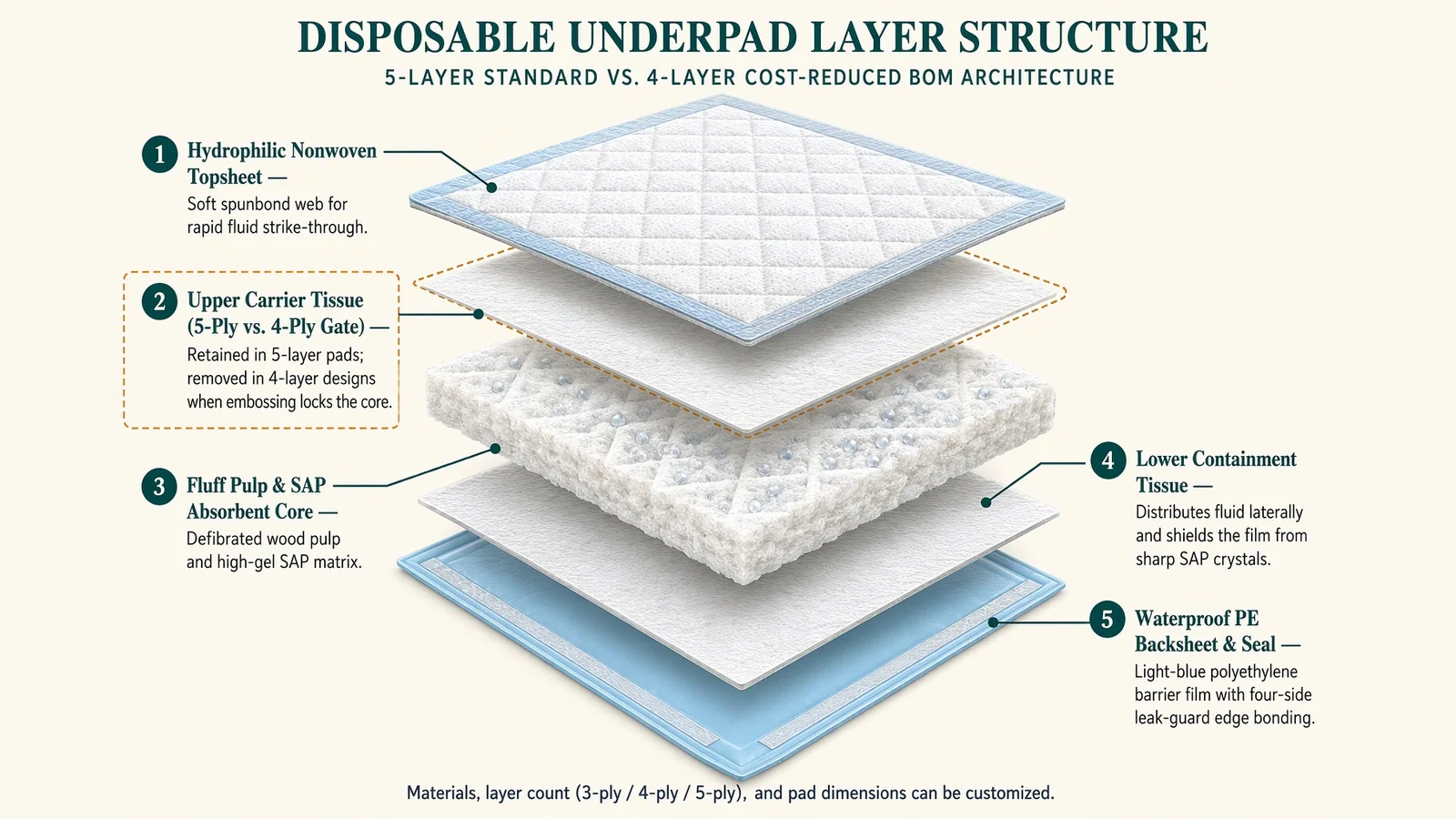
As mapped in Figure 1, industrial underpad lines are configured around three layer architectures:
- Standard 5-Layer Architecture (Hospital Benchmark): Combines Layer 1 hydrophilic spunbond topsheet (15–20 g/m²) + Layer 2 upper carrier tissue (14–18 g/m²) + Layer 3 defibrated fluff pulp and SAP + Layer 4 lower containment tissue (14–18 g/m²) + Layer 5 waterproof light-blue PE backsheet film (20–28 g/m²) sealed on four edges. Upper and lower tissues encapsulate the core before embossing.
- Cost-Reduced 4-Layer Architecture (Hygienix 2026 Focus): Eliminates Layer 2 (upper carrier tissue), leaving Topsheet + Fluff/SAP Core + Lower Containment Tissue + PE Backsheet. Retaining the lower tissue (Layer 4) spreads liquid laterally and shields the thin PE film from sharp unswollen SAP crystals under hip pressure.
- Economy 3-Layer Architecture (Retail & Pet Pad Benchmark): Produced on a 3 layers under pad machine using a tissue-free or pre-laminated core path (Topsheet + Absorbent Core + Backsheet), suitable for lower-SAP pads or airlaid cores.
4. Four Converting Defects When Dropping the Upper Carrier Tissue
A common mistake is assuming an operator on a 5-layer line can simply leave the upper tissue unwinder empty to run a 4-layer SKU at 220 pcs/min. Without recalibrating core forming, embossing, and gluing, four defects emerge within 30 minutes:
Four High-Speed Converting Failure Modes in Uncalibrated 4-Layer Underpads
What happens on the shop floor when Upper Carrier Tissue (Layer 2) is removed without station recalibration:
1. Embossing Roller SAP Crusting
Without upper tissue shielding the heated diamond roller, SAP dust migrating through spunbond pores sinters onto hot steel teeth, picking fluff tufts out of the core.
2. Dry & Wet Core Shifting
Without tissue-to-tissue bonding across diamond channels, the fluff-SAP mat relies on topsheet entanglement and splits into dry islands under patient turning.
3. Hot-Melt Adhesive Strike-Through
Construction glue sprayed onto a 15–18 g/m² spunbond topsheet over raw fluff pulp bleeds through pores, leaving sticky spots or blinding SAP granules.
4. PE Backsheet Pinhole Puncture
Cranking up calender nip pressure to lock a 4-layer core drives hard SAP crystals downward through the lower tissue, creating pinholes in 18–22 g/m² PE film.
Illustrative Example Only — Cost of Unqualified Tissue Removal: Removing a 16 g/m² upper tissue (540 mm width, 8.64 g/pad) on a 600×900 mm pad line at 220 pcs/min (13,200 pads/hour) at an illustrative tissue cost of USD 1,350/ton saves ~USD 0.00116/pad (USD 15.30/hour). Yet if roller SAP pick-off forces a 15-minute brass-brush stop every two hours and lifts waste from 1.5% to 4.8%, lost output and scrapped materials exceed USD 85/hour (Illustrative example only).
5. Station Engineering I: Core Forming & Heated Diamond Embossing Rollers
To run a 4-layer underpad cleanly on a 5 layers under pad machine (in 4-ply mode) or a 3 layers under pad machine, station upgrades must begin at the forming drum and diamond embossing calender.
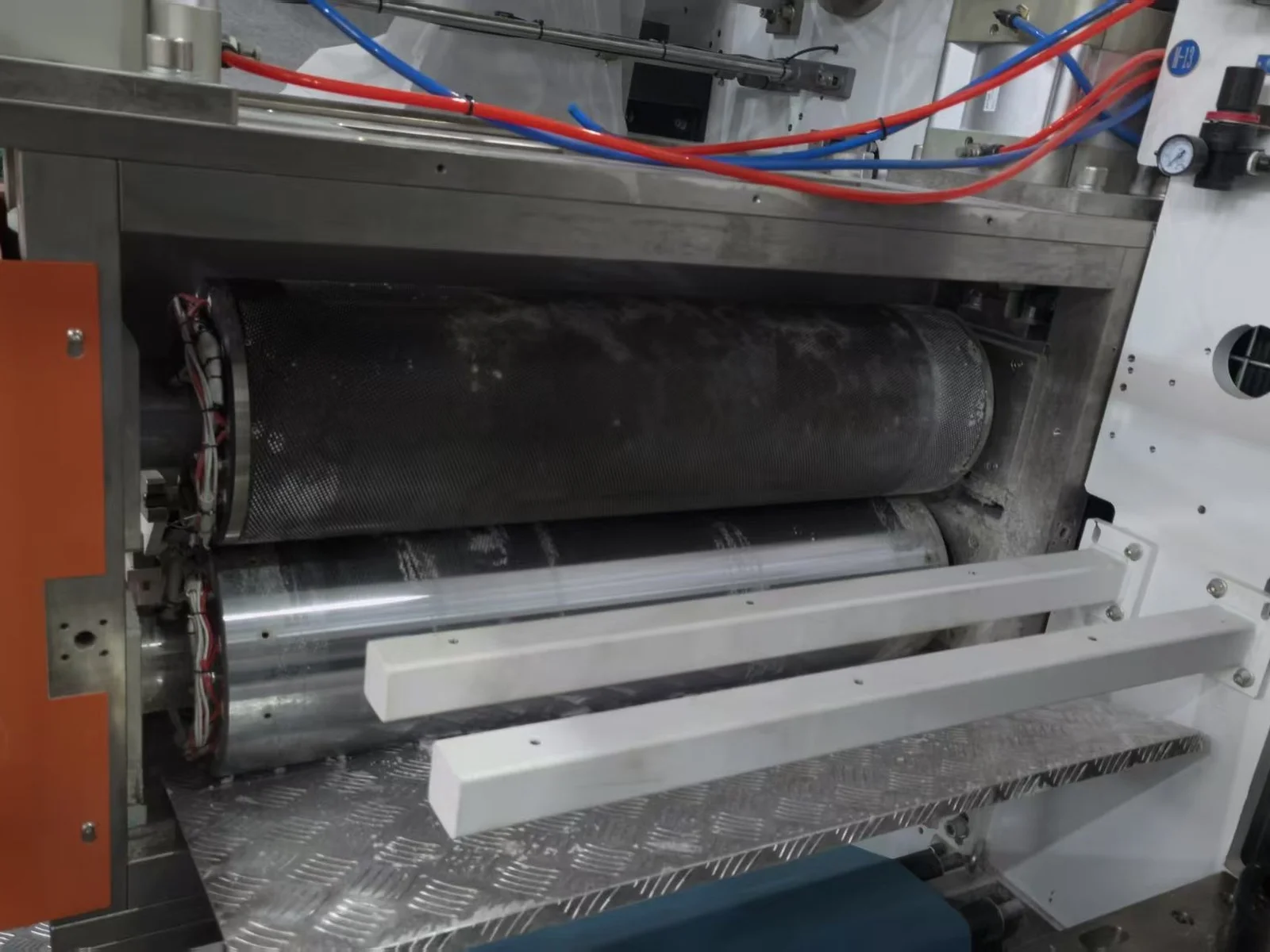
As shown in Figure 2, the upper engraved diamond roller works against a hardened lower anvil roller under regulated pneumatic loading:
- Stratified Vacuum SAP Dosing: The dosing nozzle injects granules into the lower-to-middle 60% of the forming pocket while laying a pure 100% fluff buffer layer across the top 40%, keeping loose SAP crystals off the hot embossing roller.
- Anti-Stick Surface & Closed-Loop PID: Critical rollers receive anti-stick treatment to prevent glue and fiber conglutination. Holding the diamond roller at
90–110 °Cbonds spunbond fibers into fluff intersections without web melting. - Micrometer Mechanical Gap Stops: Mechanical gap stops maintain a fixed minimum clearance between the diamond teeth and lower anvil roller so basis-weight fluctuations never crush SAP crystals through the bottom film.
6. Station Engineering II: PE Backsheet Festoon Buffering & Zero-Speed Splicing
Because underpads are wide-web products (600–900 mm wide), thin 18–25 g/m² light-blue PE film is vulnerable to cross-direction (CD) wrinkling and tension shock during roll changes.

In Figure 3, the light-blue PE backsheet threads through a horizontal festoon accumulator on an H-frame base before lamination:
- Zero-Time Splicing Without Neck-Down: Servo unwinding with buffer tension balance enables zero-time splicing and one-button motor direction switching. During splice deceleration, the festoon pays out stored film at steady tension so the 600–900 mm sheet never necks down.
- Isolated Air Line for Hot-Melt Glue: Welldone isolates a dedicated pneumatic line for the hot-melt applicator, preventing air drops during splicing or reject firing from starving wide-web adhesive coat weight.
- Automatic Web Guide (BST/Domestic): Closed-loop edge guiding holds the blue PE film centered within
±1.0 mmahead of side-cuff folding.
7. Station Engineering III: Four-Side Leak-Guard Folding & Servo Cross-Cutting
After core lamination, the left and right PE film margins fold inward over the topsheet edges to form leak-proof side cuffs, followed by rotary cross-cutting and multi-fold compaction.

As captured in Figure 4, stainless-steel folding plows turn the blue PE side margins over the white diamond-embossed topsheet before the pneumatic nip and rotary cutter:
- Eliminating Edge-Seal Pop-Open: Dual pneumatic nip cylinders apply immediate compression after edge-glue coating so folded PE cuffs bond firmly to the spunbond topsheet without springing open during tri-folding or quad-folding.
- Scratch-Mode Rotary Cross-Cutting: At 200–250 pcs/min (200–240 m/min), rotary cutters shear through the transverse gap between cores. In most cases, blade gum-up happens when end-seal glue migrates into the cut line; scratch-mode geometry and anti-stick rollers prevent adhesive build-up.
- Integrated Vacuum Conveyor & Dual-Servo Folding: A vacuum conveyor holds cut pads flat through longitudinal and transverse servo folding into compact stacks, sustaining a verified passing rate of
≥98%and waste rate<2%.
8. Connecting Upstream CPC & Tissue Investments to Hygiene Converting
The machinery developments at Hygienix 2026 connect directly to November 2026 upstream substrate investments in Europe:
- Suominen’s EUR 20M Alicante CPC Line: Card-Pulp-Card (CPC) webs sandwich wood pulp between carded nonwovens. Running CPC rolls or composite pulp-nonwoven cores requires servo unwinder tension control and low-dust rotary cutting.
- Essity’s SEK 850M (USD 85M) Lilla Edet Tissue Machine: Essity’s investment in virgin/recycled fiber capability (+50% capacity by Q4 2028) highlights a key rule: blending recycled fibers into carrier tissue lowers wet tensile strength and MD elongation. When running recycled tissue grades, retaining a 5-layer dual-tissue wrap or using servo dancer unwinders prevents web breaks.
9. Engineering Decision Matrix: Qualifying 3-Ply, 4-Ply & 5-Ply Underpad Lines
Evaluate the station-by-station engineering trade-offs below before locking your machine specification or switching from 5 layers to 4 layers:
| Underpad Architecture & Target Application | Layer Stack & Typical BOM Structure | Primary Converting Bottleneck at 200–250 pcs/min | Required Welldone Machine Station Configuration | FAT Qualification Gate (Verified & Illustrative Targets) |
|---|---|---|---|---|
| 1. Standard 5-Layer Hospital & Heavy Adult Underpad | Spunbond topsheet + Upper tissue + Fluff/SAP core + Lower tissue + PE backsheet | Synchronizing 5 wide-web unwinders & preventing tissue splice breaks | Full-servo 5-layer line (WD-CD-300-SV / WD-UPM012) with servo buffer unwinders & auto-splicing |
Stable speed 200–250 pcs/min (200–240 m/min); passing rate ≥98%; waste rate <2% |
| 2. Cost-Reduced 4-Layer Clinical & Retail Underpad | Embossed topsheet + Stratified Fluff/SAP core + Lower tissue + PE backsheet (no upper tissue) | SAP pick-off on hot diamond embossing roller, core clumping & glue bleed-through | Zoned vacuum drum (bottom-weighted SAP), PID heated anti-stick diamond calender & mechanical gap stops | Zero roller SAP crusting over 4-hour run; zero wet core split under 250 ml saline load (Illustrative) |
| 3. Economy 3-Layer Underpad & Standard Pet Pee Pad | Hydrophilic nonwoven topsheet + Fluff/SAP or airlaid core + Waterproof PE backsheet | Direct SAP crystal pressure against thin PE backsheet film during calendering | Full-servo 3-layer line (WD-CD250-HSV / WD-CD-300-SV) with controlled nip clearance & isolated glue air line |
Zero PE backsheet pinholes under vacuum leak test; stable 200–250 pcs/min output |
| 4. Wide-Web PE Backsheet & Side-Cuff Sealing Zone | 18–28 g/m² light-blue polyethylene film (600–900 mm web width) + four-side hot-melt seal | CD film wrinkling during zero-speed splice & side-margin cuff spring-back | Multi-roller H-frame festoon accumulator, BST/automatic web guide & stainless-steel folding plows | Side-border width symmetry within ±1.5 mm; 10 consecutive splices with zero film neck-down |
| 5. Multi-Fold Compaction, Cross-Cutting & Bagging | Large-format pads (e.g., 60×60 cm, 60×90 cm) folded into retail or hospital polybags | Knife glue conglutination, pad skew during longitudinal folding & stacker jam | Scratch-mode anti-stick rotary cutter, integrated vacuum conveyor & synchronized servo folders/stacker | Cut-length accuracy ±1.0 mm; one-side quick part-change access; automatic defect rejection |
10. How Welldone Supports Underpad Machinery, Raw-Material BOM & Finished Supply
Whether investing in a new underpad line or re-engineering a 5-layer BOM into a 4-layer structure, equipment and materials work together. I believe specifying a 5-layer-capable full-servo platform with independent unwinder buffers and heated diamond embossing gives buyers the strongest commercial flexibility: run a 4-layer BOM to optimize retail margin, and re-engage the fifth unwinder spindle when a hospital tender requires dual-tissue encapsulation.
Operating since 2008 across 80+ countries (ISO 9001 & CE certified), JINJIANG WELLDONE MACHINE CO., LTD. supports partners across three levels:
- Full-Servo 3-Layer, 4-Layer & 5-Layer Lines: Turnkey 5 layers under pad machines, 3 layers under pad machines, and disposable pet pee pad machines (200–250 pcs/min stable output,
≥98%passing rate,<2%waste rate) with zero-time splicing festoons, isolated glue air lines, and anti-stick heated diamond embossing rollers. - Matched Raw Materials for BOM Trials: Hydrophilic spunbond nonwovens, carrier tissues, fluff pulp, SAP, PE backsheet films, and hot-melt adhesives to freeze 3-ply, 4-ply, or 5-ply BOMs during factory trials.
- Finished Underpads & Pet Pads Supply: Finished disposable underpads and pet training pads for distributors and private-label brands building volume prior to line installation (specs, MOQs, and lead times confirmed upon inquiry).
11. 8-Step Buyer Qualification & FAT Acceptance Checklist
Actionable Buyer Checklist: Qualifying 4-Layer & 5-Layer Underpad Lines
- Lock Speed Units & Pad Dimensions: Specify rated design speed (300 pcs/min), stable speed (200–250 pcs/min) at 600×600 mm or 600×900 mm pad length, and linear web speed (
200–240 m/min). - Audit Stratified SAP Placement: Verify the SAP feeder doses granules into the lower/middle core stratum so a pure-fluff barrier shields the heated diamond embossing roller.
- Run a 4-Hour Embossing Fouling Test: Operate in 4-layer mode at 200–250 pcs/min and inspect diamond teeth every 60 minutes to confirm zero SAP sintering or fluff pick-off.
- Perform Wet Shake & Strike-Through Tests: Dose 250 ml saline onto 4-layer and 5-layer pads under a 4 kPa weight and verify zero core splitting or PE pinholes.
- Test Wide-Web PE Zero-Speed Splicing: Execute 10 automatic splices on 600–900 mm blue PE film through the H-frame festoon with CD width variation within
±1.5 mm. - Verify Dedicated Glue Air Isolation: Trigger simultaneous auto-splicing and rejection while confirming uninterrupted hot-melt manifold air pressure.
- Inspect Four-Side Cuff Folding & Cross-Cutting: Check 200 consecutive pads exiting the folding plows and scratch-mode rotary cutter for clean cuts and symmetrical borders.
- Confirm Utility Readiness: Verify floor space (
39m×9m×5mor40m×12m×5m),380V 50Hzwiring (3×120mm² + 1×50mm² + 1×25mm²), and0.6–0.8 MPacompressed air.
12. Source & Date Verification
- Primary Industry Conference Source (November 16–19, 2026): INDA (Association of the Nonwoven Fabrics Industry) — Hygienix™ 2026 Official Event Portal (November 16–19, 2026, Hyatt Regency Houston, TX) and Hygienix™ 2026 Official Conference Schedule.
- Primary Converting Machinery Exhibition Source (November 16–19, 2026): IMA Group Official Exhibition Release — IMA Tissue & Nonwoven at Hygienix 2026 (Booth 401+402: OCEAN 4-Layer Underpad Platform, EXIGE 3,000 wipes/min Cross-Folder, W-PACK & D-NAMIC).
- Auxiliary Nonwoven Substrate Startup Sources (November 12, 2026): Nonwovens Industry — Suominen Starts Up New Line in Spain (EUR 20M Alicante CPC Line) and Nonwovens News — Suominen starts production at new Spain plant (Published November 12, 2026).
- Auxiliary Tissue & Wiping Base-Sheet Investment Sources (November 13, 2026): PulPaperNews — Essity invests in increased production capacity in Lilla Edet (SEK 850m) and Nonwovens Industry — Essity Invests in Tork Capacity (~USD 85M) (Published November 13, 2026).
13. Frequently Asked Questions (FAQ)
1. Can a 5-layer disposable underpad machine be configured to run 4-layer and 3-layer underpads on the same line?
Yes. On a full-servo 5 layers under pad machine, each unwinder is driven by an independent servo motor with PLC recipe control. Operators can bypass the upper carrier tissue unwinder to run a 4-layer BOM—provided the forming drum SAP nozzle and heated diamond embossing roller temperature/gap switch to the 4-layer HMI recipe.
2. In a 4-layer disposable underpad, is it safer to remove the upper carrier tissue or the lower carrier tissue?
Removing the upper carrier tissue is the standard route when the hydrophilic spunbond topsheet and heated diamond embossing pattern lock the top of the fluff-SAP mat. The lower containment tissue should be retained in high-SAP pads to spread fluid laterally and shield the 18–25 g/m² PE backsheet film from SAP crystal punctures.
3. How do I reconcile linear speed (m/min) and piece speed (pcs/min) when comparing underpad machine quotations?
Piece speed depends directly on pad cut length. At 225 m/min linear speed, a line produces 250 pcs/min of a 900 mm hospital underpad or 375 pcs/min of a 600 mm pet pad. Always require suppliers to state both linear web speed (m/min) and qualified piece output (pcs/min) at your exact target pad length.
4. Can Welldone supply matched underpad raw materials or finished underpads alongside the production line?
Yes. JINJIANG WELLDONE MACHINE CO., LTD. supplies full-servo 3-layer and 5-layer underpad and pet pad lines, matched raw materials (nonwovens, carrier tissue, fluff pulp, SAP, PE film, and hot-melt adhesives) for BOM qualification trials, and finished disposable underpads and pet training pads.
14. Request an Underpad Line Configuration or BOM Trial Consultation
Planning to launch or upgrade a 3-layer, 4-layer, or 5-layer underpad or pet pad line—or source matched materials and finished products? Contact Welldone via our official contact page:
Website: www.cnwelldone.com | Email: welldone@cnwelldone.com
Engineering Review: Written by Welldone Machine Engineering Team | Technical review: Mostafa Ansary, Technical Sales Manager (BSc Mechanical Design and Production Management, Cairo University; 15 years in production management and machinery field) | Market context: Tidiane Thiero, International Sales Engineer (Electrical engineer, Huaqiao University Xiamen; 3 years in hygiene industry). JINJIANG WELLDONE MACHINE CO., LTD. has manufactured hygiene machinery since 2008 across 80+ countries (ISO 9001 & CE certified).