
How Material Quality Affects Machine Stability in Hygiene Production

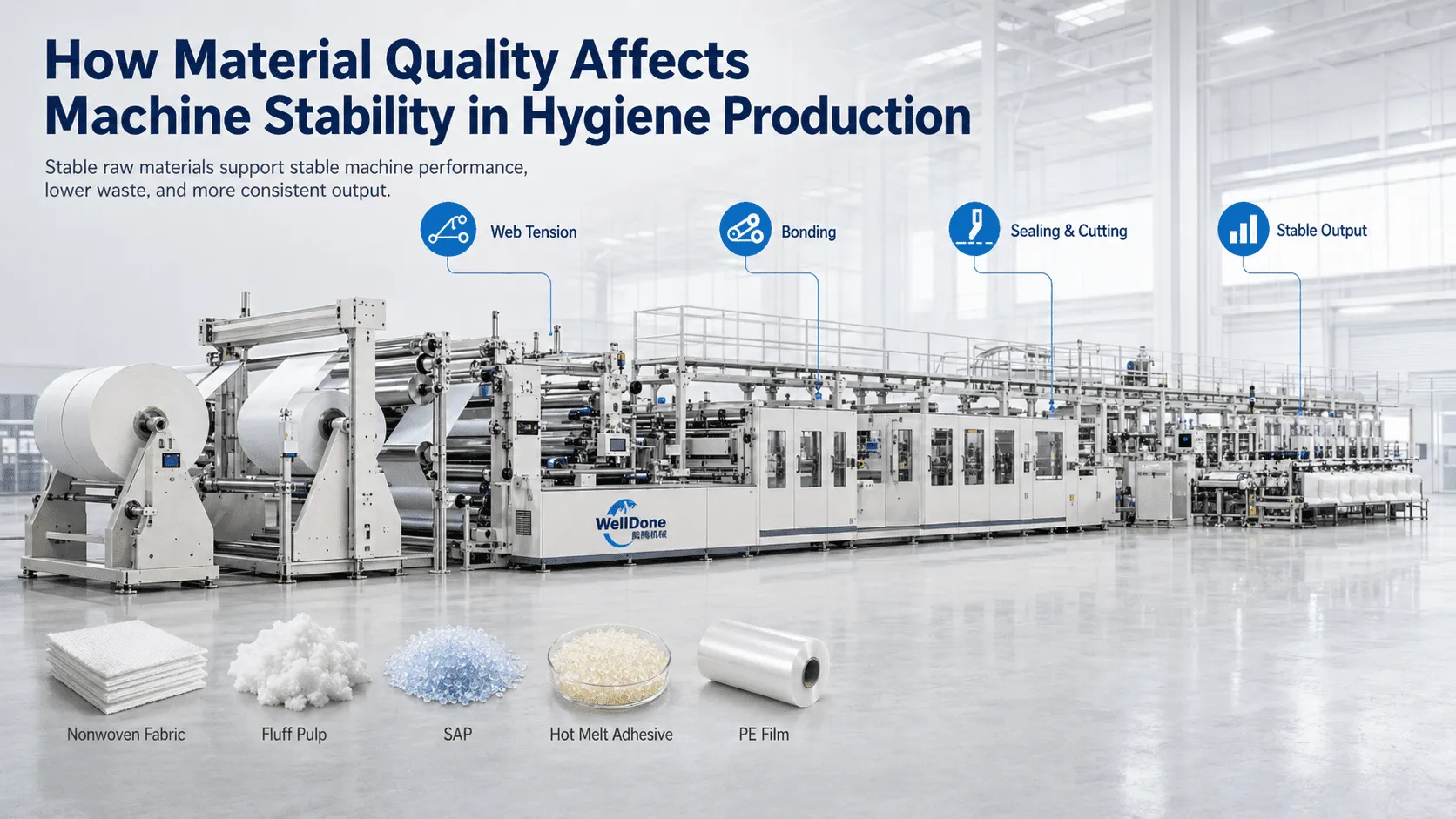
Table of Contents
- Why Machine Stability Is Not Only About the Machine
- How Raw Material Quality Affects Daily Production
- Common Material Issues in Hygiene Manufacturing
- Why Machine, Material, and Process Must Work Together
- How Welldone Supports Stable Hygiene Production
- FAQ
- SEO Block
Why Machine Stability Is Not Only About the Machine
When a hygiene production line becomes unstable, many factory owners first look at the machine.
They may ask:
Is the machine not precise enough?
Is the speed too high?
Is the operator not trained well?
Is there a mechanical problem?
These are all reasonable questions. But in real hygiene production, the answer is often more complicated.
Actually, even a high-quality hygiene machine cannot perform well if the raw materials are unstable.
For products such as baby diapers, sanitary napkins, adult diapers, underpads, pet pads, wet wipes, and tissue products, the machine does not work alone. It depends on a full production system.
That system includes:
- Machine structure
- Servo control
- Web tension control
- Raw material consistency
- Adhesive performance
- Cutting and sealing accuracy
- Operator adjustment
- Production environment
If one part of the system is unstable, the whole production line becomes harder to control.
This is why raw material quality should not be treated only as a purchasing issue. It directly affects machine performance, product quality, waste rate, and daily output.
How Raw Material Quality Affects Daily Production
In hygiene manufacturing, many materials look similar from the outside. But small differences in thickness, weight, softness, tensile strength, surface treatment, or bonding performance can create major production problems.
For example, two rolls of nonwoven fabric may have the same GSM on paper, but their tension behavior may be different during high-speed production.
Two batches of PE film may look acceptable, but one may stretch unevenly during sealing and cutting.
A hot melt adhesive may meet basic specifications, but if its viscosity or open time is not suitable for the machine speed, bonding problems may appear quickly.
In most cases, the machine is blamed first, while the real issue starts from inconsistent material quality.
This is especially important for new hygiene factories. Many new investors focus heavily on machine price, machine speed, and factory layout, but underestimate the role of material matching.
However, in daily production, material stability directly influences whether the machine can run smoothly for long hours.
Common Material Issues in Hygiene Manufacturing
1. Nonwoven Fabric Variation
Nonwoven fabric is widely used as topsheet, backsheet, side tape material, waist material, acquisition layer, and other structural layers in hygiene products.
If the nonwoven fabric has unstable thickness, poor tensile strength, uneven hydrophilic treatment, or inconsistent roll tension, it may cause:
- Unstable web tension
- Wrinkles during feeding
- Product deformation
- Poor surface appearance
- Higher rejection rate
- More operator adjustment
For baby diaper and sanitary napkin production lines, nonwoven stability is especially important because it affects product formation and consumer touch experience.
A soft material is important, but softness alone is not enough. The material must also run stably on the machine.
2. SAP Consistency
SAP directly affects absorbency, core stability, and product performance.
If SAP particle size, absorption speed, distribution, or flowability is inconsistent, the production line may face:
- Uneven absorbent core
- Poor liquid absorption
- SAP leakage
- Core breakage
- Dust issues
- Lower finished product quality
For diaper and sanitary napkin factories, SAP quality is not only a product performance issue. It also affects core forming stability during production.
More importantly, SAP must match the product design, machine structure, and target market positioning.
A low-cost SAP may reduce purchasing cost in the short term, but it can increase complaints, waste, and quality risk later.
3. PE Film Thickness Variation
PE film is commonly used as backsheet material in diapers, sanitary napkins, underpads, and pet pads.
If film thickness is unstable or the material has poor heat resistance, it may affect:
- Sealing strength
- Cutting accuracy
- Product leakage prevention
- Film stretching control
- Product appearance
- Packaging compatibility
For high-speed lines, PE film must have stable thickness and suitable mechanical strength. Otherwise, sealing and cutting problems may become frequent.
This is why material selection should always consider real machine running conditions, not only the price per kilogram.
4. Hot Melt Adhesive Quality
Hot melt adhesive plays a key role in product bonding. It affects the connection between nonwoven, film, absorbent core, elastic materials, and other components.
Poor adhesive quality may lead to:
- Weak bonding
- Glue stringing
- Dirty machine parts
- Nozzle blockage
- Higher maintenance frequency
- Product delamination
In hygiene production, adhesive performance must match production speed, temperature setting, application method, and material surface condition.
A stable adhesive can help reduce machine cleaning time and improve product consistency.
5. Fluff Pulp Quality
Fluff pulp is mainly used in absorbent cores for diapers, sanitary napkins, adult care products, and underpads.
If fluff pulp quality is unstable, it may cause:
- Uneven core formation
- Excessive dust
- Poor fiber separation
- Low absorbency stability
- Higher machine contamination
- More production waste
The quality of fluff pulp affects both machine cleanliness and finished product performance.
For long-term production, stable pulp supply is essential for keeping the production line efficient.
Why Machine, Material, and Process Must Work Together
Hygiene production is not a simple process of buying a machine and feeding materials into it.
It is a system.
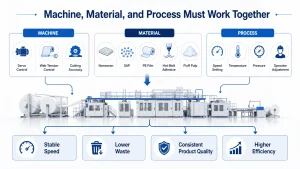
The machine must be suitable for the product design.
The materials must be suitable for the machine speed and process.
The process parameters must be adjusted according to material behavior.
If these three parts do not match, factories may face repeated problems such as:
- The machine cannot reach stable speed
- Waste rate remains high
- Finished product quality is inconsistent
- Operators need frequent adjustments
- Material cost increases
- Delivery schedules become unstable
I believe this is one of the most underestimated issues in hygiene manufacturing.
Many factories invest heavily in machines, but they do not plan material standards early enough. As a result, they may struggle after installation, even when the machine itself is well designed.
The better question is not only:
“Is the machine good enough?”
The better question is:
“Are the materials stable enough for the machine to run well?”
Material Quality and Production Cost
Some factories choose cheaper raw materials to reduce initial production cost. This may look reasonable at the purchasing stage.
But in real production, unstable materials may increase hidden costs, including:
- More waste
- More downtime
- More machine cleaning
- More rejected products
- More operator workload
- More after-sales complaints
- Lower daily output
For hygiene factories, the real cost is not only the material price. The real cost includes how that material performs on the production line.
A slightly cheaper material may become more expensive if it causes frequent stops or high waste.
This is why material evaluation should be part of production planning from the beginning.
How Welldone Supports Stable Hygiene Production
At Welldone, we do not look at hygiene production only from the machine side.
We help buyers evaluate hygiene projects from a full-system perspective, including:
- Machine selection
- Product structure planning
- Raw material matching
- Production speed planning
- Factory layout guidance
- Material consumption estimation
- Operator training support
- Production stability improvement
Our goal is to help customers build a production line that is not only fast on paper, but stable in real factory operation.
For new hygiene factories, this approach can reduce trial-and-error costs.
For existing factories, it can help improve production efficiency, reduce waste, and support product upgrades.
Welldone provides solutions for:
- Baby diaper production lines
- Adult diaper production lines
- Sanitary napkin production lines
- Underpad and pet pad production lines
- Tissue and wet wipes production lines
- Hygiene raw material supply and matching
A stable production line starts with the right machine, but it also depends on the right materials and the right production planning.
Recommended Internal Links
Related Machine Categories
- Baby Care Machines
- Female Care Machines
- Adult Care Machines
- Pet Care Product Machines
- Paper & Wet Wipes Machines
Suggested Anchor Text
| Anchor Text | Suggested Target Page |
|---|---|
| baby diaper production line | Baby Care Machines |
| sanitary napkin machine | Female Care Machines |
| adult diaper production line | Adult Care Machines |
| underpad and pet pad machine | Pet Care Product Machines |
| wet wipes and tissue production machine | Paper & Wet Wipes Machines |
| hygiene raw material matching | Raw Materials / One-stop Solution Page |
FAQ
1. Why does material quality affect hygiene machine stability?
Material quality affects web tension, bonding, sealing, cutting, absorbent core formation, and product appearance. If materials are inconsistent, the machine needs more adjustment and may stop more often.
2. Can a good machine solve poor material problems?
A good machine can improve production control, but it cannot fully solve unstable raw materials. Machine performance and material stability must work together.
3. Which materials are most important in diaper and sanitary napkin production?
Key materials include nonwoven fabric, SAP, PE film, hot melt adhesive, fluff pulp, release paper, elastic materials, and packaging film. Each material affects production stability in a different way.
4. How can a new hygiene factory reduce production instability?
A new factory should evaluate machine selection, raw material specifications, product design, factory layout, operator training, and production speed planning before starting mass production.
5. Does Welldone provide raw material matching support?
Yes. Welldone supports customers with machine selection, raw material matching, production planning, and factory setup guidance to improve line stability and reduce waste.
Conclusion
Machine stability is not only a mechanical issue.
In hygiene production, raw material quality plays a direct role in whether the production line can run smoothly, efficiently, and profitably.
Nonwoven fabric, SAP, PE film, hot melt adhesive, and fluff pulp may seem like separate purchasing items, but they are part of the complete production system.
For factory owners, the goal should not be simply to buy a fast machine.
The goal should be to build a stable production system where machine, material, and process work together.
At Welldone, we help hygiene manufacturers plan production from a full-system perspective, so every project can move closer to stable output, better product quality, and long-term profitability.
Contact Welldone
For hygiene machine selection, raw material matching, or factory setup support, contact Welldone.
Email: welldone@cnwelldone.com
Website: www.cnwelldone.com