Full Servo vs Semi Servo Pull-Up Diaper Lines | Welldone

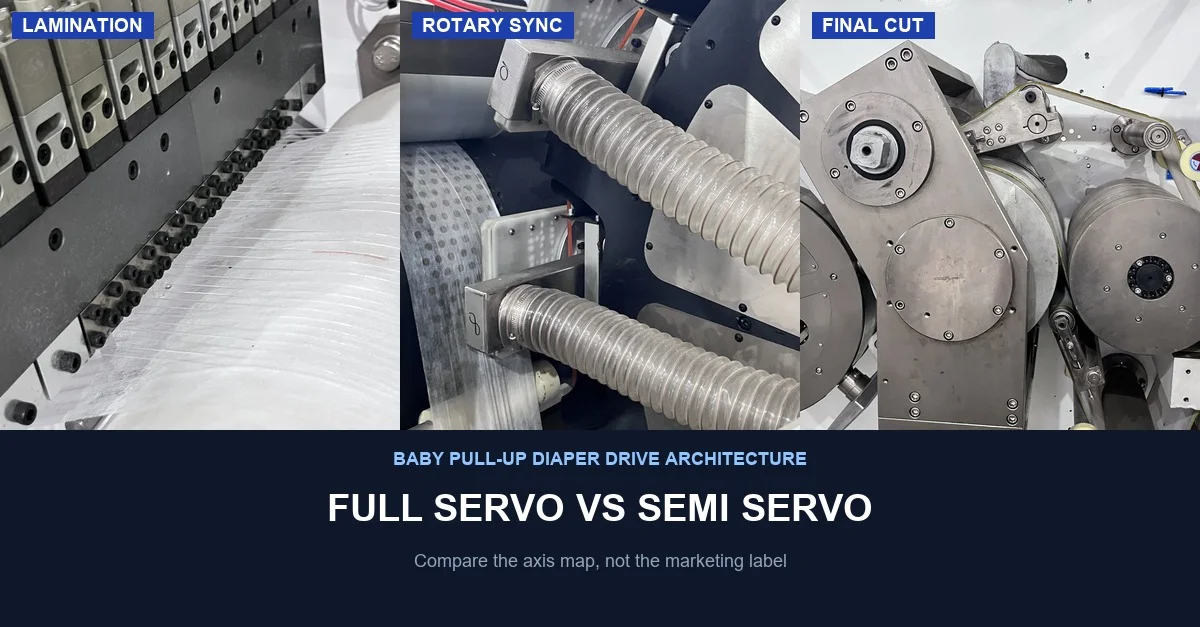
Full Servo vs Semi Servo for Baby Pull-Up Diaper Lines
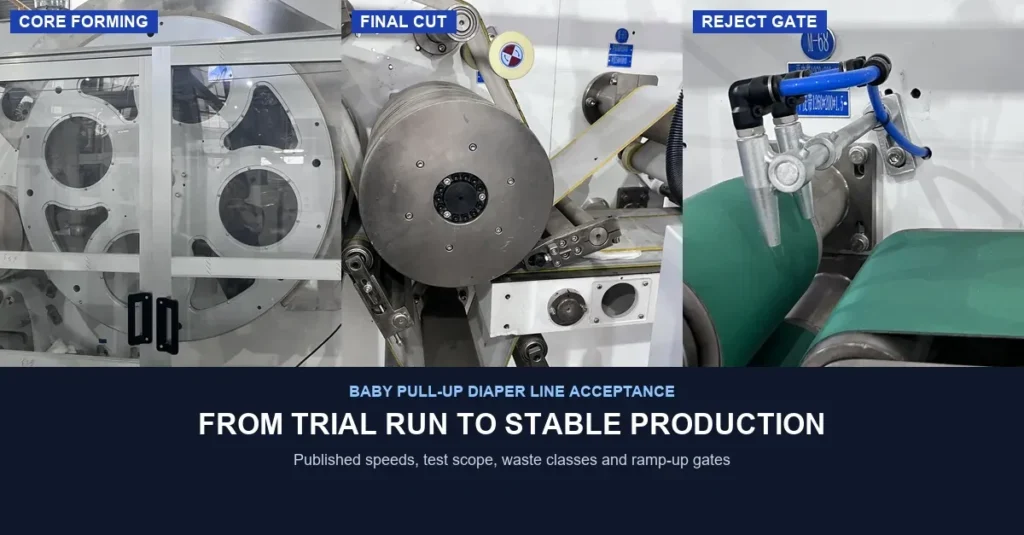
A pull-up diaper line produces acceptable samples at low speed. During acceleration, the waistband shifts, the rotated pad arrives late and the final cut begins moving toward the product edge.
The question is not whether the machine has servo motors. It is which relationships remain controlled when speed, materials or format change.
Starting a Baby Pull-Up Diaper Manufacturing Business - Part 4 of 7
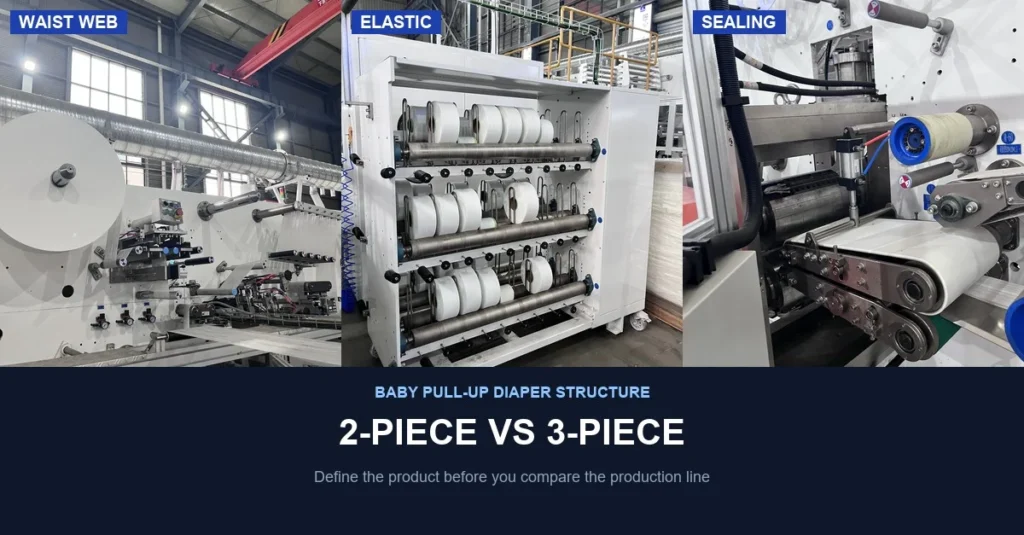
Part 1: Choose the product structure.
Part 2: Define the waistband control chain.
Part 3: Match core forming to the production BOM.
Part 4 - this article: select the drive architecture by critical synchronization tasks.
Next: size changeover and SKU planning.
Part 1: Choose the product structure.
Part 2: Define the waistband control chain.
Part 3: Match core forming to the production BOM.
Part 4 - this article: select the drive architecture by critical synchronization tasks.
Next: size changeover and SKU planning.
Do not buy a servo count; buy control over critical relationships
Actually, the words full servo and semi servo do not describe the same scope in every quotation. One supplier may count only major process axes; another may include unwind, correction and transfer functions in the headline number.
Ask for an axis list. It should identify the master reference, each driven station, the feedback device, mechanically linked sections and what the operator can adjust from a recipe.
A servo motor is a component. A coordinated process is the deliverable.
What changes between full servo and semi servo
| Decision area | Full-servo direction | Semi-servo direction | Evidence to request |
|---|---|---|---|
| Critical station timing | Independent electronic axes follow a common position reference | Some functions share mechanical transmission or grouped drives | Axis and transmission map |
| Recipe changes | More relationships may be stored as electronic settings | More physical adjustment or change parts may remain | Size-by-size changeover list |
| Fault isolation | Axis alarms and position data can narrow the search | Mechanical condition and grouped-drive checks carry more weight | Alarm history and troubleshooting workflow |
| Maintenance | Requires drive, encoder and control-system competence | Requires stronger mechanical transmission and wear inspection | Skills matrix and spare-parts plan |
A semi-servo line can be appropriate when the product range is stable, critical relationships are clearly controlled and the factory has strong mechanical maintenance. A full-servo line becomes more valuable when products, materials and operating states change frequently.
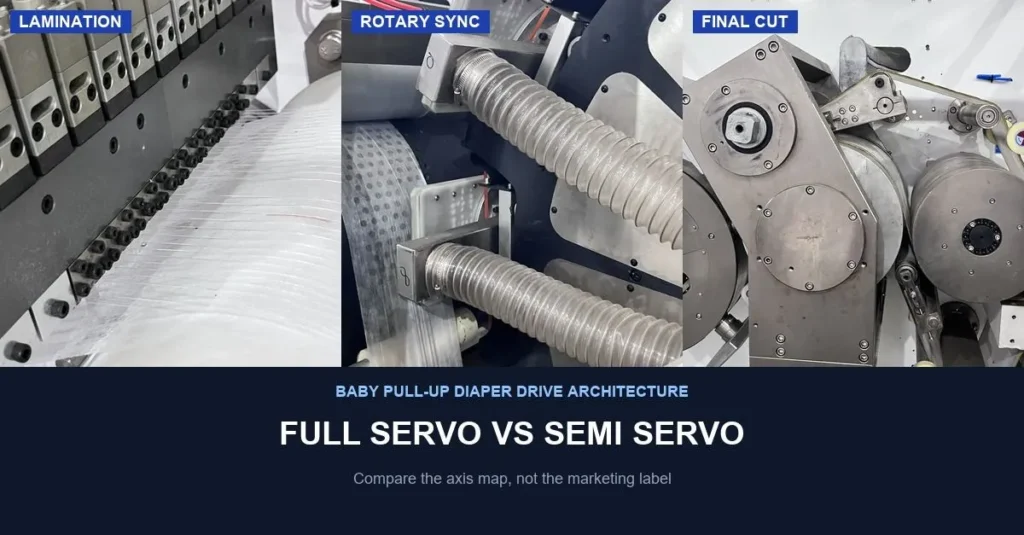
Waistband lamination exposes relative-speed errors
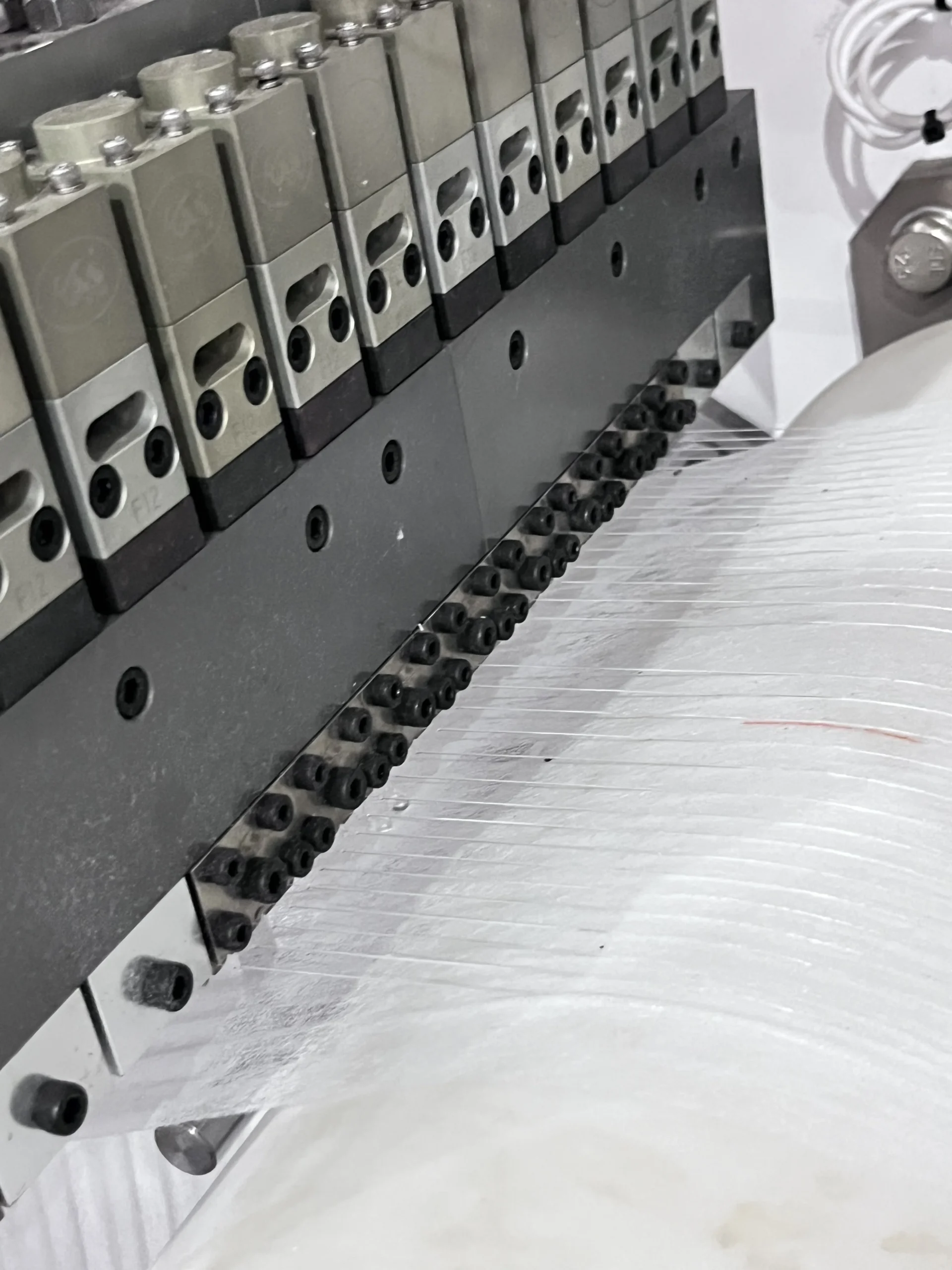
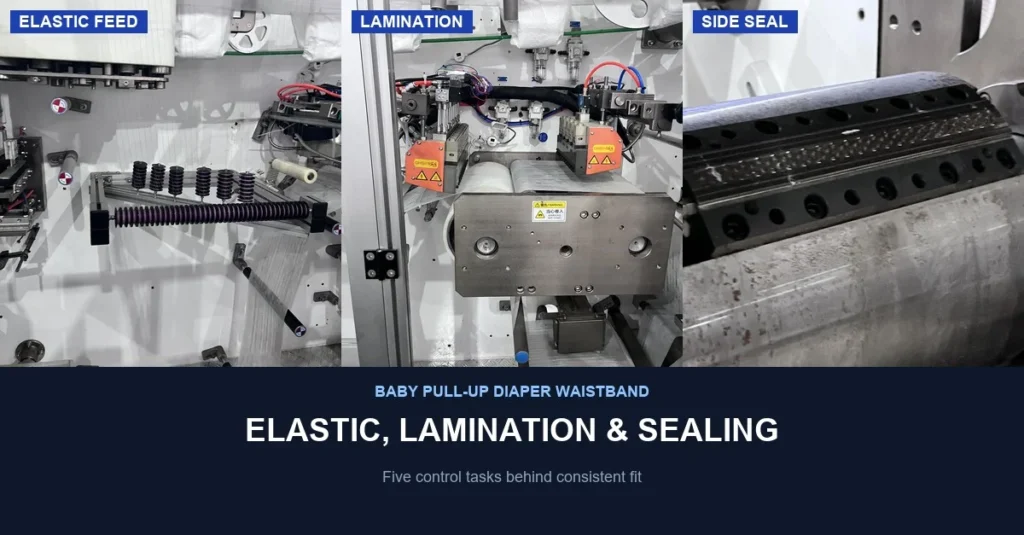
The waistband combines webs, elastic and bonding at one process point. A small relative-speed difference can remain hidden while the composite is flat and appear only after contraction.
The waistband system guide defines the five connected tasks. For drive selection, identify which of those tasks receives independent feedback and which follows a common mechanical train.
More importantly, test the waist after speed transitions. A stable sample at one fixed speed does not prove synchronized control during acceleration.
Pad short cutting must stay registered to the product pitch
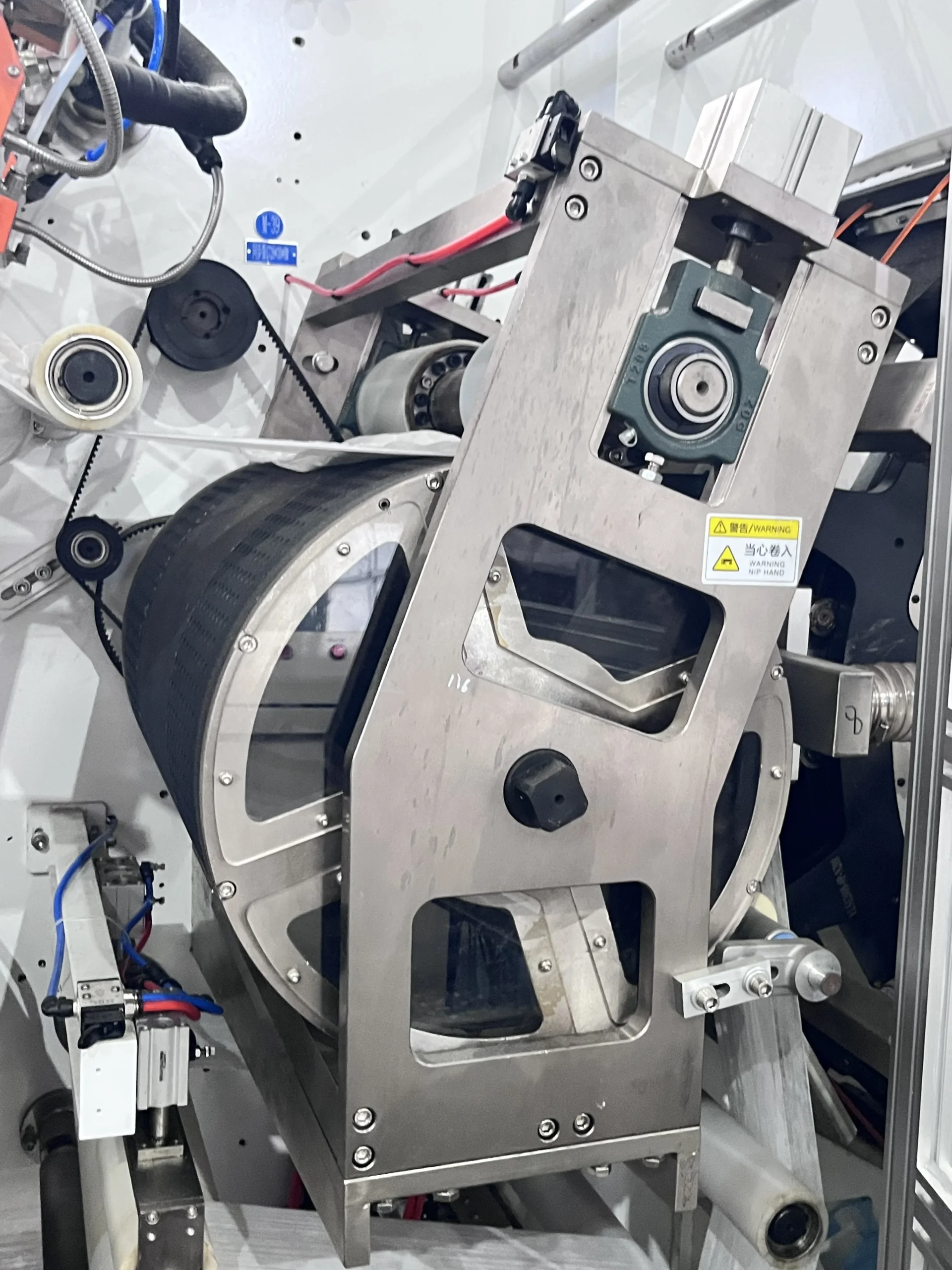
The pad cutter receives a continuous core route and creates discrete absorbent bodies. Its cut must remain tied to product pitch, not merely to the average shaft speed.
On a mechanically linked section, timing depends on transmission condition and physical phase adjustment. On an independently controlled axis, timing can be adjusted electronically, but encoder, drive and recipe integrity become part of maintenance.
Neither architecture removes blade wear or material variation. Control architecture determines how timing is created and corrected.
The 90-degree rotary system is a handoff between moving references
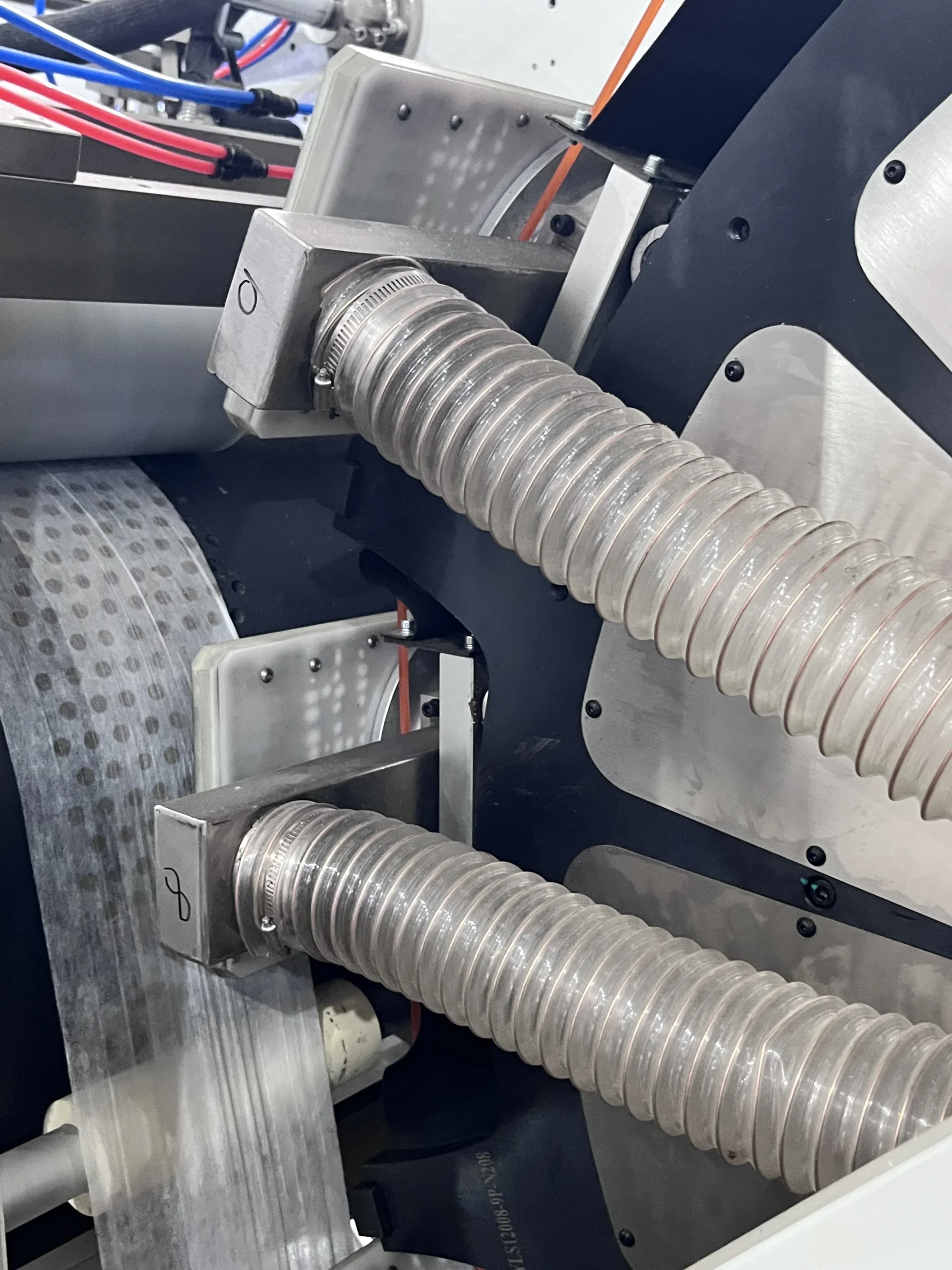
The rotary system must pick up a pad, change its orientation and release it into the garment path. Three motions meet here: incoming pitch, rotary phase and downstream receiving position.
The real question is how the machine detects and corrects phase error. Ask what reference the rotary axis follows, what alarm appears when pickup moves and how the operator restores registration after a stop.
This station is a strong reason to compare actual axis maps instead of marketing labels.
Final cutting reveals accumulated synchronization drift
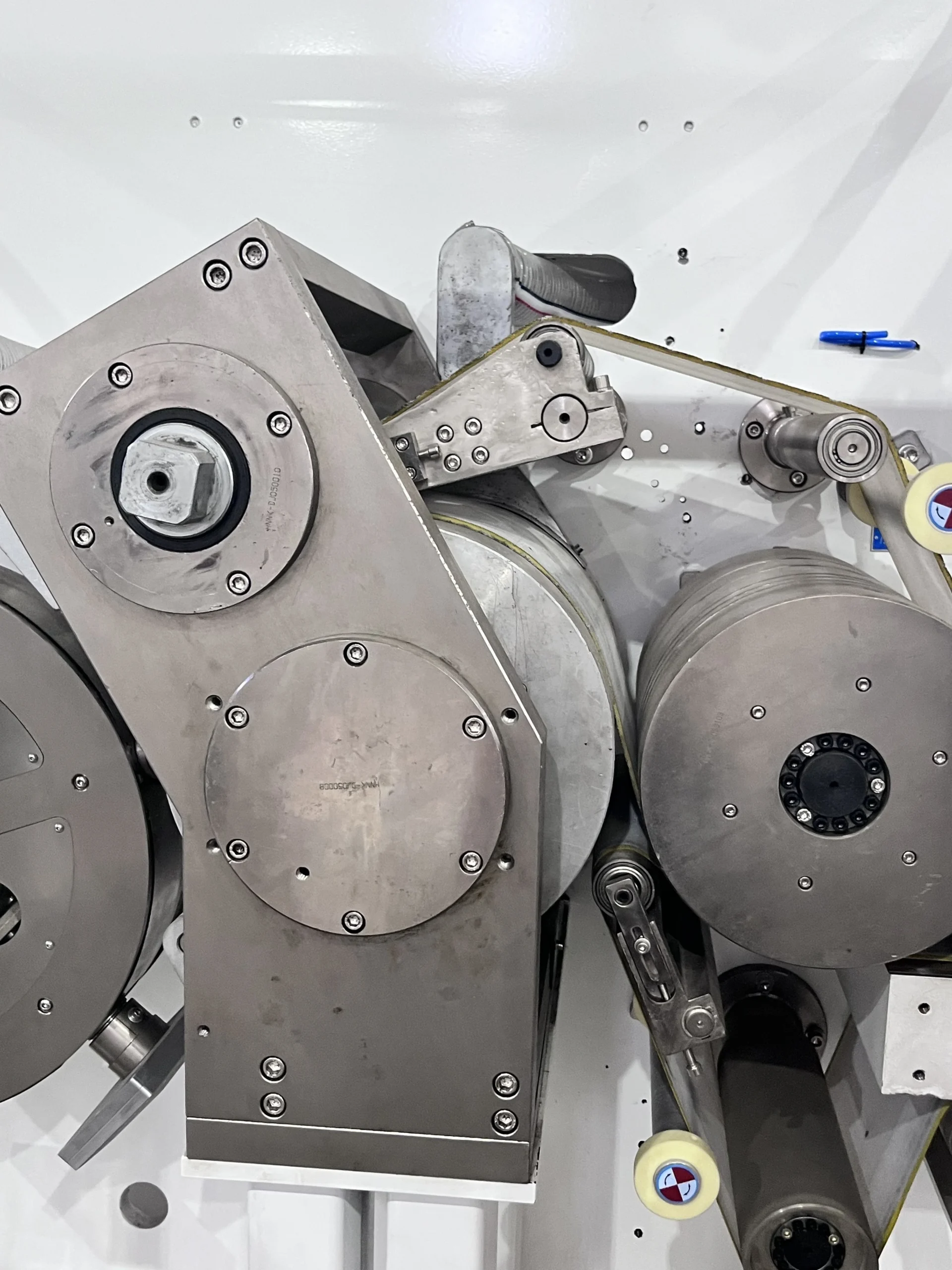
The final cut is often blamed because the defect is visible there. In reality, the cutter may be following its reference correctly while the assembled product reaches it late.
Use registration marks or dimensional checks to separate cutter phase from upstream web movement. Changing the last axis without locating the first drifting relationship can move the defect into another feature.
I believe the FAT should include repeated acceleration, controlled stop and restart, not only a long run at one comfortable speed.
Automatic rejection depends on position tracking
A detector may identify a defect several product pitches before the reject station. The control system must then follow that product through the line and activate rejection at the correct position.
A drive architecture should therefore be evaluated as a data path as well as a motion path. Ask how product identity is retained during speed changes, brief stops and restart.
Choose the architecture from the operating model
| Factory condition | What it increases | Architecture question | Management requirement |
|---|---|---|---|
| Many sizes and frequent changeovers | Recipe and phase-change workload | Which settings are electronic and which require tools? | Controlled recipes and changeover records |
| Frequent material-supplier changes | Tension and feed variation | Which axes or guides compensate, and what remains manual? | Incoming-material and trial discipline |
| Limited electrical-service capability | Recovery risk after drive faults | What remote diagnostics, training and spares are supplied? | Electrical skills and backup plan |
| Stable product with long campaigns | Value of simple repeatable setup | Can grouped or mechanical control hold the approved product? | Mechanical inspection and preventive maintenance |
The correct choice is often visible only after the first-year SKU schedule is written. A factory launching two long campaigns has a different control problem from one changing size and structure every shift.
FAT must test transitions, not only rated speed
- Run the approved material set at the agreed steady condition.
- Accelerate and decelerate through the planned operating range.
- Stop and restart with material in the line.
- Perform at least one representative size or recipe change.
- Check waistband registration, pad position, rotary handoff, final cut and reject accuracy.
- Record alarms, corrections, samples and material lots.
The rated-speed versus actual-output guide explains why peak speed alone is insufficient. Drive architecture should be accepted through recoverable, repeatable production states.
Technical data conflicts must be resolved by document version
Technical data conflict found: Welldone public pages for full-servo pull-up baby diaper equipment show different model references, installed power, dimensions and weight. The product page lists WD-NK-600I-HSV at 400 kW and also shows WD-BDM-012 in its table; the case-study page describes WD-LLK-600-SV with 350 kW installed power, approximately 300 kW consumption, 35.0 x 2.30 x 3.5 m dimensions and approximately 80 tons.
These values may describe different versions or configurations. They cannot be silently merged into one specification.
Before contract approval, request a dated technical proposal for the exact model, finished product, drive scope and optional equipment. Make the signed configuration sheet the controlling source.
Why Welldone
Welldone can configure pull-up baby diaper lines around the approved product, material route, SKU schedule and critical synchronization points.
Axis-level review
The proposal can identify driven, feedback-controlled and mechanically linked functions.
Transition testing
Acceptance can include acceleration, restart, recipe change and defect tracking.
Engineering support
Welldone can provide overseas engineer support for installation, commissioning and training.
Conclusion
Full servo and semi servo are architecture directions, not quality grades. The decision depends on which stations must move independently, how often the product changes and whether the factory can maintain the selected system.
If two quotations both say full servo but cannot provide the same axis map, are they really offering the same control scope?
FAQ
Is full servo always the better choice?
No. It offers more electronic control possibilities, but value depends on the product, SKU schedule, material changes, maintenance capability and acceptance plan.
Can servo count be used to compare quotations?
Only after suppliers use the same counting boundary. Request the axis list, mechanical links, feedback devices and optional systems.
Does full servo eliminate material problems?
No. The core-forming guide shows why pulp, SAP and tissue behavior still require validation.
What should be tested during FAT?
Test steady running, acceleration, deceleration, restart, representative changeover, registration, cutting and reject tracking with agreed materials.
Compare architectures with the same product scope
Send Welldone the approved samples, SKU schedule, material list and required FAT transitions before comparing drive systems.
Request an axis-level reviewView baby care linesWebsite: www.cnwelldone.com Email: welldone@cnwelldone.com