SAP to Fluff Ratio: Why More SAP Means a Wetter Diaper


SAP to Fluff Ratio: Why More Superabsorbent Can Make a Wetter Product
A customer told me his new formulation carried noticeably more SAP than the previous one, and his laboratory absorption test confirmed the improvement. Six weeks later his distributor reported more complaints about wetness against the skin, not fewer.
Both results were correct. They were measuring two different properties. This article explains why total absorption capacity and dryness in use are not the same thing, what gel blocking does inside a core, and which parts of your line actually control the outcome.
Two Correct Results
When a laboratory result and a customer complaint contradict each other, the usual assumption is that one of them is wrong. In this case neither was.
A standard absorption test measures how much fluid a core can hold. It is a capacity measurement. The distributor's complaint was about rebound — liquid coming back to the surface under pressure after the product has been worn for a while. That is a rate and distribution measurement.
Adding SAP reliably improves the first. It can degrade the second.
Your customer never measures capacity. They notice rebound.
Capacity Is Not Dryness
Consider what a core is asked to do in real use, as opposed to in a beaker.
A baby produces a fast insult onto a small area of the core, under body pressure, and then repeats it several times over a few hours. The core has seconds to move that liquid away from the skin and into storage. Whether it eventually holds 300ml or 400ml matters far less than whether it can accept the next 60ml quickly and keep the surface dry between events.
Those are different engineering problems. One is about total SAP mass. The other is about how fast liquid can travel through the structure to reach unused SAP — which is a question of geometry, not quantity.
What Gel Blocking Actually Is
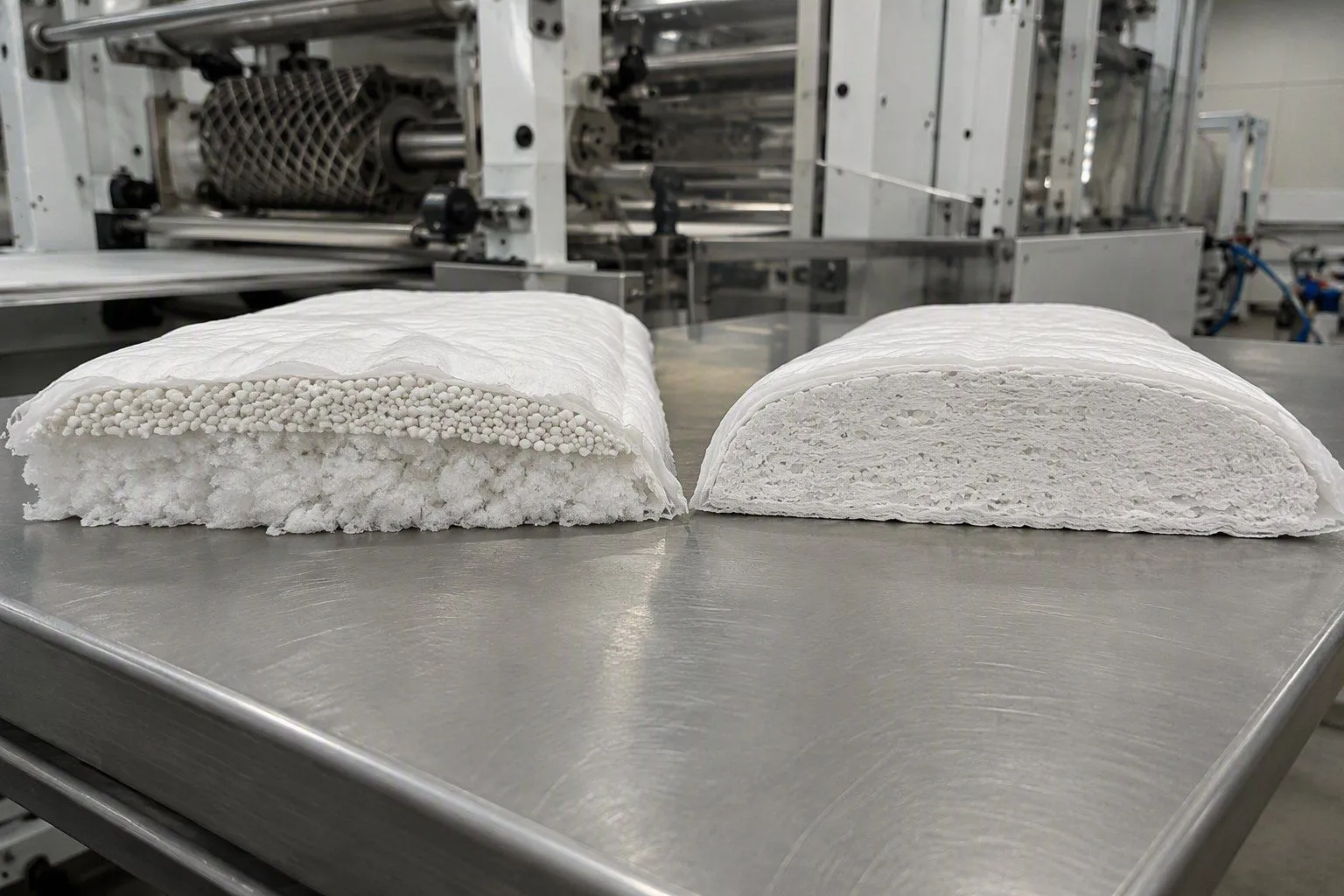
SAP granules swell as they absorb. That is the point of them. The complication is what a swollen granule does to its neighbours.
When granules are packed closely together — either because the overall concentration is high, or because they have settled unevenly into one region of the core — the first granules to hydrate expand and press against each other. They form a gel layer that is essentially closed to liquid flow.
Fluid arriving afterwards cannot pass through. Dry SAP sitting underneath that layer stays dry, holding capacity the product will never use. Meanwhile the liquid that cannot get in has nowhere to go except sideways along the top sheet, or back toward the skin when pressure is applied.
The core has not run out of capacity. It has run out of access.
Why the Lab Test Missed It
This is worth being precise about, because it determines what you should test rather than which supplier you should blame.
| Condition | Typical Capacity Test | Actual Use |
|---|---|---|
| Liquid delivery | Slow or full immersion | Fast insult onto a small area |
| Pressure | Usually none or light | Body weight, sustained |
| Number of events | Often single | Repeated over hours |
| Time allowed | Minutes | Seconds before contact with skin |
| What it reveals | Total capacity | Acquisition rate and rebound |
A slow or immersed test gives the gel time to hydrate evenly and gives liquid multiple paths inward. Under those conditions a high-SAP core performs well, because gel blocking needs speed and concentration to occur.
If your quality data and your market feedback disagree, add tests that reproduce use conditions — repeated dosing at realistic volume and interval, with load applied, measuring both acquisition time and rewet. Those two figures explain complaints that a capacity number cannot.
Distribution Beats Quantity
In most cases the useful lever is not how much SAP goes in, but where it ends up.
- SAP to fluff ratio. Fluff pulp is not filler. It is the transport network that carries liquid to the granules and the matrix that keeps swollen granules physically separated. Reduce it too far and you remove the thing that prevents blocking.
- Placement along the core profile. Insult concentrates in a specific zone. SAP distributed uniformly end to end leaves capacity unused at the extremities while the target zone saturates.
- Placement through the depth. Granules that settle toward the upper surface block the entry path. Dispersion through the thickness keeps the surface open.
- Consistency piece to piece. An average ratio that is correct means little if individual cores vary. Variation shows up as unpredictable complaints rather than a consistent defect.
The Forming Drum Decides the Profile
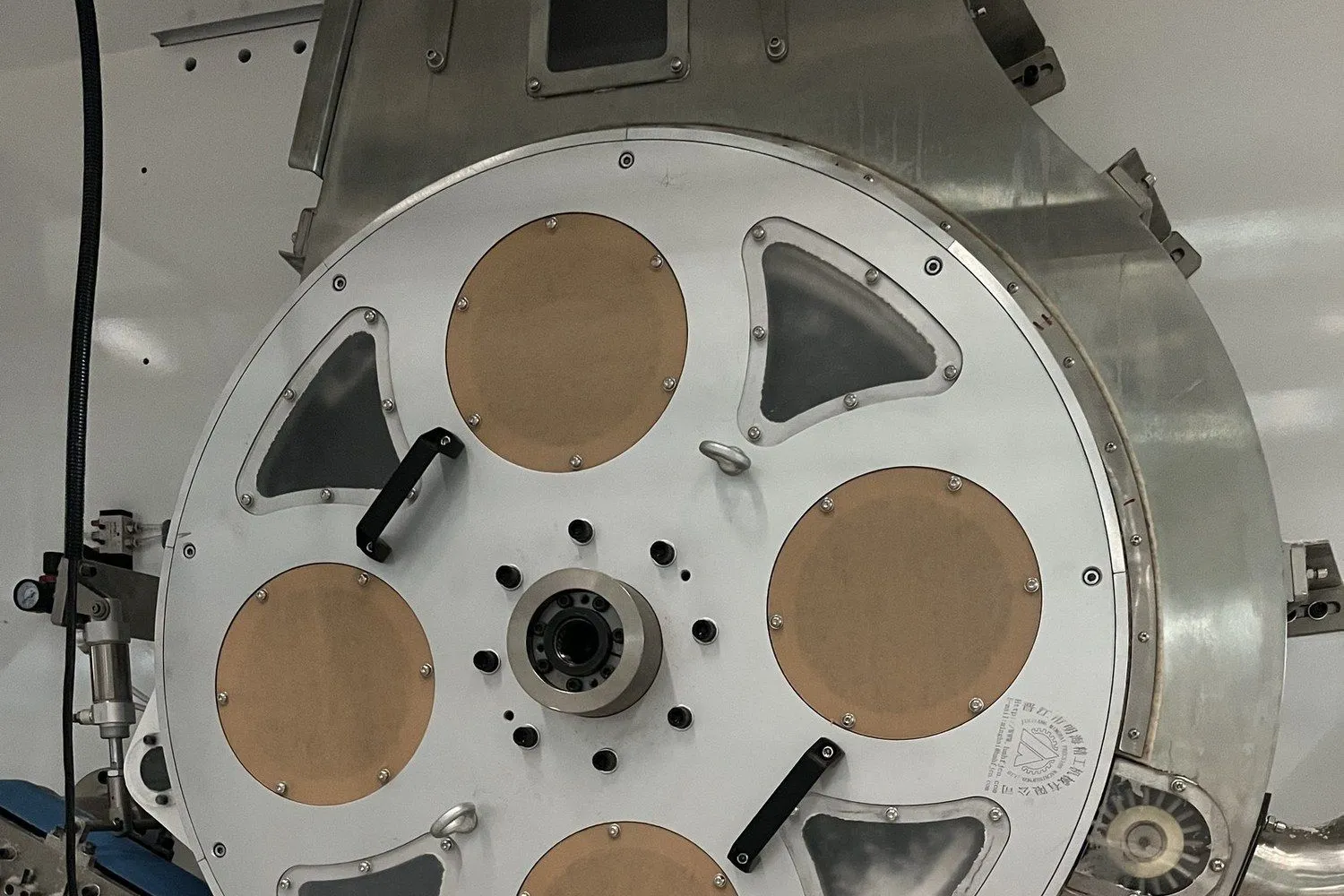
Here is the part that surprises people who think of core design as a materials question.
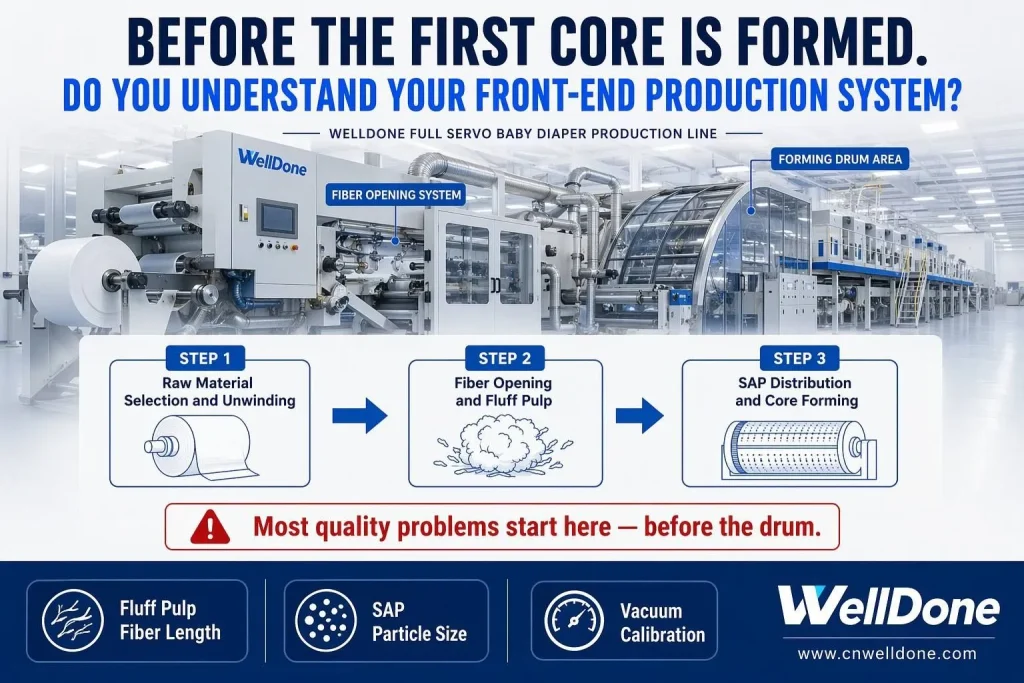
The forming drum carries shaped cavities. Fluff and SAP are drawn into those cavities under vacuum, and the cavity geometry determines where material accumulates — thickness in the centre channel, taper toward the ends, the width of the absorbing zone. That geometry is machined into the drum.
An operator can change the SAP feed rate from the control panel. Nobody can change the cavity profile during a shift. So if your intended distribution does not match what the drum was built to produce, adjusting the dosing rate will not fix it — it will only shift the same wrong distribution up or down.
This is a specification-stage decision, and it is why we ask about intended product performance before quoting rather than only about output speed.
The Layer Above the Core

An acquisition and distribution layer sits between the top sheet and the core. Its job is to take a fast insult, hold it briefly, and spread it laterally so that it enters the core across a wider area rather than at one point.
That directly addresses the mechanism described above. Gel blocking is triggered by high local concentration arriving quickly. Spreading the same volume over more area lowers the local rate, so more granules participate and fewer block their neighbours.
Factories chasing dryness by increasing SAP sometimes have no ADL at all, or an ADL specified purely on cost. Reviewing that layer is frequently a more effective route than adding material to the core, and it can be a lower-cost one.
Four Things to Check First
Before changing your SAP quantity, work through these in order. They are ranked by how often they turn out to be the actual cause.
| Check | What to Look For | Where |
|---|---|---|
| 1. Distribution uniformity | Cut cores from a run and inspect the cross-section — are granules dispersed or concentrated? | Sample from the line, not from a good batch |
| 2. ADL specification | Is there one? Is its loft and porosity suited to your insult volume? | Material specification and supplier data |
| 3. Fluff quality and defibration | Poorly defibrated pulp creates dense lumps and open voids, both of which distort distribution | Hammer mill condition and output consistency |
| 4. Dosing consistency | Piece-to-piece variation in SAP mass, not just the average | Weigh individual cores across a run |
Item 3 is the one most often overlooked. A worn hammer mill produces uneven defibration, and the resulting inconsistent fibre network changes how SAP settles — which looks like a dosing problem and is not.
Absorption tests look fine but complaints say otherwise?
Send us your core specification, product application and a description of the complaints. We will look at the distribution side — forming profile, SAP placement and ADL configuration — rather than starting from the material quantity.
Product Type Changes the Answer
The right balance is not universal, because the use conditions differ significantly by product.
| Product | Dominant Requirement | Practical Implication |
|---|---|---|
| Baby diaper | Repeated insults, sustained pressure, long wear | Rebound control and acquisition rate matter more than peak capacity |
| Adult incontinence | Larger single volumes, longer intervals | Higher total capacity is genuinely needed, but distribution across a larger area becomes harder |
| Sanitary napkin | Lower volume, higher viscosity fluid, thin profile expected | Surface dryness and rapid acquisition dominate; excess SAP adds thickness without benefit |
| Under-pad | Large area, product lies flat under the user | Lateral distribution across a wide surface is the main challenge |
A formulation developed for one of these will not transfer cleanly to another, and neither will the forming configuration that produces it.
When More SAP Is Correct
None of the above argues that SAP quantity never matters. It sometimes does, and it would be misleading to imply otherwise.
Increasing SAP is the right move when:
- Your core genuinely saturates in use. If the product reaches its capacity limit before the intended wear time, more storage is the answer — check for full saturation across the whole core, not just the target zone.
- You are moving to a thinner product. Reducing fluff to achieve a slimmer profile requires more SAP to maintain capacity, provided the distribution and ADL are redesigned alongside it rather than left unchanged.
- You are moving up a product tier. Higher-capacity overnight or extended-wear positioning requires more storage, and the added material is part of the value proposition.
- Distribution is already good. If cross-sections show even dispersion and the ADL is doing its job, headroom exists to add capacity without triggering blocking.
The distinction is whether you are adding capacity to a structure that can deliver liquid to it, or adding material to a structure that cannot.
Why Welldone
We have manufactured hygiene product machinery in Jinjiang, Fujian since 2008 and delivered to more than 60 countries. Core forming is where machine configuration and product performance meet, so we treat it as a product conversation rather than a specification checkbox.
Profile before speedWe ask what the product has to do in use — insult pattern, wear time, target tier — before recommending a forming drum configuration, because the cavity profile cannot be changed later.
The full core sectionDosing, defibration, forming and ADL lamination are specified together. Adjusting one without the others is how distribution problems are created.
Verified with your materialsVideo factory acceptance test running your fluff and SAP specification, so you see cores formed from your actual materials before shipment.
Related Machines
Conclusion
SAP quantity is the most visible variable in a core specification and the easiest one to change, which is why it absorbs attention that belongs elsewhere. Distribution, forming geometry and the acquisition layer determine whether that SAP is reachable — and unreachable capacity has no value to the person wearing the product.
Before your next formulation change, cut ten cores from a normal production run and look at the cross-sections. If the granules are not where you assumed they were, you have found something more useful than another absorption test result.
So the question worth asking your technical team: do we actually know how our SAP is distributed through the core depth — or have we only ever measured how much of it we put in?
Frequently Asked Questions
What is a normal SAP to fluff ratio?
There is no single correct figure, because it depends on product type, target tier, core thickness and whether an ADL is present. A ratio that performs well in a thin premium diaper may perform poorly in an under-pad. Rather than starting from a target ratio, start from what the product has to do in use and work backwards — then verify with cross-sections and rewet testing rather than capacity alone.
How can we tell whether we have gel blocking?
Run a repeated-insult test with load applied, measuring acquisition time for each successive dose. If acquisition time rises sharply between the second and third insult while the core still has unused capacity, blocking is a likely explanation. Cutting saturated cores open and looking for dry SAP beneath a hydrated gel layer gives visual confirmation.
Can we change SAP distribution without changing the machine?
Partly. Dosing rate and defibration quality are adjustable in production. The core thickness profile is set by the forming drum cavity geometry, which is mechanical and fixed once built. So distribution can be improved within a range, but a profile fundamentally different from what the drum produces requires a tooling change. This is why intended product performance should be discussed at order stage.
Does an ADL always improve performance?
Not automatically — it depends on specification. An ADL that is too dense provides little buffering; one that is too open does not spread liquid laterally. The layer has to be matched to your expected insult volume and rate. Where a product has no ADL, adding a suitable one is often more effective than increasing SAP, but it is a design decision rather than a universal upgrade.
Our fluff supplier changed and now performance varies. Why?
Pulp defibrates differently depending on its source and treatment. Poorly defibrated fluff creates dense lumps and open voids, and SAP settles unevenly into that irregular network. The dosing has not changed but the distribution has. Check hammer mill condition and output consistency when a material source changes, before adjusting the formulation.
What should we send you to get advice on core configuration?
Your product type and target tier, current core specification including SAP and fluff quantities, core dimensions and intended thickness, whether an ADL is used and its specification, the complaints or test results prompting the review, and your target market. The last item matters more than it appears — expectations for wear time and product thickness vary considerably between markets.
Request a Core Configuration Review
Tell us what the product has to do rather than which ratio you want, and we will advise on forming profile, SAP placement and ADL configuration — including when the honest answer is that your current specification is fine and the issue lies elsewhere. Please include:
- Product type and target tier
- Current core specification
- Core dimensions and thickness
- ADL specification, if used
- Test results or complaint descriptions
- Fluff and SAP sources
- Target market and wear-time expectation
- Existing line details, if retrofitting