Lyocell Nonwovens & Hygiene Line Qualification | Welldone

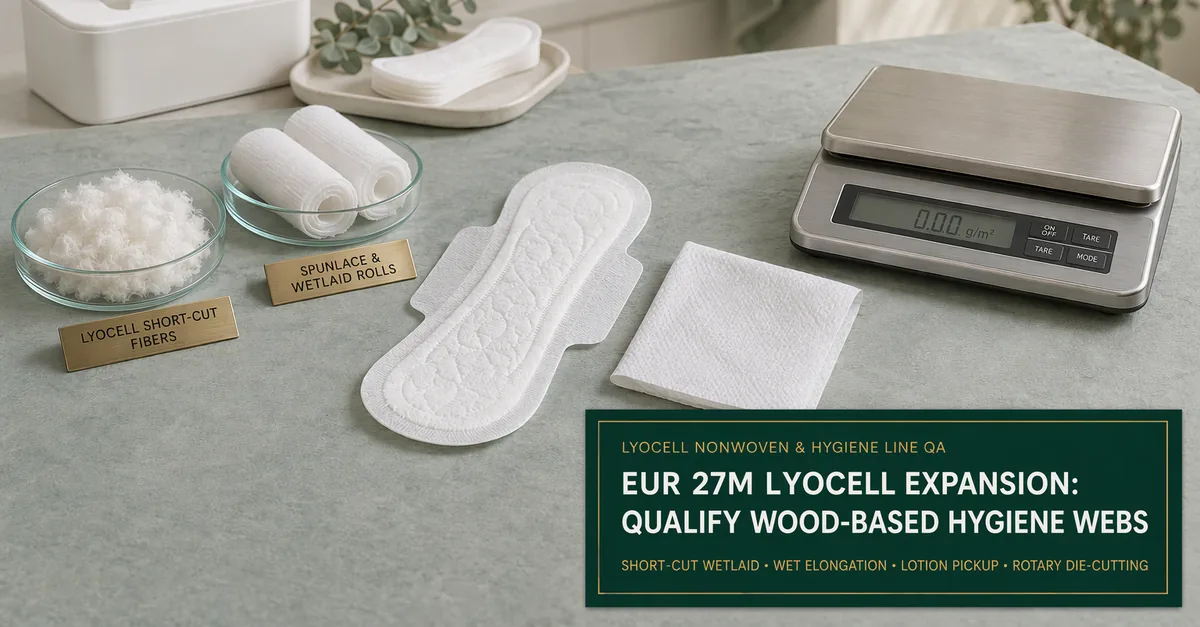
EUR 27M Lyocell Expansion: Qualify Wood-Based Nonwovens on Panty Liner & Wet Wipes Lines
When a feminine care or wet wipes manufacturer replaces fossil-based polypropylene (PP) and polyester (PET) webs with 100% wood-based lyocell spunlace or short-cut cellulosic cores, plant teams often treat the switch as a simple roll-for-roll substitution. Yet November 2026 specialty fiber investments by the Lenzing Group highlight a major shift in raw-material supply: as wood-based short-cut lyocell and dual-surface cellulosic roll goods scale across the Americas and Europe, hygiene converters running 600 to 1,200 pieces per minute must qualify wet-state elongation, rotary knife shearing, dust extraction, and lotion pickup before signing off Factory Acceptance Testing (FAT).
1. November 2026 Industry Signal: Lenzing’s EUR 27M Mobile Lyocell Expansion
On November 12, 2026, the Lenzing Group announced via its official newsroom and PulPaperNews that it is investing EUR 27 million (USD 31 million) to expand specialty fiber capabilities at its lyocell production site in Mobile, Alabama, USA. Executed under Lenzing’s “Grow NW. Reset TX.” strategy, the Mobile upgrade is part of a EUR 50 million capital program for its global Nonwovens business, alongside EUR 23 million previously announced to expand nonwoven capabilities in Lenzing, Austria.
According to Lenzing CEO Georg Kasperkovitz and EVP Global Nonwovens Patricia A. Sargeant, the EUR 27 million Mobile investment expands production flexibility in specialty wood-based fibers, including lyocell short-cut fibers, accelerating the replacement of fossil-based fibers in nonwovens. Earlier in 2026 (April 10, 2026), Lenzing also introduced LENZING™ DualWipe—an INDEX™26 Award finalist in Nonwoven Roll Goods—featuring a 100% regenerated cellulose dual-surface structure (one scrubbing side and one soft absorbent side) without synthetic fibers, binders, or chemical additives.
The real question is what this EUR 50 million transatlantic expansion of lyocell staple and short-cut fibers means for a factory specifying a panty liner machine, a high-speed sanitary pad machine, or an automatic wet wipes machine. Unlike hydrophobic polyolefin fibers that repel water and retain uniform tensile modulus across dry and wet zones, regenerated cellulosic fibers absorb liquid into their fiber walls, swell radially, and exhibit a lower wet-state modulus during high-speed web transport.
2. Source-Verified Facts vs. Converting Engineering Boundaries
To support capital-equipment and raw-material procurement, the summary below separates facts directly confirmed by official releases from Welldone’s converting engineering analysis:
- Source-Confirmed Industry Facts (Lenzing Official Release & PulPaperNews, November 12, 2026): Lenzing is investing EUR 27 million (USD 31 million) at its Mobile, Alabama lyocell plant within a EUR 50 million Nonwovens program (with EUR 23 million in Lenzing, Austria) under its “Grow NW. Reset TX.” strategy, expanding specialty wood-based fibers including lyocell short-cut fibers. Lenzing’s INDEX™26 finalist LENZING™ DualWipe (April 10, 2026) is a binder-free, plastic-free regenerated cellulose roll good integrating an abrasive scrubbing surface and a soft wiping surface.
- Source-Confirmed Welldone Machine Capabilities (Verified on cnwelldone.com): Welldone manufactures full-servo panty liner machines (<180 mm length, 1,000–1,200 pcs/min design speed,
≥98%qualified rate), sanitary pad machines (>180 mm length, 1,000–1,200 pcs/min), and wet wipes production lines (design speed 600–1,200 pcs/min, stable speed 500–1,000 pcs/min, full-servo positioning accuracy±0.02 mm, SUS304/316 product-contact parts with surface roughness≤0.8 μm). - Welldone Converting Engineering Analysis & Illustrative Commissioning Targets: Converting targets—such as keeping wet-wipes web elongation below
≤1.5%, holding panty liner core cut-length tolerance within±0.5 mm, maintaining lotion pickup within±3%across 280%–380% saturation ratios, and limiting hot-melt glue coat weight to18–25 g/m²—are engineering recommendations derived from hygiene converting mechanics, not specifications issued by Lenzing.
3. 6-Layer Wood-Based Panty Liner & Wet Wipes Architecture
To understand why wood-based lyocell fibers affect multiple stations simultaneously, buyers must examine where regenerated cellulose enters the product Bill of Materials (BOM). In feminine care and wipes converting, lyocell fibers are deployed in two primary formats: hydroentangled spunlace roll goods (typically 35–65 g/m² for panty liner topsheets and 45–80 g/m² for wet wipes) and short-cut fibers (typically 3–6 mm fiber length blended into wetlaid, airlaid, or coform absorbent cores and acquisition layers).

- Layer 1 — 100% Lyocell or Lyocell/Viscose Spunlace Topsheet (28–45 g/m²): Replaces perforated PE film or polypropylene spunbond. Because it is consolidated solely by high-pressure water jets without thermal calender bonds, it exhibits higher transverse neck-down if unwinder tension spikes.
- Layer 2 — Cellulosic Acquisition & Distribution Layer (ADL, 30–50 g/m²): Transfers fluid rapidly into the thin core without relying on coarse polyester bicomponent fibers.
- Layer 3 — Short-Cut Lyocell / Fluff Pulp Wetlaid or Airlaid Core (80–160 g/m²): Uses short-cut wood-based fibers to create a dense, uniform capillary network in ultrathin panty liners (<180 mm) where traditional thick fluff-SAP drums are unnecessary.
- Layer 4 — Breathable Micro-Porous PE or Bio-Based Backsheet Film (18–24 g/m²): Provides liquid barrier protection while maintaining moisture vapor transmission.
- Layer 5 — Positioning Hot-Melt Adhesive Stripes: Secures the liner to underwear; requires tight viscosity and temperature control so glue does not penetrate thin cellulosic cores.
- Layer 6 — Silicone-Coated Release Liner & Individual Easy-Wrap Film: Protects the positioning adhesive and forms the three-side-sealed single-piece pouch.
4. Four Converting Defects When Switching to 100% Cellulosic Webs
A common mistake is assuming that a converting line tuned for hydrophobic polypropylene spunbond or 70/30 PET/viscose wipes will run 100% lyocell or short-cut wetlaid webs at the same servo tension, knife pressure, and lotion flow rate. Four mechanical failure modes typically appear during uncalibrated trials:
Four High-Speed Converting Failure Modes on Wood-Based Hygiene Webs
Why 100% lyocell spunlace and short-cut wetlaid rolls require dedicated machine recipes at 600–1,200 pcs/min:
1. Wet-Modulus Drop & Web Neck-Down
When 100% lyocell or viscose spunlace absorbs aqueous lotion on a wet wipes line, its wet tensile modulus drops below dry PET blends. Excessive draw tension between the dosing tank and folding plate stretches the web in MD and narrows CD width by 2–4 mm.
2. High-Tenacity Lyocell Knife Wear
Dry lyocell fibers possess higher crystallinity and tenacity than standard viscose. On panty liner short-cut ADL and core rotary cutters, dull tungsten-carbide blades leave uncut fiber bridges ("angel hair") or generate fine cellulosic lint.
3. Capillary Lotion Pooling in Wipes
Wood-based lyocell swells and holds liquid inside the fiber lumen as well as between fibers. If dosing nozzles are not matched to cellulosic absorption kinetics, free liquid squeezes out at the nip rollers and contaminates flow-wrap heat seals.
4. Low-Stiffness Pad Buckling in Stackers
Ultrathin panty liners built with binder-free cellulosic topsheets and short-cut wetlaid cores have lower bending rigidity than thermally bonded PP pads, causing leading-edge curl inside 1,000–1,200 pcs/min rotary stacking wheels.
5. Station Engineering I: Multi-Tier Unwinding & Zero-Speed Splicing
On a compact high-speed panty liner machine running at 1,000 to 1,200 pieces per minute, the airlaid/wetlaid absorbent core roll, the acquisition layer (ADL), and the nonwoven topsheet unwind simultaneously within a vertically stacked frame. When converters transition from polypropylene spunbond to hydroentangled lyocell spunlace or short-cut cellulosic webs, the unwinding and splicing zone is the first bottleneck.

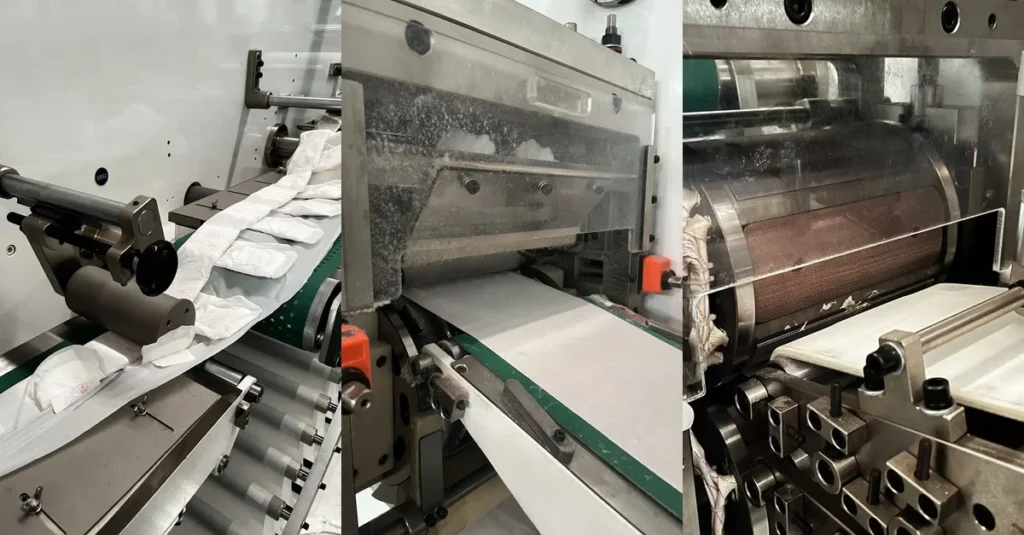
As shown in Figure 2, each stream uses dual A/B pneumatic spindles paired with an automatic zero-speed splicing head and a multi-roller dancer buffer. To qualify wood-based nonwovens without web breaks or width shrinkage:
- Independent Tension Recipes per Tier: Short-cut wetlaid cellulose cores have high initial stiffness but low elongation-at-break (3%–6%), whereas binder-free lyocell spunlace topsheets stretch more easily under low load. The PLC must store separate dancer pressure and servo payoff ratios for each spindle.
- Short-Path Festoon Buffering During Zero-Speed Splices: When the expiring roll stops for pneumatic nip-and-cut splicing at 1,000+ pcs/min, the dancer accumulator feeds the line for 0.4–0.8 seconds. Lowering dancer pressure by 15%–25% on 100% lyocell topsheets prevents neck-down across the splice tail.
- Splice Tape Adhesion on Cellulosic Rolls: Wood-based lyocell equilibrates at 11%–13% moisture regain (vs. <0.5% for polypropylene). Operators should qualify high-tack acrylate splice tapes during FAT to prevent splice slip under acceleration.
6. Station Engineering II: Short-Cut ADL & Core Rotary Knife Shearing
Lenzing’s November 2026 Mobile investment specifically expands capacity for lyocell short-cut fibers—a key feedstock for wetlaid and airlaid absorbent sheets used in ultrathin panty liners, sanitary pads, and biodegradable wipes. Once unwound, these cellulosic webs enter the rotary cutting and vacuum transfer module.
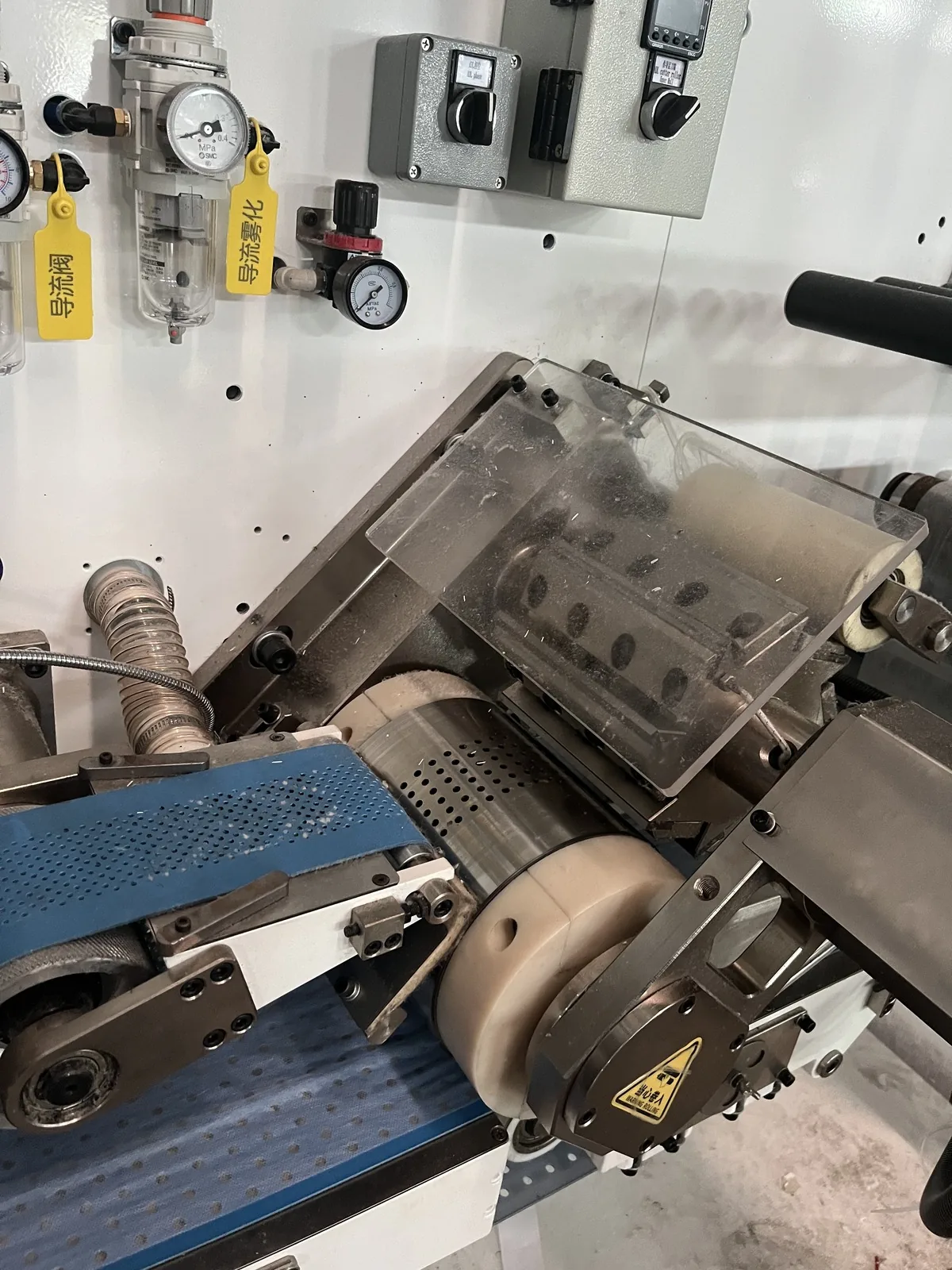
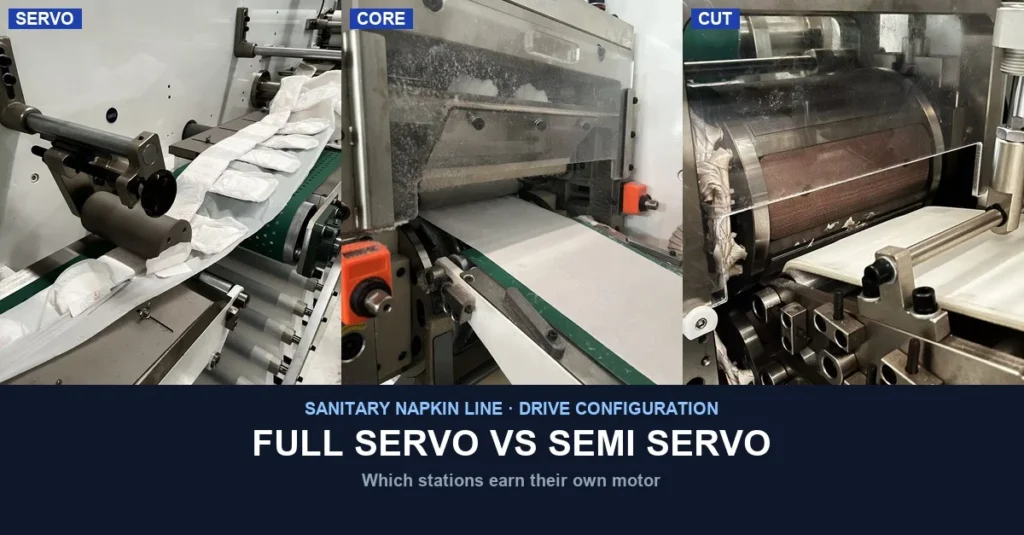
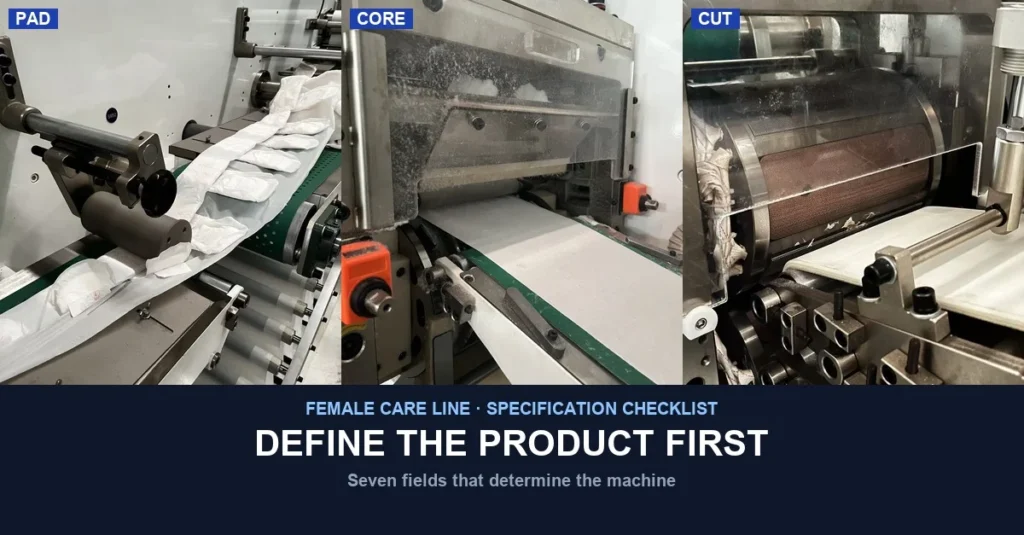
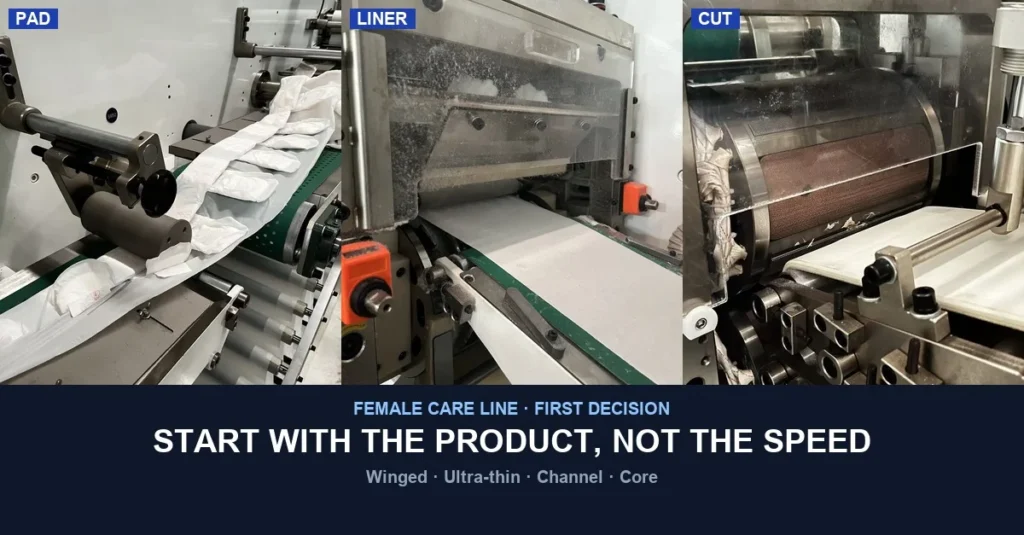
In Figure 3, the cellulosic ADL or core strip is metered into a rotary knife cylinder and transferred across a perforated stainless-steel vacuum drum onto the carrier web. In most cases, fuzzy cut edges or intermittent core slip on a 1,000–1,200 pcs/min panty liner line occur because the rotary cutter and vacuum drum were set up for synthetic thermobonded webs rather than wood-based cellulosic sheets:
- Rotary Shear Angle & Anvil Pressure Control: Unlike polypropylene fibers that deform plastically under pressure, regenerated lyocell fibers have a fibrillar cellulose structure with high dry tenacity. Rotary knife cylinders must maintain uniform pneumatic anvil loading (via SMC pressure regulators shown in Figure 3) so every cut shears cleanly.
- Perforated Drum Vacuum Zoning for Dense Wetlaid Sheets: Short-cut lyocell wetlaid and airlaid sheets have smaller pore sizes and lower air permeability than polyester high-loft ADLs. Increasing vacuum negative pressure in the transfer drum pickup zone prevents the cut patch from sliding backward by 0.5–1.5 mm during release.
- Active Cellulose Dust Extraction & Anti-Static Mist Control: Shearing wood-based short-cut webs at 1,000+ cuts/min releases fine cellulosic dust. Local negative-pressure dust extraction at the knife housing prevents lint from building up on hot-melt glue nozzles or optical sensors.
7. Station Engineering III: Wet-Wipes Lotion Dosing & Rotary Stacking
Beyond feminine care cores, wood-based lyocell is the cornerstone fiber for plastic-free baby wipes, cosmetic wipes, and household cleaning wipes. On Welldone’s wet wipes production lines (design speed 600–1,200 pcs/min, stable speed 500–1,000 pcs/min, positioning accuracy ±0.02 mm), switching from PET/viscose blends to 100% lyocell or dual-texture cellulosic roll goods requires coordinated adjustments across the liquid dosing manifold and the high-speed counting/stacking discharge.

- Closed-Loop Lotion Dosing Synchronization (SUS304/316 Contact Path): Because lyocell fibers swell and absorb liquid into the fiber wall, 100% cellulosic wipes hold a higher lotion-to-fabric weight ratio (280%–380% pickup) without surface dripping. Welldone wet wipes lines use SUS304/316 stainless-steel product-contact manifolds with surface roughness
≤0.8 μmand servo metering pumps that scale liquid flow proportionally to line speed. - Low-Shear Wetting Geometry: Multi-port wetting bars distribute lotion across the web before cross-cutting, giving the cellulosic fiber lumen sufficient dwell time to absorb the formulation before entering the flow-wrapper gusset.
- Curved-Pocket Rotary Stacking for Soft Panty Liners (Figure 4): On dry feminine care lines, 100% cellulosic panty liners are softer and more drapeable than PE-topsheet pads. As shown in Figure 4, the rotary stacking wheel uses curved blades paired with synchronous belts to guide each pad into its counting pocket without buckling, maintaining a
≥98%qualified rate at 1,000–1,200 pcs/min.
8. Dual-Surface Cellulosic Wipes vs. Standard Spunlace Converting
A critical takeaway from Lenzing’s 2026 roadmap—combining the April 2026 LENZING™ DualWipe nomination with the November 2026 EUR 27 million Mobile short-cut lyocell investment—is that wood-based nonwovens are no longer limited to flat spunlace. Dual-surface cellulosic webs integrate an abrasive scrubbing side and a smooth absorbent side within a single binder-free cellulose sheet, replacing polypropylene meltblown/spunbond abrasive laminates.
For B2B buyers operating or sourcing a wet wipes machine, running asymmetric dual-surface cellulosic roll goods introduces two specific converting requirements:
- Directional Roll Orientation & Folding Plate Friction: Because the scrubbing face has a higher coefficient of friction (COF) than the smooth face, the unwinding path must orient the smoother side against the stainless-steel V-folding boards (
Ra ≤0.8 μm) to prevent diagonal fold skew exceeding±1.5 mm. - Stack Height Calibration: Dual-surface textured cellulosic wipes exhibit 10%–18% higher bulk caliper per sheet than flat spunlace of the same basis weight. Servo stacker compression strokes and flow-wrap gusset formers must be recalibrated via HMI recipe memory when switching SKUs.
9. Engineering Decision Matrix: Qualifying Lyocell Webs by Station
Use the following engineering matrix during machine specification, raw-material sampling, and Factory Acceptance Testing (FAT) to align wood-based lyocell roll goods with converting station controls:
| Converting Station | Wood-Based Material Shift (2026 Benchmark) | Primary Mechanical Risk at 600–1,200 pcs/min | Required Machine & Control Feature | Target FAT Qualification Gate (Illustrative Engineering Target) |
|---|---|---|---|---|
| 1. Multi-Tier Unwinder & Auto-Splicer | 100% lyocell spunlace topsheet (28–45 g/m²) & wetlaid core rolls | Transverse width neck-down or splice-tail slip at 11%–13% moisture regain | Independent servo payoff ratios, low-inertia dancer buffer & high-tack splice nip | CD width shrinkage ≤1.0 mm; 10 consecutive full-speed splices with zero breaks |
| 2. Short-Cut ADL & Core Rotary Cutter | Short-cut lyocell / cellulose wetlaid & airlaid sheets (80–160 g/m²) | Uncut fiber bridges, cellulose lint buildup & patch slip on transfer drum | Precision pneumatic anvil loading, zoned high-vacuum drum & local dust suction hood | Core cut-length tolerance ±0.5 mm; zero visible fiber fuzz on glue nozzles |
| 3. Hot-Melt Structural & Positioning Coater | Binder-free cellulosic topsheets & thin breathable backsheets | Adhesive strike-through into hydrophilic cellulose fibers or thermal film distortion | Speed-linked slot/spiral glue dosing with independent zone temperature PID | Zero adhesive bleed-through; peel force stability within ±10% across speed ramp |
| 4. Wet-Wipes Lotion Dosing & Folding Unit | 100% lyocell spunlace & dual-surface cellulosic wipes (45–80 g/m²) | Wet-modulus MD elongation, diagonal fold skew or free-liquid seal contamination | SUS304/316 manifolds (Ra ≤0.8 μm), servo metering pump & low-friction folding plates |
Lotion pickup variance ±3%; wet MD elongation ≤1.5%; fold accuracy ±1.0 mm |
| 5. Rotary Stacking Wheel & Flow-Wrapper | Low-stiffness ultrathin panty liners (<180 mm) & high-bulk cellulosic wipe stacks | Leading-edge pad curl in stacker pockets or gusset seal wrinkles on thicker stacks | Curved-pocket rotary stacker with synchronous belts & HMI stack-height recipes | Qualified output yield ≥98% at rated stable speed; format changeover <60 min |
10. How Welldone Supports Panty Liner, Sanitary Pad & Wet Wipes Projects
For hygiene manufacturers, the most effective way to capture the market shift toward wood-based, plastic-free products without sacrificing line OEE is to qualify the converting equipment and the cellulosic raw-material BOM together. I believe that pre-testing your target spunlace and short-cut wetlaid rolls on the actual converting stations before shipment eliminates months of post-installation waste. Operating since 2008 across 80+ countries, JINJIANG WELLDONE MACHINE CO., LTD. serves global buyers as both a turnkey machinery builder and a raw-material supply partner:
- High-Speed Feminine Care Converting Lines: Full-servo panty liner machines (<180 mm) and sanitary pad machines (>180 mm) engineered for 1,000–1,200 pcs/min design speeds, featuring multi-tier zero-speed splicing unwinders, precision short-cut ADL/core rotary cutters with integrated dust collection, and curved-pocket rotary stackers achieving
≥98%qualified yield. - Full-Servo Wet Wipes & Tissue Production Lines: Modular wet wipes machines (600–1,200 pcs/min design speed, 500–1,000 pcs/min stable speed,
±0.02 mmfull-servo accuracy,<60 minchangeover) built with SUS304/316 stainless-steel contact surfaces (Ra ≤0.8 μm) for single-sachet, pocket-pack, and multi-pack flow-wrap formats. - Matched Hygiene Raw Materials & Finished Product Supply: Beyond machinery, Welldone supplies matched hygiene raw materials—including spunlace and hydrophilic nonwovens, airlaid/wetlaid absorbent cores, breathable PE films, hot-melt adhesives, and silicone release papers—and supports multi-roll FAT trials on your cellulosic BOM. Specific fiber blends, basis weights, roll widths, MOQs, and delivery terms are confirmed upon inquiry.
11. 8-Step Buyer Qualification & FAT Checklist
Actionable Buyer Checklist: Qualifying Wood-Based Lyocell & Cellulosic Webs
- Freeze Dry vs. Wet Tensile Curves on Incoming Roll Goods: Require nonwoven suppliers to provide MD/CD elongation values at 5 N/25 mm and 10 N/25 mm in both dry condition (for panty liner topsheets) and lotion-saturated condition (for wet wipes) before locking unwinder draw ratios.
- Audit Multi-Tier Unwinder Splicing at Target Moisture Regain: Condition 100% lyocell or viscose rolls to plant humidity (11%–13% moisture regain) and execute 10 consecutive zero-speed automatic splices at 800–1,200 pcs/min with zero splice-tail slip.
- Verify Rotary Knife Clearance on Short-Cut Cellulosic Cores: Inspect 500 consecutive cut ADL and core patches at full line speed to confirm clean shear edges, zero uncut fiber bridges, and
±0.5 mmlength repeatability. - Test Local Vacuum Dust Extraction at the Cutter Housing: Run a 2-hour continuous cutting trial on short-cut wetlaid/airlaid core rolls and verify that negative-pressure suction ducts keep optical sensors and glue nozzles free of lint.
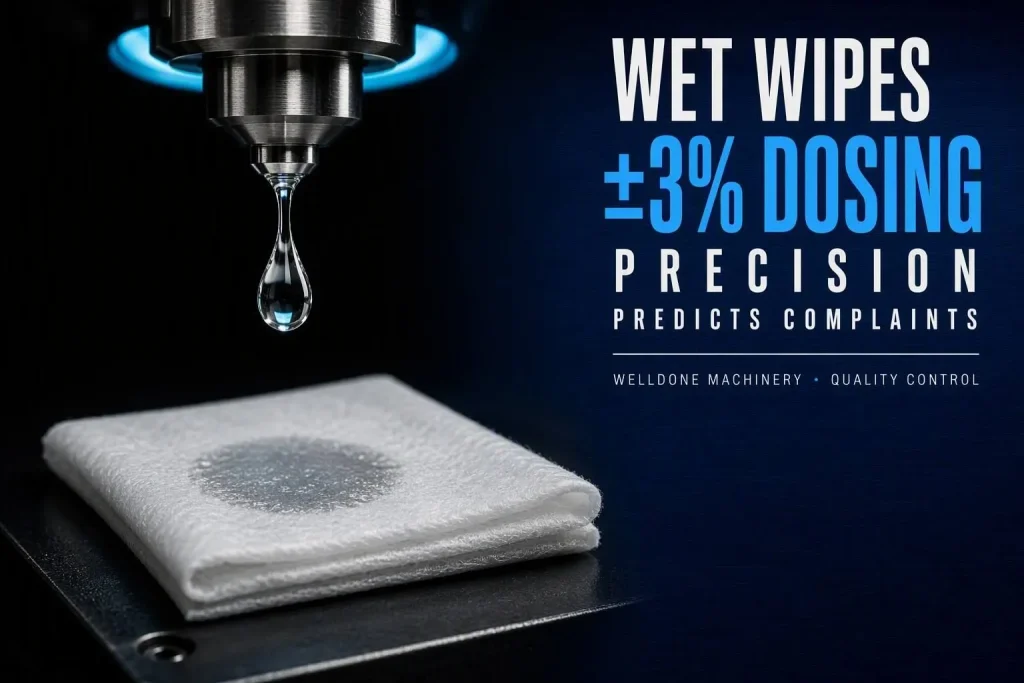
- Calibrate Wet-Wipes Lotion Pickup & Squeeze-Out Margin: Measure wipe weights across top, middle, and bottom layers of 20 finished packs to confirm lotion dosing consistency within
±3%and zero seal contamination. - Check Directional Orientation for Dual-Surface Textured Wipes: When converting dual-texture cellulosic wipes, lock roll unwinding orientation so the lower-friction face contacts the stainless-steel folding plates.
- Validate Curved-Pocket Rotary Stacking on Low-Stiffness Liners: Verify that ultrathin cellulosic panty liners (<180 mm) exit the rotary counting wheel without leading-edge curl, maintaining
≥98%qualified output. - Store Dedicated PLC Material Recipes for Synthetic vs. Cellulosic SKUs: Confirm that the Mitsubishi or Siemens HMI stores one-touch tension, anvil pressure, glue coat-weight, and stacker recipes for under-60-minute changeovers.
12. Source & Date Verification
- Primary Official Corporate Source (November 12, 2026): Lenzing Group Official Newsroom — Lenzing invests EUR 27 mn (USD 31 mn) to strengthen specialty fiber capabilities for nonwovens in Mobile, USA (Published November 12, 2026).
- Cross-Verified Industry Trade Media Source (November 12, 2026): PulPaperNews — Lenzing invests EUR 27 million to strengthen nonwovens capabilities in Mobile, USA (Published November 12, 2026).
- Auxiliary Official Technical Source (April 10, 2026 & INDEX™26 Finalist): Lenzing Group Official Newsroom — Award-nominated LENZING™ DualWipe supports Europe’s shift to bio-based materials & Nonwovens Industry EDANA Announces INDEX Award Finalists.
13. Frequently Asked Questions (FAQ)
1. Can an existing panty liner or wet wipes machine run 100% wood-based lyocell nonwovens without mechanical replacement?
In most full-servo lines, yes—provided the machine has independent closed-loop unwinder tension control, precision pneumatic anvil loading on the rotary cutters, active dust extraction, and speed-linked lotion or hot-melt dosing. Older mechanical-shaft lines with fixed draw ratios often require unwinder dancer upgrades to prevent wet elongation or width neck-down.
2. Why do short-cut lyocell wetlaid or airlaid cores require different vacuum drum settings than synthetic high-loft ADLs?
Short-cut wood-based wetlaid and airlaid sheets have a denser fiber packing structure and lower air permeability than coarse polyester bicomponent webs. Increasing negative pressure in the vacuum transfer drum pickup zone ensures the cut patch does not slip backward during high-speed transfer at 1,000–1,200 pcs/min.
3. How does switching from PET/viscose to 100% lyocell spunlace change wet-wipes lotion dosing?
Because lyocell absorbs liquid into the fiber lumen as well as the interstitial pores, it holds higher total saturation without surface dripping, but its wet tensile modulus drops once saturated. Dosing nozzles should wet the web uniformly with minimal post-dosing draw tension before cross-cutting.
4. Can Welldone supply both the converting machinery and matched cellulosic nonwoven raw materials?
Yes. JINJIANG WELLDONE MACHINE CO., LTD. supplies full-servo panty liner, sanitary pad, and wet wipes lines alongside matched raw materials (spunlace nonwovens, airlaid/wetlaid cores, PE films, adhesives, and release papers).
14. Request a Line Configuration or Raw-Material BOM Consultation
Planning to qualify wood-based lyocell topsheets, short-cut cellulosic cores, or plastic-free wet wipes on a 600–1,200 pcs/min converting line? Contact Welldone for custom machine proposals, FAT trial scheduling, or matched raw-material sampling via our official contact page:
Contact: Steven Tang | Phone/WhatsApp/WeChat: +86-13655936189 | Email: welldone@cnwelldone.com | Website: cnwelldone.com
Engineering Review: Prepared by the Hygiene Converting & Supply Chain Engineering Team at JINJIANG WELLDONE MACHINE CO., LTD. (operating since 2008 across 80+ countries; ISO 9001 & CE certified). All industry dates and investment figures are verified against November 2026 official releases.