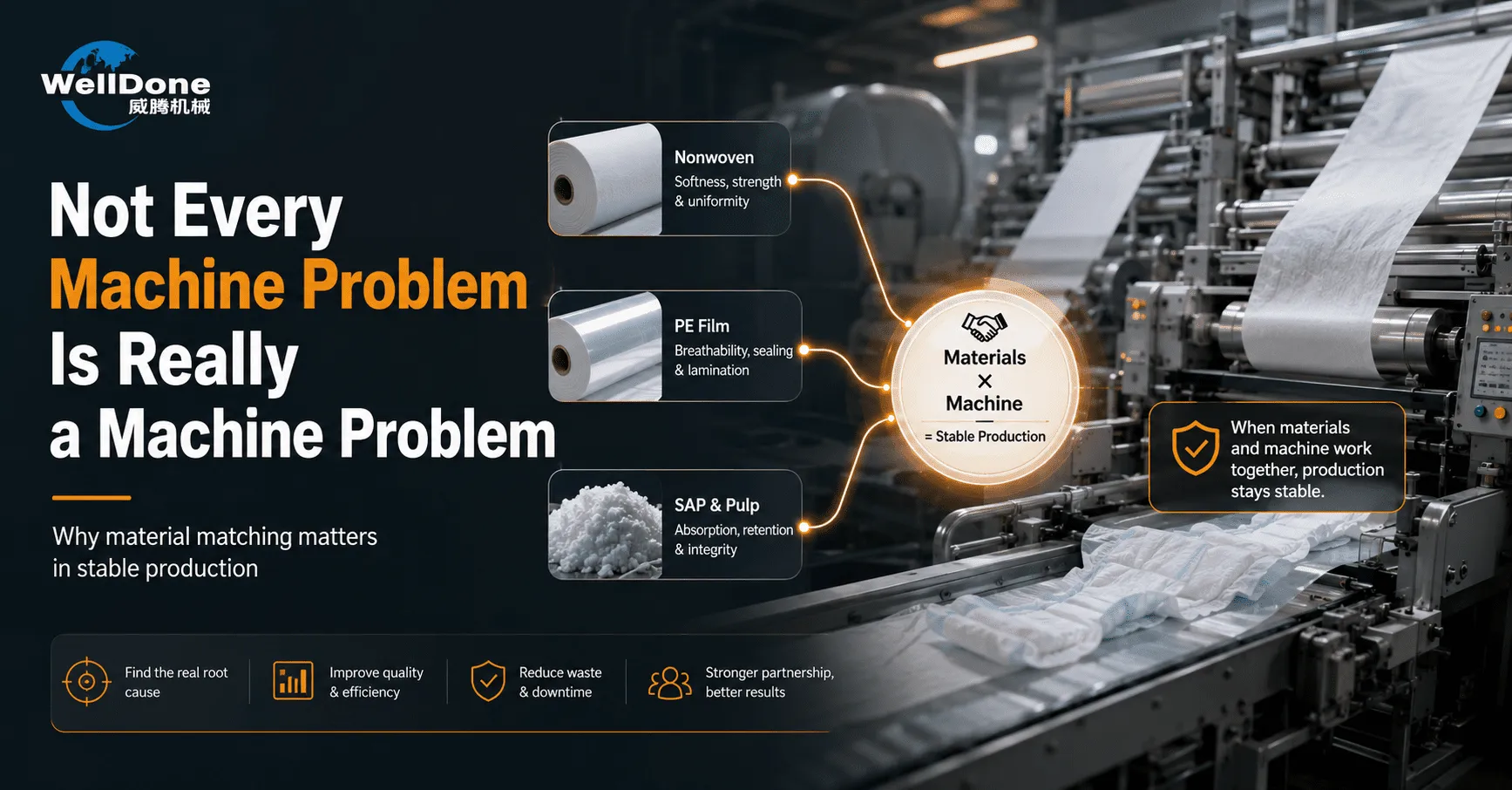
Not Every Machine Problem Is Really a Machine Problem: Why Material Matching Matters

On June 18, 2026
Comments Off on Not Every Machine Problem Is Really a Machine Problem: Why Material Matching Matters
```
Production System
Material Difference
Buyer Checklist
Cost and Risk
Testing Reality
Preparation Before Installation
Not Every Machine Problem Is Really a Machine Problem: Why Material Matching Matters in Stable Production
In hygiene product manufacturing, unstable production is not always caused by the machine alone. Very often, the real issue comes from the relationship between the machine, raw materials, operators, and process control.
Why Production Problems Are Not Always Caused by the Machine
In hygiene product manufacturing, when production becomes unstable, many buyers first think: “The machine has a problem.”
This reaction is understandable. When the product shape changes, the cutting edge is not clean, the glue bonding is weak, the absorbent core shifts, or the packing does not look good, the machine is the most visible part of the production line.
But in many real factory projects, the issue is not always caused by the machine alone. Very often, the real reason is material matching.
For a Diaper Manufacturing Machine, Sanitary Napkin Machine, Adult Diaper Machine, Pet Pad Machine, wet wipes machine, or tissue machine, the machine does not work independently. It works together with raw materials, operators, product structure, machine settings, factory environment, and production process control.
Professional buyers should not only ask “Is the machine good?” They should also ask “Are the machine, materials, product structure, and operators working together correctly?”
The Machine and Raw Materials Work as One System
A hygiene product machine is not only a mechanical structure. It is part of a complete production system. If one part of this system is not suitable, the final product may become unstable.
- Machine configuration
- Raw material specifications
- Product structure
- Glue application
- Material tension
- Cutting accuracy
- Absorbent core forming
- Product size
- Packing method
- Operator adjustment
- Quality inspection
- Maintenance support
A baby diaper may require nonwoven, PE film, SAP, fluff pulp, ADL, frontal tape, side tape, elastic materials, hot melt glue, and packing film. A sanitary napkin may require nonwoven topsheet, absorbent paper, fluff pulp, SAP, PE film, release paper, hot melt glue, individual wrapping film, and outer packing materials.
Every material has its own behavior. Some materials stretch easily, some wrinkle easily, some are too soft, some are too hard, and some do not bond well with glue.
Stable production is created by the balance of machine + materials + operators + process control.
Why the Same Machine Performs Differently with Different Materials
Many buyers may ask: “If the machine runs well in the supplier’s factory, why does it need adjustment in my factory?” The answer is simple: because raw materials are different.
Even if the material name is the same, the real performance may be different. Two rolls of nonwoven may both be called 15gsm nonwoven, but their softness, tension, thickness, surface friction, and uniformity may not be exactly the same.
Two PE films may have the same thickness, but one may be softer, one may be easier to stretch, and one may seal more stably. Two SAP brands may both have good absorption, but their particle size, absorption speed, retention ability, and distribution behavior may be different.
- Core forming and absorbent core stability
- Leg cuff stability and tape position
- Waist elastic control
- Release paper bonding and wing folding
- Pad shape and cutting edge
- Edge sealing and PE film leakage control
- Sheet cutting and final packing
This is why the same machine may perform differently with different raw materials. A good supplier should help buyers understand how material specifications affect production results.
Nonwoven, PE Film, SAP, Glue, and Packaging: What Buyers Should Check
Before machine installation or production testing, buyers should prepare raw materials carefully. The goal is not only to buy materials at a low price, but to choose materials that support stable production and final product quality.
Nonwoven
- GSM, width, softness, tensile strength, and surface uniformity
- Roll diameter, core diameter, edge quality, and batch consistency
If nonwoven is too soft or too weak, it may stretch, wrinkle, or break during production. If the surface is not uniform, the final product may look unstable.
PE Film
- Thickness, softness, strength, breathability, and sealing performance
- Width consistency, roll quality, surface treatment, and printing quality
If PE film is too thin, leakage risk may increase. If PE film is too soft, tension control may become difficult.
SAP and Fluff Pulp
- SAP absorption speed, retention ability, particle size, and distribution performance
- Fluff pulp quality, core forming stability, dust level, and supplier consistency
Hot Melt Glue
- Viscosity, melting temperature, open time, and bonding strength
- Compatibility with material surface and glue application cleanliness
Packing Materials
- Packing film thickness, sealing performance, printing quality, and bag size
- Friction behavior, packing machine compatibility, carton strength, and storage condition
How Poor Material Matching Creates Waste, Downtime, and Quality Problems
Poor material matching does not only affect product quality. It also affects factory profit. When materials are not suitable, factories may face many hidden costs.
- Higher waste rate
- Frequent machine adjustment
- Unstable product size
- Poor glue bonding
- Material wrinkles
- Core shifting
- Cutting problems
- Packing rejection
- Production downtime
- Operator stress
- Lower daily output
- Customer complaints
If nonwoven tension is unstable, operators may need to adjust the machine frequently. If PE film does not match the product structure, leakage control may become difficult. If SAP distribution is unstable, the product may pass visual inspection but fail during use.
Material matching is not a small technical detail. It is part of production cost control.
Why Supplier Testing Materials May Not Match Local Production Materials
During machine testing, suppliers usually use materials that are available in their factory or materials that are easier to run. This is normal, but buyers should understand that supplier testing materials may not be exactly the same as the materials used after installation.
- Local nonwoven may have different softness
- Local PE film may have different thickness or tension
- Local SAP may have different absorption behavior
- Local glue may require different temperature settings
- Local packaging film may not match the packing machine perfectly
- Material batch consistency may not be stable yet
The best result usually comes when both sides communicate before the machine arrives. Buyers can share material specifications, suppliers can check whether they are suitable, and engineers can reduce commissioning time.
How Buyers Should Prepare Raw Materials Before Installation
Before the machine arrives, buyers should not only prepare factory space, power, and air supply. They should also prepare raw materials carefully.
- Material name
- Material width
- Material GSM or thickness
- Roll diameter
- Core diameter
- Roll weight
- Surface treatment
- Printing requirement
- Supplier name
- Batch consistency
- Storage condition
- Test quantity
- Backup supplier plan
Test materials may be consumed during installation, adjustment, and operator training. If materials are not enough, commissioning may be delayed. If materials are not correct, the machine may not be tested properly.
From Machine Supplier to Production Solution Partner
A machinery supplier should not only be a machine seller. For hygiene products projects, the supplier should act more like a production solution partner.
Machine Seller Thinking
Only focuses on quotation, machine name, basic parameters, and delivery.
Production Partner Thinking
Helps buyers review product structure, raw materials, factory layout, packing method, operator training, and long-term production stability.
A reliable supplier should ask deeper questions: What product do you want to make? What market do you want to serve? What absorbency level do you need? What raw materials are available locally? What packing format do you need? What daily output do you expect?
These questions help create a better production solution. The goal is not only to deliver a machine. The goal is to help the buyer build stable manufacturing capacity.
Why Welldone
Welldone is a hygiene products machinery manufacturer under Quanzhou Shimao Weiteng Import & Export Co., Ltd. With more than 18 years of industry experience and our own factory support, Welldone provides machinery and production solutions for baby care, female care, adult care, pet care, paper products, and wet wipes.
Our product range includes diaper manufacturing machines, baby diaper machines, baby pull-up pants machines, sanitary napkin machines, adult diaper machines, underpad machines, pet pad machines, wet wipes machines, tissue machines, packing machines, and related hygiene product raw materials.
Welldone supports buyers not only with machine supply, but also with practical production support. We can help buyers with product structure discussion, machine configuration advice, raw material matching suggestions, SAP and absorbent core planning, glue application support, packing method suggestions, factory layout planning, installation preparation, operator training, spare parts planning, commissioning guidance, and after-sales technical support.
You can explore our related machine categories: Baby Care Machines, Female Care Machines, Adult Care Machines, Pet Care Machines, and Paper & Wet Wipes Machines.
Welldone is not a distributor or wholesaler. We are a manufacturer focused on helping buyers build stable, long-term hygiene product manufacturing capacity.
Related Machines
Diaper Manufacturing Machine
Suitable for producing baby diapers with stable absorbent core, accurate material control, flexible size options, and long-term production support.
Sanitary Napkin Machine
Suitable for producing sanitary napkins with stable core forming, clean cutting, accurate glue application, and consistent product quality.
Adult Diaper Machine
Suitable for producing adult diapers for elderly care, medical care, nursing homes, and healthcare product markets.
Underpad Machine
Suitable for producing disposable underpads for hospitals, elderly care, baby care, and pet care applications.
Pet Pad Machine
Suitable for producing pet pee pads with stable absorbency, leakage control, and flexible size options.
Wet Wipes Machine
Suitable for producing wet wipes for hygiene, cleaning, baby care, personal care, and household applications.
Tissue Machine
Suitable for producing facial tissue, napkins, toilet tissue, handkerchief tissue, and related paper products.
Conclusion
Not every machine problem is really a machine problem. In hygiene product manufacturing, many production issues come from the relationship between the machine and raw materials.
If materials are not suitable, even a good machine may produce unstable results. If materials match well, operators are trained, and the process is controlled, the production line can run more smoothly and create better products.
Stable production is not created by one factor. It is created by the balance of machine, materials, operators, and process control.
Before saying “the machine has a problem,” it is better to check whether the materials are suitable, whether the glue is compatible, whether the tension setting is correct, whether SAP performance is stable, whether PE film fits the product structure, and whether operators are adjusting the machine correctly.
That is why material matching matters.
FAQ
1. Are all production problems caused by the machine?
No. Many production problems are related to raw material matching, operator adjustment, glue compatibility, material tension, product structure, or packing materials. The machine is important, but it is not the only factor.
2. Why does the same machine perform differently with different materials?
Different materials may have different softness, thickness, strength, surface treatment, tension behavior, glue compatibility, and batch consistency. These differences can affect machine stability and product quality.
3. What raw material details should buyers check before installation?
Buyers should check material width, GSM or thickness, roll diameter, core diameter, surface quality, glue compatibility, SAP performance, PE film strength, packing film suitability, supplier consistency, and storage conditions.
4. Can poor material matching increase production cost?
Yes. Poor material matching can increase waste, downtime, rejected products, operator adjustment time, glue problems, packing issues, and customer complaints. It directly affects factory profit.
5. Can Welldone help buyers with raw material matching?
Yes. Welldone can support buyers with product structure discussion, raw material matching suggestions, machine configuration advice, glue application support, SAP and absorbent core planning, operator training, and one-stop solutions from machine to raw materials.
Need Help Matching Machines and Raw Materials?
If you are planning a hygiene products production project, Welldone can help you review machine configuration, product structure, raw materials, glue application, SAP and absorbent core planning, packing method, operator training, and stable production support.
Contact Welldone