

Diaper Line Retrofit vs Replacement Guide 2026 | Welldone


Retrofit, Add a Module, or Replace the Diaper Line?
At Monday's investment review, the maintenance manager asks for a retrofit, finance wants to extend the old line's life, and quality points to a defect that still appears under the best weekly schedule. All three arguments may be reasonable. They are not yet an investment decision.
Expanding and Upgrading Baby Diaper Production Capacity · Part 4
Part 1 converted demand into qualified-output requirements.
Part 2 assigned the gap to availability, performance, quality and packing losses.
Part 3: recover the calendar through campaign length, SKU sequence and shift handover.
Part 4 — this article: decide whether the remaining hardware-bound loss needs a retrofit, an added module or a new line.
Next: translate the chosen investment path into an inline-inspection scope and defect dictionary.
Freeze the remaining gap before discussing equipment
The previous article solved an operating question: which hours could be recovered without capital expenditure? This article starts only after that recovery has been repeated by relevant shifts and the remaining loss list has been signed.
A common mistake is to begin with a preferred solution. One team asks suppliers to quote a servo retrofit. Another assumes a camera will solve quality loss. A third requests a complete new line because the residual gap still looks large. The request should begin with the unresolved function, not the hardware name.
- State the remaining qualified packed-output gap under the best repeatable schedule.
- Name the station or interface where each hardware-bound loss appears.
- Separate mechanical wear, control limits, quality detection and downstream capacity.
- Record the longest acceptable shutdown window and the production plan that must cover it.
The number carried forward is not permission to multiply the Part 3 recovery twice. Use the verified remaining gap once, then evaluate which physical boundary prevents further recovery.
Compare three investment paths, not two price tags
PATH A
Retrofit
Change drives, controls, tooling or a bounded mechanism while retaining most of the installed line.
PATH B
Add a module
Insert a defined function such as inspection, rejection, transfer, stacking or packing without rebuilding the full process.
PATH C
Replace or add a line
Create a new production platform when the retained mechanical and control baseline cannot hold the target product and acceptance boundary.
The lowest purchase value can carry the highest integration uncertainty. Retrofit proposals often look smaller because interface engineering, restart scrap, extended commissioning and production cover are not yet visible in the quotation.
A new line can also be the wrong answer. If the residual loss is confined to one downstream constraint and the main line produces stable, qualified output, replacing the full process spends capital on sections that are not limiting the factory. The comparison must therefore follow the loss path station by station.
Mechanical boundaries decide whether the old frame can carry the new duty
A retrofit requires a stable physical reference. Check frame condition, shaft alignment, bearing seats, transmission wear, guarding, access, foundation and the mounting geometry of the affected station. New controls cannot correct a moving mechanical baseline.
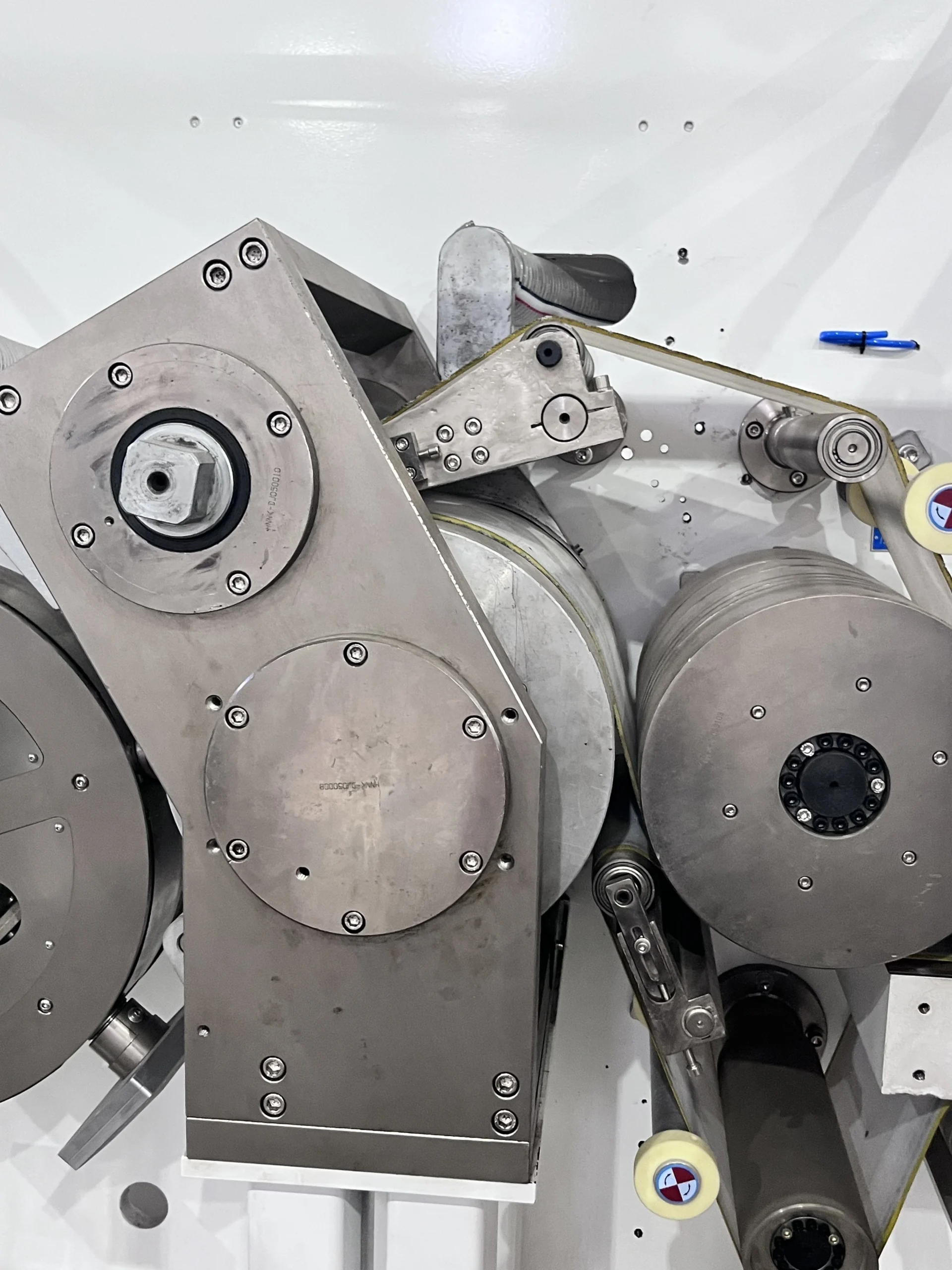
If the unresolved loss appears as position drift at final cutting, do not assume the cutter itself is the only candidate. The product may arrive late because an upstream web path, transfer or waistband relationship has moved. Replacing the last drive can relocate the visible defect without removing its source.
In most cases, retrofit remains credible when the retained frame and transmission can hold the required relationship, access can be made safe, and the changed function has a defined mechanical boundary. Replacement becomes more defensible when several dependent stations need simultaneous redesign or when the retained baseline cannot be measured repeatably.
Control architecture is an interface map, not a servo count
List the installed PLC, drives, encoders, I/O, communication networks, recipe structure, alarm history and available program documentation. Then mark every signal that the proposed change must read, write or track. A module without a data handshake becomes an isolated island.
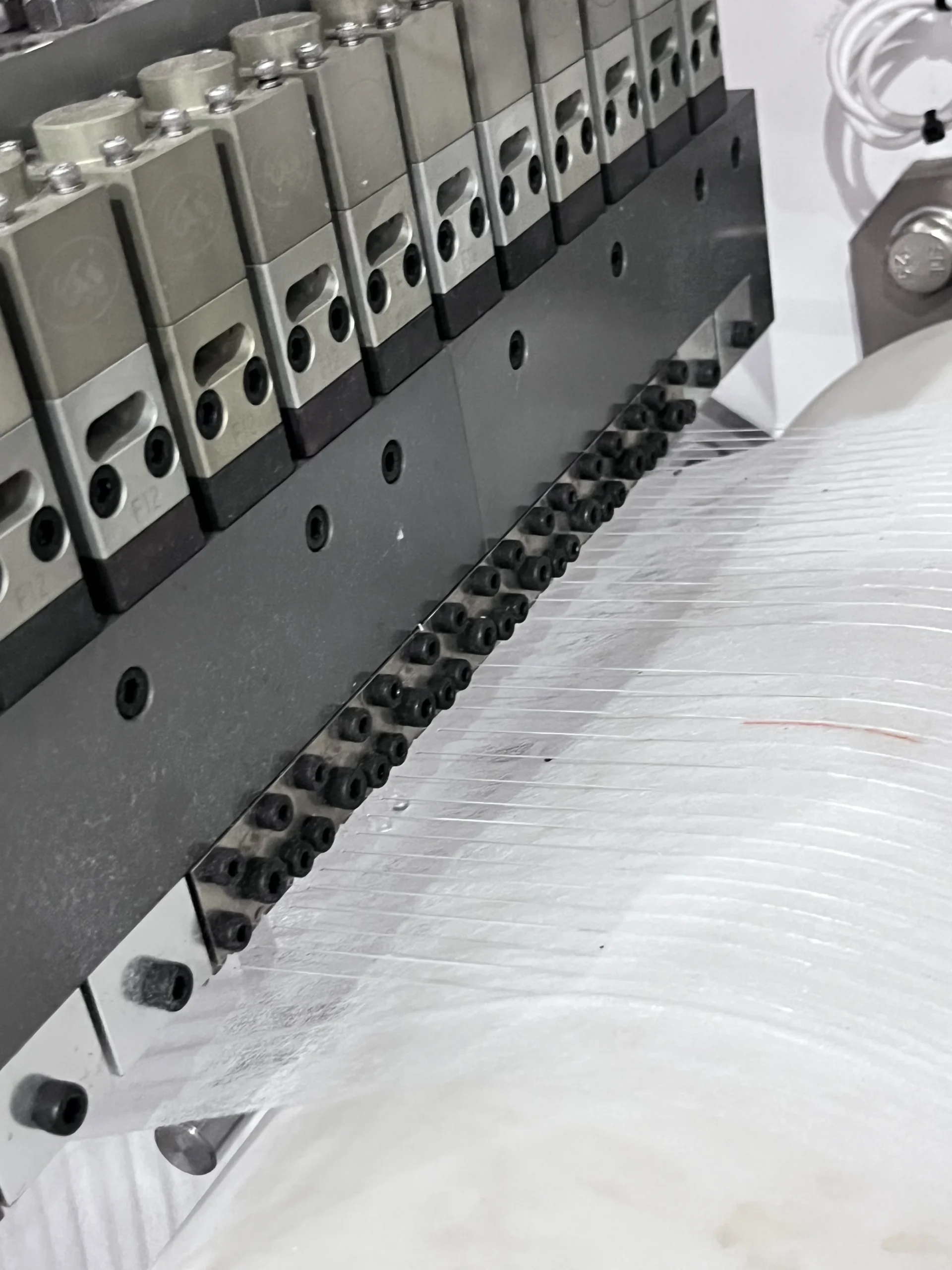
For a bounded retrofit, confirm who owns the source program, whether spare I/O and network capacity exist, how recipes are versioned, and what happens during a brief stop or power recovery. For an added module, define line-ready, module-ready, fault, bypass, reject, speed reference and product-position signals before the commercial scope is frozen.
Motion interfacePosition, phase, speed reference, safe stop and restart state.
Product interfaceSKU, size, recipe version, material lot and product pitch.
Quality interfaceDefect code, product identity, reject command and reject confirmation.
Operations interfaceAlarm ownership, bypass authority, event history and recovery procedure.
The real question is not whether new automation can be installed. It is whether the retained system can prove which product is where, which recipe is active and which device owns the next action.
Quality risk determines whether a module is enough
An added inspection or reject module is appropriate only when the defect can be observed at a stable point and the affected product can be tracked to a confirmed reject location. If the defect is created upstream by unstable formation, tension or registration, detection may contain the symptom without correcting the process.
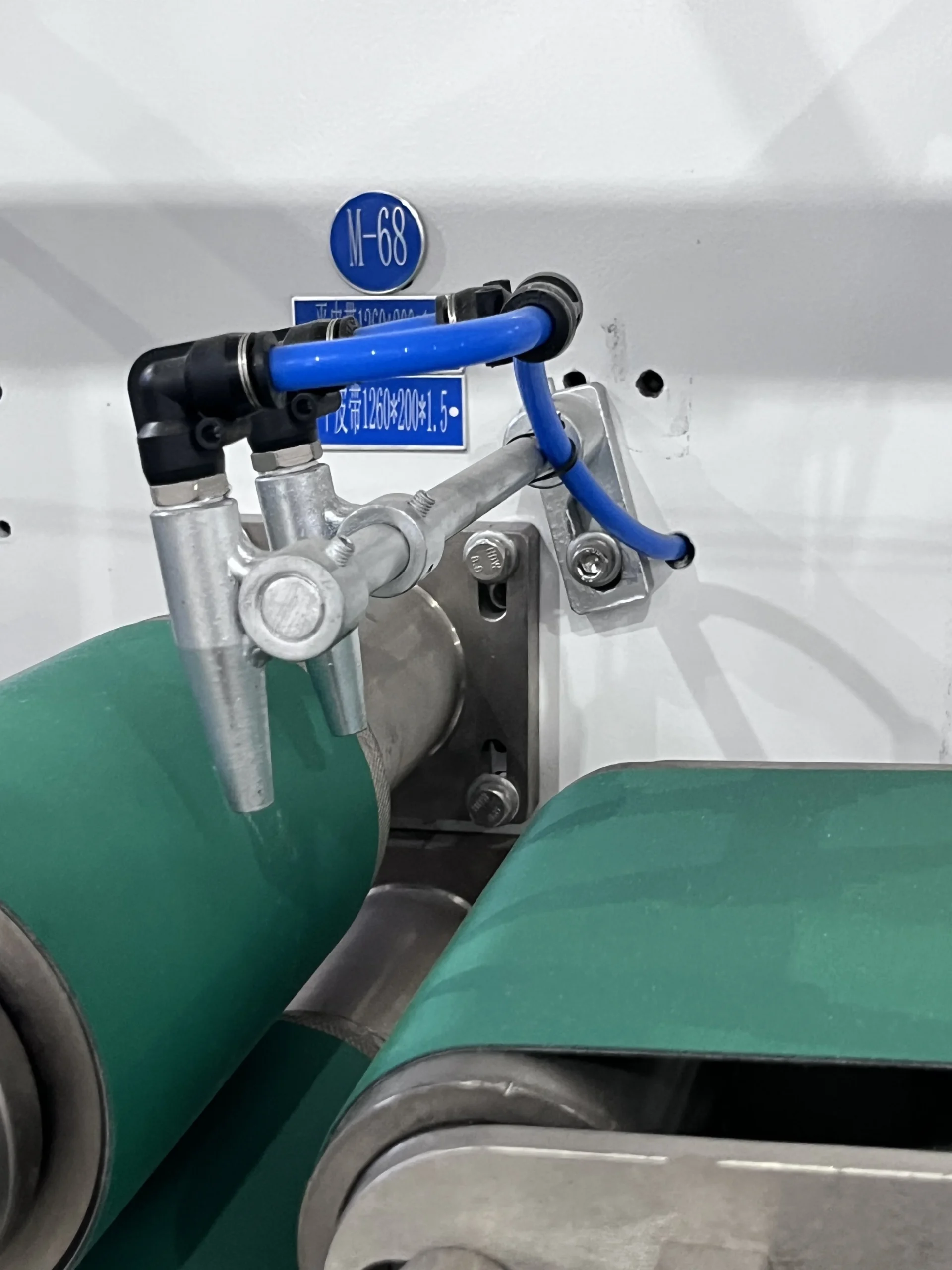
Define the quality boundary before selecting hardware: defect type, detection point, minimum evidence, reject timing, confirmation method, data record and offline sampling responsibility. Part 5 will turn that output into an inline-inspection scope.
This is where many apparently inexpensive retrofits become weak. The quotation includes a sensor or camera, but not the defect dictionary, product-tracking logic, controlled bypass or verification that the rejected item actually left the line.
The shutdown window belongs in the investment scope
A retrofit touches an operating asset. Survey access, isolation, dismantling, installation, rewiring, dry testing, material trials, first-good release and contingency rollback all consume calendar time. The plan must distinguish physical installation from the time required to return qualified packed output.
A module can be preassembled and tested outside the line, but final interface work still depends on the installed machine. A new line requires a larger project window, utilities and floor space, yet it may protect the existing line during build and reduce the risk of modifying the factory's only productive asset.
| Path | When it is credible | Main uncertainty | Shutdown evidence |
|---|---|---|---|
| Retrofit | A bounded station has a stable mechanical and control baseline | Hidden retained-condition and program interfaces | Survey, work breakdown, rollback and first-good plan |
| Added module | The constraint has a defined material, signal and discharge boundary | Handshake, buffering and product tracking | Preassembly proof plus interface commissioning plan |
| New or additional line | Several retained boundaries cannot hold the target | Ramp-up, utilities, staffing and demand absorption | Installation plan that protects current production |
Do not compare paths with a single delivery date. Compare the date of last good product before work, the date of first good product after work, and the date the accepted output becomes repeatable across shifts.
Run an interface audit before asking for the final quotation
The audit should place the proposed change inside the real line. Use current drawings, electrical backups, photographs, material routes, SKU records and defect evidence. When documentation is missing, mark the uncertainty as a survey task rather than filling it with an assumption.
| Interface | What must be verified | Red flag | Required output |
|---|---|---|---|
| Mechanical | Datums, mounting space, load path, guarding and access | The design relies on dimensions not measured on site | Signed interface drawing |
| Electrical | Power, panel space, spare I/O, safety circuit and cable route | The new scope assumes spare capacity without evidence | I/O and electrical load list |
| Control | PLC ownership, networks, recipes, alarms and data handshake | Source code or protocol responsibility is unclear | Signal and responsibility matrix |
| Material | Web path, tension zone, product pitch and buffer | The module can run alone but not at line conditions | Material-path drawing and trial plan |
| Quality | Defect definition, detection point, reject and confirmation | Acceptance uses a broad pass/fail statement | Defect dictionary and acceptance method |
Use a decision matrix that can reject all three paths
The matrix should not force a winner. If no path has sufficient interface evidence, the correct status is “survey incomplete.” That protects the factory from turning uncertainty into a cheap-looking quotation.
Illustrative framework only. The categories below are a decision structure, not customer data, a price comparison or a guaranteed recommendation. The buyer must set its own acceptance, shutdown and risk thresholds.
| Decision test | Retrofit | Add a module | New/additional line |
|---|---|---|---|
| Mechanical baseline | Must remain stable at the changed station | Needs a defined mounting and material boundary | Creates a new baseline |
| Control integration | Deep access to retained program and motion logic | Defined handshake and product tracking | New architecture plus plant-level integration |
| Quality consequence | Must prove the changed function removes the source | May detect or contain a bounded defect | Can redesign the complete process relationship |
| Production interruption | Concentrated on the operating asset | Can shift some work off-line before integration | May protect existing output during build |
| Best use case | One bounded, measurable loss | One missing function with clean interfaces | Multiple non-retainable boundaries or strategic expansion |
Do not score purchase cost alone. The commercial comparison should include survey completeness, retained-condition responsibility, required production cover, commissioning boundary and the consequence if acceptance is not reached.
Finish Part 4 with an investment path and acceptance boundary
Part 4 should not end with “retrofit is cheaper” or “a new line is safer.” It must produce a selected path, a list of interfaces still requiring verification, explicit non-retainable boundaries and target acceptance indicators.
Input from Part 3Verified no-capex recovery, remaining qualified-output gap and hardware-only loss list.
Decision added hereRetrofit, module or new-line path based on mechanics, controls, quality and shutdown.
Output to Part 5Investment path, principal defect categories, interfaces and target acceptance indicators.
- Selected path and the losses it is responsible for removing.
- Retained equipment and interfaces that remain subject to survey.
- Boundaries that cannot be retained or cannot be guaranteed.
- Acceptance units: qualified output, defect evidence, reject confirmation and repeatability by shift.
That output allows Part 5 to answer the next question: which defects need inline detection, what signal should trigger rejection, and which checks still belong offline?
Why review the investment boundary with Welldone
Welldone's Baby Care portfolio includes configurable drive architectures, modular production-line design and project customization. Those capabilities are useful only after the installed baseline and target product are audited; they do not make every third-party line automatically retrofit-ready.
Welldone can use the buyer's hardware-only loss list, interface records, target SKU and acceptance boundary to structure a project discussion around functions and evidence rather than a generic equipment label.
Related project routes
Conclusion: buy the smallest complete solution, not the smallest quotation
Retrofit, an added module and a new line are not three price levels for the same answer. Each path retains a different amount of mechanical condition, control logic, quality risk and shutdown exposure.
The correct path is the smallest complete solution that can remove the signed hardware-bound loss and pass a measurable acceptance boundary. Which part of your proposed upgrade still depends on an interface that nobody has measured?
FAQ
When is a diaper line retrofit credible?
When the hardware-bound loss is bounded, the retained mechanical baseline is stable, control access is documented and the shutdown and acceptance plan are defined.
When should a factory add a module instead?
When one missing function has clear material, signal, safety and discharge interfaces. Inspection, rejection, stacking or packing may fit this route only after interface verification.
Does an old PLC automatically require a new line?
No. Age alone is not the decision. Documentation, spare availability, network compatibility, program ownership and the required function determine whether retention is practical.
Should purchase price decide between retrofit and replacement?
No. Compare retained-condition risk, engineering scope, production cover, commissioning time and acceptance responsibility alongside the quoted equipment value.
What should be sent to the inline-inspection review?
Send the selected investment path, defect categories, detection opportunities, reject interface, data requirements and target acceptance indicators.
Turn the remaining capacity gap into a measurable investment boundary.
Website: www.cnwelldone.com | Email: welldone@cnwelldone.com
Discuss your retrofit or replacement boundary