Before Adding Another Production Line, Find the Real Bottleneck

On June 25, 2026
Comments Off on Before Adding Another Production Line, Find the Real Bottleneck
Production Capacity Guide
Before Adding Another Production Line, Find the Real Bottleneck
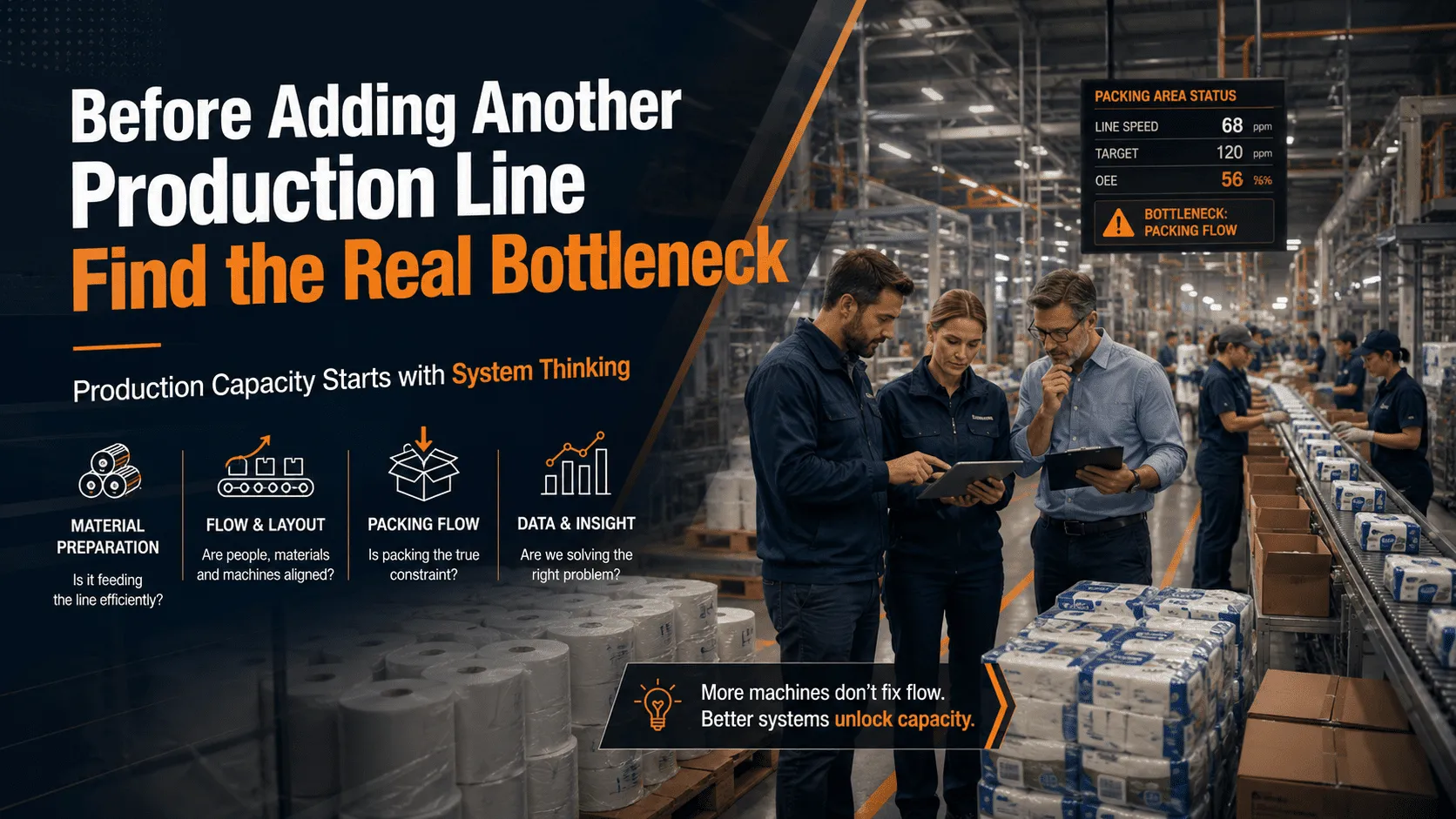
When production cannot meet market demand, many factories immediately think about buying another machine. But in real hygiene product manufacturing, low output is not always caused by machine capacity. The real bottleneck may be hidden inside the production system.
```
```
Why More Machines Do Not Always Mean More Capacity
When production cannot meet market demand, many factories start to think about buying another production line.
It sounds logical. More machines should mean more output.
But in real hygiene product manufacturing, this is not always true.
For baby diapers, sanitary napkins, adult diapers, underpads, pet pads, wet wipes, and tissue products, production capacity is not decided by the machine alone. It is decided by the whole production system.
Sometimes, the machine is not the real bottleneck. The real bottleneck may be materials, operators, packing, layout, waste, quality, or daily management.
If a factory adds another machine without finding the real bottleneck, the result may not be higher output. It may only create more pressure.
More raw materials are needed. More operators are needed. More packing space is needed. More quality inspection is needed. More finished goods storage is needed. More management control is needed.
This is why capacity expansion should not start from the question, “How many machines should we buy?”
It should start from the question, “Where is the real bottleneck in our current production system?”
What Is a Production Bottleneck?
A production bottleneck is the part of the process that limits the whole output.
It is like a narrow point in a pipe. Even if the pipe is wide before and after that point, the total flow is still limited by the narrowest section.
In hygiene product manufacturing, the bottleneck may appear in many places. It may happen before production starts, when raw materials are not prepared properly. It may happen during production, when operators spend too much time adjusting the machine. It may happen after production, when packing cannot keep up with the main machine.
Before Production
Raw materials are not ready, storage is messy, or the next roll is not prepared in advance.
During Production
Operators spend too much time on adjustment, size change, troubleshooting, or material replacement.
After Production
Packing speed is slow, cartons are not ready, or finished products pile up near the line.
Daily Management
Quality problems are found too late, waste is high, and production data is not reviewed clearly.
The bottleneck is not always obvious. Sometimes, the machine looks like the problem because it stops often. But the real reason may be unstable materials, poor material matching, wrong tension setting, or operators who do not know how to adjust the line correctly.
So the first step is not to blame the machine. The first step is to map the full production flow.
Machine Capacity vs. Factory Capacity
Many buyers compare machine capacity when purchasing equipment. This is understandable. Machine speed is important.
But machine capacity and factory capacity are not the same thing.
01
Materials Ready
02
Machine Running
03
Quality Stable
04
Packing Smooth
05
Goods Delivered
Machine capacity refers to what the machine can produce under suitable conditions. Factory capacity refers to what the whole factory can produce, pack, inspect, store, and deliver every day.
The gap between these two numbers can be large.
A machine may be designed for high-speed production, but the factory may not be ready to support that speed.
- The raw material storage area may be too far from the machine.
- Operators may need too much time to change rolls.
- The packing team may not match the line speed.
- Quality inspection may reject too many products.
- The factory layout may cause repeated movement.
- The warehouse may not have enough finished goods flow.
Real capacity is not theoretical speed. Real capacity is stable sellable output.
Raw Material Preparation: A Hidden Bottleneck
Raw material preparation is one of the most common hidden bottlenecks in hygiene product factories.
Hygiene product machines need many different materials. Baby diaper machines, sanitary napkin machines, adult diaper machines, underpad machines, and pet pad machines all depend on stable material feeding.
If materials are not prepared in time, the machine may need to slow down or stop. If the next roll is not ready, operators waste time waiting. If the wrong material is sent to the line, production may produce defects.
This kind of bottleneck is often ignored because it does not look like a machine problem. But in daily production, it has a direct effect on output.
- Materials should be prepared before the production line needs them.
- The material area should be organized by product type, size, and usage frequency.
- High-frequency materials should be closer to the production line.
- Backup rolls should be ready near the feeding area.
- Material movement routes should be clear and wide enough for trolleys or forklifts.
The machine should not wait for materials.
Materials should wait for the machine. This is especially important for high-speed hygiene product production.
Operator Efficiency and Size Change Time
Operators play a key role in real production capacity.
Even with full servo machines, operators still need to understand how to run, adjust, inspect, clean, and maintain the line.
If operators are not trained well, the machine may stop often. If they do not understand adjustment logic, small problems may become long downtime. If they are not familiar with material changing, roll replacement may take too long.
Size change is especially important in hygiene product manufacturing.
A baby diaper factory may need several sizes from newborn to XL. A sanitary napkin factory may produce different lengths and styles. An adult diaper factory may need different waist sizes. An underpad or pet pad factory may produce different dimensions.
Each size change takes time. If size change is not managed well, the factory loses output every day.
Size Change Time
How long does each size change take from stopping the machine to reaching stable production again?
Adjustment Waste
How much material is wasted before the product reaches stable quality after adjustment?
Standard Process
Do operators follow a clear size change process, or does each person adjust in a different way?
Setting Records
Are machine settings recorded clearly for different product sizes and material combinations?
Improving operator training and size change management may increase output without buying a new line immediately.
Packing Flow: The Bottleneck Many Factories Ignore
Packing is one of the most common bottlenecks in hygiene product factories.
Many buyers focus on the main machine but pay less attention to packing speed and packing layout.
But in real operation, packing decides whether finished products can leave the line smoothly.
If the main machine produces faster than the packing process, products will pile up. When products pile up, workers become busy moving, sorting, and storing temporary products. The production area becomes crowded. Quality control becomes harder. The main machine may need to slow down or stop.
In this case, the bottleneck is not the main machine. The bottleneck is packing flow.
- Manual packing is too slow.
- Packing workers are not enough.
- The packing machine does not match the main line speed.
- Cartons or bags are not prepared in time.
- The packing area is too small.
- Finished products do not move out quickly.
- There is no buffer area between production and packing.
For products like diapers, sanitary napkins, underpads, pet pads, wet wipes, and tissue products, packing is part of the production system. It should not be treated as a separate small step.
Factory Layout and Unnecessary Movement
Factory layout also affects real capacity.
A poor layout creates unnecessary movement. Workers walk more. Materials move farther. Forklifts cross operator areas. Finished products pile up in the wrong place. Waste collection blocks production routes. Maintenance space is not enough.
These problems reduce efficiency every day. They may not look serious in one hour. But over one month, they create a large loss of time, labor, and output.
01
Raw Material Storage
02
Material Feeding
03
Production Line
04
Packing Area
05
Finished Goods Warehouse
Good layout should create a clear flow from raw material storage to material feeding, production line, quality inspection, packing, and finished goods warehouse.
The flow should move forward, not back and forth.
Adding a new line to a crowded layout may make the factory harder to manage.
Sometimes, improving layout can release more capacity than expected.
Quality Problems and Waste Rate
High output is not useful if the products cannot be sold.
That is why quality and waste rate must be part of bottleneck analysis.
Some factories focus only on how many pieces the machine produces per minute. But the more important question is: how many qualified products can be packed and sold?
If the waste rate is high, real output is low. If products need rework, labor cost increases. If quality problems are found too late, the factory may lose many finished products. If customers complain about product performance, the business loses trust.
Material Quality
Unstable materials can cause tension problems, poor forming, sealing failure, or unstable absorbency.
Machine Adjustment
Wrong settings can create cutting deviation, glue problems, folding issues, or product size instability.
Operator Skill
Operators need to understand how to identify problems early and adjust the machine correctly.
Inspection Process
Quality inspection should find problems during production, not only after many defective products are already made.
Before adding another line, factories should check whether current production quality is stable. If the existing line already has high waste, adding another line may multiply the waste problem.
How to Identify the Real Bottleneck Before Expansion
Finding the real bottleneck requires looking at the full production process, not just the machine.
A factory can start by observing the daily production flow. Where do people wait? Where does the machine wait? Where do materials pile up? Where do finished products pile up? Where does waste increase? Where do operators spend the most time? Where do quality problems appear most often?
1. Check Actual Running Time
Do not only check machine speed. Check how many hours the machine actually runs every day. Downtime, size change, material waiting, and cleaning time should all be recorded.
2. Check Sellable Output
Compare total production quantity with qualified packed products. The difference shows the impact of waste, defects, and rework.
3. Check Material Preparation
Review whether materials are prepared before production needs them. Check if operators often wait for rolls, cartons, bags, glue, or other consumables.
4. Check Packing Speed
Compare main machine output with packing capacity. If packing is slower, it may be the true bottleneck.
5. Check Operator Skill
Observe how operators handle adjustment, size change, troubleshooting, and quality inspection.
6. Check Layout Flow
Map material routes, operator routes, packing routes, waste routes, and finished goods routes. Too much crossing or backtracking means layout needs improvement.
7. Check Quality Loss
Analyze where defects happen and why they happen. Quality loss is also a capacity loss.
A factory that understands its bottleneck can make better investment decisions.
When Adding a New Production Line Makes Sense
Adding another production line is still the right decision in many situations.
But it should be done after the factory understands its current bottleneck and confirms that supporting systems are ready.
- The existing line is already running stably.
- Raw material supply can support higher demand.
- Operators and supervisors are ready.
- Packing capacity can match the new output.
- Factory layout has enough space.
- Quality control process is stable.
- Warehouse and logistics can handle more finished goods.
- Market demand is strong and continuous.
In this situation, a new production line can help the factory expand capacity and grow faster.
But if the current production system is still unstable, adding a new machine too early may create more problems.
The best expansion is not only buying another machine.
The best expansion is building a stronger production system.
How Welldone Helps Buyers Think Beyond the Machine
At Welldone, we understand that hygiene product manufacturing is not only about equipment.
A successful factory needs machine configuration, raw material matching, operator training, factory layout, packing flow, quality control, installation support, and long-term production guidance.
That is why we do not only ask buyers what machine they want. We also help them think about what production system they need.
Baby Diaper Projects
The factory may need to consider product sizes, SAP application, elastic materials, waist structure, packing method, and future pull-up diaper expansion.
Sanitary Napkin Projects
The factory may need to consider product length, wing type, absorbent core, packaging style, and market positioning.
Adult Care Projects
Product size, absorbency, material strength, packing volume, and warehouse flow are important for adult diaper and underpad production.
Wet Wipes & Tissue Projects
Folding method, liquid system, counting, cutting, packing, and clean production flow must be planned carefully.
Each product has different production logic. Each factory also has different space, labor, budget, market, and future plan.
Welldone helps buyers look at the full picture before making equipment decisions.
From machine selection to factory layout, from raw materials to installation, from operator training to stable production, we support customers with practical experience.
Real capacity is not created by the machine alone. Real capacity comes from the whole system working together.
Related Machines
Different hygiene product categories have different production logic, material requirements, packing flow, and factory layout needs. Welldone supports a wide range of hygiene product production lines.
Baby Care Machines
Baby diaper machines and baby pull-up diaper machines are designed for different baby hygiene product structures and production needs.
Learn MoreFemale Care Machines
Sanitary napkin machines, panty liner machines, and related female care production lines support different product sizes, structures, and packaging requirements.
Learn MoreAdult Care Machines
Adult diaper machines, adult pull-up diaper machines, and underpad machines help manufacturers serve elderly care, medical care, and institutional hygiene markets.
Learn MorePet Care Product Machines
Pet pad machines and pet diaper machines support manufacturers entering the growing pet hygiene product market with flexible product size and structure options.
Learn MorePaper & Wet Wipes Machines
Wet wipes machines, tissue machines, facial tissue machines, napkin machines, and related packing machines support different paper and wipes production needs.
Learn MoreConclusion
Before adding another production line, factories should first find the real bottleneck.
Low output is not always caused by machine capacity. It may come from raw material preparation, operator efficiency, packing flow, factory layout, waste rate, quality instability, or weak daily management.
If the bottleneck is not found, buying another machine may not solve the problem. It may only make the problem bigger.
A strong hygiene product factory is built by system thinking. The machine is important, but it must work together with materials, people, layout, packing, inspection, maintenance, and management.
Real capacity is not the speed shown on paper. Real capacity is the stable sellable output the factory can produce every day.
Welldone helps customers think beyond equipment and build practical production systems for long-term growth.
FAQ
1. What is a production bottleneck?
A production bottleneck is the part of the production process that limits the overall output. It may be the machine, but it may also be raw material preparation, packing, operators, layout, quality control, or warehouse flow.
2. Does adding another production line always increase output?
Not always. If the real bottleneck is packing, material preparation, operators, or factory layout, adding another machine may not increase real sellable output.
3. What is the difference between machine capacity and factory capacity?
Machine capacity refers to what the machine can produce under suitable conditions. Factory capacity refers to what the whole factory can produce, pack, inspect, store, and deliver every day.
4. Why is packing flow important?
Packing flow decides whether finished products can leave the production line smoothly. If packing is slower than the main machine, products may pile up and affect total output.
5. How can raw material preparation affect output?
If materials are not prepared in time, the machine may stop or slow down. Wrong materials, messy storage, and long material movement routes can all reduce production efficiency.
6. Can operator training improve production capacity?
Yes. Skilled operators can reduce downtime, improve size change efficiency, control waste, identify problems early, and keep the production line running more stably.
7. Why does factory layout matter before expansion?
A poor layout creates unnecessary movement, crowded working areas, slow material flow, difficult maintenance, and blocked packing routes. Adding another line to a poor layout may create more problems.
8. Should factories check waste rate before buying another machine?
Yes. High waste rate reduces sellable output. Before expansion, factories should understand why waste happens and whether it can be reduced through better material matching, machine settings, or operator training.
9. When is it the right time to add another production line?
It is usually the right time when the current line is stable, market demand is strong, raw materials are ready, packing can keep up, operators are trained, layout has enough space, and quality control is reliable.
10. Can Welldone help analyze production planning before machine purchase?
Yes. Welldone can support buyers with machine selection, factory layout suggestions, raw material matching, installation support, operator training, and production system planning.
Build Real Capacity with Welldone
Before adding another production line, it is important to understand where your factory really slows down. Welldone can help you think beyond the machine and build a stronger production system for stable daily output.
Website: www.cnwelldone.com
Email: welldone@cnwelldone.com