Why Breast Pad Production Is Becoming More Relevant in Modern Maternal Care

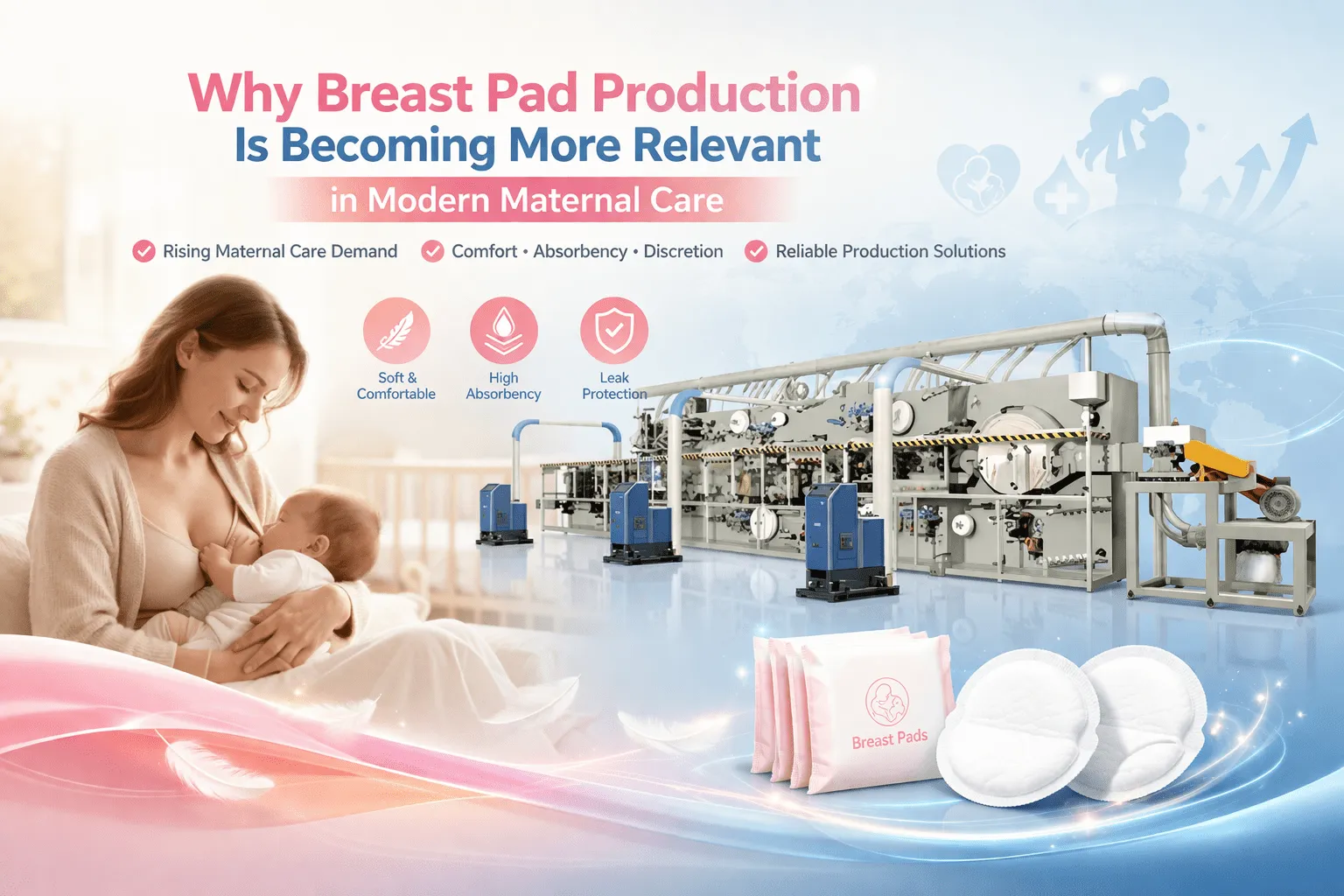
Table of Contents
- Introduction
- Maternal Care Is Receiving More Attention Worldwide
- Why Breast Pads Are Becoming a More Practical Product Category
- What a Reliable Breast Pad Making Machine Must Deliver
- Why Product Comfort and Consistency Matter in This Category
- How Production Stability Supports Better Business Growth
- Breast Pad Production as a Portfolio Expansion Opportunity
- What to Look for When Choosing a Breast Pad Machine
- FAQ
- Related Machines
Introduction
In the hygiene products industry, some categories grow quietly before they become strategically important. Breast pads are one of them.
For a long time, breast pads were often seen as a smaller supporting product compared with sanitary napkins, baby diapers, or adult care items. But market thinking is changing. As maternal care receives more global attention, products that support comfort, convenience, and daily confidence for breastfeeding mothers are becoming more commercially relevant.
That shift is happening alongside a broader change in how maternal care is discussed. WHO’s 2025 World Breastfeeding Week campaign called for stronger, more sustainable breastfeeding support, while the organization’s campaign materials continue to emphasize that policies, laws, communities, and health systems all play a role in helping mothers breastfeed for as long as they wish. The ILO likewise treats the right to breastfeed after returning to work as an important part of maternity protection.
For manufacturers, this matters because demand in maternal care is no longer shaped only by big-volume products. It is also shaped by products that solve very real day-to-day needs. Breast pads fit that reality well. They are practical, discreet, absorbent, and closely connected to the daily experience of nursing mothers.
That is why breast pad production is becoming more relevant in modern maternal care.
Maternal Care Is Receiving More Attention Worldwide
Breastfeeding support is increasingly being discussed as part of public health, women’s well-being, and workplace support rather than as a private issue that mothers must solve alone. WHO’s 2025 campaign framed breastfeeding support as something that should be built into sustainable systems, and WHO materials also highlight that enabling environments include support in communities and workplaces. The ILO’s maternity protection materials similarly identify breastfeeding after return to work as an important right linked to maternity protection.
This broader conversation changes how related products are viewed. When maternal care is discussed in a more practical way, product categories linked to feeding support become more visible. Nursing bras, breast pumps, storage bags, and breast pads all become part of a more complete care ecosystem.
From a manufacturing point of view, that creates a useful signal. It means breast pads are not just an occasional niche item. They are part of a category connected to real daily use, repeat demand, and growing attention to maternal comfort.
For companies already working in hygiene converting, this makes the category easier to understand. It is not a disconnected product. It sits naturally within the wider logic of feminine care and maternal support products. Manufacturers who are already evaluating broader Female Care Machines often find that breast pad production is a practical way to expand into a more specialized but still familiar market segment.
Why Breast Pads Are Becoming a More Practical Product Category
Breast pads solve a very specific problem, and that is exactly why they matter.
For breastfeeding mothers, leakage can affect comfort, clothing confidence, mobility, and peace of mind during daily life. A product that helps manage this discreetly is not a luxury. In many situations, it is part of everyday practicality. When a product serves a clear use case like this, it tends to remain commercially relevant even when broader market trends change.
Breast pads also fit modern consumer expectations well. They are compact, easy to package, suitable for retail or e-commerce, and can be positioned at different quality levels depending on absorbency, softness, shape, breathability, and skin-contact experience. That gives brands room to create both standard and premium offers instead of competing only on the lowest price.
For manufacturers, this is valuable because the business logic is different from some high-volume commodity categories. Breast pads are often associated with trust, care, and product experience. Buyers and brands may therefore focus more on consistency and comfort than on absolute lowest cost alone.
That gives well-made products more room to stand out.
A factory that can produce breast pads with stable shape, clean sealing, soft material handling, and reliable absorbency positioning is in a stronger position to support private label development, maternal care branding, and higher-trust product lines. In other words, breast pad production is not just about adding another SKU. It is about adding a category with practical relevance and stronger perceived value.
What a Reliable Breast Pad Making Machine Must Deliver
Because breast pads are intimate-use products, production quality matters a great deal. A reliable breast pad making machine needs to do more than run. It needs to run with control.
The finished product must feel neat, soft, symmetrical, and consistent. That requires stable coordination across several production steps, including material feeding, absorbent layer placement, forming, sealing, cutting, and final output. If those steps are not controlled properly, even a simple-looking product can end up with visible defects or inconsistent use performance.
A dependable machine should help the factory maintain control over areas such as:
- product shape consistency
- absorbent core positioning
- edge sealing quality
- material tension and feeding stability
- product thickness consistency
- clean cutting and smooth output
These details affect both the manufacturing side and the market side.
On the factory side, better control means less waste, fewer rejected pieces, and easier downstream packing. On the product side, it means better appearance, better comfort perception, and more stable customer experience. For nursing products, that matters even more than in many standard disposable categories, because end users are highly sensitive to comfort and reliability.
This is also why machine choice should not be based on catalog output alone. A faster line is not necessarily a better line if it produces unstable quality. In maternal care products, stability is often more valuable than an impressive speed figure on paper.
Why Product Comfort and Consistency Matter in This Category
Breast pads may be small products, but user expectations are high.
A mother using breast pads wants the product to feel soft against the skin, remain discreet inside clothing, absorb reliably, and stay structurally stable during use. If the product feels rough, too bulky, poorly shaped, or inconsistent from pack to pack, trust drops quickly.
That is why consistency is central to this category.
Manufacturers need to pay attention not only to absorbency, but also to overall product experience. That includes whether the pad keeps a clean and uniform shape, whether edges are sealed neatly, whether the material sits correctly, and whether the finished piece looks professional enough for modern retail presentation.
A stable machine helps protect all of that.
When production is unstable, the problems may seem small at first: slight shape differences, uneven material placement, weak edges, or inconsistent cutting. But over time, these issues increase waste, slow down quality inspection, create more operator intervention, and weaken the final product impression. For buyers building a maternal-care product line, that is a serious weakness.
When production is stable, the opposite happens. Product feel becomes more predictable. Packing looks cleaner. Brand presentation improves. The factory has fewer internal corrections to manage. Most importantly, the end user receives a more dependable product.
In a category built around trust and comfort, that reliability becomes a real commercial advantage.
How Production Stability Supports Better Business Growth
Stable production is not only a technical benefit. It is a business advantage.
Factories grow more smoothly when they can predict output, control waste, and maintain consistent finished quality across orders. For breast pad production, this matters because the category often grows through repeated purchasing, private label cooperation, and wider portfolio bundling. A buyer who trusts one batch expects the next batch to feel the same.
That makes consistency essential for long-term cooperation.
A reliable breast pad machine supports business growth in several ways. It helps reduce avoidable waste. It lowers the risk of customer complaints caused by inconsistent product appearance. It makes it easier to standardize packaging. It also improves internal factory planning because operators spend less time correcting instability and more time maintaining flow.
This is especially useful for manufacturers that want to move beyond single-product thinking. A company may start with sanitary pads or another hygiene category, then gradually build a fuller maternal-care or feminine-care range. In that process, production stability becomes the bridge between expansion and control.
Manufacturers who are comparing wider hygiene opportunities often do not evaluate breast pads alone. They may also look at complete all female care machines solutions to understand how different product categories can work together in one broader factory strategy. In that context, breast pads become a logical extension of a professional product portfolio rather than a side item.
Breast Pad Production as a Portfolio Expansion Opportunity
One of the strongest reasons to consider breast pad production is portfolio balance.
A factory that produces only one or two core products may eventually face stronger pricing pressure, tighter competition, or limited room for product differentiation. Adding a specialized category can create more flexibility. Breast pads are attractive in this sense because they are practical, care-oriented, and close to existing hygiene converting logic.
They also allow manufacturers to enter a category with a clear user story.
Unlike products that depend mainly on aggressive price positioning, breast pads can be communicated through comfort, absorbency, maternal support, convenience, and discreet use. That gives brands and manufacturers more storytelling value, which often helps in retail, e-commerce, and private label development.
For exporters and OEM suppliers, this is also useful because maternal-care products often benefit from professional presentation. A factory that can offer breast pads alongside other feminine-care or support products appears more complete and more specialized.
From the manufacturing side, the category can also be a sensible expansion step because it does not move the factory away from familiar production logic. Material handling, converting discipline, sealing quality, and hygiene product finishing remain central. That means the learning curve is more manageable than entering a completely unrelated category.
In short, breast pad production is relevant not only because the product itself is useful, but because it helps manufacturers build a more balanced and resilient product mix.
What to Look for When Choosing a Breast Pad Machine
A breast pad machine should be selected with long-term product quality in mind.
The first factor is machine stability. The line should maintain clean operation over time, not just during a short demonstration. Small product categories still require strong production discipline, and unstable running quickly becomes expensive.
The second factor is material handling. Breast pads depend heavily on comfort perception, so feeding accuracy and material control are very important. If materials drift or wrinkle, the final product quality will suffer.
The third factor is forming and sealing quality. Because breast pads are close-contact products, the final shape and edge finish need to look neat and feel comfortable. Poor sealing can damage both appearance and user confidence.
The fourth factor is ease of operation. A machine that is too difficult to adjust or maintain may create hidden labor cost and slow problem-solving on the shop floor.
The fifth factor is supplier support. Installation guidance, technical support, spare parts, and practical production understanding matter a great deal in real use. A supplier should support not only delivery, but also long-term operation.
Finally, the machine should fit the factory’s actual business plan. Some manufacturers want to build a premium maternal-care line. Others want to add breast pads as part of a broader feminine-care range. The right machine should align with that goal rather than forcing the factory into an inflexible setup.
The best investment is rarely the lowest quoted price. It is the line that helps produce a trustworthy product, reduce avoidable production problems, and support future commercial growth.
FAQ
1. What is a breast pad making machine?
A breast pad making machine is a production line used to manufacture disposable breast pads for nursing mothers. It typically handles material feeding, forming, sealing, cutting, and final output.
2. Why are breast pads becoming more relevant in the market?
Breast pads are closely connected to modern maternal care needs, especially comfort, absorbency, discretion, and daily convenience for breastfeeding mothers.
3. Is breast pad production suitable for hygiene product manufacturers?
Yes. It is a practical category for manufacturers already working in feminine care or disposable hygiene products because the production logic is familiar and the market need is clear.
4. What makes a good breast pad machine?
A good machine should provide stable running, accurate material placement, reliable sealing, clean cutting, consistent product shape, and dependable after-sales support.
5. Why is consistency so important in breast pad production?
Because breast pads are intimate-use products, buyers and end users expect softness, neat appearance, reliable absorbency, and stable quality from pack to pack.
6. Can breast pad production help expand a product portfolio?
Yes. It can help manufacturers build a more complete maternal-care or feminine-care offering and reduce dependence on a single product category.
7. Is breast pad production mainly a low-price business?
Not necessarily. The category often carries value through comfort, care, and product experience, which can support stronger positioning than purely price-led competition.
8. What other machines are often related to breast pad production?
Manufacturers interested in breast pads often also evaluate sanitary pad machines, panty liner machines, underarm pad machines, and packing machines.
Related Machines
- Sanitary Pad Machine
- Panty Liner Machine
- Underarm Pad Making Machine
- Packing Machine
- Bar-Type Winged Pad Machine
CTA
Looking for a reliable breast pad making machine for your maternal-care product line or hygiene factory expansion?
Welldone provides professional hygiene machinery solutions for feminine care manufacturing, including breast pad machines, sanitary pad machines, panty liner machines, and related production support systems.
Email: welldone@cnwelldone.com
Website: www.cnwelldone.com