
Baby Diaper Packaging Line: Folding, Inspection and Quality Assurance

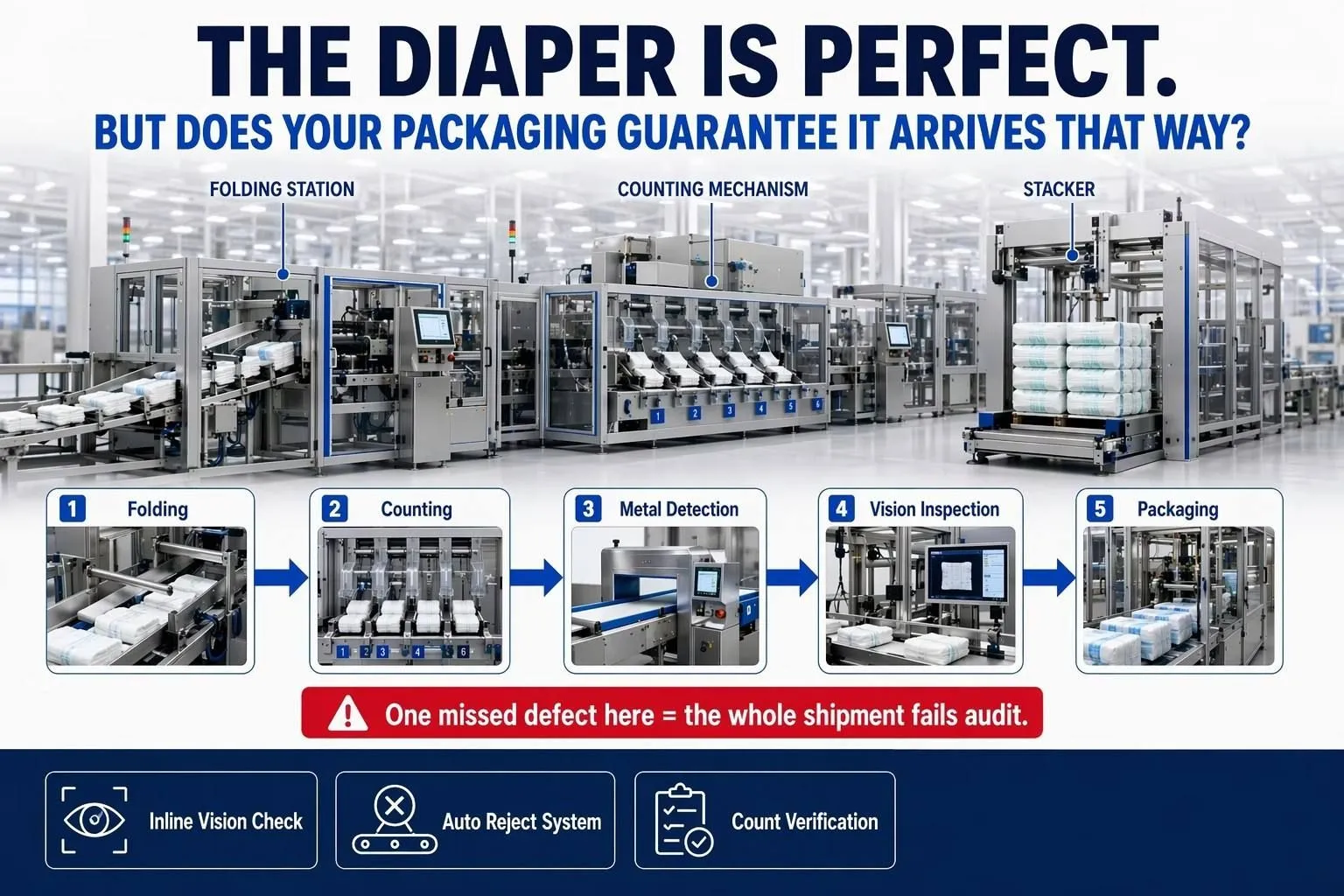
Baby Diaper Machine: A Complete Guide to Packaging, Quality Control, and Stable Production — Part 3 of 3
Parts 1 and 2 of this series walked through the front end of the baby diaper production line — raw material selection, core forming, functional component assembly, sealing, and cutting. By the time the diaper reaches the end of the middle section, it is a fully assembled product with all its functional layers in place.
Everything after that point serves one purpose: making sure the product that leaves your factory is exactly what your buyer expects to receive.
This is the section of the production line that most buyers underestimate before they invest. The forming drum gets weeks of technical discussion. The component assembly section gets careful specification review. But the folding system, the counter, the metal detector, the vision inspection unit, and the packaging line often get treated as "the last part" — the part where you just need equipment that works.
That treatment is a mistake. The back end of the production line is where every quality decision you made upstream either survives to reach the customer, or fails at the last moment. A diaper that was perfectly formed and perfectly assembled can still arrive at the buyer's dock with a folding defect, a miscount in the pack, a metal contamination flag, or a damaged outer carton — and the buyer does not care where in your line the problem originated.
This article walks through the complete back-end system: folding, inspection, packaging, and the production stabilization process that determines whether your factory can consistently deliver audit-ready product from day one.
"Your customer never sees the forming drum. They see the carton on their dock, the products inside it, and whether both match the specification they ordered. That is where your factory is judged."
1. The Folding System: The Last Mechanical Operation on the Product
After cutting, individual diapers move onto the folding conveyor. The folding system takes the flat, cut diaper and folds it into the compact form that fits into the primary packaging — typically a bi-fold or tri-fold configuration depending on the product design and the target retail pack format.
Folding sounds simple. In practice, it is one of the most timing-sensitive operations on the entire line. Each fold must occur at the correct position on the diaper — typically within ±2mm of the target fold line — while the product is moving at the same speed as the rest of the line. A folding station that is out of timing by even a small amount produces diapers with off-center folds, uneven side profiles in the pack, and visible quality issues that appear immediately when the customer opens the outer carton.
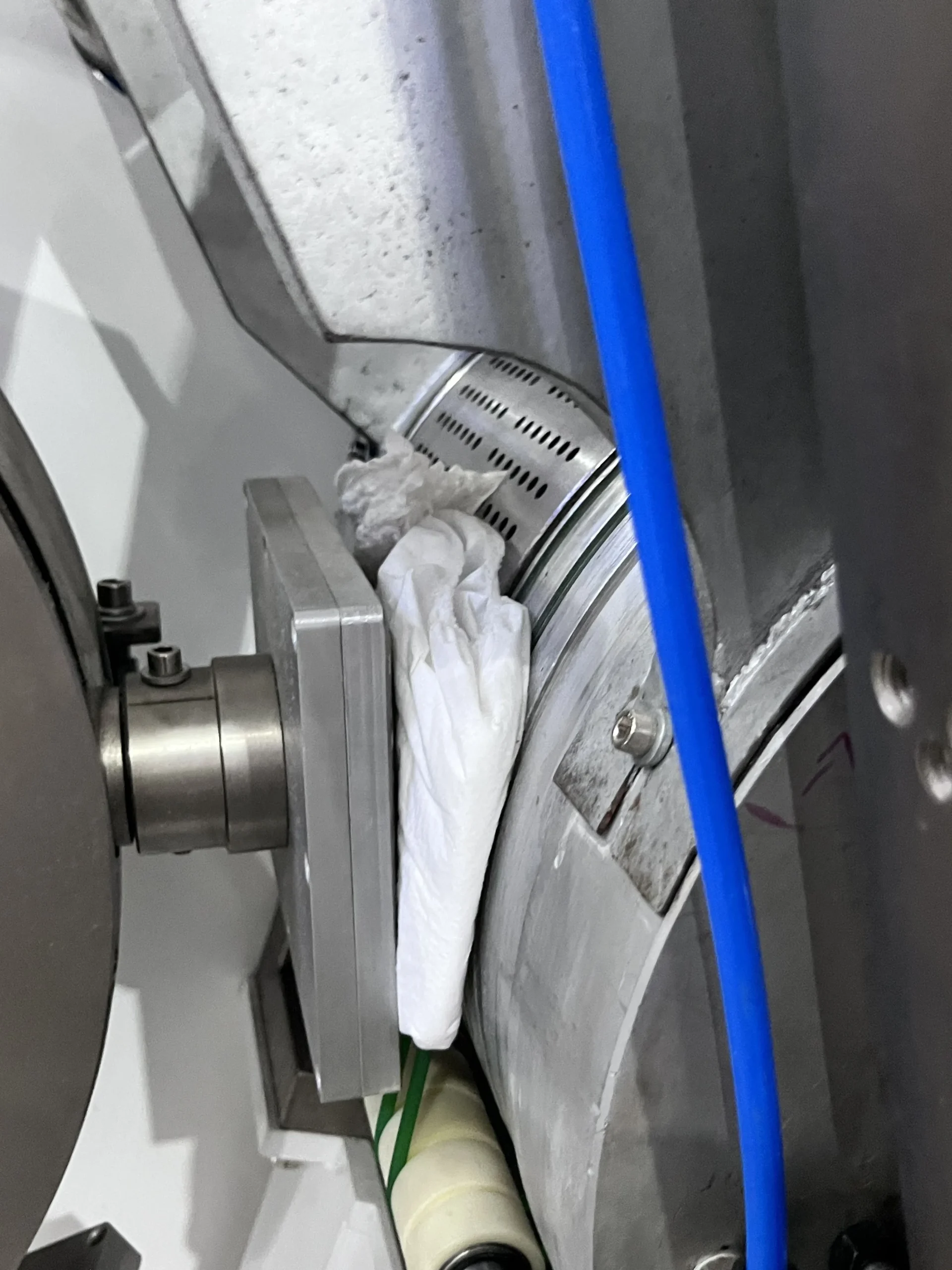
Folding timing drift is one of the most difficult problems to diagnose after the fact — because the folded product may still fit into the primary package, but the internal fold position affects how the diaper unfolds when the caregiver uses it. A product with an off-center fold may unfold with a twist, or with the back panel oriented incorrectly relative to the front. Consumers experience this as "the diaper feels wrong" — an impression that damages brand perception without giving the manufacturer specific defect data to correct.
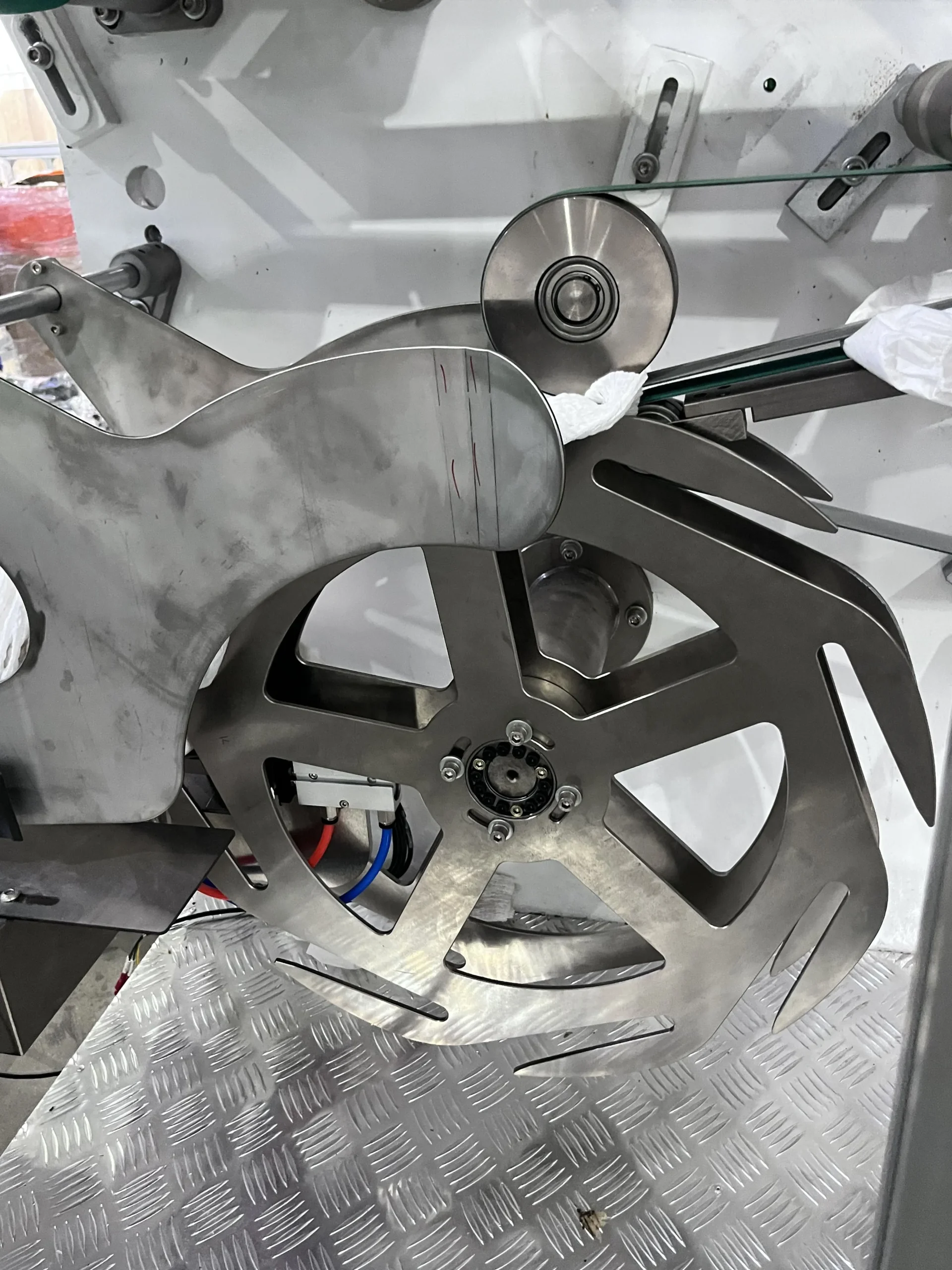
Actually, the most common cause of folding timing drift is temperature change in the servo motor drives during shift transitions. A folding station that was calibrated during a cool morning startup may drift by 3 to 5 milliseconds when the factory heats up in the afternoon. On a full servo line, automatic timing correction compensates for this drift. On a semi-servo or mechanical line, it accumulates through the shift.
2. Metal Detection and Product Safety
Metal detection is a non-negotiable requirement in baby diaper manufacturing. Foreign metal contamination — from broken machine parts, damaged cutting blades, or contaminated raw materials — is one of the most serious product safety failures possible in hygiene product manufacturing. Retail chains and institutional buyers routinely audit for metal detection procedures and reject shipments from suppliers without documented inline detection.
An inline metal detector sits between the cutting station and the packaging line. Every diaper passes through the detection zone, and any unit that triggers a metal signal is automatically diverted through the reject system before it reaches the counting station.
Metal detector sensitivity must be calibrated carefully. Too sensitive, and the system triggers false rejections from environmental interference or slight metallic content in the raw materials themselves — wasting good product and slowing down the line. Not sensitive enough, and small metal fragments pass through undetected — creating serious safety liability if the contaminated product reaches a consumer.
The detector calibration must be verified daily using test cards containing known metal particles at threshold sizes. Factories that skip daily calibration verification have no defensible position when a metal contamination complaint arrives — they cannot prove their detection system was functioning correctly at the time the affected product was manufactured.
- Metal detection sensitivity should catch ferrous particles at 1.0mm and non-ferrous at 1.5mm minimum for baby diaper applications.
- Daily test card verification with documented log is a standard requirement for retail supplier audits.
- Automatic diversion via air blast or mechanical reject arm removes flagged units without stopping the line.
- The reject bin should be inspected and emptied at defined intervals to prevent overflow that compromises detection response.
3. Vision Inspection Systems: Catching What Manual Inspection Cannot
Inline vision inspection is the difference between quality control and quality assurance. A single operator performing spot checks every thirty minutes can catch obvious defects on a sample basis. A vision inspection system checks every single unit against defined visual criteria in real time.
Modern vision systems on baby diaper lines typically check for:
- Frontal tape position: verifies the tape is placed within specification tolerance across every unit.
- Side tape presence and position: confirms both side tapes are present and correctly aligned.
- Leg cuff symmetry: measures the visible cuff dimensions on both sides for consistency.
- Core position: confirms the absorbent core is centered within the diaper body.
- Print quality: checks the printed graphic on the back sheet for color consistency and registration.
- Waistband appearance: verifies gathering pattern and elastic contraction is uniform.
- Overall dimensional accuracy: measures length and width against product specification.
Units that fail any parameter are flagged in the control system and diverted at the reject station. The system logs failure rates by parameter — allowing operators to identify which upstream process is generating quality issues before those issues become significant production problems.
The real question is not whether your inspection system catches defects. It is whether your inspection system generates data that helps you prevent defects — trending failure rates over time, correlating rejections with upstream parameter changes, and giving your production team the information they need to catch drift before it affects thousands of units.
4. The Automatic Reject System: Protecting Every Downstream Operation
The automatic reject system is what separates defective units from acceptable units in the middle of a running line. It sits at the exit of the inspection zone, receives signals from the metal detector and vision inspection system, and physically removes flagged units — typically through a high-speed air blast that redirects the defective unit into a reject bin without slowing the main product flow.
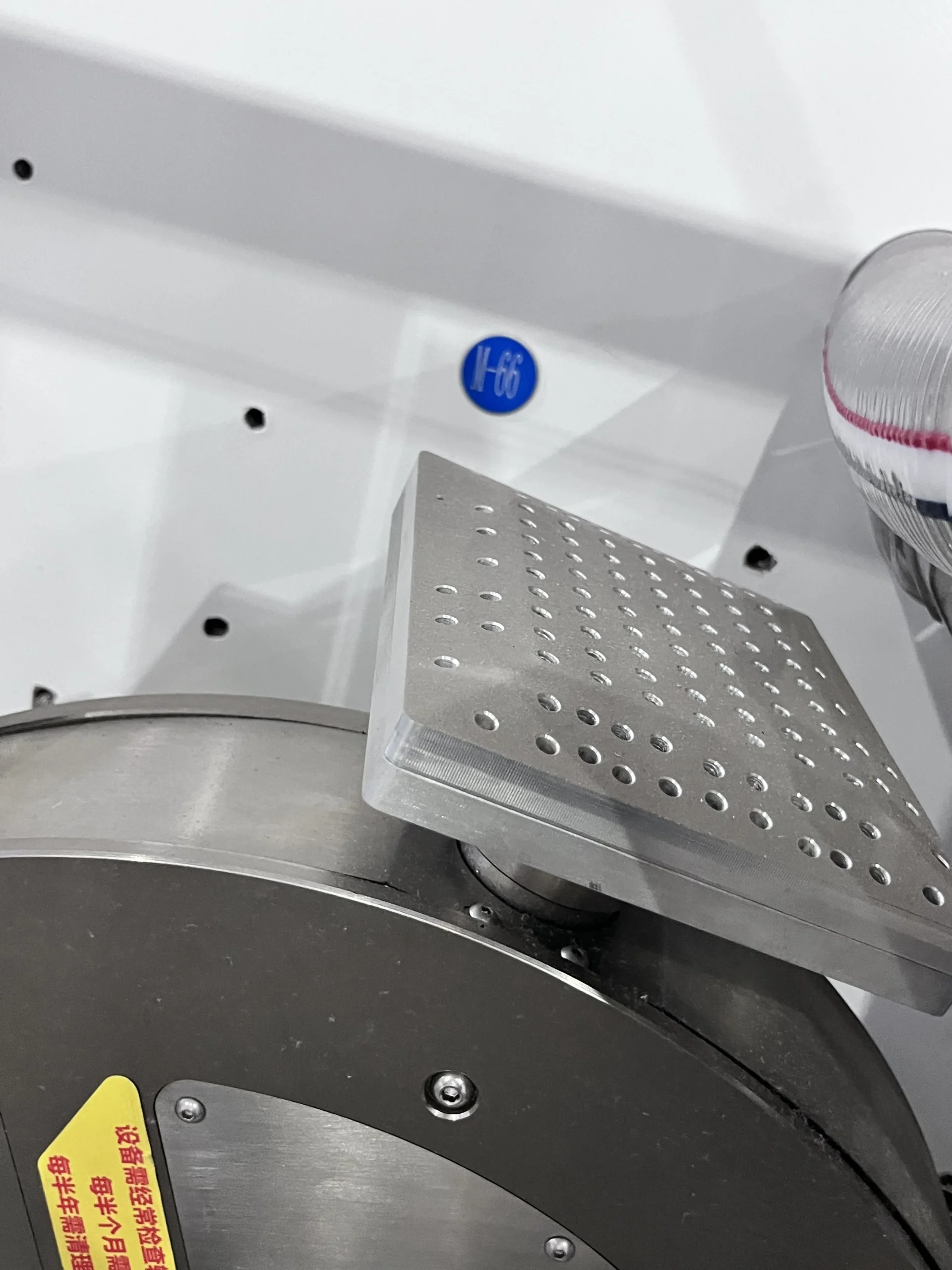
Reject system reliability directly affects both product quality and production efficiency. If the reject mechanism misses a flagged unit, that unit continues into counting and packaging — potentially causing a downstream jam, or worse, reaching the customer as a defective product in what was supposed to be a compliant carton. If the reject mechanism triggers unnecessarily on good units, production waste increases without any quality benefit.
The reject bin itself is a monitoring point that many factories neglect. A reject rate that is stable over time indicates the upstream production is in control. A reject rate that is trending upward — even if still within acceptable range — indicates something is drifting in the front-end or middle-section systems, and needs investigation before the rate exceeds acceptable limits.
Best practice is to inspect the reject bin at every shift transition and log the failure categories from the vision system. A reject bin filling with units flagged for frontal tape position issues points to a specific upstream station that needs attention. A reject bin filling with units flagged for multiple different parameters points to broader synchronization drift across the middle section.
5. Counting and Stacking: Preparing Product for Packaging
After inspection, individual diapers move to the counting and stacking station. The counter tracks each unit passing through, groups units in the count defined by the product's primary pack format (typically 20, 30, 40, 50, or 60 units per pack depending on the market), and delivers the completed count to the stacker for packaging preparation.
Counting accuracy is a certified specification, not a general expectation. When your product label states 40 diapers per pack, every retail carton must contain exactly 40 diapers. Miscounts — either under or over — are audit failures. Consistent undercounts are consumer fraud allegations. Consistent overcounts are pure margin loss.
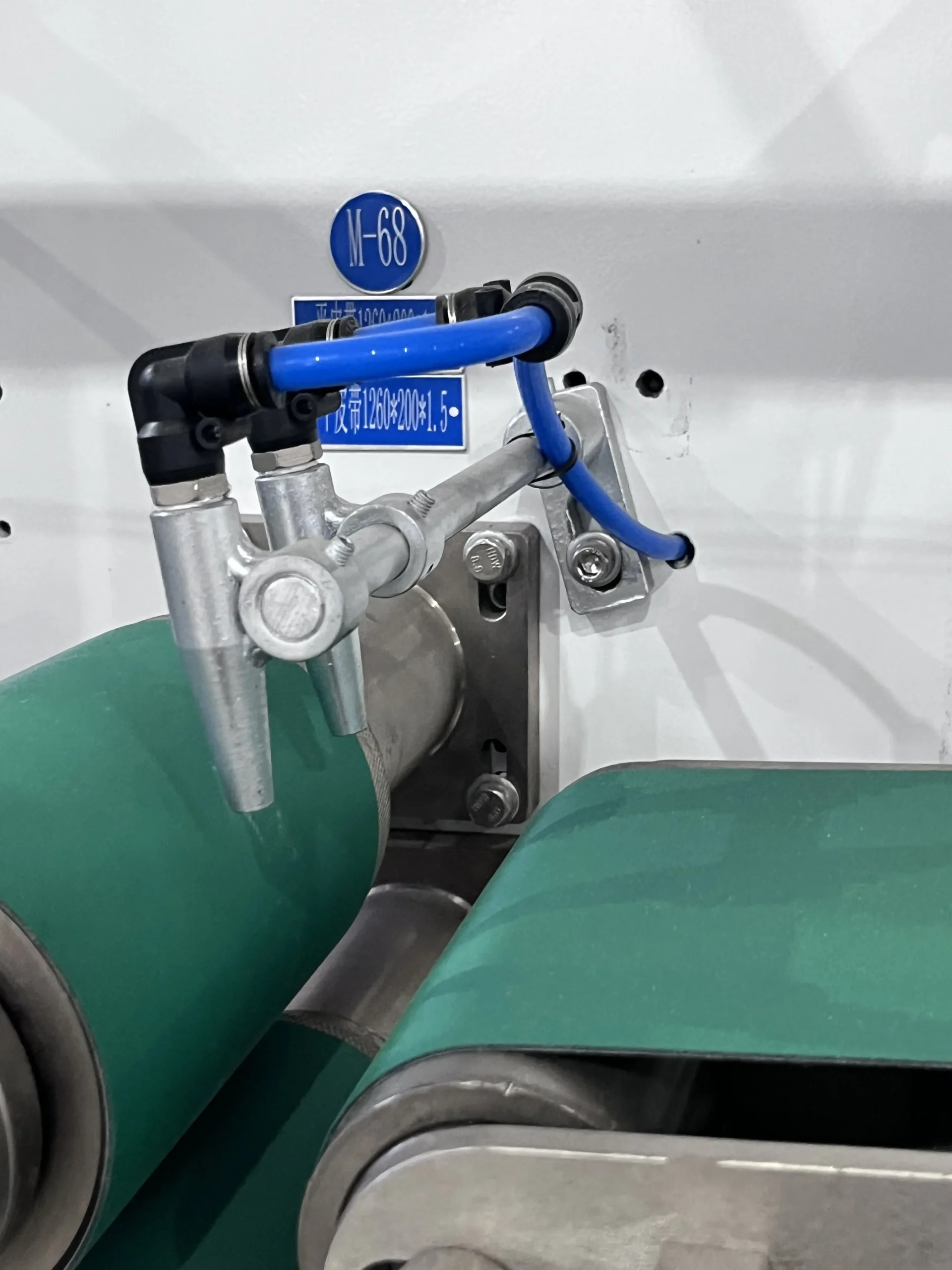
Modern counting systems use photoelectric or optical sensors that count individual units as they pass through the counting zone. The count is verified against the target before the pack is released to the stacker. If the count is short or long, the system flags the pack and either holds it for manual verification or automatically rejects it depending on the machine configuration.
The stacker organizes the counted units into the physical arrangement required by the primary packaging system — typically a vertical stack that will be inserted into a stand-up pack, or a horizontal alignment for pillow-pack style packaging. Stacker alignment affects how neatly the products fit into the primary package. Sloppy stacker alignment produces packs where products are visible through the film with uneven positioning — which reduces perceived quality even when the product inside is perfectly manufactured.
6. Primary Packaging Systems: The First Barrier Between Product and Environment
Primary packaging is the film or bag that directly contains the counted, stacked diapers. It is the first physical barrier between the product and the environment — dust, humidity, contamination — during storage and transport. It is also the surface where the brand identity, product information, and regulatory labeling are presented to the retail buyer and end consumer.
The primary packaging film must be sealed correctly across all three seal areas — the two side seals and the top seal. Weak seals allow moisture or contamination into the pack. Burned seals from excessive temperature damage the film and create visible quality defects. Seal integrity failures are one of the most common reasons for retail shipment rejection at the receiving dock.
Sealing temperature, dwell time, and film thickness must be calibrated to the specific film material being used. When a factory changes packaging film suppliers, all three parameters typically need adjustment. Running the same sealing settings with a new film supplier is a standard cause of first-week production quality problems after a supplier change.
I believe the primary packaging station is the operation where the most quality problems get created by insufficient operator training. The station looks simple — film in, sealed pack out — but the parameter interactions are subtle. An operator who does not understand how temperature, dwell time, and film thickness interact will either produce weak seals during cool ambient conditions, or burn seals during afternoon temperature peaks — without connecting either problem to the underlying cause.
7. Carton Packing and Labeling: The Container Your Customer Actually Sees First
Individual primary packs are grouped into outer cartons for shipment. The carton is what arrives at the customer's warehouse, and it is the first physical product touch point in the customer's quality inspection process.
Carton packing operations include primary pack orientation and stacking inside the carton, insertion of any protective dividers or filler material, carton flap sealing, and application of shipping labels and product identification barcodes. Each of these steps has quality tolerances that affect whether the shipment passes the customer's receiving inspection.
Common carton-level failures include: primary packs oriented incorrectly inside the carton (which can cause product damage during transit), carton flaps sealed with insufficient adhesive coverage (which cause cartons to open during handling), shipping labels with poor print quality or misalignment (which cause barcode scan failures at the customer's receiving dock), and product identification errors (which cause shipments to be misrouted or rejected).
Automated carton packing systems address these issues at the operational level, but they still require configuration matched to the specific carton size, primary pack count, and labeling requirements of each product SKU. A factory producing multiple SKUs must have documented carton pack configurations for each product — not left to operator judgment at the packing station.
8. Production Stabilization: The First 90 Days Are the Real Investment Period
Every new baby diaper production line goes through a stabilization period. The machine is installed, commissioning is completed, initial training is delivered, and production starts. What happens in the next 60 to 90 days determines whether the factory reaches its production targets on schedule — or spends the first year in continuous troubleshooting mode.
The stabilization period is when the theoretical performance from the factory acceptance test meets the reality of your specific raw materials, your local operators, your factory environment, and your production schedule. Every one of these variables introduces effects that were not present during the supplier's factory testing. The line that ran perfectly at 550 units per minute in the supplier's demonstration facility may run at 380 units per minute in your factory for the first eight weeks.
This is not a failure of the machine. It is the normal ramp-up curve for any production system where multiple new variables need to be understood, adjusted, and integrated. Factories that plan for this reality — with capacity buffer, training schedule, and technical support arrangements — reach their target output faster and with less operational stress than factories that assume day-one performance will match factory acceptance test performance.
In most cases, the biggest predictor of successful stabilization is not machine quality. It is the depth of the supplier relationship during the first 90 days. Suppliers who treat commissioning as the end of the project leave you to figure out the ramp-up alone. Suppliers who treat the first 90 days as the actual project period give you the technical support and adjustment guidance that turns installed capacity into produced output.
9. Building Audit-Ready Production: What Retail Buyers Actually Check
Retail chains, institutional buyers, and premium brand licensees conduct supplier quality audits on baby diaper manufacturers. The audits are not optional — passing them is a condition of maintaining the supply relationship. Failing them can result in shipment holds, order cancellations, or loss of the account entirely.
Audit checklists vary by buyer, but common elements include:
- Documented quality management system covering incoming materials, in-process inspection, and finished product release.
- Metal detection procedure with daily calibration verification logs.
- Vision inspection system with failure rate trending and root cause analysis documentation.
- Batch traceability from raw material lot through finished carton — enabling recall of specific product if a defect is later identified.
- Operator training records with competency verification for each production station.
- Preventive maintenance schedule with documented completion records.
- Customer complaint handling procedure with response time targets and closure documentation.
- Continuous improvement records showing systematic reduction of failure rates over time.
Factories that build these elements into their production system from day one pass audits without difficulty. Factories that treat quality documentation as an administrative task to be figured out later spend significant effort catching up when their first major buyer audit is scheduled — often under time pressure that leads to gaps or inconsistencies in the audit evidence.
10. Back-End Failure Modes and Root Cause Framework
Folded product with uneven side profiles in the finished pack
Check folding timing consistency across a full shift. Common cause: temperature-induced timing drift in the folding servo drives. Solution: automatic timing calibration during shift transitions and periodic verification.
Metal detector triggering false rejections at higher rate than baseline
Check environmental interference sources near the detector head. Common cause: new equipment installed nearby generating electromagnetic interference. Solution: relocate interference source or shield the detector head.
Vision inspection failure rate climbing gradually over multiple shifts
Do not adjust the vision system tolerance to reduce the failure rate. Investigate the upstream cause. Common cause: raw material batch change affecting the parameter being inspected. Solution: identify which parameter is trending and correlate to raw material or upstream setting changes.
Count verification alarming on completed packs
Check counting sensor cleanliness and alignment. Common cause: dust accumulation on optical sensor reducing detection reliability. Solution: sensor cleaning added to daily maintenance schedule.
Weak primary pack seals at the beginning of each shift
Check sealing temperature stability during startup. Common cause: sealing element has not reached target temperature before production begins. Solution: extended warm-up cycle before starting production, or holding zone temperature between shifts.
Shipping label print quality poor on some cartons
Check printer ribbon condition and printing surface cleanliness. Common cause: ribbon wear or dust on the carton surface at the label position. Solution: preventive ribbon replacement schedule and surface cleaning at the label application point.
Why Welldone
Welldone is a hygiene product machinery manufacturer under Quanzhou Shimao Weiteng Import and Export Co., Ltd. We have been building baby diaper machines, sanitary napkin machines, adult care machines, and related hygiene product equipment for more than 18 years.
Our baby diaper production lines integrate folding, metal detection, vision inspection, automatic reject, counting, stacking, and primary packaging as a coordinated back-end system — not as separate stations bolted together at the end of the line. Each component is calibrated to work with the others, and the vision inspection data feeds back into the production monitoring system so operators can trace quality trends to their upstream causes.
We treat the first 90 days of production as part of the project. Our commissioning process includes back-end system training, stabilization guidance, and technical support during the ramp-up period — because that is when the real production system gets built, and that is when supplier support has the highest impact on your factory's long-term performance.
Integrated Back-End System
Folding, inspection, reject, counting, and packaging designed as a coordinated system with shared data flow — not separate components assembled sequentially.
Audit-Ready by Design
Vision inspection logs, metal detection verification records, and quality trend data structured for retail buyer audit requirements from day one.
90-Day Stabilization Support
Technical support and adjustment guidance during the first 90 days of production — the period that determines whether installed capacity becomes produced output.
Conclusion
The back end of a baby diaper production line — folding, inspection, reject, counting, packaging — is where your factory's quality decisions either survive to reach the customer, or fail at the last moment. Every upstream investment in raw material quality, forming precision, and component assembly is validated or invalidated by what happens in the back-end system.
A factory that treats the back end as "the packaging area" will experience quality complaints that are difficult to diagnose and expensive to correct. A factory that treats the back end as an integrated quality assurance system — with inline inspection, automatic reject, count verification, and audit-ready documentation — builds the customer confidence that translates into repeat orders and long-term supplier relationships.
This is the section of the production line where your operators need the most systematic training, where your quality documentation needs the most structural discipline, and where your supplier relationship pays the highest return during the first 90 days of production.
This concludes the three-part series on the complete baby diaper production line. Part 1 covered raw material selection and core forming. Part 2 covered component assembly and cutting. Part 3 has covered the back-end systems and production stabilization. Together, these three articles describe what a Welldone customer engineer would walk you through — station by station — before your line goes into production.
"Your customer never asks about your servo motors. They ask whether their shipment arrived complete, on time, and inspection-ready. That answer is decided by the back end of your production line."
FAQ
How reliable is inline vision inspection compared to manual sample checking?
Inline vision inspection checks every unit against defined criteria in real time — thousands of units per hour, every parameter, every unit. Manual sample checking at 30-minute intervals covers a small fraction of production and only catches defects that develop between sample points. For any factory selling into retail or institutional channels, inline vision inspection is a standard requirement, not an optional upgrade.
What metal detection sensitivity is required for baby diaper products?
Standard sensitivity requirements for baby diaper metal detection are 1.0mm ferrous, 1.5mm non-ferrous, and 2.0mm stainless steel. These thresholds must be verified daily using calibrated test cards, with the verification logged in the quality management system. Retail buyers routinely audit detection procedures and reject suppliers without documented daily verification.
How long does the first 90 days of production stabilization typically take?
For a well-configured line with trained operators, the ramp-up to consistent stable production typically takes 60 to 90 days from the end of commissioning. During this period, output progressively climbs from initial trial rates to sustained target rates as operators develop parameter familiarity and raw material behavior becomes predictable. Factories planning capacity should assume 60 to 70 percent of rated output during the first two months, ramping to 85 to 95 percent by month three.
What audit documentation do retail buyers typically request?
Common audit requirements include incoming raw material inspection records, in-process inspection procedures, metal detection daily verification logs, vision inspection failure trend data, batch traceability records, operator training and competency verification, preventive maintenance completion logs, and customer complaint handling documentation. Our baby care production lines are configured to support these documentation requirements from initial commissioning.
What after-sales support does Welldone provide during the production stabilization period?
Our stabilization support includes remote technical consultation, parameter adjustment guidance based on your specific raw material and production data, operator refresher training as issues emerge, and scheduled review calls at defined intervals during the first 90 days. Our objective is that your factory reaches target output on schedule — because your production success is what determines whether you become a long-term Welldone customer, not just a one-time equipment buyer.
Planning a Baby Diaper Production Line?
Talk to us before you finalize your machine decision. We will walk you through the complete production line — front-end forming, middle-section assembly, back-end packaging and quality control — and configure the machine for your specific product design, raw material specifications, and target market requirements.
Website: www.cnwelldone.com | Email: welldone@cnwelldone.com
Contact Welldone Today