Baby Diaper Machine: Raw Material and Core Forming System Explained

On July 13, 2026
Comments Off on Baby Diaper Machine: Raw Material and Core Forming System Explained
Baby Diaper Machine: A Complete Guide to Raw Material and Core Forming — Part 1 of 3
Most buyers who visit a baby diaper factory for the first time watch the finished product coming off the line — folded, packaged, stacked — and feel confident they understand what they are buying. They are watching the last 20 percent of the production process.
What determines whether that line runs stably, shift after shift, is decided much earlier. It is decided by the raw material specifications, the unwinding tension, the fiber opening parameters, the SAP particle size, and the vacuum calibration inside the forming drum. These are the variables that control core quality. They are also the variables that most new factory investors have never been walked through before their machine arrives.
This article is the first in a three-part series that walks through a complete baby diaper production line the way a Welldone engineer would walk a buyer through it — section by section, function by function, with an honest explanation of what each part does and what goes wrong when it is not set up correctly.
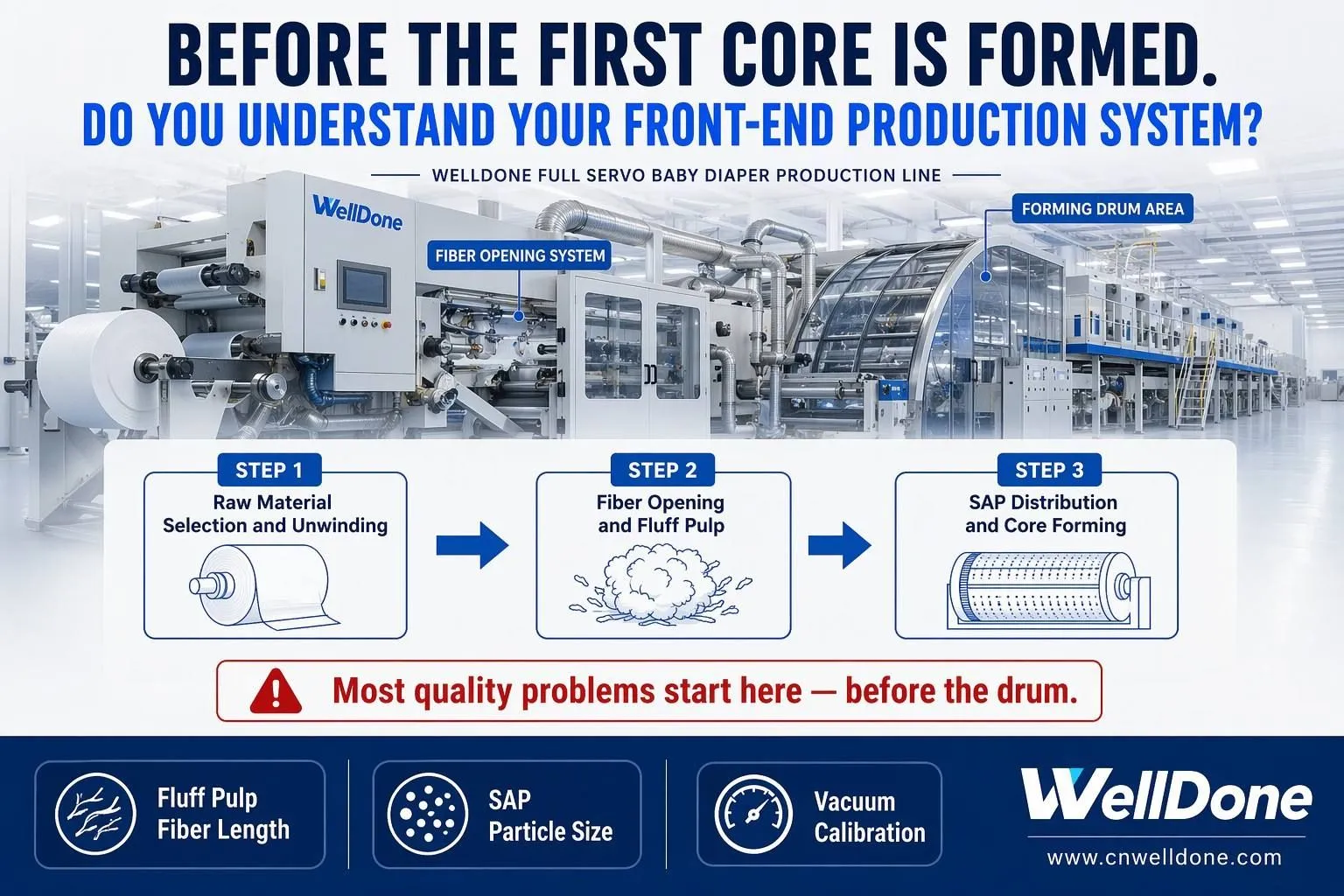
Part 1 covers the front end of the line: from raw material selection through the forming drum to the compressed core ready for the next production stage.
"The quality of a baby diaper core is determined before the forming drum ever starts spinning. It is determined by the materials going into the system and the parameters controlling how they get there."
1. Raw Material Selection: Where the Line Performance Begins
A baby diaper production line is a material processing system. Every mechanical parameter — tension settings, vacuum levels, cutting force, sealing temperature — is calibrated around specific raw material properties. Change the material without adjusting the parameters, and the line will not perform the same way it did during factory acceptance testing.
The main raw materials in a baby diaper production line include fluff pulp, SAP (Super Absorbent Polymer), top sheet non-woven, back sheet PE film, ADL (Acquisition Distribution Layer), leg cuff non-woven, elastic materials (leg and waist), frontal tape, side tape, and hot melt adhesive.
Each of these materials has specifications that matter to the machine. Not just the product. The machine.
Actually, the most common cause of instability in a new baby diaper factory is not machine quality. It is raw material specification mismatch — materials sourced locally that differ from what the machine was calibrated with, used on a line whose parameters were never adjusted to compensate.
- Fluff pulp: fiber length, bulk density, and moisture content affect how the fiber opens and distributes in the forming system.
- SAP: particle size distribution and absorption rate affect how evenly SAP integrates into the fluff matrix and how it performs in the finished product.
- Top sheet non-woven: weight (gsm), surface treatment, and tension behavior affect how the sheet feeds through the line and bonds with the adhesive system.
- PE back sheet: thickness and elongation properties affect tension control and the integrity of the leakage barrier.
- Hot melt adhesive: viscosity, open time, and application temperature range affect bonding quality across all lamination points.
Before a machine is built, buyers should share the specification sheets for the raw materials they plan to source locally. Not after the machine arrives. Before it is manufactured — so parameters can be calibrated at the factory, where adjustments are straightforward, rather than on a production floor under pressure.
2. The Unwinding System: Tension Before the Line Starts
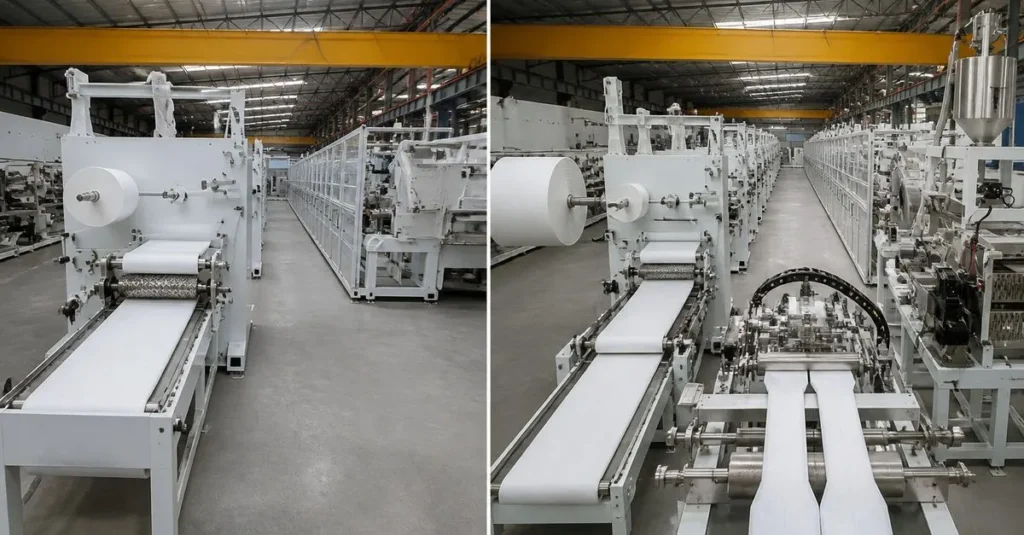
Every roll of raw material — non-woven, PE film, elastic tape — enters the production line through an unwinding station. The unwinding system's job is to feed that material at a consistent tension, at a consistent speed, without stretch, drift, or splice failure.
This sounds straightforward. In practice, it is one of the most consequential systems on the line — because every material that enters with incorrect tension will affect every downstream process it touches.
Non-woven fabric that is fed under too much tension will stretch slightly as it enters the line. Stretched non-woven changes its effective width. A material that is specified at 220mm wide may enter the core lamination station at 215mm if the tension is too high — and that 5mm deficit will show up as a core placement offset in the finished product. At 600 units per minute, that offset runs through thousands of units before anyone catches it.
PE film that is fed under inconsistent tension will develop micro-wrinkles at the back sheet lamination point. Those wrinkles create areas where the leakage barrier is not fully bonded — invisible in appearance inspection, but present as failure points when the diaper is wet.
The real question is whether your unwinding system can maintain consistent tension from a full roll to the core — because as the roll depletes, its diameter decreases, its inertia decreases, and the force required to unwind it changes. A full servo unwinding system compensates for this change in real time. A mechanical or semi-servo system does not compensate fast enough, and the tension variation accumulates through every production shift.
Key Parameters to Confirm for Each Unwinding Station
- Maximum roll diameter and core diameter the station can accommodate.
- Tension range for each material type — non-woven, film, elastic, tape.
- Automatic splicing capability and splice time to minimize production interruption.
- Edge guiding system to prevent lateral material drift across a full roll.
- Dancer roller or load cell feedback for real-time tension correction.
3. Fiber Opening and Fluff Pulp Preparation
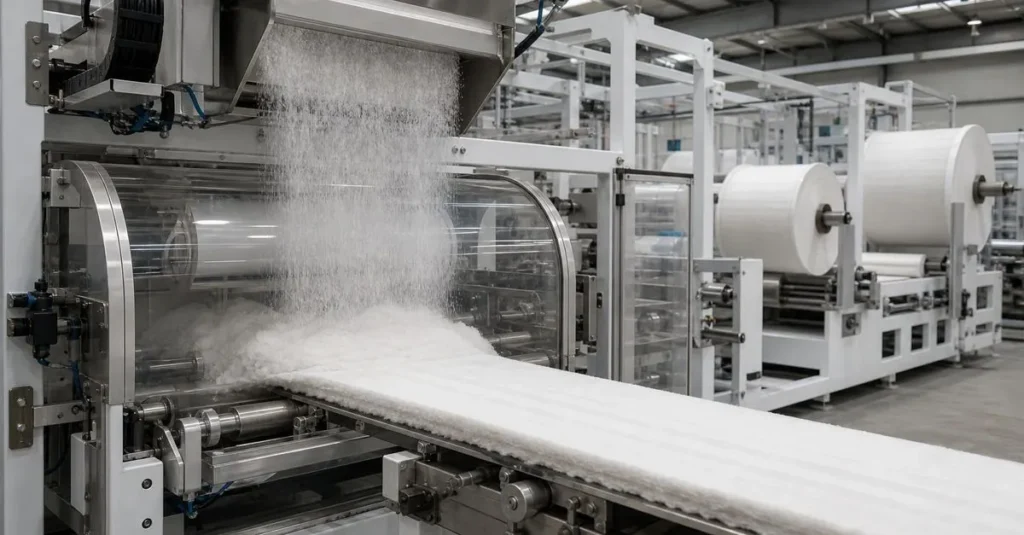
Fluff pulp arrives at the factory in compressed board form. Before it can be formed into an absorbent core, it must be opened — separated from its compressed state into individual fibers that can be distributed evenly across the forming drum.
The fiber opening system takes the compressed pulp board, feeds it through a hammermill or defibrator, and produces a consistent stream of opened fiber that flows into the forming system. The quality of that fiber stream determines everything about the core that comes out of the forming drum.
If the fiber opening rate is too slow, the fiber stream becomes irregular — thin in some sections, dense in others. The forming drum will form cores with uneven basis weight, which means some products have less absorbency than specified, and others have more. The product passes appearance inspection because it looks the same. It fails absorbency testing because the core weight varies by 15 to 20 percent across a production run.
If the fiber opening rate is too fast, the fibers can break into shorter lengths that do not interlock properly in the core matrix. Short fibers create a core that is structurally weaker — it holds its shape in the package but collapses under pressure when wet, which means poor rewet performance and leakage under load.
The fluff pulp specification matters here. Different pulp grades have different fiber lengths and different opening characteristics. A hammermill calibrated for one pulp grade may over-open or under-open a different grade at the same speed setting. When a factory changes pulp suppliers without recalibrating the fiber opening system, the core quality changes — and the cause is not obvious to an operator who has not been trained to connect fiber opening performance to finished product quality.
4. SAP Distribution: The Most Sensitive Variable in Core Quality
SAP — Super Absorbent Polymer — is the material that gives a baby diaper its absorbency. It is distributed into the fluff pulp matrix during the forming process, either by a dedicated SAP spreader positioned above the forming drum or by a combined fiber-and-SAP distribution system inside the drum itself.
The target SAP distribution for a standard baby diaper core is a specific weight of SAP per unit area, with a defined concentration pattern — typically higher in the front and back sections of the core than in the center, or distributed evenly depending on the product design. Any deviation from that target pattern affects absorbency performance.
SAP distribution failures are the most difficult quality problem to catch during production — because SAP is invisible inside the finished core, and the consequences of uneven distribution only appear when the product is wet. A diaper with SAP clustered in one area will feel firm and protective in that zone and fail immediately outside it. A diaper with SAP migration — where SAP particles shift from their distribution point during the forming process — will have unpredictable absorbency performance across the product surface.
The SAP particle size specification matters. Coarser SAP particles are easier to distribute evenly but have a slower absorption rate. Finer SAP particles absorb faster but are more prone to migration during the forming process and more likely to cause "gel blocking" — a condition where the surface of the SAP particle gels before the interior, blocking further absorption. The SAP grade must be matched to the product design and the forming system configuration.
- SAP addition rate is calibrated in grams per unit, not as a fixed machine setting — it must be adjusted if production speed changes.
- SAP distribution uniformity should be verified by core dissection and weighing of sections, not by appearance.
- SAP particle size affects both distribution behavior and finished product absorbency performance.
- SAP from different suppliers with the same nominal grade may have different particle size distributions — always test with the actual material before full production.
5. The Forming Drum: Where the Core Takes Shape
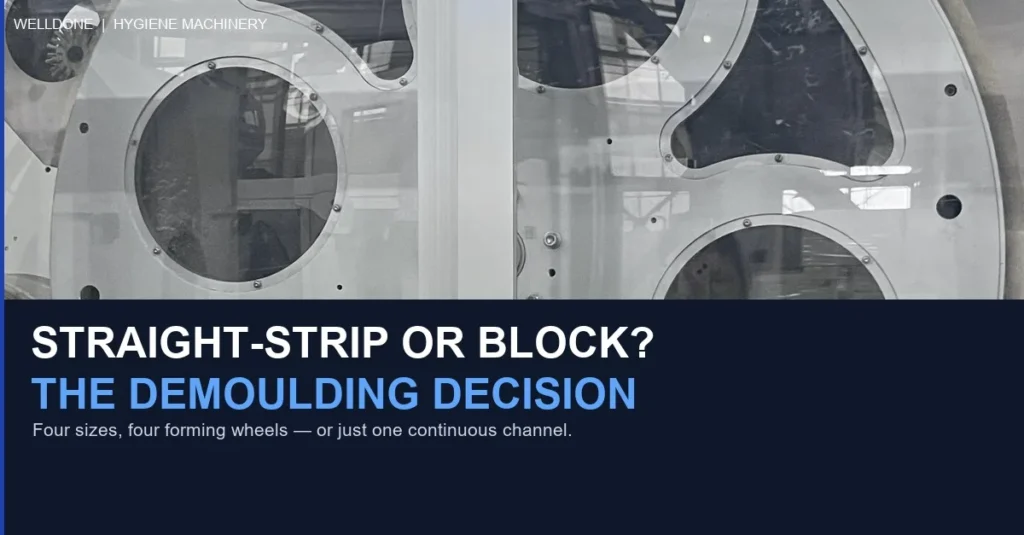
The forming drum is the mechanical heart of the front-end production system. It is a rotating cylinder with shaped molds on its surface — one mold for each diaper core size the line produces. As the drum rotates, fluff pulp and SAP are drawn into each mold by vacuum, forming the absorbent core in the target shape and weight.
The forming drum operates at high speed — on a standard baby diaper line running at 500 to 600 units per minute, each core mold is filled and released in approximately 100 milliseconds. In that 100 milliseconds, the vacuum must draw the correct weight of fiber into the mold, the SAP must distribute to the target pattern, and the core must achieve sufficient structural integrity to transfer cleanly to the next station without distortion.
Every parameter of the forming drum is interdependent. Drum rotation speed. Vacuum level inside each mold zone. Fiber feed rate from the hammermill. SAP injection rate and timing. The temperature of the air flowing through the system. Change any one of these without compensating in the others, and the core weight, core density, or SAP distribution will shift.
I believe the forming drum is the section of the baby diaper machine that requires the most thorough explanation during operator training — and the section that receives the least. Operators are shown how to start and stop the drum. They are rarely shown how to interpret the relationship between drum speed, vacuum level, and core weight variation — which means that when core weight drifts during a production shift, they adjust the wrong parameter and make the problem worse.
What Operators Need to Understand About the Forming Drum
- How drum rotation speed relates to fiber residence time in each mold cavity.
- How vacuum level in each mold zone affects fiber density and SAP retention.
- How to read core weight data from the inline weight checker and connect it to drum parameters.
- What a "bridging" failure looks like — when fiber bridges across the mold opening rather than filling it uniformly.
- How to identify SAP migration by examining core cross-sections rather than surface appearance.
6. Vacuum Calibration: The Parameter Nobody Explains
The vacuum system inside the forming drum is what draws fiber and SAP into the core molds and holds the formed core in place until it transfers to the next production stage. It is also the parameter that most operators have never been explained in enough detail to adjust correctly when something changes.
The forming drum typically has multiple vacuum zones — each zone covers a different arc of the drum's rotation cycle, and each zone has a different vacuum level. The forming zone, where fiber and SAP are drawn into the mold, requires a higher vacuum level. The release zone, where the formed core detaches from the mold onto the transfer conveyor, requires a lower vacuum level. If the release zone vacuum is too high, the core sticks to the drum and deforms during transfer. If it is too low, the core releases before it is fully formed.
Vacuum calibration is not a one-time setup. It changes with production speed — higher drum speed requires higher vacuum to maintain fiber density in the shorter time each mold spends in the forming zone. It changes with fiber moisture content — wetter fiber requires more vacuum to pull into the mold. It changes with ambient temperature and humidity — both of which affect the airflow through the system.
In most cases, vacuum calibration drifts during a production shift as the factory environment changes through the day. A line that was producing consistent 6-gram cores at the start of the morning shift may be producing 5.7-gram cores by the afternoon if nobody has checked the vacuum levels since startup. That 0.3-gram variation does not seem significant. Across a 400,000-unit production day, it represents 120 kilograms of fluff pulp that is either not going into the product — or being wasted.
7. Core Transfer and Compression: Protecting the Core Before It Leaves the Front End
After the core forms in the drum mold, it must transfer to the main production conveyor without losing its shape, its weight distribution, or its structural integrity. This transfer happens at high speed on a vacuum conveyor or suction belt that holds the core flat and moves it to the compression rollers.
The compression rollers are the final stage of the front-end system. They apply controlled pressure to the formed core, compacting it to the specified thickness and improving its structural cohesion before it enters the middle section of the line where the top sheet, back sheet, and functional components are assembled around it.
Compression pressure must be calibrated carefully. Too much compression collapses the fluff matrix and reduces the void volume that gives the core its absorbency capacity. Too little compression leaves the core structurally loose — it will shift and deform during the assembly process, creating misalignment between the core and the functional layers applied above and below it.
Core transfer failures — where the core arrives at the assembly section distorted, folded, or off-center — are one of the most disruptive problems in baby diaper production. They cause immediate machine stops, high waste during restart, and often require manual clearing of the transfer path. An operator who understands the relationship between vacuum conveyor suction level, transfer speed, and compression pressure can prevent most of these failures by catching the early signs before they cause a full stoppage.
8. Front-End Problems, Their Real Causes, and What to Check First
When something goes wrong in the front end of a baby diaper line, the symptom and the cause are rarely in the same place. Core weight variation shows up in the finished product — but the cause may be in the fiber opening rate, the vacuum calibration, the pulp moisture content, or the SAP injection timing. An operator who only checks what is visible will not find the cause.
Core weight variation across a production shift
Check fiber opening rate consistency first. Then check vacuum level in the forming zone — vacuum drift is the most common cause of gradual core weight change during a shift. If both are stable, check pulp board moisture content — a wetter board opens differently and produces different fiber density at the same hammermill speed.
SAP visible on the surface of the core or migrating to the edges
Check SAP particle size against specification. Finer particles migrate more easily. Then check the timing relationship between SAP injection and fiber forming — if SAP is injected before the fiber bed is established in the mold, it will not be retained in the matrix and will migrate to the edges or surface.
Core arrives at assembly section misaligned or folded
Check transfer conveyor vacuum level and belt speed against drum speed. A speed mismatch between the drum surface and the transfer conveyor will stretch or compress the core during handoff. Also check compression roller pressure — if pressure is uneven across the roller width, the core will exit with a thickness gradient that causes it to curl or fold on the conveyor.
Splice failures at roll changes causing core weight drop
Check unwinding tension at the splice point. Most splice failures cause a brief tension spike or drop as the new roll accelerates. If the tension spike is large enough, it pulls the fiber feed slightly off-rate at the exact moment the splice passes through the system, creating a low-weight core at the splice position. An automatic tension compensation system on the unwinding station minimizes this effect.
Why Welldone
Welldone is a hygiene product machinery manufacturer under Quanzhou Shimao Weiteng Import and Export Co., Ltd. We have been building baby diaper machines, sanitary napkin machines, adult care machines, and related hygiene product equipment for more than 18 years.
When we commission a baby diaper line, we do not hand over the machine and leave. We walk the operators through each section of the front-end system — the unwinding stations, the fiber opening system, the SAP distribution, the forming drum, and the transfer conveyor — until the team understands not just how to run each section, but why it behaves the way it does when raw materials or environmental conditions change.
That understanding is what allows a factory to catch problems early, adjust correctly, and maintain stable core quality without waiting for an engineer to fly in every time something shifts.
Full Front-End Engineering
Forming drum, vacuum system, SAP distribution, and unwinding stations designed and calibrated as an integrated system — not assembled from separate components.
Raw Material Compatibility
Machine parameters calibrated for the buyer's specific fluff pulp grade, SAP specification, and local raw material properties before shipment.
Operator System Training
Training covers the full front-end logic — not just button operations, but the parameter relationships that determine core quality on every shift.
Related Machines
Baby Care Machines
Full servo baby diaper machines and pull-up diaper machines with integrated front-end forming systems, SAP distribution, and unwinding stations.
Learn MoreAdult Care Machines
Adult diaper production lines with high-grammage forming systems designed for larger core volumes and heavier raw material rolls.
Learn MoreFemale Care Machines
Sanitary napkin and panty liner production lines with core forming systems calibrated for female care product specifications.
Learn MorePet Care Product Machines
Pet pad production lines with absorbent core forming systems adapted for pet hygiene product specifications and size ranges.
Learn MorePaper and Wet Wipes Machines
Wet wipes and tissue production lines for buyers building multi-product hygiene manufacturing operations alongside diaper lines.
Learn MoreUnderpad Machine
Disposable underpad production lines with forming systems for medical, elderly care, and home care absorbent product specifications.
Learn MoreConclusion
The front end of a baby diaper production line — from raw material unwinding through fiber opening, SAP distribution, forming drum, and core transfer — is where the quality of every product on the line is determined. It is also the section of the line that most new factory operators understand least well before production starts.
Understanding these systems before the line runs is not optional for a factory that wants to produce consistent, sellable product from the first production week. It is the difference between a factory that troubleshoots problems after they appear in the finished product, and a factory that catches parameter drift before it affects a single unit.
Part 2 of this series covers the middle section of the baby diaper production line — the functional component assembly systems, including leg cuff application, waist elastic, frontal tape, and the sealing and cutting systems that complete the diaper structure.
"If your operators cannot explain what happens between the pulp board and the formed core, they cannot troubleshoot core quality problems. And core quality problems will come."
FAQ
Why does fluff pulp fiber length affect core quality in baby diaper production?
Longer fibers interlock more effectively in the forming drum, creating a more cohesive core structure with better wet integrity. Shorter fibers — either from a different pulp grade or from over-opening in the hammermill — produce a core that is structurally weaker under wet load, which increases the risk of core collapse and leakage. The pulp specification should match the forming system parameters, not be treated as interchangeable between suppliers.
How do I know if my SAP distribution is correct without dissecting every product?
The most reliable production-floor method is periodic core dissection — cutting cores at defined intervals across the width and measuring SAP content by section weight after separation. A simpler inline indicator is finished product absorbency testing at defined sample intervals. If absorbency results vary by more than 10 percent between samples at the same production speed, SAP distribution is the first parameter to investigate.
Can the forming drum be adjusted to produce different core sizes without major mechanical changes?
Yes, within a defined size range. Welldone's baby diaper machines are designed with interchangeable forming drum molds that allow different core sizes and weight specifications without replacing the full drum assembly. Changeover requires calibrating fiber feed rate, SAP injection rate, and vacuum levels for the new mold geometry — a process that is documented and included in operator training.
How often should vacuum calibration be checked during production?
We recommend a formal vacuum level check at the start of each shift and after any production speed change. In factories with significant ambient temperature variation between morning and afternoon shifts, a midshift check is also advisable. The core weight data from the inline weight checker provides a continuous indirect indicator — consistent core weight within specification means vacuum calibration is stable. A gradual drift in core weight during a shift, with no other parameter changes, usually indicates vacuum level drift.
What information should I provide to Welldone before ordering a baby diaper machine?
The most useful pre-order information includes: target product sizes and core weight specifications, fluff pulp grade and supplier specification sheet, SAP grade and particle size data, top sheet and back sheet material specifications, target production speed range, and local raw material availability. This information allows us to calibrate machine parameters before shipment and design a training program that is specific to your materials and production targets — not a generic walkthrough that does not reflect your actual production conditions.
Planning a Baby Diaper Production Line?
Talk to us before you finalize your machine decision. Share your raw material specifications, product size range, and production targets — and we will walk you through the full front-end system configuration before anything is built.
Website: www.cnwelldone.com | Email: welldone@cnwelldone.com
Contact Welldone Today