Adult Pull-Up Diaper Machine: Why Retrofitting a Baby Line Fails

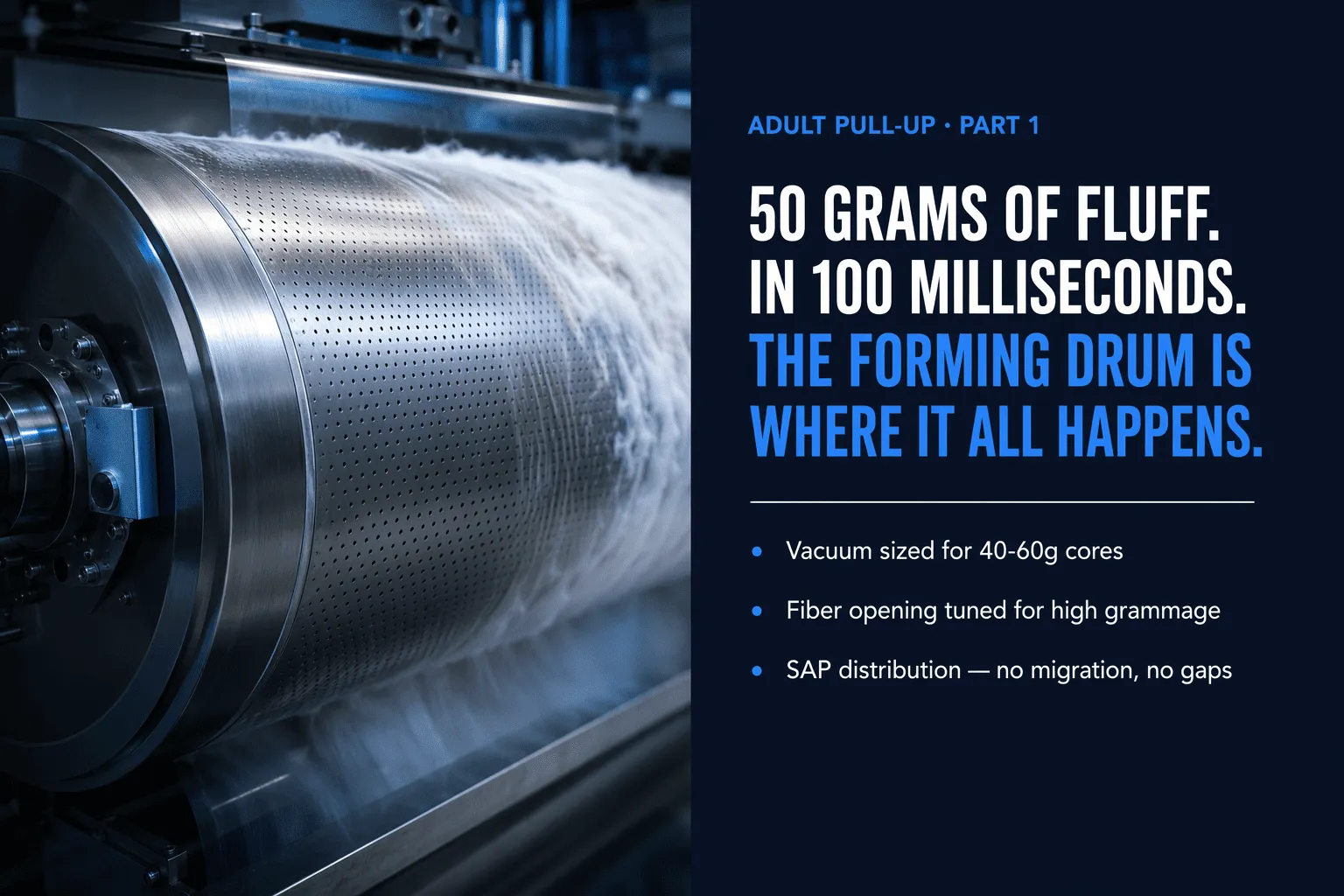
Adult Pull-Up Diaper Machine: A Complete Guide to Raw Material and High-Grammage Core Forming — Part 1 of 3
In the last six months we have talked to at least twelve investors — mostly in India, Southeast Asia, and the Middle East — who want to add adult pull-up production to a factory already making baby diapers.
Almost all of them ask the same first question. "Can we modify our existing baby line to run a bigger product?"
The honest answer is that you can. And it will run. And it will disappoint you.
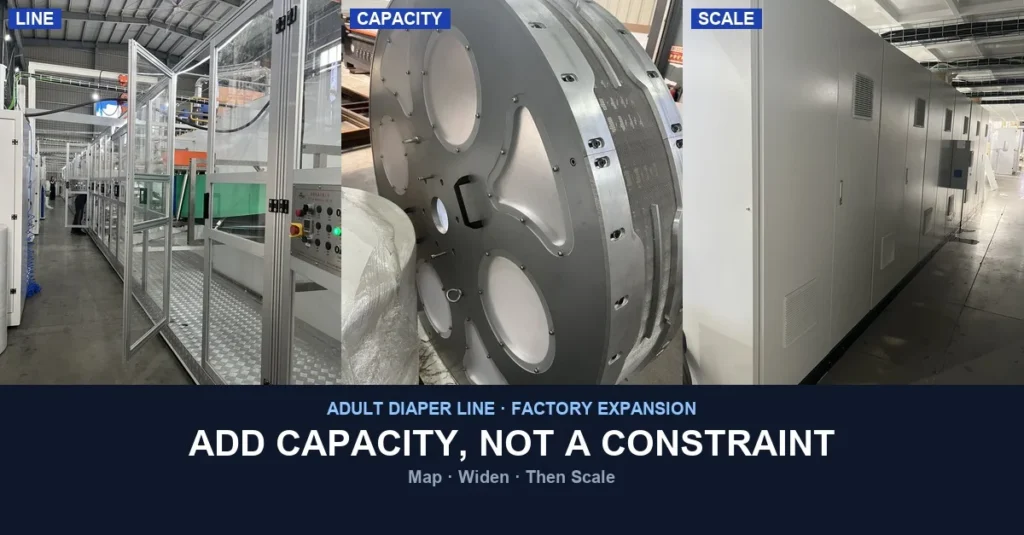
Adult pull-up diapers do not belong to the same mass class as baby diapers, or even tape-style adult diapers. They carry 40 to 60 grams of fluff pulp and SAP per unit — four to five times a baby diaper core. They use raw material rolls that can weigh over 400 kilograms. Every section of the front end of the line — the pulp rack, the fiber opener, the forming drum, the vacuum system, the compression rollers — has to be engineered for that mass from the beginning. Not adapted to it after the fact.
This is the first of a three-part series that walks through the complete adult pull-up production line, station by station, the way a Welldone engineer would walk a buyer through it before installation. Part 1 covers the front end — from raw material intake through the compressed core ready for assembly.
"In adult pull-up production, the front end is not one component to optimize. It is a single system where every station has to match the mass of the core — or the whole line underperforms together."
1. Understanding the Mass Class Before You Buy a Machine
The single most important number in an adult pull-up production project is the target core weight. Everything else on the line is engineered around it.
A baby diaper core weighs 10 to 12 grams. A standard adult tape-style diaper core weighs 25 to 35 grams. An adult pull-up core weighs 40 to 60 grams, depending on absorbency grade and target market.
That jump from 12 grams to 50 grams sounds simple. In practice it changes almost every mechanical parameter on the front end of the line. Vacuum pressure, fiber feed rate, unwinding brake logic, transfer belt speed, compression roller force — every one of these was tuned for a specific mass range. Push a system tuned for 12 grams to handle 50 grams, and it does not just work less well. It works unpredictably.
Actually, this is why most core weight variation problems in retrofit projects are not operator errors. They are physics problems. The machine is being asked to handle a mass class it was never engineered for.
| Product Type | Typical Core Weight | Typical Roll Weight | Front-End Sizing Class |
|---|---|---|---|
| Baby diaper | 10 to 12 g | 60 to 90 kg | Light-mass class |
| Adult tape diaper | 25 to 35 g | 200 to 280 kg | Medium-mass class |
| Adult pull-up diaper | 40 to 60 g | 350 to 450 kg | High-mass class |
2. The Pulp Rack: Where Raw Material Handling Begins
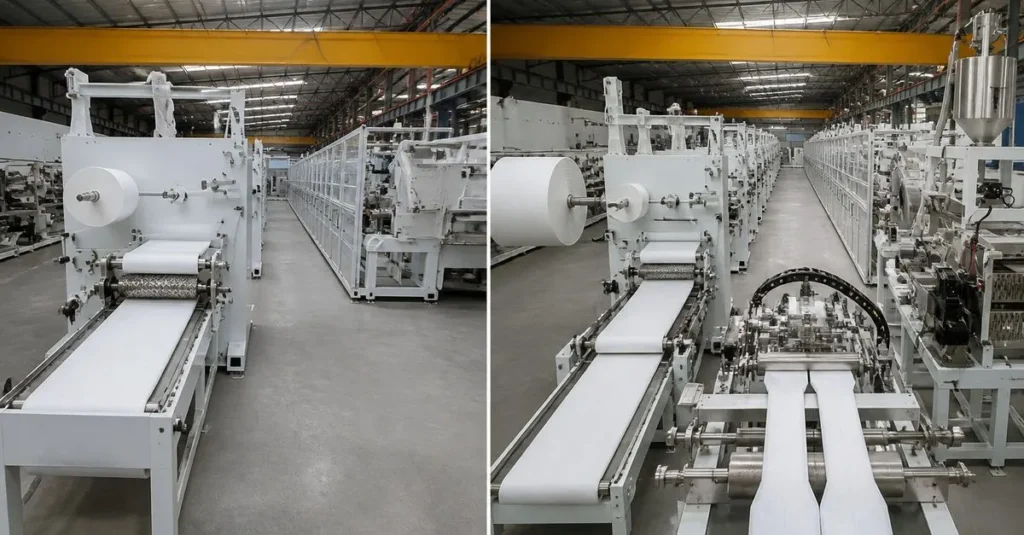
The pulp rack is the first mechanical station on the line. Fluff pulp arrives as compressed sheets or rolls, gets loaded onto the rack, and feeds into the crusher and fiber opening system.
For adult pull-up production, the pulp consumption rate is roughly three to four times higher than baby diapers at the same production speed. That means the pulp rack has to hold larger rolls, support more frequent roll changes, and integrate with an unwinding system that can maintain consistent tension as heavier rolls deplete.
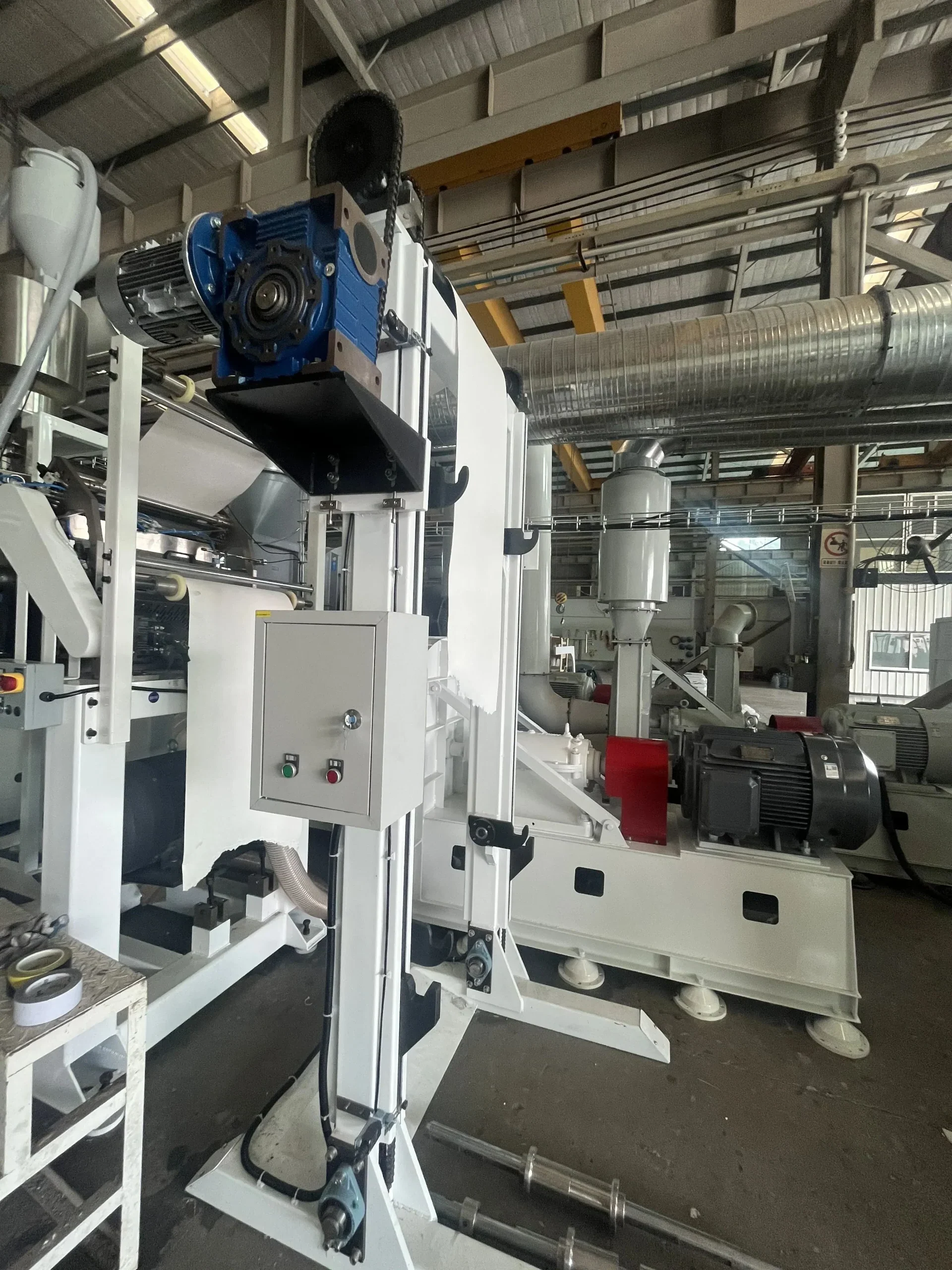
If the pulp rack is undersized for the target production rate, roll changes become the bottleneck. Operators spend a significant part of every shift loading new rolls instead of monitoring production. And every roll change is a moment where pulp feed rate briefly dips — which shows up as a small core weight dip downstream. On a properly sized rack, roll changes are infrequent enough and fast enough that they do not affect the production rhythm.
3. Fiber Opening for High Grammage: The Rate That Matters
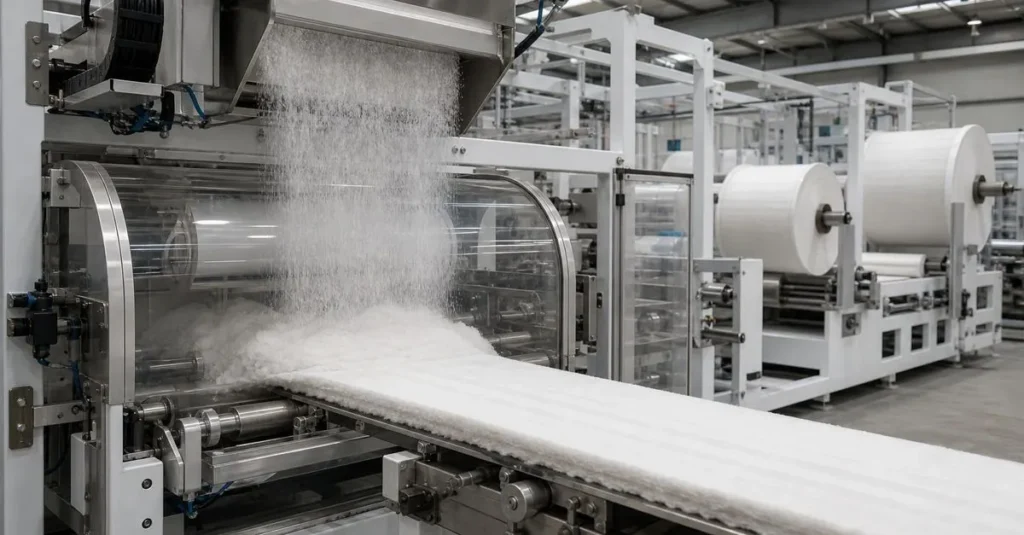
The crusher and fiber opening system takes compressed pulp and breaks it into individual fibers that can be transported to the forming drum. This sounds mechanical. In practice it is one of the most delicate operations on the front end, because the fiber length coming out of the opener determines the structural integrity of every core downstream.
For adult pull-up, the fiber opening system must deliver a much higher feed rate to keep up with 40 to 60 gram cores forming at production speed. If the opener runs too slowly, the drum cavity does not fill — you get light, weak cores. If the opener runs too fast to force higher output from an undersized unit, fiber gets broken. Short fibers do not interlock. They cannot hold SAP in place. The core looks correct by weight, but performs poorly under load.
The real question is not just whether the fiber opener can hit the throughput number. It is whether it can hit that number without breaking fiber length below the threshold that keeps the core structurally sound.
4. The Forming Drum: Where the Mass Class Shows Up
The forming drum is the mechanical heart of the front end. Fiber and SAP feed into shaped mold cavities on the drum surface, vacuum pulls them into the mold, and the formed core transfers out at drum rotation speed.
Every dimension of the drum has to be sized for the target core. A drum designed for 12-gram baby cores has small mold cavities and moderate vacuum. Trying to form a 50-gram core in the same cavity leaves the outer fiber layers under-compacted — because the vacuum was never sized for that mass class. The result is core weight variation the operator cannot fix with parameter adjustment.
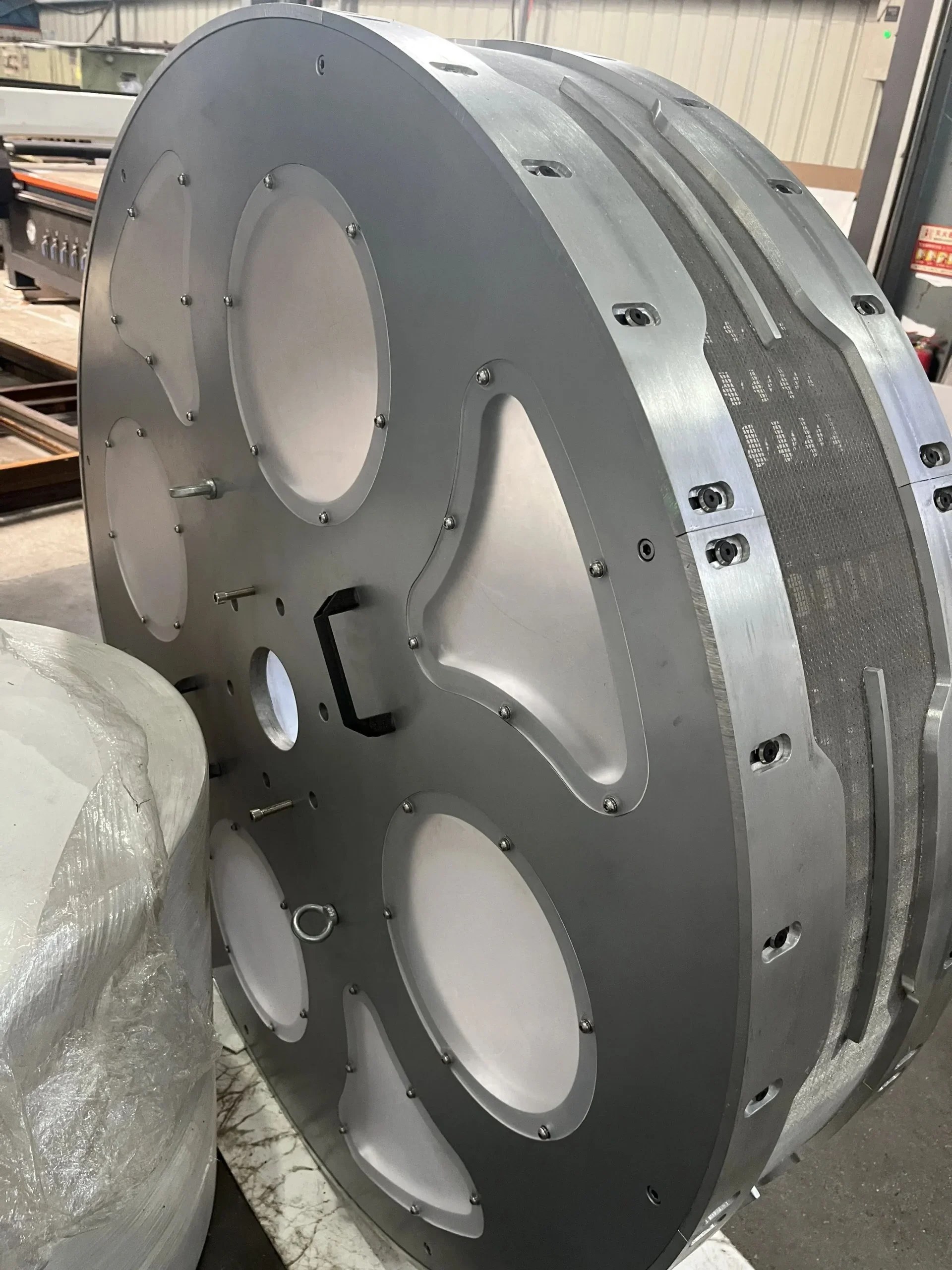
A drum designed for adult pull-up has larger cavity volume, deeper vacuum channels, and SAP injection nozzles positioned for the wider fiber flow. It is not a bigger baby drum. It is a differently engineered component built around a different mass class.
In most cases, this is the single most expensive difference between a retrofitted baby line and a purpose-built adult pull-up line. And it is also the difference operators feel first — because core weight consistency is the number they see on their inline weight checker every hour of every shift.
5. Vacuum and SAP Distribution: Where Quality Is Made or Lost
Two invisible variables inside the forming drum determine finished product performance more than anything else on the front end. Vacuum pressure across the mold cavity, and SAP distribution timing during core formation.
The vacuum system pulls fiber into the mold cavity and holds it in place until the core transfers out. For a 50-gram core, the vacuum has to be strong enough to fully seat fiber against the deepest points of the cavity — otherwise you get low-density zones near the mold walls that will collapse under compression downstream. But it cannot be so strong that it pulls SAP granules through the fiber bed and out the vacuum channels — otherwise you lose SAP before it is ever incorporated into the core.
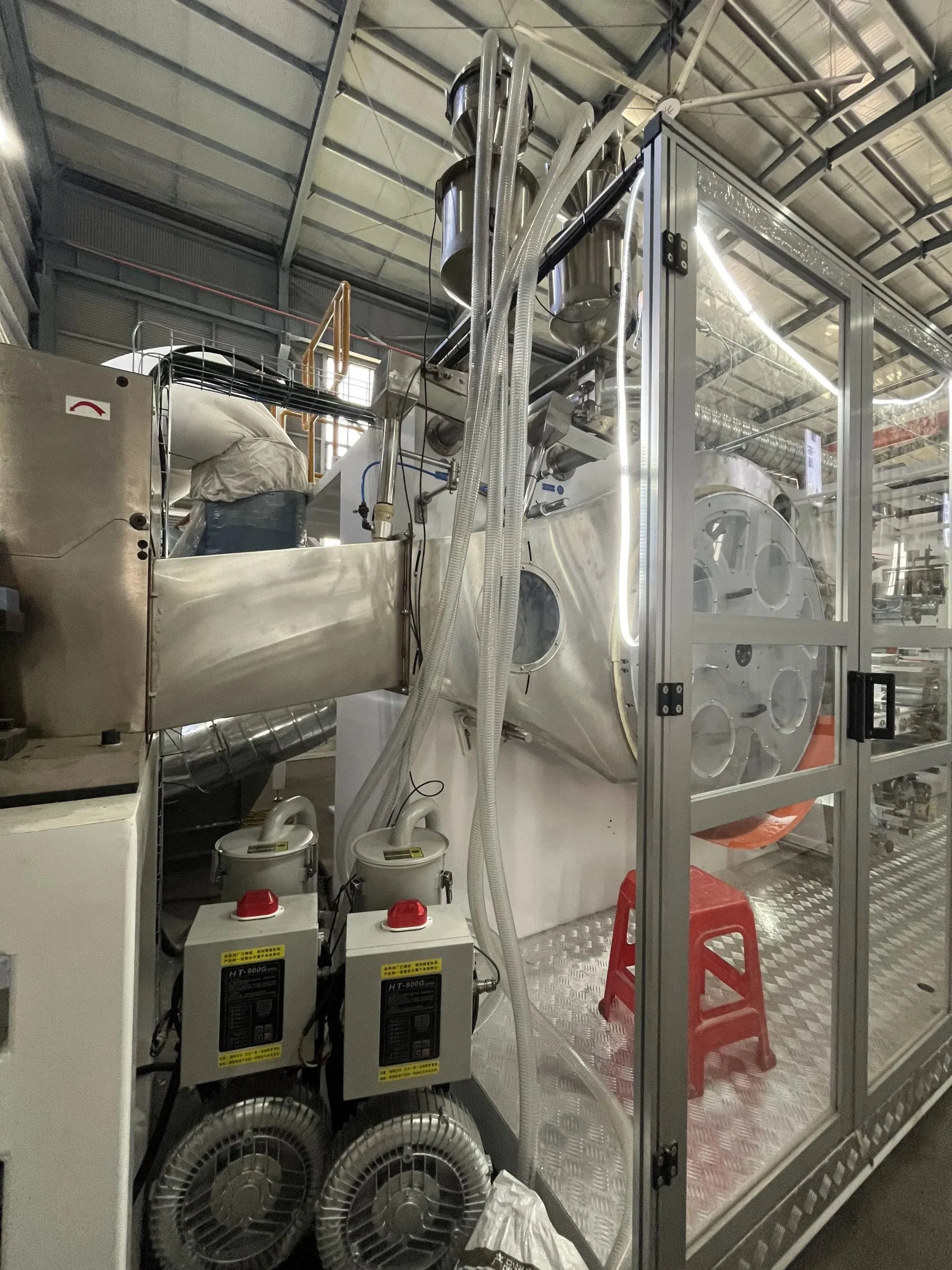
SAP distribution timing is the other half of the equation. SAP has to enter the fiber flow at the right point — early enough to disperse through the full core volume, late enough that it is not lost through the vacuum. Get the timing wrong, and SAP concentrates in one zone of the core. The product weighs correctly on the inline checker but leaks in absorbency testing, because half the core has excess SAP and the other half has almost none.
These are not adjustments an operator can make on a running line. They are engineered parameters that need to be right when the machine is designed.
6. Core Wrapping: Protecting the Core Before Assembly
After the core transfers off the forming drum, it is wrapped in tissue paper. The upper and lower tissue layers hold the formed core together during subsequent handling and provide a stable surface for adhesive bonding in the assembly section.
For adult pull-up, the tissue wrapping has to accommodate a physically larger and heavier core. Tissue tension and wrapping alignment become more critical because any wrinkling or misalignment gets amplified as the heavier core moves down the line. A tissue wrap that would be cosmetically acceptable on a baby diaper can cause visible surface defects on an adult pull-up.
Wrapping quality also affects the next step — compression. A core with wrinkled tissue wrap does not compress evenly, which means the final core thickness varies across each unit. That thickness variation then affects how the product feels to the end user.
7. Core Compression and Embossing: Setting Density Before Assembly
The formed and wrapped core moves into the compression rollers, where controlled pressure sets the final core density and thickness. For adult pull-up, this is also where the embossing pattern is applied to the core surface, giving it the visible texture that consumers associate with high-quality products.
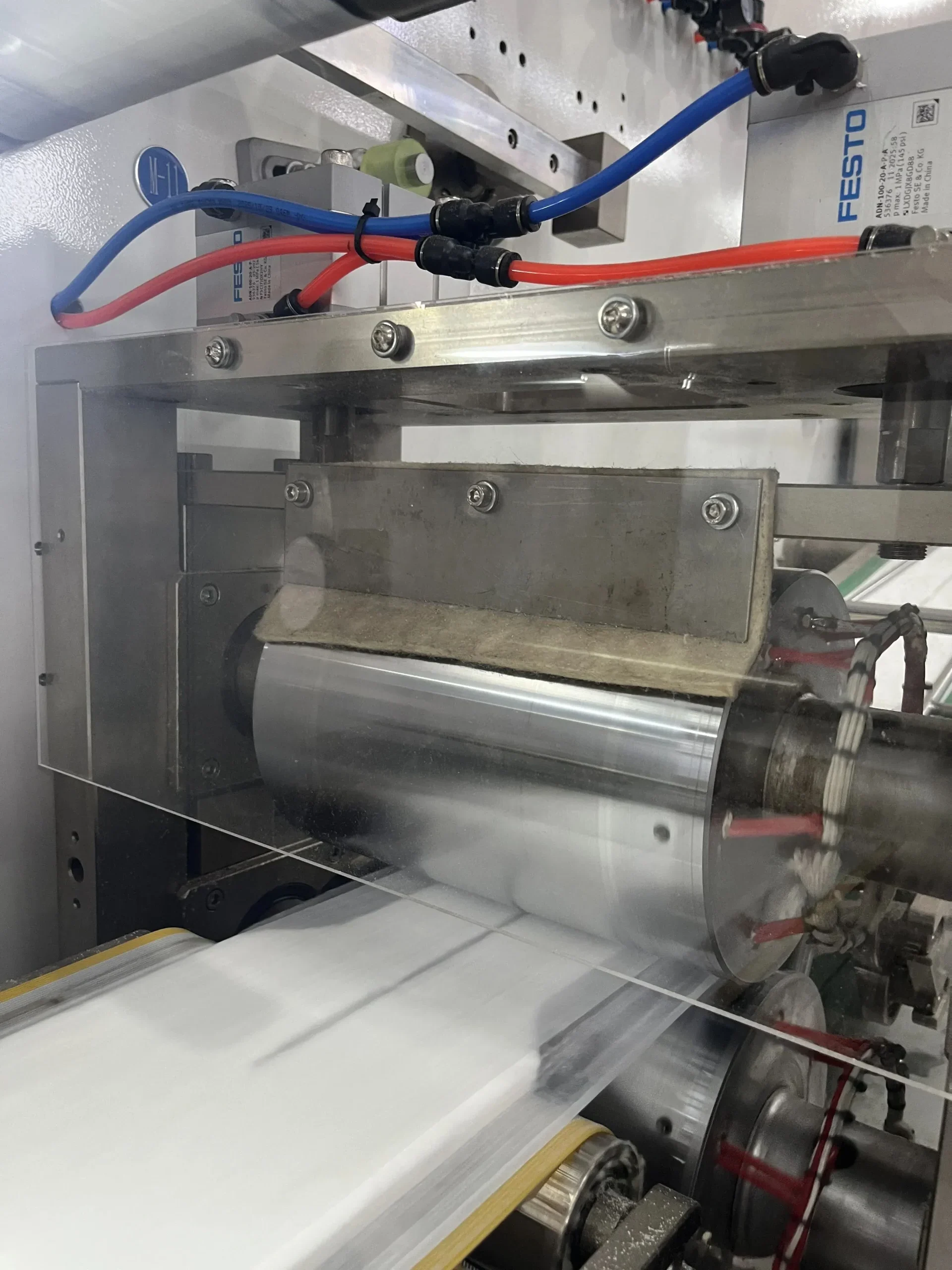
Compression pressure has to be calibrated to the core mass. Too little pressure and the core stays too thick, causing packaging problems downstream. Too much pressure and you crush the fiber structure, damaging absorbency performance. On adult pull-up lines, the compression force is significantly higher than on baby lines — which means the rollers, their bearings, and the frame supporting them all have to be built for higher loads.
By the time the core exits the compression station, it is dimensionally stable, structurally sound, and ready to enter the assembly section of the line — where the top sheet, back sheet, elastics, and closure components will be added around it.
8. The Retrofit Trap: What Really Happens When You Try to Modify a Baby Line
I understand why buyers ask about retrofit. A new production line is a significant capital investment. If an existing line can be modified for less money, that looks like the smart business decision.
Here is why it usually is not.
A baby diaper front end is a matched system where every component is sized for the 10-12 gram mass class. When you upsize the forming drum to accept a 50-gram core, you have not solved the problem. You have moved it. The vacuum system is still baby-sized. The unwinding brakes are still baby-sized. The transfer belt is still baby-sized. The compression rollers are still baby-sized. Every one of those components will now underperform against a mass class they were never engineered for.
Retrofit projects typically end up producing adult pull-up product at 55 to 65 percent of the line's rated speed, with 6 to 10 percent waste, and with core quality problems that show up as customer complaints about leakage and inconsistent absorbency. The financial math that made retrofit look attractive stops working once these production inefficiencies show up in the monthly numbers.
A purpose-built line costs more upfront. It produces at rated speed from the first stable shift, with waste rates typically below 2%, and with core quality consistent enough to compete in premium market segments. Over an 18-24 month payback period, the purpose-built line consistently outperforms the retrofit — even after accounting for the higher capital cost.
9. Questions Every Adult Pull-Up Buyer Should Ask Before Ordering
What is the target core weight range for the products you plan to produce?
This determines every front-end sizing decision. A supplier who does not ask this question in the first conversation is not thinking about your project as a system.
What is the maximum raw material roll weight the unwinding stations are designed for?
For adult pull-up, this needs to be 350-450 kg minimum. Anything designed for baby-sized rolls will show splice failures within the first weeks of production.
What is the expected core weight tolerance in stable production?
A properly designed adult pull-up front end should achieve ±3 grams or better under stable conditions. Anything wider than ±5 grams indicates undersized vacuum, undersized fiber opening capacity, or SAP distribution timing issues that will affect finished product performance.
Are the vacuum system and SAP distribution timing engineered together, or added separately?
These two systems have to work as one — separately optimized systems produce cores that look correct by weight but fail in absorbency testing.
What is the fiber length preservation performance of the opening system at target throughput?
High-grammage lines can hit throughput numbers by running the opener too aggressively, which breaks fiber and damages core integrity. A well-engineered system delivers throughput without breaking fibers below the threshold that keeps cores structurally sound.
Why Welldone
Welldone is a hygiene product machinery manufacturer under Quanzhou Shimao Weiteng Import and Export Co., Ltd. We have been building baby diaper machines, sanitary napkin machines, adult care machines, and related hygiene product equipment for more than 18 years.
Our adult pull-up production lines are not adaptations of our baby diaper lines. They are engineered from a different starting point — a different forming drum, a different vacuum system, a different unwinding architecture — because we treat adult pull-up as a distinct mass class that requires its own front-end system.
When buyers come to us for adult pull-up production, we start the conversation with target core weight, target market absorbency requirements, and expected production volume. Those inputs shape the entire front-end configuration. We do not have a "one-size-fits-all" adult pull-up line — because the market does not have a one-size-fits-all product.
Purpose-Built Front End
Forming drum, vacuum system, and unwinding architecture engineered from the ground up for 40-60g core mass — not adapted from baby diaper equipment.
Integrated System Design
Vacuum pressure, SAP distribution timing, and fiber opening rate calibrated together as one system, not optimized separately.
Core Weight Discipline
Stable production tolerance of ±3g on target core weight — the benchmark that separates purpose-built adult pull-up lines from retrofitted alternatives.
Conclusion
Adult pull-up production is one of the highest-growth segments in the global hygiene product market, driven by demographic aging and the format's steady share gain over adult tape-style products. The market opportunity is genuine.
What is not genuine is the assumption that adult pull-up is a variant of adult tape diapers, or that it can be produced cost-effectively by modifying an existing baby diaper line. It belongs to a different mass class — 40 to 60 grams per core, 350-450 kg per raw material roll — and every component of the front-end production system has to be engineered for that mass class from the beginning.
Part 2 of this series covers the middle section of the adult pull-up production line — the assembly of top sheet, back sheet, waistband elastic, leg cuff, and the closure components that turn a formed core into a fully assembled pull-up product. Part 3 covers the back end — packaging, quality control, and production stabilization.
"What is the core weight variation you are seeing on your current line? If it is wider than ±3 grams under stable conditions, the answer is almost never operator training. It is a front-end system that was never engineered for the mass class you are trying to produce."
FAQ
Can a baby diaper machine be modified to produce adult pull-up diapers?
Mechanically it can be modified, and the modified line will produce product. But every front-end component — forming drum, vacuum system, unwinding brakes, compression rollers — will be operating outside the mass class it was engineered for. Retrofit projects typically achieve 55-65% of rated speed with 6-10% waste and inconsistent core quality. A purpose-built line delivers rated speed with sub-2% waste and stable core quality from the first weeks of production.
What core weight tolerance should I expect from a well-designed adult pull-up line?
A properly engineered adult pull-up front end should achieve ±3 grams or better on target core weight under stable production. Anything wider than ±5 grams indicates undersized vacuum, insufficient fiber opening capacity, or SAP distribution timing issues that will show up as absorbency inconsistency in finished product.
How does Welldone design the forming drum for adult pull-up production?
Our adult care machines use forming drums with cavity volume, vacuum channel depth, and SAP injection positioning specifically engineered for the 40-60g mass class. The drum is not a scaled version of a baby diaper drum — it is a purpose-built component designed for high-grammage core formation.
What is the difference between adult tape diaper and adult pull-up production requirements?
Adult tape diapers are in the medium-mass class (25-35g cores, 200-280kg rolls). Adult pull-ups are in the high-mass class (40-60g cores, 350-450kg rolls). Beyond mass, pull-up production also involves waistband elastic assembly and closure engineering that tape-style production does not. The two categories require different machine architectures, not variants of the same platform.
What information should I provide to Welldone before ordering an adult pull-up production line?
The most useful pre-order information includes target core weight range, target absorbency grade, target market and product size range, expected production speed range, and raw material specifications for fluff pulp, SAP, non-woven, and PE film from your intended local suppliers. With this information we can calibrate the machine configuration before shipment and design a training program specific to your materials and production targets.
Planning an Adult Pull-Up Production Line?
Talk to us before you finalize your machine decision. Share your target core weight, target market, and expected production volume — and we will walk you through the front-end system configuration built for your specific mass class.
Website: www.cnwelldone.com | Email: welldone@cnwelldone.com
Contact Welldone Today