Diaper Shift and Changeover Planning Guide 2026 | Welldone

Can Shift and SKU Sequencing Recover Diaper Line Capacity?
At 22:40, the night-shift plan changes. A rush order is inserted between two scheduled sizes, the prepared roll set no longer matches the next recipe, and the line pays for another stop, another cleanup and another restart. Nothing has broken. The schedule has created the loss.
Expanding and Upgrading Baby Diaper Production Capacity · Part 3
Part 1 calculated the required qualified output and line count.
Part 2: separate the output gap into availability, performance, quality and packing losses.
Part 3 — this article: test whether shift allocation, campaign length and changeover sequence can recover capacity before hardware is specified.
Next: use the remaining hardware-only loss to compare retrofit, added modules and a new line.
Part 1 calculated the required qualified output and line count.
Part 2: separate the output gap into availability, performance, quality and packing losses.
Part 3 — this article: test whether shift allocation, campaign length and changeover sequence can recover capacity before hardware is specified.
Next: use the remaining hardware-only loss to compare retrofit, added modules and a new line.
Carry the Part 2 loss tree into a weekly production board
Part 2 solved a diagnostic problem: it identified which SKU, shift and station owned the lost hours. This article continues with a different decision. It asks which losses disappear when the same demand is scheduled in a better order, and which losses remain even after the schedule is disciplined.
A common mistake is to move directly from a large downtime total to a machine investment request. First mark every event in the loss tree as recurring, avoidable, movable or hardware-bound. A changeover required by customer demand is recurring. A second changeover created by splitting the same SKU into two short campaigns may be avoidable.
- Use one planning horizon that reflects the real order cycle.
- Keep the same qualified packed-output boundary used in Part 2.
- Assign each loss to an SKU, shift and reason code.
- Separate a scheduling opportunity from an assumed engineering improvement.
Classify schedule losses before trying to remove them
Not every stopped minute is available for recovery. Product demand may require a size change. Hygiene rules may require cleaning. A roll may reach its safe change point. The planning team should therefore classify the event before placing a recovery value beside it.
| Loss class | Planning question | Possible no-capex action | Evidence required |
|---|---|---|---|
| Fragmented campaign | Was the same SKU scheduled twice in one horizon? | Consolidate demand into one protected run | Order due dates and inventory limit |
| High-burden sequence | Did adjacent SKUs require the largest material and recipe changes? | Move through the lowest-change path | Observed changeover matrix by SKU pair |
| Separate service windows | Were cleaning, roll replacement and inspection stopped independently? | Combine compatible tasks in one controlled window | Task duration and safety constraints |
| Handover restart | Did the next shift stop a stable line to re-check settings? | Use a signed running handover | Shift log and first-good release rule |
| Hardware-bound | Does the loss remain under the best repeatable schedule? | None claimed | Repeated best-shift result |
Actually, the label “planned stop” does not make a loss efficient. A stop can be planned and still be duplicated, badly sequenced or scheduled after the line has already been interrupted for another compatible task.
Fix campaign length before adding another shift
A campaign is the uninterrupted quantity of one SKU produced before the line changes to another. Short campaigns improve responsiveness, but they increase the number of transitions paid by the factory. Long campaigns protect runtime, but they consume working capital and warehouse space if demand cannot absorb the output.
The planning decision is therefore not “run longer.” It is to set a minimum economic campaign by SKU using verified changeover loss, confirmed demand, shelf-life policy, warehouse capacity and delivery dates. The campaign should be long enough to avoid repeating a preventable transition but not so long that inventory becomes the new constraint.
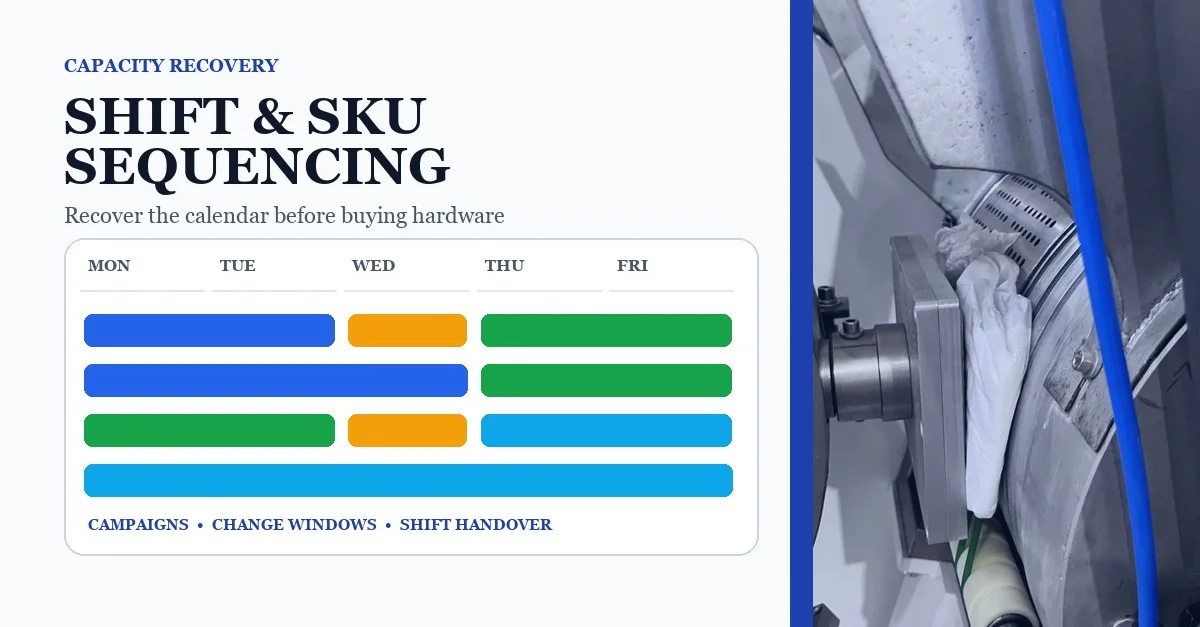
MondaySKU AChangeSKU B
TuesdaySKU B
WednesdayChangeSKU C
ThursdaySKU C
FridayChangeSKU A
The board above is a visual method, not a recommended schedule. Its purpose is to make repeated runs and transition count visible before the production meeting approves the week.
Sequence SKUs by observed change burden, not by label order
Alphabetical order and sales-entry order rarely produce the lowest-change route. Build a matrix from observed changeovers: outgoing SKU on the left, incoming SKU across the top, with total stopped minutes and first-good release time in each cell. The matrix should show direction because A-to-B may not equal B-to-A.
The earlier Welldone article on size changeover explains what changes physically inside one transition. This article does not repeat that tooling discussion. It uses the observed duration of each SKU pair as planning input, then chooses a weekly path that satisfies due dates with fewer high-burden transitions.

In most cases, the best sequence is constrained by more than changeover time. Customer due dates, material availability, packing format and warehouse limits remain hard boundaries. A schedule is improved only when it protects service as well as runtime.
Combine cleaning, roll replacement and inspection into controlled windows
Production teams often stop separately for work that could occur inside one safe, documented window. A planned SKU transition may already require access, cleaning and recipe verification. If a roll is near its approved change point and a routine inspection is due, moving compatible tasks into the same window can prevent a second interruption.
This is not permission to overlap unsafe work. Lockout requirements, access zones and quality-release steps still control the sequence. The planning gain comes from preparing tools, materials and people before the window starts, then executing a written parallel-work plan rather than discovering tasks after the line stops.
- Stage the next material set and verified recipe before the stop.
- List tasks that can run in parallel and tasks that must remain sequential.
- Name the person who releases each task and the person who releases the first good product.
- End the clock at qualified packed output, not at the first machine movement.
Protect shift handover from becoming an unnecessary restart
A stable line should not need to be stopped simply because the crew changes. Yet a weak handover can recreate startup loss: the incoming team rechecks settings, changes an unrecorded adjustment or pauses while waiting for material and quality status.
Use a running handover when site safety and staffing allow it. The outgoing operator records current SKU, material lot, active recipe, open alarms, last quality check, roll condition and expected next intervention. The incoming shift accepts the line against the same record rather than rebuilding the process state from memory.
The real question is whether the best shift can be repeated by the next team. If recovery exists only when one experienced operator is present, the capacity is not yet robust enough to enter the investment comparison as a permanent gain.
Validate recovered capacity with qualified packed output
A better-looking schedule is not evidence of recovered capacity. Run the revised sequence for enough comparable cycles to record transition count, stopped minutes, restart rejects, qualified packed output and late-order impact. Keep the same SKU, BOM and release boundary wherever comparison is intended.
Do not convert every saved minute into sellable output automatically. The recovered window has value only when demand, materials, labor, inspection and packing can use it. If the packing constraint identified in Part 2 remains full, main-line minutes may move the queue without increasing warehouse-released product.
Worked example: convert avoided transitions into a no-capex recovery
Illustrative example only. These figures are not customer data, machine specifications, guaranteed results or a Welldone quotation. Replace the transition counts, durations and qualified-output rate with your own signed production records.
Assume the Part 2 loss sheet shows that campaign consolidation removes three transitions per week. Each avoided transition, measured from last good packed product to first good packed product, averages 50 minutes. Combining compatible cleaning and roll work saves another 30 minutes per week, while a running shift handover prevents 60 minutes of repeated checks per week.
| Recovery action | Illustrative weekly recovery | Four-week recovery | Validation condition |
|---|---|---|---|
| Remove three duplicate transitions | 150 minutes | 10 hours | Due dates and inventory remain within policy |
| Combine compatible service work | 30 minutes | 2 hours | Safety and release steps remain complete |
| Use a controlled running handover | 60 minutes | 4 hours | The incoming shift repeats the qualified state |
| Total no-capex recovery | 240 minutes | 16 hours | Qualified packed output increases without service failure |
Using the Part 1 illustrative planning rate of 24,000 qualified packed pieces per hour, 16 recovered hours equal 384,000 pieces per four-week period. Spread across the original 416 scheduled hours, that is an equivalent recovery of about 923 pieces per hour. The original illustrative gap of 7,731 pieces per hour therefore falls to about 6,808 pieces per hour, not to zero.
This calculation produces a decision boundary. Scheduling can recover a measured portion of the gap, while the remaining gap moves forward as a candidate for retrofit, an added module or another line.
Decision gate: freeze the operational gain before specifying hardware
Part 3 should finish with three signed outputs: recoverable capacity without capital expenditure, the remaining capacity gap and the losses that persist under the best repeatable schedule. Do not send a total downtime figure to Part 4. Send the losses that operations could not remove.
Input from Part 2Loss tree by SKU and shift, constraint station, recoverable hours and unresolved gap.
Decision added hereWhich hours can be recovered through campaign length, SKU sequence, combined windows and shift handover.
Output to Part 4Verified no-capex recovery, remaining gap and hardware-only loss list.
Part 4 can then compare retrofit and replacement against a cleaner requirement. Mechanical limits, control architecture, quality risk and shutdown window belong in that next decision. Scheduling losses do not.
Why structure the recovery review with Welldone
Welldone can use a buyer’s SKU matrix, shift record and qualified-output definition to connect the commercial production plan with the stations and interfaces that must be verified in a machine proposal.
The useful output is not a promise that planning fixes every shortage. It is a boundary between losses that the factory can remove operationally and losses that the equipment scope must address.
Related project routes
Conclusion: recover the calendar before expanding the machine room
A production schedule can create capacity loss without a mechanical failure. Fragmented campaigns, high-burden SKU order, separate service stops and weak handovers repeatedly consume the same planned hours.
The recovery is credible only when qualified packed output rises under the same measurement boundary. After that test, the factory has a smaller and more defensible hardware problem. Which losses still appear when your best weekly sequence is repeated by every shift?
FAQ
Is this article the same as a size-changeover guide?
No. A size-changeover guide defines what must change inside one transition. This decision uses observed transition times to choose campaign length, SKU order and work windows across the planning horizon.
Should the longest production campaign always run first?
No. Due dates, material availability, warehouse limits and the directional changeover matrix all constrain sequence. The objective is qualified service with fewer avoidable transitions.
Can recovered minutes be treated as recovered output?
Only after demand and downstream capacity use the window. Validate the revised schedule with qualified packed output, reject records and delivery performance.
How many cycles should be measured?
Use enough comparable cycles to show the gain repeats across relevant shifts and SKU pairs. A single unusually good transition is not a planning standard.
What should be sent into a retrofit-versus-replace review?
Send the remaining gap, the constraint station, the best repeatable schedule and the loss list that still requires mechanical, control or downstream capacity changes.
Separate recoverable schedule loss from hardware-bound capacity loss.
Website: www.cnwelldone.com | Email: welldone@cnwelldone.com
Discuss your shift and SKU loss record