Maximum Speed Is Only a Number: Why Sellable Output Is the Real Capacity

On June 15, 2026
Comments Off on Maximum Speed Is Only a Number: Why Sellable Output Is the Real Capacity
Maximum Speed Is Only a Number: Why Sellable Output Is the Real Capacity
In hygiene product manufacturing, maximum machine speed may look attractive in a quotation. But real factory profit comes from qualified products that can actually be packed, shipped, and sold.
Why Maximum Speed Can Mislead Machinery Buyers
When buyers compare hygiene product machines, speed is often the first number they notice: 300 pcs/min, 500 pcs/min, or even 800 pcs/min. The number looks clear, easy to compare, and attractive.
But for a Diaper Manufacturing Machine, Sanitary Napkin Machine, Adult Diaper Machine, Pet Pad Machine, wet wipes machine, or tissue machine, a high speed number does not automatically mean high profit.
A machine may reach a high speed during a short test. It may look impressive in a video. It may also make the quotation look more competitive. But the buyer’s factory does not make money from the highest number written on the specification.
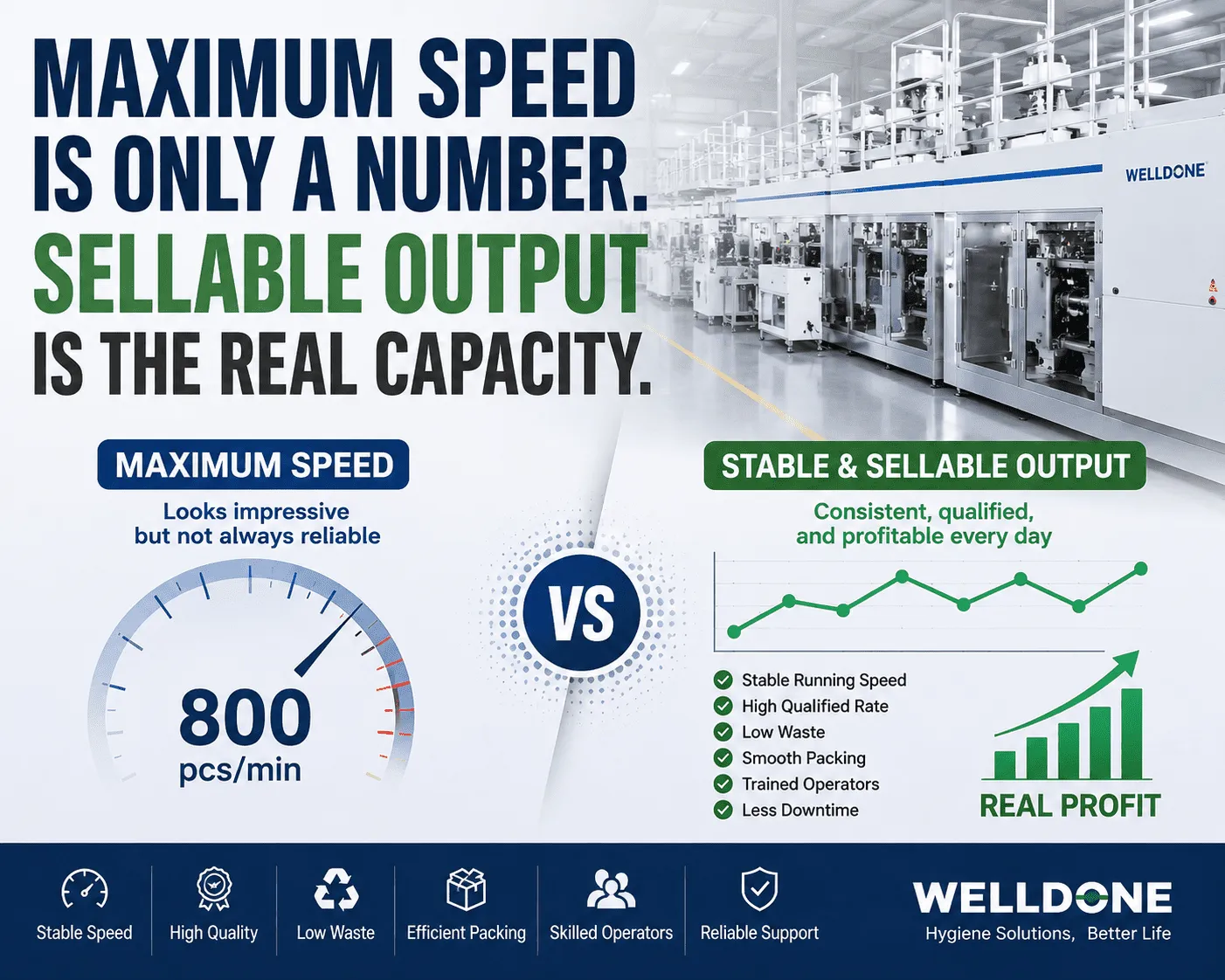
Maximum speed is a technical number under certain conditions. Sellable output is a business result under real factory conditions.
The factory makes money from products that can actually be produced, packed, shipped, and sold. This is why buyers should not only ask, “What is the maximum speed?” They should ask, “What is the real sellable output this machine can help my factory achieve?”
The Difference Between Maximum Speed, Stable Speed, and Sellable Output
To understand real production capacity, buyers should separate three different concepts. These three numbers are related, but they are not the same.
Maximum Speed
The highest speed the machine may reach under ideal or controlled conditions. It shows potential, not guaranteed daily output.
Stable Speed
The speed the machine can maintain during continuous production while keeping product quality acceptable.
Sellable Output
The qualified products that can actually be packed, stored, shipped, and sold. This is the real capacity.
Stable Running
Continuous speed that can be maintained.
Qualified Rate
Products that meet quality standards.
Effective Time
Real running time after stops and changes.
Packing Flow
Products packed without bottlenecks.
Waste Control
Less material loss and fewer rejected products.
Sellable output is not only decided by speed. It is created by the full production formula: stable running speed, qualified rate, effective running time, packing efficiency, and waste control.
Why Real Capacity Depends on the Whole Production System
A hygiene product machine does not work alone. It works inside a production system. If buyers only look at machine speed, they may miss the real reasons that affect daily output.
- Machine configuration
- Raw material quality
- Product structure
- Operator skill
- Factory layout
- Air and power supply
- Glue system
- Packing method
- Quality inspection
- Spare parts support
- Maintenance system
- After-sales response
A baby diaper machine may have a strong design speed, but if SAP distribution is unstable, the absorbent core may shift at higher speed. Then the factory has to slow down the machine to keep product quality stable.
A sanitary napkin machine may run fast, but if cutting accuracy drops after speed increases, the product appearance may become poor. The machine can still run, but the finished pads may not meet market standards.
Real capacity comes from balance. The machine must balance speed, stability, accuracy, material control, product quality, packing flow, and operator repeatability.
Qualified Product Rate: The Hidden Factor Behind Real Profit
Qualified product rate is one of the most important factors in real capacity. A machine may produce many products per minute, but the factory only earns money from qualified products.
Rejected products still consume raw materials, electricity, labor, glue, SAP, packaging film, production time, and machine life.
- Core shifting
- Uneven SAP distribution
- Weak glue bonding
- Rough cutting edge
- Unstable elastic position
- Poor side sealing
- Product deformation
- Unstable thickness
- Surface contamination
- Poor packing appearance
- Incorrect size or leakage risk
If the qualified rate is low, high speed only makes losses appear faster. Buyers should ask what qualified rate the machine can maintain during continuous production, not only what speed it can reach.
Waste Control: The Cost That Speed Cannot Hide
In hygiene product manufacturing, raw materials are a major cost. When machine speed increases but stability is not strong enough, waste may increase quickly.
- Machine start-up
- Machine stop
- Material change
- Glue adjustment
- SAP adjustment
- Size changeover
- Cutting adjustment
- Packing connection
- Product rejection
- Operator mistakes
- Unstable continuous running
A machine with lower waste can sometimes create better profit than a machine with higher speed. Every rejected product is not only a quality issue. It is a cost issue.
For a new factory, waste control is especially important because operators are still learning, material suppliers may still be changing, and product standards may still be adjusted.
Packing Efficiency: The Bottleneck Many Buyers Ignore
Many buyers focus heavily on the main machine. But packing is often the real bottleneck in daily production. A production line does not finish its job when the product comes out of the main machine.
The product still needs to be counted, stacked, packed, sealed, labeled, stored, and shipped. If the packing section cannot match the main machine speed, the whole production flow will be affected.
- Is the packing process manual or automatic?
- How many pieces are packed per bag?
- How many bags are packed per carton?
- Can the packing section match the main machine speed?
- Does the market require different packing formats?
- How many workers are needed for packing?
- Will labor cost become a long-term pressure?
- Is there enough space for finished product storage?
- Is the packing appearance suitable for the target market?
A factory may produce many pieces, but if packing is slow, the final sellable output is still limited. The machine does not create business value until the product is ready to sell.
Operator Skill and Repeatability Matter More Than a Short Test
A machine may perform well in the supplier’s factory because it is operated by experienced engineers. But after delivery, the buyer’s local operators need to run the machine every day.
- Raw material loading
- Tension adjustment
- Glue system operation
- SAP control
- Core forming adjustment
- Cutting system adjustment
- Size changeover
- Alarm handling
- Waste control
- Product inspection
- Daily cleaning and basic maintenance
- Troubleshooting
If operators cannot repeat the correct adjustment, machine stability will drop. This is why operator training is directly connected to real capacity.
A reliable supplier should not only show a successful test in their own factory. They should help buyers repeat that success in the buyer’s factory.
How Buyers Should Evaluate Real Production Capacity
To evaluate real capacity, buyers need a more practical framework. Instead of only comparing maximum speed, buyers should check the full production logic.
- Stable running speed: What speed can the machine maintain during continuous production?
- Qualified product rate: How many products meet the final quality standard?
- Effective running time: How often does the machine stop for adjustment, material change, cleaning, or maintenance?
- Waste rate: How much material is wasted during start-up, size changeover, adjustment, and daily production?
- Packing efficiency: Can the packing process match the main machine and target market format?
- Operator repeatability: Can local operators learn and repeat the required adjustment after installation?
- Supplier support: Can the supplier support installation, commissioning, training, spare parts, and troubleshooting?
This framework helps buyers understand the difference between machine speed and real production capacity. A professional supplier should welcome these questions because the buyer is not only buying a machine. The buyer is planning a factory.
Why Welldone
Welldone is a hygiene products machinery manufacturer under Quanzhou Shimao Weiteng Import & Export Co., Ltd. With more than 18 years of industry experience and our own factory support, Welldone provides machinery and production solutions for baby care, female care, adult care, pet care, paper products, and wet wipes.
Our product range includes diaper manufacturing machines, baby diaper machines, baby pull-up pants machines, sanitary napkin machines, adult diaper machines, underpad machines, pet pad machines, wet wipes machines, tissue machines, packing machines, and related hygiene product raw materials.
Welldone supports buyers not only with machine supply, but also with real production planning. We can help buyers evaluate realistic machine speed, stable running performance, product structure, raw material matching, qualified product rate, waste control, packing method, factory layout, operator training, spare parts planning, installation and commissioning support, and after-sales technical communication.
You can explore our related machine categories: Baby Care Machines, Female Care Machines, Adult Care Machines, Pet Care Machines, and Paper & Wet Wipes Machines.
Welldone is not a distributor or wholesaler. We are a manufacturer focused on helping buyers build stable, long-term hygiene product manufacturing capacity.
Related Machines
Diaper Manufacturing Machine
Suitable for producing baby diapers with stable absorbent core, accurate material control, flexible size options, and long-term production support.
Sanitary Napkin Machine
Suitable for producing sanitary napkins with stable core forming, clean cutting, accurate glue application, and consistent product quality.
Adult Diaper Machine
Suitable for producing adult diapers for elderly care, medical care, nursing homes, and healthcare product markets.
Underpad Machine
Suitable for producing disposable underpads for hospitals, elderly care, baby care, and pet care applications.
Pet Pad Machine
Suitable for producing pet pee pads with stable absorbency, leakage control, and flexible size options.
Wet Wipes Machine
Suitable for producing wet wipes for hygiene, cleaning, baby care, personal care, and household applications.
Tissue Machine
Suitable for producing facial tissue, napkins, toilet tissue, handkerchief tissue, and related paper products.
Conclusion
Maximum speed is only a number. It may look attractive in a quotation, but it does not fully represent real factory capacity.
For hygiene product manufacturing, real capacity comes from sellable output. Sellable output depends on stable running speed, qualified product rate, effective running time, waste control, packing efficiency, operator repeatability, and supplier support.
A factory does not sell speed. It sells qualified products to the market every day.
Before choosing a machine, buyers should not only ask: “What is the maximum speed?” They should ask: “What is the stable sellable output my factory can really achieve?”
FAQ
1. Is maximum speed the same as real production capacity?
No. Maximum speed is only the highest speed a machine may reach under certain conditions. Real production capacity depends on stable speed, qualified rate, waste control, packing efficiency, operator skill, and effective running time.
2. Why is sellable output more important than machine speed?
Sellable output represents the qualified products that can actually be packed, shipped, and sold. It is more important because factories make profit from market-ready products, not from speed numbers.
3. What affects the real output of a hygiene product machine?
Real output is affected by machine stability, raw material quality, product structure, qualified product rate, waste rate, packing rhythm, size changeover time, operator skill, downtime, and after-sales support.
4. How should buyers evaluate machine speed before purchasing?
Buyers should ask about stable running speed, continuous test time, qualified product rate, waste during adjustment, size changeover time, packing capacity, and whether local operators can repeat the performance after installation.
5. Can Welldone help buyers evaluate real production capacity?
Yes. Welldone can support buyers with machine configuration advice, realistic speed evaluation, raw material matching, product structure discussion, factory layout planning, operator training, spare parts planning, and after-sales technical support.
Looking for Real Sellable Output, Not Just Maximum Speed?
If you are evaluating hygiene products machinery, Welldone can help you review stable running speed, qualified rate, waste control, packing efficiency, raw material matching, operator training, and long-term production support.
Contact Welldone