A Cheap Machine May Become Expensive After Production Starts

On July 1, 2026
Comments Off on A Cheap Machine May Become Expensive After Production Starts
Machine Investment Guide
A Cheap Machine May Become Expensive After Production Starts
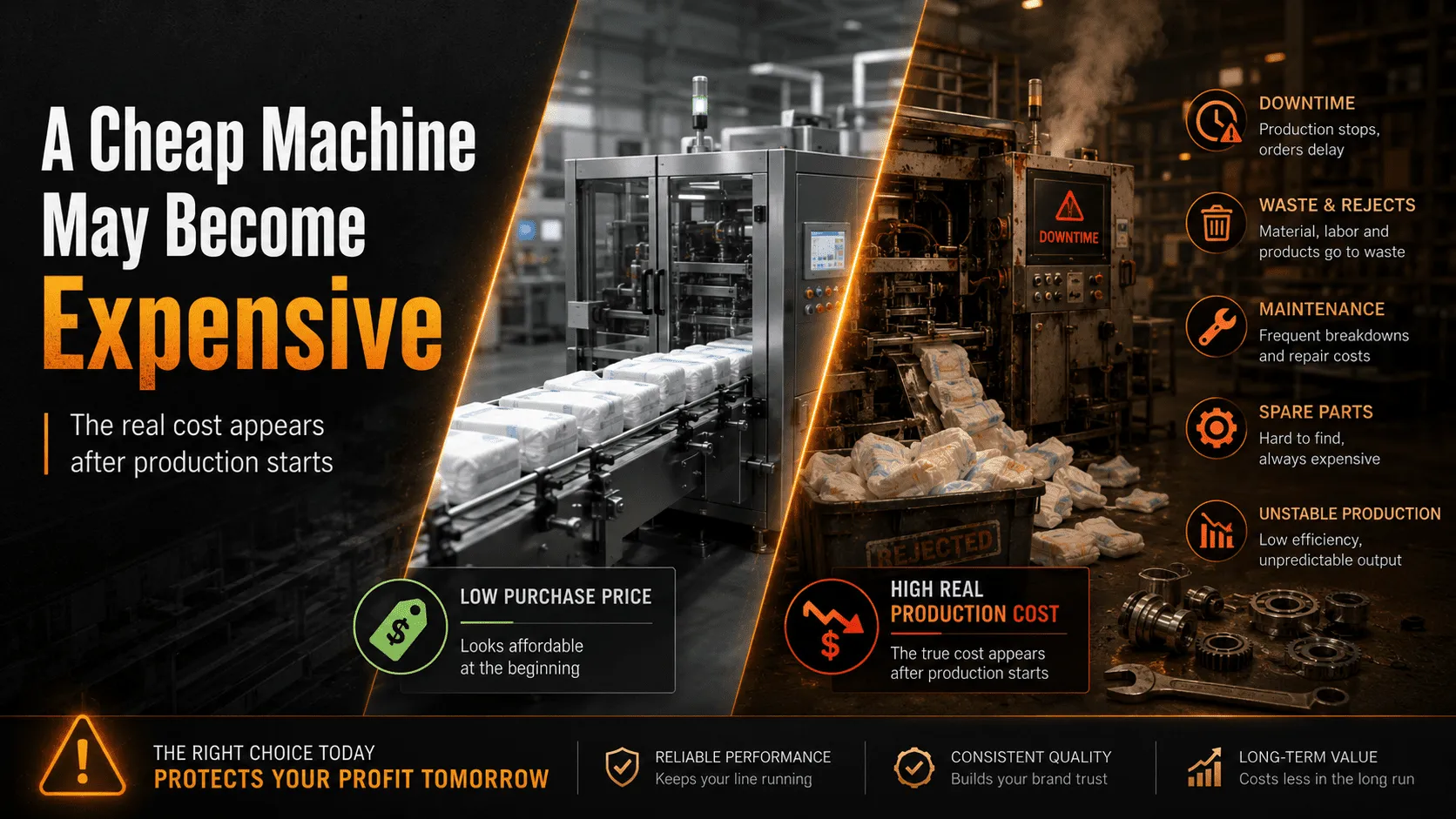
The lowest machine price is not always the lowest project cost. In hygiene product manufacturing, the real cost often appears after production starts: downtime, waste, unstable quality, difficult adjustment, spare parts delays, and weak after-sales support.
```
```
Why Low Purchase Price Can Be Misleading
When buyers compare hygiene product machines, price is often the first thing they notice.
This is understandable. A baby diaper machine, sanitary napkin machine, adult diaper machine, underpad machine, pet pad machine, wet wipes machine, or tissue machine is not a small purchase. For many factories, it is a major investment that affects future production, cash flow, product quality, and market development.
So buyers naturally want to control the budget.
But there is one important point many new investors overlook: the lowest machine price is not always the lowest project cost.
A machine may look attractive on the quotation, but after production starts, the real cost begins to appear.
A lower machine price can look very attractive at the beginning of a project. The buyer may think the saved budget can be used for raw materials, factory decoration, packaging, marketing, or working capital.
This thinking is reasonable. But the problem is that machine price is only one part of the total investment.
A hygiene product factory is not built by the machine alone. It also needs stable raw materials, trained operators, installation support, spare parts, factory layout, packing flow, quality inspection, maintenance, and long-term technical service.
If the machine price is low but the production system becomes unstable, the buyer may spend much more later.
The right question is not only: “How much does this machine cost?”
The better question is: “How much will this machine cost me after production starts?”
Purchase Price vs. Real Production Cost
Purchase price is easy to see. Real production cost is harder to see.
Purchase price appears clearly in the quotation. It includes the machine cost, configuration, delivery terms, and payment terms. Buyers can compare it quickly between suppliers.
But real production cost appears slowly in daily factory operation.
It includes downtime, waste, rejected products, labor inefficiency, maintenance difficulty, spare parts delays, product instability, customer complaints, and missed delivery schedules.
01
Machine Price
02
Downtime
03
Waste Rate
04
Quality Loss
05
Real Cost
A machine with a lower purchase price may become expensive if it creates more production stoppages, higher raw material waste, more rejected products, longer size change time, difficult operation, slow troubleshooting, poor spare parts availability, or weak after-sales support.
On the other hand, a reliable machine may cost more at the beginning, but it can help the factory reduce hidden losses over time.
For manufacturing, the lowest price is not always the best value. The best value is stable output, controlled waste, reliable quality, and lower long-term risk.
Downtime: The Hidden Cost Buyers Often Underestimate
Downtime is one of the most expensive hidden costs in production.
When a hygiene product machine stops, the factory does not only lose machine running time.
- Operators are still waiting.
- Raw materials may already be prepared.
- Packing workers may be idle.
- Delivery schedules may be delayed.
- Orders may become risky.
- The factory manager may need to spend extra time solving the issue.
If downtime happens occasionally and can be solved quickly, it may be acceptable. But if downtime becomes frequent, the factory loses confidence.
A low-price machine may create downtime for different reasons. The mechanical structure may not be stable enough. Electrical components may be unreliable. The machine may not handle materials smoothly. The control system may be difficult to troubleshoot. Spare parts may not be easy to replace. The supplier may not respond quickly.
For products such as diapers, sanitary napkins, underpads, pet pads, wet wipes, and tissue products, continuous production is important. Factories need predictable output.
A machine that looks fast but stops frequently may create less sellable output.
A machine that runs slower but more stably may sometimes create better real production value.
Waste Rate Can Make a “Cheap” Machine Expensive
Raw materials are a major cost in hygiene product manufacturing.
For baby diapers, materials may include nonwoven fabric, PE film, SAP, fluff pulp, elastic materials, side tape, frontal tape, hot melt adhesive, and packaging materials.
For sanitary napkins, materials may include surface layer, absorbent core, backsheet film, release paper, wings, glue, and individual packaging film.
For adult diapers, underpads, pet pads, wet wipes, and tissue products, material consumption also has a direct impact on production cost.
If a machine creates high waste, the buyer loses money every day.
Startup Waste
Waste may happen before the machine reaches stable running condition after startup.
Size Change Waste
Different sizes and product styles may require adjustment, and poor adjustment can increase waste.
Material Change Waste
Different material batches may behave differently and require new settings.
Packing Waste
If packing is unstable, finished products may be damaged, rejected, or repacked.
A low-price machine may create higher waste if tension control is unstable, cutting accuracy is poor, glue application is inconsistent, folding is not smooth, or operators need too much time to adjust the line.
At first, this waste may not seem serious. But when production runs every day, small waste becomes large cost.
A buyer may save money on the machine purchase, but the factory may lose that money again through raw material waste.
Unstable Quality Damages More Than Output
Product quality is not only a production issue. It is also a market issue.
If product quality is unstable, the factory may face rejected products, rework, customer complaints, lower brand trust, and difficulty entering better sales channels.
In hygiene product manufacturing, quality consistency matters a lot.
- Baby diapers must have stable absorbency, good fit, reliable elastic, and comfortable surface feel.
- Sanitary napkins must have stable sealing, accurate shape, good absorbency, and neat packaging.
- Adult diapers and underpads must maintain absorbency, strength, size accuracy, and leak protection.
- Pet pads must keep stable size, absorbency, folding, and cost control.
- Wet wipes and tissue products must maintain folding quality, cutting accuracy, softness, counting, and packing stability.
If the machine cannot keep product quality consistent, the factory may produce products that look acceptable sometimes but unstable during continuous production.
A good sample is not enough. The factory needs repeatable quality.
Unstable quality does not only create rejects.
It can also damage customer confidence, market reputation, and long-term brand trust.
Difficult Adjustment Increases Labor and Training Pressure
Some machines are not easy to adjust.
When product size changes, material changes, speed changes, or quality problems appear, operators may need a long time to find the right setting.
This creates hidden labor cost.
Longer Downtime
If adjustment takes too long, the line stays stopped or runs below target speed.
Higher Waste
Every adjustment may create waste before product quality becomes stable again.
Operator Dependence
If only one experienced operator can run the machine well, the factory becomes dependent on that person.
Training Pressure
If new operators cannot learn quickly, production becomes harder to stabilize.
A good machine should not only be advanced. It should also be practical for daily operation.
Operators should be able to understand the machine logic. The interface should be clear. Common adjustment points should be accessible. Settings should be recorded. The supplier should provide training and guidance.
The real value of a machine is not only how fast it runs when everything is perfect. It is also how quickly the factory can adjust it when conditions change.
Spare Parts and Maintenance Decide Long-Term Reliability
Spare parts are often ignored during machine purchase.
Many buyers only ask about the machine price, speed, delivery time, and basic configuration. They may not ask enough about spare parts availability, wearing parts, maintenance routines, or long-term replacement cost.
But after production starts, spare parts become very important.
- If a small part fails and there is no replacement available, the whole line may stop.
- If the supplier cannot provide the part quickly, downtime becomes longer.
- If the machine uses uncommon components, maintenance becomes more difficult.
- If the parts are low quality, replacement becomes frequent.
A low-price machine may become expensive when maintenance is difficult or spare parts are unreliable.
Good spare parts planning protects production continuity. Buyers should understand which parts are wearing parts, which parts are critical parts, how often they may need replacement, how quickly the supplier can provide them, and whether the factory should keep spare parts in stock.
Spare parts are not only a technical issue.
They are a production risk issue.
Weak After-Sales Support Creates Trial-and-Error Cost
After-sales support is not only about repairing the machine. It is about helping the factory build production ability.
When a supplier provides weak support, the buyer may need to solve many problems alone.
- Operators may adjust by guessing.
- The factory may waste more materials during troubleshooting.
- Product quality problems may repeat.
- Maintenance may be done too late.
- Spare parts may not be prepared properly.
- Production data may not be reviewed correctly.
This creates trial-and-error cost. The buyer may not pay this cost in the quotation, but they pay it during production.
A strong supplier should help customers understand why problems happen, how to adjust correctly, how to prevent repeated issues, and how to improve daily production stability.
Buyers should evaluate the supplier, not only the machine. A reliable supplier helps reduce risk. A weak supplier may make a cheap machine become expensive.
Material Matching Affects Real Production Efficiency
In hygiene product manufacturing, raw materials and machines must work together.
Even a well-designed machine needs suitable materials. Different material suppliers may provide materials with different thickness, softness, strength, surface treatment, tension behavior, glue compatibility, and stability.
If the machine is not good at handling material variation, production may become unstable.
Nonwoven Fabric
Different softness, strength, stretch, and surface treatment can affect feeding, tension, and product forming.
PE Film
Film thickness and tension behavior can affect stability, cutting, sealing, and product appearance.
SAP & Core Materials
Absorbent materials affect product weight, absorbency, core structure, and production consistency.
Glue & Packaging
Glue performance and packaging materials affect bonding, sealing, packing speed, and finished product quality.
A low-price machine may have limited tolerance for material variation. This means the buyer may need to use only certain materials, or spend more time adjusting the machine when materials change.
Material matching is not only about product quality. It also affects speed, waste, downtime, and operator workload.
Why Stable Production Is More Valuable Than a Low Quote
For a factory, the final goal is not to buy a machine.
The goal is to produce qualified products, control cost, deliver orders, build a brand, and grow in the market.
Stable production supports all of these goals.
When production is stable, the factory can plan output more confidently. Operators work more efficiently. Waste is easier to control. Quality becomes more consistent. Delivery schedules become more reliable. Customers trust the factory more.
When production is unstable, everything becomes difficult. Managers spend more time solving problems. Operators become stressed. Material waste increases. Delivery becomes uncertain. Quality complaints may appear. The factory may lose market opportunities.
A decision made during purchasing will affect the factory for years.
The machine will be used every day, so buyers should think beyond the purchase moment.
A reliable machine may not always be the cheapest at the beginning. But if it helps reduce downtime, lower waste, improve product quality, support operator training, and protect long-term production, it may be more cost-effective over time.
How Buyers Should Evaluate Machine Value
To avoid choosing only by price, buyers should evaluate machine value from a wider perspective.
A professional machine decision should consider total production cost, not only purchase price.
- Is the machine structure stable for long-term production?
- Can the machine run smoothly with the materials we plan to use?
- How easy is it for operators to learn and adjust?
- How much waste may happen during startup and size change?
- Is product quality consistent during continuous running?
- Can packing match the production speed?
- Are spare parts easy to get?
- Does the supplier provide installation and training?
- Can the supplier support troubleshooting after delivery?
- Does the supplier understand the full production process, not only the machine?
The right machine should support long-term business. It should help the factory produce stable, qualified, and sellable products every day.
How Welldone Helps Customers Reduce Long-Term Risk
At Welldone, we understand that buyers do not only need machines. They need production confidence.
A hygiene product factory must balance machine performance, raw material matching, operator training, factory layout, packing flow, quality control, spare parts, and after-sales support.
That is why Welldone focuses on helping customers think beyond the first purchase price.
Project Planning
We support customers with product planning, machine configuration, production flow thinking, and factory setup preparation.
Material Matching
We help buyers understand how raw materials affect machine performance, product quality, and waste control.
Installation & Trial Production
We support installation, commissioning, operator training, product adjustment, and production handover.
Long-Term Support
We provide spare parts guidance, maintenance advice, technical communication, and long-term production support.
For a baby diaper project, we help buyers consider product structure, size range, elastic system, SAP application, material matching, and packing flow.
For a sanitary napkin project, we help buyers focus on product length, core structure, sealing quality, wing folding, individual packing, and market requirements.
For adult diaper and underpad production, we help customers consider larger product size, higher material consumption, absorbency requirements, warehouse space, and packing efficiency.
For pet pad, wet wipes, and tissue production, we help buyers understand material behavior, folding, cutting, counting, stacking, packing, and daily operation details.
Welldone does not only help customers start production. We help customers reduce hidden costs, avoid unnecessary risk, and build stronger production ability.
Related Machines
Different hygiene product categories have different production risks, material requirements, and long-term cost factors. Welldone supports a wide range of hygiene product machines and production solutions.
Baby Care Machines
Baby diaper machines and baby pull-up diaper machines require stable material feeding, elastic control, SAP application, size change management, quality consistency, and packing coordination.
Learn MoreFemale Care Machines
Sanitary napkin machines, panty liner machines, and related female care production lines require accurate cutting, stable sealing, smooth folding, reliable packaging, and consistent product appearance.
Learn MoreAdult Care Machines
Adult diaper machines, adult pull-up diaper machines, and underpad machines need strong production stability because product size, material consumption, absorbency requirements, and packing volume are usually higher.
Learn MorePet Care Product Machines
Pet pad machines and pet diaper machines need flexible size control, accurate cutting, stable absorbent structure, smooth material flow, and cost-effective production.
Learn MorePaper & Wet Wipes Machines
Wet wipes machines, tissue machines, facial tissue machines, napkin machines, and related packing machines require stable folding, cutting, counting, liquid control, stacking, and packing connection.
Learn MoreConclusion
A cheap machine may look attractive before purchase.
But after production starts, the real cost becomes clearer.
Downtime, waste, rejected products, difficult adjustment, spare parts delays, weak after-sales support, unstable material matching, and inconsistent quality can all make a low-price machine expensive in daily operation.
For hygiene product manufacturing, buyers should not only compare purchase price. They should compare long-term production value.
The right choice today protects the factory’s profit tomorrow.
A reliable production line should help the buyer create stable output, qualified products, lower waste, trained operators, smoother packing, easier maintenance, and stronger production confidence.
At Welldone, we help customers think beyond the first quotation and focus on what really matters after production starts.
Because a good machine is not only bought once. It is used every day.
FAQ
1. Is a cheaper hygiene product machine always a bad choice?
Not always. A lower-price machine may be suitable for some projects if it can meet the buyer’s production needs, quality requirements, material conditions, and support expectations. The key is to evaluate total production cost, not only purchase price.
2. What hidden costs should buyers consider before choosing a machine?
Buyers should consider downtime, waste rate, rejected products, spare parts availability, maintenance difficulty, operator training, adjustment time, after-sales support, product quality stability, and long-term production reliability.
3. Why can a cheap machine become expensive after production starts?
A cheap machine can become expensive if it causes frequent stops, high waste, unstable quality, slow troubleshooting, difficult operation, poor material matching, or long spare parts delays.
4. How does waste rate affect production cost?
Raw materials are a major cost in hygiene product manufacturing. If the machine creates high waste during startup, size change, adjustment, or continuous running, the factory loses money every day.
5. Why is machine stability more important than theoretical speed?
Theoretical speed only shows what the machine may reach under ideal conditions. Stable production shows what the factory can produce, pack, inspect, and sell every day.
6. Why should buyers care about spare parts before purchasing a machine?
Spare parts affect production continuity. If a key part fails and replacement is not available, the whole production line may stop, causing downtime and delivery delays.
7. How does after-sales support reduce hidden costs?
Good after-sales support helps factories solve problems faster, train operators, reduce repeated mistakes, plan spare parts, improve maintenance, and stabilize production.
8. Can material matching affect machine performance?
Yes. Different materials may behave differently on the same machine. Material thickness, softness, tension, strength, glue compatibility, and surface treatment can all affect machine stability and product quality.
9. What should buyers ask before choosing a hygiene product machine?
Buyers should ask about machine stability, real production experience, material compatibility, operator training, spare parts, installation support, after-sales service, waste control, and long-term production reliability.
10. How does Welldone help buyers reduce long-term risk?
Welldone supports buyers with machine selection, product planning, factory layout suggestions, raw material matching, installation, trial production, operator training, spare parts guidance, and long-term technical support.
Choose Long-Term Production Value with Welldone
A good machine is not only purchased once. It is used every day. Welldone helps hygiene product manufacturers think beyond the first quotation and build stable, efficient, and reliable production systems.
Website: www.cnwelldone.com
Email: welldone@cnwelldone.com