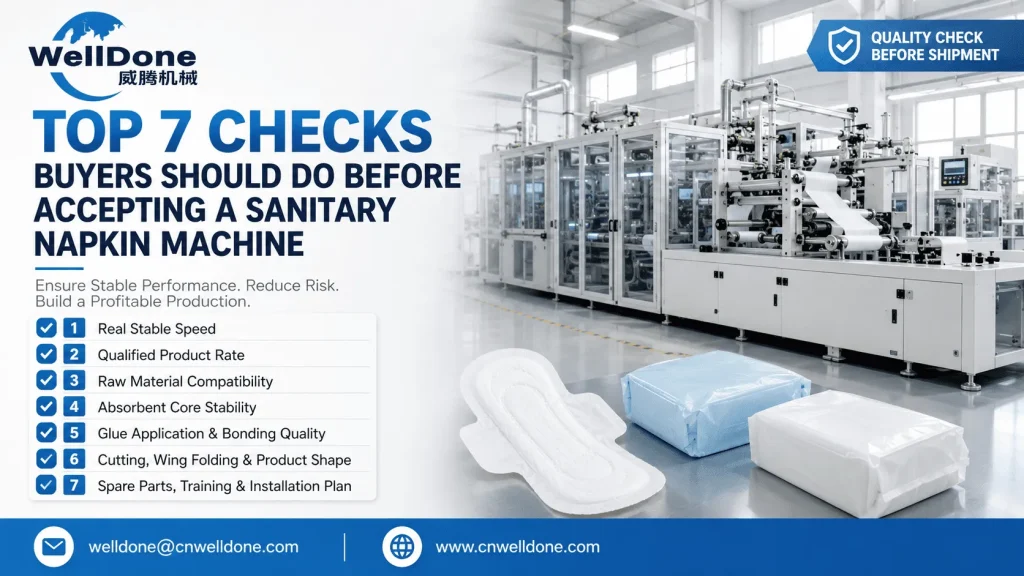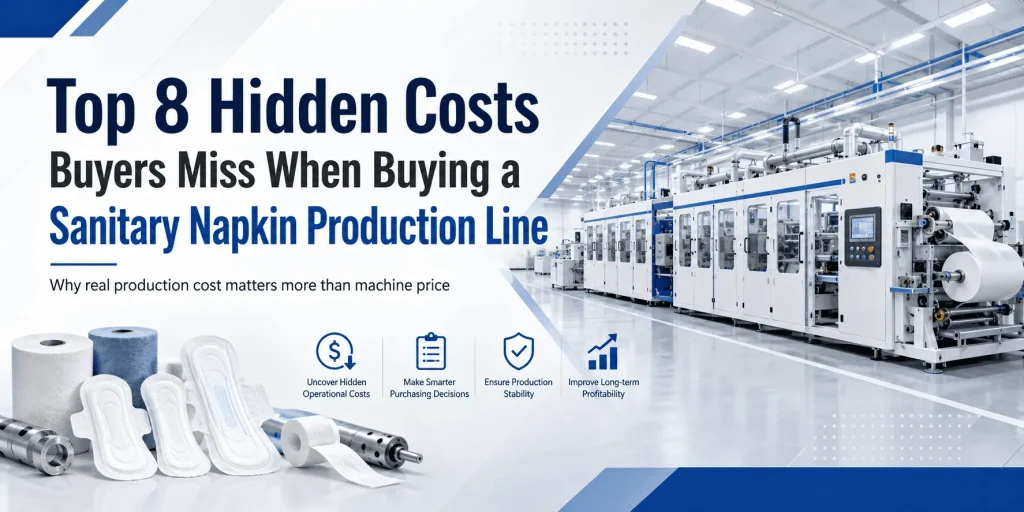

High-Loft ATB & r-PP Sanitary Pad Line Setup Guide | Welldone

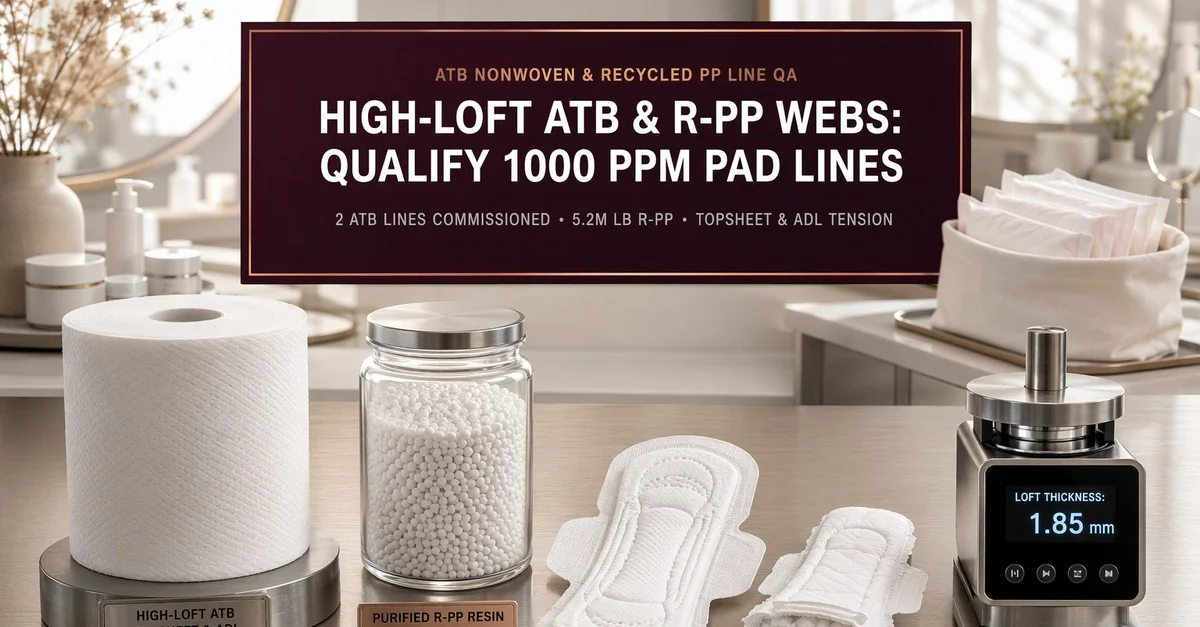
High-Loft ATB & Recycled-PP Webs: Qualify 1,000–1,200 pcs/min Sanitary Pad & Diaper Lines
Across Asia, Europe, and North America, feminine care and baby diaper brands are upgrading to ultra-soft Air-Through-Bonded (ATB) bicomponent topsheets and integrating purified recycled polypropylene (r-PP) into barrier webs. On November 19, 2026, Nonwovens News reported two supply milestones: in Bhopal, India, German-Indian joint venture Benecore Private Limited (TWE Group GmbH and Obeetee Group) commissioned two Air-Through-Bonding (ATB) lines for soft topsheet and acquisition/distribution layer (ADL) webs. On the same day, PureCycle Technologies reported Q3 output of 5.2 million lb of its PureFive purified r-PP resin at Ironton, Ohio—up 14% quarter-on-quarter. This guide explains how hygiene factories qualify high-loft ATB webs and r-PP SMS leak guards on 900 to 1,200 pcs/min full-servo sanitary pad machines without loft crush or wrapping jams.
Executive Summary for Feminine Care & Hygiene Plant Directors
Dual Material Shift (Nov 19, 2026)
Benecore commissioned two ATB lines in Bhopal for diaper and feminine care topsheet/ADL webs, while PureCycle scaled Q3 PureFive r-PP output 14% QoQ to 5.2 million lb in Ohio.
Core Mechanical Bottleneck
High-loft bicomponent PE/PP ATB webs (1.5–2.2 mm caliper) suffer 25%–35% loft loss and hot-pin sticking if run under standard PP spunbond tension and 135°C embossing recipes.
Buyer Engineering Solution
Specify carbon-fiber guide rollers, stepped-clearance thermal embossing, servo-isolated 3D leak-guard spandex feeders, and 90° easy-pack pitch compensation at 900–1,200 pcs/min.
1. November 19, 2026 Signal: Benecore ATB Commissioning & PureCycle r-PP Scale-Up
Regional sanitary napkin and baby diaper manufacturers in South Asia, the Middle East, Africa, and Latin America historically relied on imported air-through-bonded (ATB) rolls for premium "cloud-soft" SKUs, while using hydrophobic polypropylene (PP) spunbond for standard lines. On November 19, 2026, two upstream announcements confirmed that localized ATB supply and purified recycled polypropylene are entering mainstream converting:
- Two New Air-Through-Bonding (ATB) Lines in Bhopal, India: As reported by Nonwovens News (November 19, 2026) and Press Trust of India (PTI), Benecore Private Limited—the Indo-German joint venture between TWE Group GmbH and Obeetee Group—inaugurated its hygiene nonwovens plant in Bhopal's Acharpura Industrial Area, Madhya Pradesh, commissioning two ATB lines to supply soft topsheets and acquisition/distribution layers (ADLs) for feminine hygiene and baby diapers.
- Purified Recycled Polypropylene (r-PP) Output Rises 14% QoQ: On November 19, 2026, Nonwovens News reported that PureCycle Technologies produced 5.2 million lb of its PureFive purified r-PP resin in Q3 2026 at Ironton, Ohio—up 14% over Q2 after resolving operational bottlenecks. Meanwhile, on November 18–19, 2026, Kimberly-Clark appointed Katie Devine Chief Growth & Innovation Officer and Brian Giroux Chief Customer Officer, and Poland's Harper Hygienics (Cleanic) expanded its flushable intimate wipes range.
The real question is whether your 900 to 1,200 pcs/min sanitary napkin or panty liner line can transition from flat PP spunbond to compressible 1.5–2.2 mm bicomponent ATB topsheets/ADLs and r-PP barrier cuffs without web elongation, embossing pin buildup, or wrapping rejects.
2. Confirmed Facts, Data Conflicts & Converting Machinery Scope
We strictly separate facts confirmed by November 2026 reports from Welldone's converting engineering analysis:
- Confirmed Facts from Primary Sources (November 18–19, 2026): According to Nonwovens News (November 19, 2026) and PTI, Benecore Private Limited (TWE Group GmbH / Obeetee Group JV) started production on two ATB lines in Acharpura Industrial Area, Bhopal, Madhya Pradesh, targeting baby diaper and feminine hygiene webs. According to Nonwovens News (November 19, 2026), PureCycle Technologies produced 5.2 million lb of PureFive recycled PP resin in Q3 2026 at Ironton, Ohio (+14% vs. Q2). According to Nonwovens Industry (November 19, 2026), Kimberly-Clark named Katie Devine Chief Growth & Innovation Officer and Brian Giroux Chief Customer Officer (with Chief R&D Officer Craig Slavtcheff departing in January). According to Nonwovens News (November 18, 2026), Harper Hygienics launched Cleanic Daily Sensitive, Pure Balance, and Intima SOS flushable intimate wipes.
- Welldone Converting & Supply Chain Engineering Analysis: Neither Benecore, TWE Group, PureCycle, Kimberly-Clark, nor Harper Hygienics mentioned Welldone, and Welldone is not involved in their operations. The carbon-fiber roller tension windows, bicomponent ATB embossing clearances, 3D leak-guard spandex tolerances, and 90-degree easy-pack wrapping parameters below represent Welldone's engineering guidance for buyers of sanitary pad machines, panty liner machines, and female care packing machines.
⚠ News Data Conflict Found (Cross-Source Verification Disclosure):
- Conflict 1 — Benecore Bhopal Facility Capital Investment Figure Across Indian Media: Press Trust of India (PTI) dispatches state that Benecore opened a Rs 160-crore hygiene nonwoven facility in Bhopal, whereas regional industrial summaries cite total committed investment of over Rs 200 crore across the Bhopal site phases. Both figures are disclosed side by side without merging; only the commissioned hardware fact (two ATB lines in Acharpura, Bhopal) is used as our technical baseline.
- Conflict 2 — Welldone Sanitary Pad Page Speed Tiers & Legacy Template Text: On Welldone's website, the category page (
/products/sanitary-pad-machine) states speeds "up to 1000–1200 pieces per minute", the fast & easy-pack model page (WD-SP011at/sanitary-pad-packing-machine) specifiesDesign speed: 1000 pcs/minandStable speed: 900 pcs/min(while its generic top table row contains a copy-paste string reading "High speed 600 pcs per minutes diaper manufacturing machine"), and the shaft-driven frequency model page (/automatic-sanitary-pad-production-line) specifiesdesign speed is 600pcs/min, and its stable speed is as high as 500pcs/minfor 240 mm and 290 mm pads. Always match drive architecture to the dedicated model specification table.
3. 8-Layer High-Loft ATB & Recycled-PP Winged Sanitary Napkin Architecture
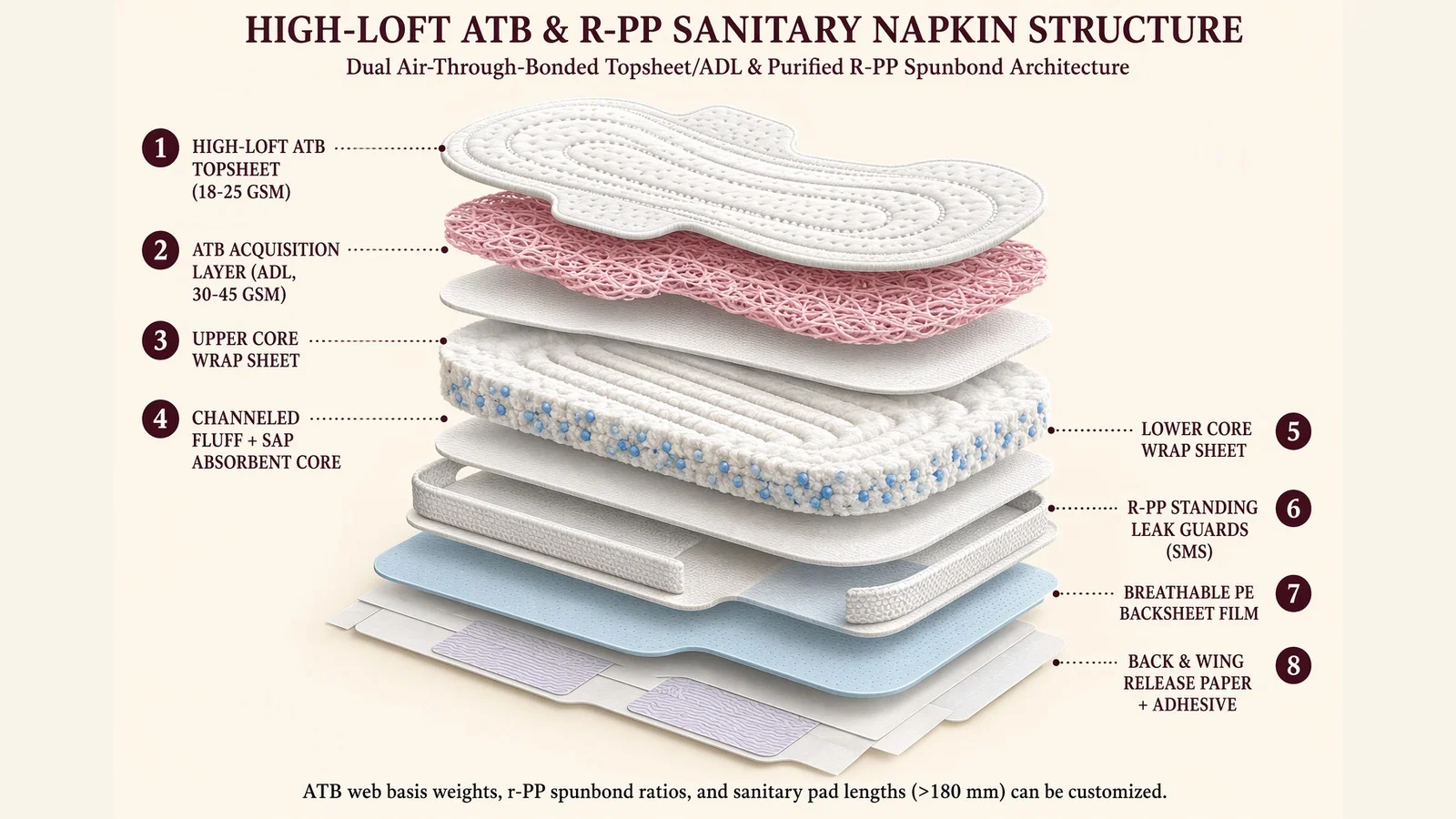
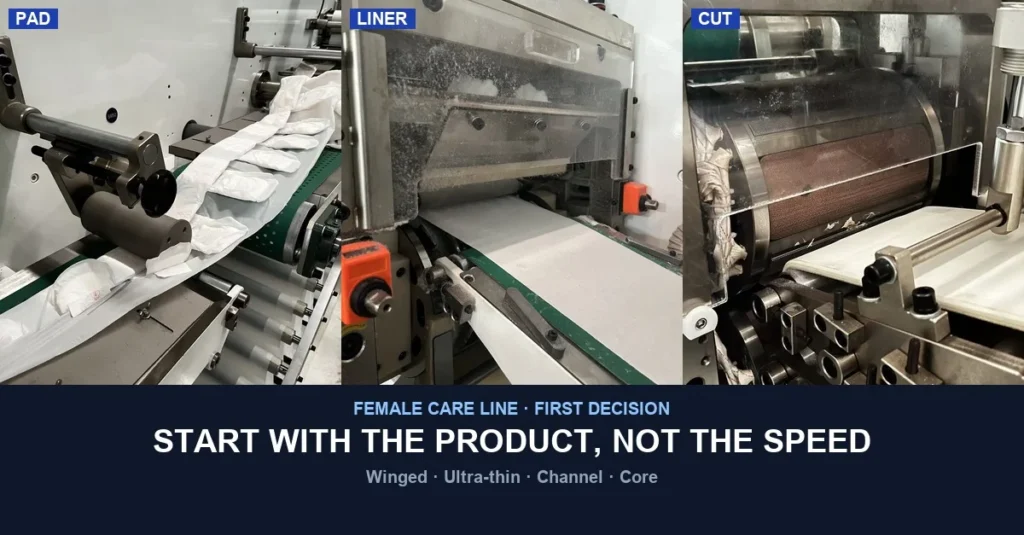
Why are feminine care brands replacing flat calendered PP spunbond with Air-Through-Bonded (ATB) webs? Instead of crushing fibers between heated steel calender rolls, ATB lines pass carded bicomponent sheath/core fibers (typically a low-melting polyethylene sheath around a polypropylene or PET core) through a hot-air oven. The sheath melts at fiber intersections, locking in a resilient three-dimensional loft. As shown in Figure 1, integrating ATB webs and purified r-PP spunbond into a modern winged sanitary pad (>180 mm, typically 240 mm, 290 mm, or 350–420 mm overnight formats) involves eight engineered layers:
- Layer 1 — 3D Pearl-Embossed High-Loft ATB Nonwoven Topsheet (18–25 g/m²): Provides a cushiony, micro-pillowed contact surface that isolates menstrual fluid away from skin and reduces wet-back by 30%–45% compared with flat spunbond.
- Layer 2 — High-Resilience ATB Acquisition & Distribution Layer (ADL, 30–45 g/m²): Uses open-pore bicomponent fiber loft to pull viscous fluid downward in under 2.5 seconds while resisting wet collapse under body weight.
- Layer 3 & Layer 5 — Upper & Lower Wet-Strength Core Wrap Sheets (14–16 g/m²): Stabilize the absorbent core or airlaid/SAP composite sheet during high-speed rotary cutting and folding.
- Layer 4 — Contoured Fluff Pulp + High-SAP Absorbent Core (or SAP Paper Composite): Formed on a strip-demoulding vacuum wheel with central anti-leakage flow channels.
- Layer 6 — Dual Hydrophobic Standing Leak-Guard Cuffs (13–17 g/m² SMS with Purified r-PP): Where odor-free purified r-PP resins (such as PureCycle's PureFive grade) can be blended into non-skin-critical barrier spunbond/SMS layers without compromising hydrohead barrier ratings.
- Layer 7 — Breathable Microporous PE Backsheet Film (18–24 g/m²): Prevents strikethrough while evacuating humidity.
- Layer 8 — Back & Wing Silicone-Coated Release Paper Strips + Positioning Adhesive: Protects pressure-sensitive garment glue until consumer use and synchronizes with the 90-degree easy-pack wrapping pouch.
4. Four Converting Failures When Switching to High-Loft ATB & r-PP Webs
A common mistake is mounting localized 20–25 g/m² ATB topsheet or 35 g/m² ATB ADL rolls onto a sanitary napkin machine calibrated for 16 g/m² calendered PP spunbond. At 900 to 1,000 pcs/min stable speeds, four failure modes appear:
- Failure Mode 1 — Permanent Loft Crush Across High-Inertia Rollers: Bicomponent ATB webs have 40%–55% lower MD modulus than PP spunbond. Dragging over heavy aluminum rollers or high-pressure dancers stretches the web (necking width by 3–5 mm) and flattens 1.8 mm loft down to 1.1 mm.
- Failure Mode 2 — PE Sheath Sticking on Channel Embossing Pins: Because the outer sheath of an ATB bicomponent fiber is polyethylene (melting at 128–132°C) rather than homopolymer PP (160–165°C), running channel embossing at a 140°C PP setpoint melts the PE sheath onto the engraving roll.
- Failure Mode 3 — r-PP SMS Cuff Slitting Jitter & Spandex Creep: Recycled-PP blended SMS webs can show minor melt-flow variations that alter edge stiffness, causing middle-slitting wander or cuff curl unless spandex pre-stretch is servo-locked.
- Failure Mode 4 — 90° Flapping & Easy-Pack Seal Wrinkles: High-loft ATB webs add 0.4–0.8 mm to pad thickness. At the 90-degree flapping unit and PE wrapper, unadjusted pocket heights cause pad skew and seal leaks.
Illustrative Example Only (ATB Loft Retention & Embossing Yield on a 900 pcs/min Line):
Consider an illustrative scenario on a full-servo fast & easy-pack sanitary napkin line (
Consider an illustrative scenario on a full-servo fast & easy-pack sanitary napkin line (
WD-SP011, design speed 1,000 pcs/min, stable speed 900 pcs/min) running 240 mm winged pads with a 22 g/m² ATB topsheet and 35 g/m² ATB ADL. Legacy PP spunbond tension (2.8 N/cm) and a 142°C embossing roll can crush caliper by 32% and trigger two wrap-ups per shift (~18,000 lost pads). Lowering carbon-fiber unwinder tension to 1.2–1.5 N/cm and setting embossing to 118–124°C preserves ≥92% of ATB loft while holding passing rate at ≥98%. (Note: Illustrative model only; not a customer case study.)
5. Station Focus I: Carbon-Fiber Unwinding & High-Loft ATB ADL Feeding
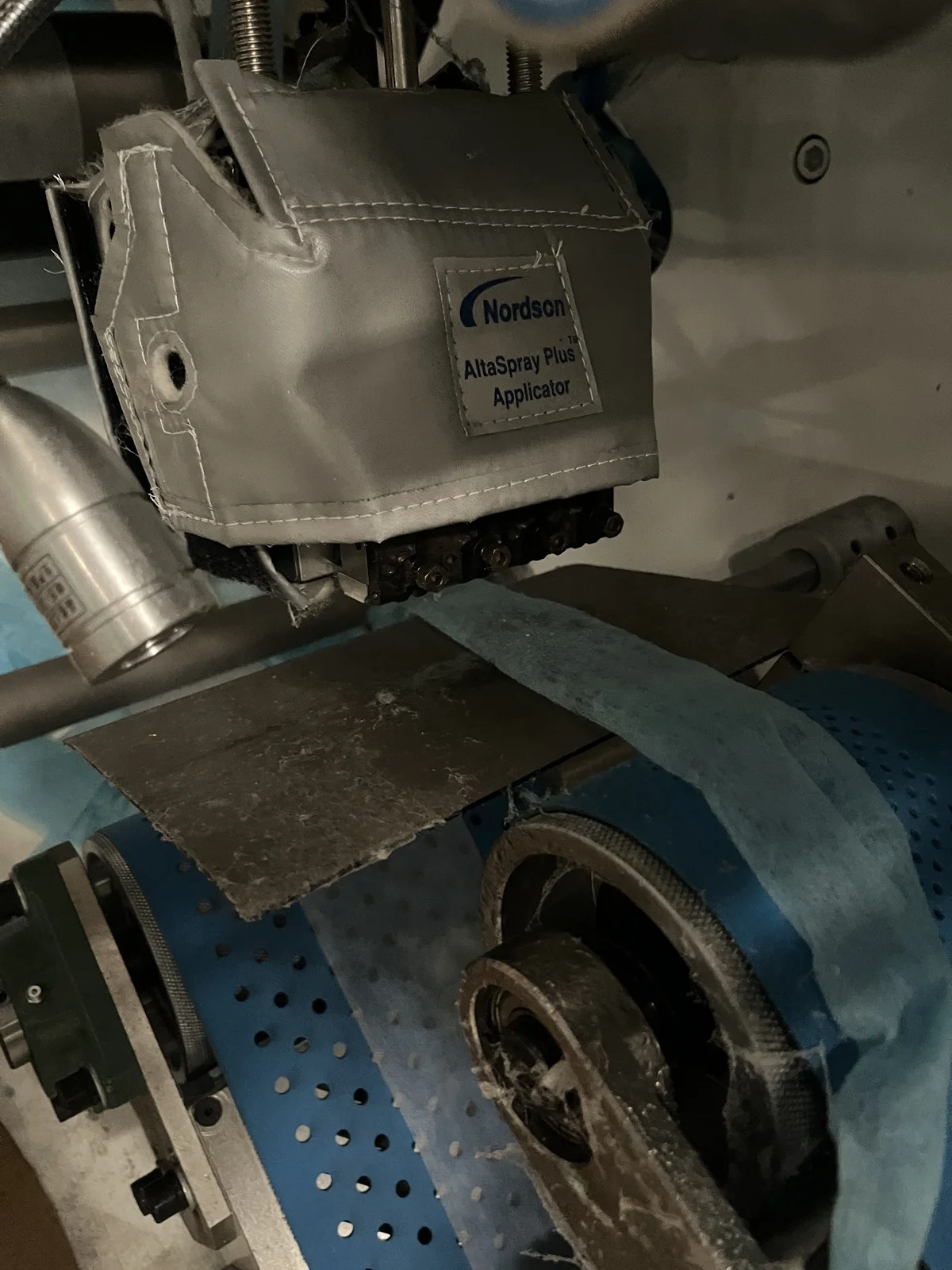
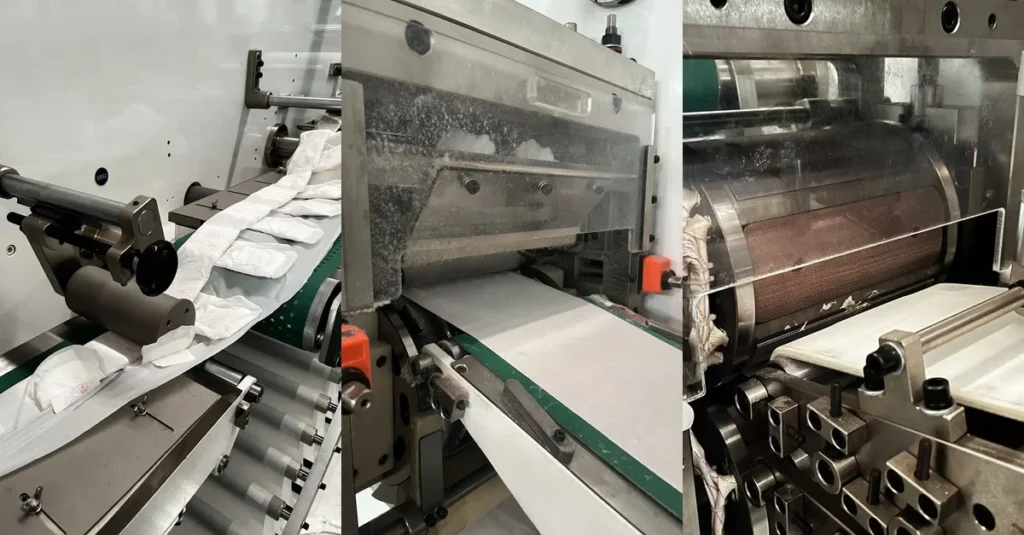
As highlighted on Welldone's sanitary pad machine specifications, Welldone uses carbon-fiber guide rollers rather than heavy aluminum rollers to stabilize tension. In Figure 2, three controls protect ATB web loft at 900–1,000 pcs/min:
- Low-Inertia Carbon-Fiber Rollers & Servo Unwinding: Reduce rotational inertia during zero-speed automatic splicing so ATB webs run at 1.0–1.6 N/cm with neck-down kept inside ≤ 1.0 mm.
- Photoelectric Web Guiding: Non-contact edge sensors track porous ATB edges without snagging lofty fibers.
- Vacuum-Assisted Short-Cut ADL Transfer: Holds cut 30–45 g/m² ATB ADL patches flat on the vacuum transfer drum before core bonding.
6. Station Focus II: r-PP 3D Leak-Guard Spandex Forming & Channel Embossing
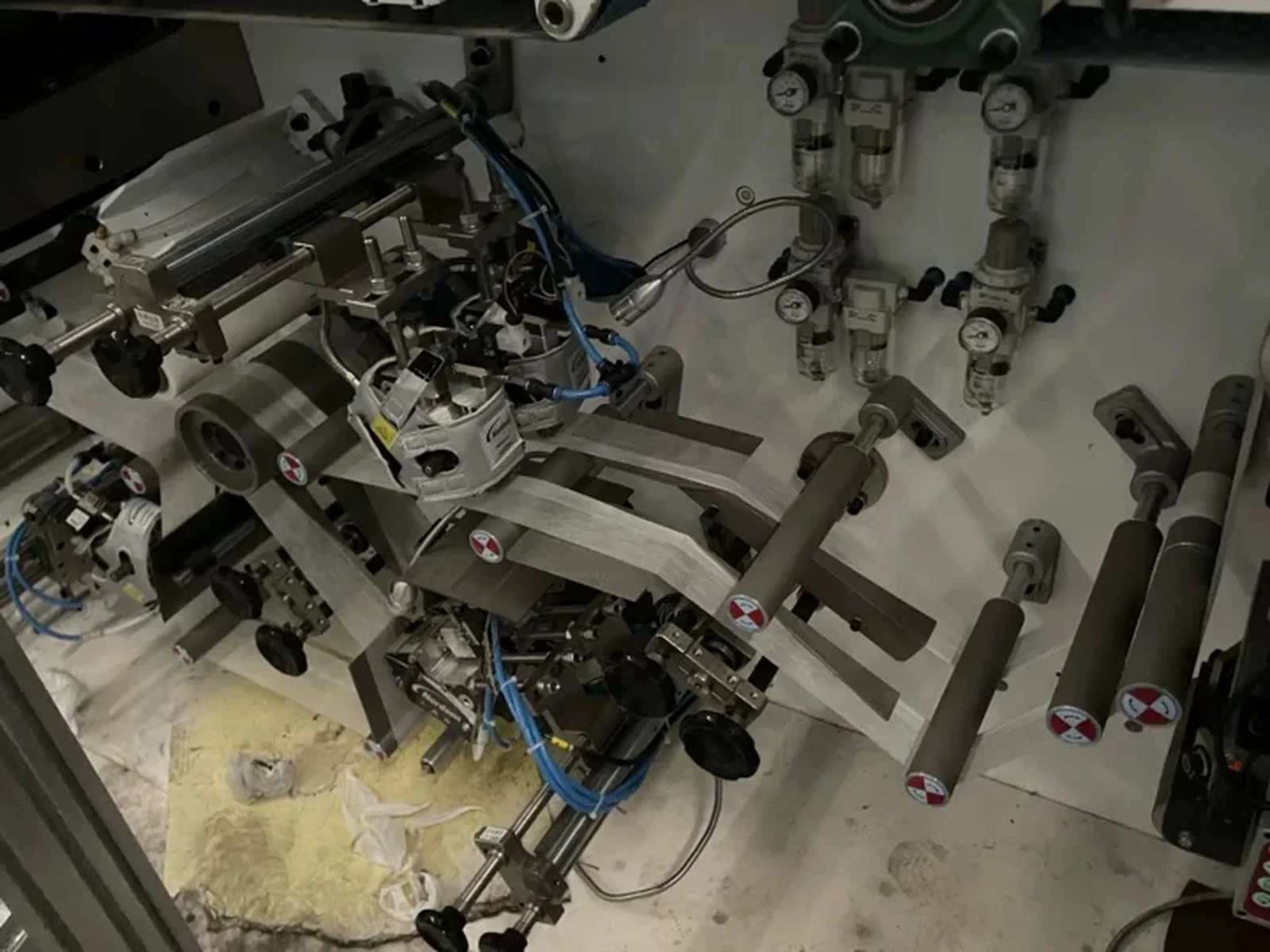
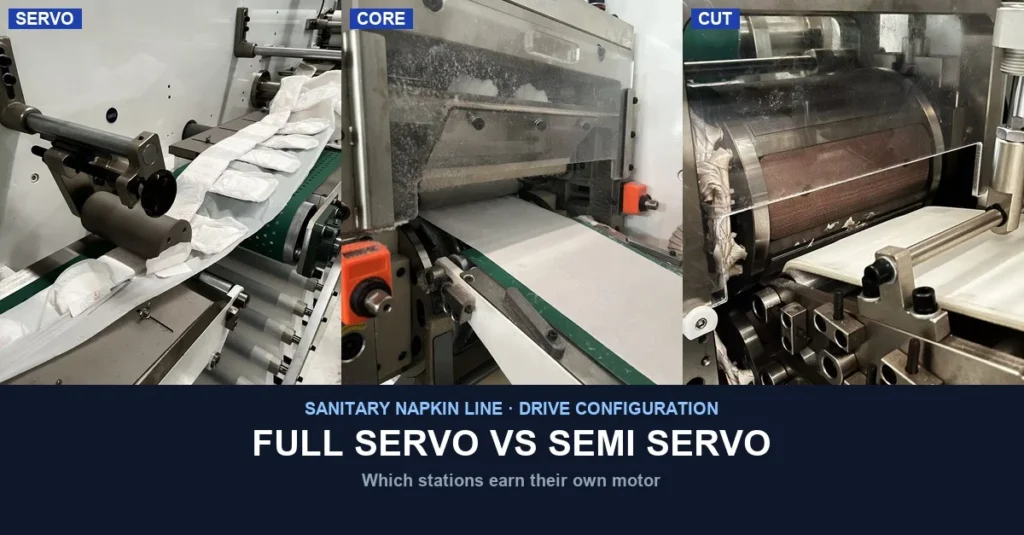
Premium sanitary napkins pair central flow-channel embossing with dual standing leak guards (Figure 3). Running PE/PP bicomponent ATB topsheets alongside r-PP SMS leak-guard strips requires two adjustments:
- Dual-Zone PID Embossing (115–126°C for PE/PP ATB): Pairs independent PID zones with micrometer gap stops (0.15–0.35 mm) so channels fuse cleanly while surrounding ATB zones stay lofty.
- Middle Slitting, Spandex Feeding & 3D Cuff Plows: Slits the r-PP SMS web symmetrically, encapsulates pre-stretched spandex with spiral glue, and folds 3D cuffs onto ATB margins with creep kept below ≤ 1.5%.
7. Station Focus III: 90° Flapping & Fast Easy-Pack Individual Film Wrapping
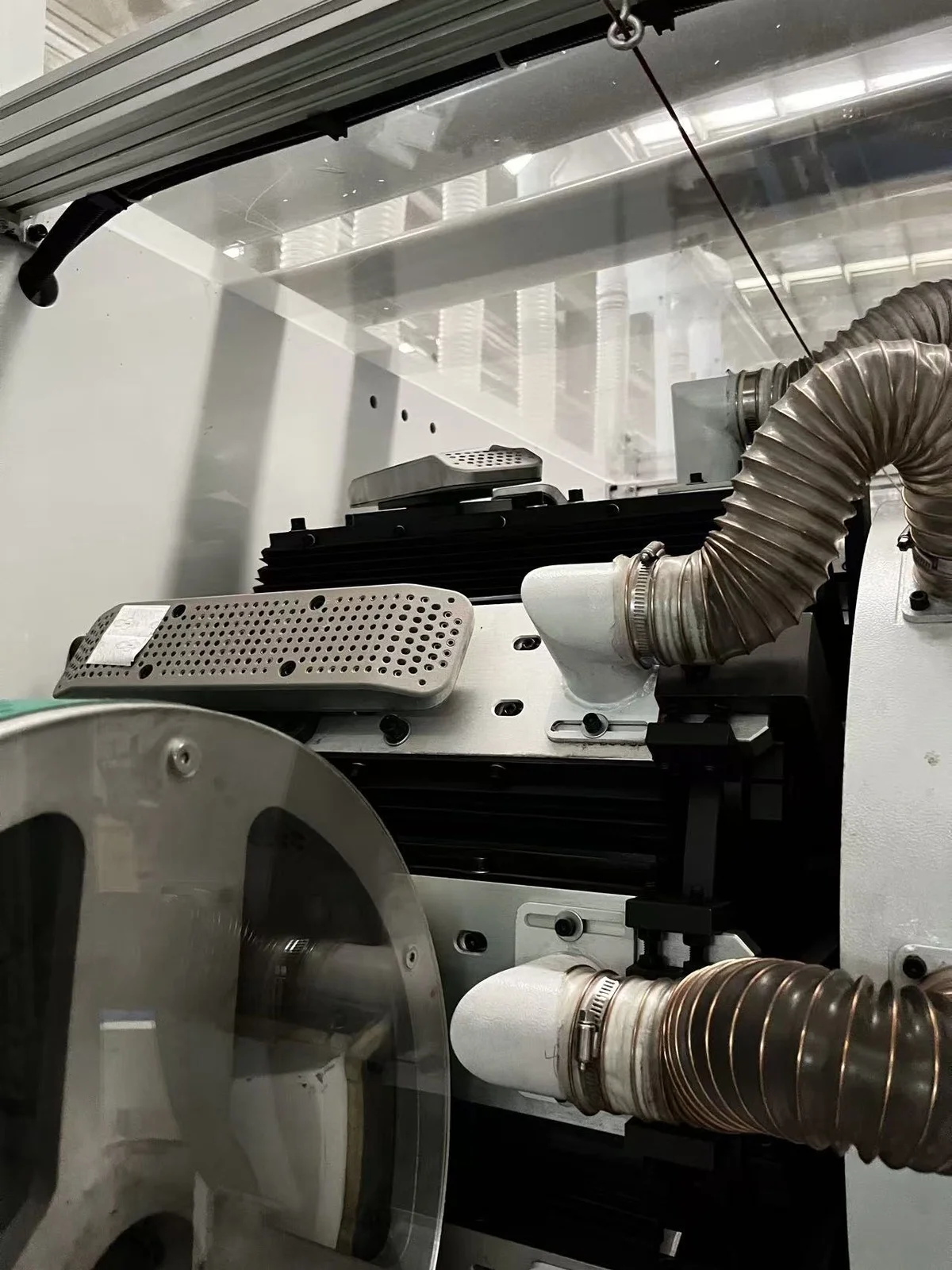
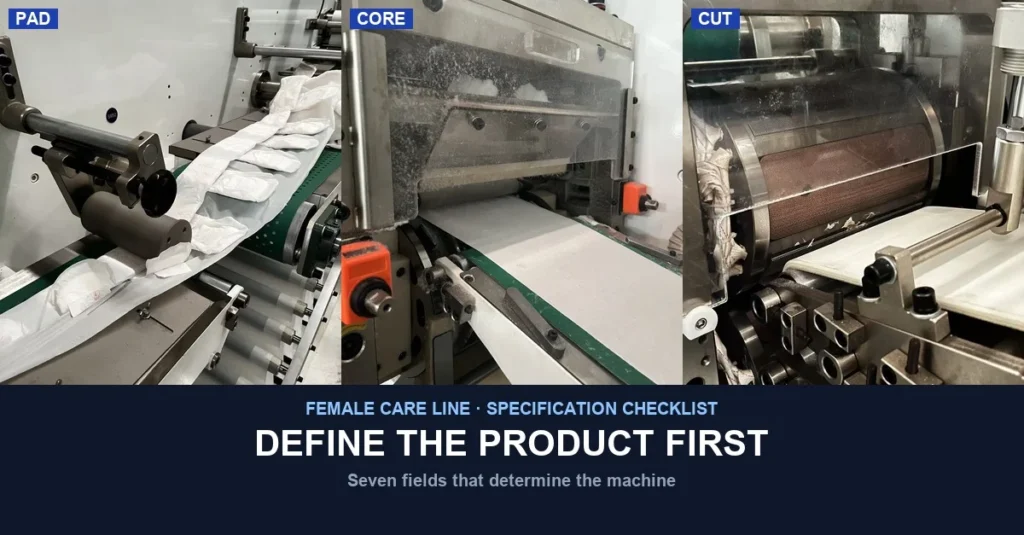
In most cases, high-speed sanitary napkin lines lose their highest percentage of good pads at the transition between final cutting, 90-degree turning, and individual PE film wrapping. As shown in Figure 4 on Welldone's fast & easy-pack platform (WD-SP011, 1,000 pcs/min design, 900 pcs/min stable speed), converting thicker ATB pads requires three servo adjustments:
- Servo 90-Degree Flapping Pocket Clearance: Adjusts vacuum timing and transfer gap height via the Mitsubishi/Siemens HMI so thicker ATB pads rotate 90 degrees without edge folding.
- Wing & Back Release Paper Sync: Places back and wing silicone release strips within ±1.0 mm before tri-folding into the PE wrapping film.
- Easy-Pack Sealing Tab & Side-Seal Nip Control: Synchronizes fast-tear tape with rotary heat-sealing knives, keeping waste rate < 2% and passing rate ≥ 98%.
8. End-of-Line Sync: Panty Liner Lines & Automatic Female Care Bagging
Feminine care brands launching high-loft ATB overnight and day pads (>180 mm) frequently pair them with ultra-thin daily panty liners (<180 mm) and intimate wet wipes (such as Cleanic's November 18, 2026 15-count flushable packs). Welldone manufactures dedicated panty liner machines (reaching 1,000–1,200 pcs/min) and female care packing machines that automatically count, compress lofty ATB pad stacks to target retail bag thickness, and seal polybags with film eye-mark tracking and auto-rejection.
9. Engineering Matrix: Conventional PP Spunbond vs. High-Loft ATB & r-PP Webs
Use the 5×5 engineering comparison matrix below to configure your sanitary napkin or panty liner line when upgrading from standard PP spunbond to high-loft ATB topsheets/ADLs and r-PP barrier cuffs:
| Converting Parameter | Standard Calendered PP Spunbond Topsheet (15–18 gsm) | High-Loft Bicomponent PE/PP ATB Topsheet (18–25 gsm) | High-Resilience ATB ADL Web (30–45 gsm) | Purified r-PP Blended SMS Leak-Guard Web (13–17 gsm) |
|---|---|---|---|---|
| Fiber & Bonding Architecture | Homopolymer PP continuous filaments; hot calender point bond | Sheath/core PE/PP staple fibers; through-air oven thermal bond | Coarse denier bicomponent PE/PP or PE/PET open-pore 3D loft | Virgin PP + purified r-PP (e.g., PureFive grade) spunbond-meltblown |
| Unwinder & Carbon-Fiber Roller Tension | 2.2–3.0 N/cm standard dancer tension | 1.0–1.5 N/cm ultra-low servo tension to prevent loft crush | 1.2–1.8 N/cm tension + vacuum transfer drum after short-cut knife | 1.5–2.2 N/cm closed-loop tension before center slitter |
| Channel / Edge Embossing Recipe | 138–148°C roll setpoint; standard nip pressure | 115–125°C PID setpoint (matched to PE sheath) + micro-gap stop | Sub-layer compression limited to channel lines; ≥90% loft recovery | Side-seal nip 125–135°C or ultrasonic cuff tacking |
| Hot-Melt Adhesive Application | 1.5–2.5 gsm construction spray at 155–160°C | 1.2–1.8 gsm fine spiral/slot spray at 145–152°C (zero strike-through) | Zone-indexed intermittent glue stripes leaving center pores open | Dedicated elastic strand encapsulation glue for 3D cuff spandex |
| 90° Easy-Pack & Stack Bagging Setup | Baseline 90° turn gap; standard stack compression | +0.5 mm 90° flapping gap + controlled stack gusset compression | Pre-bagging stack press dwell 0.4–0.6 s to stabilize pouch thickness | Cuff fold flat verification via inline vision before tri-folding |
10. How Welldone Supports Feminine Care Machinery, BOM Materials & Finished Supply
With ATB capacity expanding in India and purified r-PP scaling in North America, I believe feminine care manufacturers gain the strongest edge when their converting line, raw-material BOM, and packaging automation are validated together.
Operating since 2008 and incorporated in 2013, JINJIANG WELLDONE MACHINE CO., LTD. supports global partners across three scopes:
- Full-Servo Sanitary Pad, Panty Liner & Packing Machinery: We manufacture full-servo sanitary pad machines (including
WD-SP011fast & easy-pack lines at 1,000 pcs/min design / 900 pcs/min stable speed, up to 1,000–1,200 pcs/min, plus 500–600 pcs/min lines), panty liner machines (1,000–1,200 pcs/min), and female care packing machines, with carbon-fiber rollers and Mitsubishi/Siemens PLCs. - Matched Hygiene Raw Material BOM Supply: Welldone supplies pre-tested BOM packages—ATB topsheets, ATB and airlaid ADLs, fluff pulp, SAP paper, SMS leak-guard webs, breathable PE backsheets, release papers, easy-pack films, and hot-melt adhesives.
- Finished Feminine Care & Hygiene Products Supply: We also coordinate supply of finished sanitary napkins, panty liners, menstrual pants, diapers, and wet wipes. Exact specs, MOQs, and terms are confirmed via inquiry.
11. 8-Step Buyer & Factory Actionable FAT Qualification Checklist
Before qualifying a new Air-Through-Bonded (ATB) nonwoven supplier or ordering a high-speed sanitary napkin production line, execute this 8-step verification checklist:
- Freeze Bicomponent Sheath/Core Melting Points in Your BOM Spec: Require your ATB supplier to certify exact PE sheath melting temperature (typically 128–132°C) and uncrushed roll caliper (mm at 0.5 kPa) before setting embossing recipes.
- Verify Carbon-Fiber Guide Rollers Across Unwind & Splicing Paths: Confirm that topsheet and ADL web paths use low-inertia carbon-fiber rollers so zero-speed splicing at 900–1,000 pcs/min never stretches lofty ATB webs.
- Test Calibrated Micro-Gap Channel Embossing During FAT: Run 20–25 g/m² ATB topsheet at 115–125°C during Factory Acceptance Testing and verify zero PE fiber buildup on engraving pins over a continuous 2-hour run.
- Validate Vacuum Transfer on Short-Cut ATB ADL Patches: Confirm that 30–45 g/m² ATB ADL patches hold ±1.0 mm longitudinal registration on the absorbent core without edge curling.
- Audit r-PP SMS Standing Leak-Guard Slitting & Spandex Retraction: If testing recycled-PP blended SMS barrier webs, verify center slitting accuracy and confirm cuff spandex creep stays ≤1.5%.
- Tune 90° Flapping Pocket Clearance for High-Loft Pads: Adjust the 90-degree turning wheel gap and vacuum timing so thicker ATB pads rotate smoothly into the PE easy-pack wrapper.
- Synchronize Wing & Back Release Paper Registration (±1.0 mm): Inspect tri-folded easy-pack pouches at 900 pcs/min stable speed to verify clean side seals and automatic stack bagging compression.
- Lock Separate PLC Recipes for ATB vs. Spunbond SKUs: Store password-protected HMI tension, temperature, and stack-press recipes for both premium ATB SKUs and standard spunbond SKUs via Welldone engineering support.
If your procurement team sourced localized ATB topsheet rolls next quarter, could your sanitary pad line switch to high-loft ATB in ten minutes without crushing pad thickness?
12. Source & Date Verification
- Primary Hygiene Nonwoven Line Source (November 19, 2026): Nonwovens News (Haydn Davis) — Benecore start-up new hygiene nonwovens facility (German-Indian JV between TWE Group GmbH and Obeetee Group commissions two Air-Through-Bonding ATB lines in Bhopal, Madhya Pradesh) & Press Trust of India (PTI): Benecore opens hygiene nonwoven material facility in Bhopal.
- Primary Recycled Polypropylene Source (November 19, 2026): Nonwovens News (Haydn Davis) — PureCycle expands recycled polypropylene supply (5.2 million lb Q3 PureFive resin output at Ironton, Ohio, up 14% QoQ).
- Secondary Industry Innovation Governance Source (November 19, 2026): Nonwovens Industry (Tara Olivo) — Kimberly-Clark Makes Executive Leadership Appointments (Katie Devine named Chief Growth & Innovation Officer; Brian Giroux appointed Chief Customer Officer).
- Secondary Feminine Care Product Source (November 18, 2026): Nonwovens News (Haydn Davis) — Cleanic expands intimate wet wipes range (Harper Hygienics launches three flushable variants).
13. Frequently Asked Questions (FAQ)
1. Can one Welldone sanitary pad line run both PP spunbond and high-loft ATB topsheets?
Yes. On Welldone full-servo sanitary pad machines and panty liner machines, operators switch between calendered PP spunbond and bicomponent PE/PP ATB webs by loading pre-saved PLC tension and embossing temperature recipes.
2. Why do carbon-fiber rollers matter when converting 18–25 gsm ATB nonwovens at 900–1,000 pcs/min?
Carbon-fiber rollers have significantly lower rotational inertia than aluminum rollers, preventing tension spikes and permanent loft flattening during automatic zero-speed roll splicing.
3. Where can purified recycled polypropylene (r-PP) be used in a sanitary pad BOM?
Purified odor-free r-PP resins can be blended into hydrophobic SMS standing leak-guard webs or outer non-skin-contact spunbond layers while keeping virgin bicomponent ATB on the direct skin-contact topsheet.
4. Does Welldone supply ATB raw materials and finished sanitary pads alongside machinery?
Yes. Alongside converting and female care packing machines, Welldone supplies matched BOM raw materials and finished feminine care products via our official inquiry page.
14. Request a Sanitary Pad Line Configuration or ATB BOM Consultation
Planning to upgrade a 900–1,200 pcs/min sanitary napkin or panty liner line for high-loft ATB nonwovens, source matched BOM raw materials, or procure finished feminine care products? Contact Welldone via our official contact page:
- Company: JINJIANG WELLDONE MACHINE CO., LTD. (Operating since 2008 • Incorporated 2013)
- Website: https://cnwelldone.com/contact-us
- Email: welldone@cnwelldone.com
- WhatsApp / Phone: +86-13655936189 / +86-18859710618