
Airlaid Nonwoven Hygiene Core Line Guide 2026 | Welldone

Airlaid Roll vs. Inline Drum Core: Map Hygiene Line Compatibility
When upstream nonwoven suppliers bring new biodegradable airlaid roll capacity online across 50 to 100 gsm basis weights, sanitary pad, panty liner, underpad, and wet wipe manufacturers face an immediate engineering question: should the product BOM rely on pre-formed airlaid rolls, an inline defibrated fluff pulp and SAP forming drum, or a hybrid core-wrap architecture? Locking that decision before freezing machine unwinding, embossing, and lamination parameters prevents web breaks, adhesive strike-through, and costly line retrofits.
1. What SharpCell's €30 Million Finnish Airlaid Line Start-Up Confirms
On November 6, 2026, Nonwovens Industry reported that Finnish airlaid manufacturer SharpCell Oy completed an approximately €30 million investment at its Tervasaari mill in Valkeakoski, Finland, upgrading and rebuilding a production line acquired from Germany. According to the report, the project progressed from dismantling the line in Germany to producing its first commercial roll at Tervasaari in 18 months, and commercial deliveries have now begun.
Cross-checking SharpCell's official corporate and product pages alongside earlier trade reporting confirms the technical and operational scope of this upstream expansion:
- Machine origin and rebuild scope: The upgraded machine (internally nicknamed "Herbert") was originally manufactured in 2020 by Finnish supplier Anpap Oy, operated for two years in Nuremberg, Germany, and was purchased from Ascutec Sales UG before being relocated and rebuilt inside the former UPM Tervasaari PM6 hall in Valkeakoski.
- Independent financing and workforce expansion: SharpCell financed the €30 million investment independently without state subsidies, hiring 25 new employees in the initial phase. Combined with its existing Kausala machine (commissioned in 2010), the family-owned company employs 80 people across Kausala and Valkeakoski and reported 2025 revenue of €30.6 million.
- Low-carbon utilities roadmap: At the Valkeakoski facility, steam is generated without fossil fuels, electricity and binders are CO₂-free, and fluff pulp raw material is transported by biogas-powered trucks. SharpCell stated its goal of adopting fossil-free drying energy in 2028 and achieving net-zero operations by the end of 2030.
- Verified hygiene and wiping substrate grades: According to SharpCell's official product specifications, its wood-pulp Binder Bonded Airlaid (BBAL, bonded with EVA dispersion) serves feminine hygiene, baby care, wet and dry wiping, hospital patient care (bed covers, draw sheets, patient care products, laboratory pads), and tabletop applications. Its published catalog spans DS 50 & 60 gsm, DS 80 gsm, DS 100 gsm (which can be laminated with film for waterproof barrier protection), Mono 50 & 60 gsm with a textile-like handfeel, and DIA 50 & 60 gsm diagonal-pattern grades, alongside certified industrially compostable materials compliant with EN 13432 and newly validated wire patterning.
2. Evidence Boundary: Verified Mill Facts vs. Converting Engineering Analysis
To keep procurement and engineering decisions grounded in verifiable evidence, this guide separates facts directly confirmed by the November 2026 news and official SharpCell documentation from Welldone's converting machinery analysis:
Three-Tier Fact & Engineering Boundary:
- Source-Confirmed Facts: SharpCell's €30 million Valkeakoski Tervasaari airlaid line completion and start of commercial deliveries (reported November 6, 2026); the 18-month rebuild of the Anpap 2020 machine from Nuremberg, Germany; 25 new hires, 80 total staff, and €30.6 million 2025 revenue; fossil-free steam, CO₂-free electricity and binders, biogas pulp trucks, 2028 fossil-free drying goal, and 2030 net-zero target; and published BBAL grades (DS 50/60/80/100 gsm, Mono 50/60 gsm, DIA 50/60 gsm, EN 13432 compostable capability).
- Welldone Engineering & Supply Chain Analysis: All evaluations of how 50 to 100 gsm airlaid rolls interact with sanitary pad, panty liner, underpad, baby care, and wet wipe converting equipment—including unwinding, splicing, core embossing, hot-melt transfer, and inline drum versus roll-fed core selection—represent Welldone's engineering guidance. Welldone was not involved in SharpCell's investment.
- Illustrative Examples Only: Sample BOM pairings and station checkpoints labeled Illustrative example only serve as engineering templates that buyers must calibrate against supplier datasheets and trial protocols.
3. Inside the 8-Layer Sanitary Pad BOM: Where Airlaid Rolls and Fluff Cores Sit
When a feminine care or incontinence brand evaluates new biodegradable airlaid capacity, procurement cannot treat "absorbent core material" as a single line item. In a modern winged sanitary pad or ultra-thin liner, up to eight distinct functional layers converge inside the converting line, and each layer maps to a dedicated unwinder, applicator, or forming station.

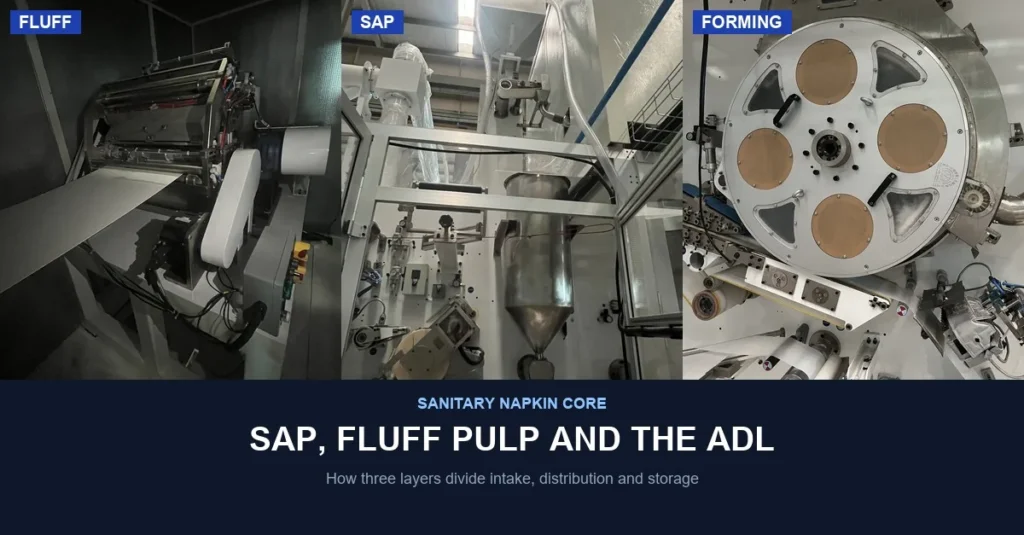
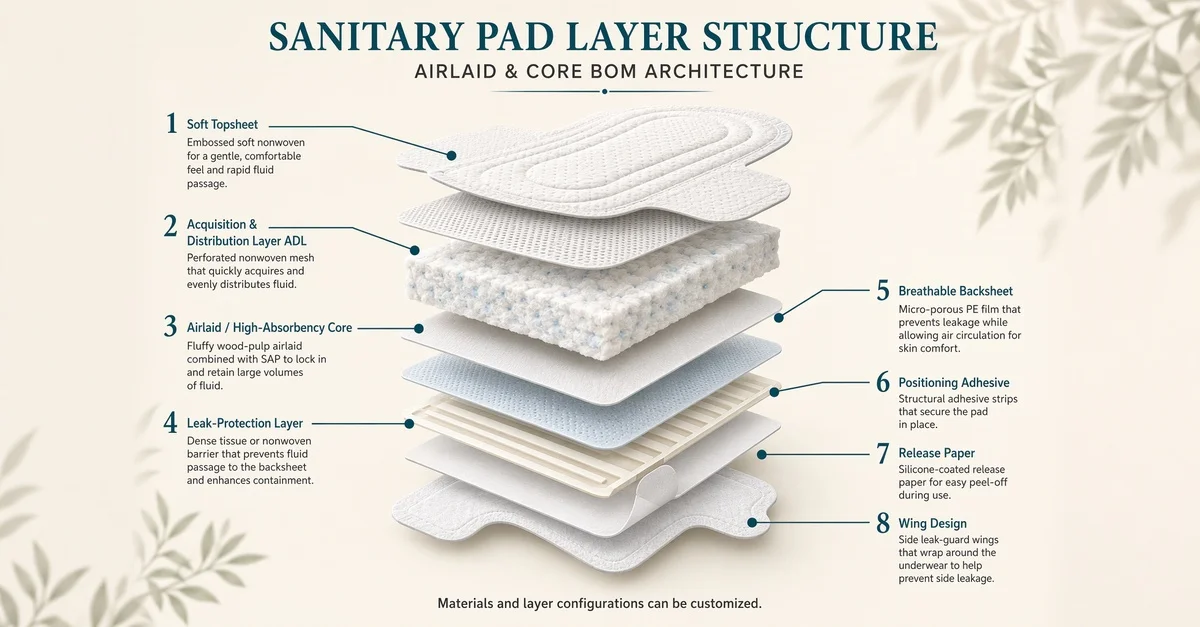
Mapping the eight functional layers shown in Figure 1 clarifies exactly where a 50 to 100 gsm airlaid substrate can enter the bill of materials on sanitary pad and feminine care production lines:
- Layer 1 — Soft Topsheet (Embossed Spunbond / Hot-Air Nonwoven): Unwound under low servo tension to preserve surface loft and skin softness before meeting the underlying transfer layer.
- Layer 2 — Acquisition & Distribution Layer (ADL): A perforated mesh or low-density fibrous strip cut and placed over the target insult zone to accelerate fluid intake and longitudinal spreading.
- Layer 3 — Airlaid / High-Absorbency Core: The primary fluid storage engine. Depending on pad thickness and target absorbency, converters configure this layer either as a roll-fed pre-formed airlaid/SAP composite web (for ultra-thin pads and panty liners) or as an inline defibrated fluff pulp and SAP drum-formed core wrapped in airlaid or tissue carrier paper.
- Layer 4 — Leak-Protection Layer (Dense Tissue or Airlaid Barrier Wrap): Positioned beneath the core to stabilize loose fibers, prevent SAP gel pinholing against the backsheet, and improve lateral fluid containment.
- Layer 5 — Breathable Backsheet (Micro-Porous PE Film or Film-Laminated Nonwoven): Acts as the liquid-impermeable bottom barrier while permitting water vapor transmission.
- Layer 6 — Positioning Adhesive (Structural & Garment Hot-Melt Strips): Slot-coated or spiral-sprayed onto the exterior backsheet surface and wing undersides to secure the pad to underwear during wear.
- Layer 7 — Release Paper (Silicone-Coated Easy-Peel Strip): Registered over the garment positioning adhesive and wing adhesive zones to protect tack until consumer use.
- Layer 8 — Wing Design (Side Leak-Guard Flaps): Formed by extending the topsheet and backsheet laminate laterally around the absorbent core profile and die-cutting contoured side flaps.
4. Pre-Formed Airlaid Roll Infeed vs. Inline Drum-Formed Core: Choosing the Converting Route
The real question is whether your converting line is configured for pre-formed airlaid roll unwinding, inline fluff pulp drum forming, or a hybrid core-wrap architecture. When upstream mills expand capacity for 50 to 100 gsm BBAL airlaid rolls—including EN 13432 compostable grades and textile-feel wire patterns—hygiene factory planners must match the material format to the right machine architecture:
Three Converting Architectures for Airlaid & Fluff Pulp Hygiene Cores
Selecting between roll-fed airlaid and inline drum forming determines machine footprint, dust collection load, and SKU changeover speed:
Route A: Pre-Formed Airlaid Roll Infeed (Ultra-Thin Pads & Liners)
Replaces the hammermill defibrator and vacuum forming drum with servo-driven airlaid unwinders. Ideal for panty liners and ultra-thin sanitary pads using 50–100 gsm airlaid rolls combined with SAP sheet or multi-layer airlaid lamination. Eliminates mill-hammer energy draw and reduces airborne cellulose dust.
Route B: Hybrid Airlaid Carrier + Inline Fluff/SAP Drum (Maxi & Night Pads)
Retains the high-capacity hammermill crusher and 3D vacuum forming drum for bulk fluid capacity, while substituting 50–60 gsm biodegradable airlaid for conventional wet-laid tissue as the upper distribution wrap or lower core containment layer.
Route C: Multi-Ply Laminated Airlaid + Barrier Film (Underpads & Medical Draw Sheets)
Pairs heavier 80–100 gsm airlaid webs directly with breathable PE film or pre-laminated waterproof barrier substrates on wide-web underpad and hospital draw-sheet lines where uniform sheet wet strength is critical.
Route D: Diagonal-Pattern Airlaid Webs (Wet Wipes & Personal Care Wiping)
Feeds 50–60 gsm patterned airlaid (such as diagonal DIA or Mono structures) into wet wipe folding, lotion dosing, and flow-wrapping lines where biodegradable wood-pulp fibers must survive high-moisture lotion saturation without tearing.
5. Unwinding, Splicing, and Web Tension Window across 50 to 100 gsm Airlaid Grades
A common mistake is treating a 50 gsm soft-touch airlaid roll and a 100 gsm barrier-grade airlaid roll as drop-in substitutes under the same unwinder tension recipe. Unlike thermally bonded polypropylene spunbond nonwovens—which rely on continuous synthetic filaments for machine-direction tensile strength—Binder Bonded Airlaid (BBAL) consists of short defibrated softwood fluff pulp fibers held together by an aqueous EVA dispersion binder or bicomponent fiber network.

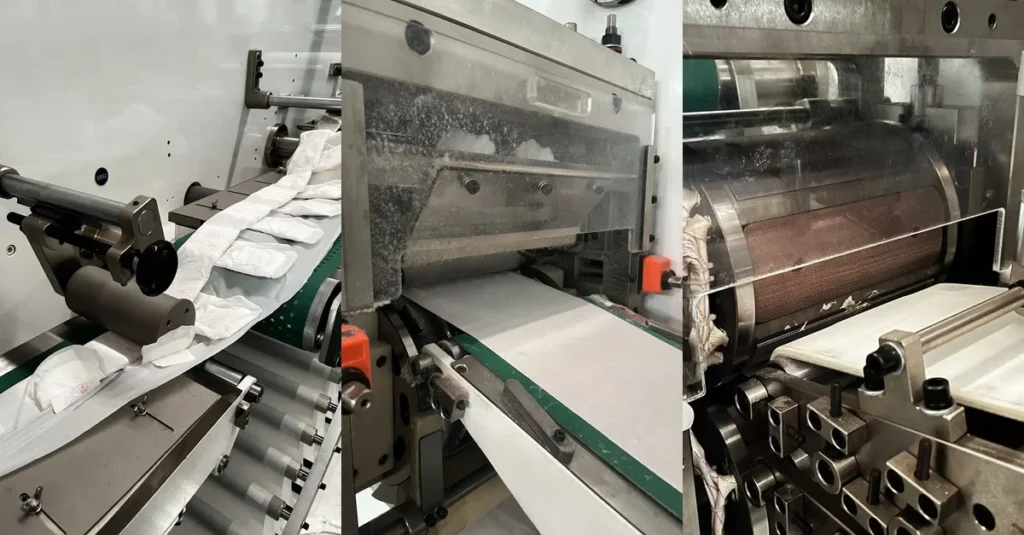
When qualifying new European or international airlaid rolls on a high-speed sanitary pad or liner unwinder (Figure 2), process engineers must lock four mechanical variables:
- Closed-loop dancer accumulator geometry: When a 50 or 60 gsm textile-feel airlaid roll accelerates during an automatic zero-speed splice, excessive festoon spring pressure or slow servo brake response can neck the web or fracture short wood-pulp fiber bonds. Multi-roller low-inertia accumulators buffer the splice transient so web tension stays flat across the splicing cycle.
- Roll diameter taper tension curve: Because 80 to 100 gsm airlaid rolls build significantly higher rotational inertia at full parent-roll diameter than thin spunbond rolls, the servo unwinder PLC must apply a progressive diameter-taper profile from full reel down to core exhaustion.
- Splicing tape tack on fibrous airlaid surfaces: Loose surface lint or deep wire embossing (such as diagonal DIA or soft Mono textures) reduces effective contact area for standard double-sided splicing tapes. Qualifying high-shear, high-initial-tack splice tapes prevents tail peel-back inside downstream guide rollers.
- Edge guiding and dust extraction at the slitting/infeed zone: Even binder-bonded airlaid releases fine cellulose dust where slit edges rub against static guide bars. Low-friction anodized rollers paired with localized suction manifolds keep ultrasonic web-edge sensors clean.
6. Core Embossing Nip Gap, Channel Integrity, and Rotary Die-Cut Knife Wear
In most cases, adhesive strike-through or core channel delamination after a substrate switch traces back to unadjusted embossing nip pressure and hot-melt add-on weight rather than a defective parent roll. Once the airlaid layer converges with the absorbent core or SAP carrier, it passes through the core embossing and channel-forming station before final rotary die-cutting.
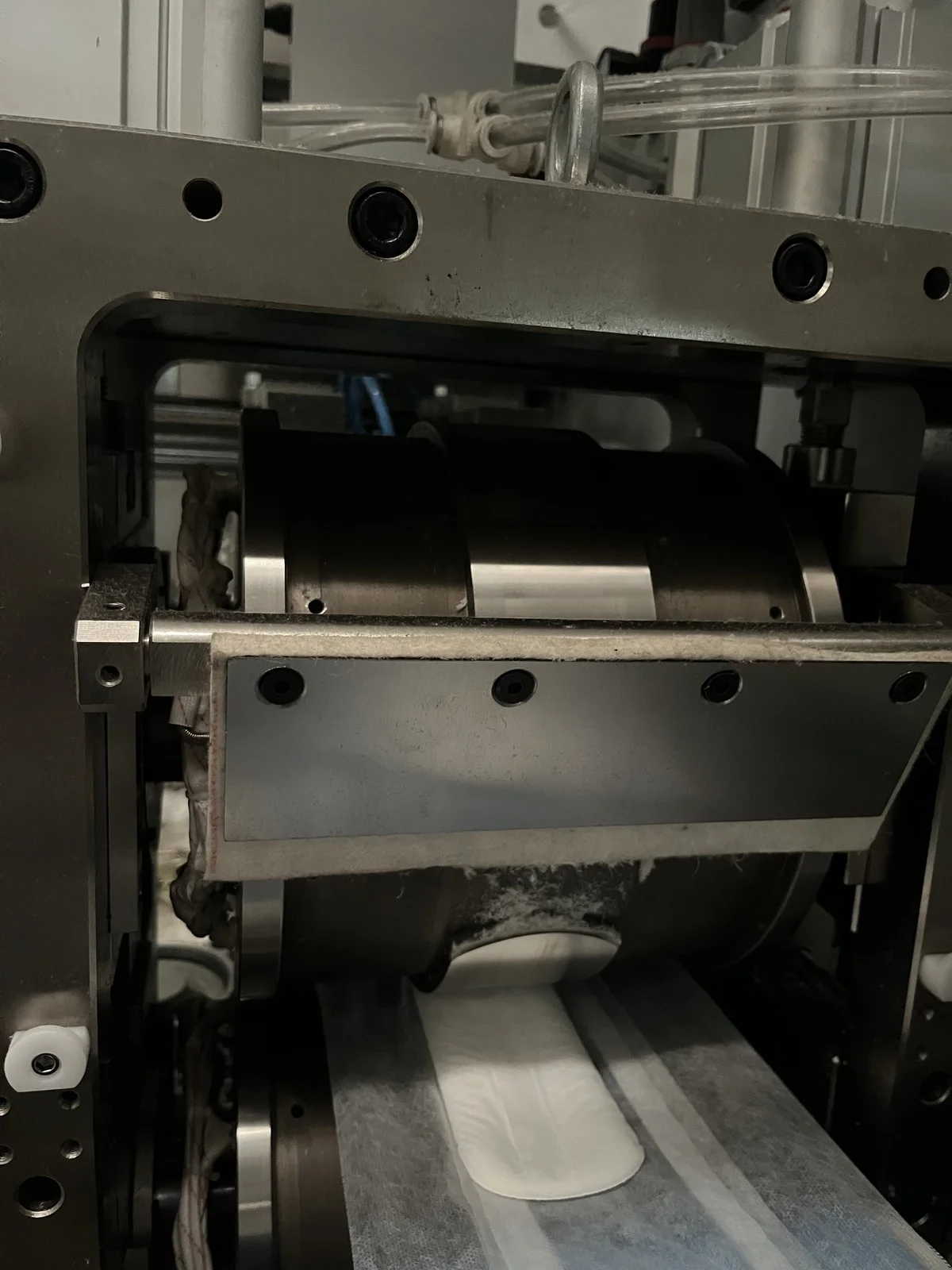
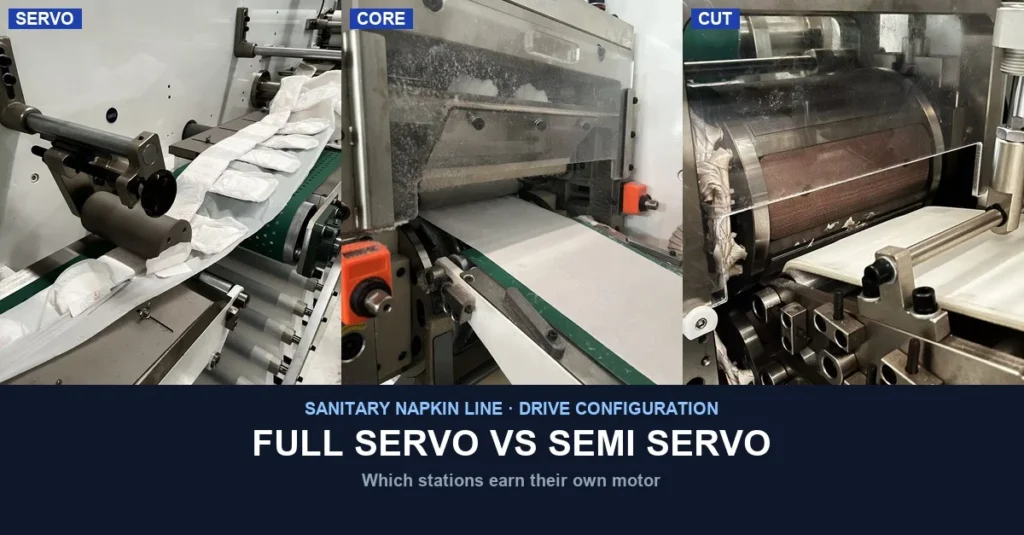
Switching between 50–60 gsm and 80–100 gsm airlaid grades—or moving from conventional petro-binder webs to EN 13432 compostable structures—alters how the core responds inside the embossing unit (Figure 3):
- Embossing nip gap and pneumatic cylinder loading: If a line switches from a 50 gsm carrier wrap to an 80 gsm airlaid core layer without recalibrating the mechanical stop gap, over-compression crushes the internal void volume required for rapid fluid intake and can shear the cellulose web along the engraved channel edges. Conversely, under-compression on a loftier 60 gsm Mono textile-feel grade leaves channels indistinct, allowing lateral pad bunching during wear.
- Interaction with EVA binder systems: Because BBAL airlaid relies on EVA dispersion binders, excessive roller heating or high-friction slip in the embossing nip can cause binder build-up on engraved steel teeth. Maintaining clean anti-stick roller coatings and verified nip surface temperatures preserves crisp channel definition across multi-shift runs.
- Rotary die-cut anvil load on dense composite cores: When 80 to 100 gsm airlaid layers are paired with SAP or film laminates, cutter anvil pressure must be balanced so the rotary knife severs wood-pulp fibers cleanly without generating frayed edges or premature blade dulling.
7. Backsheet Lamination, Adhesive Strike-Through, and Barrier Film Pairing
Downstream of core embossing, the sealed absorbent assembly meets the breathable PE backsheet, positioning adhesive applicators, and silicone release paper station. As SharpCell's product technical notes highlight, higher-basis-weight grades such as DS 100 gsm can also be laminated directly with barrier film to create waterproof protection for medical and hygiene pads.
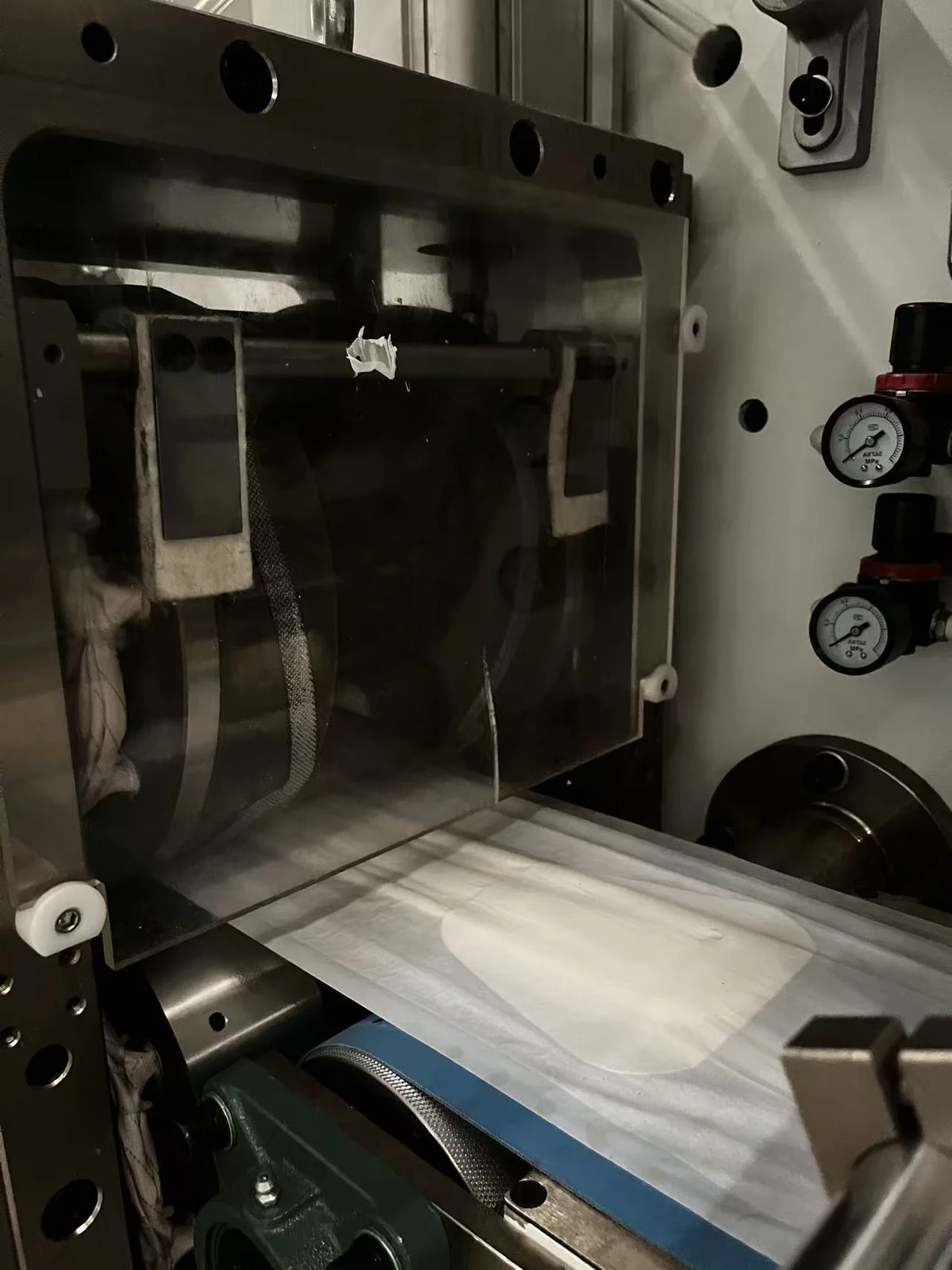
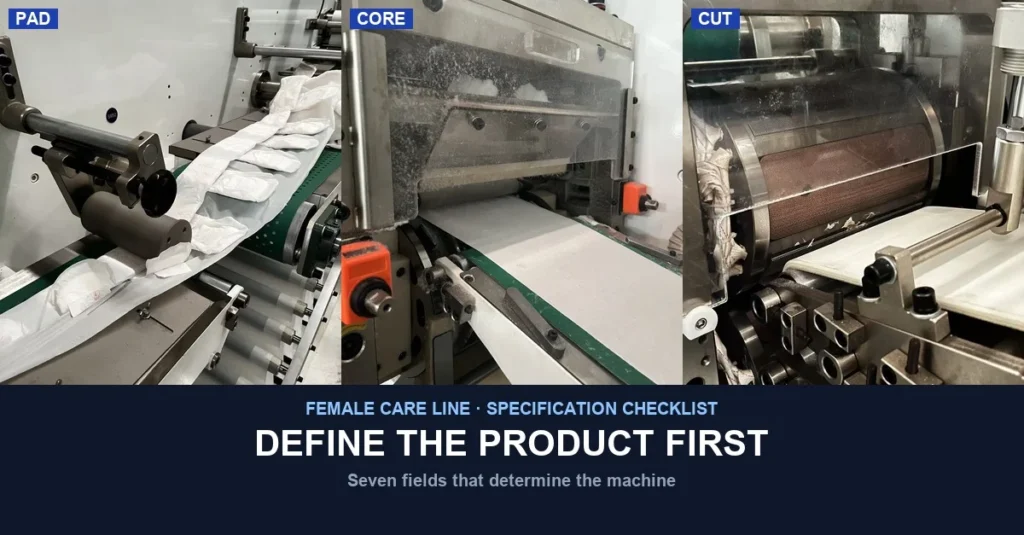
At the backsheet lamination station (Figure 4), engineering teams should audit three critical transfer points before approving a new airlaid specification:
- Hot-melt spray pattern vs. open airlaid pore structure: Open-pattern 50 to 60 gsm airlaid webs have higher air permeability than calendered tissue. If construction hot-melt adhesive is applied at excessive temperature or coat weight, low-viscosity adhesive strikes through the porous airlaid sheet and contaminates the steel compression roller. Switching to fine-fiber spiral or multi-slot coating at controlled open times locks the interface without bleed-through.
- Dual-regulator lamination nip pressure: As visible on the pneumatic pressure regulators in Figure 4, independent left/right nip pressure control ensures uniform cross-machine lamination between the airlaid core bottom, the breathable backsheet film, and the side-wing nonwoven extensions.
- Compostable BOM alignment (EN 13432 product development): When a converter purchases EN 13432 certified compostable airlaid rolls to build eco-positioned sanitary pads or liners, the substrate alone does not make the finished pad compostable. Engineers must verify how biopolymer backsheet films—which often exhibit lower thermal shrinkage thresholds than standard PE film—behave under positioning-adhesive application temperatures before release paper lamination.
8. Cross-Category Implications for Wet Wipes and Patient-Care Underpads
Because wood-pulp airlaid roll investments serve multiple hygiene verticals simultaneously, multi-line converters can leverage the same upstream material family across wet wipes converting and packaging lines as well as baby care and underpad production lines:
- Wet wipes converting (DIA 50 & 60 gsm and Mono 50 & 60 gsm): Unlike spunlace nonwovens containing polyester or viscose blends, 100% wood-pulp BBAL airlaid exhibits a lower wet-to-dry tensile ratio once saturated with aqueous lotion. On wet wipe folding and cutting machines, dosing lotion after longitudinal folding—or lowering post-wetting web draw tension between the wetting manifold and the reciprocating stacker—prevents wet web elongation and stack skew.
- Hospital patient care, draw sheets, and underpads (DS 80 & 100 gsm): In disposable medical draw sheets, laboratory pads, and baby changing mats, 80 to 100 gsm airlaid webs provide rapid fluid wicking and wet cushion integrity without the shifting or clumping sometimes seen in un-embossed loose fluff mats. When running film-laminated DS 100 gsm structures, rotary heat-sealing or ultrasonic perimeter sealing must be tuned to the combined caliper of the cellulose web and barrier film.
9. Converting Line & BOM Compatibility Matrix across Hygiene Categories
The table below translates SharpCell's published 50 to 100 gsm airlaid grade families into concrete converting station checkpoints across sanitary pads, panty liners, wet wipes, and medical underpads (Illustrative example only — converter engineering framework):
| Airlaid Grade Family (Source-Verified) | Target Hygiene Product & BOM Layer | Primary Converting Station Impact | Key Process Risk During Material Switch | Machine Qualification & Acceptance Gate |
|---|---|---|---|---|
| DS 50 & 60 gsm Standard BBAL | Sanitary pad / baby core wrap & distribution layer | Core wrapping unwinder, zero-speed splicer & core embossing nip | Web necking at splice acceleration or hot-melt strike-through onto nip rolls | Verify zero splice breaks across 3 consecutive parent rolls & zero roller adhesive build-up |
| Mono 50 & 60 gsm Textile-Feel | Ultra-thin sanitary pads & daily panty liners | Low-tension servo unwinder, ADL/core lamination & contour embossing | Over-compression in embossing nip reducing soft handfeel and void volume | Calibrate embossing nip gap to preserve target caliper and channel peel strength |
| DIA 50 & 60 gsm Diagonal Pattern | Biodegradable personal care & surface wet wipes | Wet wipe folding deck, lotion dosing manifold & cross-cut stacker | Wet-state MD elongation or sheet tearing after aqueous lotion saturation | Lock wet-draw ratio and verify cut-length tolerance across full lotion add-on range |
| DS 80 gsm High-Capacity Airlaid | Heavy-flow ultra-thin pads & composite absorbent cores | Core die-cutter anvil, SAP sheet lamination & dust extraction manifold | Increased rotary knife wear and cellulose edge lint at high line speeds | Audit die-cut pad edge cleanliness and suction filter differential pressure over 2-hour run |
| DS 100 gsm + Barrier Film Laminate | Hospital draw sheets, patient underpads & laboratory pads | Wide-web unwinder taper tension, backsheet lamination & perimeter seal | High parent-roll inertia spikes or film thermal distortion at seal bars | Confirm taper tension curve and test hydrostatic barrier integrity after lamination |
10. How Welldone Supports Hygiene Machinery, Raw Material Trials, and Finished Product Supply
I believe buyers evaluating European biodegradable or EN 13432 compostable airlaid grades should lock a three-roll machine trial matrix across splicing, embossing, and backsheet lamination before signing annual supply contracts. Whether your factory is building a new feminine care or wet wipes line, retrofitting an existing machine to run pre-formed airlaid rolls, or sourcing matched raw materials and finished hygiene products, Welldone supports your project across three integrated levels:
- Servo Hygiene & Wet Wipes Converting Machinery: Welldone designs and manufactures sanitary napkin, panty liner, baby diaper, pull-up, adult incontinence, underpad, and wet wipes lines supporting both inline fluff-pulp drum forming and multi-shaft servo unwinding for pre-formed airlaid rolls.
- Raw Material Sampling & BOM Matching: Welldone supplies coordinated hygiene raw materials—including nonwovens, topsheet, ADL, airlaid and tissue carriers, fluff pulp, SAP, breathable PE films, release paper, spandex, and adhesives—matched to your machine window.
- Finished Hygiene Goods Supply: For distributors, hospital tenders, and private-label brands scaling market entry alongside line installation, Welldone coordinates finished sanitary pads, panty liners, baby diapers, adult care products, underpads, and wet wipes. Specific grades, certifications, packaging, MOQs, lead times, and commercial terms are confirmed upon inquiry.
11. Buyer Action Checklist Before Qualifying New Airlaid or Core Materials
8-Point Engineering & Procurement Verification Checklist
- Freeze your 8-layer BOM architecture first: Define whether each SKU uses an inline defibrated fluff/SAP drum core, a roll-fed airlaid/SAP composite core, or a hybrid airlaid carrier wrap around a fluff core.
- Request full MD/CD dry and wet tensile curves: Obtain machine-direction and cross-direction tensile strength, elongation at break, and caliper data across 50, 60, 80, and 100 gsm candidate rolls before scheduling line trials.
- Audit unwinder core chuck and parent-roll diameter limits: Confirm that your unwinder shaft diameter, maximum parent-roll OD, and servo taper-tension curve accommodate thicker 80–100 gsm airlaid reels.
- Validate zero-speed splicing tape adhesion on textured webs: Test splice reliability at full operating speed on Mono textile-feel and DIA diagonal-pattern surfaces to prevent tail lift.
- Recalibrate core embossing nip gap by basis weight: Adjust mechanical stops and pneumatic loading when stepping between 50–60 gsm and 80–100 gsm grades so channels form cleanly without fiber shearing.
- Check hot-melt adhesive coat weight and open time: Verify that construction and positioning adhesives bond the porous airlaid layer to the breathable PE backsheet without striking through onto press rollers.
- Test wet-state draw tension on wet wipe lines: When running 50–60 gsm biodegradable airlaid on wet wipe machines, verify lotion saturation uniformity and stack alignment after cross-cutting.
- Align compostable or eco-label claims across the full BOM: If specifying EN 13432 compostable airlaid, verify thermal and adhesive compatibility with matching backsheet films, release papers, and packaging films.
12. Source & Date
Verified Industry & Corporate Sources Used in This Article:
- Nonwovens Industry (November 6, 2026): SharpCell Completes Airlaid Investment (€30 million investment upgrades existing line at Tervasaari mill in Valkeakoski).
- SharpCell Official Website — Corporate Overview (Accessed November 9, 2026): SharpCell Oy — Airlaid paper & Valkeakoski Tervasaari mill investment overview.
- SharpCell Official Product Specifications (Accessed November 9, 2026): Biodegradable airlaid solutions for wiping, hygiene and tabletop applications (DS 50/60/80/100 gsm, Mono 50/60 gsm, DIA 50/60 gsm, EN 13432).
- SharpCell Official Sustainability Page (Accessed November 9, 2026): SharpCell Sustainability — Bio-based binder development and carbon footprint targets.
- Paper Market Trade Background Report (January 9, 2025): Herbert (A Papermachine) Is Moving to Valkeakoski, Finland (Anpap 2020 machine relocation background).
13. Frequently Asked Questions (FAQ)
Q1: What did SharpCell announce in November 2026 regarding its airlaid production capacity?
On November 6, 2026, Nonwovens Industry reported that Finland's SharpCell Oy completed an independently financed €30 million investment at its Tervasaari mill in Valkeakoski, rebuilding a relocated German airlaid line in 18 months, hiring 25 employees in the initial phase, and starting commercial deliveries.
Q2: Can a sanitary pad machine run both pre-formed airlaid rolls and an inline fluff pulp forming drum?
Yes, when built with modular unwinders. Ultra-thin pads and liners unwind pre-formed airlaid/SAP composite rolls directly, while maxi and night pads pair an inline hammermill and vacuum drum with an airlaid or tissue wrap.
Q3: Why do 50–60 gsm and 80–100 gsm airlaid rolls require different machine recipes?
Lighter 50–60 gsm grades require tighter splice acceleration tension and controlled adhesive coat weight to prevent web necking and strike-through. Heavier 80–100 gsm grades carry higher roll inertia and caliper, requiring adjusted taper tension, wider embossing nip gaps, and higher die-cut load.
Q4: Can Welldone supply both the converting machinery and matching hygiene raw materials or finished products?
Yes. Welldone supplies servo sanitary pad, liner, diaper, adult care, underpad, and wet wipes machines alongside coordinated hygiene raw materials and finished products. Exact specifications, samples, MOQs, and terms are confirmed upon inquiry.
14. Request a Line Compatibility Review, Material Sample Trial, or Finished Goods Quote
Whether you are configuring a new sanitary pad, panty liner, underpad, or wet wipes production line, qualifying 50 to 100 gsm airlaid and absorbent core materials on your existing equipment, or sourcing finished hygiene products, contact Welldone's engineering and supply team with your target SKU structure.
- Contact: https://www.cnwelldone.com/contact-us
- Website: www.cnwelldone.com
- Email: welldone@cnwelldone.com