What Do Buyers Expect from Eco-Friendly Hygiene Materials in 2026?

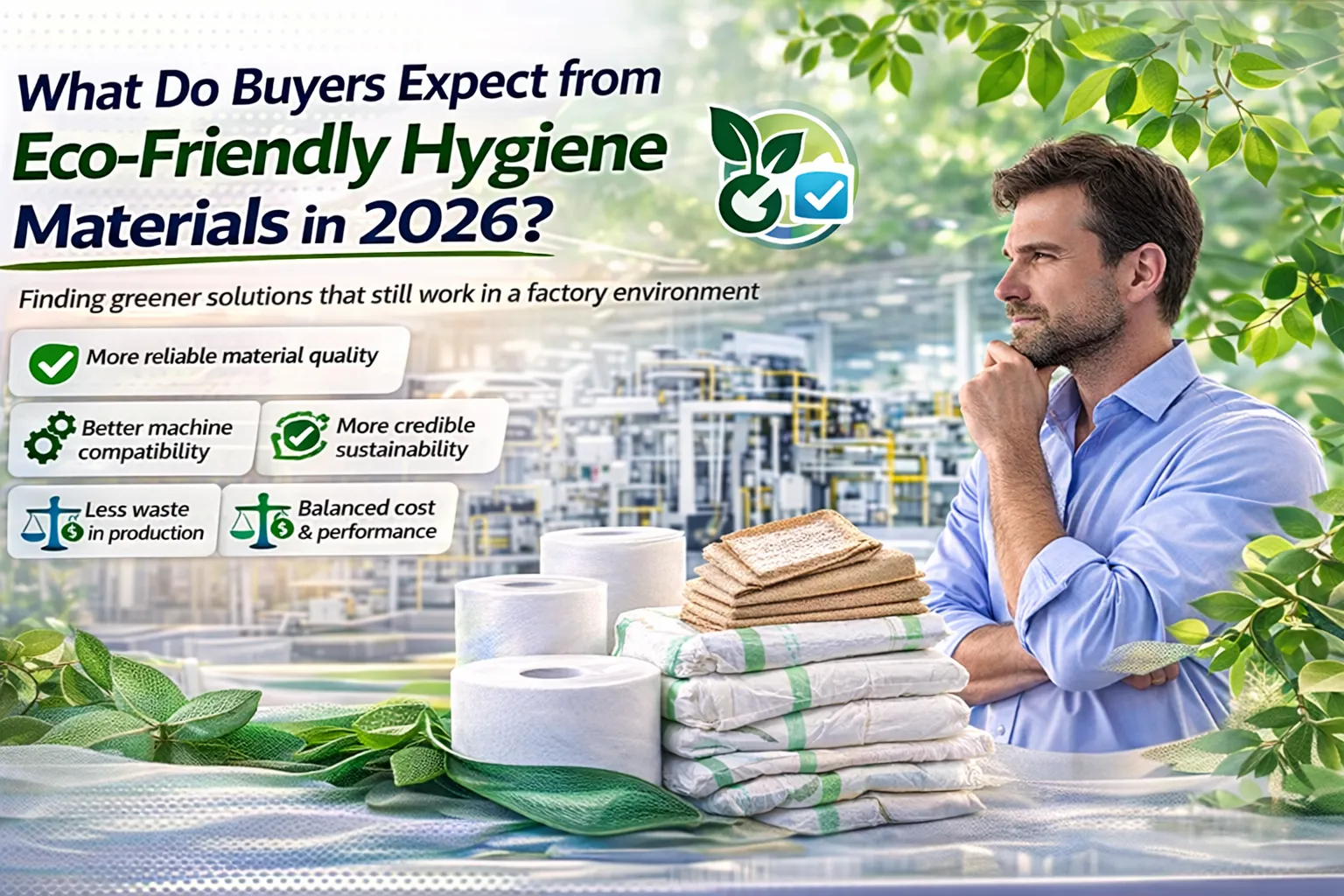
Eco-friendly hygiene materials are getting more attention in 2026, but buyers are no longer satisfied with simple “green” positioning.
They still want sustainability. They still want a better environmental story. But they also want materials that can work inside a real factory, on a real production line, under real cost pressure.
That is the real shift.
Actually, that is why buyers are asking better questions now. They are not only asking whether a material sounds eco-friendly. They are asking whether it is reliable, credible, machine-compatible, and commercially workable.
Table of Contents
- Why eco-friendly materials matter more in 2026
- What buyers really expect today
- Performance still matters as much as sustainability
- Why machine compatibility is a bigger issue than many suppliers admit
- Why credibility matters more than vague green claims
- Why cost and waste still decide adoption
- A common mistake suppliers make
- How buyers evaluate eco-friendly hygiene materials more carefully
- Why Welldone
- Related production directions
- FAQ
- Conclusion
Why Eco-Friendly Materials Matter More in 2026
A few years ago, eco-friendly hygiene materials were often discussed as a niche topic or a future option.
In 2026, that is no longer the case.
The market is moving toward stricter scrutiny. Buyers are seeing more sustainability messaging, more end-customer attention on materials, and more pressure to explain why a material choice makes sense commercially as well as environmentally.
For buyers, that changes procurement logic.
They are still interested in greener materials, but they are becoming more careful about what those materials actually deliver.
What Buyers Really Expect Today
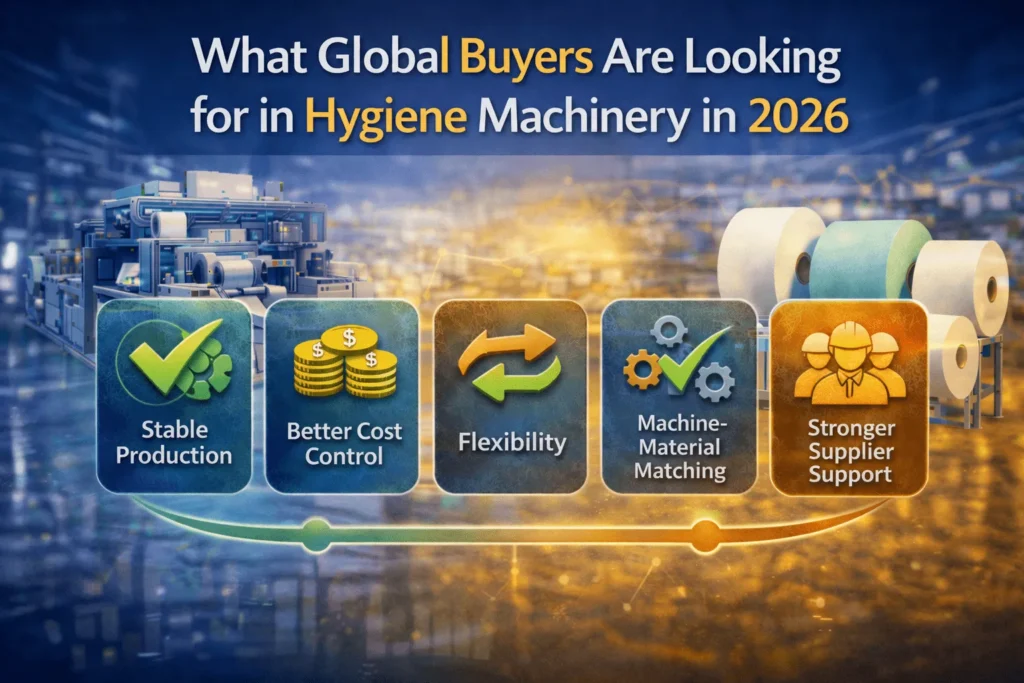
In practical terms, buyers in 2026 usually expect five things from eco-friendly hygiene materials:
1. More reliable material quality
A sustainable material still needs to be consistent.
Buyers want stable basis weight, better roll consistency, predictable converting behavior, and fewer surprises during production. If a material varies too much from batch to batch, its green positioning quickly becomes less attractive.
2. Better machine compatibility
If the material cannot run smoothly, it becomes difficult to scale.
That means buyers are looking closely at tension behavior, sealing performance, bonding response, surface feel, absorption-related function, and how the material behaves during cutting, folding, laminating, and packaging.
3. More credible sustainability positioning
This is becoming a much bigger issue.
A buyer wants to know what makes the material better, how that claim is supported, and whether the improvement is meaningful in the target market. Broad claims without technical clarity are becoming less convincing.
4. Lower waste in production
A material is harder to sell as a better option if it increases factory waste.
If it causes more rejection, more startup loss, more instability, or more operator correction, buyers will question whether the total sustainability case is really stronger.
5. A practical balance between cost and performance
This may be the most important one.
Buyers rarely adopt a material only because it sounds greener. They adopt it when the material gives them a more realistic balance of sustainability, performance, and commercial viability.
Performance Still Matters as Much as Sustainability
One of the clearest realities in 2026 is that eco-friendly does not replace performance.
It has to work with performance.
A hygiene material still needs to satisfy core production and product expectations such as softness, absorbency, strength, stability, runnability, converting consistency, and packaging suitability. If those basics become weaker, adoption becomes much harder.
For me, this is where some market conversations still go wrong. A greener story may open the door, but production performance usually decides whether the material stays in the project.
Why Machine Compatibility Is a Bigger Issue Than Many Suppliers Admit
This is one of the most underestimated parts of the discussion.
A material may look strong in a lab sheet or sales deck, but the factory experiences it differently. Once it enters real production, buyers start asking:
- Does it run smoothly at speed?
- Does it seal well?
- Does it stretch or deform too easily?
- Does it create more waste at startup?
- Does it increase downtime or adjustment time?
More importantly, if a material requires constant operator intervention to stay under control, buyers may see it as less sustainable in practice, even if the environmental positioning is appealing.
That is why machine-material matching matters so much. Materials do not succeed in isolation. They succeed when they fit the production system.
This is especially relevant for factories running Baby Care Machines, Female Care Machines, Adult Care Machines, and Paper & Wet Wipes Machines, where material behavior can directly affect output stability and finished-product consistency.
Why Credibility Matters More Than Vague Green Claims
The market is getting stricter about sustainability language.
Buyers do not only want an eco-friendly label. They want to understand the basis of the claim.
That can include questions such as:
- Is the material bio-based, recyclable, recycled-content based, or designed for lower-impact use?
- What part of the product or packaging is changing?
- Is the claim about the fiber, the structure, the packaging, or the full product system?
- Can the supplier explain the trade-offs honestly?
A common mistake is to assume that buyers only want “biodegradable” or “bio-based” at any cost.
In most cases, that is not how real purchasing works.
Serious buyers want a material they can defend technically and commercially, not just market emotionally.
Why Cost and Waste Still Decide Adoption
Even in a greener market, cost discipline is still real.
If an eco-friendly material creates more waste, more instability, or more converting trouble, its cost rises in ways that buyers cannot ignore. And if the material is already carrying a price premium, that extra waste becomes even more visible.
This is why many buyers are not looking for the greenest claim in isolation. They are looking for the best practical outcome:
- lower waste
- stable quality
- workable machine compatibility
- believable sustainability value
- acceptable cost structure
I believe that is the real commercial test in 2026. Buyers want greener materials, but they want them to be production-ready, not just presentation-ready.
A Common Mistake Suppliers Make
Some suppliers still present eco-friendly hygiene materials as if sustainability alone will close the deal.
That is rarely enough now.
Buyers want a fuller explanation: what the material is, what it improves, what machine conditions it suits, what type of product it fits, what compromises may exist, and how it performs in real converting conditions.
The wiser choice is to sell sustainable materials as practical factory solutions, not as abstract claims.
How Buyers Evaluate Eco-Friendly Hygiene Materials More Carefully
In 2026, a smarter buyer often evaluates materials through a system lens.
That means asking:
- Is the quality stable enough for long production runs?
- Can the current machine handle it well?
- Will it increase or reduce waste?
- Does the sustainability claim hold up under scrutiny?
- Is the cost-performance balance realistic?
- Will the final product still meet market expectations?
Those questions are helping buyers avoid purely cosmetic green decisions and move toward materials that can create real long-term value.
Why Welldone
Welldone helps buyers evaluate hygiene projects from a broader production perspective.
That includes:
- machine selection
- raw material matching
- production stability planning
- line suitability for different material structures
- startup guidance for better converting results
Because eco-friendly materials only create value when they can work smoothly in production, the right discussion is not just about the material itself. It is about the full machine-material-product relationship.
If your project is related to diaper, feminine care, adult care, wipes, or tissue production, you can also explore our main equipment categories here:
- Baby Care Machines
- Female Care Machines
- Adult Care Machines
- Pet Care Product Machines
- Paper & Wet Wipes Machines
Related Production Directions
This topic is especially relevant to buyers and converters working around:
- baby diaper production through Baby Care Machines
- sanitary napkin production through Female Care Machines
- adult diaper production through Adult Care Machines
- pet pad production through Pet Care Product Machines
- wet wipes and tissue converting through Paper & Wet Wipes Machines
FAQ
Do buyers in 2026 want eco-friendly materials at any cost?
No. Most buyers still want a practical balance between sustainability, performance, waste control, and total cost.
What matters most besides the green claim itself?
Material consistency, machine compatibility, product suitability, and credibility of the sustainability position are all critical.
Why is machine compatibility so important?
Because a material that cannot run smoothly may create more waste, more downtime, and more cost, which makes adoption much harder.
Are buyers paying more attention to packaging too?
Yes. Packaging is also becoming part of the broader sustainability discussion, especially in more regulated markets.
What is the biggest mistake when promoting eco-friendly hygiene materials?
Oversimplifying the message. Buyers usually need a full explanation of performance, runnability, suitability, and trade-offs.
Conclusion
Eco-friendly hygiene materials matter more in 2026, but the market is becoming more demanding, not less.
Buyers are still interested in greener options, yet they increasingly expect reliable quality, stronger machine compatibility, lower production waste, better sustainability credibility, and a realistic cost-performance balance.
So the better question in 2026 is not only:
Is this material eco-friendly?
It is:
Can this eco-friendly material help build a more reliable and more competitive hygiene product?