Why Southeast Asia, India, and Africa Still Matter for Hygiene Factory Investment

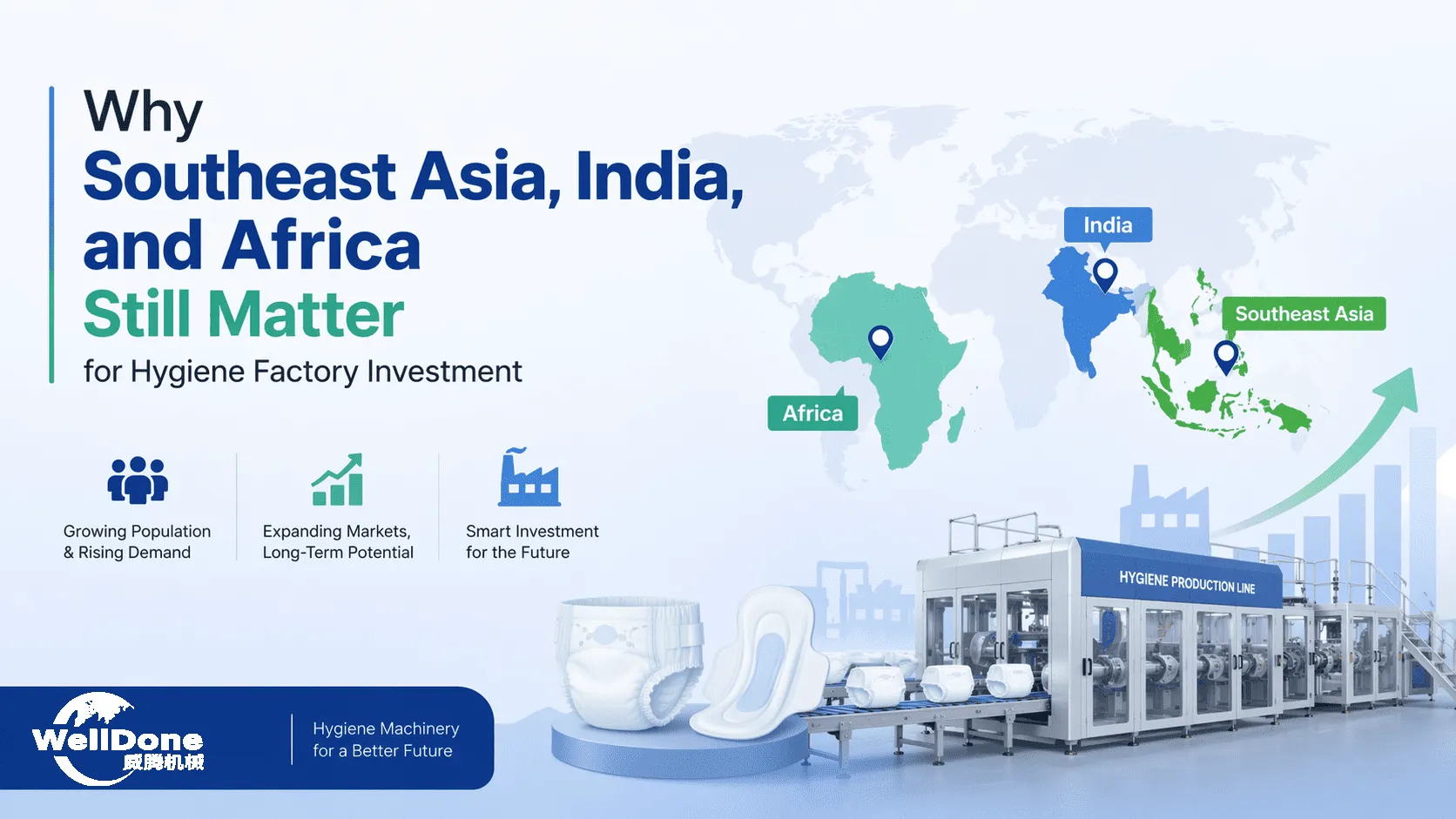
In 2026, many investors are more cautious about building new hygiene factories.
That is understandable.
Costs are still under pressure. Buyers are comparing projects more carefully. Product positioning is becoming more sensitive. And in many markets, investors no longer want to expand based on optimism alone.
But that does not mean growth markets have lost their value.
Actually, Southeast Asia, India, and Africa still matter for hygiene factory investment because they continue to combine long-term demand potential with room for local production development. These are not markets where investors should act blindly. But they are still markets where disciplined, realistic factory planning can create strong opportunities.
Table of Contents
- Why these regions still matter in 2026
- What makes these markets different from mature markets
- Why demand potential is still attracting investors
- Why local factory logic matters more than ever
- Why the wrong investment approach creates problems
- What buyers should think about before entering these markets
- Why step-by-step expansion is often the smarter route
- Why Welldone
- Related machine categories
- FAQ
- Conclusion
Why These Regions Still Matter in 2026
When people talk about hygiene market growth, Southeast Asia, India, and Africa still remain central to the conversation for one simple reason:
they still have room to grow.
In many mature markets, hygiene products are already deeply established, competition is dense, and product categories are highly segmented. In contrast, many buyers looking at Southeast Asia, India, and Africa still see room for expanding usage, broader product availability, stronger local converting capacity, and more practical factory development.
That is why these regions continue to matter.
Not because they are easy.
But because they are still moving.
What Makes These Markets Different from Mature Markets
These markets are important, but they should not be approached with the same assumptions used in fully mature hygiene markets.
That is one of the first things investors need to understand.
In these regions, success often depends more on:
- matching product type to local demand
- controlling total factory cost carefully
- balancing automation with labor reality
- planning for realistic, not oversized, output
- keeping material supply and machine matching practical
A common mistake is to treat growth markets as if demand alone will make the project successful.
In most cases, that is not enough.
The market opportunity may be real, but the factory still needs the right setup, the right product route, and the right level of investment.
Why Demand Potential Is Still Attracting Investors
There are several reasons why these regions still attract serious attention.
1. Large and growing populations
For hygiene-related products, population scale still matters. It creates long-term consumption potential and supports gradual market expansion over time.
2. Rising hygiene awareness
In many areas, product awareness, retail access, and category penetration are still developing. That means market growth is not only tied to premiumization. It can also come from broader first-stage adoption.
3. Room for local production
Imported products can help build a category, but local production often becomes more important as markets grow. Buyers want better supply control, more flexible pricing, and shorter response times.
4. Opportunities across multiple product levels
Not every market needs the same product structure. Some opportunities are in value products. Some are in mid-tier products. Some are in gradual upgrades. That gives investors more than one way to enter.
For me, that flexibility is one of the strongest reasons these regions still matter. They do not offer only one path. They offer several possible factory routes, if the project is planned carefully.
Why Local Factory Logic Matters More Than Ever
A hygiene factory project should not be built around a global idea alone. It has to fit the local market.
That means investors should think about questions like:
- What product type should come first?
- What price range is realistic?
- What level of automation matches the team?
- What raw materials are practical to source?
- What output is truly manageable in the first stage?
- How fast should expansion happen?
More importantly, the best project is not always the biggest one.
In growth markets, oversized investment can become a burden if the line, labor, product mix, and market pace are not aligned. A factory that is better matched to local demand often performs more strongly than a larger factory built on the wrong assumptions.
Why the Wrong Investment Approach Creates Problems
Some factory projects struggle not because the market is weak, but because the project logic is weak.
This usually happens in a few common ways:
Buying too much capacity too early
A line may look impressive, but if demand is still developing, oversized output can create pressure on cash flow, inventory, and pricing.
Choosing the wrong product focus
A market may need diapers, but not necessarily the exact diaper structure the investor planned first. The same applies to sanitary napkins, under pads, wipes, or tissue.
Ignoring machine-material reality
If local material conditions are not considered early, the project may face stability issues after installation.
Assuming every region should use the same factory model
Southeast Asia, India, and Africa all matter, but they are not identical. Product strategy, line design, and operating structure should reflect that.
I believe this is where many buyers still make avoidable mistakes. They identify the right region, but enter it with the wrong project model.
What Buyers Should Think About Before Entering These Markets
Before moving ahead, investors should think about the full production picture.
The right questions usually include:
- Which product category gives the best starting point?
- What level of machine speed is realistic?
- How much labor support can the factory manage?
- Can the line run steadily with available materials?
- What level of automation fits the budget and the market stage?
- Should the project begin with one focused line or a broader setup?
This is especially relevant for investors exploring Baby Care Machines, Female Care Machines, Adult Care Machines, and Paper & Wet Wipes Machines, because each route creates different production logic, raw material needs, and market-entry strategies.
Why Step-by-Step Expansion Is Often the Smarter Route
In many of these regions, the smartest investment is not “build everything at once.”
It is usually better to build the right first step.
That can mean:
- starting with one product line
- choosing a manageable automation level
- focusing on stable output before larger scale
- matching the machine to available materials
- leaving room for future expansion instead of forcing it immediately
The wiser choice is often to grow with the market, not ahead of it.
This approach helps control risk while still leaving room for long-term opportunity.
Why Welldone
Welldone supports hygiene factory projects from a full-factory perspective.
We help buyers think through:
- machine selection
- raw material matching
- layout planning
- startup preparation
- engineer support
- long-term production stability
For different product routes, you can also explore our main categories here:
- Baby Care Machines
- Female Care Machines
- Adult Care Machines
- Pet Care Product Machines
- Paper & Wet Wipes Machines
That makes it easier to compare factory plans not only by machine type, but by real market fit.
Related Machine Categories
Depending on your investment plan, this topic is especially relevant to buyers exploring:
- baby diaper machine
- pull-up baby diaper machine
- sanitary napkin machine
- panty liner machine
- adult diaper machine
- under pad machine
- pet pee pad machine
- wet wipes machine
- tissue machine
FAQ
Why do Southeast Asia, India, and Africa still matter for hygiene factory investment?
Because they still offer long-term demand potential, room for local production growth, and practical opportunities for step-by-step factory development.
Are these easy markets for new factory investors?
No. They are promising markets, but they still require realistic planning, correct product positioning, and careful factory setup.
What is the biggest mistake investors make in these regions?
One of the biggest mistakes is assuming that growth potential alone guarantees project success.
Should buyers build large factories immediately?
Not always. In many cases, starting with the right-sized factory and expanding gradually is the better strategy.
Why is local market fit so important?
Because product type, price segment, material conditions, labor structure, and machine setup all need to match the actual market stage.
Conclusion
Southeast Asia, India, and Africa still matter for hygiene factory investment in 2026 because they continue to offer something many investors are still looking for:
real room to build.
But the opportunity is no longer about building the biggest factory or moving the fastest. It is about building the right factory for the right market stage.
That means choosing the right product direction, the right automation level, the right material logic, and the right path for expansion.
So the better question is not only:
Is this market growing?
It is:
Can this factory grow with the market in a stable and practical way?