Why Buyer Priorities Are Changing in 2026

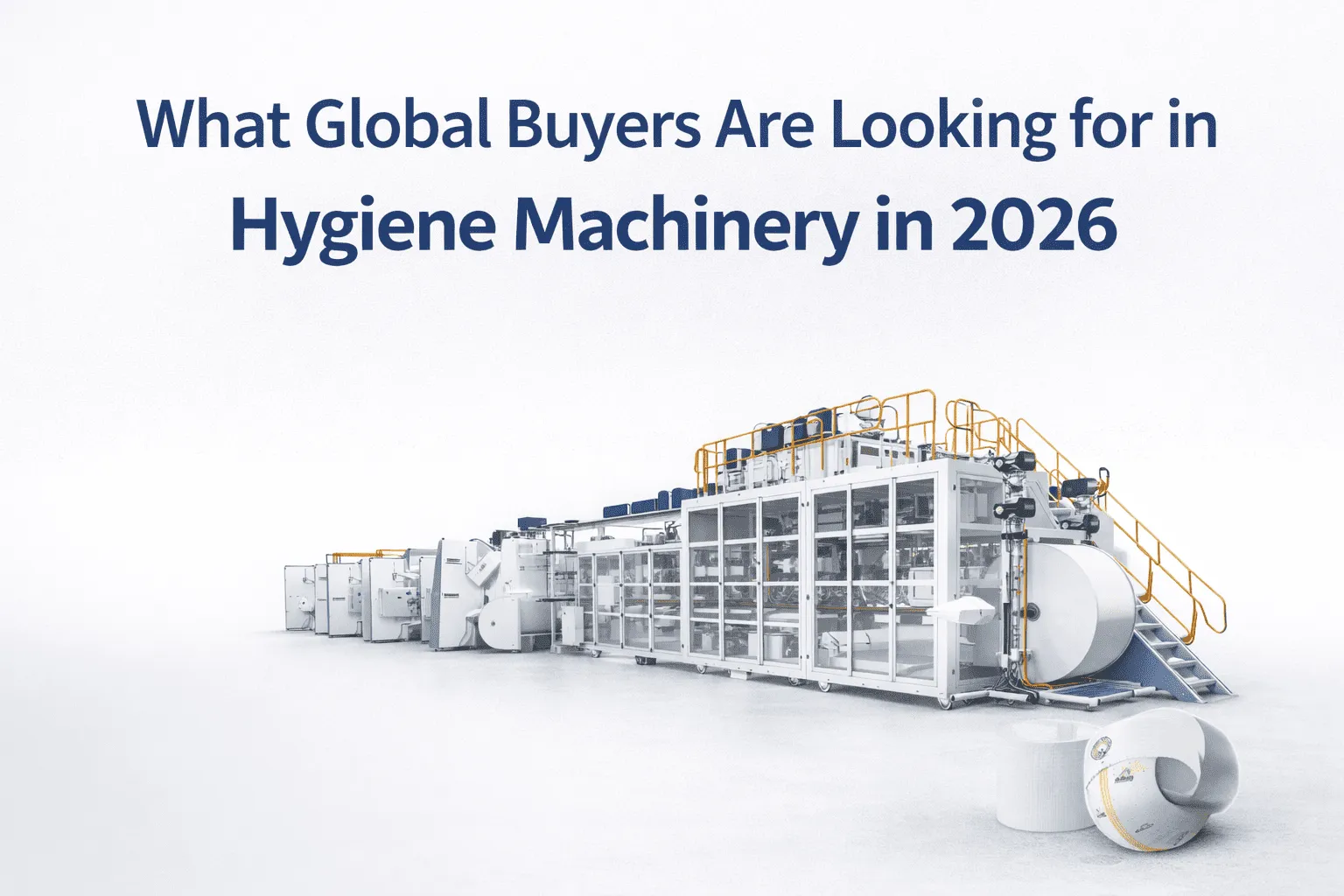
Global buyers are evaluating hygiene machinery very differently in 2026.
A few years ago, many buyers started with familiar questions:
How fast is the line? How much does it cost? How soon can it be delivered?
Those questions still matter, but they are no longer enough.
UNCTAD says global trade growth continued into early 2026, but fragility has increased as trade costs rise and geopolitical tensions continue to weigh on business confidence. UNCTAD also notes that trade growth is expected to slow in 2026 under geopolitical uncertainty, persistent inflation pressure, and rising trade costs. Reuters has also reported that manufacturers in March faced slower supplier deliveries, rising input costs, and renewed supply-chain strain in multiple major markets.
Actually, that wider environment helps explain why serious buyers are now looking beyond machine brochures and headline speed. They want machinery that can protect factory results after startup, not only look impressive during quotation review.
Table of Contents
- Why buyer priorities have changed in 2026
- The five things global buyers care about most
- Why stable production matters more than ever
- Why total cost matters more than purchase price
- Why flexibility is becoming a buying priority
- Why machine-material matching is now essential
- Why supplier support can change the project outcome
- A common mistake machinery suppliers still make
- Why Welldone
- Related machine categories
- FAQ
- Conclusion
Why Buyer Priorities Have Changed in 2026
In 2026, buyers are making decisions in a market that is still active, but clearly less forgiving.
UNCTAD’s April 2026 update says global trade remained strong into early 2026, with goods and services both expanding, but also warns that fragility is rising and that part of the growth reflects higher prices rather than volumes. EDANA’s INDEX™26 positioning tells a similar story from the nonwovens side: the industry is increasingly thinking in terms of the full value chain, from raw materials and machinery to components and converters, with innovation, collaboration, and sustainability playing a bigger role.
That means buyers are less interested in isolated machine claims and more interested in how a line performs inside a real factory system.
For hygiene products, that shift is important. A machine is not judged only by what it can do in theory. It is judged by what it can do under real material conditions, real labor conditions, and real cost pressure.
The Five Things Global Buyers Care About Most
From that perspective, global buyers in 2026 are usually focusing on five practical priorities.
1. Stable production
Buyers want a line that can run consistently.
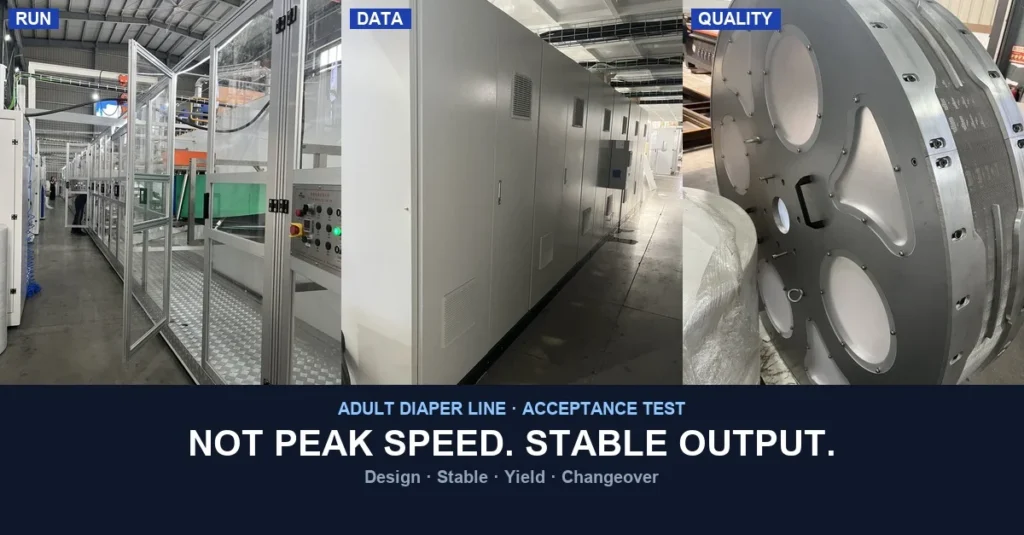
A machine that claims high speed but struggles with waste, tension control, bonding stability, or size changeovers creates risk instead of confidence. In today’s environment, stable output is often more valuable than a high theoretical maximum.
2. Better cost control
Many buyers are now thinking more carefully about total cost of ownership.
Reuters’ recent manufacturing coverage shows why: higher energy-related costs, slower deliveries, and stronger price pressure are making input inflation more visible across regions. That pushes buyers to ask harder questions about waste, labor, downtime, and maintenance instead of focusing only on purchase price.
3. Flexibility
Buyers want machinery that can adapt.
That may mean handling different product sizes, adjusting to market demand shifts, or leaving room for future upgrades. In uncertain markets, fixed production logic is less attractive than a line with reasonable expansion space.
4. Machine-material matching
This is becoming one of the most important topics in hygiene production.
A machine may be well designed, but if it does not run smoothly with the chosen nonwovens, SAP, hot melt adhesive, PE film, fluff pulp, tissue, or other materials, the line can quickly face instability, waste, and higher operator intervention.
5. Supplier support
Buyers are also looking more closely at the supplier behind the machine.
Installation guidance, startup support, engineer service, and practical factory advice matter much more when the outside business environment is less predictable.
Why Stable Production Matters More Than Ever
Stable production has always mattered, but I believe it matters even more in 2026 because buyers are operating with less margin for avoidable mistakes.
If deliveries are slower, energy costs are higher, or input prices are rising, then internal factory instability becomes more expensive. Reuters’ reporting on March manufacturing conditions across several regions points in exactly that direction: factories are facing more pressure from both supply disruptions and cost increases.
That is why many serious buyers are no longer asking only, “How fast can this line run?”
They are asking, “How steadily can this line run over the next 12 months?”
Why Total Cost Matters More Than Purchase Price
A low quotation still attracts attention. That will not change.
But a common mistake is to assume that a lower machine price automatically means a better buying decision.
In many cases, the bigger cost question comes later:
- How many operators will the line need?
- How much waste will it create?
- How long will changeovers take?
- How often will the line need correction?
- How manageable will the machine be in daily operation?
That is why global buyers are paying closer attention to total cost, not just purchase cost.
Why Flexibility Is Becoming a Buying Priority
Flexibility is not just a technical advantage. It is now a business advantage.
UNCTAD’s trade outlook and EDANA’s 2026 event positioning both point to a market that is more connected, more uncertain, and more demanding at the same time. In that kind of environment, buyers do not want machinery that locks them into one narrow production path.
They want equipment that can support product changes, future upgrades, and more practical scaling decisions.
Why Machine-Material Matching Is Now Essential
This is one of the clearest shifts in buyer thinking.
EDANA describes INDEX™26 as representing the full nonwovens value chain, which is a strong reminder that production performance is not created by machinery alone. It comes from the interaction between machine, material, process settings, and operating discipline.
More importantly, global buyers now better understand that poor machine-material matching can quietly damage profitability through:
- higher waste
- unstable output
- slower adjustment
- weaker product consistency
- more downtime
That is one reason why many buyers are no longer treating raw materials as a separate discussion from machine selection.
Why Supplier Support Can Change the Project Outcome
In a more fragile market, supplier support becomes part of the machine value.
A buyer may still compare price, speed, and delivery time. But once the project starts, what often matters more is whether the supplier can help with:
- startup stability
- material matching
- layout logic
- process adjustment
- long-term running advice
That kind of support is especially important for buyers planning new projects in Baby Care Machines, Female Care Machines, and Adult Care Machines, where product structure, materials, and line stability all need to work together.
A Common Mistake Machinery Suppliers Still Make
Some suppliers still sell machines as if buyers only care about speed and price.
That approach is weaker in 2026.
Buyers are paying more attention to whether the supplier understands the full project: machine choice, raw materials, labor logic, product plan, and future expansion path.
I believe that is one of the biggest changes in the market this year. Buyers still care about what the machine is. But increasingly, they care more about what the machine will help the factory become.
Why Welldone
Welldone supports hygiene projects from a broader factory perspective.
We do not simply discuss the machine itself. We help customers think through:
- machine selection
- raw material matching
- factory layout planning
- installation and startup support
- engineer guidance
- long-term production stability
For related production directions, buyers can also explore our core categories:
- Baby Care Machines
- Female Care Machines
- Adult Care Machines
- Pet Care Product Machines
- Paper & Wet Wipes Machines
That makes it easier to compare machinery not only by model, but by actual factory direction.
Related Machine Categories
Depending on your target products, this topic is especially relevant to buyers exploring:
- baby diaper machine
- pull-up baby diaper machine
- sanitary napkin machine
- panty liner machine
- adult diaper machine
- underpad machine
- pet pee pad machine
- wet wipes machine
- tissue machine
FAQ
What is the biggest change in global buyer priorities in 2026?
The biggest shift is that buyers are focusing more on long-term operating performance, not only on machine speed or purchase price.
Do buyers still care about machine price?
Yes, but they are also looking more closely at total cost, including labor, waste, downtime, and future upgrade potential.
Why is machine-material matching so important?
Because weak matching can reduce stability, increase waste, and create daily operating problems after startup.
Why does supplier support matter more now?
Because in a more fragile market, buyers want fewer surprises after installation and stronger help during startup and operation.
Are buyers paying more attention to flexibility in 2026?
Yes. Many buyers want machinery that can adapt to product changes and future growth rather than a line built only for one fixed scenario.
Conclusion
Global buyers in 2026 are still looking for good machinery, but their definition of “good” has changed.
UNCTAD’s April 2026 trade update and EDANA’s INDEX™26 messaging both point to a market that is still moving, but under greater fragility, cost pressure, and value-chain awareness. Reuters’ manufacturing coverage reinforces the same point from another angle: costs, delivery pressure, and supply uncertainty are all making factory decisions more practical and more demanding.
So the global buyer in 2026 is not only asking, “Which machine should I buy?”
The real question is, “Which machine can help me run a more stable, flexible, and efficient factory?”