What Usually Goes Wrong in the First 6 Months of a New Hygiene Factory?

Starting a new hygiene factory in 2026 is exciting. It represents a fresh start, new opportunities, and an investment that could support business growth for years to come.
But that first six months can also be the most challenging, especially when factory owners and managers are still getting used to the real demands of running a production line.
Actually, many new factories do not face major problems with the machine itself. They face operational issues that emerge because their production systems were not fully prepared for the reality of factory startup, including labor management, materials control, and factory stability.
The first 6 months are critical because they can set the stage for long-term performance or lead to repeated challenges later on. In fact, many new factories struggle because they don’t address a few key issues during the initial phase.
Table of Contents
- Common challenges in the first 6 months
- Why many new factories struggle with machine-material mismatch
- Labor management and operator training issues
- Why startup delays affect the first 6 months
- What can go wrong with raw material supply
- Why too much complexity can harm the startup process
- What smarter planning looks like
- Why Welldone
- Related machine categories
- FAQ
- Conclusion
Common Challenges in the First 6 Months
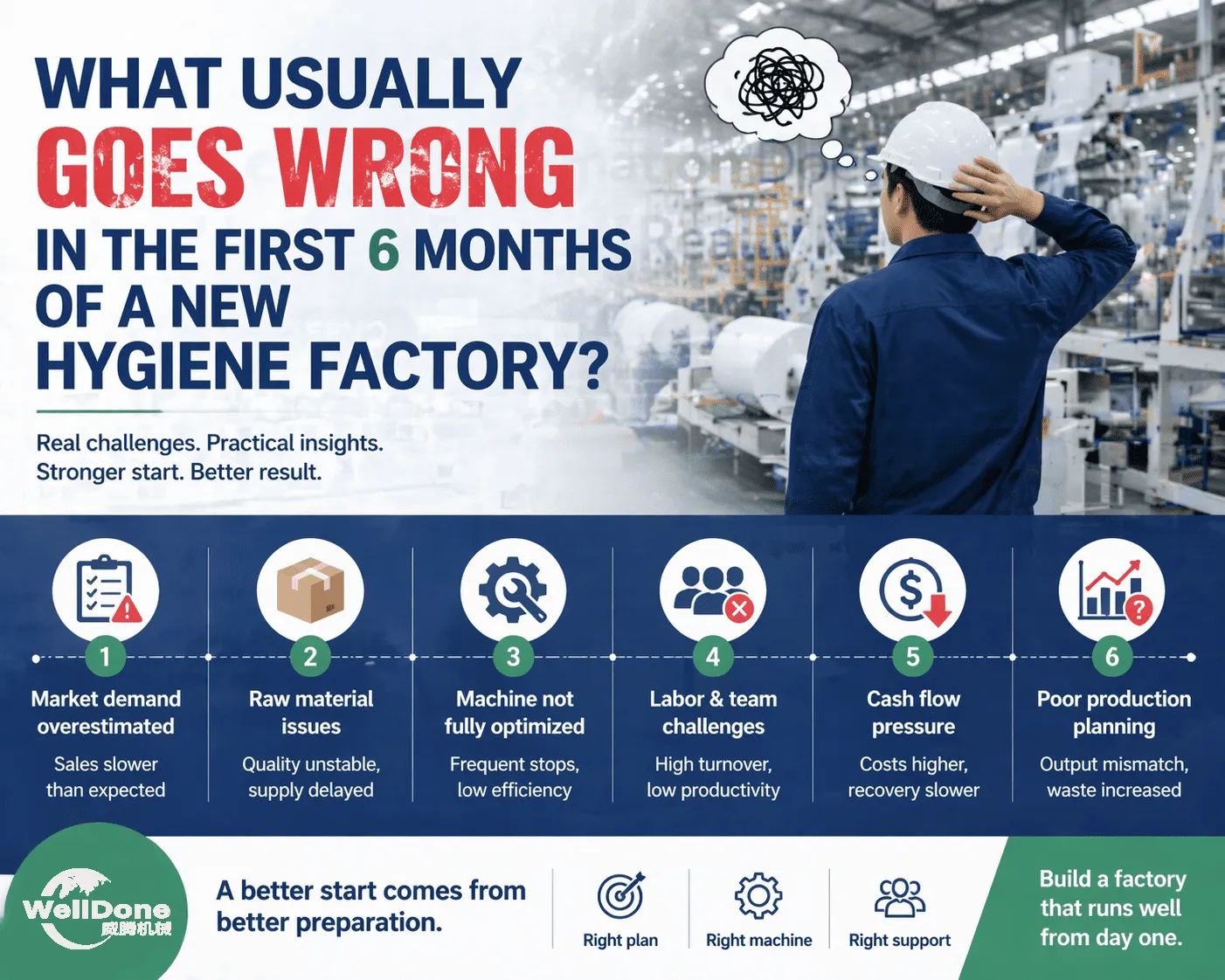
In the first 6 months of a new hygiene factory, common problems often arise in a few key areas. These are issues that any new investor or factory manager should pay attention to early on:
- Machine and material mismatch
- Labor management challenges
- Raw material supply issues
- Startup delays
- Overcomplicated processes
I believe addressing these key areas early will help any new factory avoid long-term delays, cost overruns, and quality control problems. Below, we’ll explore each area more in depth.
Why Many New Factories Struggle with Machine-Material Mismatch
One of the most common issues in the first 6 months is the mismatch between the chosen machine and raw materials.
A machine may look great on paper and even run smoothly in early tests. But when it is faced with real production conditions, the material behavior may not match the machine’s needs, leading to issues such as:
- Excessive waste
- Material quality problems
- Poor bonding or sealing
- Inconsistent output
For me, this is one of the most critical issues new factories face. If machine and material do not work together well, even the best machine will not deliver the expected results.
The smartest move is to start with a detailed discussion about the compatibility between your machine and raw materials. This helps avoid costly changes once the factory is up and running.
Labor Management and Operator Training Issues
Another challenge for new factories is labor management. The first 6 months are crucial for building stable processes, and this often means the factory team needs to be trained properly and effectively.
Training new operators is rarely as easy as it seems. The learning curve for new machinery, production protocols, safety standards, and material handling can be steep. Without proper training and a solid labor management plan, new factory workers may cause more delays and errors.
This is where many factories fall behind schedule. Labor and training are often under-budgeted or overlooked, leading to unnecessary mistakes during early-stage production. If new operators cannot manage the machine or materials effectively, downtime increases and production quality suffers.
To avoid these problems, the factory should prioritize proper labor training, clear guidelines, and support during the early months.
Why Startup Delays Affect the First 6 Months
Most new factory owners and managers have a plan for startup, but that plan often runs into delays. These delays typically occur due to:
- Machine delivery and installation issues
- Raw material supply problems
- Unforeseen technical challenges
- Training or staffing difficulties
For me, startup delays often reflect unrealistic expectations of how fast the factory will be running at full capacity. These delays do not only waste time; they waste money and may reduce buyer confidence. When the factory is not running as expected in the early stages, it may create a feeling of instability that can affect long-term performance.
A smarter approach is to set realistic startup goals, allow room for adjustments, and ensure that every piece of the factory is ready before full-scale production begins.
What Can Go Wrong with Raw Material Supply
Raw material supply issues often become apparent in the first 6 months. Factories may experience delays, quality issues, or higher-than-expected costs in materials. If the raw materials are not available on time or at the expected quality, production schedules can quickly be derailed.
A common issue is that new factories often assume raw material sourcing will be straightforward. However, fluctuations in material availability, price increases, and logistical problems can cause significant delays.
For many factories, this is the part of the project that needs closer attention early on. The factory should ensure that material supply is stable and reliable before reaching full production capacity.
What Can You Do?
- Build strong supplier relationships from the beginning.
- Always have backup suppliers or material options.
- Align the raw material selection with the expected machine capabilities and product types.
Why Too Much Complexity Can Harm the Startup Process
Many new factories are tempted to implement overly complex systems or automation processes right away. They often invest in machines with the latest advanced features or multiple product lines that seem like a good idea on paper.
But too much complexity can backfire. When a new factory has too many processes to manage from the start, it increases the risk of delays, operational mistakes, and wasted resources.
In 2026, starting simple is often the smartest strategy. Begin with a product line that matches market demand and is not overly complicated. Build up complexity and automation gradually, as you gain confidence in the production process.
I believe new factories often underestimate how important it is to start simple. A stable, simple, and flexible setup creates a stronger foundation for growth than an overly complex one.
What Smarter Planning Looks Like
The smarter approach to planning for the first 6 months involves careful alignment of the following factors:
- Machine and material compatibility
- Proper labor management and training programs
- Realistic startup schedules
- Raw material supply stability
- Simple, manageable processes for early production
When all of these pieces are aligned, the factory is much more likely to experience a smoother startup process and avoid costly delays.
At Welldone, we support hygiene factory projects from the very beginning, helping new buyers avoid common mistakes in the first 6 months.
We help with:
- Machine selection
- Raw material planning
- Factory layout
- Startup support
- Operator training
- Long-term production stability
Why Welldone
Welldone is here to ensure your hygiene factory starts the right way. Our expert team helps guide you through the initial stages of factory setup, with a focus on machine-material compatibility, smooth startup processes, and steady production planning.
Our approach is always based on real-world, long-term value, ensuring that your factory gets off to the best start possible.
If you want to know more about our range of machinery and services, visit the pages below:
- Baby Care Machines
- Female Care Machines
- Adult Care Machines
- Pet Care Product Machines
- Paper & Wet Wipes Machines
Related Machine Categories
This topic is especially relevant for those looking to explore the following production routes:
- baby diaper machine
- sanitary napkin machine
- adult diaper machine
- under pad machine
- pet pee pad machine
- wet wipes machine
- tissue machine
FAQ
What is the biggest mistake new hygiene factories make?
The biggest mistake is often rushing into full-scale production without proper planning, training, and alignment between machine capabilities and material availability.
Why is labor management so important?
Without a trained and stable workforce, even the best machines will not run at their full potential. Proper training and clear guidelines are essential to avoid downtime and waste.
What should be the first priority in the first 6 months?
The first priority should be aligning machine and material compatibility, followed by stabilizing the production process and training the team.
Is it better to choose a high-tech machine from the start?
Not necessarily. Starting simple can help manage risks better. The key is to match machine complexity with the actual needs and scale of the factory.
How do raw material issues affect new factories?
Raw material issues, such as supply disruptions or inconsistent quality, can lead to production delays, wasted materials, and increased costs.
Conclusion
The first 6 months are critical for a new hygiene factory. By addressing the common challenges—such as machine-material mismatch, labor issues, startup delays, and raw material supply problems—you can ensure a smoother path to stable, profitable production.
At Welldone, we help guide you through the initial phases with the right strategy for every piece of the project, ensuring that your factory gets off to the right start.