Adult Pull Up Diaper Machine Assembly & Cutting Guide

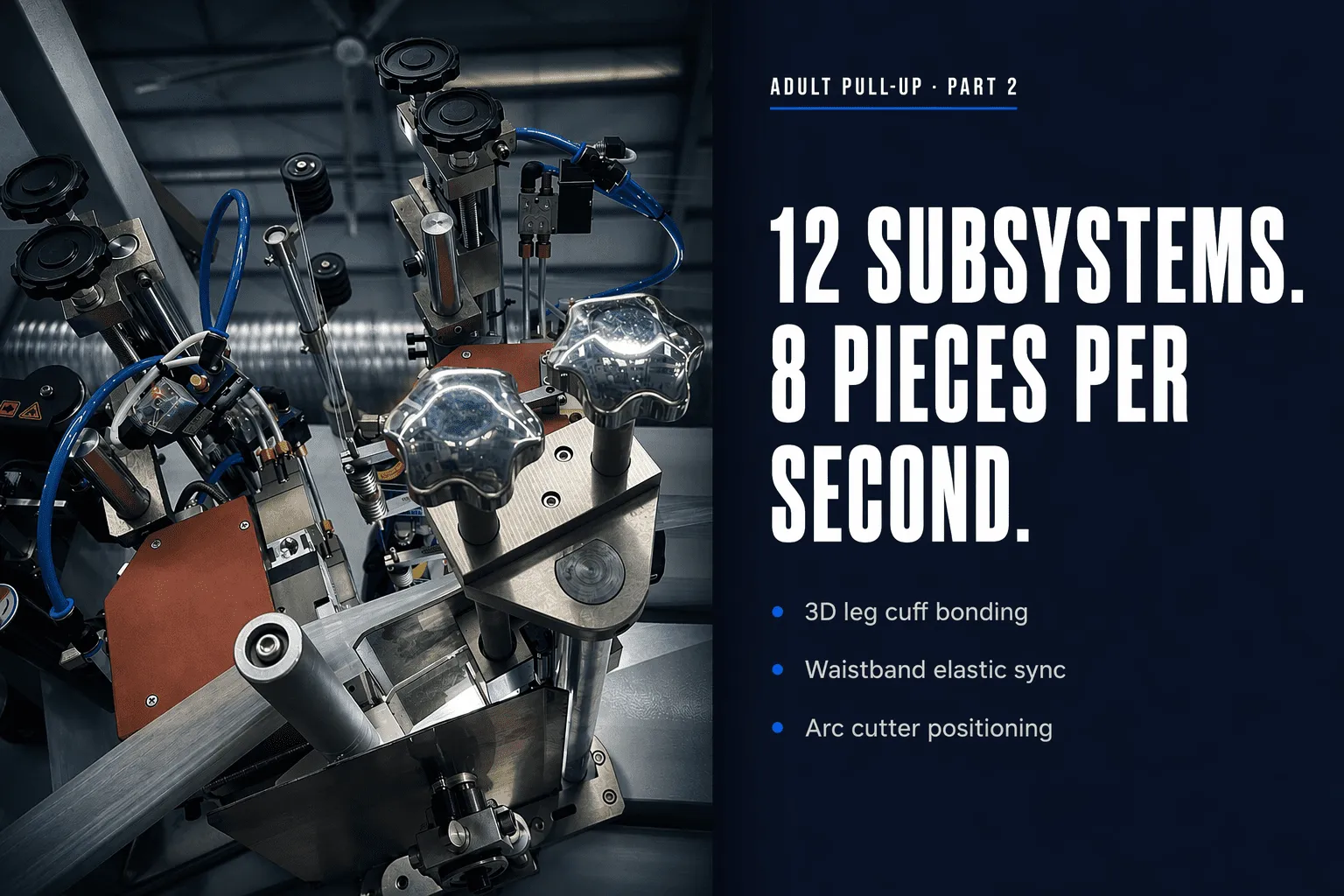
Adult Pull-Up Diaper Machine Assembly & Cutting System — Where 500 ppm Lines Actually Break (Part 2 of 3)
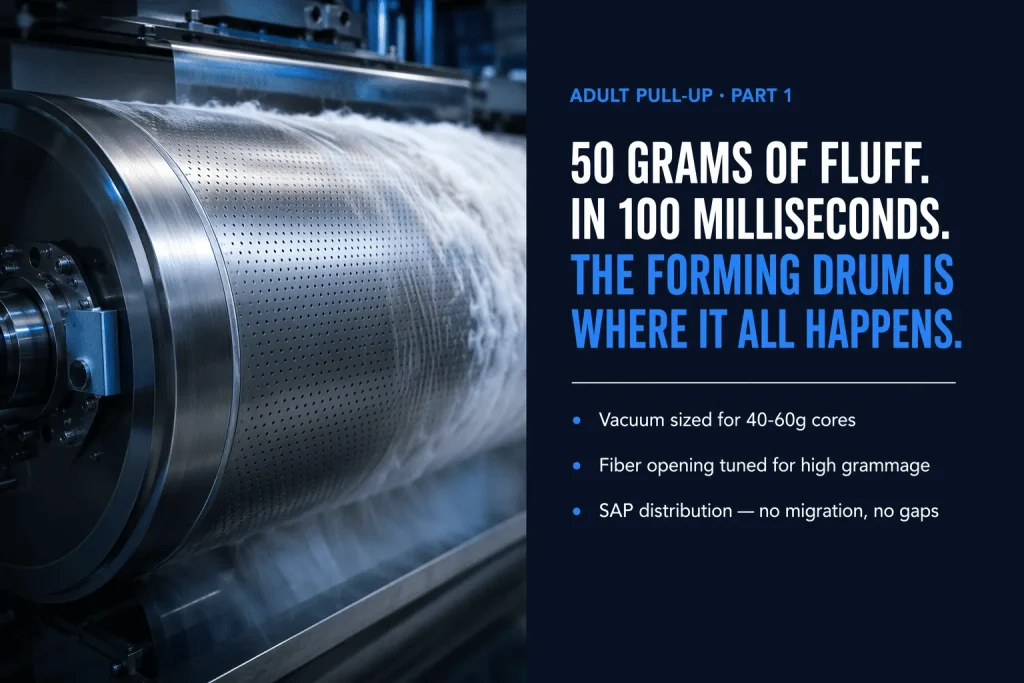
Part 1 of this series covered the front end of the adult pull-up production line — the raw material handling and the high-grammage core forming system that shape the absorbent body of a pull-up. This Part 2 walks through the middle section: the 3D leg cuff, the topsheet-backsheet-core meeting point, the waistband assembly, and the arc cutter that shapes the leg opening. In most cases, this is the section that decides whether your line hits 82% OEE or bleeds down to 71% without anyone knowing why.
Why the Middle Section Decides Your OEE
Most buyers I meet obsess over the forming drum. They should be worrying about what happens 40 feet later.
Once a core is formed, it enters the middle section — where the leg cuff bonds to the topsheet, where waistband spandex meets the pant body, where the arc cutter shapes the leg opening, and where a dozen material streams have to arrive on the same frame at the same moment.
This is where 500 ppm lines quietly bleed money. Not through catastrophic failure. Through slow drift — a 0.3 mm belt misalignment that throws every third product off by 3 mm at the edge. A tension sensor reading 4% high on one spandex strand. A glue head firing 8 ms late. Each fault too small to trigger a stop, all of them adding up to a scrap rate that eats your margin one shift at a time.
Actually, this is the industry misconception I fight most often. Buyers think the forming drum is the "hard part" because it looks complex. In most cases, the front end runs itself once tuned. The middle section is where the machine either earns your investment back or quietly gives it away.
The Frame-by-Frame Synchronization Problem
An adult pull-up line running at 500 ppm produces roughly 8 pieces per second. In that second, the machine has to feed spandex, apply glue, bond a cuff strip, laminate a waistband, align an arc cutter, and pass a formed product to the next station — 12 subsystems moving in step, for 20 hours a day.
If any single subsystem drifts by more than a few milliseconds, the fault is not always visible. The machine keeps running. The output looks fine at the counter. But the product edges start to shift, the waist elasticity becomes uneven, and quality complaints start reaching your distributor two weeks later.
The real question is not whether your line runs. It's whether every station is running on the same clock.
Full servo vs semi-servo — where it actually matters
In the front end, semi-servo is often good enough. Roll changes are infrequent. Tension is relatively stable. Mechanical linkages between forming stations are short.
In the middle section, this changes. Every station is downstream of another moving material — spandex, non-woven, glue, tissue, waistband. Semi-servo lines use shared shafts and mechanical timing belts, which means when one station drifts, the correction has to travel mechanically through the whole train. By the time it reaches the source, three more stations have drifted.
Full servo lets every station feel and react on its own — the waistband laminator does not wait for the arc cutter to tell it the tension is off. It compensates in real time. Not because it's faster, but because the fault stays contained instead of cascading.
3D Standing Leg Cuff Construction
The 3D standing leg cuff is what stops side leakage on an adult pull-up. It is also the first place in the middle section where synchronization failure shows up in real customer complaints.
A standing cuff is built from a folded non-woven strip with two to four spandex strands bonded inside. When the product is worn, the spandex contracts and lifts the cuff into a vertical wall against the leg, sealing the gap. If the spandex pre-stretch is wrong, or if the cuff strip is bonded off-center, the wall never rises properly — and the entire leakage protection promise collapses.
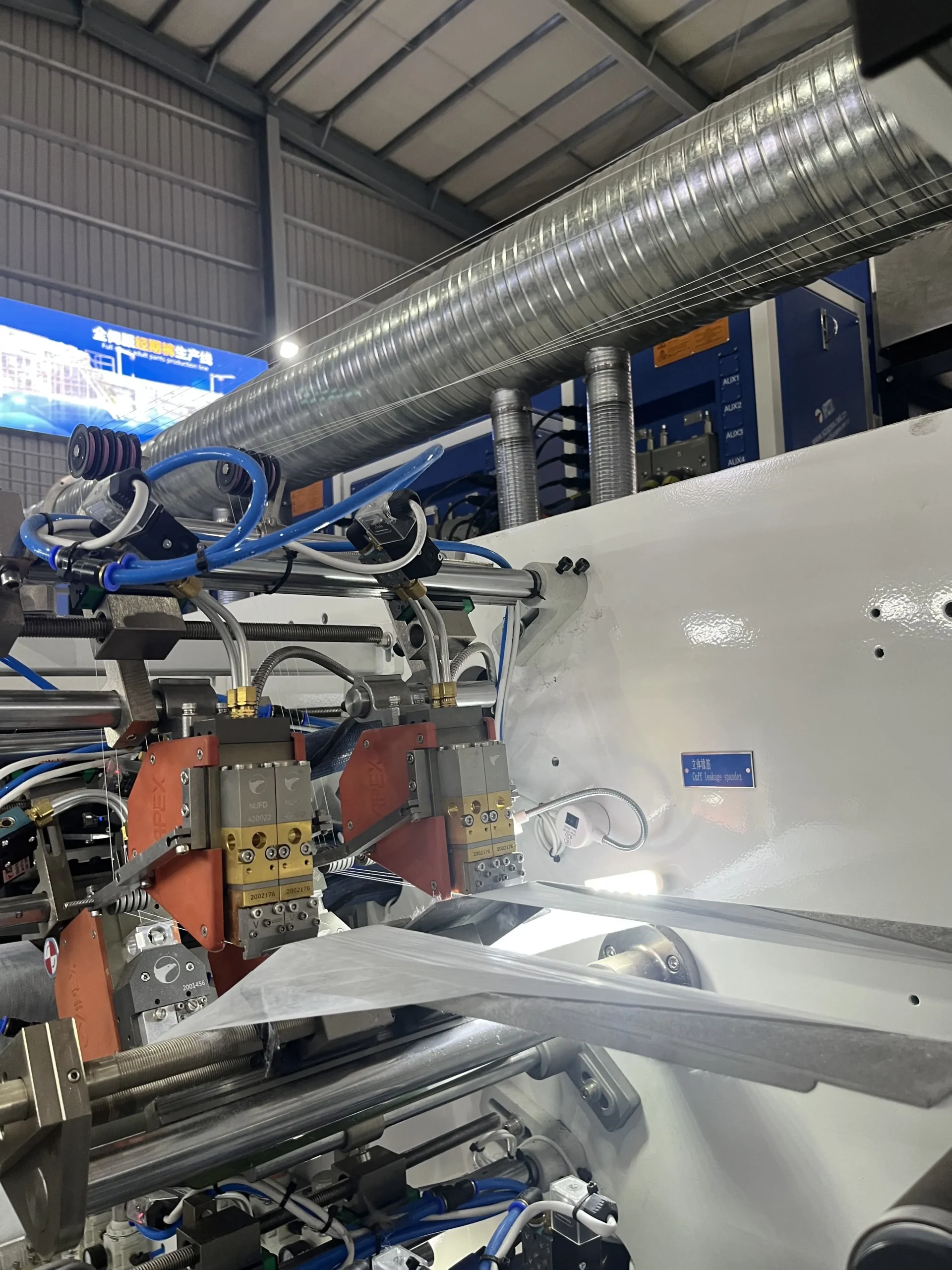
What separates a well-designed cuff station from a marginal one is the independence of each spandex strand. On semi-servo lines, all cuff strands come from a single unwind system with shared tension. If one strand runs slightly slack, the whole cuff wall becomes uneven. On a proper full-servo cuff station, each strand has its own tension guide and its own compensating servo — so one slack strand does not drag the others.
I've seen this before. A customer in Egypt kept getting side-leakage complaints on the last 100 products of every roll change. The cores were fine. The topsheet was fine. The problem was that the shared cuff tension system was drifting during the roll deplete phase, and nobody caught it until the finished products were already boxed.
Topsheet, Backsheet & Core Meeting Point
The meeting point is where three material streams converge — the topsheet from above, the backsheet from below, and the formed core (with cuff already bonded) running in between. All three arrive on a shared conveyor at the same moment, and a set of compression rollers seals them together into a single laminated web.
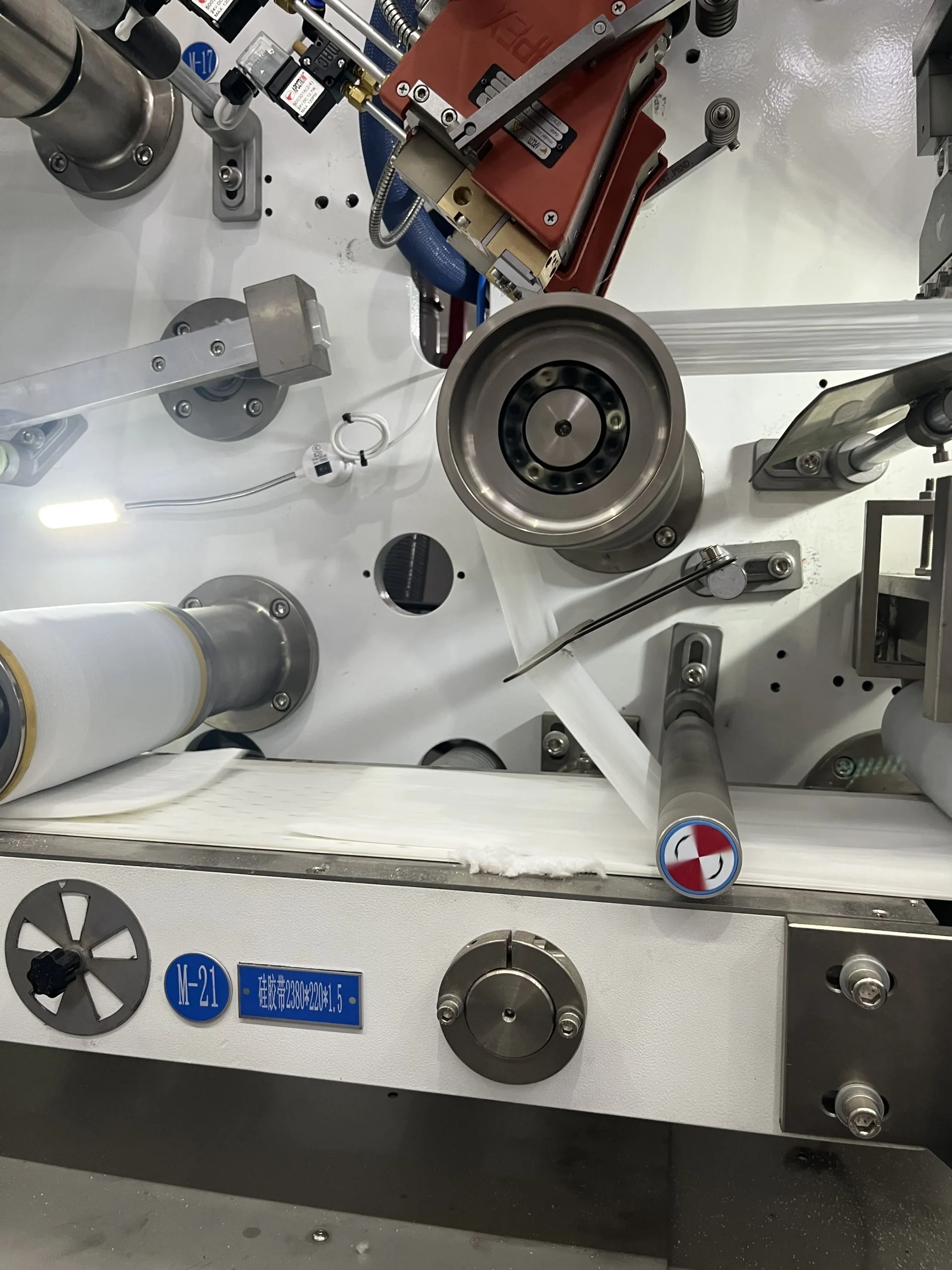
The single biggest failure at this station is layer shifting. If the topsheet arrives 1 mm behind the core, the finished product will have exposed core edges — visible under the topsheet, uncomfortable against the skin, and rejected at the buyer's quality inspection.
The way this is prevented is by giving every layer its own tension zone, its own edge-guide sensor, and its own servo-driven correction motor. Cheap lines run the topsheet, backsheet, and core off shared drives; when one drifts, the operator has to stop the line and manually re-thread. Well-designed lines run each layer independently and correct on-the-fly. The difference over a 20-hour shift is measured in hundreds of thousands of pieces.
Outer & Inner Waistband Application
The waistband is what distinguishes a pull-up from a taped diaper. It has to stretch, hold shape, feel comfortable, and survive dozens of on-off cycles without losing elasticity. Building it properly requires two synchronized non-woven layers (outer and inner), multiple pre-stretched spandex strands, and precise glue application.
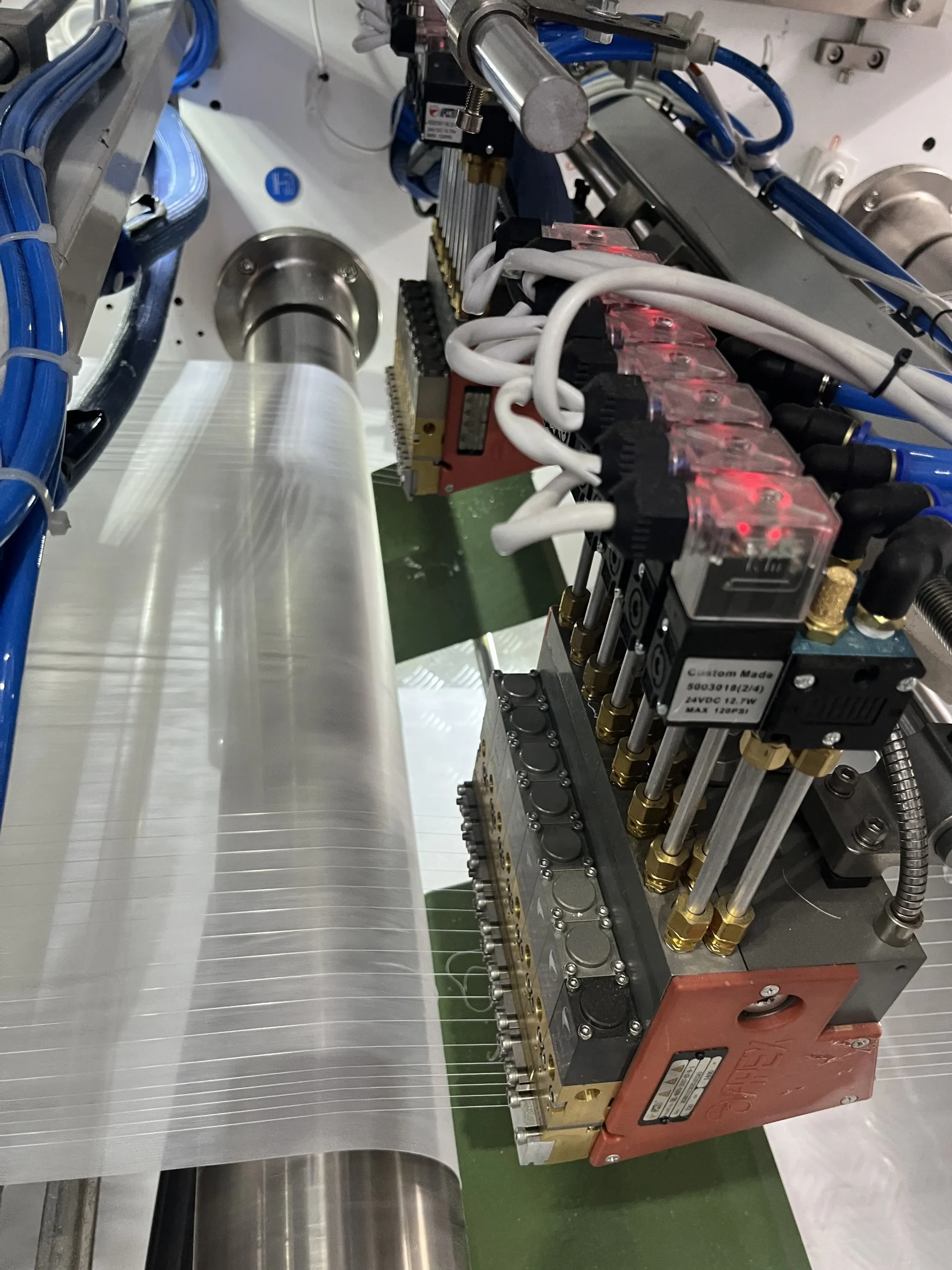
The inner waistband station lays down the spandex strands and applies hot-melt glue to bond them. The outer waistband station brings the second non-woven layer to cover and seal them. These two operations have to be in perfect sequence, because if the inner glue cures before the outer waistband arrives, the bond is weak and the finished waistband loses elasticity in the field.
What I tell buyers to check on any candidate line: how many independent spandex strands does the waistband station support, and is each strand independently tensioned? On adult pull-ups the answer needs to be six to eight strands minimum, with independent servo tension on each. Cheaper designs use two or three strands with shared tension — the product still passes visual inspection, but the waist grip weakens after 4 to 6 hours of wear, and the end user notices.
Waistband Spandex & Lamination
After the spandex is bonded and the outer waistband has covered it, the entire assembly passes through a lamination roller that presses the two non-woven layers together around the pre-stretched spandex. This is the moment where the elastic memory of the waistband gets locked in.
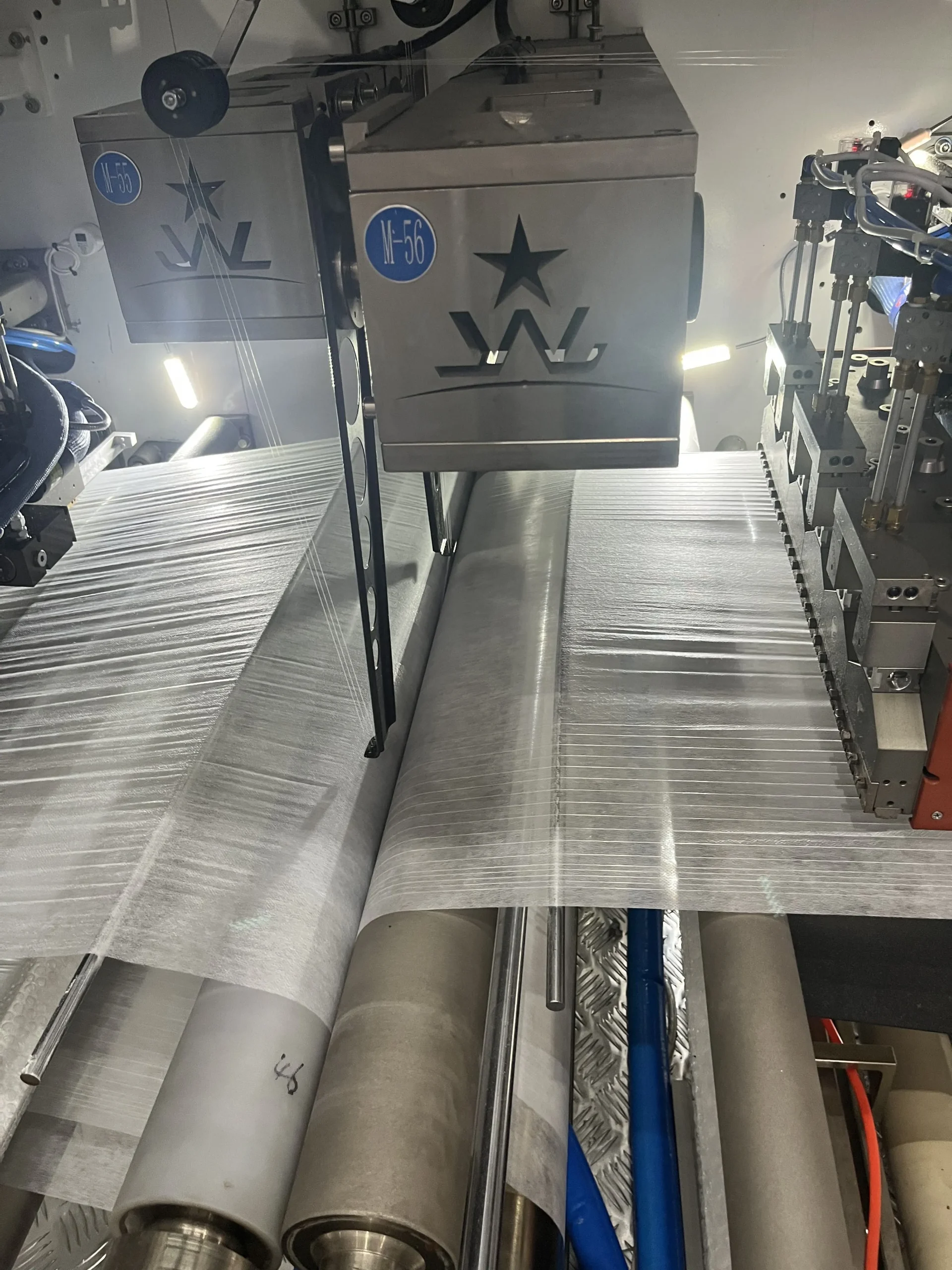
The pressure and dwell time at this roller matter more than most spec sheets admit. Too little pressure, and the spandex is not fully encapsulated — you get delamination after a few wear cycles. Too much pressure, and the non-woven fibers get crushed, reducing softness and creating a rough band against the skin.
I've seen a customer in Turkey run a stable front end for six weeks. Cores were perfect. Then the OEE report came out at 71%. The real question was not why the machine slowed down — it was why nobody caught the 0.3 mm belt misalignment on the waistband laminator that was throwing every third product off by 3 mm at the edge. The lamination roller was fine. The upstream belt was drifting. Every hour that passed, the drift got worse, but no alarm ever fired because no individual sensor threshold was crossed.
Full servo saves you here. Not because the roller runs faster, but because the upstream belt has its own encoder feedback, and the drift is corrected before it reaches the roller. On semi-servo lines, the same drift accumulates for the whole shift.
Arc Cutter — 0.3 mm Determines Edge Quality
The arc cutter is where the leg opening is shaped into the assembled web. The die cutter drum carries a curved blade set that rotates in perfect sync with the moving product web. On each rotation, it removes a crescent of material — the leg opening — and hands the trim off to a waste extraction system.
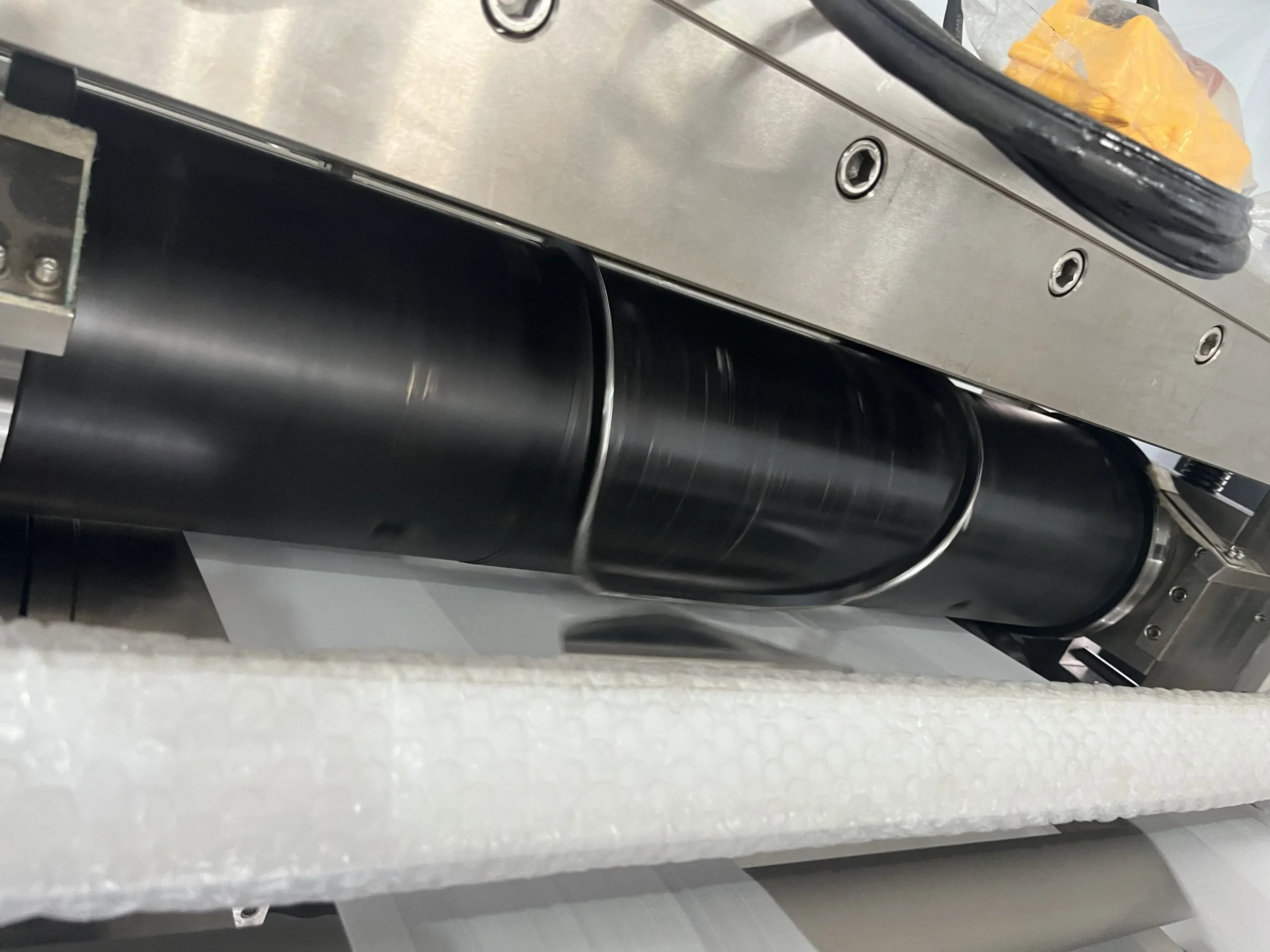
The tolerance here is brutal. A 0.3 mm timing drift between the cutter drum and the product web means the leg opening is cut off-center by 0.3 mm. That does not sound like much, until you realize the arc travels roughly 10 mm across the product, so a 0.3 mm drift shows up as a visible asymmetry — one leg opening looks larger than the other. On a supermarket shelf, that is the difference between a repeat purchase and a returned pack.
Full servo on the arc cutter is not optional at 500 ppm. It is the only way to keep the drum encoder locked to the web tension sensor with sub-millisecond response. Semi-servo cutters rely on mechanical timing belts, and every belt has some elasticity — meaning at high speed, there is always a lag that no operator adjustment can fully eliminate.
The blade itself matters too. A dull blade produces a torn edge instead of a clean cut, and the torn fibers become the seed for further tearing during use. Blade life on a well-designed cutter is around 6 to 8 months at 500 ppm; if you're changing blades every 8 weeks, the material composition or the tension setup is wrong.
Heat Sealing & Final Cutting
After the arc cutter, the web enters the heat sealing station, where the two ends of the waistband are ultrasonically welded to form the closed-loop pant shape. This is the last major structural step before the product is separated into individual pieces by the final cutter.
Heat sealing is temperature-critical. Too cool, and the weld does not fully bond — the pant seam opens under load. Too hot, and the non-woven fibers scorch, becoming brittle and tearing the moment the user pulls the pant on. The temperature window on modern welding heads is about plus or minus 3 degrees Celsius, and full servo temperature controllers with real-time feedback are what keep the process inside that window shift-after-shift.
The final cutter separates the continuous web into individual pull-up units. It sounds trivial after everything upstream, but it is not — a mistimed final cutter can produce products with uneven length, which will fail your customer's quality inspection even if every other station ran perfectly.
The Retrofit Trap
A lot of buyers ask if they can save money by retrofitting an existing semi-servo baby-diaper line to produce adult pull-ups. Actually, this is one of the most expensive mistakes I've seen in this industry.
The middle section on a baby diaper line is designed for lower material widths, lower spandex strand counts, and different tension ranges. When you try to run adult pull-up materials through it, three things break:
- Waistband tension is under-provisioned. Baby diaper lines rarely need more than 3 to 4 spandex strands per waistband. Adult pull-ups need 6 to 8. Retrofitting extra spandex guides onto a shared unwind system creates uneven tension that a servo upgrade alone cannot fix.
- Arc cutter geometry is wrong. Baby diaper cutters have a smaller arc radius. Retrofitting a larger arc means the cutter drum has to run at a different linear speed than the rest of the line, which introduces timing errors that cascade downstream.
- Frame stiffness is insufficient. Adult pull-up material streams are heavier and wider. The frames on older baby-diaper lines flex under the increased load, and this flex shows up as edge quality issues that nobody can trace back to the frame.
The honest math is this: a well-executed retrofit costs 60 to 75% of a new adult pull-up line and delivers 40 to 55% of the OEE. The gap between those two numbers is where retrofit projects go to die.
Questions Buyers Should Ask Before Signing
When you're evaluating an adult pull-up line, the front-end specs — grammage capacity, forming drum design, SAP distribution — get most of the attention in every quote. But the middle section is where the money is either made or lost. These are the questions I would ask before signing anything:
- How many independent spandex strands does the waistband station support, and is each strand independently tensioned?
- Is the arc cutter timing servo-locked to the web tension sensor, or does it rely on a mechanical timing belt?
- What is the temperature control tolerance on the heat sealing station, and how is it monitored during production?
- How does the machine detect and alert on sub-alarm drift — the kind of slow drift that does not trigger a stop but degrades product quality over the shift?
- What is the expected blade life on the arc cutter at your target line speed, and what is the total replacement cost per year?
- Can the middle section be inspected and serviced without stopping the front end of the line?
If any of these questions gets a vague answer, that section of the machine is either under-specified or the vendor has never actually measured it in production.
Why Welldone
Welldone is a hygiene machinery manufacturer, not a distributor. We build every station of our adult pull-up line in-house, which means when we specify "full servo waistband lamination", we can show you the servo, the encoder, the control code, and the tension log from a running customer line.
Frame-Locked Full Servo
Every middle-section station runs on independent servo control with sub-millisecond response, so upstream drift is corrected before it becomes downstream damage.
Sub-Alarm Drift Detection
Our HMI shows the slow drift patterns that never trigger a stop but always erode OEE — so you catch problems before your distributor does.
48-Hour Engineer Response
Adult pull-up buyers get direct engineer support with 48-hour on-site response for the first 6 months after commissioning — not a call center, an actual engineer.
Related Machines
Adult pull-up assembly is one part of the Welldone hygiene machinery portfolio. Buyers evaluating a full production capability typically look at the following categories together:
Conclusion
The front end of an adult pull-up line is what looks impressive in a video walk-through. The middle section is what decides whether that line pays back its investment in three years or five. Every station between the formed core and the final cutter is either compensating for upstream drift or amplifying it — and the difference across a 20-hour shift is measured in tens of thousands of finished products.
If your line lost 4 hours yesterday to trim errors, waist deformation, or cuff misalignment — was the fault in the machine, or in the middle-section design that nobody audited before you signed?
Part 3 of this series covers the back end of the adult pull-up line: heat sealing final inspection, vision-based defect rejection, product folding and stacking, packaging integration, and the OEE stabilization work that turns a technically capable line into a commercially profitable one.
Frequently Asked Questions
What line speed is realistic for an adult pull-up machine in production?
Commercially viable adult pull-up lines run between 350 and 550 ppm in daily production, depending on product size and material specifications. Nameplate speeds above 600 ppm are technically achievable but usually require material quality and operator experience that most new buyers don't have on day one. We recommend targeting 450 ppm sustained for your first 6 months and scaling up from there.
How many spandex strands does an adult pull-up waistband really need?
Six to eight independently tensioned strands is the practical minimum for a comfortable, durable adult pull-up. Below six strands, the waist grip weakens after 4 to 6 hours of wear. Above eight strands, the cost and complexity outweigh the comfort benefit for standard adult sizes. For bariatric or extra-large sizes, ten to twelve strands may be justified.
Is it worth retrofitting a baby diaper line to run adult pull-ups?
In most cases, no. Retrofit costs typically reach 60 to 75% of a new dedicated line, but OEE ends up at 40 to 55% of what a new line would deliver. The middle section — waistband tension, arc cutter geometry, frame stiffness — is where retrofit projects fail. See our adult care machine range for dedicated adult pull-up options.
Full servo or semi-servo — which one do I actually need for the middle section?
For adult pull-ups above 400 ppm, full servo on the middle section is not a nice-to-have — it is the difference between an OEE of 82% and 71%. The middle section has too many dependent subsystems for mechanical timing belts to keep in sync at production speed. On the front end, semi-servo can still make economic sense; on the middle section, it rarely does.
How do I catch middle-section drift before it hits my customer complaints?
You need three things: sub-alarm HMI visibility on every station (not just fault alerts), a daily edge-quality sampling routine at the arc cutter output, and a weekly tension log audit at the waistband lamination roller. Any well-designed line lets your operator monitor all three in real time. If your current line doesn't, that's a specification gap that no maintenance schedule will fix.
Building or upgrading an adult pull-up line?
If you are specifying a middle section for a new adult pull-up line, or trying to figure out why your current line's OEE is stuck below 75%, we can walk you through a station-by-station audit based on real production data from lines running today.
Explore Adult Care Machines Request Middle-Section Audit