Adult Diaper Manufacturing ROI: The Silver Economy Investment

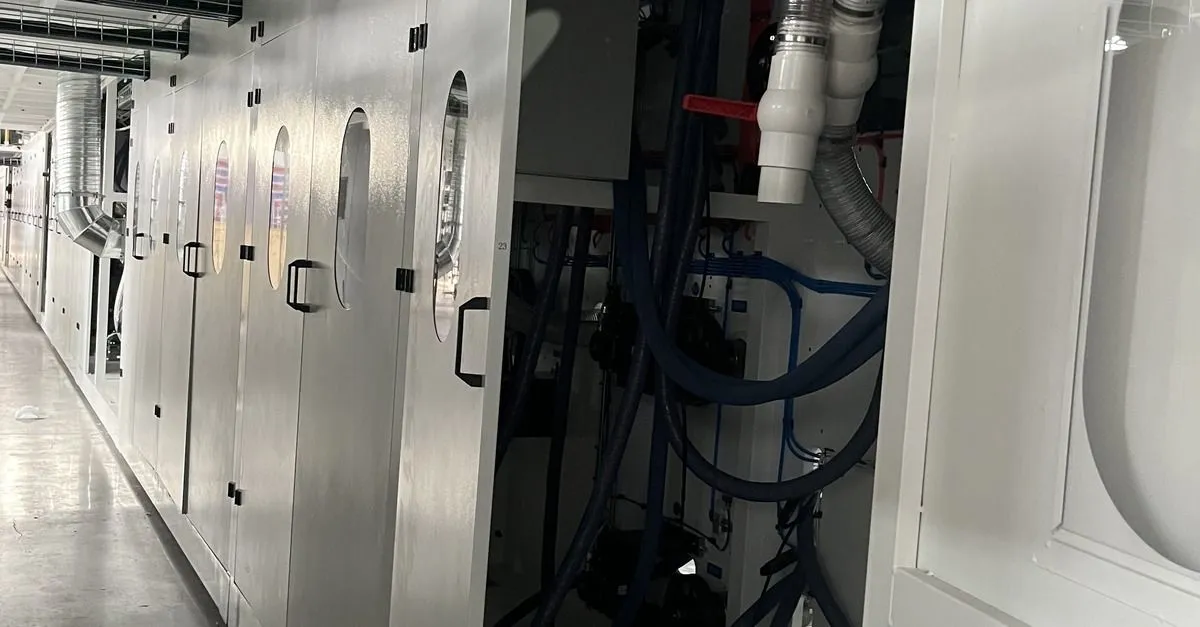
Adult Diaper Manufacturing ROI: Investing in the Silver Economy
A manufacturer running a baby diaper line asked us about adult incontinence products. His distributor network thought he was chasing a niche. He was chasing demographics — a customer base that grows every year in markets with ageing middle classes, and a buyer that behaves very differently from a retail parent.
This article looks at the adult care investment as a channel decision rather than a machine decision: who the buyer actually is, how product choice and drive tier shape the return, and what genuinely transfers from a baby diaper operation.
Chasing a Niche, or Chasing Demographics
The framing matters more than most investors realise, because "adult diapers" sounds like a narrow product category when it is actually a demographic wave.
In most markets where the middle class is ageing, adult incontinence is growing faster than the baby diaper category. The drivers are structural: longer life expectancy, a growing share of the population above 65, rising healthcare spending, and — critically — a shift from stigma to normalisation. People are buying products their parents would have refused to buy.
The demand is not speculative. It is already being placed through channels that did not exist for hygiene products a decade ago: hospital group purchasing, government welfare programmes, private elder care chains, and direct-to-home subscription services.
The question for a manufacturer is not whether the market exists. It is whether the channel you already hold can reach it.
A Different Buyer Altogether
This is the commercial difference that changes the investment case, and it is easy to underestimate.
| Dimension | Retail Parent (Baby) | Institutional Buyer (Adult) |
|---|---|---|
| Order size | Single packs, fragmented | Bulk, recurring, often by framework contract |
| Decision basis | Price and brand on the shelf | Specification, supply reliability, compliance |
| Switching cost | Low — the next shelf is one aisle over | High — procurement cycles, tender, validation |
| Demand visibility | Forecast from sell-through | Contract volume known in advance |
| What wins the account | Marketing and distribution reach | Consistent supply from a known manufacturer |
The implication is that the same factory produces both products, but it does not sell them the same way. An institution buying 40,000 units a month on a framework contract evaluates a supplier on consistency and compliance before price. That is a materially better customer to build a new line around than a retail parent — provided you can reach them.
In most cases the deciding factor is whether you already talk to the right people: distributors who supply hospitals, tender agents, government programme administrators, elder care operators. If the answer is no, the machine is not the first thing to buy.
Three Drive Tiers, Three Investments

Adult care machinery is generally offered across three drive tiers, and the tier you choose is really an investment decision wearing a technical name.
| Drive Tier | Typical Speed | Who It Suits |
|---|---|---|
| Full servo | Design 300 / stable 250 pcs/min | Established manufacturers competing on consistency and large contracts |
| Semi servo | Design 250 / stable 200 pcs/min | Growth operations balancing capital cost against automation |
| Mechanical | Design 200 / stable 150-180 pcs/min | Entry into a price-sensitive market with modest volume |
Higher automation generally means lower labour cost, better repeatability and a higher ceiling, at a higher capital outlay. The mistake is defaulting to the top tier because it looks like the safe choice. If your channel is price-led and your volume does not yet justify three shifts, a full servo line can become an expensive asset running well below capacity.
The right tier follows from the volume you can actually place, not the volume you hope to reach.
Product Choice Changes the ROI
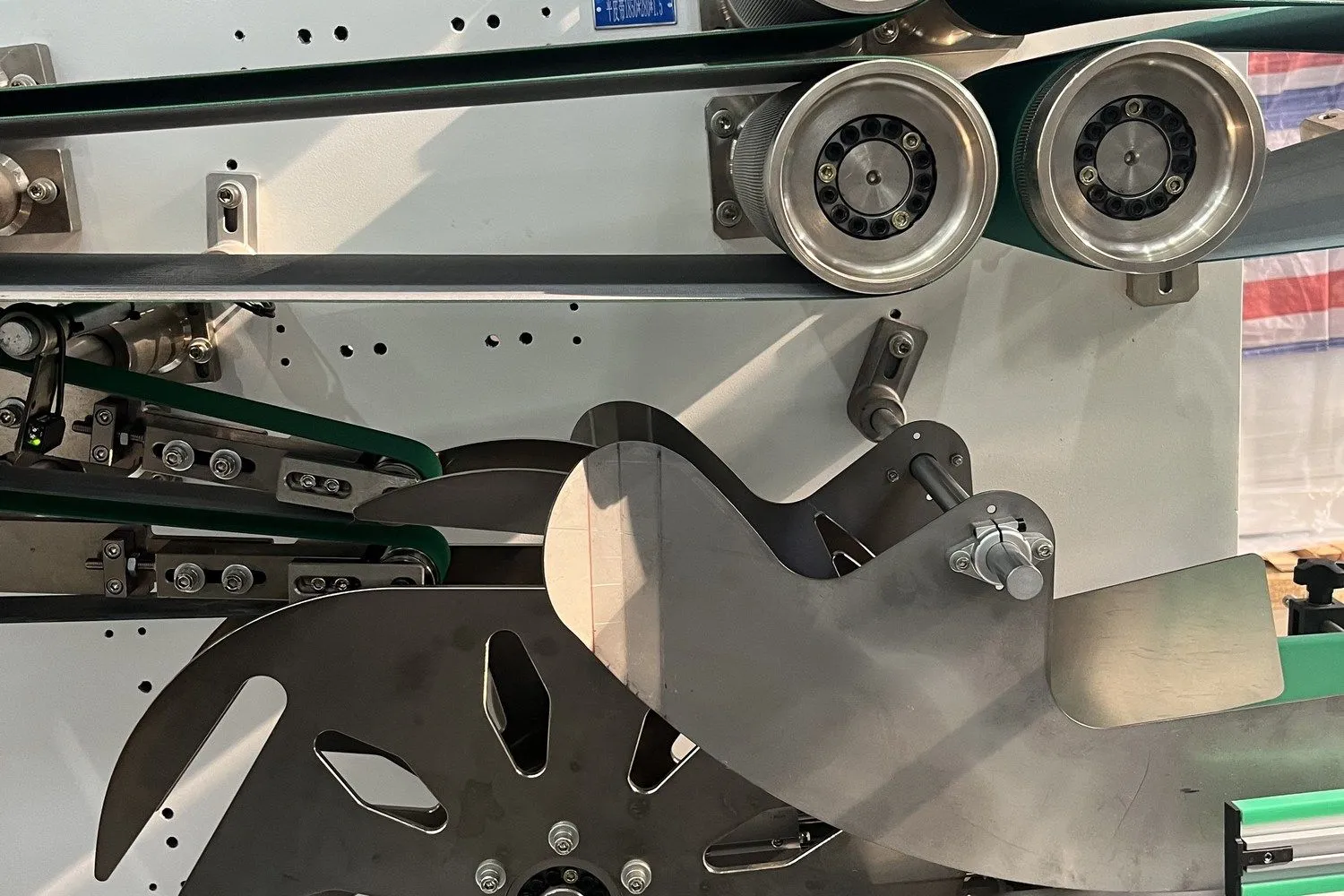
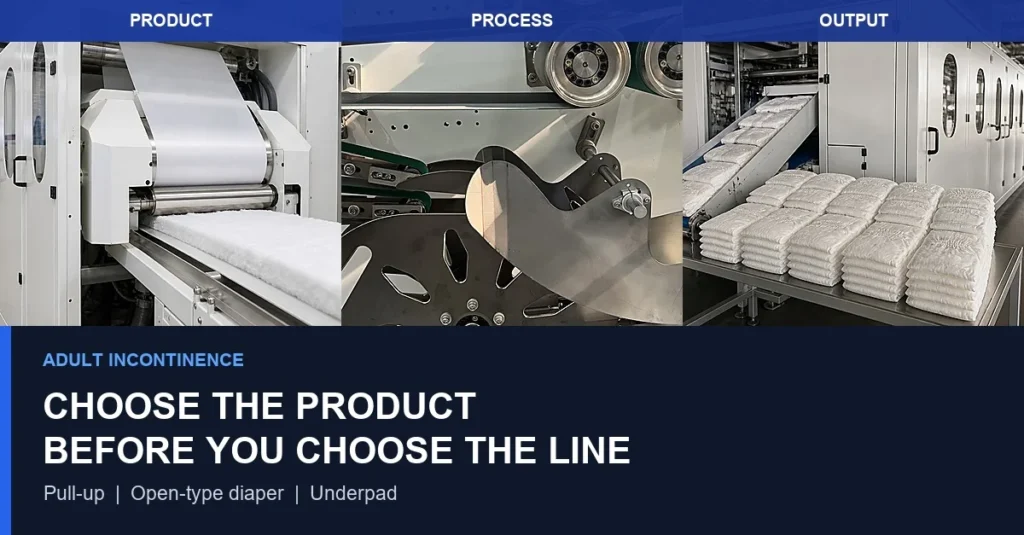
Adult care is not one product. The three main formats have different cost structures and different buyers.
| Format | Typical Speed | Buyer Profile |
|---|---|---|
| Adult pull-up pants | Design 300 / stable 250 pcs/min | Retail and home care, active users, premium positioning |
| Open-type tape diaper | Design 300 / stable 250 pcs/min | Institutional, bed-bound care, tender-driven |
| Underpad | Design 700-900 / stable 600-800 pcs/min | Hospitals and elder care, high volume, lower unit value |
Notice the underpad speed — roughly twice the diaper formats. Underpads run faster because they are simpler, flatter products, but they carry a lower unit value. The ROI is a different shape: higher throughput, thinner margin, volume-dependent.
Choosing between these is not a technical preference. It is a statement about which buyer you are building for.
What Transfers From Baby Diapers
One reason baby diaper manufacturers keep appearing in the adult care conversation is that the transfer is real.
- Machinery architecture. The converting logic — core forming, elastic application, cutting, folding — is the same family of equipment. The differences are scale, absorbency and product width.
- Raw materials. Non-woven, film, SAP, fluff pulp and adhesive all overlap. Existing supplier relationships and volume leverage carry over.
- Process discipline. Yield management, changeover discipline and quality control transfer directly, because the equipment behaves the same way.
- Factory footprint. A building, utilities, compressed air and waste handling are product-agnostic once built.
This is why the incremental investment for an established baby diaper manufacturer is smaller than it looks from the outside. The new line is the large item; much of the surrounding infrastructure is already paid for.
The Payback That Matters
For an investment of this size, the payback calculation should be built on the same disciplined logic as any capacity decision — not on an optimistic top-line number.
Illustrative framework only. The structure below shows how to think about the return. It contains no customer data, no price indication and no performance guarantee. Replace every term with your own figures.
The return breaks into a small number of terms, and the one most people get wrong is the first.
Annual contribution = saleable volume × contribution margin per piece
Saleable volume is not rated speed times time — it is stable speed, reduced by availability, passing rate and changeover loss, exactly as in any other line. Contribution margin is selling price minus variable cost, not revenue and not gross profit.
Against that contribution sit the investment and running costs:
| Term | What It Captures |
|---|---|
| Equipment | The line itself, sized by drive tier |
| Commissioning and ramp-up | Installation, training, and the lower yield of the learning period |
| Working capital | Raw material stock for the new product range |
| Certification where required | Market-specific compliance for institutional supply |
| Running cost | Labour, energy, maintenance, spares |
Payback in years is then simply total investment divided by annual contribution after running cost. What changes the result most is not the machine price — it is whether the volume term is built on a contract you already hold or on a market you are still hoping to enter.
Working through the numbers for an adult care line?
Send us your target volume, product format and distribution channel. We will help you work backwards to the drive tier and format that fit — including when the answer is to wait.
Worked Example: Channel vs Machine
Illustrative example only. The figures below demonstrate how channel access changes the outcome. They are not Welldone customer data and not a quotation.
Consider two manufacturers looking at the same full servo line.
The first already supplies distributors who deliver to hospitals. Before the machine arrives, they hold framework agreements representing a meaningful share of the line's stable output. Their ramp-up is short, because the volume is committed and the product specification is already agreed.
The second is entering the category with no institutional channel. They intend to sell through retail and build relationships after launch. The same machine, but the first months of output go to filling a sales pipeline rather than fulfilling contracts, and the learning period is longer because specifications are still moving.
Neither is wrong. But the payback calculation is different, and the difference is almost entirely in the volume term — not in the machine price. This is the point that gets lost when the decision is framed as "which machine should I buy."
What Does Not Transfer
It would be misleading to present adult care as a free extension of a baby diaper business. Several things do not carry over.
- The sales motion. Institutional selling is relationship-based and slow. A retail sales team does not automatically become a tender team.
- Compliance burden. Products supplied to hospitals and government programmes often carry registration and documentation requirements that retail baby products do not. Budget time and cost for these before the line, not after.
- Absorbency expectations. Adult products are specified for substantially larger fluid loads, which affects core design, SAP content and raw material cost. A baby core recipe does not scale up.
- Size complexity. The adult size range is wider, and the waist fit requirements differ from baby products, which feeds into changeover frequency and product complexity.
None of these is a reason to avoid the segment. They are reasons to plan the channel and compliance work in parallel with the machinery decision rather than after it.
When This Is Not Your Market
As with any capacity decision, there are conditions under which the honest answer is "not now."
Adult care may not be the right move when your existing channel cannot reach institutional or elder-care buyers, when your market has not yet reached the demographic inflection point that creates sustained demand, or when your current baby diaper operation is still absorbing the learning curve of its own ramp-up.
The segment rewards entrants who arrive with a channel. For everyone else, the machine is an expensive way to begin building one.
Why Welldone
We have manufactured hygiene product machinery in Jinjiang, Fujian since 2008 and delivered to more than 60 countries. Adult care is a core category for us, not an add-on, and we are direct about which tier and format fit a given volume.
Three tiers, sized honestlyFull servo, semi servo and mechanical options are matched to the volume you can place, not the volume you hope to reach.
Format and ROI supportWe provide feasibility and ROI study support as part of the specification process, so the format and tier decision is grounded in your numbers.
Transfer made concreteFor baby diaper manufacturers moving up, we map what carries over and what does not before you commit capital.
Related Machines
Conclusion
Adult incontinence is growing in most markets with an ageing middle class, and the institutional buyer behind that growth is a fundamentally different customer from a retail parent. The investment case turns on whether you can reach that buyer — the machine decision is downstream of it.
What transfers from a baby diaper operation is substantial: equipment architecture, materials, process discipline and site. What does not transfer is the sales motion and the compliance burden. Both have to be planned for.
So before you ask which machine to buy, answer the question that actually decides the return: who are you already talking to, and can they place the volume a line needs before it is installed?
Frequently Asked Questions
Is adult incontinence really a growth market, or is it still small?
It is growing faster than the baby category in most markets with an ageing middle class, and the structural drivers — life expectancy, the over-65 share of population, healthcare spending and destigmatisation — point the same way. The scale varies by country, which is why the channel question matters more than a global figure: demand concentrates where institutional buyers exist.
Should we choose full servo, semi servo or mechanical?
Match the tier to the volume you can place. Full servo suits established manufacturers competing on consistency and large contracts; semi servo suits growth operations balancing cost and automation; mechanical suits entry into a price-sensitive market at modest volume. The tier decision follows from your channel and volume, not from an assumption that the highest tier is safest.
Can our baby diaper line be converted to make adult products?
Generally not. Adult products are wider, carry far higher absorbency, and use a different size range and core specification. The machinery architecture is in the same family, but a baby line is not convertible. The realistic path is a dedicated adult line, with the surrounding infrastructure — building, utilities, materials — already leveraged from the existing operation.
What compliance do we need for institutional supply?
It depends on the market and the buyer. Hospital and government contracts often require product registration, quality system documentation and specific testing, which vary by country. This work takes time and should be started before the line is commissioned, because the product specification you build against depends on it. Budget both time and cost in the investment case.
Which format has the best return — pull-ups, open-type or underpad?
They are different businesses, not points on a scale. Pull-ups carry premium positioning in retail and home care; open-type serves institutional and bed-bound care through tenders; underpads run at roughly twice the speed but with thinner unit margin and volume dependence. The best return is the one whose buyer you can actually reach, not the one with the highest unit price.
What should we prepare before asking for a quotation?
Target product format, annual volume you can place, distribution channel and buyer type, whether you have institutional or tender access, existing factory footprint, available utilities, and your target market with any compliance requirements. The last three determine what transfers from your current operation and what has to be built new.
Request an Adult Care Feasibility Review
Tell us your channel and volume rather than starting from a machine choice, and we will work backwards to the format and drive tier that fit — including whether the honest answer is to wait. Please include:
- Target product format
- Annual volume you can place
- Distribution channel and buyer type
- Institutional or tender access
- Existing factory and utilities
- Target market and compliance needs
- Current baby line output, if any
- Country and financing timeline