Adult Diaper Production Line: Precision and Stability in the Silver Economy

On July 3, 2026
Comments Off on Adult Diaper Production Line: Precision and Stability in the Silver Economy
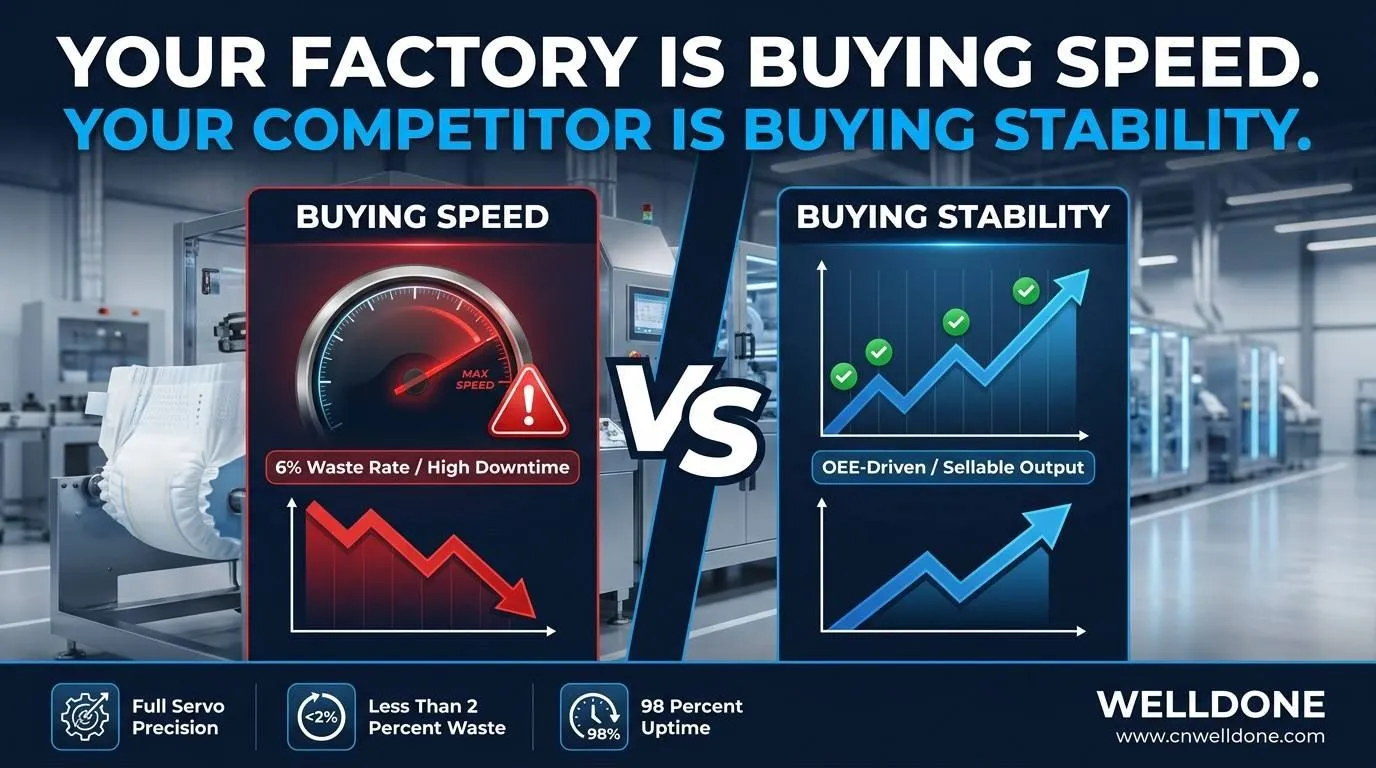
The "Silver Economy" is Booming: Is Your Adult Diaper Production Line Ready for the Precision Challenge?
Most buyers who contact us about adult diaper machines have already done their research. They know the market is growing. They have seen the aging population data. Some of them have visited factories in China, met three or four suppliers, and collected a stack of quotations.
What surprises them — sometimes after they have already placed an order — is how different adult care production actually is from what they expected.
The machine looks similar to a baby diaper line. The raw materials overlap. The production process follows the same basic logic. But once you start running product at scale, the challenges are in a completely different category. The core is heavier. The rolls are bigger. The tolerance for tension error is much tighter. And the cost of getting it wrong is much higher — because adult care raw materials cost more per unit than almost anything else in hygiene manufacturing.
Actually, the factories that struggle most in the adult care market are not the ones that chose the wrong product. They are the ones that chose a machine that was not built for this level of physical demand — and only discovered that after production started.
"The adult care market does not punish slow factories. It punishes imprecise ones."
Adult Care Is Not Baby Care Made Larger
This is the assumption that causes the most problems. A manufacturer already running baby diaper lines looks at adult care and sees a logical extension. Same product category. Similar machine structure. Familiar raw materials.
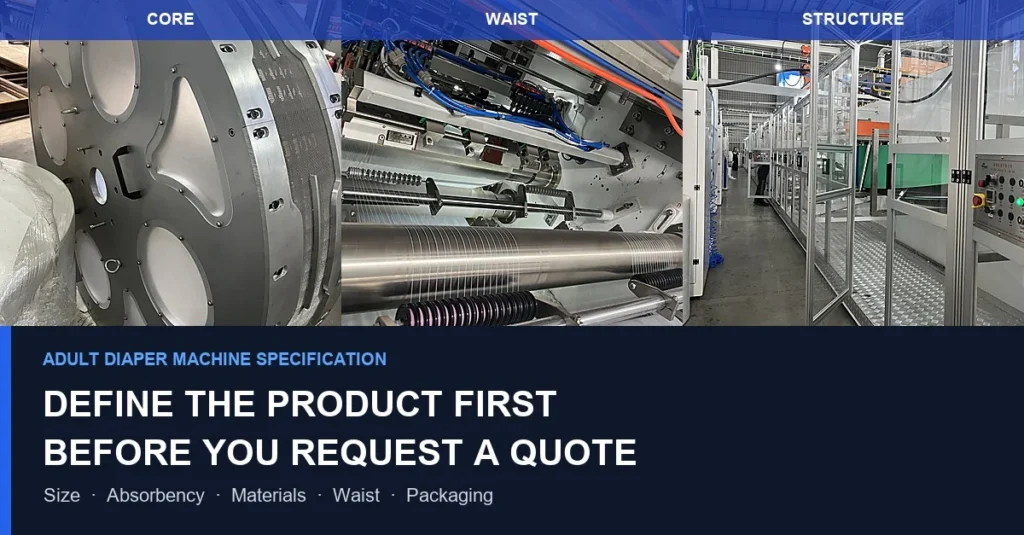
The difference shows up in the numbers. A standard baby diaper core contains around 8 to 12 grams of fluff pulp and SAP combined. An adult diaper core — depending on the absorbency grade — may require 30 to 50 grams. That is not a size change. That is a fundamentally different forming challenge.
The roll weights are heavier. The product is bigger and harder to transfer without distortion. The waistband elastics are wider and under more tension. The folding mechanism has to handle a product that weighs three to four times more than a baby diaper. Every section of the machine is working harder.
Operators who have only worked on baby diaper lines typically need four to six weeks before they can manage an adult care line with confidence. The adjustment logic is different. The quality checkpoints are different. The failure modes are different.
Understanding this before you invest is the difference between a smooth ramp-up and six months of troubleshooting.
The Forming Drum Problem Nobody Talks About
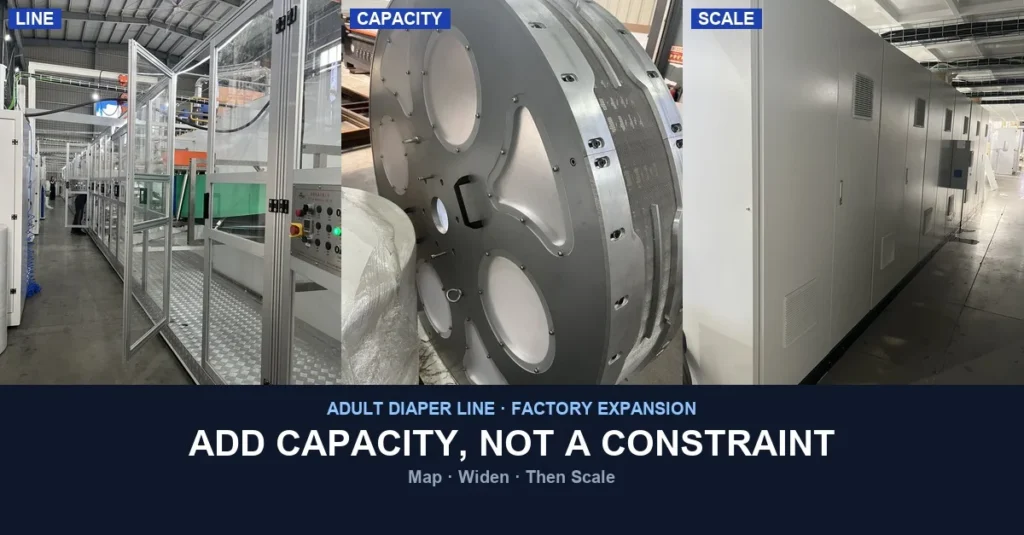
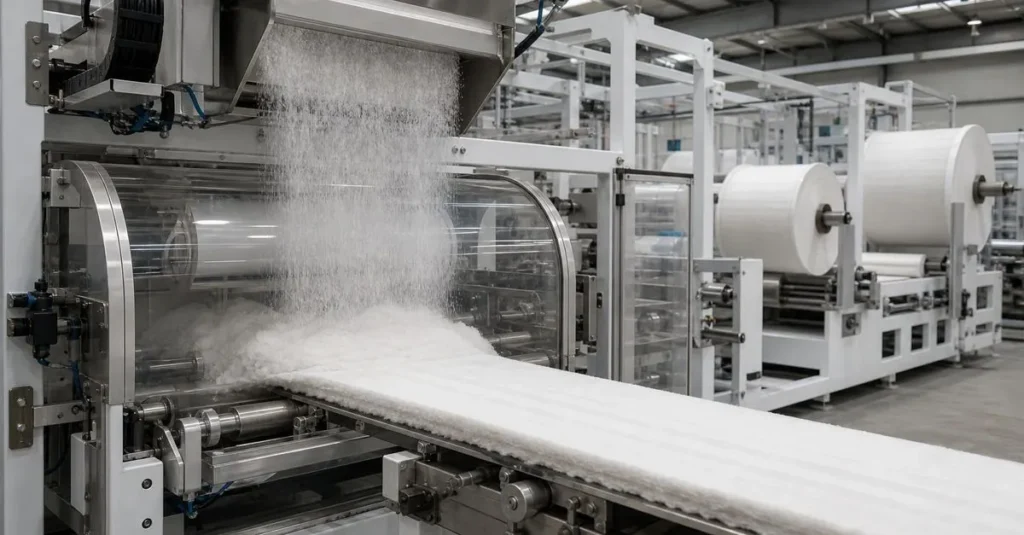
The forming drum is where the absorbent core is built. Fluff pulp is drawn in from the fiber opener, SAP is injected into the airflow, and the vacuum inside the drum pulls everything down into a mold that shapes the core.
On a baby diaper line running at 600 units per minute, this process is fast and well-understood. On an adult care line handling 40 grams of material per unit at 400 units per minute, the physics change significantly.
At higher grammage, the centrifugal force acting on the material during drum rotation is much stronger. If the vacuum pressure is not calibrated precisely to the drum speed and the fiber feed rate, the SAP does not distribute evenly. It clusters. It migrates toward the edges. It leaves thin spots in the center.
The real question is not whether your machine can form a core. The question is whether it can form the same core — consistently — across a full production shift, as temperatures rise, as material lots change, as the line speeds up and slows down during shift transitions.
Products with uneven SAP distribution will pass a basic appearance check. They will look fine in the sample review. The problem shows up when a nursing home orders ten thousand units and starts seeing leakage complaints from staff. By then, the production run is long finished and the root cause is buried in a machine parameter that nobody recorded.
- SAP clustering causes leakage channels in the center of the core.
- Thin spots in the fluff matrix collapse under pressure, reducing effective absorbency.
- Core weight variation across a shift creates inconsistent product performance between batches.
- Fiber loss from poorly calibrated vacuum adds 1 to 2 percent to your daily raw material waste — every day.
Tension and the Real Waste Bill
Picture a roll of non-woven fabric for adult care production. Full diameter: around 1.2 meters. Weight: several hundred kilograms. As the line runs, that roll gets lighter every minute. The inertia changes. The force required to unwind the material decreases. But the machine is still pulling at the same rate it was calibrated for at the start of the roll.
On a semi-servo or mechanical line, the system does not detect this change fast enough to compensate. The material runs slightly tighter as the roll depletes. Tighter means stretched. Stretched non-woven fabric changes its width slightly — which means the leg cuff position shifts, the core placement shifts, and by the time you are at the last 20 percent of the roll, dimensional variation is creeping into every unit.
I believe this is the most underestimated source of waste in adult care production — not because it is invisible, but because it happens gradually and nobody connects the late-roll dimensional drift to the tension system.
Run the calculation on a 400,000-unit production day with a 4 percent waste rate. That is 16,000 rejected units. At a raw material cost of USD 0.18 per adult diaper, that is USD 2,880 of material in the waste bin every single day. Over a year, that is over USD 1 million. Not from a machine failure. From a tension system that was not precise enough to feel the roll getting lighter.
- Non-woven stretch under tension variation causes leg cuff and core position drift.
- PE film tension inconsistency creates micro-tears in the leakage barrier — invisible until the product is wet.
- Elastic waistband tension variation produces products that are too tight or too loose across the same production run.
- Splice failures at roll changes — the most common cause of unplanned stoppages — are almost always tension-related.
The Speed Trap: What the Quotation Sheet Does Not Tell You
Every supplier quotation lists a maximum design speed. Some list 600 units per minute. Some list 800. Some list 1,000.
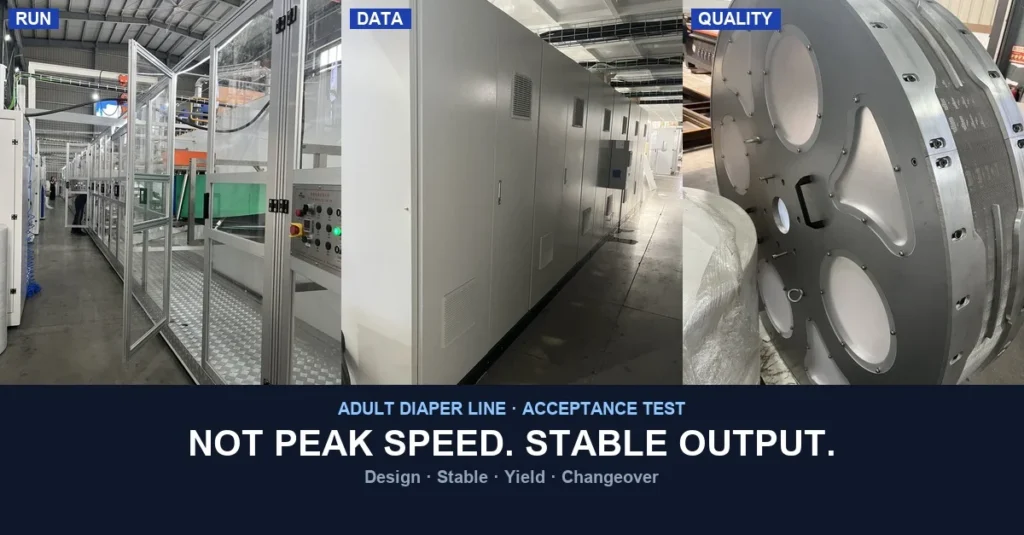
Here is what the quotation does not list: the stable running speed under your factory conditions, with your raw materials, operated by your team, over a full eight-hour shift.
Those two numbers are rarely the same. In adult care, they are often very far apart.
A machine rated at 800 units per minute may run stably at 450 in a real production environment. Add humidity variation, raw material batch inconsistency, and the learning curve of a new operator team, and that number may drop further during the first three months of production.
More importantly, pushing a machine to its rated maximum speed in adult care does not just reduce quality. It increases the failure rate on every mechanism that handles heavy product — the transfer belts, the folding system, the elastic application unit. Higher speed means more mechanical stress on every component that was not designed for that load at that frequency.
The factories that build profitable adult care businesses are not the ones with the highest rated speeds. They are the ones that found their line's stable sweet spot — the speed at which OEE is high, waste is low, and the machine can run for twelve hours without an unplanned stop.
What OEE Actually Tells You
OEE — Overall Equipment Effectiveness — is the number that tells you what your machine is actually producing, not what it is theoretically capable of.
It has three components. Availability: how many hours the machine actually ran versus how many hours it was scheduled to run. Performance: how close to rated speed it ran during those hours. Quality: what percentage of units produced met product standards.
Multiply those three percentages together and you get OEE. A machine with 90 percent availability, 80 percent performance, and 96 percent quality rate has an OEE of about 69 percent. That sounds reasonable until you realize that 31 percent of your potential production capacity disappeared — into minor stops, speed reductions, and rejected units.
In most cases, adult care lines with poor tension systems show low performance scores. The machine is running, but it keeps stepping down its speed to avoid splice failures. Lines with forming drum calibration issues show low quality scores. Units are coming off the line, but 5 to 8 percent of them fail absorbency checks.
When you are evaluating a machine investment, ask the supplier for their typical OEE benchmark for adult care lines in similar factory conditions. If they cannot give you a number, that tells you something.
Where the Money Really Goes
Raw materials in adult diaper production account for 70 to 80 percent of the total cost per unit. That ratio is higher than in almost any other hygiene product category — because the product is larger, uses more SAP, and requires more expensive elastic materials for the waistband system.
This means that material efficiency is not just an operational metric. It is your primary profit lever.
A one percent improvement in material waste rate on a line producing 400,000 adult diapers per day saves approximately USD 260,000 per year — assuming a raw material cost of USD 0.18 per unit. That is pure margin. It does not require selling more product, finding new customers, or renegotiating supplier contracts. It just requires a machine that handles material precisely enough to stop losing it.
The factories that build strong adult care businesses treat material efficiency as the first KPI they optimize — not speed, not uptime, not even output volume. Because at the margins this category operates on, what you save is often more valuable than what you can sell more of.
Quality Control Starts on the Machine, Not at the End of It
Many factories inspect adult care products at the end of the line. A team checks samples every thirty minutes. They weigh a few units, open a few products, check the tape placement by eye.
At 400 units per minute, thirty minutes of production is 12,000 units. If a quality problem developed at the fifteen-minute mark, 6,000 units with that problem have already moved through the packaging system before anyone catches it.
Modern adult care lines integrate inline detection systems that check every unit in real time — core weight, tape position, cutting accuracy, folding integrity. Units that fall outside spec are automatically ejected before they reach packaging. The reject rate data feeds back into the control system and triggers an alert if any parameter trends out of range.
This is not a luxury for large factories. It is a basic requirement for any adult care operation that sells into retail or institutional channels — because those buyers do quality audits, and a single bad batch damages your relationship far more than any short-term production saving.
- Inline core weight detection catches SAP distribution failures in real time.
- Tape placement sensors verify frontal and side tape position on every unit.
- Cutting accuracy checks prevent dimensional non-conformance across a full shift.
- Automatic rejection via air blast keeps contaminated or defective units out of the finished goods stream.
Sustainable Materials Are Coming — Is Your Line Ready?
European retail chains have started requiring minimum sustainability credentials for adult care products on their shelves. Some institutional buyers — hospital procurement agencies, elderly care operators — have begun including environmental specifications in their tender documents.
Biodegradable non-wovens, bamboo-based fluff pulp alternatives, and bio-derived SAP are moving from specialty products into mainstream supply chains. These materials are not interchangeable with their synthetic counterparts. They are softer, which means lower tensile strength. They behave differently under tension. Their friction coefficients require different calibration on the forming drum and the folding system.
A machine that was tuned specifically for standard synthetic materials will not simply run sustainable alternatives without adjustment. In some cases, the mechanical configuration needs to change. In others, the control parameters need to be rebuilt from scratch.
If you are investing in adult care production today, ask whether the machine platform can accommodate material changes — not just now, but as the supply landscape continues to shift over the next five years. A rigid machine is not just an operational limitation. It is a future investment risk.
Mistakes That Cost Factories Real Money
Comparing machines only by maximum speed
Maximum design speed is a specification, not a production reality. The number that matters is stable running speed under your actual factory conditions. Always ask for that figure specifically — and ask what the expected waste rate is at that speed.
Underestimating the forming system
The forming drum is where core quality is determined. Buyers who focus on overall machine price often discover too late that the forming system was the component that was compromised to hit the price point. Once the machine is running, replacing or upgrading the forming drum is expensive and time-consuming.
Skipping material compatibility testing
Raw material behavior varies between suppliers and between batches from the same supplier. A machine that runs well with the material the supplier used during factory acceptance testing may need significant adjustment when your local material arrives. Confirm material compatibility testing before sign-off — with your specific materials, not the supplier's samples.
Not planning for size changeover time
If your factory will run more than one adult care product size, changeover time directly affects your production planning flexibility. A machine that needs four hours for a size change cannot respond quickly to short-run orders. Ask for the actual changeover procedure and time — and have your operators walk through it before delivery.
Treating after-sales support as secondary
Adult care machines develop problems that are not always simple to diagnose remotely. The speed of your supplier's technical response — and the quality of that response — directly affects how long your line is down when something unexpected happens. This matters more in adult care than in almost any other hygiene product category, because your buyers expect consistent delivery.
Why Welldone
Welldone is a hygiene product machinery manufacturer under Quanzhou Shimao Weiteng Import and Export Co., Ltd. We have been building hygiene product machines for more than 18 years. We are not a trading company. We manufacture, and we support what we manufacture.
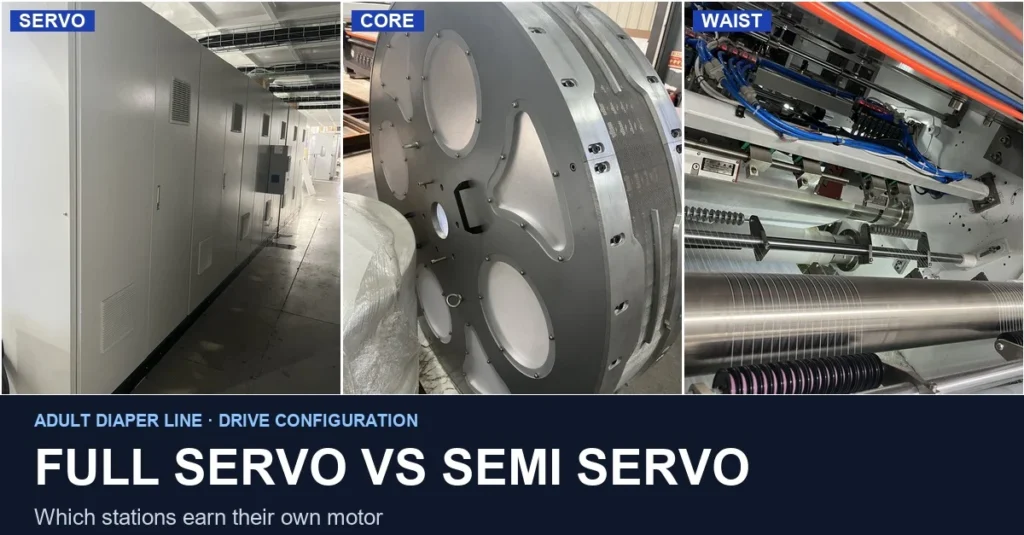
Our adult care lines are built specifically for the physical demands of high-grammage production — forming systems calibrated for 30 to 50 gram cores, servo tension control that compensates for roll inertia in real time, and transfer mechanisms designed to handle heavier product without distortion.
We do not consider a project complete when the container ships. We consider it complete when your line is running stably, your operators understand the machine, and your quality numbers are where they need to be.
18+ Years Manufacturing
Factory-owned production with full engineering support. Not a trading company reselling third-party equipment.
Built for Adult Care
Forming systems, tension control, and transfer mechanisms engineered specifically for high-grammage adult care production demands.
Full Project Support
Factory layout, raw material matching, installation, operator training, and long-term technical support included in every project.
Related Machines
Adult Diaper Machine
Full servo lines for adult diapers and pull-up pants. Designed for stable high-grammage core forming and large-format product handling.
Learn MoreBaby Diaper Machine
High-speed baby diaper and pull-up diaper production lines with advanced servo control and consistent core forming.
Learn MoreSanitary Napkin Machine
Female care production lines for sanitary napkins and panty liners with accurate sealing, cutting, and individual packaging systems.
Learn MoreUnderpad Machine
Production lines for disposable underpads for medical, elderly care, and home care markets with stable absorbent layer control.
Learn MorePet Pad Machine
Flexible production lines for pet pee pads with adjustable size configurations and consistent absorbency performance.
Learn MoreWet Wipes Machine
Wet wipes production lines for baby care, personal care, household, and industrial cleaning applications.
Learn MoreConclusion
The adult care market will keep growing. The demographic shift driving it is not a projection anymore — it is already visible in buying patterns, in hospital procurement volumes, in the retail shelf space being allocated to incontinence products in markets that barely stocked them a decade ago.
The factories that capture that growth will not necessarily be the ones with the newest machines or the largest production floors. They will be the ones that understood what adult care production actually demands before they invested — and chose equipment, partners, and processes that were built for those demands.
Precise core forming. Stable tension control across the full roll. Quality inspection on every unit. A production team that understands the machine well enough to catch problems before they become losses.
"If your line ran 4 fewer hours next month because of tension-related stops, what would that cost you? That number is worth knowing before you choose your next machine."
FAQ
Why does adult diaper production have higher waste rates than baby diaper production?
The core mass is three to five times heavier, which amplifies the effect of any tension or forming inconsistency. A tension variation that causes a minor cosmetic issue on a baby diaper line can cause a structural failure on an adult care line. Raw material cost per unit is also higher, so the financial impact of each rejected unit is greater.
What is a realistic stable running speed for an adult care machine in a new factory?
This depends on the machine configuration, raw material quality, and operator experience level. In a new operation with a well-configured machine and trained operators, a realistic stable speed during the first three months is typically 60 to 70 percent of rated maximum. Planning production capacity around maximum design speed will lead to shortfalls during ramp-up.
How does Welldone handle forming drum calibration for high-grammage adult care cores?
Our Adult Care Machines use a multi-zone vacuum system that maintains consistent negative pressure across the forming surface at different production speeds. Vacuum calibration is set specifically for the grammage range of the target product, and parameters are documented and transferable across production shifts.
Can Welldone adult care lines handle more than one product size?
Yes. Our lines support size changeover for different waist sizes and absorbency grades. Changeover procedures are documented as part of operator training, and target changeover times are established during commissioning so your production planning team has accurate numbers to work with.
What after-sales support does Welldone provide for adult care projects?
We provide installation supervision, commissioning support, operator training, spare parts planning, and ongoing technical communication. For adult care projects specifically, we include a production stabilization review at 90 days — a check-in to assess line performance, identify any adjustment needs, and confirm that the operation is on track to hit its production targets.
Planning an Adult Care Production Project?
Talk to us before you finalize your machine decision. We can help you evaluate configuration options, understand the realistic production ramp-up timeline, and identify the right raw material partners for your target market.
Website: www.cnwelldone.com | Email: welldone@cnwelldone.com
Contact Welldone Today