
Wet Wipes Category Switch: 6 Things to Re-Validate First
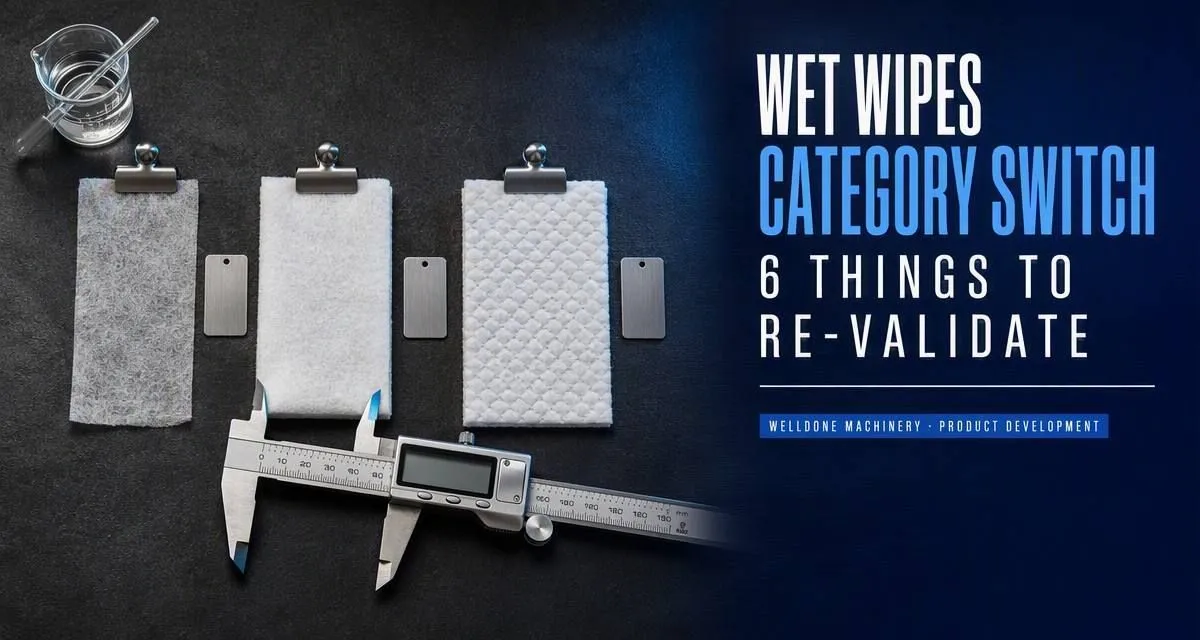
Baby Wipes to Adult Wipes: The 6 Things You Must Re-Validate Before the First Run
Switching wet wipes categories looks like a recipe change on the HMI. It is not. Five of the six parameters that break are chemistry and material problems the machine will happily run at rated speed while producing rejects. This article — Part 3 of the wet wipes series — is the re-validation checklist to run before the first production shift, not after.
Part 1 of this series covered the sachet-versus-tub architecture decision — matching the machine to the SKU your buyer signed. Part 2 walked through liquid dosing precision, the specification that predicts consumer complaints six months after launch. This is Part 3: what happens when you take a line that runs one category perfectly and point it at a different one. The failure mode is not mechanical. It is a validation gap.
1 · 40,000 rejected packs in one week
A wet wipes factory in Turkey called me in March. Four years running baby wipes. Clean line, good OEE, a private-label contract with a regional supermarket group and effectively zero consumer complaints. By any operational measure, a well-run factory.
Then they won an adult personal-care wipes contract. Same machine, same operators, same shift structure. They switched the SKU on a Monday morning.
By Friday they had 40,000 rejected packs in the quarantine cage.
Nothing broke. No alarm, no downtime event, no maintenance ticket. The line ran at rated speed all week and produced scrap at rated speed while doing it. The machine had no way to know the product was wrong.
What changed was six parameters, and the factory had formally re-validated exactly one of them — pack count, because it was obvious on the drawing. The other five were assumed to carry over from baby wipes. None of them did.
2 · Why category switching is not a recipe change
Modern servo wet wipes lines store SKU parameters as recipes. Select the recipe, the line writes the setpoints, production starts. That workflow is exactly what makes category switching dangerous — it makes a fundamentally different product feel like a menu selection.
A recipe change moves setpoints within a validated envelope. A category change moves the product outside that envelope, and the recipe system has no way to flag it. The HMI does not know that 65 GSM non-woven absorbs lotion at a different rate than 45 GSM. It just applies the dosing volume you told it to apply.
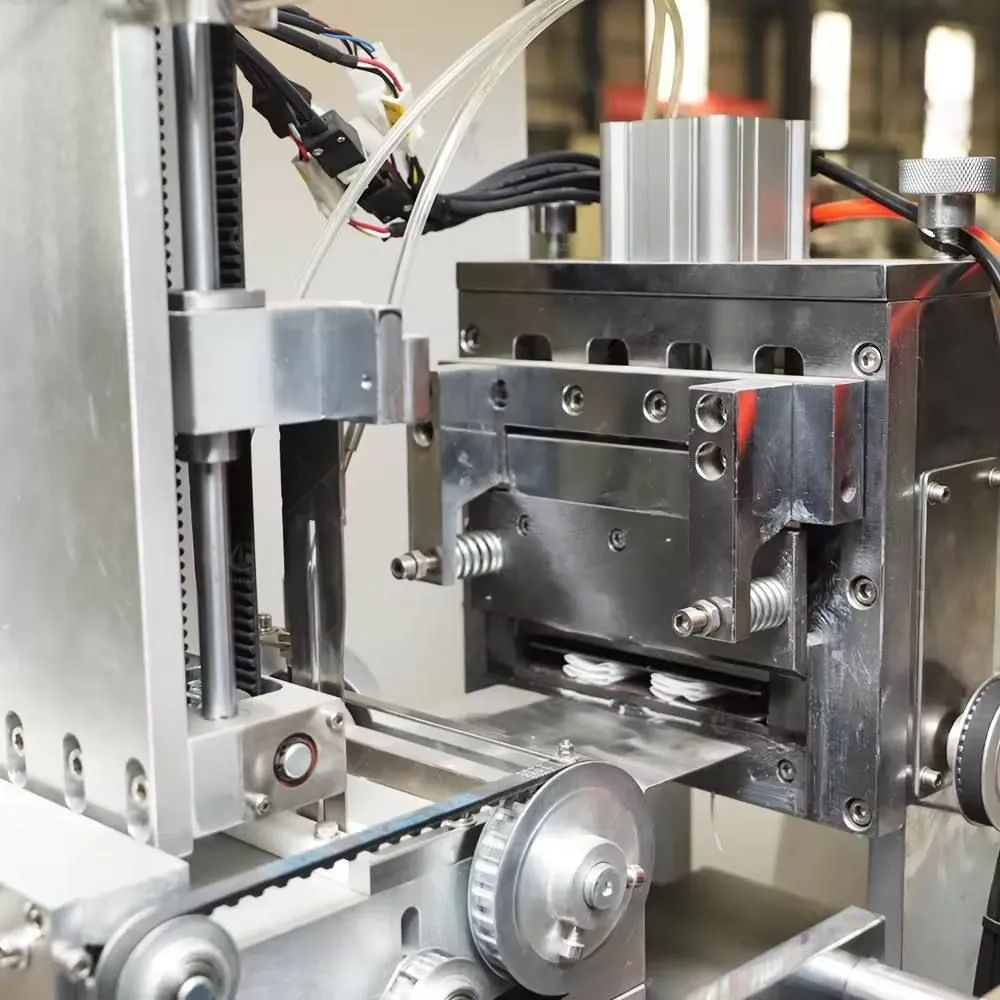
Here is the distinction worth writing into your factory SOP: a recipe change is a parameter adjustment inside a validated design space. A category change is a new design space that requires its own validation. Treating the second as the first is how a well-run factory produces 40,000 rejects without a single alarm.
3 · The 6 parameters that must be re-validated
Parameter 1 — Non-woven GSM and its downstream effects
Baby wipes typically run 40-50 GSM spunlace. Adult personal-care wipes need 55-70 GSM for the tensile strength and hand-feel consumers expect. That is not a small delta — a 40% GSM increase changes web tension behavior at the unwind, changes fold accuracy at the folding head, and changes blade wear rate at the cutter.
The web tension setpoint validated for 45 GSM will run 65 GSM material, but it will run it with more wander. Fold accuracy degrades from ±1mm to ±3mm. On an 80-count stack, that accumulates into a stack height variance the tub-loading module cannot absorb.
Parameter 2 — Liquid absorption rate
Thicker, denser substrate absorbs lotion more slowly. Same dosing volume applied to a higher-GSM web means the liquid has not fully penetrated the fiber matrix by the time the wipe reaches the folding station. Result: wipes that look correctly saturated at the folding head but come out of the pack with surface-wet, core-dry distribution.
Consumers describe this as "wet on the outside but doesn't clean properly." It is one of the most common complaint patterns after a category switch, and it is invisible to every QC check that measures total liquid weight rather than distribution.
Parameter 3 — Lotion viscosity and pump behavior
Adult and personal-care formulations often carry higher glycerin, higher emollient, or higher active-ingredient loading than baby formulations. Viscosity commonly runs 1.5-3x higher. As covered in Part 2 of this series, dosing pumps are calibrated against a specific viscosity range — the same pump setting delivers a materially different volume when viscosity changes.
Parameter 4 — Pack count and stack geometry
Baby wipes commonly ship 60-100 count. Adult personal-care wipes commonly ship 30-50. Fewer wipes means a shorter stack, which means the compression setting validated for an 80-count stack over-compresses a 40-count stack. Over-compression on a higher-GSM substrate causes edge deformation the consumer sees the moment they open the lid.
Parameter 5 — Preservative system compatibility
This is the one that catches factories most often, because it is a chemistry problem hiding inside a mechanical system. Adult and intimate-care formulations frequently use different preservative chemistry — different pH, different solvent carriers, sometimes different organic acid systems. Some of those are incompatible with the elastomer seals in a dosing pump validated for a baby wipes formulation.
Seal degradation is not instant. It takes 3-8 weeks. Which means the switch appears successful, production runs clean for a month, and then dosing precision starts drifting for reasons nobody connects to the category change that happened six weeks earlier.
Parameter 6 — Regulatory classification
Baby wipes are classified as cosmetics in most markets. Adult intimate-care and personal-hygiene wipes can fall under cosmetic, medical device, or biocidal product regulation depending on the claims on the pack. A "cleansing wipe" is cosmetic. An "antibacterial wipe" may be a biocidal product under EU BPR. The manufacturing requirements, documentation burden, and audit expectations are materially different.
4 · The validation matrix by category pair
Not every category switch requires re-validating all six parameters. The matrix below shows which parameters change materially for the most common switch directions on a private-label wet wipes line:
| Switch direction | Substrate GSM | Lotion viscosity | Pack geometry | Regulatory class |
|---|---|---|---|---|
| Baby → Adult personal care | Major (40-50 → 55-70) | Major (1.5-3x) | Major (80 → 30-50) | Possible reclass |
| Baby → Household / surface | Major (40-50 → 60-80) | Major (solvent-based) | Moderate | Biocidal likely |
| Baby → Cosmetic / makeup remover | Moderate (40-50 → 45-60) | Major (oil phase) | Major (25-30 count) | Cosmetic, same class |
| Adult → Medical / clinical | Minor | Moderate | Minor | Major — device class |
| Any → Flushable / dispersible | Major (fiber system change) | Moderate | Minor | INDA/EDANA GD4 required |
Read the bottom row carefully if flushable wipes are on your roadmap. Dispersible substrate is not a GSM change — it is a completely different fiber bonding system, and the INDA/EDANA GD4 flushability protocol is a separate qualification project, not a line parameter.
5 · Four misconceptions that cause switch failures
Misconception 1: "Our line is full servo, it handles any product."
Full servo means the line can hold precise setpoints. It does not mean the setpoints are correct for a product they were never validated against. Servo precision applied to a wrong parameter produces consistently wrong output — which is arguably worse than mechanical variability, because it produces 40,000 identically defective packs instead of a mixed batch someone would have caught.
Misconception 2: "We'll adjust on the fly during the first shift."
Some parameters respond to on-the-fly adjustment: web tension, blade pressure, compression setting. Others do not: preservative-seal compatibility takes weeks to manifest, absorption profile requires a controlled soak test, regulatory classification requires documentation before the first commercial shipment. Trying to tune all six live means the three that cannot be tuned live get skipped.
The uncomfortable pattern: factories that fail a category switch are almost never the ones with poor equipment. They are the ones with good equipment and a strong operational track record — because a strong track record in one category creates exactly the confidence that skips the validation protocol for the next one.
Misconception 3: "The lotion supplier confirmed compatibility, so we're covered."
The lotion supplier confirms the formulation is stable and skin-safe. That is their scope. Whether the formulation is compatible with your dosing pump's elastomer seals, your stainless steel grade, and your line's contact-time profile is a question only you or your machine supplier can answer. Ask your machine supplier for the seal material specification and send it to the lotion supplier for a compatibility review — in writing.
Misconception 4: "We ran a sample batch and it looked fine."
A sample batch validates the parameters that fail immediately. It does not validate the parameters that fail over time — seal degradation, absorption profile changes as substrate settles, dosing drift as pump tolerance widens under new viscosity. A meaningful category validation runs a minimum of 5 production days with dosing precision measured daily, not one shift with a visual inspection.
6 · The 5-day re-validation protocol
The protocol below is what I recommend to any factory switching wet wipes categories. It costs five production days. A failed switch costs considerably more.
- Day 0 — Documentation review. Substrate spec sheet, lotion spec sheet including viscosity and preservative system, machine seal material spec, target market regulatory classification. Get all four in writing before any material is loaded.
- Day 1 — Dry run, no lotion. Run the new substrate through the full line with dosing off. Measure fold accuracy, cut edge quality, and stack height variance. Adjust web tension and blade pressure until fold accuracy is back inside ±1mm.
- Day 2 — Dosing calibration. Run with the new lotion, measure actual delivered volume with a flow meter on the injection line. Recalibrate the pump for the new viscosity. Confirm dosing precision is inside ±3% across a full shift.
- Day 3 — Absorption profile test. Pull samples at 0, 30, and 120 minutes after production. Section the wipes and measure core-versus-surface moisture distribution. Adjust dosing timing or line speed until distribution is uniform.
- Day 4-5 — Sustained production run. Full production speed, both shifts, dosing precision measured every 4 hours, stack height variance logged every hour. If precision drifts more than 1% across the two days, the pump-lotion combination has a compatibility problem that will worsen over weeks.

The one item you cannot compress: preservative-seal compatibility. It takes 3-8 weeks to manifest as dosing drift, which means no 5-day protocol will catch it. The only defense is the documentation review on Day 0 — get the seal material spec from your machine supplier and the preservative system from your lotion supplier, and have both parties confirm compatibility in writing before the switch. This single step prevents the most expensive failure mode in category switching.
📚 The complete wet wipes trilogy
Part 1 — Wet Wipes Machine Sachet vs Tub: Which Line Pays Back
Part 2 — Wet Wipes Liquid Dosing Precision: The Spec That Predicts Complaints
Part 3 — You are here.
7 · Why Welldone Machinery for multi-category wet wipes production
Welldone ships wet wipes lines with a documented category-switch validation protocol — the same five-day sequence above, adapted to your specific substrate and lotion combination. We publish the seal material specification on every dosing system we build, so your lotion supplier can review compatibility before you commit to a formulation.
01 · VALIDATION PROTOCOL
Documented category-switch sequence
Every line ships with a written five-day re-validation protocol covering substrate, dosing, absorption profile, and sustained-run verification — adapted to the specific categories in your SKU roadmap.
02 · SEAL SPEC PUBLISHED
Elastomer compatibility upfront
Dosing system seal material specification is published in the equipment manual and provided at quotation — so your lotion supplier can confirm chemical compatibility before you commit to a formulation.
03 · SUBSTRATE ENVELOPE
Validated GSM range on the spec sheet
Every line quotes an explicitly validated substrate GSM window, not an open-ended "handles all materials" claim. If your roadmap crosses that window, we say so before the PO, not after the first reject batch.
9 · Conclusion — closing the wet wipes trilogy
Across three articles this series has walked the full wet wipes production decision chain: which line architecture matches your SKU (Part 1), which specification decides whether consumers buy the second pack (Part 2), and what has to be re-validated when the SKU book expands into a new category (Part 3).
The thread running through all three is the same one that runs through every hygiene machinery decision: the machine will faithfully execute whatever specification you give it. Whether that specification is correct for the product you are actually selling is a question the machine cannot answer, and one that most RFQ conversations never ask.
An open question to close the series: if your SKU roadmap for the next 24 months includes a category you are not producing today, has anyone on your team written down which of the six parameters will change — and who owns validating each one? If that document does not exist, it is the cheapest insurance policy you will buy this year.
10 · Frequently asked questions
How long does a proper wet wipes category switch validation take?
Five production days for the mechanical and dosing parameters, plus a documentation review before any material is loaded. The preservative-seal compatibility question cannot be validated inside five days — it takes 3-8 weeks to manifest — which is why it must be resolved through supplier documentation upfront rather than through production testing.
What substrate GSM range can a single wet wipes line handle?
A well-specified servo line typically holds a validated window of about 40-70 GSM without mechanical modification, though web tension and blade pressure setpoints must be re-established at each end of that range. Going below 35 GSM or above 80 GSM generally requires hardware changes at the unwind and cutting stations. Ask your supplier for the explicitly validated window rather than accepting an open-ended claim.
Can I switch from regular wipes to flushable wipes on the same line?
Mechanically, often yes — dispersible substrate runs through most servo lines. But flushability is a product qualification project, not a line parameter. The INDA/EDANA GD4 protocol requires third-party testing of dispersion behavior, and the fiber bonding system in dispersible substrate behaves differently under tension than spunlace. Plan for a separate qualification timeline, typically 3-4 months, alongside the 5-day line validation.
Who is responsible for confirming lotion-to-seal compatibility?
Jointly the machine supplier and the lotion supplier — but the factory has to initiate it. The machine supplier provides the elastomer seal material specification; the lotion supplier reviews the preservative and solvent system against that material. Neither party will proactively raise it. Getting both confirmations in writing before the switch is the single highest-value item on the Day 0 documentation checklist.
Can Welldone Machinery provide a category-switch validation protocol for my specific product roadmap?
Yes. Send us your current production category and the categories on your 24-month roadmap. We return a parameter-by-parameter validation matrix showing which of the six change materially for each switch direction, the seal material specification for your dosing system, and a day-by-day protocol adapted to your substrate and lotion combination.
Planning a wet wipes category expansion — or recovering from a failed switch?
Send us your current production category, your target category, and your substrate and lotion specifications. We return a parameter-by-parameter validation matrix and a day-by-day protocol sized to your specific switch — before you load the first roll.
Related Posts

25
Aug
Tissue Machine Speed: Why 400 to 1,000 pcs/min Is a Range
-
Posted by
cnwelldone
.wd-ready-article{--wd-navy:#1e40af;--wd-blue:#2563eb;--wd-blue-light:#eff6ff;--wd-dark:#0f1...
24
Aug
3-Layer vs 5-Layer Under-Pad: What the Extra Layers Buy You
-
Posted by
.wd-ready-article{--wd-navy:#1e40af;--wd-blue:#2563eb;--wd-blue-light:#eff6ff;--wd-dark:#0f1...
21
Aug
Pet Pee Pad vs Hospital Under-Pad: What Changes on the Line
-
Posted by
.wd-ready-article{--wd-navy:#1e40af;--wd-blue:#2563eb;--wd-blue-light:#eff6ff;--wd-dark:#0f1...
10
Aug
Under-Pad Export Compliance: EU MDR, GCC, and Africa Paths
-
Posted by
:root{
--wd-navy:#1e40af;
--wd-blue:#2563eb;
--wd-blue-light:#eff6ff;
--wd-dark:#0f1...
06
Aug
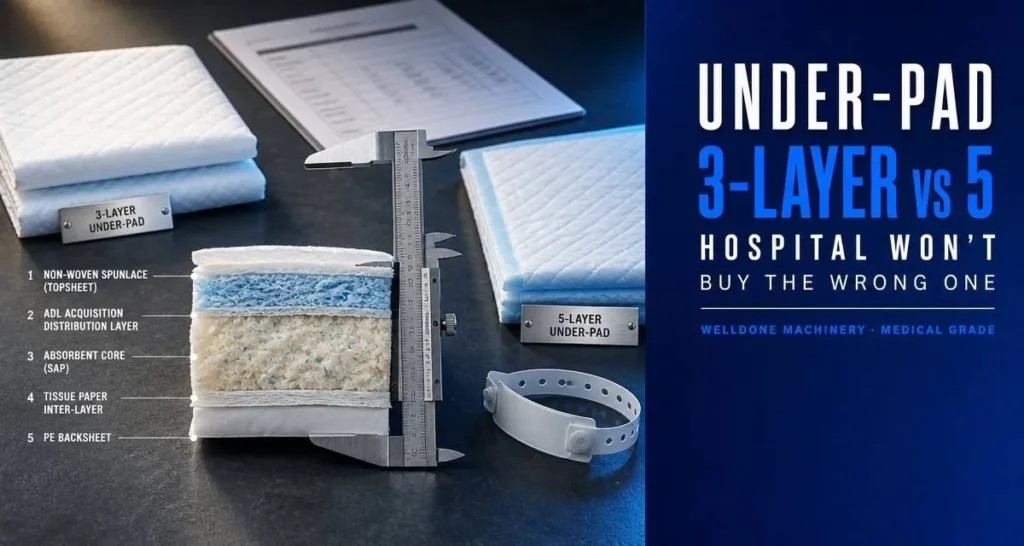
3-Layer vs 5-Layer Under-Pad: What Hospitals Actually Buy
-
Posted by
:root{
--wd-navy:#1e40af;
--wd-blue:#2563eb;
--wd-blue-light:#eff6ff;
--wd-dark:#0f1...
05
Aug
Under-Pads or Pull-Ups: Which Line Pays Back First
-
Posted by
:root{
--wd-navy:#1e40af;
--wd-blue:#2563eb;
--wd-blue-light:#eff6ff;
--wd-dark:#0f1...
29
Jul
Wet Wipes Liquid Dosing Precision: The Spec That Predicts
-
Posted by
:root{
--wd-navy:#1e40af;
--wd-blue:#2563eb;
--wd-blue-light:#eff6ff;
--wd-dark:#0f1...
28
Jul
Wet Wipes Machine Sachet vs Tub: Which Line Pays Back
-
Posted by
:root{
--wd-navy:#1e40af;
--wd-blue:#2563eb;
--wd-blue-light:#eff6ff;
--wd-dark:#0f1...
27
Jul
S3 vs S5 Sanitary Napkin Machine: When $400K Actually Pays
-
Posted by
:root{
--wd-navy:#1e40af;
--wd-blue:#2563eb;
--wd-blue-light:#eff6ff;
--wd-dark...
24
Jul
Sanitary Napkin Hidden Costs: 4 Items Missing from CAPEX
-
Posted by
:root{
--wd-navy:#1e40af;
--wd-blue:#2563eb;
--wd-blue-light:#eff6ff;
--wd-dark:#0f1...
23
Jul
Sanitary Napkin SKU Changeover Time: Why It Beats Line Speed
-
Posted by
:root{
--wd-navy:#1e40af;
--wd-blue:#2563eb;
--wd-blue-light:#eff6ff;
--wd-dark:#0f1...
21
Jul
Adult Pull-Up Line Back-End: Vision Inspection, Packaging & OEE — Welldone
-
Posted by
:root{
--wd-navy:#1e40af;
--wd-blue:#2563eb;
--wd-blue-light:#eff6ff;
--wd-dark...