3-Layer vs 5-Layer Under-Pad: What Hospitals Actually Buy

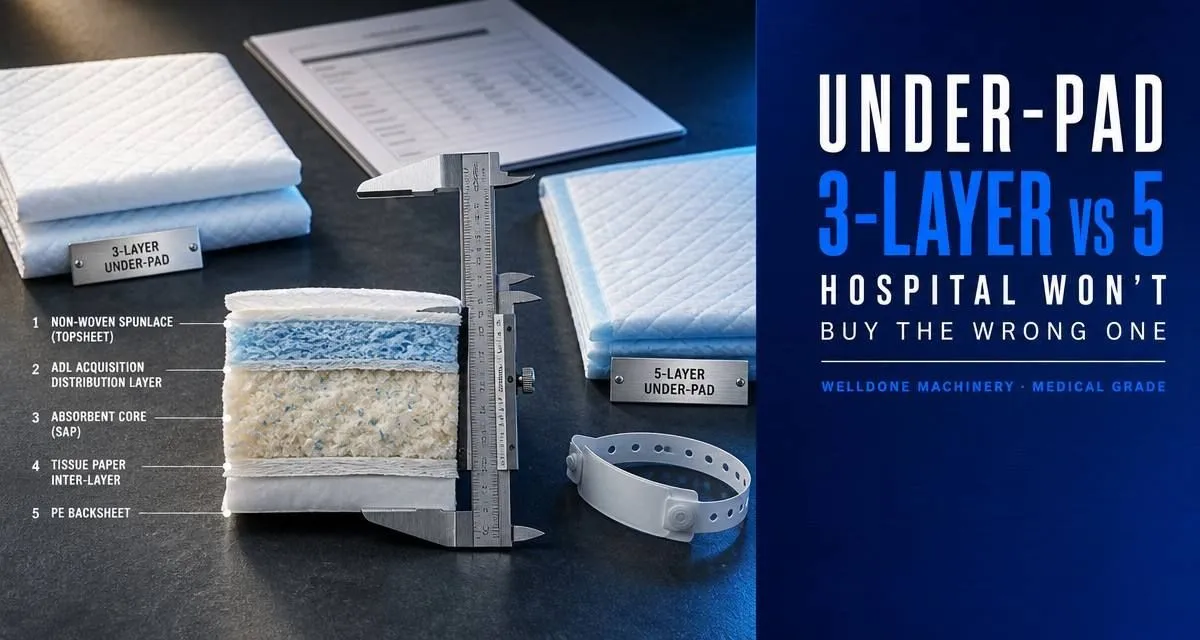
3-Layer or 5-Layer Under-Pads: The Structural Decision That Decides Whether Hospitals Will Buy from You
A 3-layer under-pad and a 5-layer under-pad can be identical in size, weight, and total absorbency — and one will pass hospital procurement and the other will not. The difference is not how much fluid the product holds. It is how quickly the fluid moves away from skin contact, and whether that movement can be measured to a clinical standard. This article breaks down exactly where the structural line is drawn.
Part 1 of this under-pad series covered the CAPEX and payback decision between under-pads and adult pull-ups — which line to build first, and why elder-care operators with captive institutional demand almost always get the sequencing backwards. This is Part 2: once you have decided to build an under-pad line, the next decision is whether to build for nursing home supply, hospital supply, or both. That decision is made at the layer-count specification, and it is not reversible without a second machine.
1 · The Egypt factory that lost the hospital tender
A disposable under-pad manufacturer in Egypt called me after losing a hospital procurement tender in the GCC region. They had won a nursing home supply agreement six months earlier on the same product. Same 60×90cm size, same SAP loading, same PE backsheet. The hospital procurement officer returned the sample with one note: "Does not meet ADL requirement."
The factory had never heard the term "ADL" in a sales context. Their product was technically correct — good absorbency, adequate backsheet impermeability, competitive unit cost. It was correct for the buyer channel they had been selling to. Hospital procurement reads from a different specification sheet entirely.
What the Egypt factory was missing was not better SAP or a thicker core. It was a single additional layer — the acquisition distribution layer — that costs roughly USD 0.008-0.014 per piece in raw material and requires a dedicated feeding and cutting station on the production line. Without it, the product is a nursing home product regardless of how it performs on total absorbency.
2 · What 3-layer and 5-layer actually mean structurally
3-layer construction
The standard 3-layer under-pad is: non-woven topsheet / SAP + fluff pulp absorbent core / PE backsheet. The topsheet receives fluid, the core absorbs and retains it, the backsheet prevents strike-through to the mattress. This construction is adequate for general institutional bedding protection — nursing home, home care, rehabilitation ward — where the primary specification is total absorbent capacity and impermeability.
5-layer construction
The 5-layer under-pad adds two components: non-woven topsheet / ADL (acquisition distribution layer) / SAP + fluff pulp absorbent core / tissue inter-layer / PE backsheet.
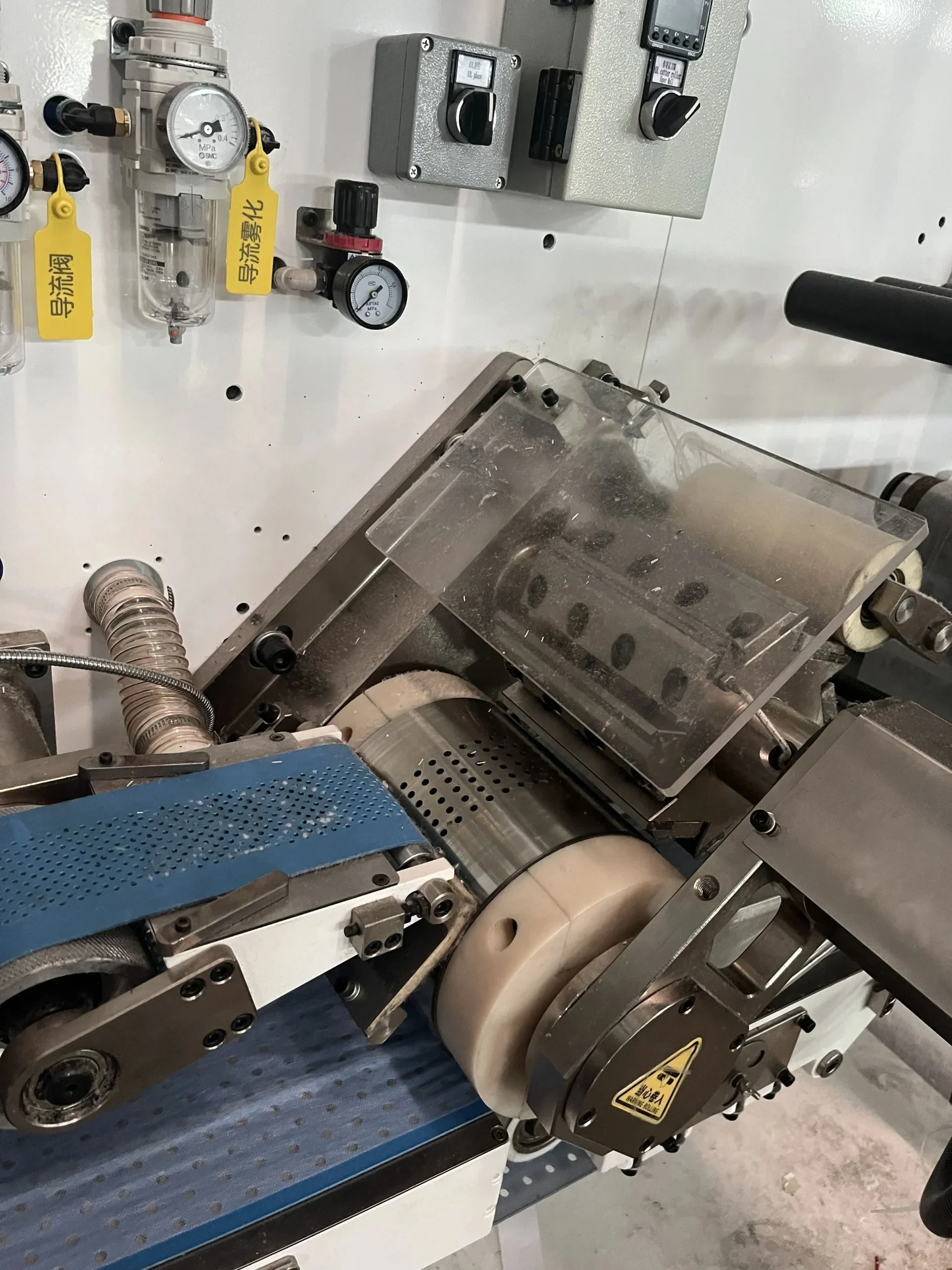
- ADL (acquisition distribution layer): A porous, low-density non-woven placed between topsheet and core. Its function is to receive fluid from the topsheet and distribute it laterally across the core surface before the core absorbs it. This dramatically reduces surface rewet — the fluid that migrates back toward the skin after initial absorption.
- Tissue inter-layer: A wet-strength tissue between the SAP core and the PE backsheet. Its functions are: (1) prevent SAP granule migration through the backsheet under compression, (2) provide a measurable strike-through resistance test layer, and (3) maintain dimensional stability of the core under load.
3 · The three structural tests hospital procurement actually runs
Hospital procurement for bedding protection is not asking about total absorbency. Every hospital procurement officer I have worked with runs variations of three structural tests, in this order:
Test 1 — Surface rewet time (the ADL test)
A standardized fluid load is applied to the topsheet surface. After 30 seconds, a weighted blotter paper is applied to the topsheet and the absorbed weight is measured. The lower the rewet, the better. Hospital-grade specification typically requires rewet below 1.0g at 5 minutes, with most clinical wound-care procurement officers targeting below 0.5g. A 3-layer under-pad without ADL typically measures 2.0-4.0g rewet. A 5-layer with ADL typically measures 0.3-0.8g. The gap is not marginal — it is the clinical difference between a product that keeps skin dry and one that does not.
Test 2 — SAP core weight variance (the ±3% test)
Hospital procurement cuts ten pads from a production batch and measures SAP weight distribution across the core area. The specification typically requires that no individual measurement deviates more than ±3% from the target weight. A 3-layer line built without a servo-metered SAP dosing system typically holds ±6-8% variance. That level of variance is invisible in nursing home supply — the product still absorbs adequately. In a hospital procurement audit, ±6% fails the test and the supply agreement does not advance.
Test 3 — Strike-through resistance (the tissue inter-layer test)
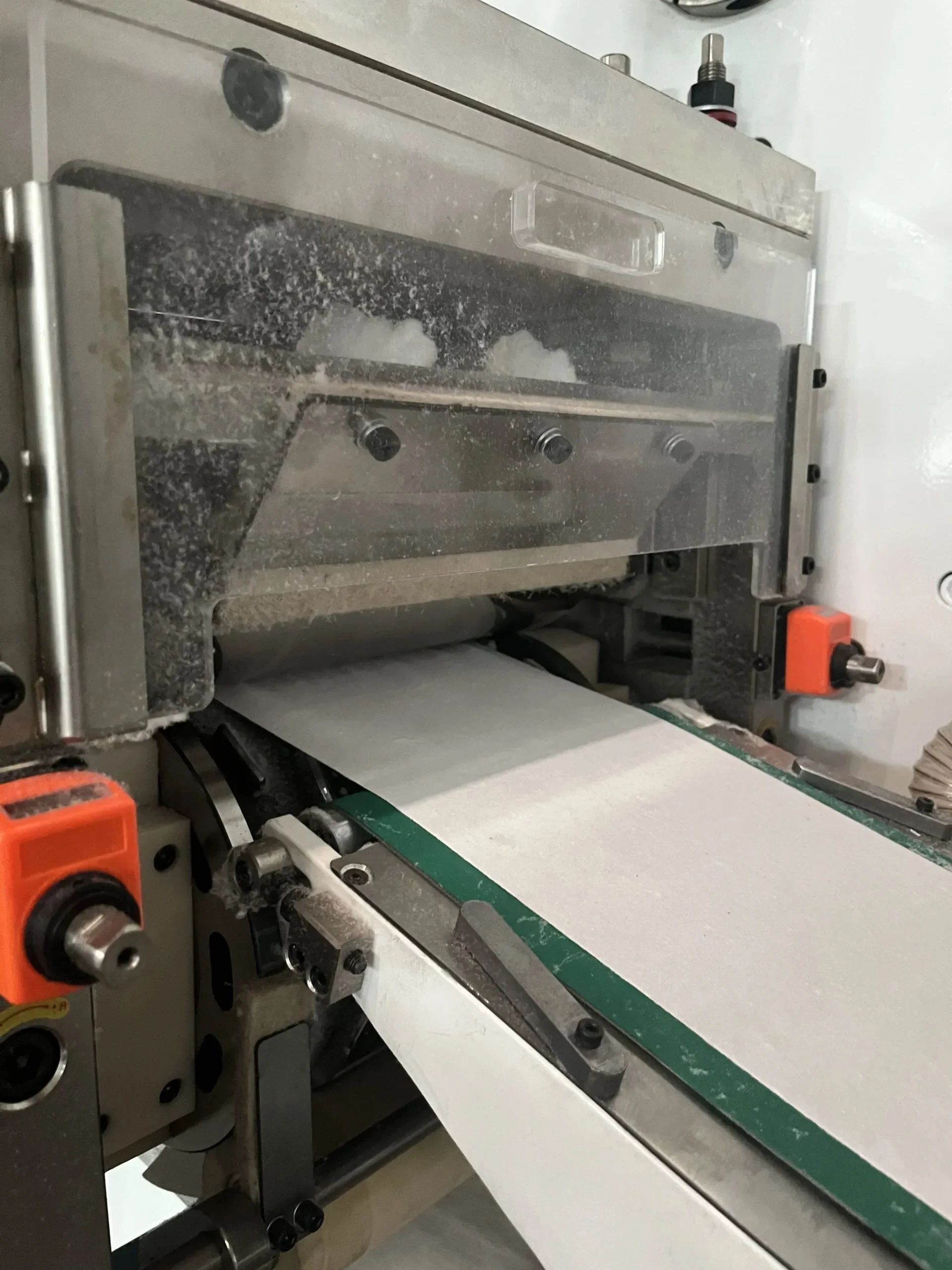
A standardized fluid load is applied to the topsheet and after absorption, a blotter is placed beneath the PE backsheet. Strike-through is the weight of fluid that passed through the entire product and contacted the underside surface. Hospital procurement — particularly for surgical drape and clinical bedding applications — references EN 13795 performance levels. A 3-layer under-pad with standard PE backsheet passes general hygiene product strike-through tests. It may fail clinical-grade strike-through requirements without the tissue inter-layer, which provides a second physical barrier against fluid migration under dynamic compression (patient weight shifting).
4 · Where the line is drawn by buyer channel
| Buyer channel | ADL required | SAP variance spec | Strike-through test | Layer count needed |
|---|---|---|---|---|
| General nursing home | No | ±6-8% acceptable | General hygiene standard | 3-layer sufficient |
| Rehabilitation ward | Sometimes | ±5% preferred | General hygiene standard | 3-layer or 5-layer |
| Hospital general ward | Usually yes | ±3% required | Clinical grade | 5-layer required |
| Hospital wound care / ICU | Yes, mandatory | ±2-3% required | EN 13795 reference | 5-layer required |
| Medical distributor (EU) | Yes | ±3% required | EN 13795 reference | 5-layer required |
| Home care / retail | Premium SKU only | ±5% acceptable | General hygiene standard | 3-layer base, 5-layer premium |
Read the table against your actual buyer base, not your aspirational buyer base. If 80% of your current volume is nursing home supply, a 3-layer line is the correct specification. If your growth plan requires hospital procurement or EU medical distribution in years 2-3, plan for 5-layer from day one — because retrofitting a 3-layer line to 5-layer requires adding two complete feeding and lamination stations, which is a factory-shutdown project, not a maintenance window.
5 · Four misconceptions about the layer-count decision
Misconception 1: "More layers means better absorption."
Not directly. Total absorbency is a function of SAP loading rate and core weight — both available on 3-layer and 5-layer lines. The extra layers in a 5-layer construction improve fluid distribution speed and surface rewet, not total capacity. A 3-layer pad with heavy SAP loading will outperform a 5-layer pad with light SAP loading on total absorbent capacity. The layer count determines the structural test profile, not the raw absorbency number.
Misconception 2: "We can add the ADL later as a product upgrade."
You can add the ADL product. You cannot add it on your current line without mechanical modification. The ADL feeding and cutting station is a discrete mechanical module. If the line was built without it, adding it requires stopping production for 2-4 weeks to install the module, re-commission the line, and re-validate the product. The practical cost of that shutdown — lost production, re-qualification, potential supply gap penalties — typically exceeds the CAPEX difference between a 3-layer and 5-layer line at purchase.
The pattern I see consistently: factories that buy 3-layer lines planning to "upgrade later" end up running two parallel lines — the original 3-layer for nursing home supply and a new 5-layer for hospital supply — because the cost of shutting down the first line for modification is prohibitive once it is fully loaded with contracts. That is the correct outcome if both channels are profitable. It is an expensive surprise if only one was planned for.
Misconception 3: "Hospital procurement will accept a 3-layer if the absorbency data is strong enough."
In most cases, no. Hospital procurement for bedding protection is increasingly specification-driven, not performance-negotiated. If the specification says ADL required, a product without ADL is not evaluated on its absorbency numbers — it is returned at the sample stage. The specification exists because hospital infection control protocols require measurable surface rewet performance, not because the procurement officer has preferences about construction.
Misconception 4: "The tissue inter-layer is cosmetic — it doesn't affect clinical performance."
It is not cosmetic. The tissue inter-layer serves two clinical functions that matter in audit: it prevents SAP granule migration under patient weight cycling (which is a contamination risk in wound care environments), and it provides the secondary barrier that EN 13795 strike-through testing measures. Remove it and the product fails the strike-through test at hospital-grade specification — regardless of how the topsheet and core perform.
6 · Five questions to ask before specifying the layer count
- Who is your day-one buyer, and what does their procurement specification say about ADL? Get the procurement spec sheet before you finalize the machine order. If it says ADL required, the answer is 5-layer. If it does not mention ADL, ask explicitly whether the buyer has a surface rewet specification — that is the functional proxy for the ADL requirement.
- What is your 24-month growth plan by buyer channel? If hospital supply appears anywhere in the 24-month plan, build 5-layer now. The CAPEX difference at purchase is USD 80K-100K. The cost of a production shutdown retrofit is USD 150K-250K plus supply gap risk.
- Does your target market reference EN 13795 or equivalent? EU, GCC, and increasingly East African hospital procurement reference EN 13795 or WHO medical-device procurement guidelines. If your target geography is in scope, 5-layer is not optional for hospital channel.
- What SAP dosing precision does your machine supplier quote — rated or measured? Ask for measured shift-level SAP variance from a reference site running the same product weight. ±3% rated is a design target. ±3% measured across a production shift is a specification you can commit to a hospital buyer.
- Can your line be upgraded to 5-layer without a production shutdown? Some manufacturers design the 3-layer line with provisions for an ADL module — extra frame sections, pre-wired control interfaces, placeholder drive positions. If your 3-layer line has that provision, the upgrade cost and downtime drop significantly. Ask for it in writing at purchase.
7 · Why Welldone Machinery for under-pad layer specification
Welldone Machinery builds both 3-layer and 5-layer under-pad lines, and quotes both configurations against your specific buyer channel map. The layer-count recommendation comes from your actual procurement specification, not from a general market assumption.
01 · SPEC-DRIVEN QUOTE
Layer count from your buyer spec
Send us your target buyer's procurement specification sheet. We return a layer-count recommendation with the structural test profile your product will need to pass — before you commit to a machine configuration.
02 · ±3% SAP PRECISION
Servo-metered dosing as standard
Servo-metered SAP dosing holds ±2-3% core weight variance across the production shift — the specification hospital procurement audits test against. Measured reference-site data available before PO.
03 · UPGRADE PROVISION
3-layer with 5-layer upgrade path
3-layer lines ship with optional pre-engineered ADL module provisions — extra frame, control interfaces, drive positions — so the upgrade to 5-layer requires a 5-day installation rather than a factory-shutdown retrofit.
📚 The under-pad series
Part 1 — Under-Pads or Pull-Ups: Which Line Pays Back First
Part 2 — You are here.
9 · Conclusion
The layer-count decision on an under-pad line is not a technical question. It is a commercial question disguised as a technical one. The structure you build into the machine on day one determines the buyer channels accessible to you for the operational life of that line. Hospital procurement requires ADL and ±3% SAP precision. Nursing home supply does not. Both are valid markets — they just require different machines.
The Egypt factory that lost the hospital tender was not making a bad product. It was making the right product for the wrong buyer. That is a machine specification problem, and it was locked in the day they purchased their 3-layer line without asking what the hospital procurement spec said about ADL.
An open question to take back to your team: before you finalize the layer count on your next under-pad line order, can you produce the procurement specification sheet from your target hospital or medical distributor buyer — in writing — that defines their ADL and surface rewet requirement? If that document does not exist, the layer-count decision is being made on assumption, not on buyer data.
10 · Frequently asked questions
What is the cost difference between a 3-layer and 5-layer under-pad line?
The machine CAPEX difference between a 3-layer and 5-layer configuration is typically USD 80K-120K, reflecting the ADL feeding and cutting station and the tissue inter-layer lamination module. The raw material cost difference per finished pad is USD 0.008-0.018, depending on ADL material grade and tissue specification. At typical institutional selling prices, the material premium is recovered in the first 6-10 months through higher per-unit pricing on hospital-channel product.
Can I run both 3-layer and 5-layer products on the same line?
Yes, if the line is configured with the ADL and tissue stations as bypass-able modules. A 5-layer line can run 3-layer product by bypassing those stations with a 20-30 minute changeover. A 3-layer line cannot run 5-layer product without the stations present. If your buyer mix includes both nursing home and hospital supply, spec the 5-layer line and run 3-layer when the product economics warrant it.
Does the EN 13795 standard apply directly to disposable under-pads?
EN 13795 is technically a surgical drape and gown standard, not an under-pad standard. However, hospital procurement officers and medical distributors in Europe and GCC frequently reference EN 13795 performance levels — particularly the strike-through resistance test — as a proxy specification for clinical-grade bedding protection. The standard is not mandatory for under-pads, but products that can demonstrate EN 13795-comparable strike-through resistance have a measurable advantage in hospital tender qualification.
How long does hospital procurement qualification take for a new under-pad product?
Typically 4-9 months for a new supplier entering hospital procurement in the EU or GCC. The process includes sample submission and structural testing (4-6 weeks), procurement committee review (4-8 weeks), and a pilot supply period with quality monitoring (8-12 weeks). Planning the 5-layer line for this timeline means ordering the machine while the qualification process runs, so production capacity is available when the supply agreement is signed.
Can Welldone Machinery provide a layer-count recommendation against my specific buyer specification?
Yes. Send us your target buyer's procurement specification sheet — or the tender document if the specification is embedded there — along with your target unit selling price. We return a layer-count recommendation, the structural test profile your product needs to pass, and a machine configuration that meets that profile with reference-site measured performance data. The recommendation is based on your buyer data, not on a generic market assumption.
Specifying an under-pad line — or trying to qualify for hospital procurement?
Send us your buyer's procurement specification sheet and target channel. We return a layer-count recommendation with the structural test profile, SAP precision specification, and machine configuration matched to your buyer's actual audit requirements.