3-Layer vs 5-Layer Under-Pad: What the Extra Layers Buy You

3-Layer vs 5-Layer Under-Pad: What the Extra Layers Actually Buy You
Pet & Under-Pad Series · Part 2
Part 1: Pet Pee Pad vs Hospital Under-Pad — why the same line sells to two completely different buyers.
Part 2 — what the layer count on the spec sheet does and does not tell you.
Part 1: Pet Pee Pad vs Hospital Under-Pad — why the same line sells to two completely different buyers.
Part 2 — what the layer count on the spec sheet does and does not tell you.
Almost every under-pad enquiry we get includes a version of the same question: should I buy the 3-layer machine or the 5-layer machine? The buyer has usually already decided that five is better than three, and is really asking whether the price gap is justified.
It is a fair question with an awkward answer. Layer count is a construction description, not an absorbency rating. You can build a 3-layer pad that outperforms a badly specified 5-layer pad, and buyers discover this after the machine is installed.
Where the layer count question comes from
Retail packaging created this problem. Walk through a pet store or a pharmacy and the pads are labelled by layer count, because it is the one specification a shopper can understand without a datasheet. Five sounds thorough. Three sounds basic.
That logic then travels backwards up the supply chain. A brand owner who has been selling 5-layer pads asks a factory for a 5-layer line. The factory asks us for a 5-layer machine. Nobody along that chain has questioned whether the fifth layer is doing anything the customer can feel.
The real question is what each layer is made of and how much absorbent material is in the core. Two pads with identical layer counts can differ by a factor of two in fluff pulp weight, and that difference is invisible on the packaging.
What each layer actually does
Strip the marketing off and an under-pad is doing four jobs: let liquid through quickly, hold it, stop it coming back out, and stop it reaching the mattress.
The Welldone 3-layer configuration is described on the product page as top sheet + absorbent core + back sheet, running raw materials of wood pulp, PE film, nonwoven and SAP. That is the minimum honest structure — one layer for each of those jobs, with the core doing both the holding and the distribution.
The 5-layer build separates functions that the 3-layer build combines. Additional layers typically handle acquisition and distribution independently from storage, which is where the performance difference comes from when it exists at all. The Welldone 5-layer page positions it for premium underpads, hospital-grade pads and premium pet pads.
The layer count tells you how the work is divided. It does not tell you how much work the pad can do.
Why absorbency is not really a layer problem
Total capacity comes from two things: how much fluff pulp is in the core, and how much SAP is distributed through it. Everything else affects how fast and how evenly that capacity gets used.
This is why the comparison so often disappoints. A buyer upgrades from 3-layer to 5-layer, keeps the same core weight to protect margin, and finds the pad holds roughly the same volume. What improved was rewet performance and surface dryness, which matter clinically but do not show up in the simple test most buyers run.
In most cases, if the goal is more absorbency, the cheaper route is more SAP and fluff in a 3-layer build. If the goal is a drier surface under a patient who stays in contact with the pad for hours, that is where the separated layers earn their cost.
A practical test before you commit: ask your supplier for samples of both builds at the same core weight. Comparing a light 3-layer against a heavy 5-layer tells you nothing about the layer structure — you are just measuring fluff.
The two lines are not quoted on the same speed basis
This is the part that causes real confusion at quotation stage, and it is worth being direct about it.
| Parameter | 3-Layer line | 5-Layer line |
|---|---|---|
| Design speed | 300 pcs/min | 250 m/min |
| Stable speed | 200–250 pcs/min | 200–240 m/min |
| Passing rate | ≥98% (excl. glue applicator, auto splicing) | ≥98% (excl. glue applicator, auto splicing) |
| Machine dimension | 35 × 4 × 3 m | 28.0 × 7.0 × 3.5 m |
| Working space | 40 × 12 × 5 m | 39 × 9 × 5 m |
| Power | 380V 50Hz / 220KW | 380V 50Hz / 220KW |
| Raw materials | Wood pulp / PE film / Nonwoven / SAP | Wood pulp / PE film / SAP |
Read the units before you compare the numbers. The 3-layer line is quoted in pieces per minute; the 5-layer line is quoted in metres per minute. These are not interchangeable. To compare them you need your own pad length — a 250 m/min web producing 600 mm pads is a very different piece count from the same speed producing 900 mm pads. Ask your supplier to restate both on one basis using your actual size before drawing any conclusion about which line is faster.
This unit mismatch is common across the industry, not unique to one catalogue. Flat-product lines are naturally measured by web speed, while lines with a discrete stacking or counting stage often get quoted per piece. Neither is wrong. Comparing them without converting is.
Fluff and SAP dosing is where the money is
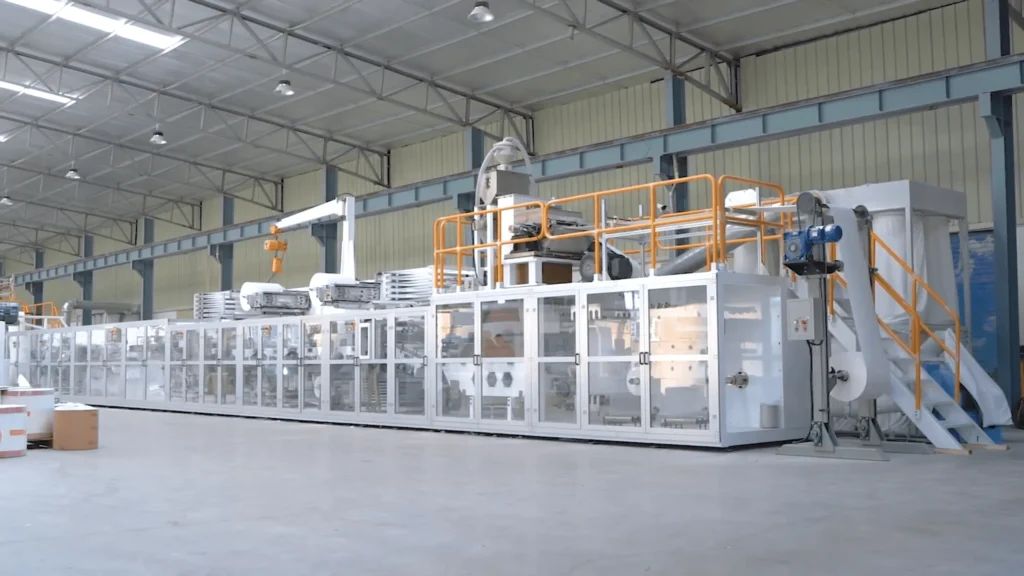
Both builds live or die on core consistency. The forming drum lays down fluff pulp and the SAP is metered into it, and the tolerance on that dosing determines whether pad number 400,000 performs like pad number one.
Under-dose and you get complaints. Over-dose and you have quietly given away margin on every pad — at high volume, a few grams of unnecessary fluff per pad becomes a significant annual number. More importantly, dosing drift is gradual, so nobody catches it on a spot check.
This is the argument for paying attention to the forming section rather than the layer count. A well-controlled 3-layer core beats a loosely controlled 5-layer core on both performance and cost.
Embossing and lamination
Embossing bonds the layers and gives the pad its surface texture. On a 3-layer pad the settings are relatively forgiving because there is less material in the stack.
Add layers and the window tightens. Too little pressure and the layers separate in the pack. Too much and you compress the acquisition layer, which defeats the reason for adding it. The pad then tests worse than the 3-layer version it replaced, and the fault gets blamed on the design rather than the setting.
Cutting and stacking
A thicker pad is harder to cut cleanly and harder to stack squarely. Neither is a design flaw; both are things to plan for.
Blade wear on a 5-layer line progresses faster simply because there is more material per cut. If you move from a 3-layer product to a 5-layer product on the same site and keep the old maintenance interval, the first sign is usually a fibrous edge that the packing station starts rejecting.
Footprint and power are closer than you would expect
Here is a result that surprises most buyers. Both lines are specified at 380V 50Hz / 220KW. The extra layers do not bring a step change in power draw.
The footprint difference is a shape difference rather than a size difference. The 3-layer machine is listed at 35 × 4 × 3 m — long and narrow. The 5-layer machine is 28.0 × 7.0 × 3.5 m — shorter but nearly twice as wide, and half a metre taller. Working space is quoted at 40 × 12 × 5 m and 39 × 9 × 5 m respectively.
Check the shape against your building, not just the area. The constraint frequently turns out to be a column spacing or a door width rather than total floor area, and that tends to come to light only after the deposit.
Which line fits which buyer
| If your situation is… | The sensible starting point | Why |
|---|---|---|
| New factory, single product, volume-led market | 3-layer | Simpler forming, more forgiving embossing window, lower operator skill requirement |
| Supplying pet retail brands on price | 3-layer | Shelf appeal is driven by pack and print more than by internal structure |
| Hospital-grade or premium positioning | 5-layer | Surface dryness and rewet performance are specified and inspected |
| Mixed portfolio, some premium SKUs | 5-layer | A 5-layer line can run simpler builds; a 3-layer line cannot add layers |
| Building height under 4 m | Check first | The 5-layer machine is 3.5 m tall with 5 m working space quoted |
That last row is not a joke. It has decided more than one of these projects.
The misconception that costs money
I believe the most expensive assumption in this category is that layer count is a proxy for quality, and therefore that buying the higher number is the safe choice.
It is not a safe choice, it is a more expensive choice with a narrower operating window. The 5-layer line asks more of your operators, your maintenance schedule and your material consistency. If your team is already stretched running a single product, adding layers adds failure modes rather than performance.
The buyers who get this right tend to work backwards. They start from what their end customer inspects — is it total absorbency, or is it surface dryness after twenty minutes? — and let that decide the build. The layer count comes out as a result, not as a starting requirement.
Choosing without a spec sheet in front of you
If you cannot get comparable samples, three questions will get you most of the way.
- What is the target core weight per pad, and can the supplier hold it to a stated tolerance across a full shift?
- Does your end customer test rewet, or only total absorption? Only the first justifies separated layers.
- How many products will this line run in a year? A single long-running SKU rarely needs the flexibility of the more complex build.
Why Welldone
Welldone has manufactured hygiene converting equipment in Jinjiang, Fujian since 2008, incorporated in 2013, supplying baby care, female care, adult care and pet care lines to factories across Asia, Africa, the Middle East and Latin America.
Both builds, one platform
3-layer and 5-layer configurations share engineering and support, so the choice is a specification decision rather than a change of supplier.
Honest speed figures
Design and stable speeds are quoted separately, with the passing rate stated at ≥98% excluding glue applicator and auto splicing.
Engineering support
Commissioning, operator training and remote diagnostics from the team that builds the line, not a subcontracted installer.
Related machines
Conclusion
Three layers or five is the wrong opening question. The useful one is what your end customer actually measures, because that determines whether separated acquisition and distribution layers are doing paid work or just adding cost and complexity.
Get samples at matched core weights. Convert both speed figures onto one basis using your own pad size. Check the machine shape against your building before you check the price.
Then ask yourself the question that decides it: if a customer complained tomorrow, would they be complaining that the pad did not hold enough, or that it felt wet on the surface? Those two complaints point at different machines.
Frequently asked questions
Does a 5-layer pad absorb more than a 3-layer pad?
Not automatically. Total capacity is driven by fluff pulp weight and SAP quantity in the core, not by how many layers the structure is divided into. A 5-layer pad usually performs better on surface dryness and rewet, which is a different property from total absorption.
Why is one line quoted in pcs/min and the other in m/min?
The 3-layer line is specified at 300 pcs/min design and 200–250 pcs/min stable; the 5-layer line at 250 m/min design and 200–240 m/min stable. Converting between them requires your pad length. Always restate both on one basis before comparing.
Can a 5-layer machine also produce 3-layer pads?
Running a simpler build on a more capable line is generally possible, but confirm the specific configuration with the engineering team before assuming it. The reverse is not possible — a 3-layer line cannot add layers it was not built for.
Do the two lines need different building space?
The shape differs more than the area. The 3-layer machine is 35 × 4 × 3 m; the 5-layer machine is 28.0 × 7.0 × 3.5 m. Quoted working space is 40 × 12 × 5 m and 39 × 9 × 5 m respectively. Both are specified at 380V 50Hz / 220KW.
Which build suits pet training pads?
Both are used for pet pads. The 3-layer page lists disposable underpads and pet training pads; the 5-layer page targets premium pet pads alongside hospital-grade products. Our comparison of pet pee pads and hospital under-pads covers why the same pad sells very differently into those two channels.
Not sure which build your market needs?
Send us your target pad size, core weight and what your end customer inspects. We will tell you honestly whether the extra layers are worth paying for in your case.
Website: www.cnwelldone.com
Email: welldone@cnwelldone.com