Under-Pad Export Compliance: EU MDR, GCC, and Africa Paths

On August 10, 2026
Comments Off on Under-Pad Export Compliance: EU MDR, GCC, and Africa Paths
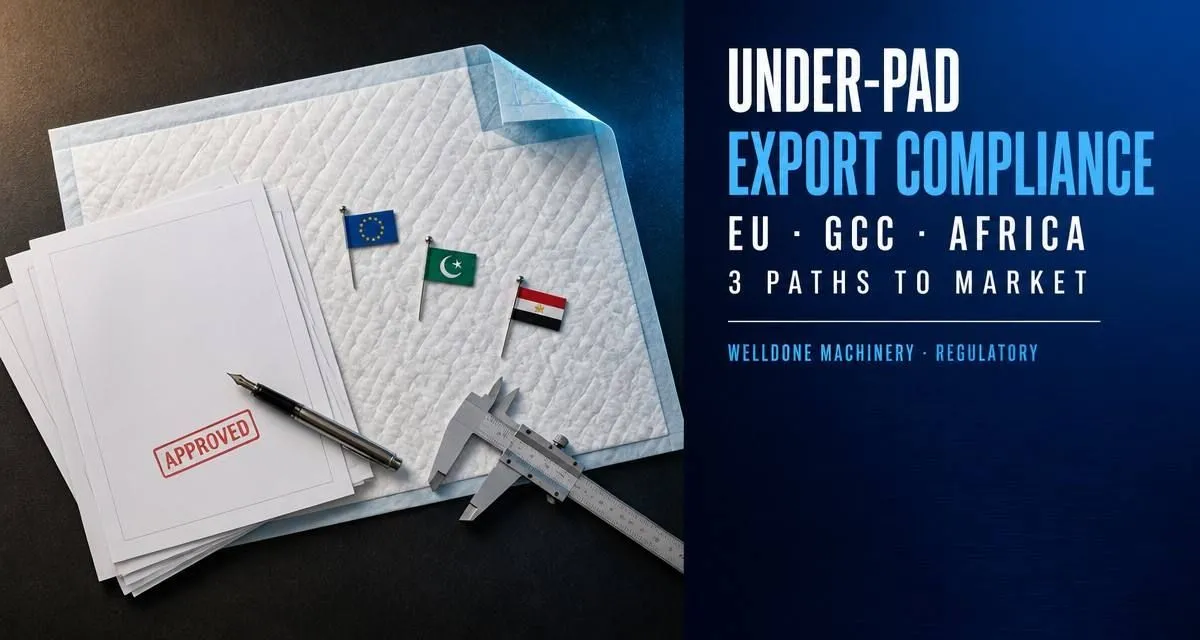
Selling Under-Pads into Europe or GCC? The Compliance Path Nobody Tells You at the Machine Quotation Stage
CE marking, ISO 13485, GCC registration — three compliance requirements that most under-pad manufacturers discover six months after they have started production, when the first export shipment hits a customs hold or a distributor rejects the documentation. This article is the compliance map to read before the machine ships, not after.
Parts 1 and 2 of this series covered the CAPEX decision between under-pads and pull-ups, and the structural specification that determines whether hospital or nursing home procurement will accept your product. This is Part 3 — the compliance layer that sits above both. You can build the right machine, configure the right layer count, and still not be able to sell the product in the market you are targeting if the regulatory documentation was not planned from the start.
1 · The Turkey shipment that sat in Hamburg for six weeks
A Turkish disposable under-pad manufacturer had done everything right on the production side. Good 5-layer construction, ADL present, SAP variance within ±3%, clean packaging. They signed a supply agreement with a German medical distributor and shipped 40 pallets.
The shipment was held at Hamburg customs for six weeks.
The CE mark on the packaging was not wrong — it was the wrong type of CE mark. The manufacturer had self-declared conformity under the General Product Safety Directive. The distributor's import compliance team required CE marking under EU MDR 2017/745 — a medical device declaration backed by a formal technical file, clinical evaluation, and an EU Authorized Representative on the conformity declaration.
The shipment was released after six weeks of documentation rebuild — urgent consultant fees, EU Authorized Representative emergency appointment, and a storage cost the manufacturer had not budgeted for. The distributor waived the penalty clause on the first offense. There is rarely a second offense opportunity with a European medical distributor.
The compliance timeline for that technical file should have started eight months before the machine was ordered. It started six months after the machine shipped. That is the gap this article is written to close.
2 · Why under-pads are medical devices in export markets
In China, disposable under-pads are classified as general hygiene products and regulated accordingly. In Europe, GCC, and much of North Africa, the regulatory classification is different — and it matters enormously for what documentation you need before the first shipment leaves the factory.
The classification logic in most markets is: if a disposable product is intended to manage the consequences of a medical condition (urinary or fecal incontinence), and if it makes contact with the human body or controls exposure to body fluids, it falls under medical device or at minimum medical-adjacent regulation. Under-pads used in hospital and elder-care settings are typically sold with efficacy claims — absorbency volume, rewet performance, strike-through resistance — and those claims trigger regulatory scrutiny.
The specific classification tier (Class I, Class II, general hygiene) determines the documentation burden. But in all three target markets, the minimum bar for institutional and medical channel supply is substantially higher than the Chinese general hygiene product standard that most under-pad manufacturers have been producing to.
3 · EU market: CE marking under MDR 2017/745
Classification
Disposable under-pads for medical use fall under EU MDR 2017/745. Most configurations — absorbent bedding protection for incontinence management — are classified as Class I medical devices (non-sterile, no measuring function). This is the lowest regulatory tier, and it allows self-declaration without a Notified Body. But "self-declaration" in EU MDR is not a stamp on a box — it is a formal process with specific documentary requirements.
Required documentation for CE marking (Class I under MDR)
- Technical File: product description, intended purpose, design and manufacturing information, risk management per ISO 14971, clinical evaluation report, post-market surveillance plan, and labeling documentation
- Clinical Evaluation Report (CER): evidence that the product performs as claimed — typically sourced from published literature on comparable products, plus your own performance testing data
- EU Declaration of Conformity (DoC): signed by the manufacturer's EU Authorized Representative
- EU Authorized Representative (EUAR): a legal entity established in an EU member state who acts as the responsible party for the product in the EU market — mandatory for non-EU manufacturers
- QMS baseline: ISO 13485 certification is not legally mandated for Class I under MDR, but in practice most EU distributors and healthcare system procurement require it as a supplier qualification prerequisite
MDR transition timeline: EU MDR 2017/745 has been phased in with staggered deadlines. As of 2026, Class I devices must comply with MDR for new products entering the EU market. Legacy IVDR-marked products under MDD 93/42/EEC have extended sell-through periods in some categories, but new supply agreements with EU distributors will specify MDR compliance. Do not assume your MDD-era CE marking covers a new product launched for a new distributor relationship.
Realistic timeline to first shipment
For a new under-pad manufacturer entering the EU market from scratch:
- Technical file preparation: 3-4 months (with consultant support)
- Clinical evaluation report: 2-3 months (concurrent with technical file)
- EU Authorized Representative appointment: 1-2 months
- ISO 13485 certification (if starting from scratch): 8-14 months
Realistic minimum from project start to first compliant shipment: 6-9 months if ISO 13485 is already in place; 14-20 months if ISO 13485 is not.
4 · GCC market: SFDA, MoH, and country-by-country registration
The GCC is not a single regulatory zone for medical devices. Each member state maintains its own registration system, and an under-pad registered in Saudi Arabia is not automatically registered in the UAE or Kuwait. That said, the frameworks are increasingly harmonized around the GSO (Gulf Standardization Organization) technical regulations.
| Country | Regulatory body | Registration required | ISO 13485 required | Typical timeline |
|---|---|---|---|---|
| Saudi Arabia | SFDA (Saudi FDA) | Yes — product registration + establishment license | Yes, mandatory | 8-14 months |
| UAE | MoH + DOH (Abu Dhabi) + DHA (Dubai) | Yes — federal + emirate-level | Yes, strongly preferred | 6-10 months |
| Kuwait | Ministry of Health | Yes — via local agent | Yes | 8-12 months |
| Qatar | Ministry of Public Health | Yes | Preferred | 6-10 months |
| Oman | Ministry of Health | Yes — via registered local agent | Preferred | 6-9 months |
The GCC registration dossier typically mirrors the EU technical file structure — product description, performance data, labeling, and QMS documentation. Saudi SFDA specifically requires ISO 13485 certification from an accredited body. UAE MoH registration increasingly aligns with SFDA requirements as the two systems harmonize under the Gulf Health Council framework.
The practical implication: a manufacturer targeting both EU and GCC markets should build the EU MDR technical file first, then use it as the basis for GCC dossier submissions. The documentation investment is largely shared; the registration timelines run in parallel.
5 · North Africa: Egypt EDA, Morocco, and the EU MDR shadow
Egypt
The Egyptian Drug Authority (EDA) — previously CAPA — expanded its medical device jurisdiction in 2022 and accelerated enforcement through 2024-2025. Disposable under-pads for hospital and institutional use now require EDA product registration for formal institutional channel supply. Registration requires an Egyptian importer of record, a product dossier, and increasingly, evidence of CE marking or equivalent international registration as a baseline quality indicator.
Timeline: 6-12 months for new registrations. EDA enforcement is still inconsistent in the retail channel, but hospital procurement and Ministry of Health tenders now verify EDA registration status.
Morocco
Morocco's medical device regulatory framework is under the Ministry of Health and aligns closely with EU standards as part of the EU-Morocco Association Agreement. For hospital tender qualification, CE marking is effectively required — Moroccan hospital procurement committees routinely request EU DoC documentation as part of tender pre-qualification. No separate national registration is required for CE-marked products in most procurement contexts, but this is evolving.
6 · ISO 13485: the QMS baseline all three markets require
ISO 13485 is the quality management system standard specific to medical device manufacturing. It is not the same as ISO 9001 — the additional requirements cover design control, risk management integration, post-market surveillance, and traceability to a level that general manufacturing QMS does not address.
For under-pad manufacturers targeting export markets, ISO 13485 is effectively a prerequisite — not because every market legally mandates it, but because every serious distributor and procurement body uses it as a supplier qualification filter. A manufacturer without ISO 13485 certification will not be shortlisted for hospital tender supply in Saudi Arabia, will not be accepted as a new supplier by a German medical distributor, and will not be able to submit a credible technical file for EU MDR conformity.
ISO 13485 implementation timeline
For a manufacturer starting from a general manufacturing QMS (ISO 9001 or equivalent):
- Gap analysis and project scoping: 1-2 months
- QMS documentation development: 3-5 months
- Internal audit and management review cycle: 2-3 months
- Stage 1 and Stage 2 certification audit: 2-3 months
- Certificate issuance: 1 month
Total: 9-14 months from project start, assuming no significant findings during the certification audit that require corrective action cycles. For manufacturers starting with no QMS at all, add 3-4 months to the documentation phase.
The uncomfortable arithmetic: if you order an under-pad machine today and it ships in 90 days, and you start the ISO 13485 project the day the machine arrives, your ISO certificate will arrive roughly 12-15 months after the machine starts producing. That is 12-15 months of production that cannot be legally supplied to hospital or EU-channel buyers under their procurement requirements. Plan the compliance project in parallel with — or before — the machine order, not after the machine starts running.
7 · The compliance timeline vs the production timeline
| Milestone | Typical timing | Parallel or sequential? |
|---|---|---|
| Machine order placed | Month 0 | — |
| Machine delivery | Month 3-4 | — |
| ISO 13485 project start | Month 0 (parallel) | Must run parallel with machine build |
| ISO 13485 certificate issued | Month 9-14 | Parallel — ideally complete before first shipment |
| EU technical file complete | Month 6-10 | Parallel — can use pre-production samples |
| GCC registration submitted | Month 6-8 | Parallel with EU technical file |
| First compliant EU shipment | Month 9-14 | After ISO 13485 + EU DoC complete |
| First compliant GCC shipment (Saudi) | Month 14-18 | After SFDA registration complete |
The table above assumes compliance work starts at the same time as the machine order. If compliance work starts when the machine is delivered, add 3-4 months to every downstream milestone. If it starts when the machine is already running and producing non-compliant inventory, add the cost of that inventory sitting in a warehouse to the budget.
8 · Why Welldone Machinery for export-ready under-pad production
Welldone Machinery ships under-pad lines with production documentation packages designed to support ISO 13485 QMS implementation — including device history record templates, equipment qualification protocols (IQ/OQ/PQ), and process validation frameworks compatible with EU MDR technical file requirements.
01 · IQ/OQ/PQ DOCUMENTATION
Equipment qualification package
Installation Qualification, Operational Qualification, and Performance Qualification protocols shipped with every line — the documentation backbone of an ISO 13485-compliant process validation file.
02 · PRODUCTION TRACEABILITY
Batch record and device history support
HMI logging architecture supports batch-level production records including SAP dosing data, web tension logs, and rejection events — the traceability data EU and GCC technical files require.
03 · COMPLIANCE PARTNER NETWORK
Regulatory consultant referrals on request
We maintain referral relationships with EU MDR technical file consultants and ISO 13485 certification bodies experienced in hygiene product manufacturing. Available on request at quotation stage — before the machine ships.
📚 The complete under-pad series
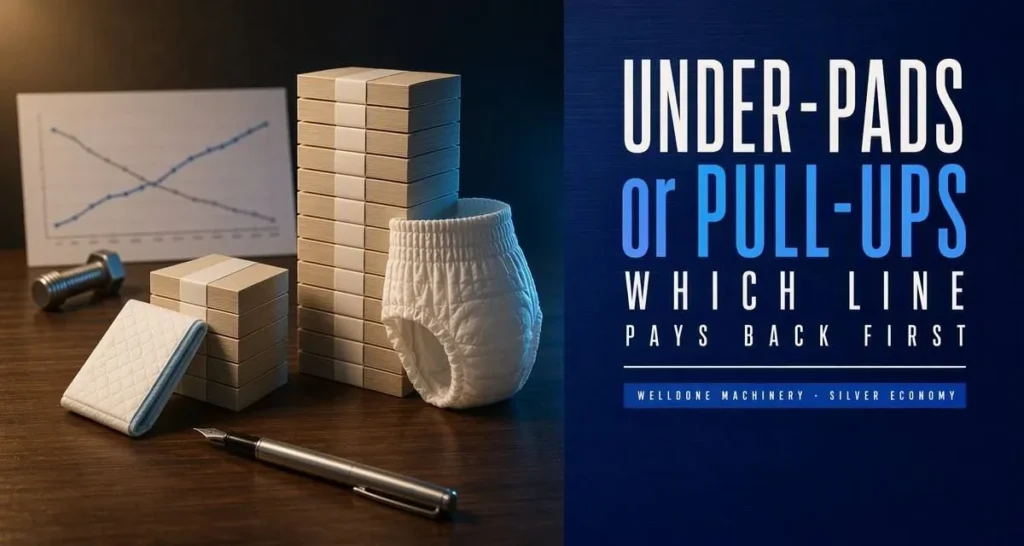
Part 1 — Under-Pads or Pull-Ups: Which Line Pays Back First
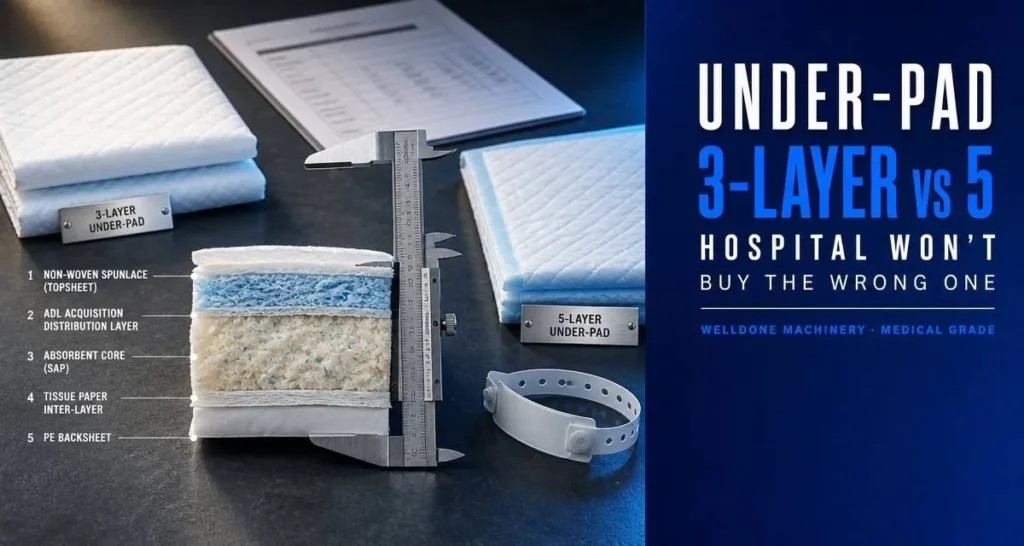
Part 2 — 3-Layer vs 5-Layer Under-Pads: What Hospitals Actually Buy
Part 3 — You are here.
9 · Related Welldone adult care machinery
Disposable under-pad machine
3-layer and 5-layer configurations with IQ/OQ/PQ documentation and ISO 13485-compatible production traceability architecture.
View under-pad machine →Adult pull-up diaper machine
Full servo adult pull-up line 300-600 pcs/min. Same compliance documentation architecture — EU MDR technical file support available for export market entry.
View adult pull-up line →Open-type adult diaper machine
Tape-type adult diaper for medical and institutional channels. CE marking and GCC registration pathways follow the same framework as under-pad compliance.
View open-type line →Sanitary napkin machine (S3 / S5)
Full-servo sanitary napkin lines for Female Care. EU market entry for sanitary napkins follows cosmetic product regulation — different compliance path from under-pads.
View sanitary napkin line →Baby diaper machine (T-shape)
T-shape baby diaper with tapes. Baby diapers in EU are classified as cosmetics — a different compliance pathway from adult incontinence products targeting medical channel.
View baby diaper line →3-piece pull-up baby diaper machine
High-speed 3-piece baby pull-up line. ISO 13485 QMS implemented for under-pad production is fully applicable to baby diaper manufacturing if expanding into regulated export markets.
View baby pull-up line →10 · Conclusion — closing the under-pad series
Across three articles this series has walked the complete under-pad investment decision: which line to build first against your actual day-one demand (Part 1), which structural configuration your target buyer channel will accept (Part 2), and which compliance path to start before the machine ships (this article).
The thread running through all three is identical to the one running through every hygiene machinery investment: the decisions that determine commercial success are made before the machine is ordered, not after it starts running. Layer count, buyer channel, and compliance timeline are all machine-order-stage decisions. They cannot be corrected cheaply once production has started.
An open question to close the series: if you are planning an under-pad line for export to Europe or GCC, write down today's date. Then write the date your ISO 13485 project needs to start for the certificate to arrive before your first target shipment. If that date is already in the past, the compliance project is already behind the production timeline.
11 · Frequently asked questions
Do I need a Notified Body for CE marking of a Class I under-pad?
No — Class I medical devices under EU MDR 2017/745 are self-declared. You do not need a Notified Body audit or certificate. However, you must maintain a complete technical file, appoint an EU Authorized Representative, register the device in EUDAMED (the EU medical device database), and issue a formal Declaration of Conformity. "Self-declaration" is a regulatory term, not an invitation to skip documentation.
Can I use the same technical file for both EU and GCC registration?
The core documentation is largely shared — product description, performance testing data, risk management, labeling, and QMS evidence. The EU MDR technical file is the most comprehensive structure, so building it first gives you a foundation for GCC dossier submissions. Each country's registration system will require market-specific additions (local language labeling, country-specific conformity declarations, local agent documentation), but the technical substance is the same.
What performance tests does the EU technical file require for an under-pad?
The clinical evaluation must be supported by performance data relevant to the intended purpose claims. For under-pads, this typically includes: total absorbent capacity (grams), surface rewet (grams), fluid acquisition time, strike-through resistance, and dimensional stability under load. These tests can be conducted by your own QC laboratory if properly calibrated and documented, or by an accredited third-party testing laboratory for stronger evidential weight in the clinical evaluation.
How long does Saudi SFDA registration take for a new under-pad product?
SFDA registration for a new foreign manufacturer and new product typically takes 10-16 months from first submission to registration certificate. The process involves: establishment license application for the foreign manufacturer (3-4 months), product registration dossier submission and review (6-10 months), and potential query response rounds. Working with a Saudi registered local agent who has prior SFDA relationship shortens the timeline by 2-4 months on average.
Can Welldone Machinery provide the IQ/OQ/PQ documentation needed for the ISO 13485 technical file?
Yes. Every under-pad line from Welldone Machinery ships with Installation Qualification (IQ), Operational Qualification (OQ), and Performance Qualification (PQ) protocol templates specific to the equipment. These protocols cover the critical process parameters relevant to under-pad manufacturing — SAP dosing precision, web tension, lamination temperature, and cut-and-seal integrity — in a format compatible with ISO 13485 process validation requirements. Contact us at quotation stage to confirm the documentation package for your specific line configuration.
Planning an under-pad line for EU or GCC export — or already producing and not yet compliant?
Send us your target export market and your current QMS status. We return a compliance timeline mapped against the machine delivery schedule, the documentation gaps to close, and a referral to a regulatory consultant experienced in hygiene product EU MDR and GCC registration — so the compliance clock starts at the right time, not six months late.
Frank Yang — Welldone Machinery. Frank has spent 15+ years auditing hygiene machinery installations across Europe, the Middle East, and Asia. He writes about what specifications actually matter in the field, not what looks good on a datasheet.