
Silicone Release Paper & Sanitary Pad Line Guide | Welldone

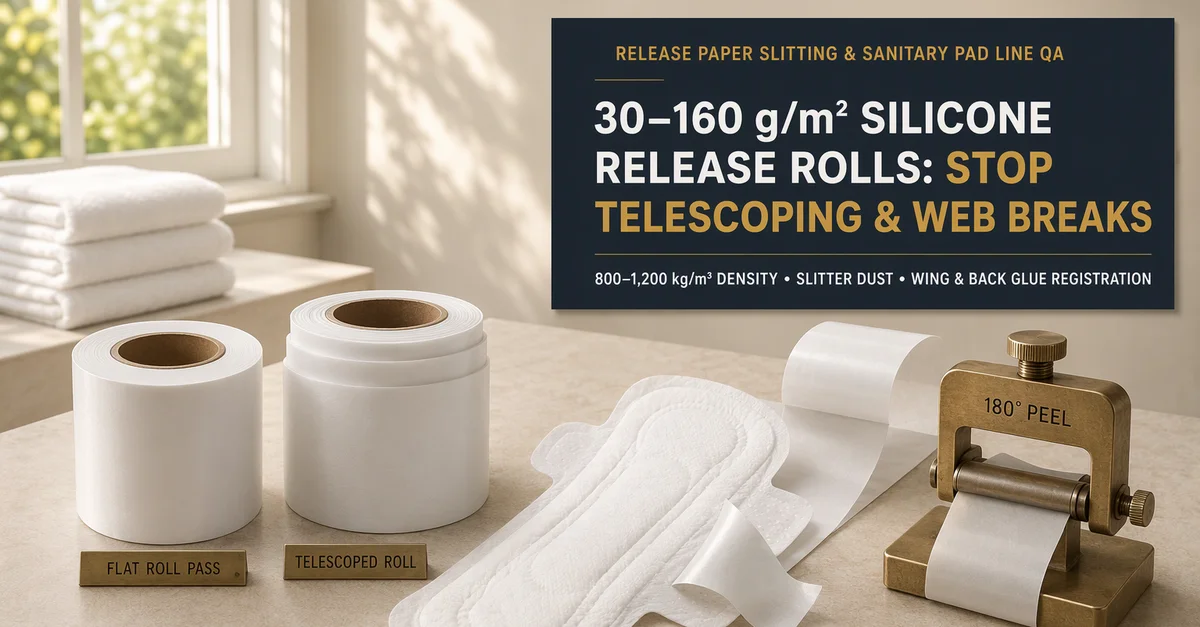
30–160 g/m² Silicone Release Rolls: Qualify Sanitary Pad Lines
When a high-speed sanitary pad or panty liner line suffers frequent web breaks, exposed positioning glue, or crooked wing release strips at 1,000 to 1,200 pieces per minute, plant teams often blame servo unwinder tension loops first. Yet November 2026 specialty paper rewinding benchmarks from Italy's Cartiera Ermolli and De Iuliis confirm that silicone-coated and PE-coated papers are slippery, air-entraining webs whose roll density (800–1,200 kg/m³), telescoping stability, flatness, and slitter-dust control are fixed at the upstream winder before reaching the factory floor.
1. What Cartiera Ermolli's November 2026 Flexi Wind Upgrade and Ahlstrom's Release Paper Launch Reveal
On November 10, 2026, PulPaperNews reported that Italian specialty paper mill Cartiera Ermolli installed a Flexi Wind slitter-rewinder built by De Iuliis C. & A. S.p.A. to strengthen finished-roll quality and format flexibility across coated, PE-coated, and silicone-coated release grades. Cross-checking the November 10, 2026 report with De Iuliis's technical specification, Cartiera Ermolli's mill disclosures, and the November 9, 2026 Ahlstrom × Solventum release-paper announcement confirms five developments:
- High wound-roll density (800–1,200 kg/m³) across 30–160 g/m² slippery silicone and PE-coated grades: At Cartiera Ermolli, web tension control, rider-roll pressure management, and automatic front-to-rear drum torque control handle basis weights from 30 to 160 g/m² and achieve wound-roll densities of 800 to 1,200 kg/m³ on silicone-coated release papers, gloss-coated papers, and PE-coated papers.
- Real-time CD/MD oscillation against telescoping and lightweight bagginess: Because lightweight release base papers are sensitive to tension variations and flatness (bagginess) defects, the unwind and rewind units integrate cross-direction (CD) and machine-direction (MD) control with an oscillation function that corrects parent-reel defects in real time and prevents telescoping.
- Boundary-layer air-flow management at 2,200 m/min: The Cartiera Ermolli winder operates at up to 2,200 m/min with field-verified acceleration above 0.67 m/s² (reaching 2,200 m/min from standstill in under 60 seconds). Dedicated aerodynamic channelling evacuates the boundary-layer air entrained by the moving web so trapped air cushions cannot destabilize slippery silicone layers.
- Slitter-knife usage timer, reground-knife HMI compensation, and fast single-operator cycles: Software tracks the operating hours of every top and bottom knife, indicates when regrinding or replacement is due, and updates settings on the HMI when reground knife dimensions are entered. Single-operator cycles complete twin reel change in 180 seconds, empty spool unloading in 30 seconds, parent reel loading in 200 seconds, and slitter repositioning in an average of 40 seconds, alongside an automatic core loader accepting multiple inside and outside core diameters.
- Ahlstrom & Solventum's Acti-V® BIO controlled-bioburden release paper (November 9, 2026): Ahlstrom announced Acti-V® BIO, developed with Solventum to expand its cellulose-based Acti-V® release base paper platform (which includes Acti-V Industrial RF Natural) for pressure-sensitive adhesive (PSA) healthcare products requiring pre-sterilization microbial load control—such as wound dressings, transdermal patches, surgical tapes, and wearable diagnostic devices.
2. Evidence Boundary & Source Parameter Reconciliation: Verified News vs. Converting Line Analysis
To support accurate procurement decisions, this guide separates source-confirmed facts, cross-source parameter differences, and Welldone's sanitary pad machinery analysis:
Three-Tier Fact & Engineering Boundary:
- Source-Confirmed Facts: Cartiera Ermolli's De Iuliis Flexi Wind installation reported on November 10, 2026 (2,200 m/min speed, >0.67 m/s² acceleration under 60 s, 30–160 g/m² basis weight, 800–1,200 kg/m³ density, 180 s twin reel change, 30 s spool unload, 200 s parent reel load, 40 s slitter repositioning, CD/MD oscillation against telescoping and bagginess, boundary-layer air channelling, slitter knife timer with HMI reground-knife compensation, and multi-diameter core loader); De Iuliis's general Flexi Wind catalog (up to 2,500 m/min, 3,000 mm parent roll, 2,000 mm finished roll, low-dust slitting); Cartiera Ermolli's mill portfolio (since 1922 in northern Friuli, 20–150 g/m² papers); and Ahlstrom's November 9, 2026 Acti-V® BIO release with Solventum.
- Cross-Source Parameter Differences Disclosed (Not Merged): Two numerical ranges differ by scope across the primary sources and are preserved side by side: (a) Speed: the Cartiera Ermolli winder is rated at 2,200 m/min in the November 10, 2026 report, whereas De Iuliis's general Flexi Wind catalog lists up to 2,500 m/min; (b) Basis weight: the Cartiera Ermolli Flexi Wind winder covers 30 to 160 g/m², whereas Cartiera Ermolli's corporate website lists 20 to 150 g/m².
- Welldone Engineering & Supply Chain Analysis: All evaluations linking incoming release roll density, telescoping, bagginess, and slitter dust to unwinders, rotary applicators, wing die-cutters, and individual wrappers on sanitary pad production lines represent Welldone's independent engineering guidance. Welldone was not involved in the Cartiera Ermolli, De Iuliis, Ahlstrom, or Solventum projects.
- Illustrative Examples Only: Tolerances and checkpoints marked Illustrative example only serve as reference templates to calibrate against your release liner TDS and hot-melt adhesive grades.
3. Inside the 7-Layer Sanitary Pad Adhesive & Release Liner Architecture
On a winged sanitary napkin, panty liner, or bar-type pad line running at 1,000 to 1,200 pieces per minute, release paper is a multi-zone functional carrier that protects hot-melt pressure-sensitive adhesive (PSA) zones during rotary cutting, folding, and individual sachet wrapping—and then must peel cleanly in the consumer's hand without tearing or leaving adhesive residue.
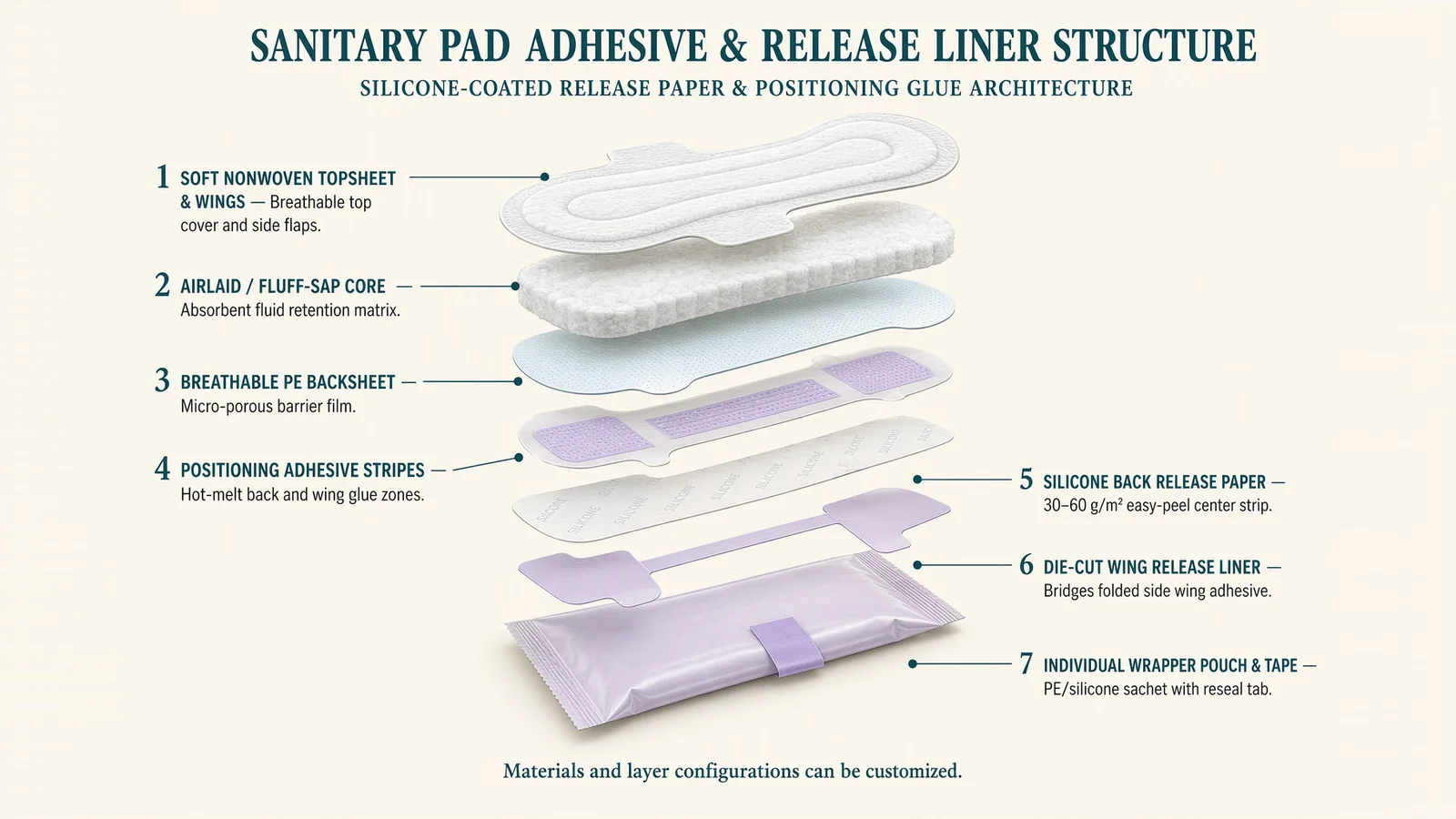
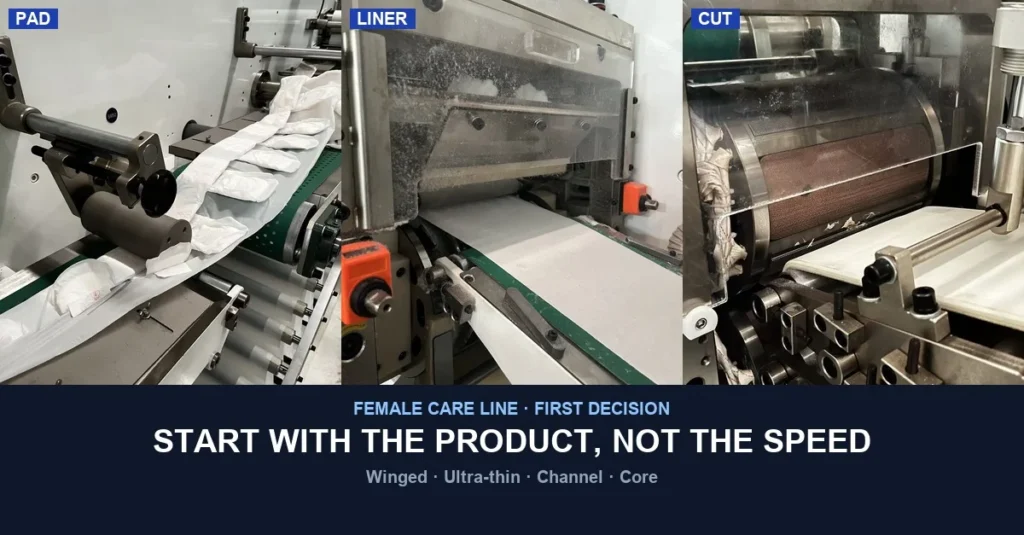
Examining the seven functional layers in Figure 1 clarifies why upstream slitting and winding defects disrupt high-speed converting across full-servo sanitary pad machines and panty liner machines:
- Layer 1 — Soft Nonwoven Topsheet & Side Wing Extensions: Hydrophilic nonwoven or perforated film topsheet extending laterally to form foldable side wings.
- Layer 2 — Airlaid / Fluff-SAP Absorbent Core Matrix: Embossed fluff-SAP or airlaid composite core defining pad caliper and tri-fold stiffness.
- Layer 3 — Breathable Micro-Porous PE / Nonwoven Backsheet Film: Thin barrier film (18–25 g/m², Illustrative example only) carrying the underside positioning adhesive.
- Layer 4 — Hot-Melt Positioning & Wing Adhesive Stripes: Slot-coated or spiral-sprayed PSA glue zones on the center backsheet and lateral wing tabs.
- Layer 5 — Silicone-Coated Back Release Paper (30–60 g/m²): Silicone-coated glassine or supercalendered kraft strip laminated over the center backsheet glue, sitting at the lightweight lower end of the 30–160 g/m² Flexi Wind range.
- Layer 6 — Die-Cut Wing Release Liner Strip: Narrow silicone-coated release strip—or bridge liner—protecting the folded wing adhesive tabs.
- Layer 7 — Individual PE / Silicone-Treated Wrapper Pouch & Easy-Tape Tab: Outer wrapper film that, on fast & easy-pack lines, pulls the back release liner off automatically when the consumer opens the pouch.
4. Four Upstream Winding & Slitting Defects That Trigger Sanitary Pad Line Stops
The real question is why a silicone-coated release paper roll that passes basic basis-weight and silicone coat-weight lab checks still snaps or wanders when unwound at 1,000 to 1,200 pads per minute. The Cartiera Ermolli / De Iuliis benchmark highlights four upstream mechanisms that drive converting stops:
How Upstream Winder Physics Govern Downstream Sanitary Pad Converting
Map each papermill winding parameter from the November 2026 Flexi Wind benchmark to its failure mode on a sanitary pad or panty liner line:
1. Boundary Air & Roll Telescoping
Silicone liners have an ultra-low coefficient of friction (COF). If boundary-layer air is trapped or roll density drops below 800–1,200 kg/m³, wraps slide axially during braking—shifting the liner 1.5–4.0 mm off the glue stripe.
2. Lightweight Bagginess (30–45 g/m²)
Lightweight 30–45 g/m² base papers are sensitive to cross-direction caliper and moisture streaks. Without real-time CD/MD oscillation, one edge winds tighter, creating a slack "baggy" edge that folds into diagonal creases in the nip.
3. Dull Slitter Knives & Paper Dust
When slitter blades exceed service life or reground diameters are uncompensated on the HMI, shear slitting turns into micro-crushing—leaving edge nicks that cause breaks and dust that fouls glue stripes and sensors.
A fourth factor is core tolerance and chuck seating: narrow wing release rolls (25–45 mm wide, Illustrative example only) wound on eccentric cores generate cyclic tension spikes every spindle revolution.
5. Wing Release Paper Unwinding, Festoon Buffering & Zero-Speed Splicing Under Low COF
On a winged sanitary napkin machine, the narrow wing release paper unwinder is most sensitive to roll telescoping and slitter nicks because its breaking force is modest while interlayer slip is high.

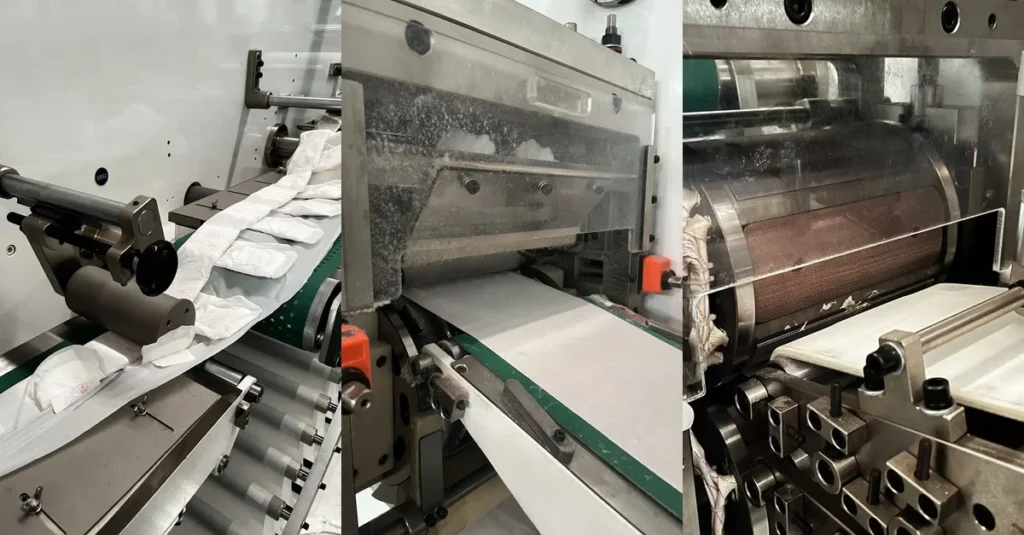
As shown in Figure 2, Welldone configures the wing release paper feeding module (Station C4) to protect narrow-slit silicone rolls:
- Dual-spindle A/B chuck rigidity and axial alignment: Expanding pneumatic spindles lock cardboard cores concentrically and align Spindle A with Spindle B so flat rolls feed into the exact same centerline plane.
- Multi-roller festoon accumulator for zero-speed splicing: During an automatic splice at 1,000–1,200 pcs/min, the central splicing head clamps both webs at zero speed while the line draws stored web from the dancer festoon rollers on the left of Figure 2. Rolls wound below 800–1,200 kg/m³ or containing trapped air dish sideways under splice deceleration.
- Closed-loop low-inertia dancer tension control: Servo unwind motors adjust braking torque continuously as roll diameter decreases, preventing tension overshoot from snapping slit edges.
6. Back Release Paper Rotary Application, Glue Registration & Dust Control
A common mistake is blaming the hot-melt adhesive supplier when back release paper lifts at the corners or leaves exposed glue along the pad edge. Once positioning glue is slot-coated onto the breathable PE backsheet, the back release paper must be registered, cut to pitch, and pressed onto the warm adhesive within a sub-millimeter window.

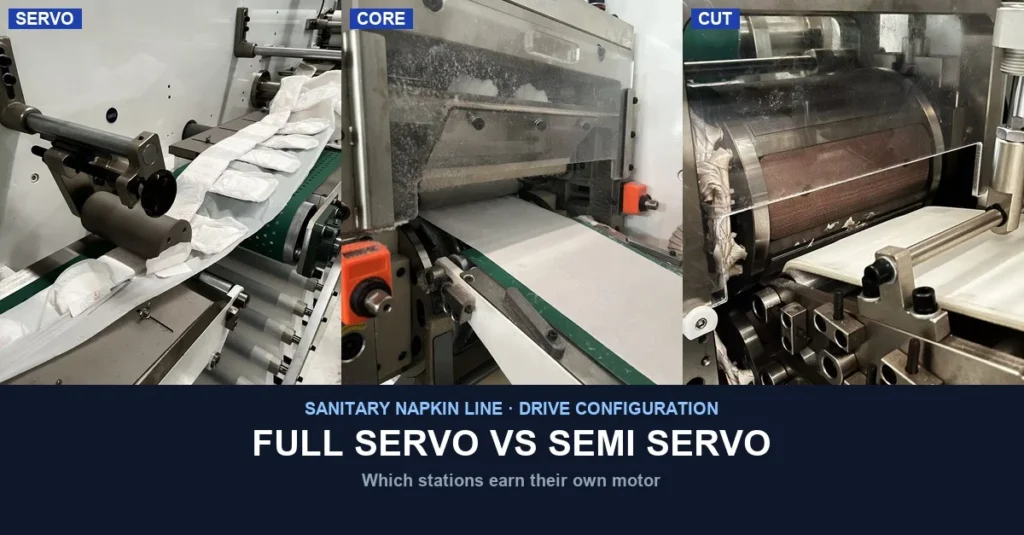
Figure 3 shows the rotary back release paper applicator assembly (Station SM29) above the main vacuum conveyor on Welldone's sanitary napkin line:
- Perforated vacuum transfer drum & compliant pressure roller: The perforated stainless-steel drum holds each cut release segment flat while the compliant roller applies regulated pneumatic pressure across the glue stripe. A slack "baggy" edge forms micro-pleats under the roller and traps unbonded air channels.
- Why +/-0.5 mm roll edge flatness prevents glue bleed-out: On sanitary pads (>180 mm) and panty liners (<180 mm), the back release strip is only slightly wider than the glue zone. If a telescoped roll wanders beyond +/-1.0 mm, exposed adhesive fouls guide plates and vacuum belts.
- Slitter-dust mitigation at the adhesive nip: Fiber dust from dull winder knives accumulates on the yellow compliant roller and vacuum holes in Figure 3, blinding sensors and weakening adhesive tack on underwear fabric.
7. Wing Folding, Individual Pouch Wrapping & Easy-Tape Reseal Synchronization
Release-liner engineering extends into final folding and individual pouch wrapping. As confirmed on Welldone's sanitary pad machine page, lines support fast & easy-pack formats (wrapper film and release liner peel open together) or strip packaging styles.

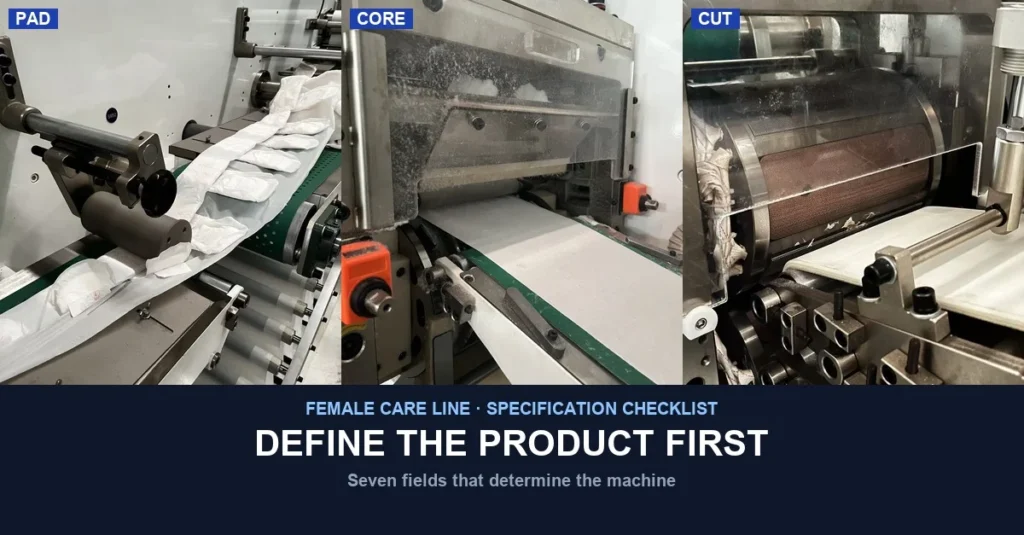
In most cases, consumers judge sanitary pad quality during the first three seconds of opening the pouch: if the easy-tape tab rips the wrapper or the back release paper fails to lift with the wrapper film, complaints follow immediately. Station SM52 in Figure 4 governs three interfaces:
- Balanced differential release force (wrapper vs. backsheet glue): In fast & easy-pack designs, the bond between the back release liner and outer wrapper pouch must exceed the 180° peel force between the silicone coating and positioning glue.
- Tri-fold crease stiffness across 30–60 g/m² release papers: Passing under the contoured folding guides and grey compression roller in Figure 4, the paper must fold cleanly along two transverse crease lines without springing open before side-seal embossing.
- Downstream handoff to automatic counting and bagging: Flat individual sachets exit Station SM52 into automatic female care packing machines for counting, stacking, and bagging.
8. Consumer Hygiene Release Liners vs. Controlled-Bioburden Medical Release Papers (Ahlstrom Acti-V® BIO)
Procurement teams should maintain a clear boundary between consumer hygiene release liners and sterilized medical PSA release papers. On November 9, 2026, Ahlstrom and Solventum launched Acti-V® BIO, a cellulose-based controlled-bioburden release base paper for healthcare PSA applications—such as wound dressings, transdermal patches, surgical tapes, and wearable diagnostic sensors—where pre-sterilization microbial load is assessed prior to terminal sterilization.
Retail sanitary napkins and panty liners do not undergo terminal medical sterilization, so specifying medical controlled-bioburden grades adds unnecessary BOM cost. However, two lessons apply directly:
- Uniform cellulose formation and silicone anchorage: Dense base-sheet holdout prevents silicone migration into the paper core and avoids "silicone lock-up" after warm storage.
- Sterile maternity or surgical SKUs: Controlled-bioburden release base papers are only required when producing hospital-grade sterile postpartum pads or surgical dressings that undergo validated sterilization.
9. Incoming Release Paper Roll & Sanitary Pad Line Qualification Matrix
Use the matrix below during supplier audits and Factory Acceptance Testing (FAT) to align upstream slitter-rewinder roll quality with converting line settings (Illustrative example only — calibrate exact tension, peel force, and width tolerances against your liner TDS and SKU format):
| Release Liner Parameter & Nov 2026 Winder Benchmark | Sanitary Pad / Panty Liner Station Affected | Converting Failure Mode if Out of Spec | Recommended Incoming Roll & Machine Spec | Incoming QC / FAT Verification Method |
|---|---|---|---|---|
| Wound-Roll Density & Boundary-Air Evacuation (Ermolli / De Iuliis Flexi Wind: 800–1,200 kg/m³ at up to 2,200 m/min) | Back & wing release paper dual-spindle unwinders and zero-speed splicers (Fig. 2) | Soft, air-trapped rolls dish or telescope axially during unwinder deceleration and splice clamping | Target 800–1,200 kg/m³ uniform roll density; closed-loop servo dancer tension with tapered brake curve | Roll hardness profile check across inner, middle, and outer diameter |
| Roll Side-Wall Flatness & Anti-Telescoping Control (Flexi Wind real-time CD/MD oscillation & drum torque balance) | Back positioning glue slot-coater & rotary vacuum applicator SM29 (Fig. 3) | Liner shifts >1.0 mm off center, exposing hot-melt positioning glue onto guide plates and vacuum belts | Roll side-wall telescoping step <= +/-0.5 mm; active photoelectric edge-guiding sensor before rotary cutter | Steel straightedge check on both roll faces; 10-splice registration audit at FAT |
| Lightweight Web Flatness / Anti-Bagginess (30–60 g/m² hygiene grades within 30–160 g/m² winder window) | Multi-roller dancer festoon (Fig. 2), rotary applicator nip (Fig. 3) & tri-folder SM52 (Fig. 4) | One slack ("baggy") edge forms diagonal wrinkles under the pressure roller and twists during tri-folding | Cross-direction moisture/caliper profile within +/-3%; crowned spreader roller ahead of rotary knife | 2-meter free-hang strip camber inspection; high-speed strobe check at 1,000–1,200 pcs/min |
| Low-Dust Slitting & Knife-Life Management (Flexi Wind knife usage timer + HMI reground-knife compensation) | Narrow wing liner unwinder (Fig. 2), hot-melt glue stripe, vision camera & rotary anvil knife | Edge micro-nicks snap narrow wing strips; paper/silicone dust contaminates hot-melt glue and optical sensors | Burr-free shear slitting with tracked knife-grind intervals; vacuum dust-extraction bar at unwinder exit | Black-cloth wipe test on both slit roll faces; 10x magnifier edge-nick inspection |
| 180° Silicone Peel Force & Cure Stability (Silicone-coated release liner vs. healthcare Acti-V® BIO boundary) | Fast & easy-pack wrapper delamination & consumer underwear peel interface (Fig. 1 & Fig. 4) | Too tight: liner tears or fails to open with wrapper; too loose: liner pre-releases during folding | Matched 180° peel window against your back/wing PSA hot-melt grade; reserve bioburden paper for sterile SKUs | FINAT FTM 1 / ASTM D3330 180° peel test (initial + aged at 40 °C / 72 h) with actual line glue |
10. How Welldone Supports Sanitary Pad Lines, Panty Liner Machines, and Release Paper BOM Matching
I believe the fastest way to eliminate release-paper web breaks and adhesive registration waste on a feminine care project is to qualify the silicone release rolls, hot-melt adhesives, and servo unwinding stations together before shipment. Operating since 2008 across 80+ countries, JINJIANG WELLDONE MACHINE CO., LTD. supports manufacturers as a machinery and raw-material partner:
- High-Speed Sanitary Pad & Panty Liner Production Lines: Welldone builds full-servo, semi-servo, and frequency-driven lines reaching 1,000–1,200 pieces per minute across Sanitary Pad Machines (>180 mm, fast & easy-pack or strip styles) and Panty Liner Machines (<180 mm), paired with Female Care Packing Machines.
- Hygiene Raw Material Supply & FAT Matching: Welldone supplies silicone-coated back and wing release paper, wrapper PE film, breathable backsheet film, nonwovens, airlaid paper, fluff pulp, SAP, and hot-melt adhesives—testing your exact BOM during FAT.
- Finished Hygiene Products & Custom Consultation: Welldone also coordinates finished hygiene product supply; roll widths, basis weights, core diameters, MOQs, and commercial terms are confirmed upon inquiry.
11. Buyer Actionable Checklist: 8 Verification Steps Before Freezing Release Paper & Sanitary Pad Line Specs
8-Step Pre-Freeze Qualification Checklist for Silicone Release Paper & Sanitary Pad Lines
- Specify Wound-Roll Density (800–1,200 kg/m³) on Purchase Orders: Require suppliers to control wound density and boundary-air evacuation across 30–60 g/m² back and wing release rolls so rolls do not telescope during transport or braking.
- Enforce a <= +/-0.5 mm Roll Side-Wall Flatness Gate at Incoming QC: Check narrow wing and back release rolls with a straightedge before loading onto the unwinder spindle.
- Audit Slitter-Edge Cleanliness with a Black-Cloth Wipe Test: Wipe both cut faces of incoming slit rolls to verify zero loose fiber dust and confirm documented slitter-knife regrind intervals.
- Standardize Core Inside Diameter & Crush Strength: Lock cardboard core ID tolerances and radial crush strength to match dual-spindle pneumatic chucks (Figure 2).
- Test Zero-Speed Automatic Splicing Across 10 Roll Changes at FAT: Verify that the dancer festoon accumulator (Figure 2) holds tension during full-speed (1,000–1,200 pcs/min) A-to-B splices without axial slippage.
- Run Strobe Registration Checks at the Rotary Applicator (Station SM29): Measure cut-to-pitch and lateral placement over the positioning glue stripe (Figure 3) across 30 minutes of continuous running.
- Validate Differential Peel Force on Fast & Easy-Pack Pouches (Station SM52): Perform 180° peel testing both fresh and after 40 °C / 72-hour aging to ensure smooth opening with the wrapper film (Figure 4).
- Separate Consumer Feminine Care Grades from Sterile Medical Liners: Use standard low-dust hygiene silicone release papers for retail pads and liners, reserving controlled-bioburden grades (such as Acti-V® BIO) for terminally sterilized medical SKUs.
12. Source & Date
Primary & Cross-Checked Industry Sources (Verified November 11, 2026):
- Primary Source: PulPaperNews — "For Ermolli a New Flexi Wind Winder for High-Efficiency Production" (Published November 10, 2026).
- Auxiliary Source 1: De Iuliis C. & A. S.p.A. — Flexi Wind Series Rewinder Technical Specification.
- Auxiliary Source 2: Cartiere Ermolli S.p.A. — Cartiere Ermolli Official Mill Overview.
- Auxiliary Source 3: Ahlstrom Oyj — "Ahlstrom Collaborates with Solventum in the Development of Controlled-Bioburden Release Paper" (November 9, 2026, cross-checked with Nonwovens News).
13. Frequently Asked Questions (FAQ)
1. Why do silicone-coated release paper rolls telescope more easily than nonwovens on a sanitary pad line?
Silicone-coated liners combine a smooth calendered paper base (30–60 g/m²) with a low-friction silicone layer. If boundary air is trapped during rewinding or roll density falls below 800–1,200 kg/m³, interlayer friction cannot resist unwinder braking forces.
2. Why do the Cartiera Ermolli report and De Iuliis catalog list 2,200 m/min vs. 2,500 m/min and 30–160 g/m² vs. 20–150 g/m²?
The November 10, 2026 report gives the operating parameters of the Flexi Wind winder at Cartiera Ermolli (2,200 m/min and 30–160 g/m²), whereas De Iuliis's catalog lists the broader series ceiling (up to 2,500 m/min) and Cartiera Ermolli's website summarizes its commercial range (20–150 g/m²).
3. How does slitter dust from upstream release-paper conversion affect a 1,000–1,200 pcs/min sanitary napkin machine?
Fiber and silicone dust from dull slitter knives transfers onto the positioning glue stripe, the compliant nip roller (Station SM29), and optical sensors—reducing adhesive tack and triggering false registration stops.
4. Do standard retail sanitary pads require controlled-bioburden release papers such as Ahlstrom Acti-V® BIO?
No. Controlled-bioburden papers like Acti-V® BIO are built for healthcare PSA devices that undergo validated sterilization. Retail pads and liners use low-dust hygiene silicone release papers matched to hot-melt positioning adhesives.
Editorial & Technical Verification Note: Prepared by the Welldone Hygiene Machinery & Supply Chain Engineering Team. JINJIANG WELLDONE MACHINE CO., LTD. has specialized in hygiene machinery, raw material matching, and turnkey solutions since 2008 across 80+ countries under ISO9001 and CE standards.
14. Request a Sanitary Pad Line, Panty Liner Machine, or Release Paper BOM Consultation
Planning to qualify 30–60 g/m² silicone release liners, upgrade to a 1,000–1,200 pcs/min servo sanitary pad or panty liner line, or source matched hygiene raw materials? Contact Welldone for equipment, FAT trials, or raw-material sampling:
Contact: Steven Tang | Phone/WhatsApp/WeChat: +86-13655936189 | Tel: +86 595-28082887
Website: https://cnwelldone.com/contact-us
Email: welldone@cnwelldone.com