
Closed-Loop Tension & Spandex Guide for Diaper Lines | Welldone

Closed-Loop Tension & Spandex Control: Qualify 600 ppm Diaper Lines
When a high-speed baby diaper line suffers from inconsistent diaper length, asymmetric elastic ears, curling leg cuffs, or web breaks during automatic splicing at up to 600 pieces per minute, plant teams often blame rotary knives or hot-melt glue coaters first. Yet November 2026 web-handling and nonwovens benchmarks from Maxcess (MAGPOWR) and Trützschler Nonwovens underscore a deeper reality: a diaper converter is a multi-web tension synchronization system that simultaneously unwinds low-modulus hydrophilic topsheets, breathable PE backsheets, spandex yarns, elastic ear laminates, and hook-and-loop closure tapes. This guide translates those latest tension-control and nonwoven developments into a practical Factory Acceptance Testing (FAT) and BOM qualification protocol for diaper manufacturers.
1. The November 2026 Signal: Modular Closed-Loop Tension Control Meets Next-Generation Hygiene Nonwovens
On November 11, 2026, Nonwovens Industry and Label & Narrow Web reported that global web-handling specialist Maxcess unveiled the MAGPOWR MAXTRAC modular closed-loop tension control system, scheduled for live demonstration at LOUPE Americas 2026 alongside Componex WINertia idler rollers and Plasma Coatings release coatings. According to the release, MAXTRAC is engineered as a 3-in-1 configurable platform—available as a compact load-cell controller with a small footprint, a touchscreen HMI unit, or a networked PLC-integrated module—paired with an automatic tuning wizard that calibrates tension loops without manual PID trial-and-error, plus onboard recipe memory for repeatable material changeovers.
On the same day (November 11, 2026), Nonwovens News reported that German machinery maker Trützschler Nonwovens is sharpening its strategic focus on hygiene and technical nonwovens across spunlacing (hydroentanglement), through-air bonding, and high-speed carding lines, highlighting energy-efficient machinery and digital process optimization for lighter, softer baby care, feminine care, and wet-wipes webs.
The real question is why these two upstream announcements matter directly to a plant manager or project buyer specifying a T-shape baby diaper machine, an I-shape baby diaper production line with big elastic waistband, or a full-servo pull-up baby diaper machine. As hygiene brands push for softer 12–18 g/m² carded or through-air topsheets, breathable low-gauge PE backsheets, and finer spandex yarns to improve infant comfort and trim unit BOM cost, the mechanical margin for tension error shrinks dramatically. A tension spike that a stiff 22 g/m² spunbond web tolerated five years ago will neck down, wrinkle, or snap a low-basis-weight hygiene web running at 500 to 600 pieces per minute today.
2. Fact Boundary: Source-Confirmed Facts vs. Diaper Converting Engineering Analysis
To keep capital-equipment specifications and incoming material contracts rigorous, procurement and engineering teams should separate what is directly confirmed in the November 2026 industry disclosures from the downstream diaper-converting rules derived for hygiene lines:
- Directly confirmed by Nonwovens Industry & Label & Narrow Web (November 11, 2026 — Maxcess / MAGPOWR): Maxcess launched the MAGPOWR MAXTRAC modular closed-loop tension control system with three deployment modes (compact load-cell controller, touchscreen HMI version, and PLC/networked configuration), an automatic tuning wizard, recipe storage for repeatable changeovers, and integration with Componex rollers and Plasma Coatings non-stick roller surfaces.
- Directly confirmed by Nonwovens News (November 11, 2026 — Trützschler Nonwovens): Trützschler Nonwovens is targeting hygiene, wipes, and technical nonwoven producers with high-output carding, hydroentanglement (spunlacing), and through-air bonding systems emphasizing web uniformity, energy efficiency, and digital line control.
- Directly confirmed on Welldone official product pages: Welldone supplies full-servo and semi-servo T-shape baby diaper machines, I-shape baby diaper lines with big elastic waistbands (including configurations up to 600 pcs/min), and pull-up baby pant lines featuring full-servo tension control, automatic web splicing, elastic ear application, standing leak guards, and automated defect rejection.
- Welldone converting engineering analysis & illustrative commissioning targets: Specific diaper converting tolerances discussed below—such as keeping spandex yarn creep within ≤2.0%, holding left/right elastic ear pitch symmetry within ±1.0 mm, maintaining nonwoven neck-down below 1.5%, and verifying zero-speed splice survival across 10 consecutive roll changes—are Welldone engineering recommendations and illustrative acceptance benchmarks for high-speed hygiene lines, not statements quoted from Maxcess or Trützschler press releases.
Procurement & Commissioning Takeaway: Never accept a generic "full-servo drive" line item on a diaper machine quotation without auditing how each web zone closes its tension loop. Full-servo main shafts synchronize roller surface speed, but only dedicated load-cell feedback, multi-roller dancer accumulators, and constant-tension yarn creels compensate for parent-roll diameter decay, out-of-round rolls, and zero-speed splice acceleration.
3. 7-Layer Baby Diaper Multi-Web Tension & Elastic Lamination Architecture
Unlike a single-web printing press or film slitter, a modern T-shape or I-shape baby diaper line merges at least seven distinct continuous or intermittent material streams onto a single carrier centerline. Every layer enters the lamination nip with a different basis weight, coefficient of friction, and tensile modulus:
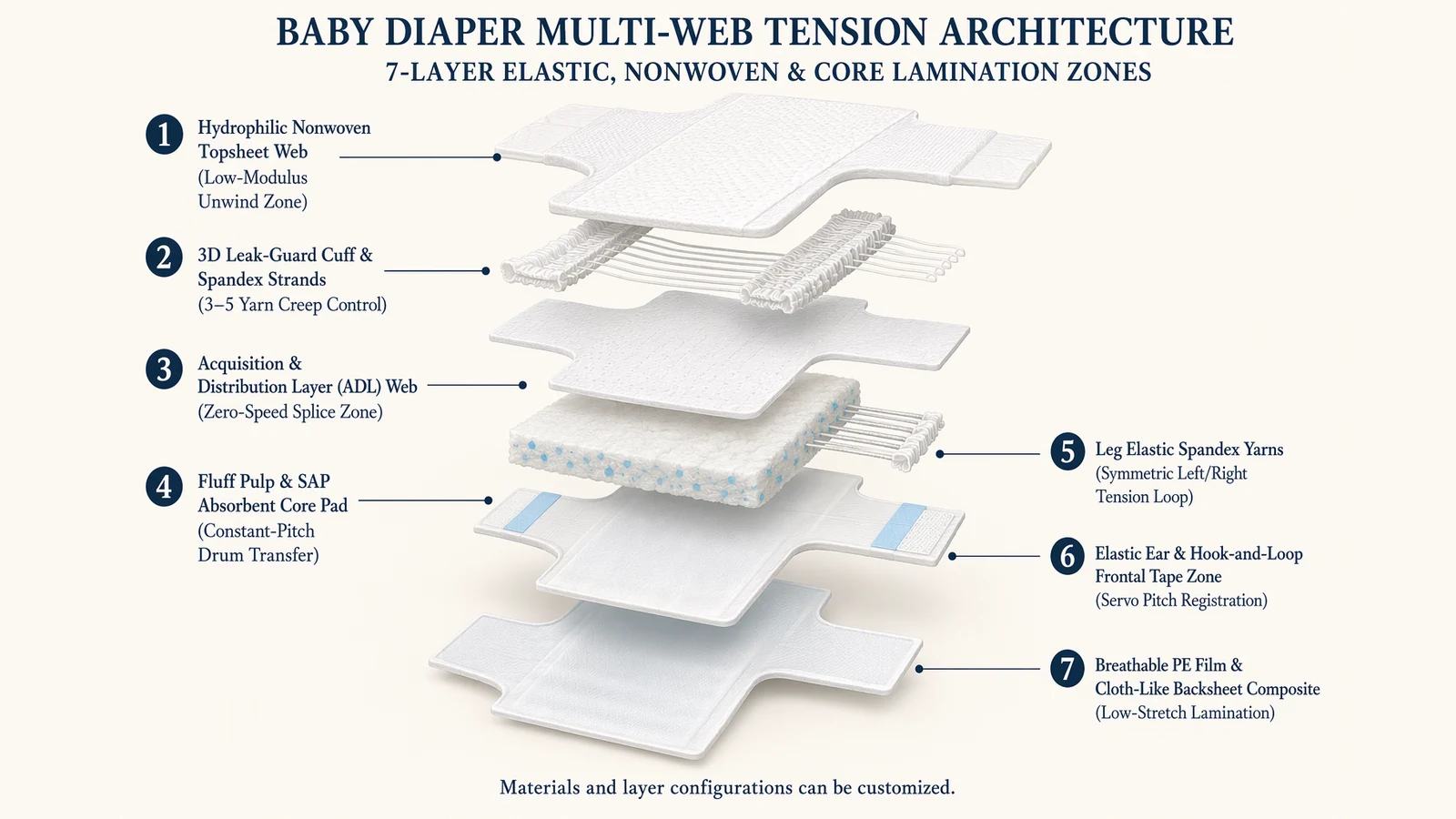
- Hydrophilic Nonwoven Topsheet Web (12–18 g/m²): Ultra-soft spunbond or through-air bonded web with low MD tensile stiffness; highly susceptible to width neck-down (transverse width shrinkage) if unwind tension exceeds target grams per linear centimeter.
- Hydrophobic 3D Leak-Guard Cuff Nonwoven & Cuff Spandex Strands (3–5 yarns per side): Fine polyurethane spandex yarns (typically 470–620 dtex) pre-stretched 200%–300% and encapsulated inside folded SMS barrier cuffs.
- Acquisition & Distribution Layer (ADL, 25–45 g/m²): Lofted resin-bonded or through-air nonwoven fed continuously or cut-and-placed over the core transfer zone; requires zero-crush nip pressure and stable zero-speed splice transitions.
- Fluff Pulp & SAP Absorbent Core Pad: Formed on the vacuum drum and wrapped in tissue or ultralight core-wrap nonwoven; transferred onto the carrier web at constant pitch.
- Leg Elastic Spandex Yarns (2–4 strands per leg opening): High-elongation elastomer threads applied continuously or with intermittent relaxation zones around the crotch; any left-to-right tension imbalance causes the finished diaper to twist or bow.
- Elastic Ear Laminate & Hook-and-Loop Frontal Tape Zone: High-recovery elastomeric side panels and mechanical hook closures rotary-cut and transferred intermittently at high cycle rates.
- Breathable Microporous PE Film + Hydrophobic Nonwoven Backsheet Composite: Thin 14–20 g/m² breathable PE film laminated inline with a cloth-like polypropylene nonwoven outer cover; sensitive to thermal and mechanical stretching before final cutoff.
4. Four Chronic Defects Caused by Open-Loop Tension Drift at 500–600 pcs/min
A common mistake is assuming that once an operator sets pneumatic brake pressure on a parent-roll spindle at shift start, web tension stays constant until the core expires. As a nonwoven roll unwinds from a 1,000 mm diameter down to a 100 mm core—a 10:1 radius drop—constant brake torque multiplies linear web tension tenfold unless closed-loop dancer or load-cell control intervenes.
Four High-Speed Converting Failure Modes Linked to Tension & Tuning Gaps
When unwinding loops lack closed-loop feedback or PID tuning for low-modulus webs, four defects degrade OEE:
1. Nonwoven Width Neck-Down & Edge Exposure
Excess MD tension on a 14 g/m² topsheet pulls the web inward by 2–4 mm, exposing hot-melt glue along diaper margins and fouling nip rollers.
2. Spandex Creep & Asymmetric Leg Gather
If left and right leg-cuff spandex yarns differ by more than 10%–15% in tension, or if slot/spiral glue fails to lock the yarn, strands slip back ("spandex creep") after cutoff.
3. Post-Splice Pitch Drift & Core Misregistration
During a zero-speed splice at 500–600 pcs/min, poorly tuned dancer loops cause a transient tension spike that shifts frontal tape and printed backsheet pitch by 5–15 mm.
4. Elastic Ear Wave & Hook-Tape Skew
Over-stretching elastomeric ear webs prior to rotary anvil cutting causes snap-back on the vacuum puck, resulting in crooked ear bonding or peel failures.
5. Station Engineering I: Constant-Tension Spandex Yarn Creel & Creep Control
Spandex accounts for less than 3% of a baby diaper's mass, yet it controls 100% of waist conformity and standing leak-guard geometry. Unlike paper or film webs, spandex yarns on modern diaper lines unwind actively via surface-driven takeoff or electronic constant-tension creel feeders.

As shown in Figure 2 on Welldone's T-shape baby diaper line, each spandex bobbin sits in a vertical creel equipped with individual closed-loop tension heads. When auditing this station during FAT:
- Independent strand-by-strand closed loop: Leg cuffs and 3D leak guards require multiple parallel spandex strands (3 strands per leg opening and 2–3 strands per barrier cuff) running at 180% to 300% elongation. Each strand needs its own closed-loop tension sensor and broken-yarn alarm so a snapped thread immediately flags the PLC reject gate.
- Non-stick guide surfaces: Spandex paths from the creel to the hot-melt nozzle must use polished ceramic eyelets and low-inertia grooved pulleys so adhesive mist does not trigger stick-slip tension oscillation.
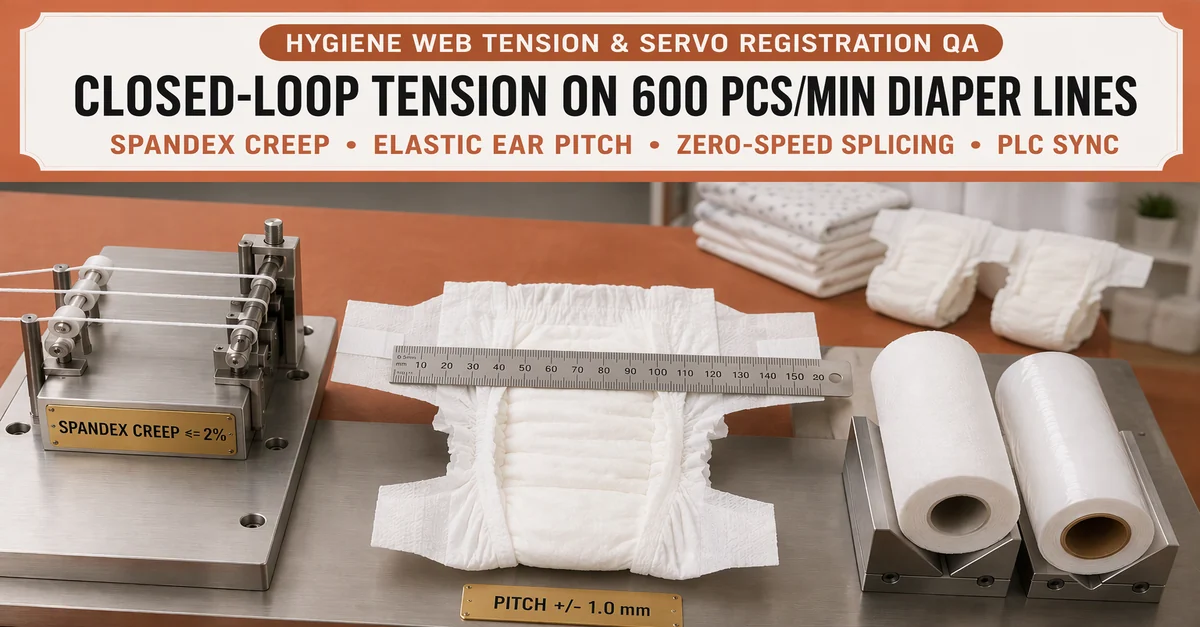
- Spandex creep audit (≤2.0%): Cut 20 consecutive diapers at rated speed (500–600 pcs/min), mark a 100 mm gauge length over the glued spandex zone, and age at 40 °C for 4 hours. Total retraction slippage (creep) must remain ≤2.0%.
6. Station Engineering II: Frontal Tape & Main Web Zero-Speed Auto-Splicing
On a 600 pcs/min diaper line, stopping and re-threading every time a backsheet, topsheet, or frontal tape roll expires destroys OEE and generates startup scrap. Zero-speed automatic splicing unwinders with multi-roller dancer accumulators are mandatory across all primary webs.

In most cases, web breaks two to five seconds after an automatic splice are caused not by bad splice tape, but by an under-damped tension loop or an aggressive acceleration ramp on the standby spindle. Looking at the dual-spindle unwinder in Figure 3:
- Zero-speed festoon storage window: When expiring Spindle A decelerates to zero for the pneumatic splice, the line draws material from the dancer festoon accumulator while the servo unwind drive regulates tension smoothly.
- Auto-tuning across roll inertia: Just as modular tension controllers use auto-tuning wizards to match roll inertia, the unwinder servo drive must scale proportional-integral gain dynamically from full roll down to core diameter.
- Printed registration recovery: For registered frontal tapes and printed PE backsheets, eye-mark sensors work with unwinder servo phase correction so pitch recovers within 1–2 diaper cycles after the splice joint passes.
7. Station Engineering III: Elastic Ear & Hook-and-Loop Tape Pitch Registration
Premium T-shape and I-shape baby diapers rely on wide elastic side ears laminated with mechanical hook tapes. Because elastomeric ear laminates combine high cross-direction stretch with narrow slit widths, they require isolated tension control to prevent edge curl or pitch drift.

As illustrated in Figure 4, isolating the unwinder tension zone from the rotary cutter-and-transfer anvil is essential for ear symmetry:
- Decoupled metering nip before rotary cut: The unwinder dancer maintains uniform draw tension out of the parent roll, while a servo metering nip feeds the exact ear patch length into the vacuum anvil drum.
- Left/right ear placement symmetry (±1.0 mm): Buyers should verify that left-to-right ear leading-edge offset stays within ±1.0 mm and that hook-to-ear bond peel strength meets targets across all sizes (NB, S, M, L, XL).
- Synchronized auto-reject on splice & phase shift: Welldone lines integrate local phase controls (folded phase, final cutter phase, and auto/manual reject gates) with the main PLC so any splice joint or tension excursion automatically diverts the affected diaper.
8. Material-to-Machine Alignment: Switching Between Carded, Spunbond, and Spunlace Rolls
Trützschler Nonwovens' November 2026 focus on high-efficiency carded, through-air bonded, and spunlaced hygiene webs highlights an important operational trend: hygiene converters increasingly qualify multiple regional nonwoven suppliers—or switch between standard PP spunbond, lofty through-air carded topsheets, and cotton-blend spunlace backsheet covers—on the same diaper machine to hedge raw-material costs and launch tiered retail SKUs.
Each nonwoven bonding technology exhibits a distinct stress-strain curve under machine-direction (MD) tension:
- PP Spunbond (12–17 g/m²): Continuous filaments thermally point-bonded; relatively high initial MD modulus, allowing moderate unwind tension (illustrative range: 1.5–2.5 N per 100 mm web width), but prone to brittle tearing if a slitter nick encounters a splice tension spike.
- Through-Air Bonded Carded Webs (16–22 g/m²): Staple fibers thermally fused by hot air without calender compaction; prized for cushiony softness in premium baby diapers, but exhibits lower MD yield strength and higher compressibility—requiring 20%–35% lower unwind tension and low-pressure nip rollers to avoid crushing loft.
- Spunlace / Hydroentangled Webs (30–55 g/m²): Mechanically entangled fibers with high drape and softness, but pronounced Poisson neck-down (width shrinkage under MD tension). Running a spunlace web on a spunbond tension recipe causes severe width loss and edge wrinkling unless the HMI recipe reduces unwind tension and adjusts web-guiding edge positions.
9. Engineering Decision Matrix: Multi-Web Tension Zones & FAT Acceptance Criteria
Use the following engineering matrix to specify closed-loop tension hardware, HMI recipe parameters, and measurable FAT acceptance targets across the five primary web zones of a high-speed baby or adult diaper line:
| Diaper Web / Material Zone | Typical Substrate & Basis Weight | Primary High-Speed Failure Risk | Required Tension & Control Hardware | FAT / Incoming QC Acceptance Target (Illustrative) |
|---|---|---|---|---|
| 1. Topsheet & ADL Unwind | 12–18 g/m² spunbond or through-air carded nonwoven; 25–45 g/m² ADL | MD neck-down (>2 mm width loss), loft crushing, post-splice web break | Dual-spindle servo unwinder, low-friction dancer festoon, recipe-based closed-loop tension | Width neck-down ≤1.5%; 10/10 zero-speed splices at rated speed without break |
| 2. Leg & 3D Cuff Spandex | 470–620 dtex polyurethane elastane yarns (180%–300% draw) | Spandex creep (>3%), asymmetric leg gather, undetected single-yarn break | Active constant-tension yarn creel with per-strand load sensor and broken-thread alarm | 40 °C / 4h thermal creep ≤2.0%; left/right cuff tension delta ≤5% |
| 3. Breathable PE + Backsheet | 14–20 g/m² microporous PE film + 13–17 g/m² hydrophobic nonwoven | Film micro-pinholes from over-tension, printed eye-mark registration drift | Independent servo unwind drives for PE and nonwoven + high-speed color mark phase loop | Print registration within ±1.5 mm steady state; recovery ≤2 pads post-splice |
| 4. Elastic Ear & Hook Tape | Elastomeric nonwoven laminate (45–80 g/m²) + mechanical hook tape | Elastic snap-back on anvil drum, left/right ear pitch skew, weak bond seam | Decoupled dancer unwinder + servo metering nip + ultrasonic/adhesive anvil pressure control | Left/right ear longitudinal symmetry ≤±1.0 mm; zero hook-tape delamination |
| 5. Frontal Tape & Waistband | Brushed loop frontal tape (35–60 g/m²) & elastic waist foam/nonwoven | Misplaced landing zone, curled tape edges, splice wrap-up on cutter roll | Dual-spindle zero-speed splicer + vacuum transfer drum + automatic splice-joint reject | Landing zone placement ≤±1.5 mm; 100% automatic ejection of spliced diaper |
10. How Welldone Supports High-Speed Diaper Lines, Tension Integration & Raw-Material BOM Matching
I believe the most reliable way to prevent high-speed web breaks and elastic registration defects is to engineer the servo unwinding architecture and the raw-material BOM as a single system before shipment. Operating since 2008 across 80+ countries, JINJIANG WELLDONE MACHINE CO., LTD. supports hygiene manufacturers as both a turnkey machinery builder and a one-stop hygiene supply partner:
- Full-Servo Baby & Adult Diaper Lines: From T-shape baby diaper machines and 600 pcs/min I-shape big-waistband baby diaper lines to full-servo pull-up baby pant machines, Welldone equips every critical web path with synchronized servo drives, closed-loop constant-tension spandex creels, dual-spindle zero-speed splicers, and PLC HMI recipe memory.
- Multi-Grade Nonwoven & Elastomer Compatibility Trials: When buyers plan to run lighter 12–15 g/m² spunbond, lofty through-air carded topsheets, or locally sourced breathable PE films, Welldone pre-tests the exact customer roll grades during Factory Acceptance Testing (FAT)—calibrating dancer pressure, unwinder PID gain, and hot-melt coat weights for each SKU recipe.
- Matched Hygiene Raw Materials & Finished Product Supply: Beyond equipment, Welldone supplies matched hygiene raw materials (hydrophilic/hydrophobic nonwovens, ADL, breathable PE film, spandex yarns, elastic ear laminates, frontal/side tapes, fluff pulp, SAP, and hot-melt adhesives) plus finished hygiene products tailored to buyer specs. Specific grades, roll widths, certifications, MOQs, and delivery terms are confirmed per inquiry.
11. 8-Step Buyer Actionable Checklist: Auditing Web Tension & Elastic Control Before Shipment
Pre-Shipment FAT & Material Qualification Checklist for Diaper Converters
- Map Every Unwinding Zone by Modulus: List all 7+ incoming webs (topsheet, ADL, core wrap, PE film, outer nonwoven, leg/cuff spandex, elastic ears, frontal tape) with target basis weight (g/m²), MD elongation, and maximum neck-down (≤1.5%).
- Verify Closed-Loop Architecture per Station: Confirm which stations use active load-cell feedback or pneumatic dancer accumulators, and verify that all spandex yarns run on active constant-tension creel feeders rather than passive brakes.
- Audit Auto-Tuning Across Full-to-Core Roll Decay: Run the line at rated speed (500–600 pcs/min) both with a full 1,000 mm parent roll and a near-empty 150 mm core to verify zero tension oscillation or registration drift as roll inertia drops.
- Execute a 10-Splice Zero-Speed Stress Test: Trigger at least 10 consecutive automatic zero-speed splices across topsheet, backsheet, elastic ear, and frontal tape stations at full speed; require 100% splice survival and automatic PLC rejection of the spliced pad.
- Measure 40 °C Spandex Creep & Left/Right Balance: Sample 20 diapers from a full-speed run, verify left-vs-right leg cuff tension symmetry (≤5% delta), and conduct a 4-hour 40 °C oven test to confirm spandex creep stays ≤2.0%.
- Check Elastic Ear & Frontal Tape Pitch Accuracy: Measure 30 consecutive diapers with a steel rule; confirm left/right elastic ear offset is within ±1.0 mm and frontal tape landing zone placement stays within ±1.5 mm.
- Inspect Roller Surfaces & Web Guiding Paths: Verify that adhesive-adjacent guide rollers use non-stick coatings or polished sleeves and that edge guides maintain web centerline within ±1.0 mm without edge folding.
- Lock HMI Tension Recipes per SKU & Supplier Grade: Store dedicated PLC tension, dancer pressure, and phase-offset recipes for each diaper size (NB/S/M/L/XL) and each qualified nonwoven grade (spunbond vs. through-air carded) before signing off FAT.
12. Source & Date Verification
Primary & Auxiliary Industry News Sources Verified in This Analysis:
- Primary Machinery / Web-Handling Source: Nonwovens Industry — MAGPOWR Unveils MAXTRAC (Published November 11, 2026; United States / Global).
- Cross-Verified Technical Trade Source: Label & Narrow Web — MAGPOWR Unveils MAXTRAC Modular Tension Control System (Published November 11, 2026; confirming 3-in-1 load-cell, touchscreen, and PLC configurations, auto-tuning wizard, recipe storage, and LOUPE Americas 2026 showcase with Componex and Plasma Coatings).
- Auxiliary Hygiene Nonwoven Machinery Source: Nonwovens News — Trützschler Targets Hygiene and Technical Nonwovens (Published November 11, 2026; Germany; confirming focus on carding, spunlace, and through-air bonding for hygiene and wipes).
13. Frequently Asked Questions (FAQ)
1. Why do full-servo baby diaper machines still need closed-loop load-cell or dancer tension control?
Full-servo main drives synchronize the rotational velocity of converting drums and nip rollers, but they cannot sense changes in parent-roll diameter, roll eccentricity, or material modulus on their own. Closed-loop load cells and dancer accumulators measure actual web tension in real time and trim unwinder motor speed continuously so tension stays constant from a 1,000 mm full roll down to the core.
2. What causes spandex creep on baby diaper leg cuffs and 3D leak guards at 500–600 pcs/min?
Spandex creep occurs when pre-stretched elastane strands (drawn 180%–300%) slip inside the nonwoven laminate after cutoff. Root causes include uneven unwind tension from the spandex creel, adhesive mist on guide pulleys, insufficient hot-melt glue coat weight, or low nip roller pressure.
3. How does switching from spunbond to through-air bonded topsheets change unwinder settings?
Through-air bonded carded nonwovens have higher loft and lower MD tensile stiffness than thermally point-bonded PP spunbond. Operators must load a 20%–35% lower unwind tension recipe and reduce nip pressure to prevent width neck-down (>1.5%) and caliper crushing.
4. Can Welldone supply both the servo diaper production line and matched low-basis-weight nonwovens and spandex?
Yes. JINJIANG WELLDONE MACHINE CO., LTD. supplies full-servo T-shape, I-shape, and pull-up diaper lines alongside matched raw-material packages—including nonwovens, breathable PE films, spandex yarns, elastic ears, and frontal tapes—pre-tested during FAT before shipment.
About This Engineering Guide: Prepared by the Hygiene Converting & Project Engineering Team at JINJIANG WELLDONE MACHINE CO., LTD. (Operating since 2008 · Incorporated 2013; 80+ countries served). Technical review aligned with Factory Acceptance Testing (FAT) protocols for high-speed servo baby and adult diaper production lines.
14. Request a Diaper Production Line, Tension Audit, or Raw-Material BOM Consultation
Planning to invest in a 500–600 pcs/min full-servo T-shape, I-shape, or pull-up diaper line, upgrade your multi-web tension and spandex creel configuration, or source matched hygiene raw materials and finished products? Contact Welldone for technical specifications, FAT trial protocols, or sample validation:
Contact: Steven Tang | Phone/WhatsApp/WeChat: +86-13655936189 | Tel: +86 595-28082887
Website: https://cnwelldone.com/contact-us | Email: welldone@cnwelldone.com