
Diaper Forming Drum vs Block Demoulding: Which to Choose

On August 31, 2026
Comments Off on Diaper Forming Drum vs Block Demoulding: Which to Choose
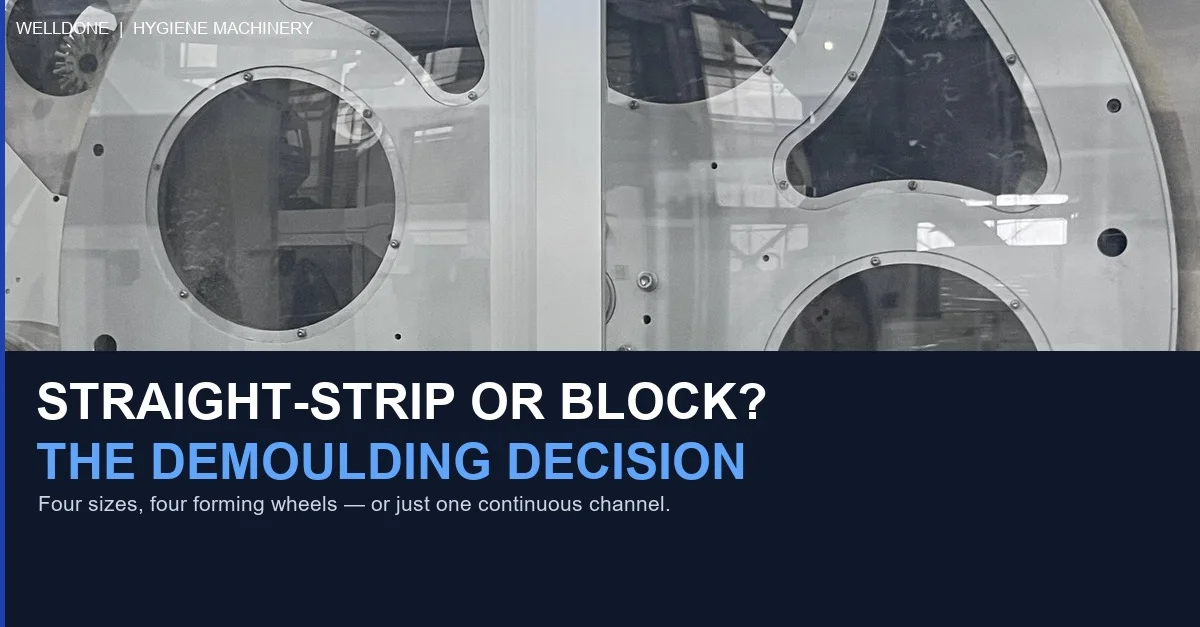
Diaper Core Forming: Straight-Strip vs Block Demoulding
Station-Selection Series · Part 1
This series examines individual stations on a baby diaper line — not the whole machine. Each part covers one decision that gets made at quotation stage and cannot be cheaply reversed later. Part 1: the forming drum and how the core leaves it.
This series examines individual stations on a baby diaper line — not the whole machine. Each part covers one decision that gets made at quotation stage and cannot be cheaply reversed later. Part 1: the forming drum and how the core leaves it.
The absorbent core is the most expensive component in a baby diaper. The forming station
is where that core is built — fluff pulp and SAP deposited into a shaped cavity rotating
on a drum. How the core exits that cavity is called demoulding. There are two ways to do
it, and the choice determines how many sizes you can run on one machine.
What demoulding actually means
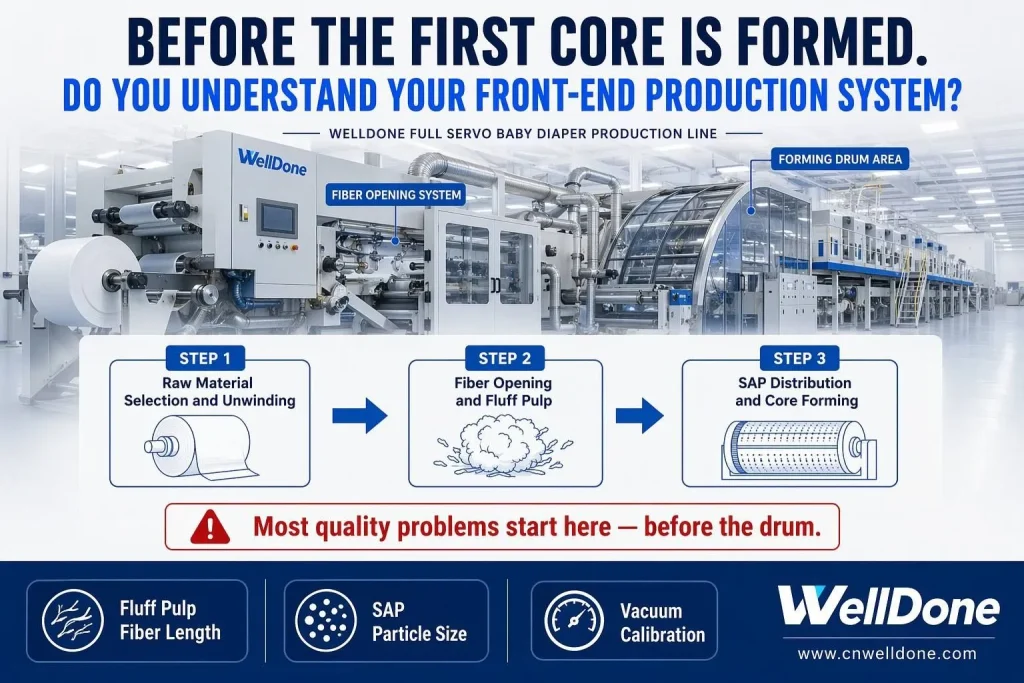
The forming drum carries a series of mould cavities — recessed pockets shaped to the target core dimensions. As the drum rotates, each cavity passes under the forming hood where fluff and SAP are drawn in by vacuum and compressed into shape. When the cavity rotates past the transfer point, the core must be released onto the carrier tissue below. That release is demoulding.
It sounds like a minor mechanical detail. It is not. The geometry of the mould cavity determines the core's length, width, thickness profile, and SAP distribution. Change the geometry and you change the product. Change the product and, depending on which demoulding method you chose, you may or may not need new tooling to do it.
The two methods
C2.1 — Straight-strip demoulding
The mould cavity runs as a single continuous channel along the full width of the drum. The core is formed as an unbroken strip and cut to length downstream by the core cutter. The drum itself carries no size information: it produces a ribbon, and the cut length is what defines the NB / S / M / L / XL product dimension.
Changing sizes means adjusting the cutter pitch. The drum stays the same. No mould swap, no tooling cost, no downtime beyond the cutter adjustment time.
"The forming wheel is shared across all sizes. Size change lives in the cutter, not in
the drum." — WD-NK800I-SV configuration document, Section C2.1
C2.2 — Block demoulding
The drum carries discrete block-shaped cavities, each machined to a specific core length. The core is formed and demoulded as a finished block — no downstream cutting required for the core itself. The block shape also allows a contoured thickness profile (thicker in the crotch, thinner at the ends) which a straight-strip channel cannot easily achieve without additional compression tooling.
The constraint is direct: one block geometry equals one size. The WD-NK800I-SV configuration book states this explicitly — when running block demoulding across four sizes (NB / S / M / L), four separate forming wheel sets are required. Each set must be machined, stored, fitted, and re-aligned during a size changeover.
The SKU constraint nobody puts in the headline spec
Most machine quotations lead with speed. The forming drum section might say "600 pcs/min stable, 800 pcs/min design." What it will not say in large print is how many size changes per week that speed figure assumes, or what each change costs.
Actually, the SKU question is the more important number for most factories. A line running two shifts at 600 ppm but changing sizes four times a week loses more output to changeover than a line running at 500 ppm with a single SKU.
| Factor | Straight-strip (C2.1) | Block demoulding (C2.2) |
|---|---|---|
| Tooling per size | None — cutter pitch adjustment only | One full forming wheel set per size |
| 4-size SKU tooling cost | Baseline | 3 additional wheel sets (significant CAPEX) |
| Size changeover time | Shorter — cutter only | Longer — drum tooling swap + re-alignment |
| Core thickness profile | Uniform (or shaped by downstream press) | Contoured per block geometry |
| Waste during changeover | Lower — less re-threading | Higher — vacuum re-seal and cavity alignment |
| Typical application | Multi-SKU, retail, private label | Dedicated premium SKU, shaped-core requirement |
Source note: The two-method classification (C2.1 / C2.2) and the
"four sizes require four forming wheel sets" statement are taken verbatim from the
WD-NK800I-SV configuration document (Section C, Core Forming). Product length range
360–580 mm and L-size pitch of 500 mm are from the same document. No figures in this
article are derived from industry estimates.
Speed and waste — what the spec sheet does not connect
The WD-NK800I-SV runs at 600 pcs/min stable on L size, which corresponds to a line speed of 300 m/min at a 500 mm pitch. That is a fast line. The question is how many of those minutes per shift are actually producing saleable product.
In straight-strip forming, a size change touches the core cutter and the downstream cutting pitch. The forming drum keeps spinning. Restart waste is confined to the rethreading of the cutter section — typically one to two minutes of sub-spec product.
In block demoulding, the drum must be stopped, the wheel set physically removed and replaced, vacuum seals checked, and the new cavity geometry re-aligned to the transfer tissue. The machine then runs slowly up to verify SAP distribution before returning to full speed. More importantly, every forming wheel set must be stored, tracked, and kept in calibrated condition. At four sizes, that is four sets of precision tooling in the spare parts inventory.
The real question is not which method is faster at steady state — both can run the same drum speed. The question is how often you plan to open that panel, and what it costs each time you do.
Which one to choose
In most cases, the answer comes down to one question: how many sizes will you run in a typical production week?
If the answer is one — a single dedicated SKU for a brand or a contract — block demoulding is worth considering. The contoured thickness profile can be a genuine product differentiator, and the tooling cost is a one-time purchase against a long dedicated run.
If the answer is three or more, straight-strip almost always wins on economics. The tooling saving alone across a four-size range typically offsets a meaningful fraction of the machine price difference, and the changeover time advantage compounds with each weekly SKU rotation.
| Your situation | Recommended method | Primary reason |
|---|---|---|
| Single SKU, dedicated brand contract | Block demoulding (C2.2) | Shaped core profile, one-time tooling |
| 2–3 sizes, weekly rotation | Straight-strip (C2.1) | Changeover time and tooling cost dominate |
| 4+ sizes, private label / multi-customer | Straight-strip (C2.1) | 4 wheel sets is a significant hidden cost |
| Premium shaped-core product plan | Block demoulding (C2.2) | Contoured profile not achievable with strip |
| Uncertain — SKU mix not yet decided | Straight-strip (C2.1) | Lower commitment; SKU flexibility preserved |
Why Welldone
Welldone has manufactured hygiene converting equipment since 2008. The I-shape and T-shape baby diaper lines are offered with both C2.1 and C2.2 forming configurations — the choice is made at specification stage, not as an aftermarket modification.
⚙️
Both methods available
Straight-strip and block demoulding are both supported configurations. The specification is locked before manufacturing begins, not retrofitted.
📐
Full servo tension control
Forming quality depends on consistent vacuum and web tension throughout the drum rotation. Full servo drives eliminate the speed fluctuations that cause uneven SAP distribution at the cavity edges.
🔧
Configuration before commitment
We discuss SKU plans, production schedules, and size mix before quoting the forming section. The tooling cost difference between methods is part of the project economics conversation, not a post-sale discovery.
Related Machines
I-shape Baby Diaper Machine
Full servo line. Available with C2.1 or C2.2 forming configuration.
Learn MorePull-up Baby Diaper Machine
Pants-style line. Core forming station is upstream of the side-seam section.
Learn More2-piece Pull-up Machine
Two-component construction with independent core and chassis web.
Learn More3-piece Pull-up Machine
Three-component architecture for premium pants diaper construction.
Learn MoreDiscuss Your Configuration
Core forming is specified per project. Share your SKU mix and we will recommend the right method before quoting.
Contact UsConclusion
The forming drum demoulding method is one of those decisions that looks minor on a spec sheet and proves consequential in operation. Straight-strip costs less to tool across a multi-size range and changes sizes faster. Block demoulding produces a shaped core and suits a dedicated SKU strategy. Neither is universally better — the right answer depends on the production schedule you are actually planning to run.
The question worth asking before signing a machine specification is: in twelve months, how many different sizes will this line be running in a typical week? The answer to that question should drive the forming station choice — not the other way around.
FAQ
Can I switch from block to straight-strip demoulding after the machine is built?
Not easily. The drum geometry, vacuum channel layout, and transfer timing are all engineered around one method. Retrofitting the other method is typically treated as a rebuild, not a modification. This is why the choice is made at specification stage.
How long does a size changeover take with block demoulding?
Changeover time varies with operator experience and machine design. The WD-NK800I-SV configuration document specifies an overall line changeover target of under 60 minutes; the forming station is typically the longest single step when a wheel set swap is involved. Straight-strip changeover for the forming section alone is significantly shorter because the drum is not touched.
Does block demoulding produce a higher-quality core than straight-strip?
It produces a differently shaped core — contoured in thickness rather than uniform. Whether that constitutes higher quality depends on the product specification. Premium brands that require a shaped absorbent zone specify block demoulding for that reason. Mainstream multi-SKU production rarely requires it, and the tooling cost is hard to justify without a clear product brief that demands the shaped profile.
What is the cost of one additional forming wheel set for block demoulding?
Forming wheel sets are precision-machined tooling; pricing depends on core dimensions and material specification. We do not publish per-set pricing here. Contact us with your target core dimensions and size range — we include tooling costs in the project quotation so the comparison with straight-strip is transparent before you decide.
Does this choice affect SAP distribution?
Yes. In straight-strip forming, SAP distribution across the core width is controlled by the metering gate, which can be adjusted without tooling changes. In block demoulding, the SAP concentration profile is partly defined by the block cavity geometry — changing the profile means changing the wheel set. If you anticipate needing to adjust SAP distribution by size, straight-strip gives you more flexibility.
Specifying a forming station?
Tell us your target sizes, weekly SKU rotation, and volume — we will recommend C2.1 or C2.2 and include tooling costs in the quotation so the comparison is clear.
Website: www.cnwelldone.com
Email: welldone@cnwelldone.com
Send Your Forming Spec
Written by: Welldone Machine Engineering Team
Technical review: Mostafa Ansary, Technical Sales Manager — BSc Mechanical Design and Production Management, Cairo University; 15 years in production management and machinery.
Market context: Tidiane Thiero, International Sales Engineer — electrical engineer, Huaqiao University Xiamen; 3 years in the hygiene industry, covering line configuration and raw material planning.
Welldone Machine Co., Limited has manufactured hygiene converting equipment since 2008.
Technical review: Mostafa Ansary, Technical Sales Manager — BSc Mechanical Design and Production Management, Cairo University; 15 years in production management and machinery.
Market context: Tidiane Thiero, International Sales Engineer — electrical engineer, Huaqiao University Xiamen; 3 years in the hygiene industry, covering line configuration and raw material planning.
Welldone Machine Co., Limited has manufactured hygiene converting equipment since 2008.