
Hygiene Packaging Film & Bagging Line Guide 2026 | Welldone

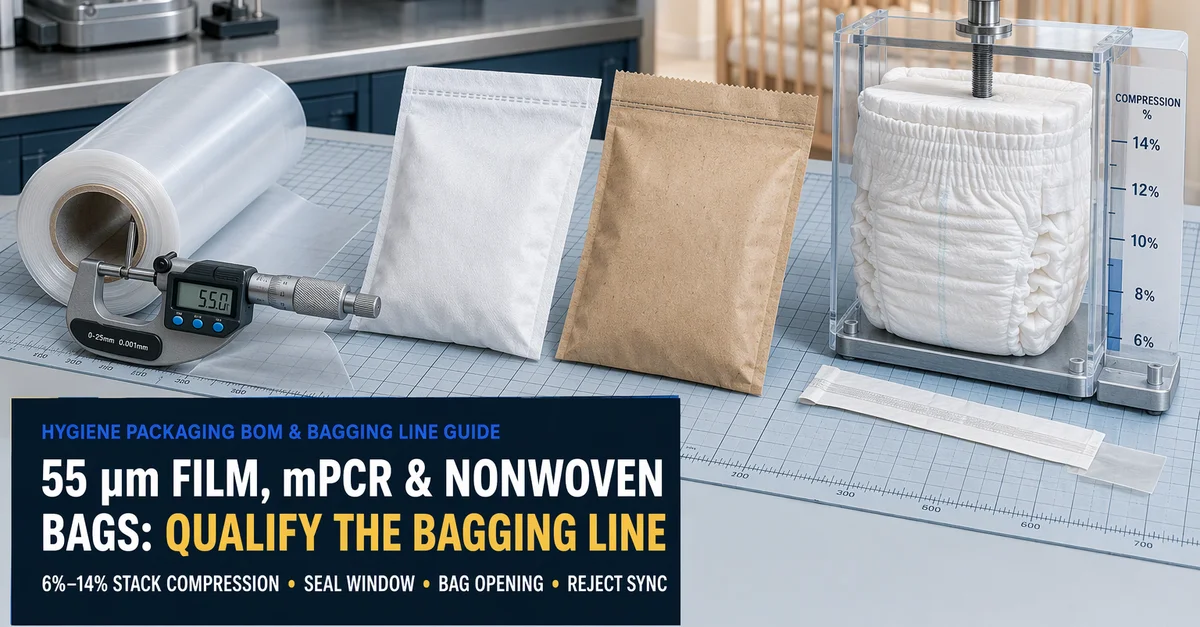
55 µm Film, mPCR & Nonwoven Bags: Qualify Hygiene Bagging Lines
When global hygiene manufacturers reduce primary diaper packaging film thickness from 60 to 55 micrometers, compress diaper-pant stacks by 6% to 14%, eliminate laminated bags in favor of mono-material mechanically recycled polyethylene (mPCR), or adopt recyclable nonwoven and paper bags, the engineering impact lands directly on the end-of-line counting, stacking, compression, and heat-sealing stations. Qualifying these packaging BOM changes against your servo stacker and automatic bagger before freezing bag specifications prevents seal burn-through, gusset splitting, and core spring-back jams.
1. What the November 2026 Hygiene Packaging Shift Confirms Across Unicharm, Ontex, Drylock, and Pampers
On November 4, 2026, Nonwovens Industry published an industry report examining how major absorbent hygiene producers—including Unicharm, Ontex, Drylock Technologies, and Procter & Gamble (Pampers)—are redesigning primary packaging structures across baby diapers, pull-up diaper pants, feminine pads, light incontinence products, and baby wipes. Cross-checking the November 4, 2026 report with official sustainability disclosures and European packaging trade coverage from Packaging Europe and Sustainable Packaging News confirms four concrete technical shifts:
- LG Unicharm's 60 to 55 µm film downgauging and 6%–14% diaper-pant compression: In South Korea, LG Unicharm reduced the thickness of its MamyPoko primary packaging film from 60 micrometers to 55 micrometers, expected to cut plastic consumption by approximately 16% and save roughly one ton of plastic per year. Increased diaper compression also reduced packaging size and plastic consumption by approximately 14% for the MamyPoko Diaper-Pants Day&Night range and 6% for the standard MamyPoko Diaper-Pants range. In Australia and New Zealand, Unicharm Australasia introduced linear low-density polyethylene (LLDPE) containing approximately 15% post-consumer recycled (PCR) plastic for newborn and S-size baby diaper bags (launched November 2024), while in Thailand, Sofy TanomPew Natural Love combines recycled-material packaging with a 35% reduction in plastic use alongside paper-based transitions.
- Ontex's 40% recycled plastic share, elimination of laminated bags, and mPCR line compatibility: By the end of 2025, 40% of Ontex's primary plastic packaging contained recycled content—spanning post-industrial recycled (PIR), chemically recycled post-consumer, and mechanically recycled post-consumer (mPCR) polyethylene. Ontex confirmed that it has stopped using laminated bags and designed 100% of its product packaging to be recyclable. As Catherine Weyne, Senior Marketing Specialist at Ontex, emphasized, flexible packaging films integrating mPCR polyethylene must pass compliance and traceability checks while maintaining pack integrity and performing reliably on existing production lines.
- Drylock Technologies' patented recyclable nonwoven diaper bag and glue-free paper pouches: Developed jointly by Drylock Technologies, flexible packaging specialist Korozo Group, and Belgian retail chain Colruyt, Drylock commercialized a patented single-material recyclable nonwoven diaper bag containing recycled content that reflects the softness of the diaper inside before opening. Werner Van Ingelgem, Vice President of Procurement at Drylock Technologies, noted that Drylock eliminated 100% virgin oil-based plastic bags from its European portfolio in 2022, maintains at least 15% recycled content across European packs (with select packs reaching 100% recycled polyethylene), introduced 100% recycled-fiber paper bags across baby, feminine, and adult care, and developed a plastic-free, recyclable, compostable, glue-free paper pouch for light incontinence products inspired by a coffee filter. Eco-design reduced plastic use in Drylock's bag portfolio by 30%, and in 2024 close to 90% of its primary packaging contained recycled content while nearly one-third came from renewable sources.
- P&G Pampers' one-hand, single-wipe dispensing redesign: Across its baby care brands, Procter & Gamble redesigned baby wipes dispensing so parents can pull one wipe at a time with one hand rather than pulling several sheets, addressing consumer feedback reported by Caroline Sanchez, Senior Brand Director at Pampers.
2. Evidence Boundary: Verified Packaging Facts vs. End-of-Line Engineering Analysis
To support accurate technical decisions, this guide separates source-confirmed facts from Welldone's machinery and BOM analysis:
Three-Tier Fact & Engineering Boundary:
- Source-Confirmed Facts: LG Unicharm's 60 to 55 µm MamyPoko film reduction (~16% plastic reduction, ~1 ton/year saved), 14% Day&Night and 6% standard diaper-pant compression, 15% PCR LLDPE in Australasia, and 35% plastic reduction on Sofy TanomPew Natural Love; Ontex's 40% recycled content at end-2025, elimination of laminated bags, and 100% recyclable design; Drylock's Colruyt/Korozo recyclable nonwoven bag, glue-free paper pouch, 15%–100% European recycled PE share, 30% eco-design plastic reduction, and ~90% recycled-content primary packs in 2024; and Pampers' single-wipe dispensing upgrade.
- Welldone Engineering & Supply Chain Analysis: All evaluations of how 55 µm films, mPCR mono-material PE webs, nonwoven bags, paper pouches, and 6%–14% stack compression interact with 90° transfer drums, reject nozzles, rotary stacking wheels, compressors, and sealing jaws represent Welldone's engineering guidance. Welldone was not involved in the initiatives of Unicharm, Ontex, Drylock, Korozo, Colruyt, or P&G.
- Illustrative Examples Only: Trial windows and checkpoints marked Illustrative example only serve as reference templates to calibrate against your resin datasheets and machine configurations.
3. Inside the 7-Zone Hygiene Pack & Bag Architecture: Where Compression Meets the Seal Seam
In an automated diaper, pull-up pant, or sanitary napkin plant, the primary bag is a pressurized mechanical containment vessel. When a servo compressor squeezes a stack of folded baby pull-up pants by 6% to 14% and pushes it into a flexible wicket bag or pouch, the stored elastic energy of the fluff pulp, SAP, and waist elastics pushes outward against the bag walls and weld seams immediately after pusher retraction.

Breaking down the seven functional zones in Figure 1 clarifies why dropping film thickness from 60 µm to 55 µm or removing a laminated outer layer requires coordinated settings on automatic baby diaper packing machines:
- Zone 1 — Outer Printable PE / Nonwoven Layer: Provides surface stiffness, print registration for eye-mark sensors, and anti-stick resistance. Unlike laminated bags with a heat-resistant outer PET/OPP layer, mono-material PE or nonwoven bags melt at nearly the same temperature on the outside as on the inside.
- Zone 2 — mPCR / Virgin LLDPE Structural Core Web (55–60 µm): Carries hoop tension when the compressed diaper stack expands. Downgauging from 60 µm to 55 µm reduces cross-sectional thickness by 8.3%, while adding 15% to 40%+ mPCR resin introduces microscopic gels and wider melt-flow index (MFI) tolerances.
- Zone 3 — Inner Low-SIT Sealant Layer: Formulated with metallocene LLDPE to deliver a low seal initiation temperature (SIT) and high hot-tack strength while the weld seam is still warm.
- Zone 4 — Compressed Diaper-Pant Stack (6%–14% Volume Reduction): Higher compression cuts bag dimensions and shipping volume but increases lateral spring-back force against bag-opening duckbills and side gussets.
- Zone 5 — Side Gusset Expansion Fold: Side pleats that unfold during stack insertion; here the sealing jaw must weld four film layers simultaneously without burning through the two-layer center span.
- Zone 6 — Impulse / Constant-Heat Weld Seam: Cross-seal closure whose peel and burst strength depends on jaw pressure, impulse duration, and cooling-bar hold time.
- Zone 7 — Easy-Open Perforation & Carry Handle Zone: Laser or mechanical tear lines and handle patches that must resist premature splitting under 6%–14% internal stack expansion.
4. Four Hygiene Packaging Substrate Routes: Downgauged PE, Mono-Material mPCR, Recyclable Nonwoven, and Paper Bags
The real question is whether your existing stacker and automatic bagger can absorb a thinner, non-laminated, or fiber-based bag specification without losing net bags per minute. Across the November 2026 benchmarks, brands are adopting four primary packaging BOM pathways:
Engineering Trade-Offs Across Modern Hygiene Packaging Substrates
Compare how each sustainable packaging material behaves inside high-speed stacking and bagging machinery before freezing bag artwork:
Route 1: Downgauged 55 µm & mPCR Mono-Material PE
Mirrors LG Unicharm's 60 to 55 µm shift and Ontex's non-laminated mPCR PE bags. Eliminating laminated outer layers narrows the thermal sealing window, requiring closed-loop PID impulse jaws, PTFE release tapes, and polished duckbill pusher plates.
Route 2: Single-Material Recyclable Nonwoven Bags
Mirrors Drylock and Korozo Group's tactile nonwoven diaper bag for Colruyt. Polyolefin nonwoven bags offer soft handfeel and tear resistance, but exhibit higher air permeability under suction cups and require ultrasonic or stepped impulse sealing across gussets.
Route 3: Recycled-Fiber Paper Bags & Glue-Free Pouches
Mirrors Drylock's recycled-fiber paper diaper bags, glue-free light incontinence pouches, and Unicharm Thailand's paper transitions. Because paper lacks high elastic elongation, stack compression must be moderated and duckbill clearance widened to prevent corner tearing.
5. Upstream 90° Transfer & Orientation Stability Before the Stacking Lane
Packaging line reliability starts before the diaper reaches the stacking wheel. When a brand increases stack compression by 6% to 14%, every millimeter of pad alignment inside the bundle matters. If individual pants enter the stacker skewed or with unfolded waist ears, compressing the stack concentrates peak stress on the thickest overlap zone and jams inside a tightened 55 µm bag mouth.

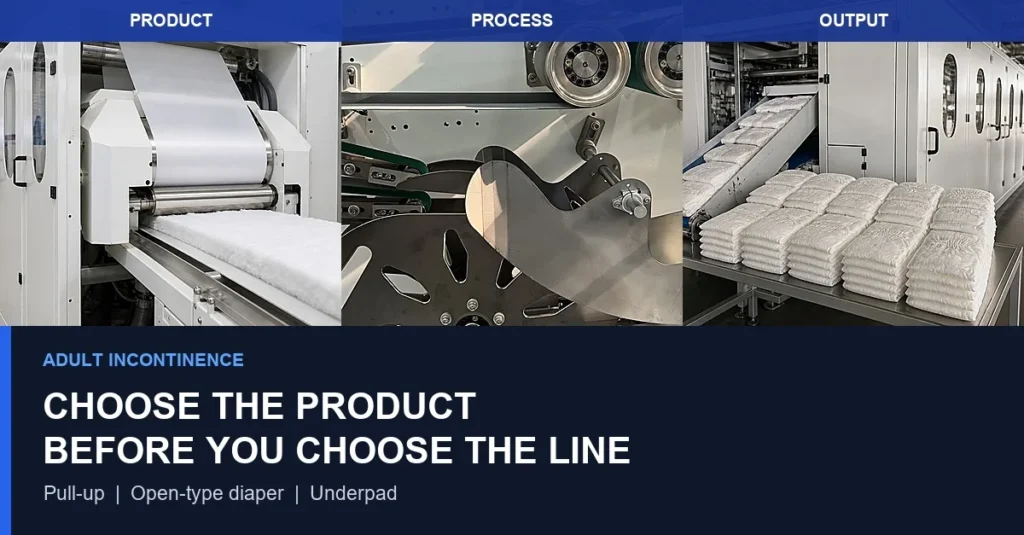
As shown in Figure 2, after final cutting and folding, the product passes through a vacuum-perforated 90-degree transfer turning drum:
- Vacuum zone holding stability: Perforated stainless-steel transfer pucks apply zoned negative pressure across the folded pant body so waist elastics cannot recoil during angular rotation.
- Pitch-to-pitch phase registration: Servo electronic cam profiles synchronize the drum release point with the downstream conveyor belt, delivering uniform leading-edge registration.
- Why orientation protects downgauged bags: A stack with ≤±2–3 mm edge stagger presents a square front face to the bagger duckbill plates, preventing protruding cuffs from tearing 55 µm films or scuffing paper bags.
6. Automatic Reject Synchronization: Preventing Defective or Spliced Pads from Reaching the Bagger
A common mistake is auditing packaging film waste only at the heat-sealing jaw while ignoring how upstream raw-material splices and vision rejects disrupt stack geometry. Whenever an unwinder executes a roll splice, the spliced pad carries double-thickness tape. If that pad enters the rotary stacker under a 14% compression setting, it produces an overweight, bulged pack that splits its mono-material mPCR weld seam.

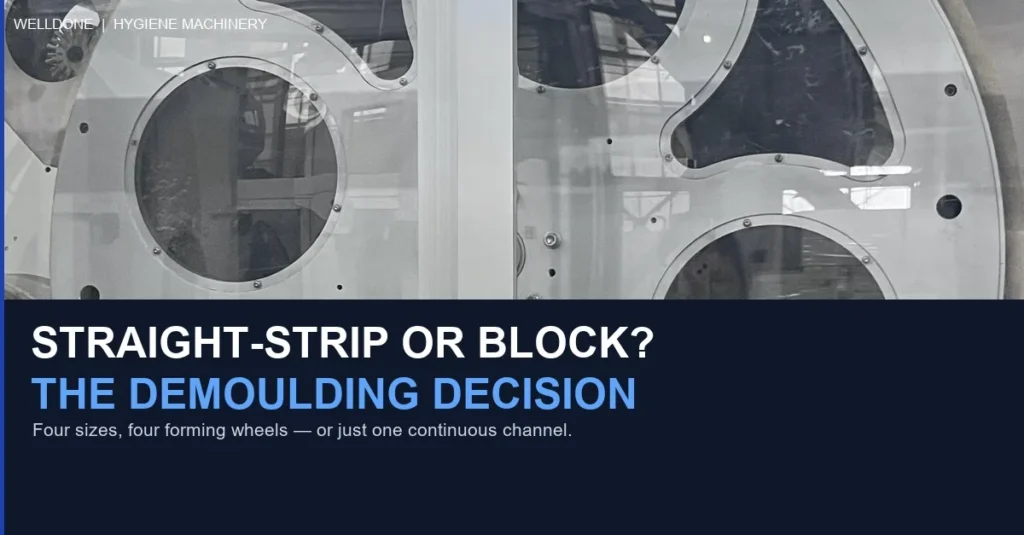
Figure 3 shows the dual high-pressure pneumatic reject nozzles positioned ahead of the counting and stacking section on Welldone's pull-up diaper line:
- Shift-register tracking from splice to eject: The PLC tracks the virtual encoder position of every raw-material splice, metal-detector trigger, or vision defect, firing the dual air-jet nozzles within milliseconds at the transfer gap.
- Zero-corruption count compensation: When a defective pant is ejected, downstream counting logic holds the bag-indexing trigger until the exact target piece count is completed with 100% conforming units.
- Protecting eco-packaging yields: Preventing a single defective pad from spoiling a finished bag protects both OEE and higher-cost mPCR, nonwoven, or printed paper bag inventories.
7. Rotary Stacking Wheel & 6%–14% Stack Compression: Balancing Volume Reduction Against Core Spring-Back
Once conforming pads pass the reject gate, they enter the rotary stacking wheel (Figure 4) and servo compression chamber. LG Unicharm's achievement of a 14% packaging size and plastic reduction on MamyPoko Diaper-Pants Day&Night versus 6% on standard MamyPoko Diaper-Pants highlights a key physical rule: overnight SKUs with thicker fluff-pulp layers have greater compressible void volume than thinner daytime pants with higher SAP ratios.

In most cases, pushing stack compression beyond the core's elastic recovery ceiling crushes the acquisition distribution layer (ADL) void space and forces SAP granules against thin tissue wraps. To run 6% to 14% stack compression safely across adult care and high-compression diaper packing machines or sanitary pad packing machines, engineers balance three settings:
- Rotary wheel pocket deceleration: Curved stainless-steel pockets in Figure 4 decelerate each incoming pant smoothly so folded leg cuffs do not unfold during stack indexing.
- Two-stage servo pre-compression and dwell: Rather than a single rapid stroke that traps air inside the fluff core and breathable backsheet, a two-stage profile expels interstitial air first and then holds target compression height, reducing immediate spring-back against the bag seam.
- 72-hour post-compression core recovery verification: QC teams verify that pad thickness and rewet values after 72 hours of compressed pallet storage remain within specification.
8. Heat-Sealing Jaw Window, Bag Opening & Wipes Dispensing Registration Across New Substrates
Eliminating laminated bags in favor of mono-material mPCR PE (Ontex), adopting recyclable nonwoven or paper bags (Drylock/Korozo), and upgrading to single-wipe dispensing (Pampers) require targeted adjustments at the bagging and sealing section:
- Narrower thermal window on non-laminated 55 µm and mPCR PE films: Without a heat-resistant outer PET/OPP layer, mono-material PE bags require closed-loop PID jaw temperature control (±2–3 °C) and water-chilled cooling bars so the inner sealant fuses across both 2-layer spans and 4-layer gussets without burn-through.
- Bag opening on nonwoven and paper bags: Slightly air-permeable nonwoven bags require higher-flow venturi vacuum suction cups and ultrasonic or stepped impulse jaws, whereas low-elongation recycled-fiber paper bags require +3–5 mm wider duckbill clearance and gentler pusher acceleration curves.
- Wet wipes single-wipe dispensing registration: Pampers' one-hand single-wipe extraction relies on holding wet-wipe interfolding overlap within ±1.0 mm and synchronizing flow-wrap die-cut orifice and flip-top lid registration so sheets separate cleanly from first to last pull.
9. Hygiene Packaging Substrate & Bagging Line Compatibility Matrix
Use the matrix below during supplier qualification and Factory Acceptance Testing (FAT) to align your packaging substrate with stacker, compressor, and bagger settings (Illustrative example only — calibrate exact parameters against your film/bag TDS and SKU stack dimensions):
| Packaging Substrate & Industry Benchmark | Target Hygiene Categories | Stack Compression & Infeed Impact | Bag Opening, Pusher & Sealing Adjustments | FAT / Incoming QC Verification Gate |
|---|---|---|---|---|
| Downgauged 55 µm Virgin / 15% PCR LLDPE Film (LG Unicharm MamyPoko 60→55 µm; Unicharm Australasia 15% PCR) | Baby diapers (NB/S/M/L/XL), baby pull-up pants, sanitary napkin multi-packs | Supports 6%–14% stack compression with two-stage air-expulsion servo pre-compression and ±2 mm stack alignment | Reduce film unwind tension by 10%–15%; polish duckbill pusher edges; shorten impulse heat duration to prevent thin-gauge burn-through | Micrometer check (55 µm ± tolerance); hot-tack & 1.2 m drop test after 14% compression |
| Mono-Material mPCR PE Film (No Lamination) (Ontex 40% recycled content & zero laminated bags; Drylock 15%–100% rPE) | Baby care, feminine care, adult incontinence pants & briefs, underpads | Requires uniform stack density and zero spliced-pad intrusion so resin gel spots are not over-stressed at gussets | Closed-loop PID jaw temperature control (±2 °C); PTFE anti-stick covers; extended cooling-bar dwell before spring-back release | Seal peel strength across 2-layer center and 4-layer gusset; resin COA & mPCR traceability check |
| Single-Material Recyclable Nonwoven Bag (Drylock Technologies + Korozo Group + Colruyt soft diaper pack) | Premium baby diapers, pull-up pants, sensitive-skin adult care packs | High tear strength tolerates firm compression, but higher inner COF requires square stack leading edges | High-flow venturi suction cups for porous web pickup; ultrasonic or stepped impulse sealing jaws for thicker seams | 1,000-bag continuous opening miss rate (<0.2%); gusset weld peel test without fiber delamination |
| Recycled-Fiber Paper Bag & Glue-Free Pouch (Drylock paper diaper bags & coffee-filter light-inco pouch; Sofy Thailand) | Sanitary pads, panty liners, light incontinence pads, eco-tier baby diapers | Moderate stack compression due to low paper elongation; pre-creased bag gusset lines required | Wider duckbill clearance (+3–5 mm); smooth pusher acceleration curve; mechanical folding or dispersion heat-seal coating | Corner tear check at rated pusher speed; ambient humidity conditioning check (50%–65% RH) |
| One-Hand Single-Wipe Dispensing Flow-Wrap (P&G Pampers single-wipe dispensing upgrade across baby care) | Baby wet wipes, personal care wipes, disinfecting wipes | Precision interfolding overlap (±1.0 mm) and controlled lotion wetting ratio to prevent multi-wipe chaining | Servo eye-mark registration for die-cut dispensing slit, resealable label, and rigid flip-top lid placement (±1.0 mm) | Single-hand pull force & consecutive single-sheet extraction rate from first to last wipe |
10. How Welldone Supports Hygiene Production Lines, Automatic Packing Machines, and Packaging BOM Matching
I believe the most resilient hygiene factories treat converting equipment, automatic stacker-baggers, and packaging film BOMs as one integrated engineering specification rather than disconnected purchase orders. Operating since 2008 across 80+ countries and regions, JINJIANG WELLDONE MACHINE CO., LTD. supports manufacturers and brand buyers as a complete project and supply-chain partner:
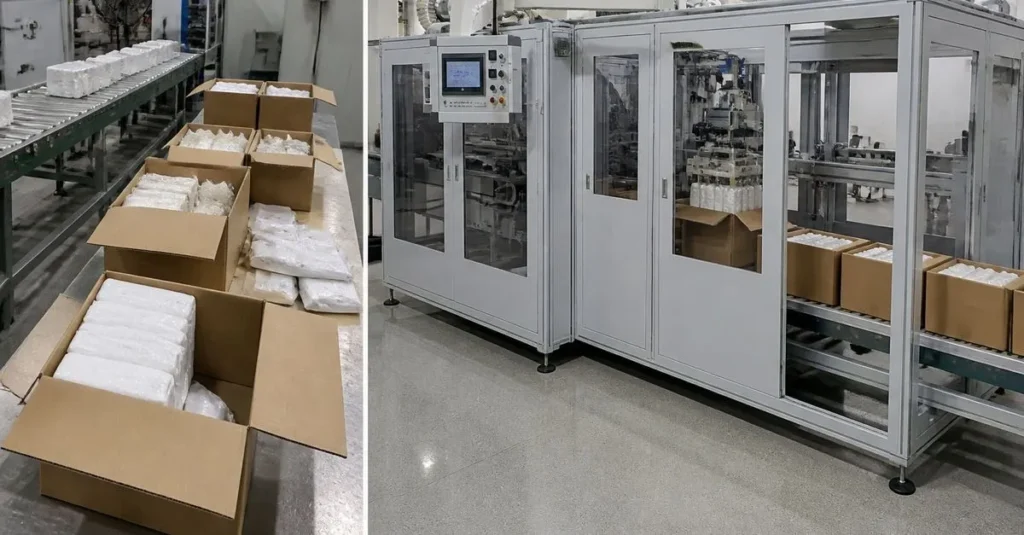
- End-to-End Converting & Automatic Packing Machinery: Welldone manufactures servo production lines and matched packing systems for baby diapers (Baby Diaper Packing Machines), sanitary pads and panty liners (Female Care Packing Machines), adult diapers and underpads (Adult Care Packing Machines), and wet wipes—integrating 90° turning drums, reject nozzles, rotary stacking wheels, servo pre-compression units, and automatic baggers.
- Hygiene Raw Material & Packaging Film BOM Matching: Welldone supplies hygiene raw materials—including PE packaging films, backsheet films, nonwovens, fluff pulp, SAP, hot-melt adhesives, release paper, and spandex—and tests your target film or bag substrates during FAT.
- Finished Hygiene Products & Custom Consultation: Welldone also coordinates finished hygiene product supply and custom pack specifications; grades, dimensions, MOQs, lead times, and commercial terms are confirmed upon inquiry.
11. Buyer Actionable Checklist: 8 Verification Steps Before Freezing Packaging Film & Bagger Specs
8-Step Pre-Freeze Qualification Checklist for Hygiene Packaging & Bagging Lines
- Lock Stack Compression by Core Type (6% vs. 14%): Measure uncompressed stack height, compressed height, and 5-second recovery separately for high-fluff overnight SKUs versus thin daytime SKUs before ordering narrower bags.
- Audit 90° Transfer & Rotary Stacking Registration: Verify ≤±2–3 mm stack edge stagger so protruding leg cuffs or waist ears do not snag thinner 55 µm bag mouths.
- Couple Upstream Splice & Vision Signals to Pre-Stacker Reject Nozzles: Ensure every spliced or defective pad is ejected before entering the rotary stacking wheel.
- Specify Two-Stage Air-Expulsion Pre-Compression: Use an initial air-venting squeeze before final compression dwell so trapped air does not balloon the bag before sealing.
- Re-Index Heat-Sealing Jaws for Non-Laminated Mono-Material & mPCR Films: Verify closed-loop PID jaw temperature control (±2 °C) and cooling-bar hold time across 2-layer spans and 4-layer gussets.
- Test Bag-Opening Suction & Duckbill Clearance on Nonwoven or Paper Bags: Check vacuum cup flow on slightly porous nonwoven bags and widen duckbill clearance (+3–5 mm) for low-elongation paper bags across a 1,000-bag trial.
- Validate Easy-Open Perforation & Handle Tear Under Pallet Load: Run 1.2 m drop tests and 72-hour pallet compression checks to confirm 6%–14% spring-back does not split perforations.
- Ship Target Eco-Film or Wicket Bags for Live Machine FAT: Run 2 to 3 master rolls or wicket-bag cases of your actual 55 µm PE, mPCR PE, nonwoven, or paper substrate during FAT at rated bags per minute.
12. Source & Date
Primary & Cross-Checked Industry Sources (Verified November 10, 2026):
- Primary Source: Nonwovens Industry — "More than a Wrapper: Hygiene Manufacturers Balance Performance, Usability, Sustainability and Cost When Designing Packaging Concepts" by Karen McIntyre (Published November 4, 2026).
- Auxiliary Source 1: Packaging Europe — "Recyclable Nonwoven Pack Designed to Reflect Softness of Drylock's Diapers" (Cross-verifying Korozo Group, Drylock Technologies, and Colruyt's recyclable nonwoven diaper packaging).
- Auxiliary Source 2: Sustainable Packaging News — "Korozo Group, Drylock Technologies, and Colruyt Partner on Recyclable Nonwoven Diaper Packaging" (Cross-verifying the single-material recyclable nonwoven pack rollout).
- Auxiliary Source 3: Drylock Technologies — Drylock Technologies Sustainability Overview (Confirming Drylock's paper bag and recyclable PE packaging programs).
13. Frequently Asked Questions (FAQ)
1. Can an existing automatic diaper bagger run 55 µm downgauged or mPCR mono-material PE bags without machine replacement?
In most servo-driven bagging systems, yes—provided the sealing station has closed-loop PID temperature and impulse-time control, smooth PTFE jaw covers, and adjustable cooling-bar hold time. Older constant-heat sealers built for laminated films often need a jaw and controller retrofit to prevent burn-through.
2. Why did LG Unicharm achieve a 14% compression reduction on Day&Night diaper pants versus 6% on standard diaper pants?
Overnight diaper pants contain more high-loft cellulose fluff pulp for nocturnal capacity, providing higher compressible air void volume than thinner, higher-SAP daytime pants whose safe compression ceiling is around 6%.
3. What machine adjustments are needed when switching from PE wicket bags to recyclable nonwoven or paper diaper bags?
Nonwoven bags require high-flow venturi suction cups and ultrasonic or stepped impulse sealing jaws, whereas recycled-fiber paper bags require moderated stack compression, +3–5 mm wider duckbill clearance, and gentler pusher acceleration.
4. How does Welldone help buyers coordinate converting machinery, packing machines, and packaging film BOMs?
Welldone supplies complete diaper, sanitary pad, adult care, underpad, and wet wipes lines with matched automatic stackers, compressors, and baggers, plus hygiene raw materials and packaging films verified during live FAT.
Editorial & Technical Verification Note: Prepared by the Welldone Hygiene Machinery & Supply Chain Engineering Team. JINJIANG WELLDONE MACHINE CO., LTD. has specialized in hygiene machinery, raw material matching, and turnkey solutions since 2008 across 80+ countries under ISO9001 and CE standards.
14. Request a Hygiene Production Line, Packing Machine, or Packaging BOM Consultation
Planning to qualify 55 µm PE films, mPCR mono-material bags, recyclable nonwoven or paper packaging, or high-compression automatic stacker-baggers? Contact Welldone for production line configurations, automatic packing equipment, raw material sampling, or finished hygiene product specifications:
Contact: Steven Tang | Phone/WhatsApp/WeChat: +86-13655936189 | Tel: +86 595-28082887
Website: https://cnwelldone.com/contact-us
Email: welldone@cnwelldone.com