Automatic Case Packing: The Cost Manual Packing Hides

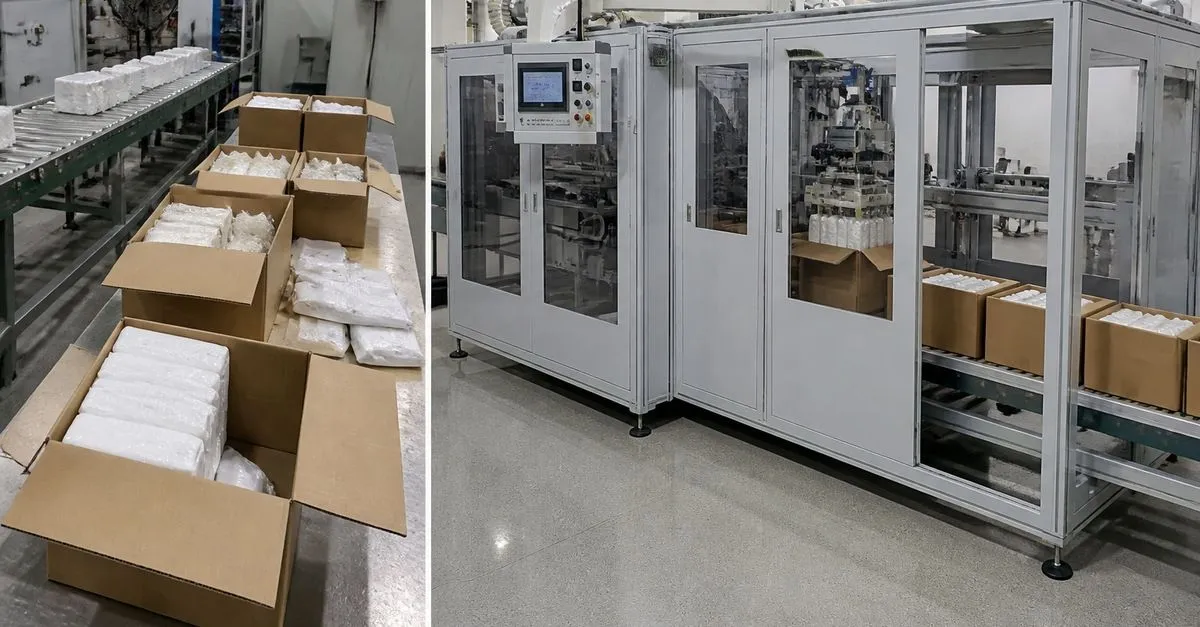
Manual vs Automatic Case Packing for Diaper & Hygiene Factories: Hidden Costs and ROI
Most diaper factories and hygiene product manufacturers automate the converting line first, then the bagging machine, and stop there. Case packing stays manual because the arithmetic looks obvious: a few operators cost less than an automatic case packing machine.
This article takes that calculation apart. It compares manual case packing against automated secondary packaging for hygiene product lines — what inconsistent carton fill does to a sea shipment, why manual packing quietly caps line speed, and how to build an ROI case that includes the costs currently sitting on someone else's spreadsheet.
End-of-Line Series · Part 4
Part 1: In-Line Bag Making vs Pre-Made Bags — where the bag comes from.
Part 2: Rated Speed vs Actual Output — how fast it really runs.
Part 3: Seal Integrity in Export Shipping — whether the seal holds.
Part 4 — what happens to the bag after it is sealed.
Part 1: In-Line Bag Making vs Pre-Made Bags — where the bag comes from.
Part 2: Rated Speed vs Actual Output — how fast it really runs.
Part 3: Seal Integrity in Export Shipping — whether the seal holds.
Part 4 — what happens to the bag after it is sealed.
Where Automation Usually Stops
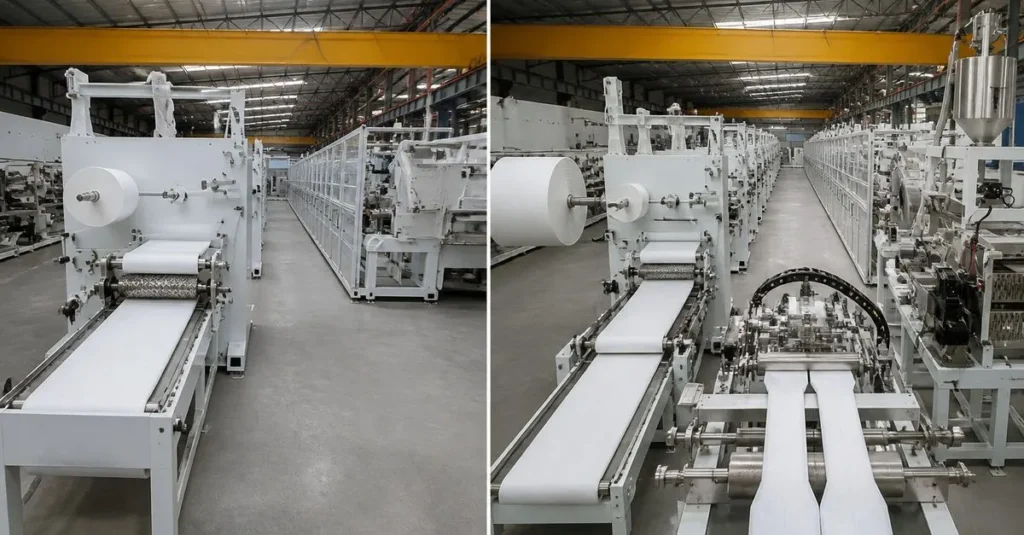
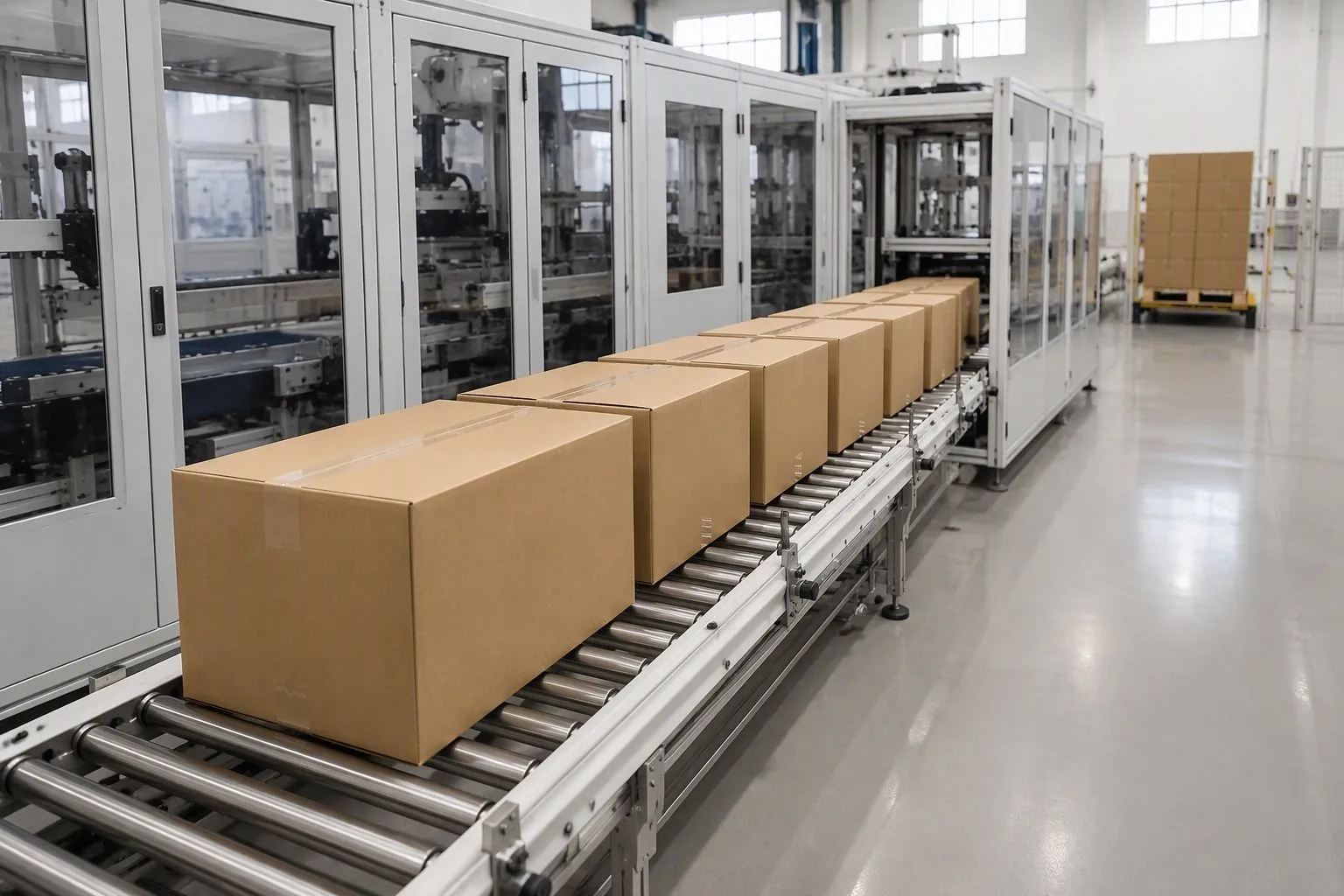
Walk through a hygiene products factory in a growth market and you will often see the same picture. A full servo converting line running at several hundred pieces per minute. An enclosed bagging machine behind it. And then, at the end of the aisle, a plain steel bench with cartons on it and people filling them by hand.
Nobody planned that. It is what happens when each investment is justified separately and case packing never quite clears the hurdle.
The converting line was justified by capacity. The bagging machine was justified by labour and pack quality. The case packer gets compared against wages alone, and against wages alone it usually loses.
The Void in the Carton
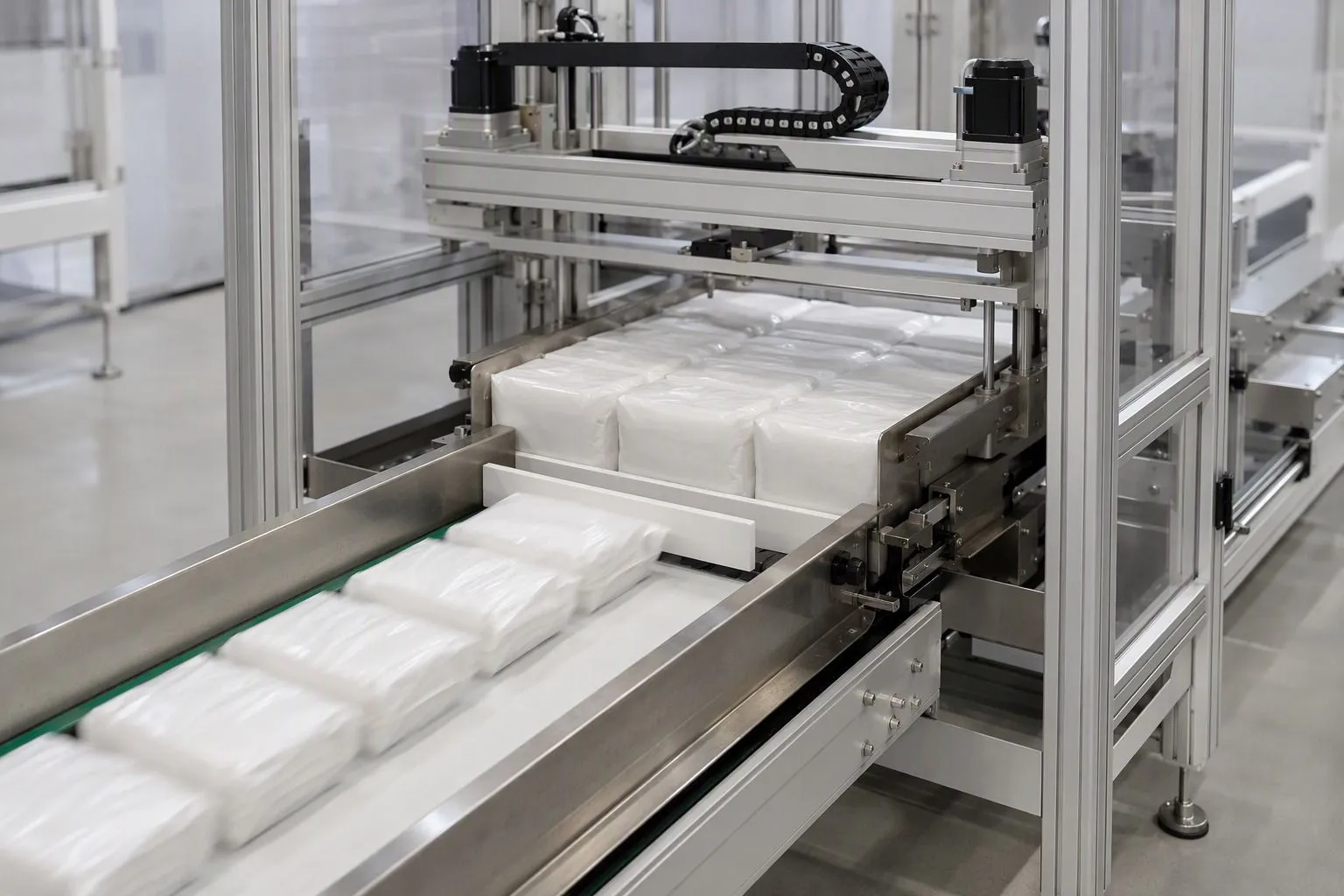
Here is what differs mechanically between a hand-packed carton and a machine-packed one.
A person filling a carton works to a count, not to a density. Twelve bags go in. Whether those twelve bags sit tightly against each other or leave two centimetres of air at one end depends on how they were placed, how the previous carton went, and what point of the shift it is.
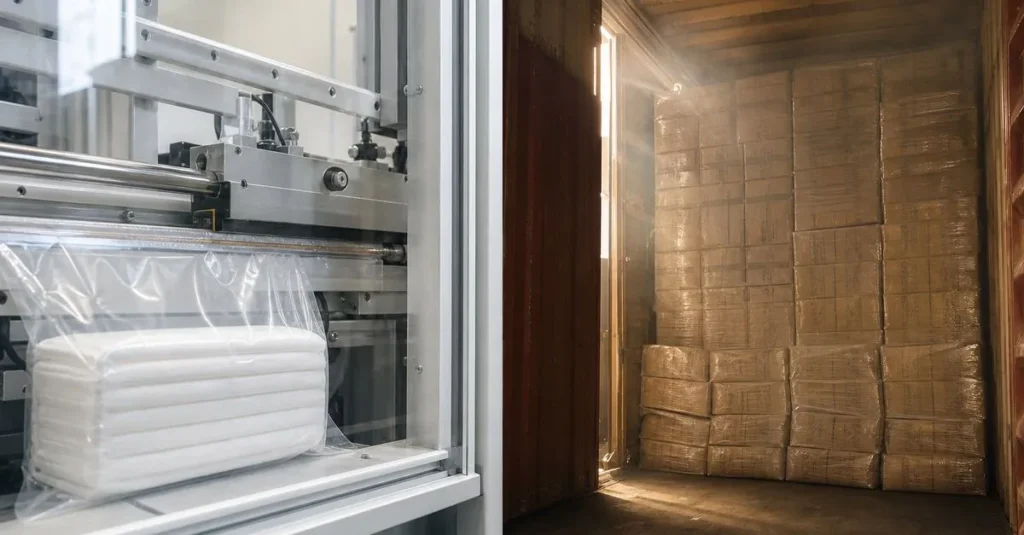
That air is the problem. On a pallet, a carton with a void does not carry load evenly — it can deform into the void, and cartons stacked above it settle. Across a full pallet stack and several weeks of ocean freight, the lower layers may arrive crushed or deformed.
The carton did not fail because the board was weak. It failed because it was asked to carry a load it was not filled to carry.
In Part 3 the conclusion was to let the carton carry the load rather than the pack. This is the other half of that sentence: a carton can only carry load if it is filled to do so.
Two Costs, Two Ledgers
The reason this decision goes wrong so consistently is organisational rather than technical.
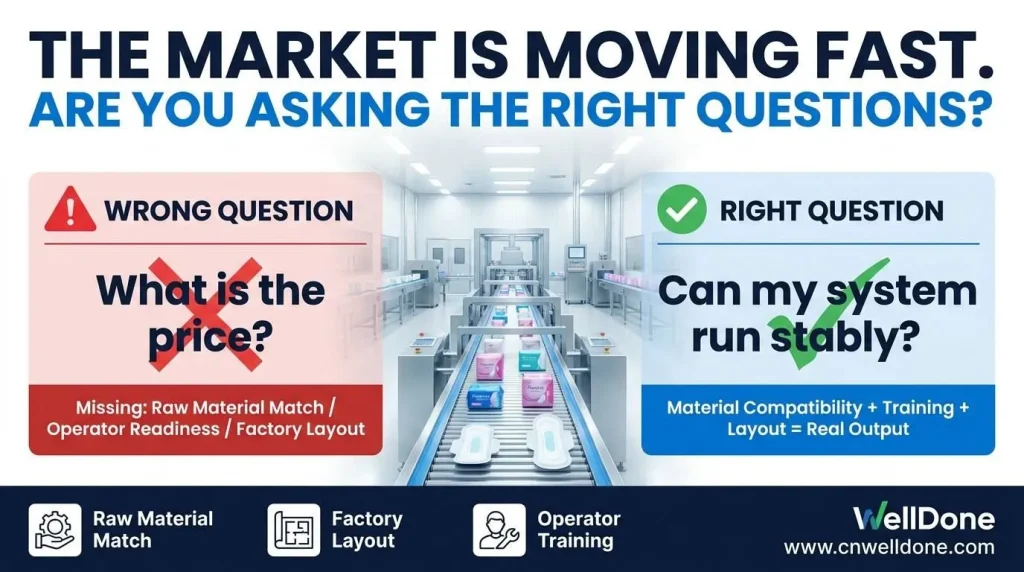
Labour cost is visible, monthly, and owned by production. Transit damage is delayed, irregular, and often absorbed by sales or logistics as a customer complaint. The two numbers rarely appear on the same page, so the comparison is rarely made.
| Cost | Visibility | Who Sees It | Usually in the ROI? |
|---|---|---|---|
| Operator wages | Monthly, obvious | Production | Yes |
| Transit damage claims | Delayed until delivery or customer inspection | Sales / logistics | Seldom |
| Rework and repacking | Often absorbed into overhead | Warehouse | Seldom |
| Line speed ceiling | Invisible unless measured | Frequently nobody | Rarely |
| Customer confidence | Shows up at reorder | Sales | Rarely |
Typically only the first row enters the calculation. The other four are real money.
Consistency Beats Headcount
In most cases the argument for automating this section is not about removing people at all. It is about removing variation.
A machine fills every carton the same way — same group geometry, same compression, same flap fold, same seal position. That consistency is what makes pallet stacking predictable, and predictable stacking is what survives a container.
It also makes everything downstream easier to plan. Cartons of identical dimension and weight palletise cleanly, load into a container without gaps, and give your freight forwarder a stack that can be secured properly.
Manual Packing Caps Line Speed
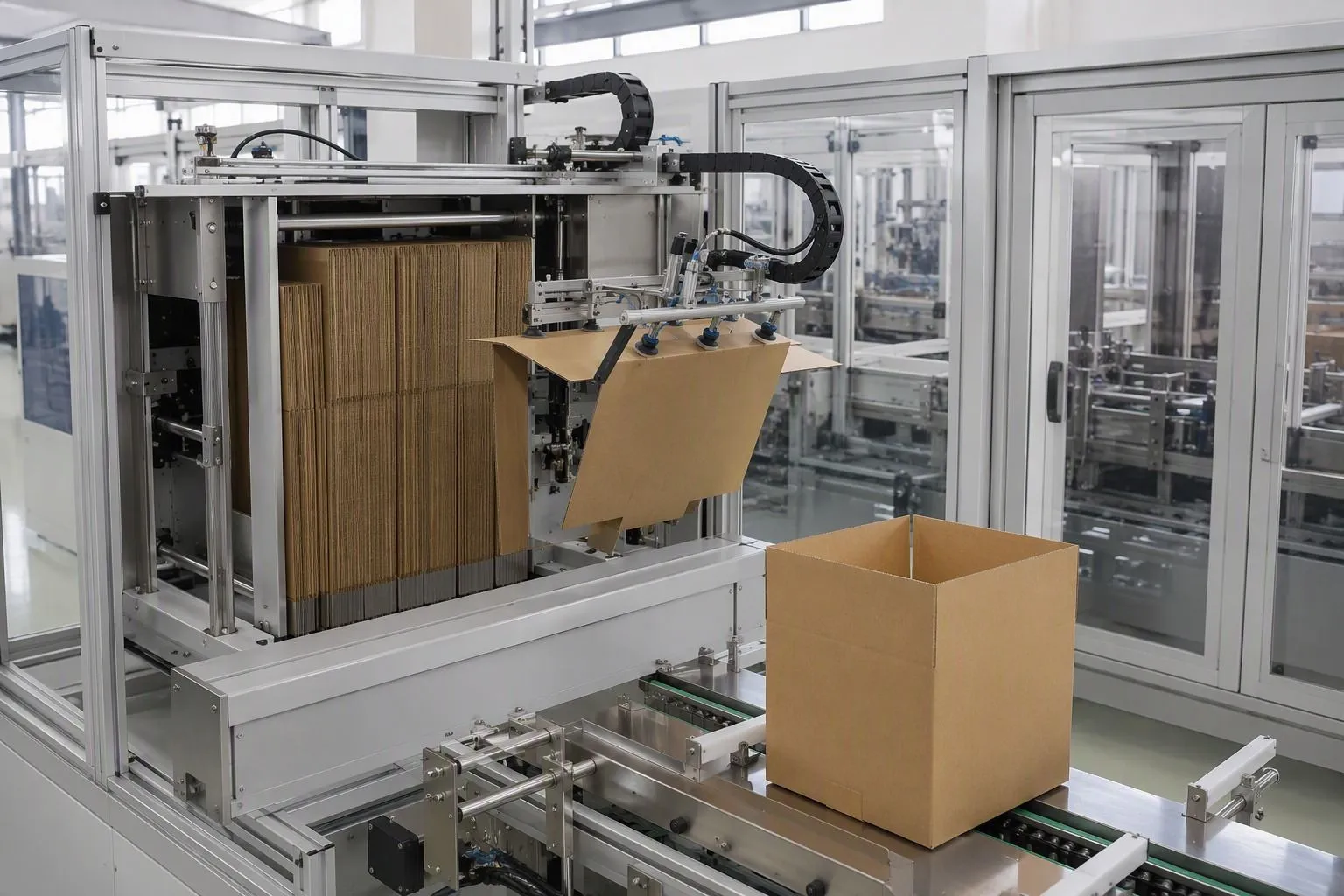
This is the cost that is least often measured, and it can be the largest.
A bagging machine can only discharge as fast as something takes the bags away. If that something is a pair of hands, the hands set the rate — not at the start of the shift, but late in it.
Part 2 covered how a converting line caps a bagging machine. The same logic applies one station further down. You can specify a bagging machine at 50 packs per minute, but if case packing sustains 35, you bought 50 and you run 35.
Factories in this situation often believe their bagging machine is underperforming. Frequently it is not underperforming — it is waiting.
Worked Example: Capacity Loss
Illustrative example only. The figures below are a worked calculation to demonstrate method, not data from a specific customer installation. Substitute your own measured values.
Consider a baby diaper line where case packing has never been timed against the bagging machine.
| Parameter | Illustrative Value |
|---|---|
| Product | Baby diaper, 30 pieces per bag |
| Bagging machine rated output | 50 bags/min |
| Bags per carton | 6 |
| Cartons required to keep pace | 50 ÷ 6 ≈ 8.3 cartons/min |
| Manual packing sustained rate | 6 cartons/min |
| Effective bagging rate imposed | 6 × 6 = 36 bags/min |
| Capacity not used | (50 − 36) ÷ 50 = 28% |
In this illustration the factory owns a 50 bags/min machine and operates it at 36. Over a 20-hour production day that is roughly 16,800 bags of unrealised output — capacity that was already purchased and is being discarded daily.
Run the same arithmetic with your own numbers. The two you need are the bagging machine's sustained output measured late in a shift, and the number of completed cartons in the same period.
What a Case Packer Actually Does
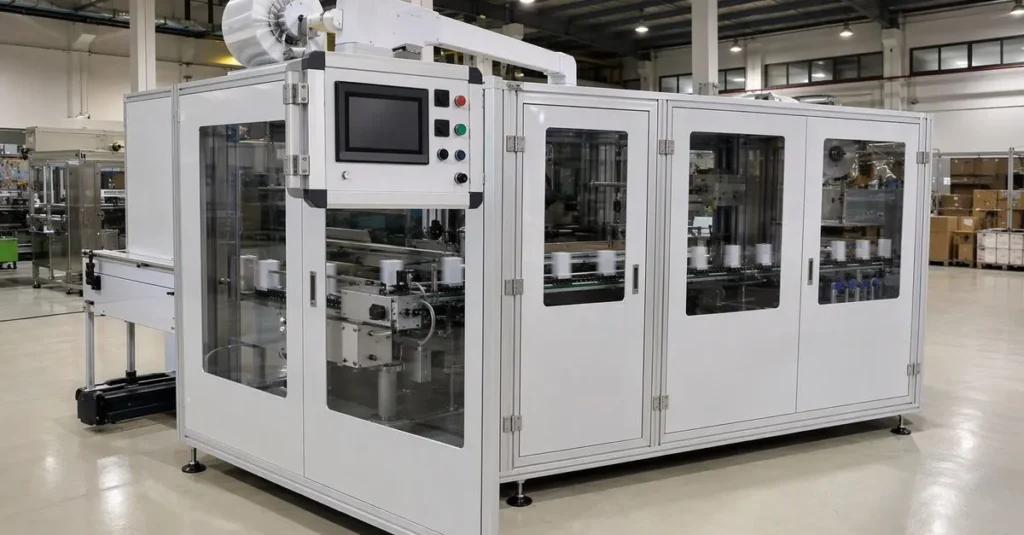
Secondary packaging covers more than dropping bags into a box. A full station typically handles four functions, and which of them you need depends on your carton and your market.
- Collating. Sealed bags are grouped into the exact pattern that will fill the carton — count, orientation and layer arrangement.
- Carton erecting. Flat blanks are opened, squared and bottom-sealed ready to receive product.
- Loading. The grouped block enters the carton, either dropped from above or pushed from the side.
- Closing and sealing. Flaps are folded and sealed with tape or hot melt adhesive.
Some factories automate only collating and loading, keeping carton closing manual. That is a legitimate intermediate step, and it captures most of the fill-consistency benefit at lower capital cost.
You can review our full-servo in-line packaging system and its end-of-line configuration options to see how these four functions are integrated into a single station.
Drop, Side or Wrap-Around
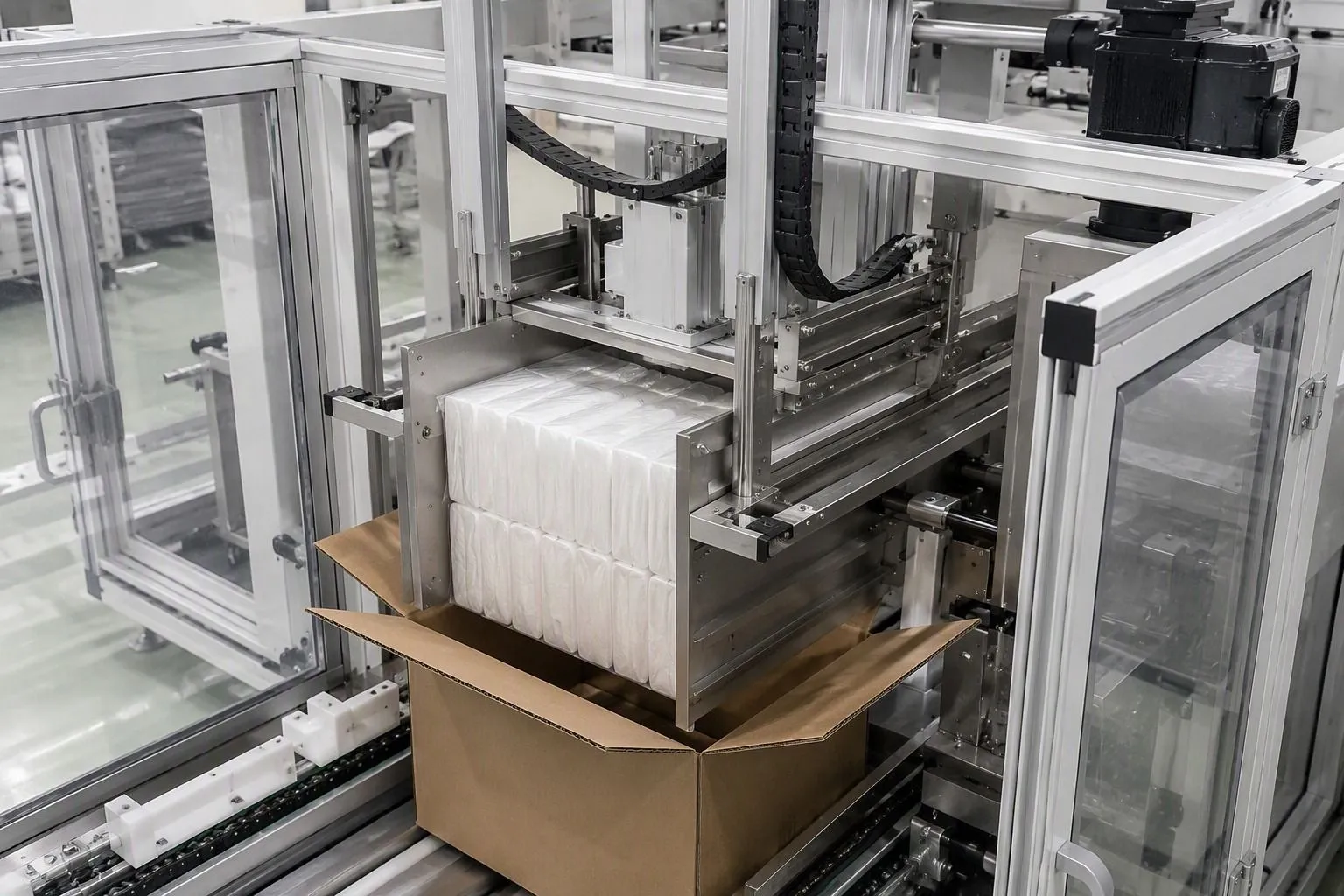
Three loading approaches cover most diaper and hygiene applications.
Drop loading
The grouped block is lowered into an open-top carton. Compact and mechanically simple. Suited to compressible products such as diapers and sanitary pads, where a short controlled descent causes no damage. Less suitable where the group must retain a precise arrangement, since the block can shift on entry.
Side loading
The carton lies on its side and the group is pushed in horizontally. Preferred for taller pack counts, for rigid or semi-rigid packs, and where a vertical drop would disturb the group order. Requires more floor length than drop loading.
Wrap-around
A flat blank is formed around the grouped product rather than the product entering a pre-formed carton. Produces the tightest pack with the least void and generally uses less board, which matters for sea freight. The trade-off is a larger machine footprint and a tighter blank specification.
Which method fits depends on product bulk, carton supply and available floor space at the line end. You can compare packing machine configurations for different diaper pack formats or the equivalent range for female care products, but the final selection is a layout conversation rather than a catalogue choice.
Carton Quality Sets the Limit
One practical warning before budgeting for this section.
An automatic case packer is considerably less tolerant of carton variation than a person is. An operator compensates for a warped blank, a slightly out-of-spec crease or an inconsistent board grade without thinking about it. A machine does not — it jams.
Factories buying their first case packer in markets with variable board supply sometimes find the machine has effectively raised their carton specification. Budget for that. Discuss crease tolerance, board grade consistency and moisture content with your supplier before commissioning rather than after the first week of stoppages.
Building an Honest Business Case
If you want a calculation that reflects reality rather than the wages line, gather five figures before comparing quotations.
| Figure to Collect | Where to Find It |
|---|---|
| Transit damage claims and credits, last 12 months | Sales records |
| Repacking and rework hours | Warehouse labour records |
| Sustained packs/min measured late in a shift | Time the line yourself; do not use the rating |
| Gap between bagging capacity and case packing rate | Compare the two measured rates |
| Case packing labour, fully loaded | Payroll, including overtime and turnover cost |
The third and fourth rows are the ones most likely to change the decision. A factory that discovers its line has been running well below bagging capacity is no longer evaluating a labour-saving device — it is evaluating recovered capacity it has already paid for.
Not sure whether manual case packing is limiting your line?
Send us your actual bagging output, carton size and line-end layout. Our engineering team can help identify where the bottleneck sits before you compare any quotations.
Example ROI Calculation
Illustrative calculation only. The values below are placeholders chosen to demonstrate the method. They are not Welldone customer data and not a price indication. Replace every figure with your own before drawing conclusions.
The point of this exercise is not the final number. It is to show which lines belong in the calculation and are usually left out.
| Line Item | Manual | Automated |
|---|---|---|
| Operators on case packing per shift | 6 | 1 (supervision) |
| Shifts per day | 2 | 2 |
| Annual labour cost | A | A ÷ 6 |
| Annual repacking and rework | B | Reduced |
| Annual transit damage claims | C | Reduced |
| Unrealised capacity (from Section 6) | D | Recovered |
| Equipment investment | — | E |
| Annual maintenance and spares | — | F |
Simplified payback:
Payback (years) = E ÷ [ (A − A÷6) + B + C + D − F ]
Two observations about this formula.
First, if you populate only A — labour — the payback period will look long, which is exactly why this investment is so often deferred. Terms B, C and D are real costs that sit in other departments' budgets.
Second, D is frequently the largest term and the hardest to obtain, because it requires timing your own line rather than reading a specification sheet. It is also the term most likely to change the answer.
When Manual Is Still Right
Automation is not automatically correct here, and I would rather say so than recommend a machine that sits idle.
Manual case packing remains a reasonable choice when:
- Output is modest and stable. If hands comfortably keep pace with the bagging machine late in a shift, there is no capacity to recover.
- You run many small-batch SKUs with different carton formats. Frequent format changes erode the consistency advantage and add changeover time.
- Product ships domestically over short distances. Light stacking and short transit reduce the cost of fill variation considerably.
- Carton supply is too variable. If your board grade and crease tolerance fluctuate, a machine will convert that variation into downtime.
- Floor space at the line end is genuinely unavailable. Wrap-around in particular needs more area than many retrofits allow.
The case for automating becomes strong when three conditions hold at once: line output exceeds what hands sustain, the product travels by sea, and the carton format list is short.
Where budget is the constraint rather than the case, automating collating and loading while keeping carton closing manual captures most of the fill-consistency benefit at lower cost. That is often a better first step than deferring the decision entirely.
Why Welldone
We have manufactured hygiene product machinery in Jinjiang, Fujian since 2008 and delivered to more than 60 countries. Because we supply converting lines, bagging machines and end-of-line equipment, we size the chain together rather than quoting one station in isolation.
Whole-line sizingWe check case packing rate against bagging capacity and converting output before recommending a configuration, so you are not sold capacity your line cannot feed.
Staged automationWhere budget is limited we will propose automating collating and loading first, keeping carton closing manual, rather than pushing a full station.
Carton spec reviewWe review your existing carton supply for crease tolerance and board consistency before commissioning, so the machine is not fighting your packaging.
Related Machines
Conclusion
Across this series the same theme keeps returning: the end of the line gets specified last and constrains everything upstream. The bag supply limits what you can sell. The speed rating rarely matches your output. The seal decides whether the product survives the journey. And case packing quietly caps the rate of everything before it.
None of these are exotic engineering problems. They are consequences of evaluating each station on its own.
So here is the question worth taking back: what did your factory pay in damage claims and rework last year — and has that number ever appeared in the same conversation as your case packing decision?
Frequently Asked Questions
How do we know if manual case packing is limiting our line?
Time it yourself rather than relying on ratings. Measure sustained packs per minute leaving the bagging machine late in a shift, then count completed cartons over the same period. If bags accumulate between the two stations, case packing is your constraint. Many factories only discover the size of the gap after measuring sustained output.
Can we automate part of the process rather than all of it?
Yes, and it is often the sensible first step. Automating collating and loading captures most of the fill-consistency benefit — which is what protects cartons in transit — while carton closing stays manual. It lowers the capital requirement and shortens payback. We will propose this route where it fits rather than defaulting to a full station.
Will our existing cartons work with an automatic case packer?
Not necessarily without review. Machines are less tolerant of warped blanks, inconsistent creases and variable board grade than an operator is. Before commissioning, check crease tolerance, board consistency and moisture content with your supplier. Problems created by carton variation are frequently attributed to the machine.
Does carton fill really affect transit damage?
Yes, because voids concentrate load. A carton with air at one end can deform into that space under stacking pressure, and cartons above it settle. Over several weeks in a container the lower layers absorb the accumulated effect. Seal integrity matters alongside carton fill — the two are covered together in Part 3 of this series.
Which loading method should we choose?
It follows from product and floor space rather than preference. Drop loading is compact and suits compressible products such as diapers and pads. Side loading suits taller pack counts where a vertical drop would disturb the group. Wrap-around gives the tightest pack with least void but needs more floor area. Send us your carton dimensions and line-end layout for a recommendation.
How much floor space does an automatic case packing machine require?
It depends on the loading method and how many of the four functions are automated. Drop loading is the most compact; side loading needs additional length for the horizontal push stroke; wrap-around typically needs the largest area. Rather than quoting a generic footprint, we work from your line-end drawing, including conveyor discharge height, aisle width and the position of any existing metal detector or checkweigher.
Can one case packer handle different diaper bag sizes?
Within a configured range, yes. What is fixed at order time is the geometry of the collating and loading mechanism, so the range of bag sizes and carton formats it will accept is defined before manufacture. A machine configured for one bag size and later asked to run a substantially different one will need mechanical modification. List every pack format you expect to run over the next few years at enquiry stage, not just the current one.
What information is required before choosing a case packing system?
At minimum: product type and dimensions, bag dimensions, bags per carton, carton internal and external dimensions, your bagging machine's sustained output, available floor space and conveyor discharge height at the line end, destination markets and typical transit mode, and your carton board specification. Missing the last two is the most common reason a specification turns out to be wrong after installation.
Request an End-of-Line Review
We will assess whether case packing is currently constraining your line and recommend a configuration — including whether a staged approach or continued manual packing makes more sense for you. Please include:
- Product type and size
- Bags per minute (sustained)
- Pieces per bag
- Bags per carton
- Carton dimensions
- Existing bagging machine output
- Available floor space at line end
- Country and destination markets