dult Diaper Machine Specification Checklist | Welldone

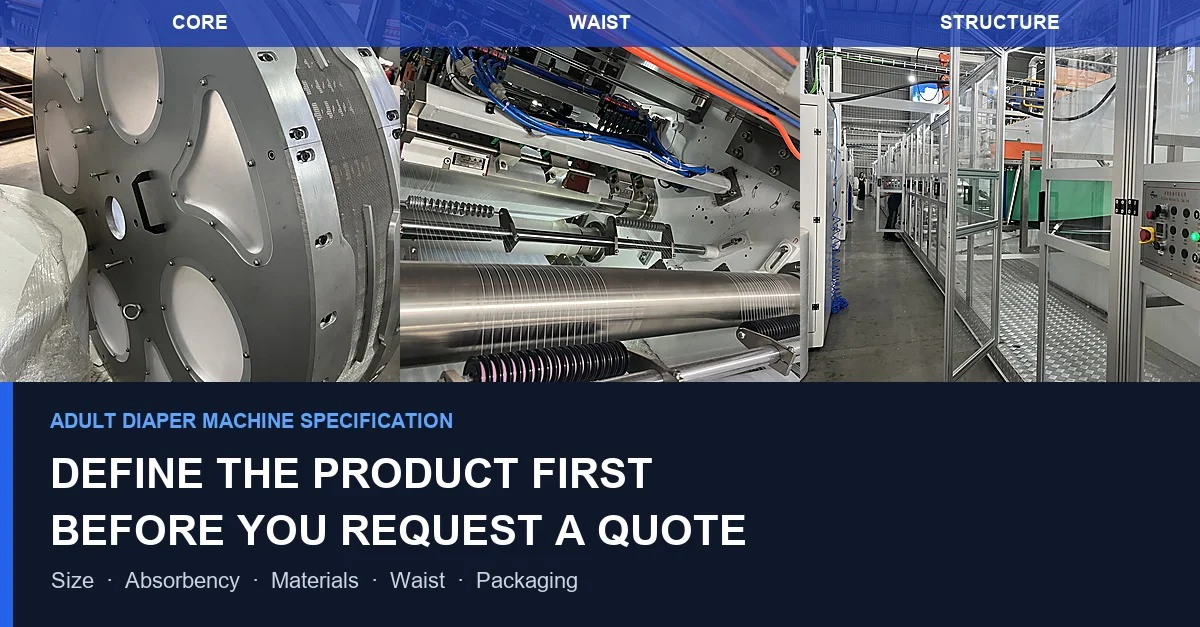
Define the Product Before Requesting an Adult Diaper Machine Quote
A first-time adult care investor often sends a supplier one sentence: "Please quote your adult diaper machine." The supplier replies with a list of questions, and the conversation slows down. The problem is not the supplier's responsiveness. It is that "adult diaper" is a product category, not a product specification.
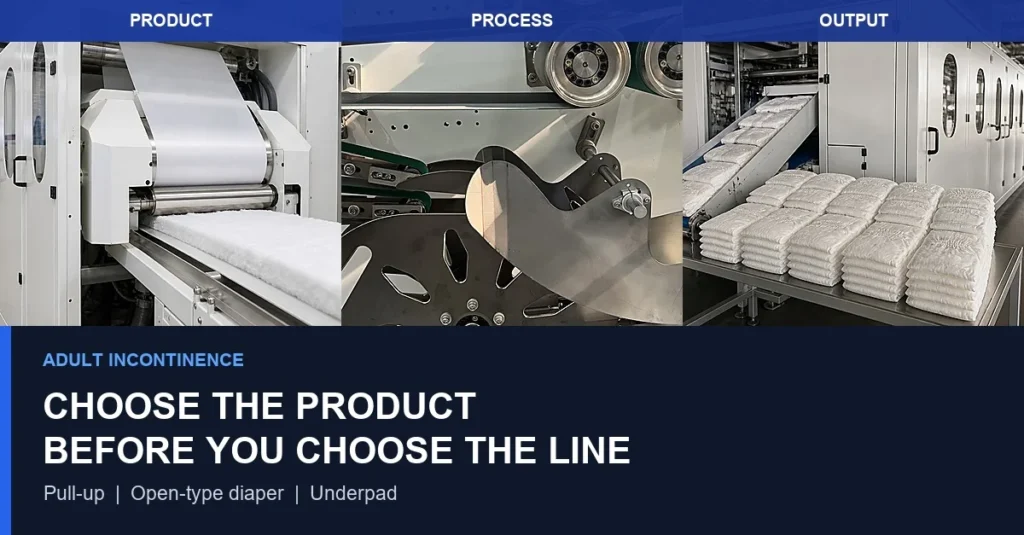
Actually, a machine quotation converts a finished-product definition into mechanical scope. When that definition is vague, every supplier prices a different assumption. One prices a pull-up line, another an open-type line, a third an underpad line — all under the same request heading.
Planning an Adult Incontinence Products Factory · Part 2 of 7
Part 1 — Adult Pull-Up vs Open-Type Diaper vs Underpad: choose the finished format first.
This article turns that decision into a written specification checklist before any quotation is requested.
Part 1 — Adult Pull-Up vs Open-Type Diaper vs Underpad: choose the finished format first.
This article turns that decision into a written specification checklist before any quotation is requested.
Why a product name is not a specification
"Adult diaper" does not define the finished dimensions, the absorbent core weight, the SAP ratio, the waist construction, the fastening method, the material widths or the pack arrangement. Two factories can ask for an adult diaper machine and be describing two different products with two different production systems.
A supplier cannot configure a line from a product name alone. The more information is missing, the more the quotation is built on the supplier's own assumptions. When three suppliers each assume a different product, the three prices cannot be compared — the comparison is false before it begins.
I believe a useful RFQ should begin with a finished-product sample or an agreed product drawing, then state the required sizes, material layers, absorbency target, packaging format, operating pattern and acceptance method. This lets competing quotations describe the same machine scope instead of competing assumptions.
The specification checklist that changes the machine
The following fields are the minimum inputs a supplier needs before a quotation becomes meaningful. Each one maps directly to a physical part of the production line.
| RFQ input | Machine consequence | Evidence to provide |
|---|---|---|
| Finished format (pull-up / open-type / underpad) | Sets the web path, assembly stations and product handling | Product drawing or physical sample |
| Size range (S / M / L / XL) | Defines cut-off length, tooling, change parts and recipe count | List of sizes with finished dimensions |
| Absorbency level (core weight, SAP ratio) | Sets SAP dosing, fluff forming and core forming method | Target absorbency value (CRC / AUL) |
| Material structure (topsheet / core / backsheet, ADL) | Defines unwinding positions, lamination and tension zones | Bill of materials with confirmed specifications |
| Waist / fastening system (elastic waist vs tape) | Determines elastic application or tape-fastening stations | Sample or drawing of the waist / tape design |
| Packaging format (stack count, bagging) | Sets stack compression, bagging and line hand-off | Pack sample and required count |
| Acceptance target (test product, speed basis) | Defines the test product, speed basis, duration and pass criteria | Draft FAT or RFS protocol |
This is a living list. The goal is not to answer every field perfectly before the first call, but to stop requesting a quotation while the central fields are still blank.
1. Format: the decision that sets the whole line
The finished format — pull-up pant, open-type diaper or flat underpad — decides the machine architecture before any speed or price discussion. The three formats share fluff pulp, SAP, nonwoven and PE film, but they do not share the same converting structure. The previous article in this series explains why they are not three sizes of one machine, so this checklist assumes the format decision has been made and records it in writing.
Welldone's adult care category covers pull-up and open-type adult diapers plus 3-layer and 5-layer underpads. Each format changes where elastic is applied, whether a tape system is needed and how finished products are folded, stacked and packed.
2. Size range: more than a number
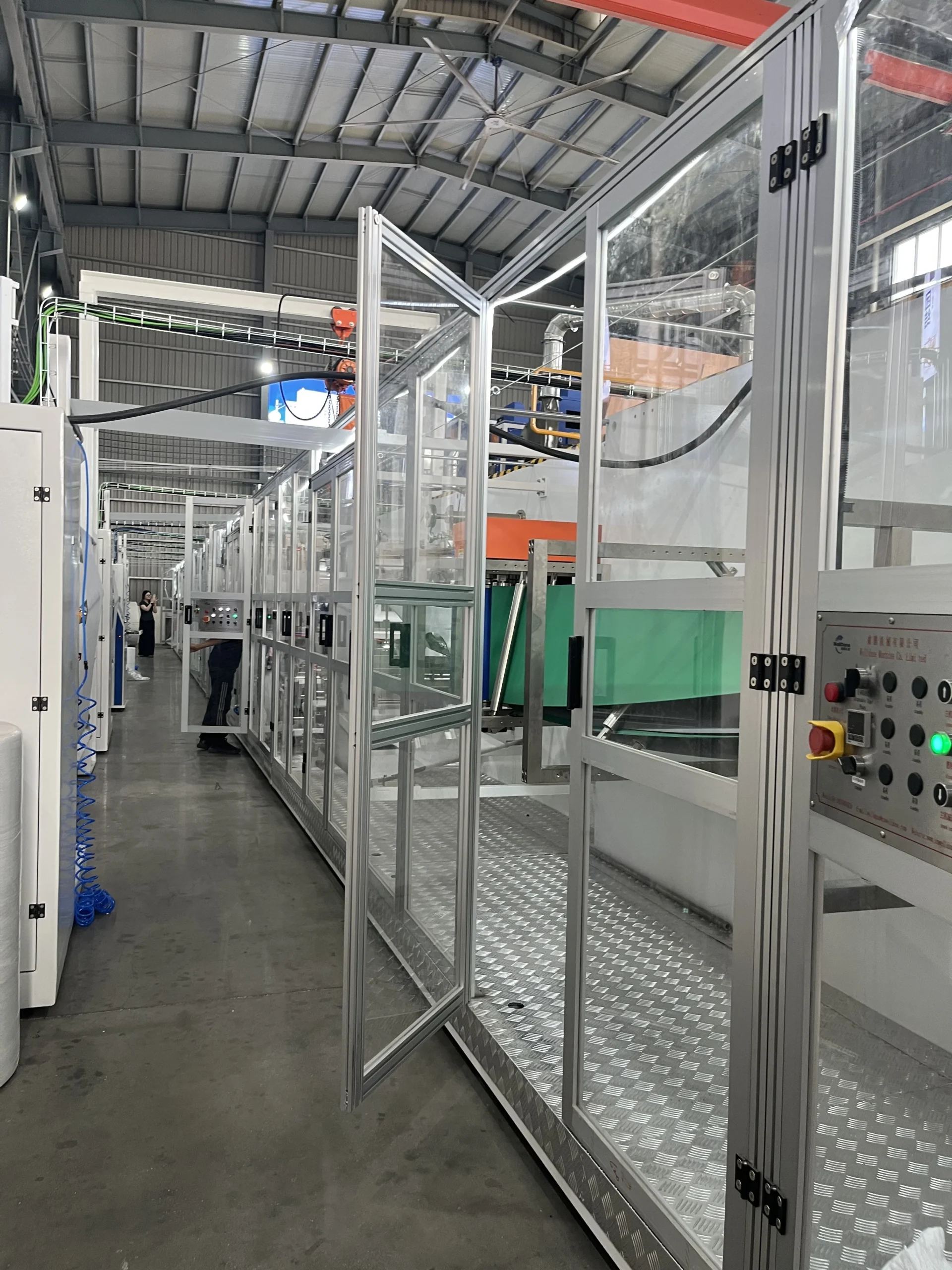
Adult products span a wider dimensional range than baby products. A line that must run S through XL has different tooling, cut-off length and change parts than a line built for two sizes. Welldone's control panel supports recipe management for S / M / L / XL size changeover, and its adult care design guidelines list a minimum changeover time of under 90 minutes — but that figure only means something when the buyer has named the sizes that must be produced and how often the line will switch.
The real question is not "what is the biggest size?" It is "which sizes will actually be sold in the first twelve months, and how many changeovers will a shift absorb?" A buyer who names eight sizes but sells two is paying for changeover flexibility that never gets used.
3. Absorbency level and core structure
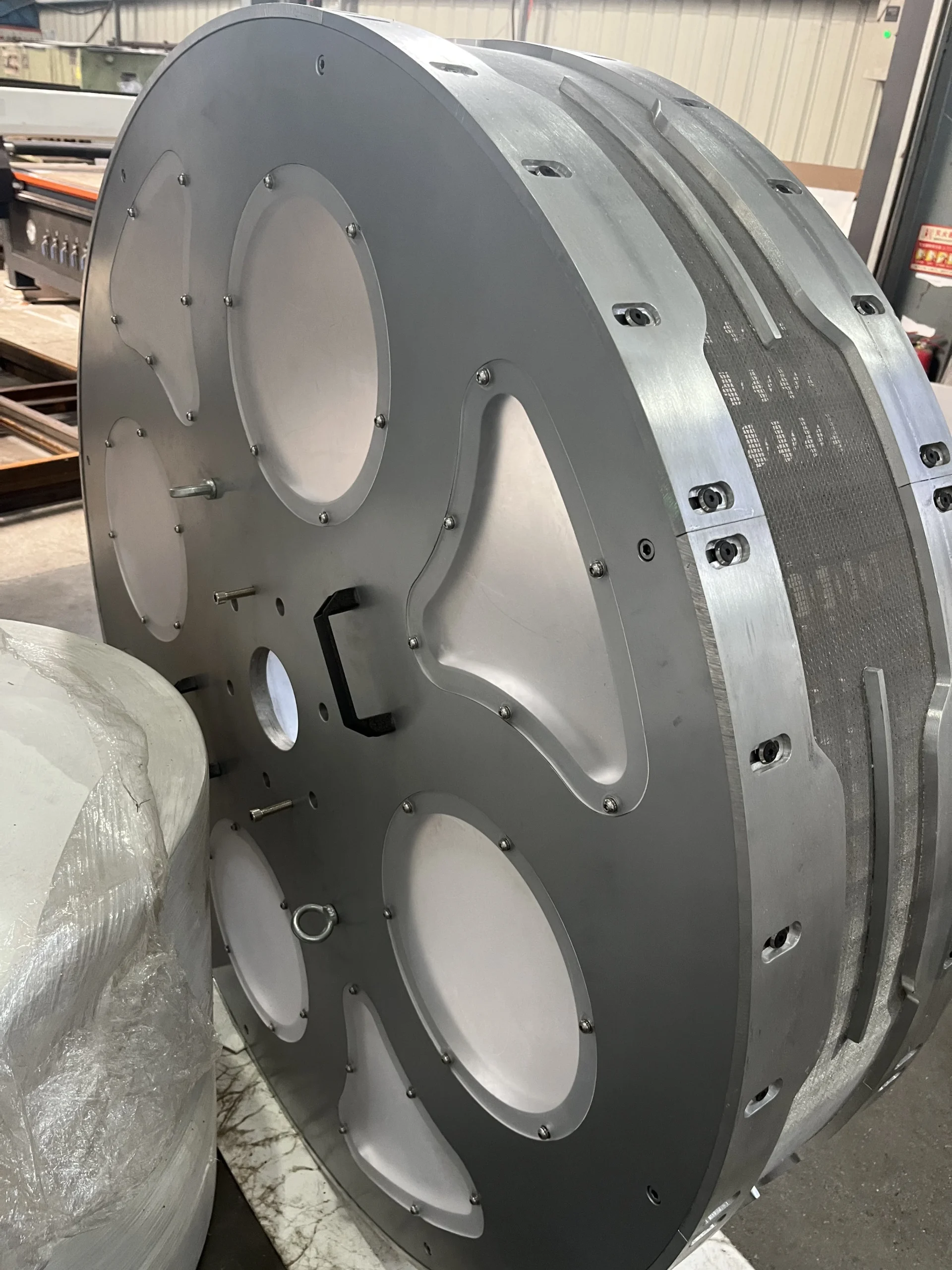
Absorbency is the most specification-driven field, and it changes three machine functions at once: SAP dosing, fluff forming and core forming. A high-absorbency product needs a higher SAP ratio and a stable core forming method, while a basic product can run a simpler structure. The supplier cannot know which one you mean without a target absorbency value.
Welldone asks buyers to share the spec ranges that match their target product tier — GSM, tensile, CRC / AUL and peel / shear. These values are the only reliable bridge between a marketing phrase like "heavy absorbency" and a machine that can actually form it. The acquisition layer (ADL) position and the number of core layers also have to be written down, because they change the unwinding and lamination sequence.
4. Material structure and widths
The adult care overview lists the compatible materials: nonwoven fabrics, tissue, PE backsheet, elastic waist / spandex, SAP, fluff pulp, acquisition layer, release paper and hot-melt adhesives. That list is a compatibility statement, not a recipe. The buyer must still specify which layers their product uses, in what order, and at what width.
Material width and tension control are where quotation assumptions hide. A supplier who assumes a narrow web may quote a line that cannot run the buyer's full-width topsheet. In most cases, the finished width and the material roll widths should be fixed before the quotation is final, because they decide the unwinding stands, the lamination section and the cutting system.
5. Waist and fastening system
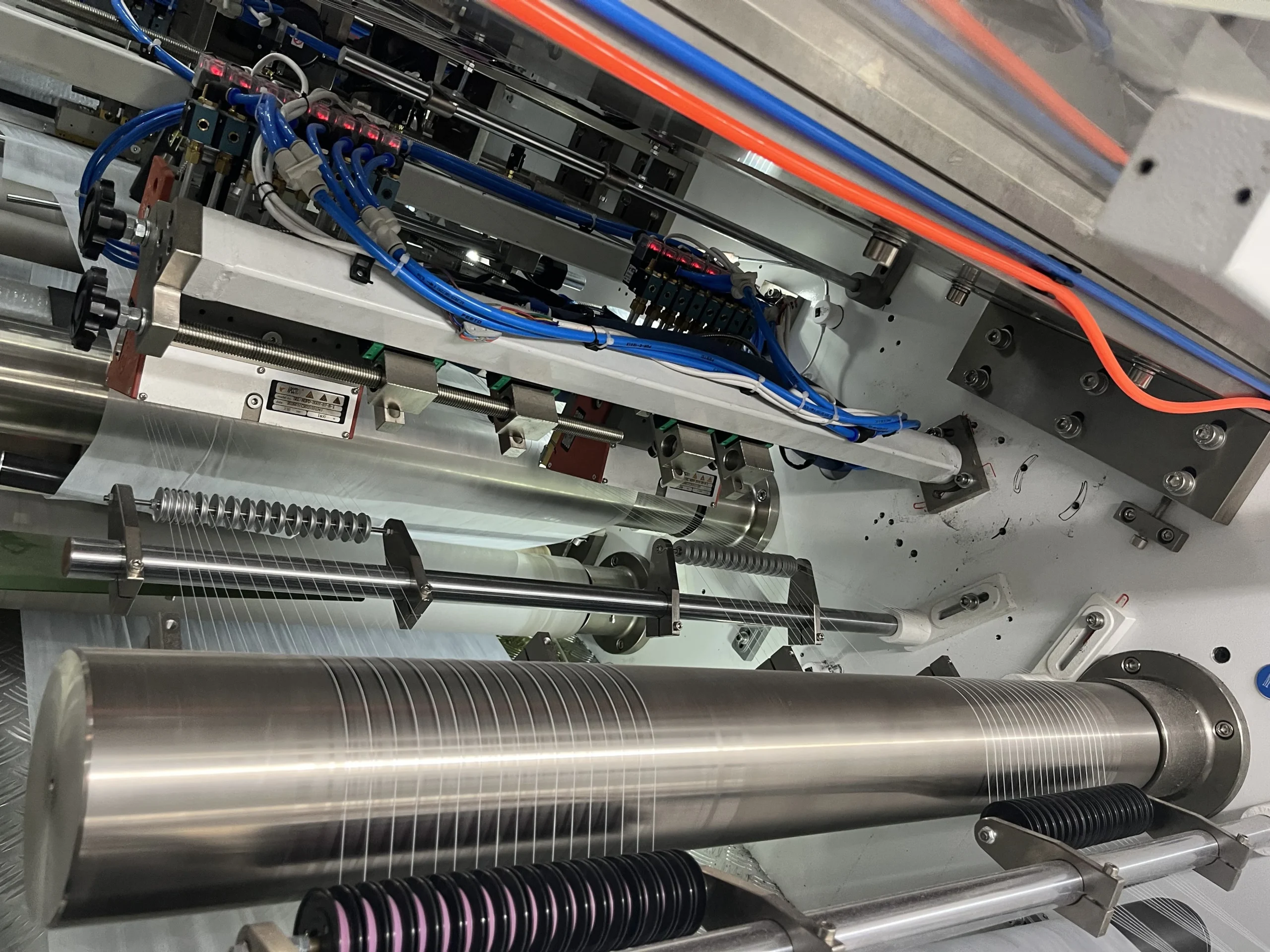
A pull-up pant needs a controlled elastic waist that must be formed, laminated and assembled before the individual pant is produced. An open-type adult diaper uses a tape-fastened body, which replaces that elastic-waist assembly with tape application and different alignment. An underpad removes wearable waist construction entirely.
Note that "elastic waist" is not a single specification. The number of elastic strands, their position and the waist construction change the stations and the change parts. A buyer should describe the waist or tape design — ideally with a sample — rather than leaving the supplier to guess between a closed pant and a tape system.
6. Packaging: the step buyers plan last
Packaging is discussed too late in most projects, but it determines the line's back end. The stack count, compression, bagging and carton arrangement all have to be defined before the machine hand-off can be quoted. Welldone can integrate bagging and sealing options such as the P25 auto-packing unit, but only when the buyer has stated the pieces-per-bag and the pack format.
A line that converts 250 pcs/min but hands off into manual bagging is a different economic model from one with automatic packing. The packaging decision changes both the machine scope and the labour plan, so it belongs in the first RFQ, not the final discussion.
7. Speed and acceptance: compare the same basis
Speed is the field where suppliers and buyers most often talk past each other. Welldone's adult care overview lists adult open-type and pull-up lines at a design range of 250–300 pcs/min and a stable range of 200–260 pcs/min, while underpad lines are listed at 700–900 pcs/min design and 600–800 pcs/min stable. These are category-level ranges, not a promise for every SKU.
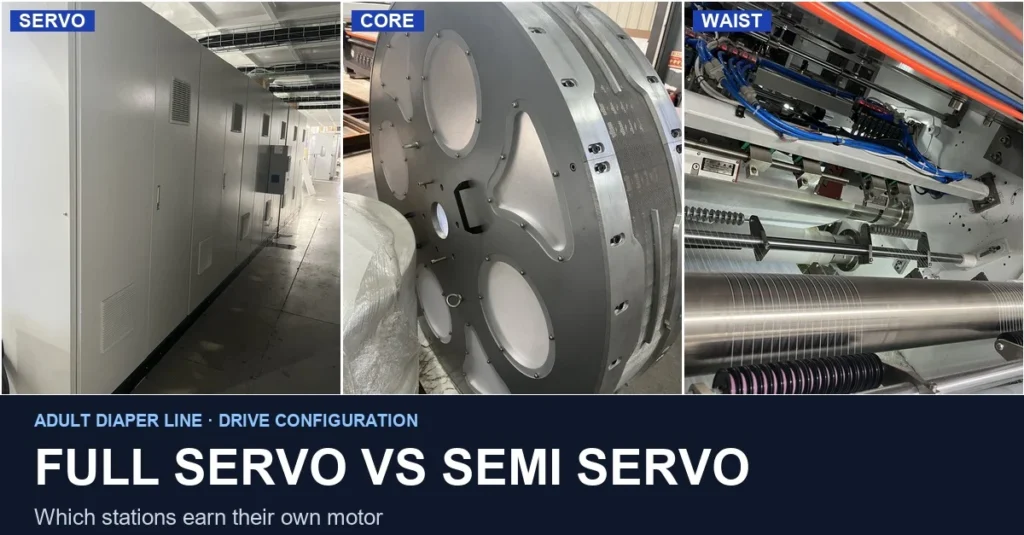
| Drive system | Design speed | Stable speed | Typical use |
|---|---|---|---|
| Full-servo | 300 pcs/min | 250 pcs/min | Premium pull-up and high-end open-type diapers |
| Semi-servo | 250 pcs/min | 200 pcs/min | Standard adult diapers and underpads |
| Fully mechanical | 200 pcs/min | 150–180 pcs/min | Basic open-type adult diapers, local production |
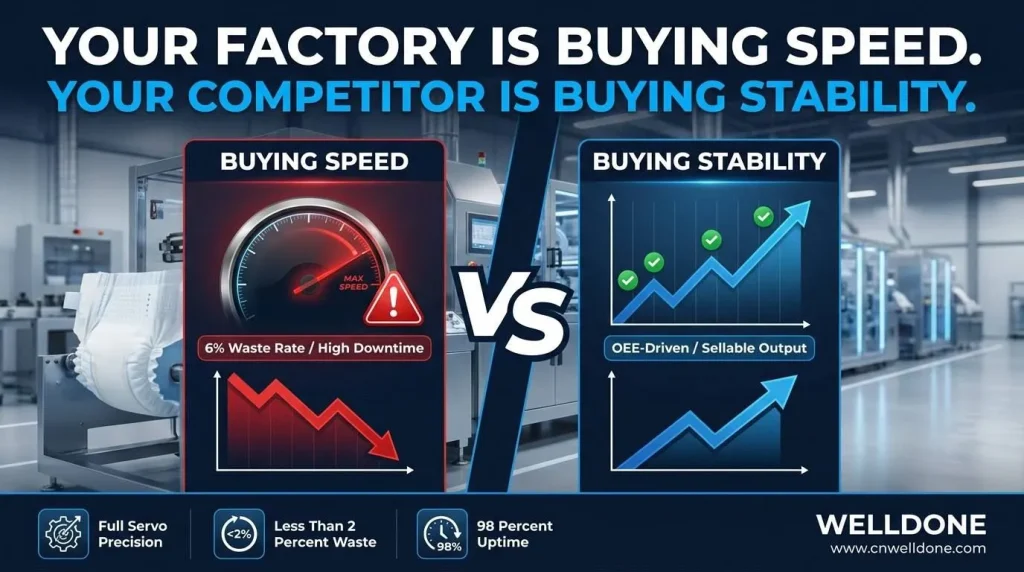
Two buyers can compare the same numbers and reach different conclusions because they never stated whether they meant design speed or stable speed, pcs/min or another unit, and which SKU would be running during the test. The acceptance target — test product, speed basis, test duration and pass criteria — should be written into the RFQ so the comparison is against the same conditions. A broader explanation of the design-speed versus actual-output gap is available in the rated speed vs actual output guide, and the adult-specific drive comparison follows later in this series.
The RFQ one-pager: what to send before the first call
Before requesting an adult diaper machine quotation, prepare these items. They can be approximate at first — the point is to send them together, so the supplier's first reply is a configuration discussion rather than a list of clarifying questions.
Send a sample or drawing, a size list, a material layer list, an absorbency target, a packaging format, an operating pattern and a draft acceptance method. Then the quotation can describe the same machine scope for every supplier.
- A finished-product sample or an agreed product drawing
- The size range to be sold first, with dimensions
- The material layer structure, in order, with widths
- A target absorbency value (CRC / AUL) and SAP ratio
- The waist or tape fastening design
- The packaging format and pieces-per-bag
- The planned operating pattern and daily output target
- A draft acceptance protocol (test product, speed basis, duration, pass criteria)
Welldone's service range covers finished-product design, cost and feasibility study, ROI reporting, factory layout, material planning, quality control and after-sales support. The machine scope is built from this brief, not from the product name alone.
Why Welldone
- Product-led configuration: the line scope is built from the target format, size range, material structure, absorbency target and packaging brief.
- Adult care category depth: pull-up, open-type and underpad options are reviewed within one adult care planning process without treating them as interchangeable.
- Project support: overseas engineer support is available for installation, commissioning and training, subject to the agreed project scope.
Related adult care machines and guides
Conclusion
An adult diaper machine quotation is only as accurate as the product definition behind it. Define the format, size range, absorbency, materials, waist system, packaging and acceptance basis first — then request the quotation. The comparison is only fair when every supplier prices the same machine scope.
If your next RFQ could only contain one specification field, which one would most likely change the line the supplier quotes?
Frequently asked questions
What should I send before asking for an adult diaper machine quote?
Send a product sample or drawing, the size range, the material layer structure, an absorbency target, the waist or tape design, the packaging format, the operating pattern and a draft acceptance protocol.
Can I request a quote with only a product name?
You can, but the quotation will be built on the supplier's assumptions. Two suppliers may price different formats, sizes and packaging scopes, making the comparison misleading.
Which speed should I use in my plan, design or stable?
Use the stable speed agreed for your product and acceptance conditions. Design speed is a capability reference, not the sustained output of your chosen SKU.
Does packaging need to be decided before the quotation?
Yes. Stack count, compression and bagging decide the line's back end and the labour plan, so they should be in the first RFQ rather than left to the end.
Planning an adult care line?
Send your product brief and we will map the machine scope around it.
Website: www.cnwelldone.com | Email: welldone@cnwelldone.com