S3 vs S5 Sanitary Napkin Machine: When $400K Actually Pays


S3 vs S5 Sanitary Napkin Machine: When the Extra $400K Actually Pays Back
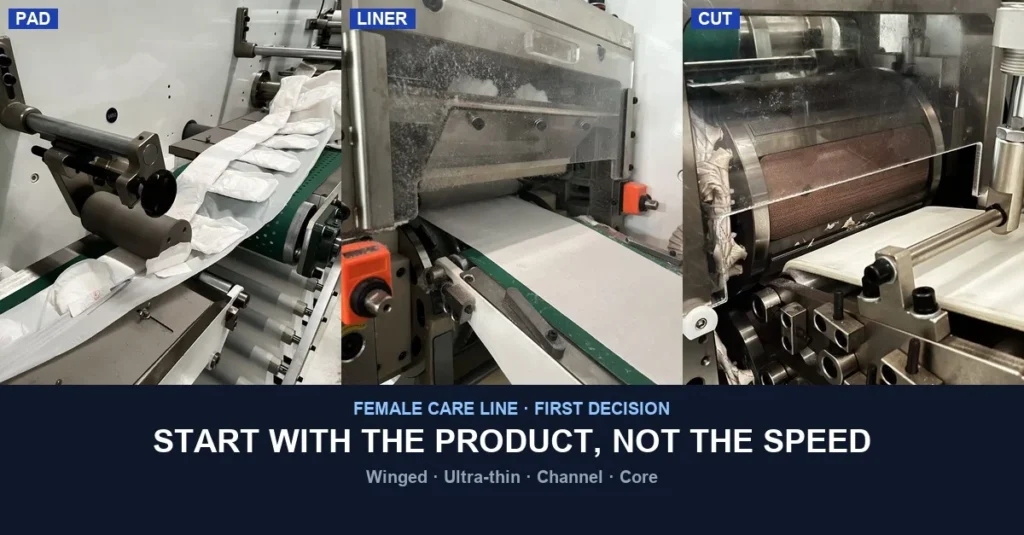
Two suppliers, two quotes, one $400K gap. The S3 line runs at 600 pieces per minute; the S5 line runs at 1,000. Both suppliers say theirs is right for your program. This article — the Female Care series finale — walks through the payback math on a napkin, so you know which side of the decision you actually live on.
Part 1 of this series looked at SKU changeover time. Part 2 walked through the four hidden operating costs missing from every CAPEX table. This is Part 3 — the tier decision. Because after you understand what to buy and what it truly costs, one question is left: which line configuration actually pays back on your specific SKU book?
1 · A Morocco buyer with two quotes and one right answer
A private-label sanitary napkin buyer in Morocco messaged me last week with two quotes on the table. Same product spec — 240mm night pad, wing folded, individually wrapped. Two suppliers, both credible, both delivering to European drugstores today.
Quote A: S3 servo line at $900K.
Quote B: S5 full-servo line at $1.3M.
Both suppliers say theirs is right for his program. Which one is honest?
Both were, actually. Which one was right for him depended on one number nobody in the RFQ had bothered to ask him for: his shortest-run SKU volume, and how fast the private-label book was growing.
The pattern I see on almost every S3-vs-S5 decision: buyers are handed two quotes optimized to two different assumptions, and asked to pick between them without ever seeing the assumption sheet. The rest of this article is that assumption sheet, made explicit.
2 · The payback math on a napkin
The commercial gap between an S3 and an S5 line boils down to three numbers on the same product spec:
| Metric | S3 servo line | S5 full-servo line |
|---|---|---|
| CAPEX (typical, USD) | $900K | $1.3M |
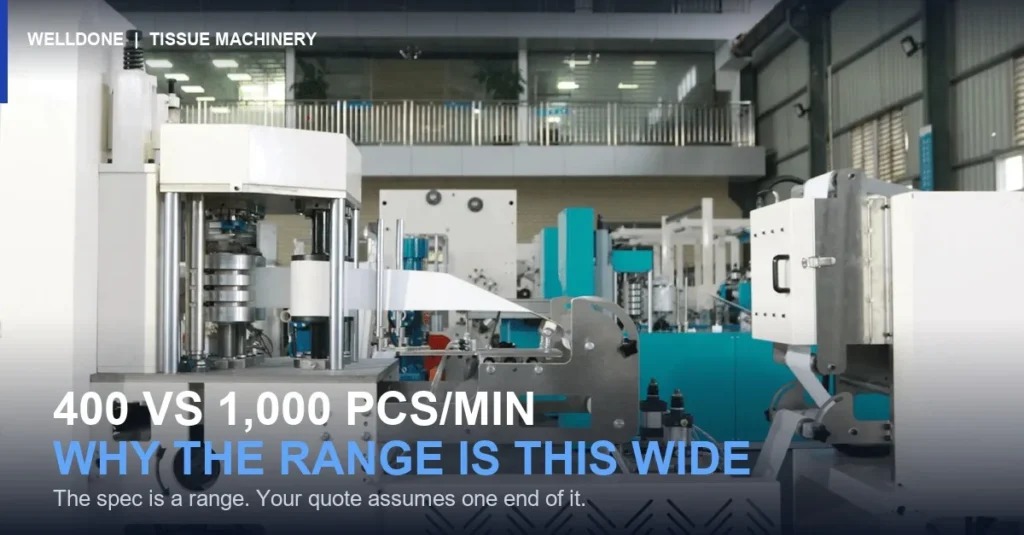
| Peak line speed | 600 ppm | 1,000 ppm |
| Realistic SKU changeover | 20 min | 10 min |
| Approx. annual output (3 shifts, 300 days, 3 SKU switches / shift) | ~244 M pcs | ~442 M pcs |
| Output gap vs S3 | — | ~198 M pcs / year |
Now run the money. At a private-label ASP of USD 0.045 and a gross margin of 18%, that ~200-million-piece annual gap = roughly USD 1.6 million of extra gross profit per year. The extra $400K in CAPEX pays back in under four months.
That looks like an obvious call. Except the math above only holds if the buyer can actually pull the extra output. If his private-label book is 240 million pieces a year and he cannot sell more, the S5 sits idle 45% of the time. The $400K never earns back. Peak-speed capacity you cannot sell is CAPEX buried in a warehouse.
The real question is not what does the line produce. It is what will your buyers absorb.
3 · When S3 is the honest answer
An S3 servo line pays back and outperforms an S5 in three specific situations:
- One buyer, one country, one to three SKUs. If your entire book is a private-label supply agreement with one European drugstore chain covering their day pad, night pad, and ultra-thin — running 200 million pieces a year total — an S5 is CAPEX you will never earn back. The S3's slower changeover does not matter, because you barely change SKU.
- Annual volume under 200 million pieces with slow growth. If your private-label book is stable and you are not actively closing new buyers, the S5 payback horizon stretches past 5 years — which is longer than the equipment depreciation cycle most CFOs will underwrite.
- Cash constraint or first-plant risk profile. A first-time sanitary napkin factory owner who is still learning the demand curve should not spend the top of their CAPEX budget on peak throughput. The S3 preserves cash for Round 2 — either a second S3 line, or an S5 once demand is proven.
4 · When S5 pays back the extra $400K
An S5 full-servo line is the honest answer in three profiles — and in each case the payback horizon lands well inside 18 months, often under 6:
- Three or more private-label buyers on the same shelf. The moment your book covers three private-label contracts across three retailers, you are running 8 to 12 SKUs. Every SKU changeover on an S3 is 20 minutes. Every changeover on an S5 is 10. The delta is your entire margin on the smaller accounts.
- Any SKU below 5 million pieces per year in the mix. A short-run SKU on an S3 line spends more time in changeover than in production. On an S5 line the same SKU is economically viable — and short-run SKUs are precisely where private-label buyers pay the highest per-piece prices.
- Any growth curve above 15% year-on-year. If you are actively closing new buyers, the S5's headroom becomes the constraint you will not have to redesign a factory to remove. The extra $400K buys 4 to 5 years of demand growth on the same line.
5 · The differentiation specifications only S5 holds at rated speed
The one place the S3-vs-S5 comparison is not symmetrical: the S5 line holds more product differentiation specifications at rated speed, without compromising throughput. This matters because private-label buyers in mature markets are moving up-market, and the SKUs that earn premium pricing are the ones with differentiated topsheet, print register, and embossing patterns.
An S3 line can produce every specification an S5 line produces — but often needs to slow the line to hold the tighter tolerances, especially on multi-channel embossing and full-color print register. That trade-off is fine on a single-SKU stable run. On a mixed book with three premium SKUs and two commodity SKUs, the S3 ends up running at 480 ppm effective on the premium SKUs to protect quality — cutting into the CAPEX advantage that made the S3 look attractive in the first place.
6 · Three misconceptions that push buyers to the wrong tier
Misconception 1: "S5 is always the safer bet — buy up on capacity."
No. Idle CAPEX depreciates on schedule regardless of whether the line runs. An S5 running at 45% utilization loses more money in unrecovered CAPEX per year than an S3 at 95% utilization saves in throughput. Capacity you cannot sell is not safety — it is a fixed cost with no offsetting revenue.
Misconception 2: "S3 today, upgrade to S5 next year — same result cheaper."
Rarely. Upgrading an S3 to S5 architecture (recipe HMI, pre-loaded splice magazines, higher-speed servo drives) is typically a 60-70% rework of the line, not a bolt-on. Total spend on the upgrade path usually runs 20-30% higher than buying S5 up front — and takes 4-6 weeks of downtime nobody planned for. The upgrade math is honest only if demand genuinely was not there year one.
The uncomfortable pattern: the buyers who regret the S5 decision three years in are usually the ones who bought on optimism, not on a signed SKU book. The buyers who regret the S3 decision three years in are usually the ones who won an unexpected private-label contract and could not scale to serve it. The first regret is more expensive; the second regret is more common.
Misconception 3: "The tier decision is between two suppliers — one quotes S3, one quotes S5, pick your favorite."
A serious supplier will quote both, side by side, with the payback assumption sheet explicitly attached. If both suppliers on your desk each only offer one tier, you are choosing between two commercial strategies — not two engineering solutions. Ask each for the other quote before signing.
7 · Why Welldone Machinery
Welldone Machinery quotes S3 and S5 side by side on every RFQ — with the payback assumption sheet explicitly attached. The private-label buyers we work with make the tier decision on their SKU book and their growth curve, not on a supplier's commercial preference.
Why Welldone quotes both tiers on every RFQ
01 · TIER TRANSPARENCY
S3 and S5 quoted side by side
Every RFQ receives both an S3 and an S5 configuration with matching product specs, so you can read the CAPEX-to-payback trade-off on one page.
02 · PAYBACK MODEL
SKU-mix-based payback attached
Send us your SKU book (or a target book) and annual volume. We return the payback calculation on the S3-to-S5 delta, sized to your program — not to a generic assumption.
03 · UPGRADE PATH
Honest scope on future upgrades
If S3 is right for you today, we quote the honest scope of an S3-to-S5 upgrade in Year 3 — including the downtime cost, so the future decision has real numbers, not marketing.
9 · Conclusion — closing the Female Care trilogy
Across three articles, this series has walked the full Female Care CAPEX decision: what to buy (SKU changeover time in Part 1), what it truly costs (four hidden operating cost items in Part 2), and which tier actually pays back on your specific SKU book (this article). If there is one thread through all three, it is this: the specifications you write before the PO is signed determine the operating cost you will run for the next five years. Everything after PO signature is either enforcement or damage control.
The S3-vs-S5 tier decision is not about which line is better in the abstract. It is about which line is better against your book. Bring the SKU count, the annual volume, and the honest growth curve to the conversation before the quote arrives — and the right answer usually becomes obvious in fifteen minutes on a napkin.
An open question to close the series: if you had to choose between an S3 line running at 95% utilization for five years, and an S5 line running at 55% utilization for the same five years, which one is the honest CAPEX call for your business? The number that decides it is not on the equipment brochure — it is in your sales pipeline.
10 · Frequently asked questions
What is the shortest-run SKU volume at which S5 pays back over S3?
Roughly 5 million pieces per year. Below that, the shorter S5 changeover is not producing enough extra pieces on the specific SKU to justify the CAPEX delta. Above that — especially if you have two or more sub-5M-piece SKUs in the book — the S5 payback lands under 18 months in almost every private-label scenario.
Can I run an S3 line at S5 throughput by running longer shifts?
Only partially. Adding a third shift and skipping weekend maintenance can lift S3 annual output by 25 to 35% — but at the cost of accelerated wear on mechanical components and a compressed maintenance window that shortens equipment life by 20 to 30%. The extra pieces cost more than the S5 CAPEX difference over five years.
How long does an S3-to-S5 upgrade take, and what does it cost?
A full S3-to-S5 architecture upgrade — recipe HMI, pre-loaded splice magazines, higher-speed servo drives — is typically a 60-70% rework of the line. Realistic scope: 4-6 weeks of factory downtime, total spend USD 500K-650K depending on baseline configuration. Total lifetime cost usually runs 20-30% higher than buying S5 up front.
Does Welldone Machinery quote both S3 and S5 on every RFQ?
Yes. Send us your product spec, SKU book (or a target SKU envelope), and annual volume. You receive both an S3 and an S5 quotation side by side, with a payback calculation on the CAPEX delta sized to your specific program. If your book clearly points to one tier, we say so — and explain why.
What is your typical lead time on S3 vs S5?
Standard S3 lines ship in 90-120 days from PO. S5 lines with custom SKU envelopes and full recipe HMI configuration take 120-150 days. On-site installation and SAT run 30-45 days after arrival. Timelines are the same regardless of which tier — the difference is only in build complexity, not delivery predictability.
Making the S3-vs-S5 decision on your next sanitary napkin line?
Send us your SKU book — or a target SKU envelope — and your annual volume. We return both an S3 and an S5 quotation side by side, with the payback math on the CAPEX delta sized to your specific program. No commercial preference on our side; only the number on the page.