Sanitary Napkin SKU Changeover Time: Why It Beats Line Speed

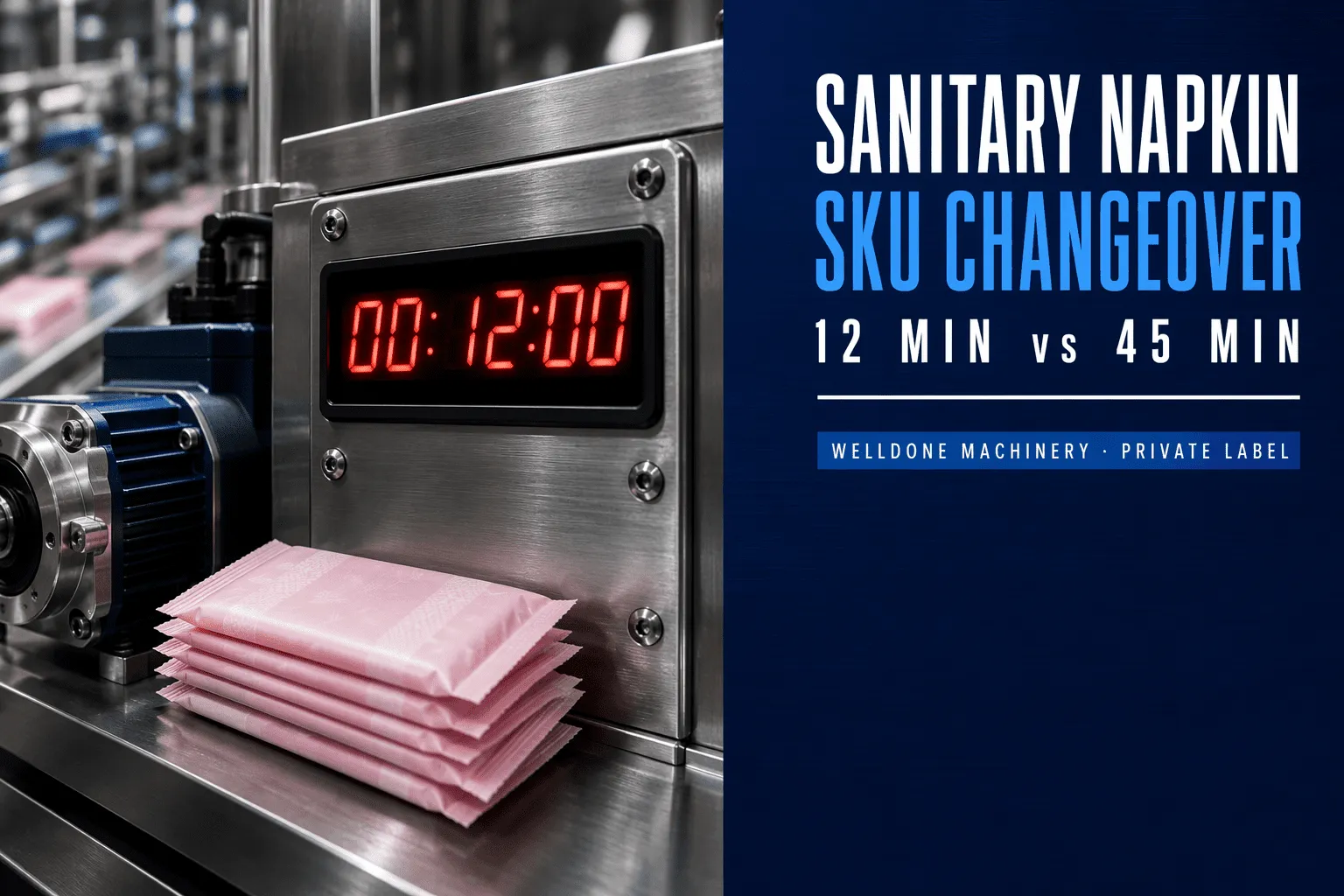
Why SKU Changeover Time — Not Line Speed — Decides Your Sanitary Napkin Private-Label Cost
Every private-label sanitary napkin buyer asks about peak line speed. The one number that actually determines annual output — and therefore private-label margin — is SKU changeover time. This article breaks down why a 1,000-ppm line can ship less than an 800-ppm line, and the three servo-level specs that decide which side of that math you land on.
Peak line speed is the first number in every sanitary napkin machine brochure. It is also the wrong number for a private-label buyer to optimize. The number that decides annual output — and therefore the profit on your order — is how long the line sits idle between SKUs. This is Part 1 of a Female Care series that walks through the specifications retailers push back on, machine by machine.
1 · The German audit that ended in the slower quote
A private-label buyer for a German drugstore chain audited two Chinese sanitary napkin factories last quarter. Same product spec — 240mm night pad, wing folded, individually wrapped. Same rated line speed: 800 pieces per minute.
She placed the order with the slower-quoted factory. Not the one with the newer building. Not the one with the more polished sales team. The one whose technical review page carried a smaller number in a line most buyers skip: SKU changeover time.
Factory A quoted 45 minutes per SKU changeover. Factory B quoted 12 minutes. The rest of the audit report was almost identical. That one row was the entire commercial decision.
Her purchase covered 5 SKUs across 3 pantone codes — a typical drugstore private-label book. At three changeovers per shift, the gap between 45 and 12 minutes works out to roughly 99 extra downtime minutes per day. Over a year, that is about 8 million pieces of lost output on the slower line. On a private-label margin, that number wipes out the entire annual profit on one of her SKUs.
The 800-ppm line she chose delivers more annual pieces than the 1,000-ppm line she rejected. The datasheet said otherwise. The math did not.
2 · The math nobody puts on a spec sheet
Sanitary napkin private-label programs almost never run one SKU at a time. A typical order covers day pads, night pads, ultra-thin, and one or two regional variants — plus different pantone codes for the outer wrap. Three shifts a day, three to four SKU switches per shift is normal.
Here is what the annual arithmetic actually looks like, at three changeovers per shift, three shifts per day, 300 working days per year:
| Line configuration | Peak speed | Changeover per SKU | Approx. annual output |
|---|---|---|---|
| Legacy mechanical, brochure line A | 1,000 ppm | 45 min | ≈ 342 M pcs |
| Servo mid-range, brochure line B | 800 ppm | 12 min | ≈ 350 M pcs |
| Full-servo S5, recipe-based HMI | 1,000 ppm | 10 min | ≈ 442 M pcs |
| Servo entry, manual splice cores | 600 ppm | 25 min | ≈ 244 M pcs |
Read across the top two rows. The 800-ppm line beats the 1,000-ppm line — by roughly 8 million pieces a year — on nothing but changeover discipline. Read the bottom row and the ceiling changes again. Peak speed is a component. Changeover time is a multiplier.
3 · Three specs that decide changeover time
Every sub-15-minute changeover on a sanitary napkin line comes down to the same three engineering choices. If any of them is missing on a supplier's quote, the 45-minute number is the real number — regardless of what the sales sheet says.
Spec 1 — Servo-driven pattern change (not mechanical cam swap)
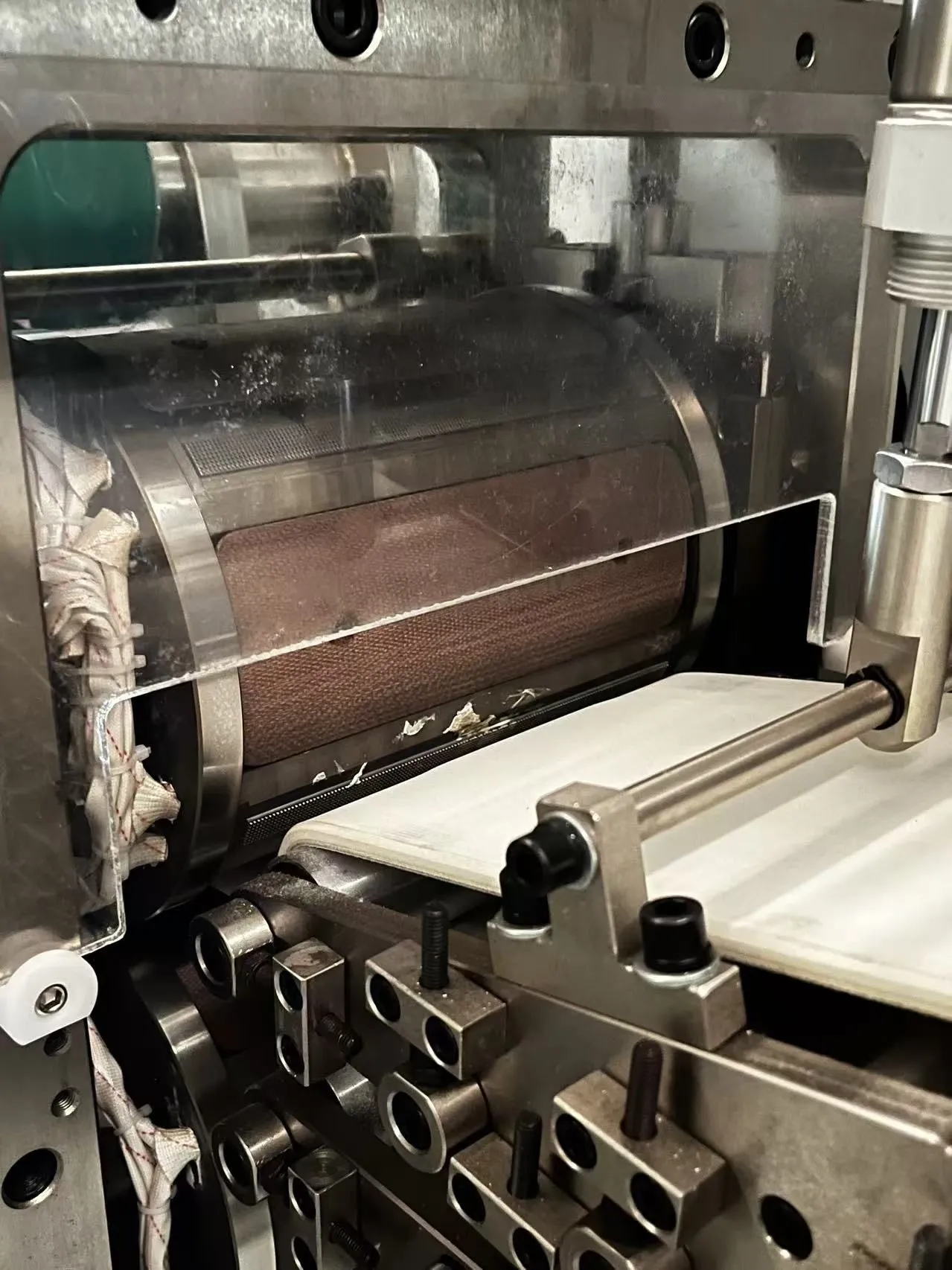
On a mechanical-cam line, a wing-fold change or an embossing pattern change means physically pulling and replacing a cam, then re-timing the servos to it. A skilled operator does it in 25 minutes. A tired night-shift operator takes 50. On a servo-driven line, the cam is virtual — the profile is a stored parameter set. The change is a menu selection, not a mechanical operation. Real customer floor data shows the gap between the two is not 10 minutes; it is 25–35.
Spec 2 — Pre-loaded core roll magazines (not manual splicing)
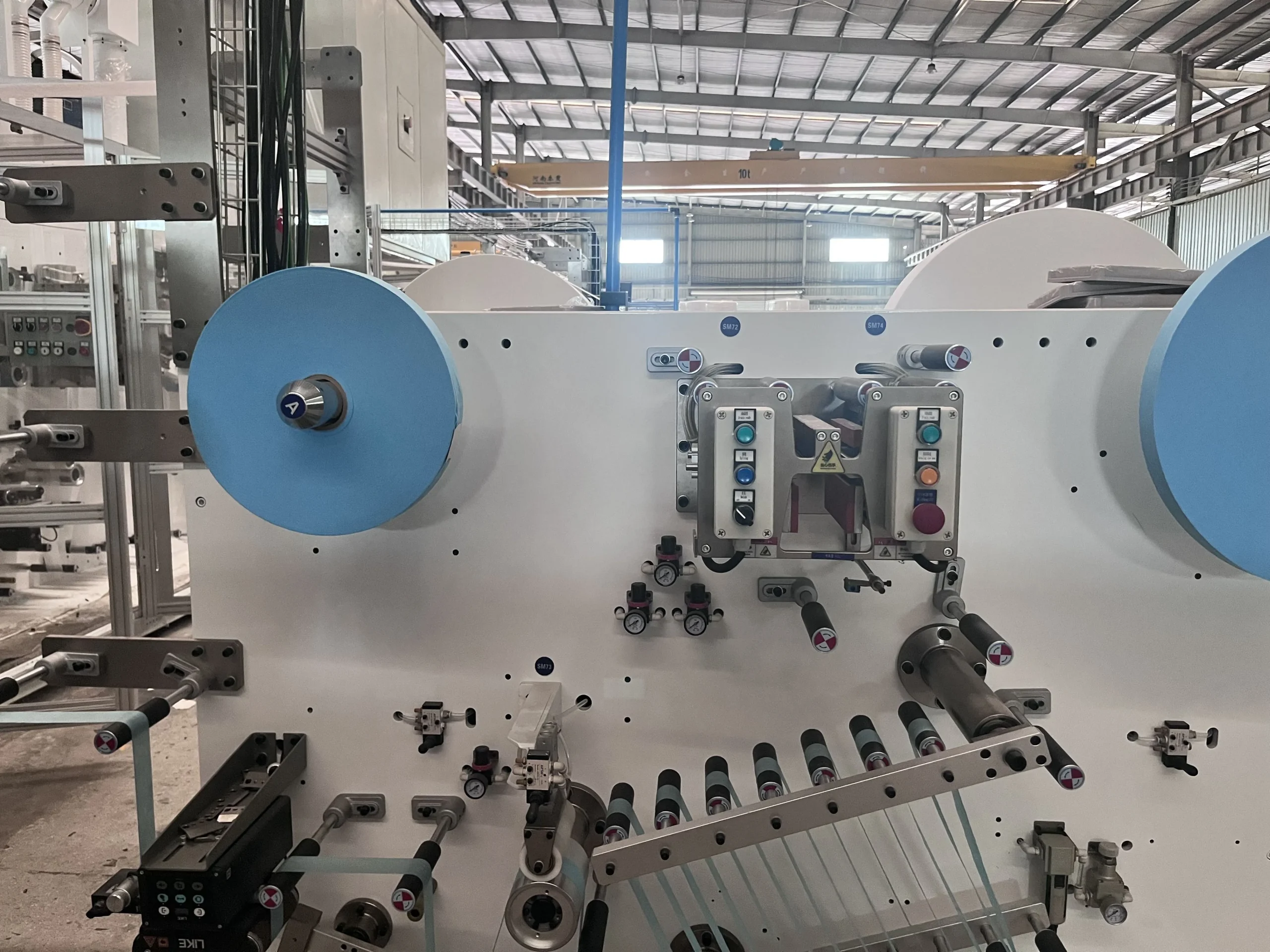
Manual splicing on core rolls means stopping the line, feeding the leading edge of the new roll into the pinch, spraying adhesive, and starting up in low-speed acceptance mode. Ten minutes if nothing tears. A pre-loaded magazine holds the next roll ready, spliced automatically at line speed. The changeover cost for a core roll swap collapses from 8–12 minutes to under 90 seconds — and that saving compounds every time the roll runs out mid-SKU.
Spec 3 — Recipe-based HMI (one-touch SKU recall)
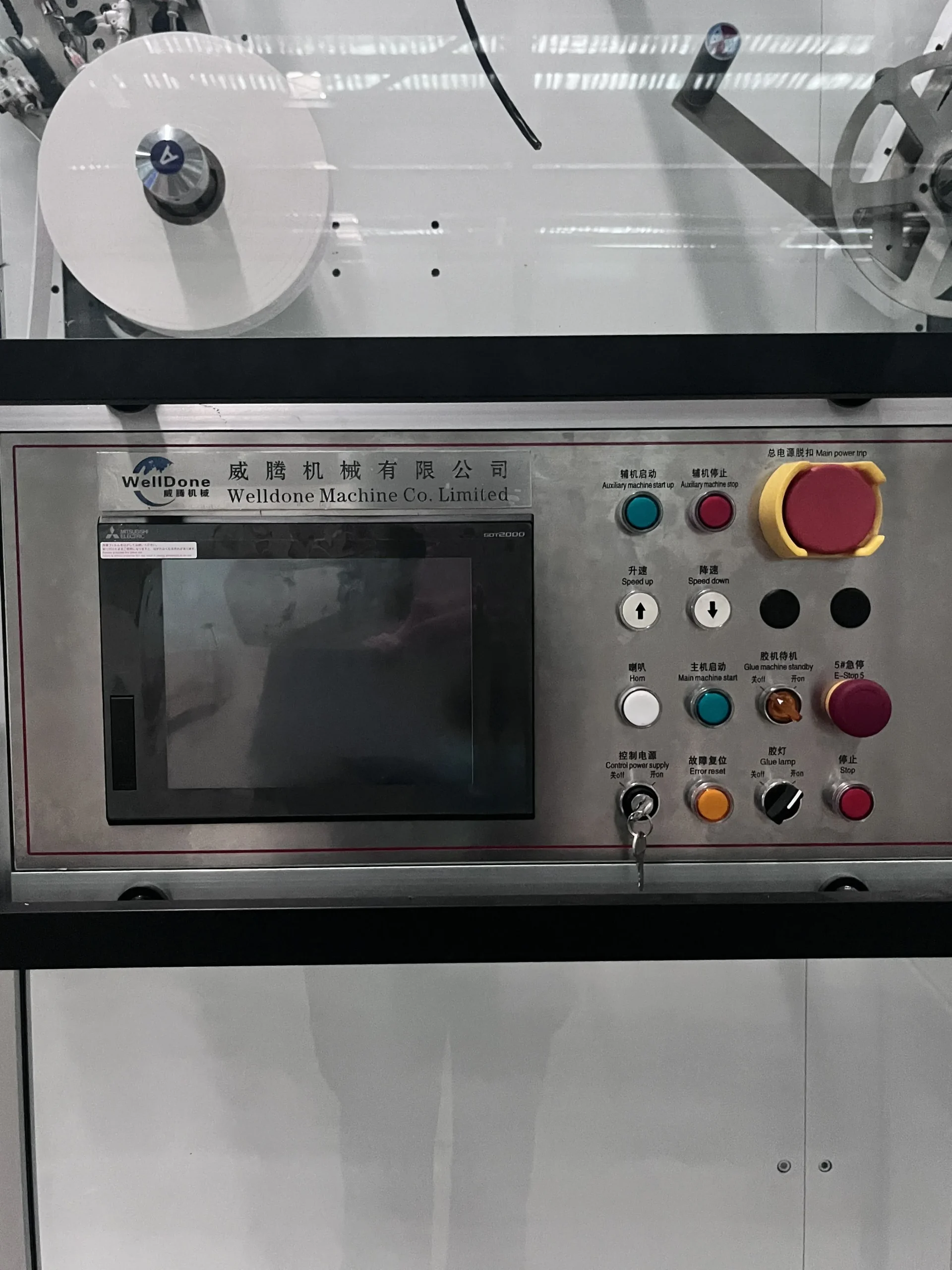
Every SKU has 30–60 parameters: pad length, absorbent core weight, wing angle, adhesive dot pattern, pouch dimension, print register. On a legacy line, an operator dials them in one by one from a printed SKU book. On a recipe-based HMI, the operator selects "Night 240mm — Buyer X — Pantone 213C" and the line writes all 60 parameters at once. This is where the last 5 minutes of the changeover disappears — and where operator error, the invisible cost most buyers never see, disappears with it.
4 · Four misconceptions buyers keep paying for
Misconception 1: "Peak speed is the honest number, changeover is a soft variable."
Peak speed is measured for 10 minutes in a supplier's demo hall on one SKU. Changeover is measured on your factory floor, on your SKU mix, for the next five years. The soft variable is the one running your P&L, not the one printed on the sales sheet.
Misconception 2: "We can fix changeover time later with better SOPs."
Some of it, yes. A 45-minute mechanical-cam change does not become a 15-minute change through operator training. The ceiling is set by the machine architecture the day the PO is signed. Everything after that is either enforcement or working around a hard limit.
Misconception 3: "A cheaper line saves money we can spend on labor."
A cheaper line with 45-minute changeovers needs two extra operators per shift to hit target output — plus a shift supervisor to keep them productive during the downtime. Over five years the labor differential typically dwarfs the CAPEX gap, and every hour of that labor is a variable cost that grows with wage inflation.
The uncomfortable pattern: the factories that struggle to keep private-label accounts three years in are almost never the ones that lost the price war. They are the ones that won the price war on peak-speed spec, then discovered SKU changeover time was the number the buyer was actually managing to.
Misconception 4: "Any full-servo line will hit 15-minute changeovers."
No. "Full servo" is a category, not a specification. A servo line without a recipe-based HMI still needs manual parameter entry. A servo line without pre-loaded core magazines still needs manual splicing. Read the three specs above on every quote, not the servo label on the cover page.
5 · What to ask on your next factory audit
"What is your rated speed?" is a marketing question. Try these instead — in this order — on your next sanitary napkin factory audit:
- Show me a live changeover video on the exact SKU mix I plan to run. Not a demo hole in the schedule. A real shift, real operators, timestamped.
- Walk me through your recipe HMI. How many parameters are stored per SKU? Who has permission to edit them? What happens if two SKUs share a pantone but not a wing profile?
- Open the core roll magazine. Is the splice automatic or manual? What is the maximum roll diameter and how many rolls does it hold?
- Give me 30 days of production data. Not peak, not best week — 30 days of shift-level output on your current private-label accounts, with changeover events flagged.
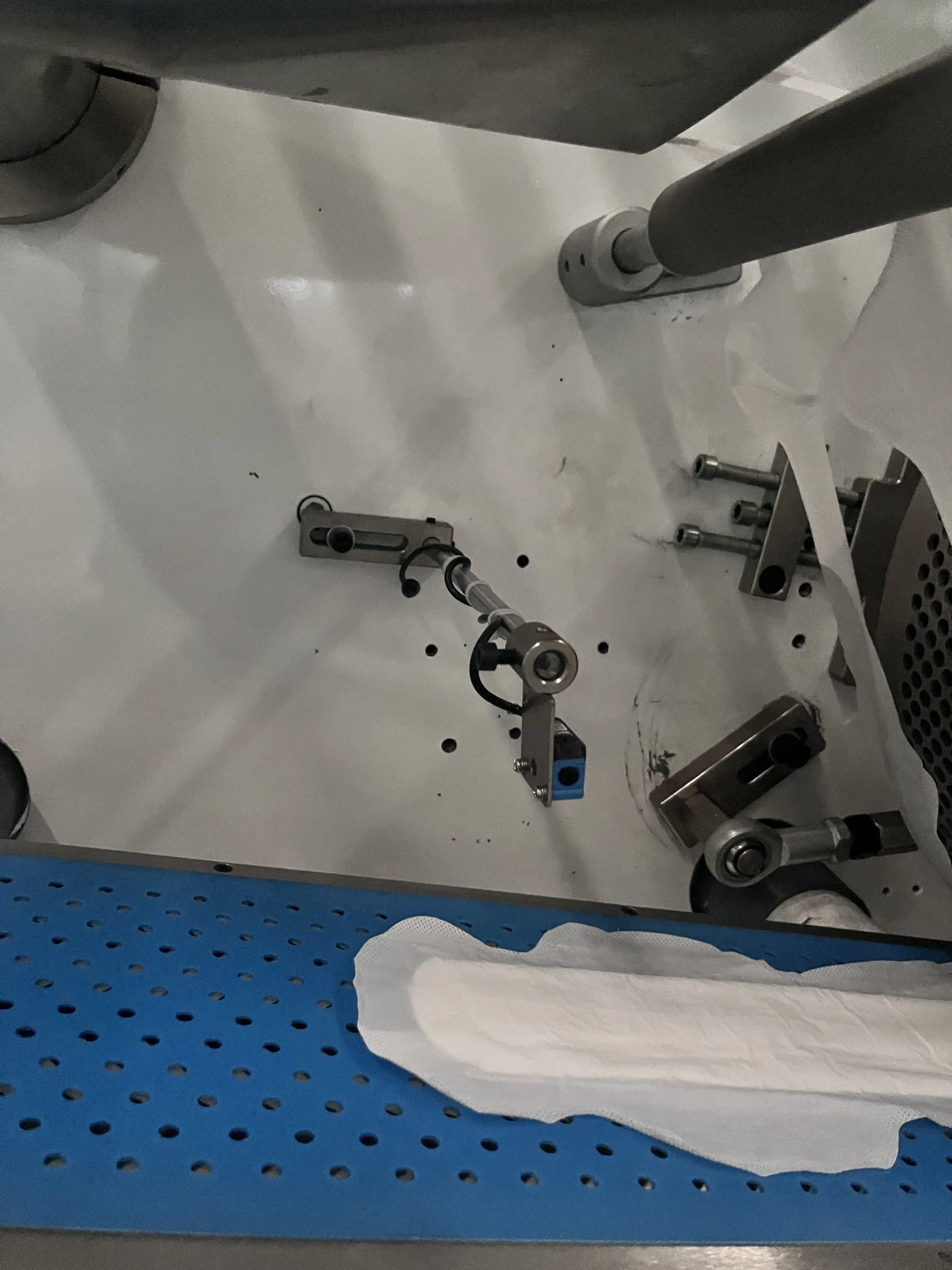
Red flag on any audit: the supplier can show you peak speed on demand, but cannot produce the last 30 days of shift-level output. That means either the data does not exist, or it exists and they do not want you to see it. Both answers point to the same underlying line discipline.
6 · Why Welldone Machinery for sanitary napkin private-label programs
Buyers work with Welldone Machinery because our S3 and S5 servo lines are built for the SKU-mix reality of private-label programs — not the one-SKU peak-speed demo. The recipe HMI, the pre-loaded magazine architecture, and the sub-15-minute changeover discipline are shipped as standard, not quoted as extras.
01 · CHANGEOVER FLOOR
Sub-15-minute contractual target
S5 lines carry a contractual sub-15-minute changeover target across the SKU mix you specify in the technical agreement — enforced at SAT, not on the sales sheet.
02 · RECIPE HMI
Up to 200 SKUs, one-touch recall
Stored parameter sets for up to 200 SKUs. Operator permission tiers. Pantone-linked print register recall. Every parameter change logged to the shift record.
03 · REFERENCE DATA
30-day production reports
We publish OEE by shift, changeover event logs, and outgoing ppm defect rates from reference lines running today — not peak, not best week, the full 30 days.
8 · Conclusion
If you are specifying a sanitary napkin line for a private-label program — or trying to explain why the line you already run is missing its output target — the answer is almost never the peak speed on the datasheet. It is the changeover time on the shortest-run SKU in your book, multiplied by the number of times your operators change it every day.
An open question to take back to your team: is a contractual sub-15-minute SKU changeover target written into your next sanitary napkin line technical agreement — with acceptance criteria measured on your actual SKU mix, not a demo SKU? If not, that is the single most valuable clause you can add before signing.
9 · Frequently asked questions
What is a realistic SKU changeover time on a modern full-servo sanitary napkin line?
For a well-configured S5 servo line with recipe HMI and pre-loaded core magazines, 10–15 minutes per SKU changeover is realistic and can be written into the technical agreement as a contractual target. Sub-10-minute changeovers are achievable for SKU pairs that share the pantone code and pouch dimension, and only change absorbent core or wing angle. Anything above 20 minutes on a supposedly full-servo line points to a missing recipe HMI or manual core splicing.
Can I upgrade an existing mechanical-cam line to sub-15-minute changeovers?
Partially. Adding a recipe HMI on top of a mechanical-cam line can save 3–5 minutes of parameter dial-in per changeover, and pre-loaded core magazines can save another 5–8 minutes. But the cam swap itself remains a manual operation. Total achievable improvement on a legacy retrofit is typically 30–40%, not the 70% gap between a mechanical and a servo line built from scratch.
How many SKUs can a recipe-based HMI store?
Welldone S5 HMI stores up to 200 SKU recipes with parameter tiers, edit permissions, and a full change-log for each recipe. For most private-label programs, 50–80 active SKUs at any time is a realistic operating envelope. Retired SKUs stay in the library — useful for re-orders or when a private-label buyer revives an older pantone.
What is your typical lead time and installation timeline for a sanitary napkin line?
Standard S3 lines ship in 90–120 days from PO. S5 lines with custom SKU envelopes and recipe HMI configuration take 120–150 days. On-site installation and SAT run 30–45 days after arrival. Timelines compress with SKU envelope standardization and expand with custom pouch dimensions or non-standard print register requirements.
Do you support EU / GCC / North American retail compliance out of the box?
Standard configuration includes durable LOT / date coding rated for 24-month warehouse humidity, print register verification suitable for CE and FDA labeling requirements, and metal detection at the wrapping stage. For EU private-label retail we also configure the vision system to include mandatory hygiene product symbol verification. Compliance is a configuration item, not a custom project.
Specifying a sanitary napkin line or diagnosing missed output targets?
If you are budgeting a new private-label program, or trying to explain why your current line is missing its annual piece target on a mid-teens SKU mix, we can walk you through a shift-level output audit — based on real production data from lines running today.