In-Line Bag Making Packaging Machine for Hygiene Products

In-Line Bag Making Packaging Machine: Why Your Pack Format Should Not Depend on a Bag Supplier
Most hygiene factories do not lose money on packaging film. They lose it on the pre-made bags already sitting in the warehouse.
This article looks at the packaging section from a procurement angle rather than a machine-spec angle: what a pack format change actually costs you, why the constraint is usually the bag supply chain rather than the machine, and what changes when the bag is formed inside your own factory from a film roll.
The Order You Cannot Accept
A supermarket buyer in Pune asks for an 8-piece retail pack. Your line already runs the product. The machine can handle the count. The material is in stock.
You still cannot say yes this month.
Because the bag for that pack does not exist yet. It has to be designed, approved, printed, and produced at a minimum order quantity you did not plan for. Six weeks, sometimes eight. By the time the bags arrive, the buyer has placed the order somewhere else.
Here is the pattern I keep seeing in factories across India, Egypt and Nigeria. The production line is capable. The commercial team is capable. The bag lead time is what decides whether a new SKU happens.
What a Pre-Made Bag Really Costs
Compare two bags and the pre-made one often looks cheaper per piece. That comparison is incomplete, because the price per bag is not where the money goes.
- Minimum order quantity. You rarely buy what you need. You buy what the printer will accept as a run.
- Dead stock on format change. Change the artwork, the count, or the pack size, and the remaining bags become scrap with a printed brand on them.
- Warehouse space. Printed bags for six SKUs occupy floor area that produces nothing.
- Lead time as a commercial ceiling. Every new pack format your sales team wants to quote carries a six-week delay before the first carton ships.
- Bag-feeding stops. Pre-made bags are handled, stacked and fed. Deformed or stuck bags are a routine cause of short stops in the packaging section.
A factory that changes pack format twice a year does not feel this. A factory trying to win retail listings feels it every quarter.
How In-Line Bag Making Works
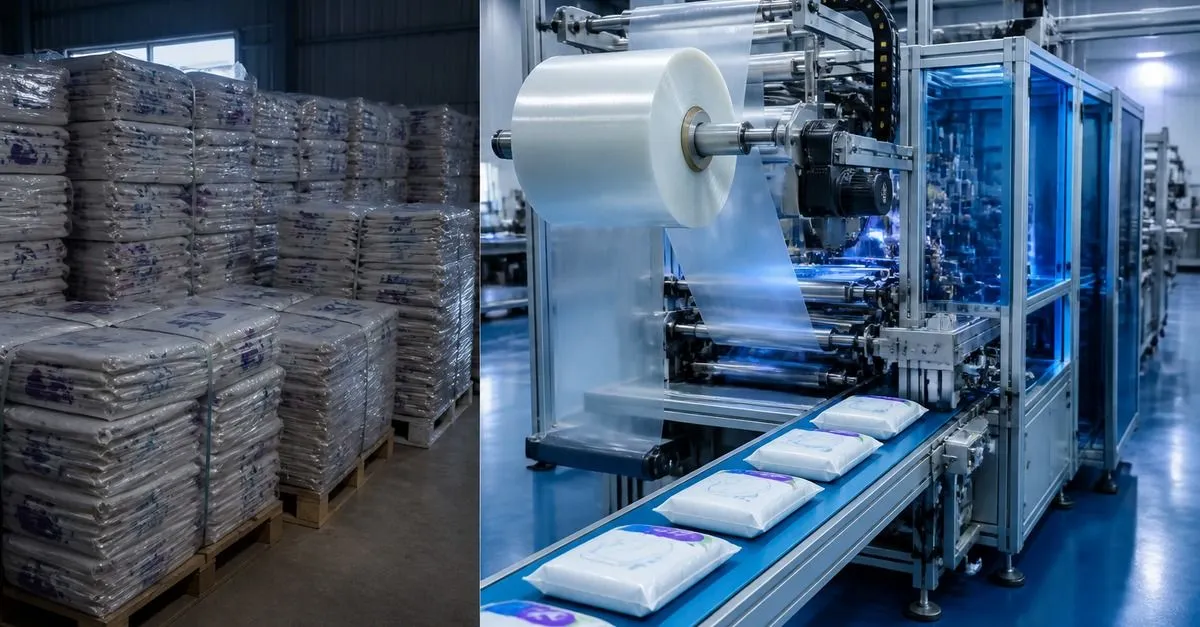
An in-line bag making packaging machine does not receive a finished bag. It receives a roll of film.
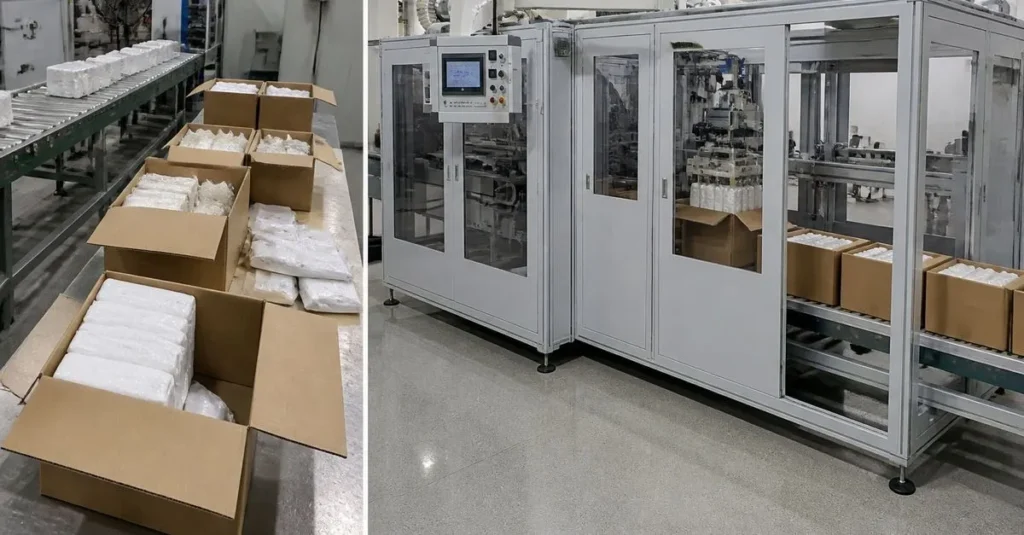
Film unwinds, the machine forms the bag, the product group is inserted, and the bag is sealed and discharged in one continuous motion. Bag length, seal width and depth are parameters on the touchscreen rather than a specification you send to a printer.
That single difference moves the pack-format decision from your supplier's production schedule back into your own factory. Changing from a 10-piece pack to a 20-piece pack becomes a recipe change and a short changeover, not a purchase order.
Film Roll vs Pre-Made Bag
| Factor | Pre-Made Bag | In-Line Bag Making (Film Roll) |
|---|---|---|
| New pack format | New bag order, MOQ, 6-8 weeks | Parameter change on HMI, same day |
| Inventory held | Printed bags per SKU | Film rolls, shared across sizes |
| Obsolescence risk | High — artwork or size change scraps stock | Low — film is not size-specific |
| Storage footprint | Pallets per SKU | Rolls, 500-550mm diameter |
| Common stop cause | Bag pick-up and opening failure | Film splice at roll change |
| Best suited to | Stable, high-volume single SKU | Multiple SKUs and frequent format change |
Neither column is wrong. If you run one SKU at high volume and never change it, pre-made bags are perfectly rational. The calculation changes the moment your product range grows.
Why 14 Servo Axes Matter
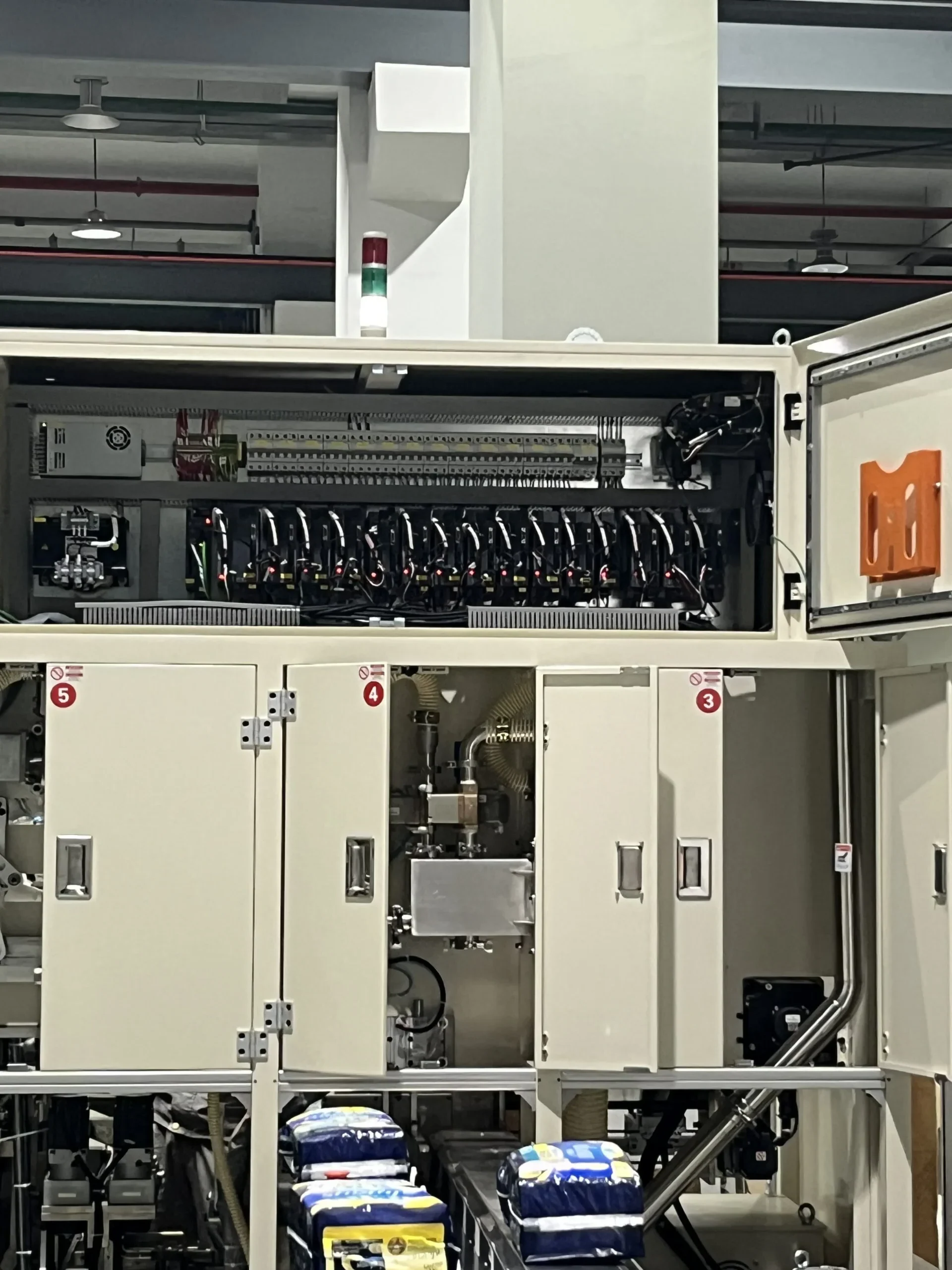
Forming a bag and filling it at the same time is a timing problem. The film has to advance a precise length, the forming station has to shape it, the product group has to arrive at exactly the right moment, and the seal bar has to close on a bag that is neither over-fed nor under-fed.
On a mechanically linked machine, all of that is set by cams and adjusted by feel. Change the pack size and you are back to mechanical adjustment.
Our TW1100Z-WSJ60-M uses 14 Mitsubishi JE-series servo axes with independent control. Each motion is a value in the program rather than a mechanical setting. That is what makes a same-day format change realistic instead of theoretical, and it is why the machine holds insert corner deviation within 3mm at rated speed.
Flat Insert vs Standing Insert
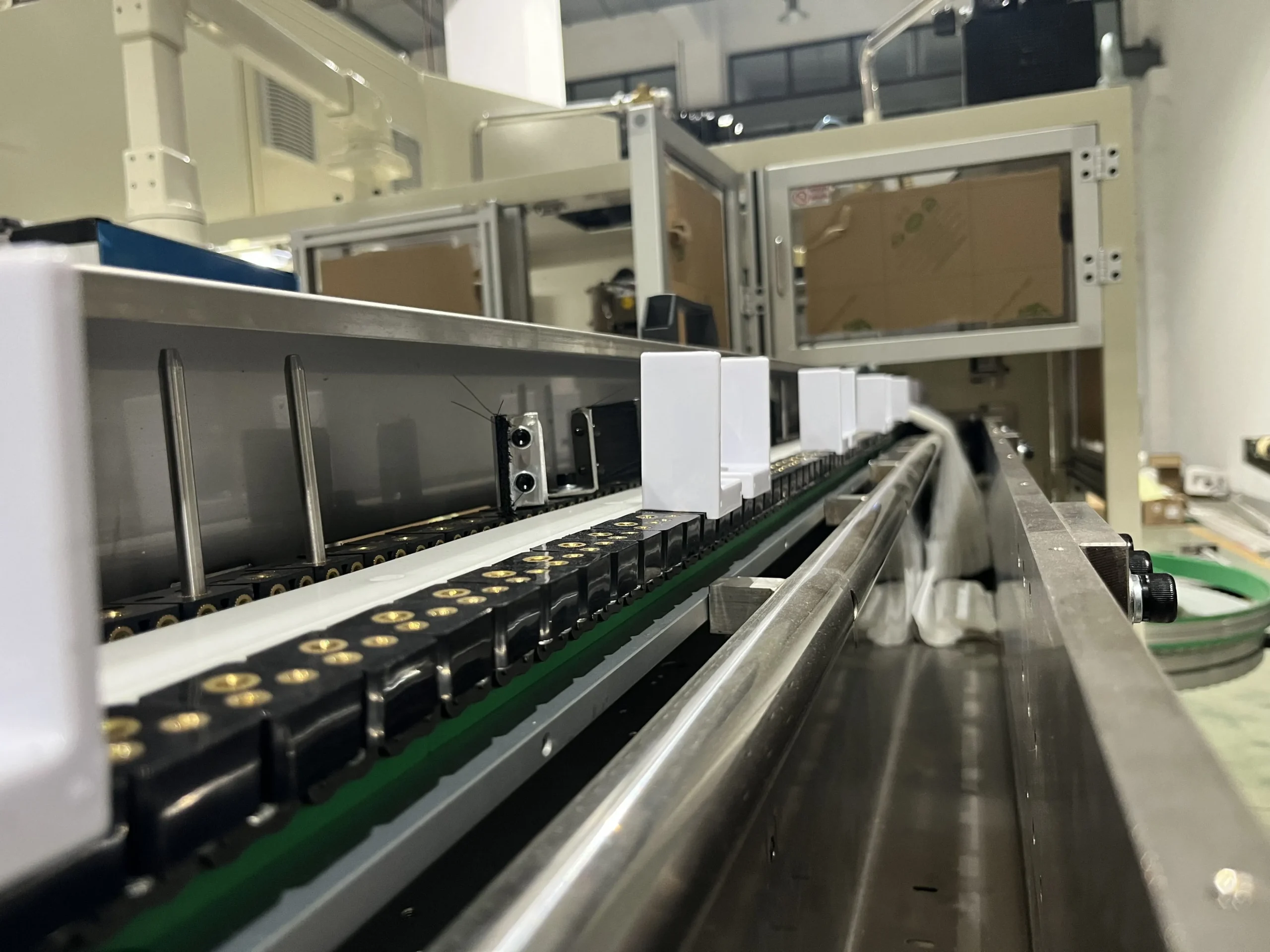
Two loading modes cover most hygiene pack formats, and the difference is not cosmetic.
Flat insert
Products lie flat and are pushed in as a stack. Typical for smaller counts such as 6 pieces per pack. Gives a thin, shelf-friendly pack.
Standing insert
Products stand on edge and enter as a block. Typical for larger counts such as 20 pieces per pack. Uses bag volume more efficiently at higher counts.
The mode is configured at order time based on your product and target count, because it determines the geometry of the insertion mechanism. Tell us the pack counts you plan to sell in the next three years, not only the one you sell today.
Counting and Stacking First
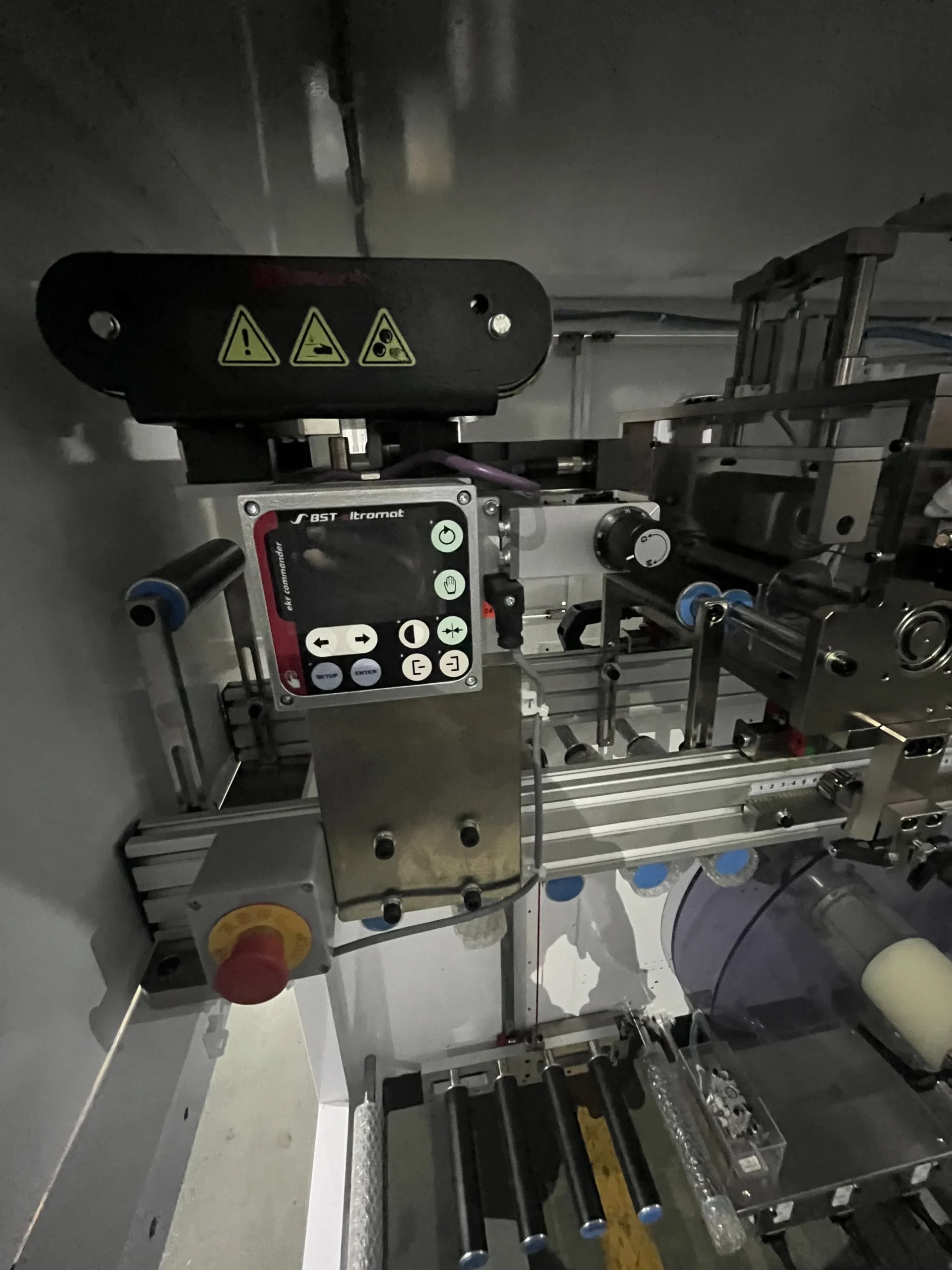
Most seal problems are not seal problems. They start earlier.
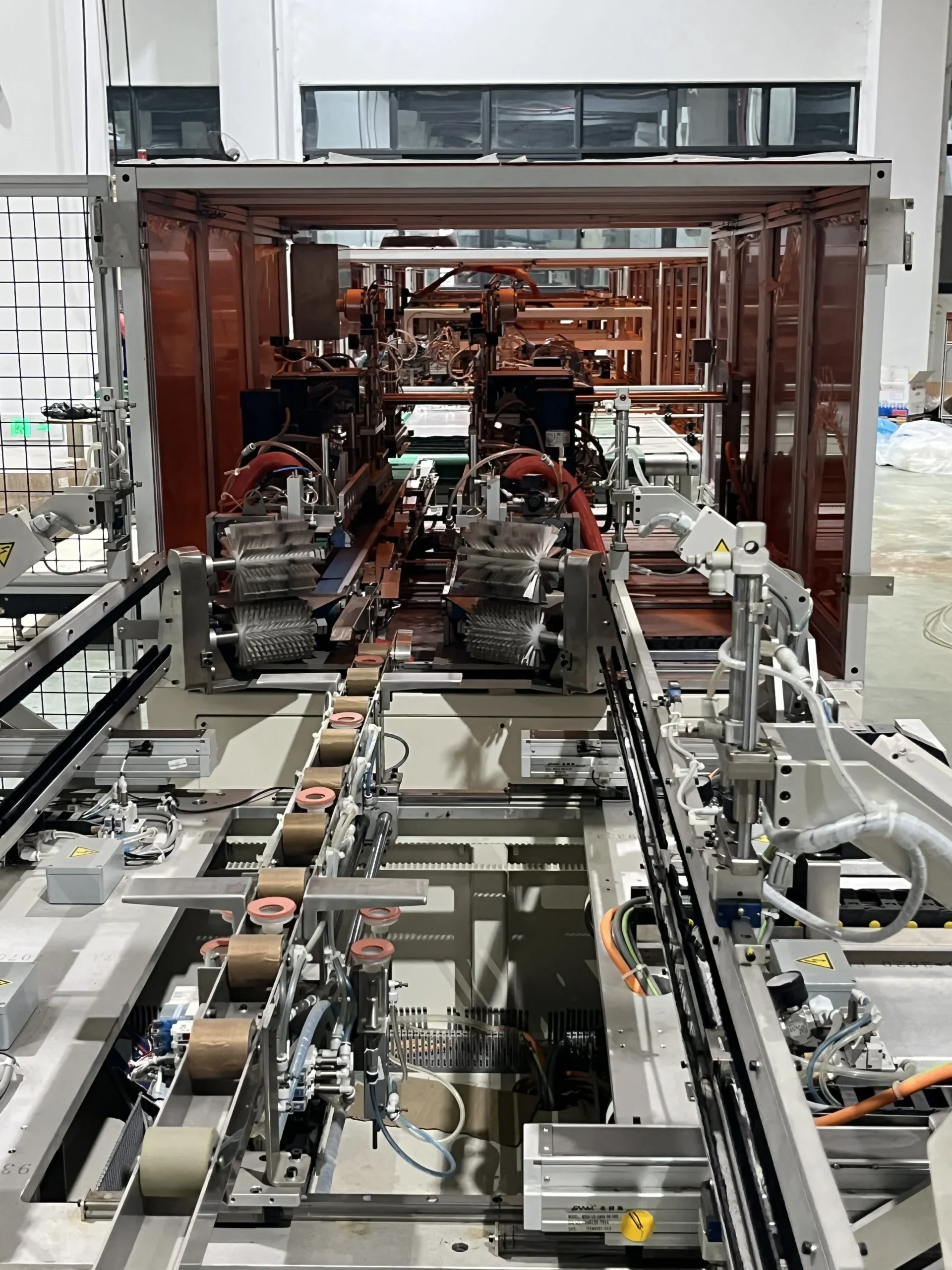
If the stack arriving at the insertion station is uneven, the bag receives an irregular block. The corner deviates, the film stretches on one side, and the seal closes on material that is not flat. The seal bar gets blamed for a fault created two stations upstream.
This is why counting accuracy and stack squareness deserve attention during machine selection, not just packaging speed. A machine rated at 50 packs per minute that produces uneven stacks will not deliver 50 good packs per minute.
Seal Quality and Pass Rate
A pass rate figure only means something when you know what it is measured against. Ours is stated as a qualified product rate of at least 98% at rated speed, with machine efficiency at or above 95%.
In practice, the defects that matter in hygiene packaging are these:
- Seal contamination — product edge caught in the seal line
- Corner deviation beyond 3mm — pack looks skewed on shelf
- Incomplete seal — pack opens during transport or stacking
- Film burn-through — seal temperature not controlled at speed
Constant-temperature control on the sealing station is what keeps the fourth item off the list during a long shift. Temperature drift is not visible on the HMI; it is visible in the reject bin two hours later.
Integrating Into an Existing Line
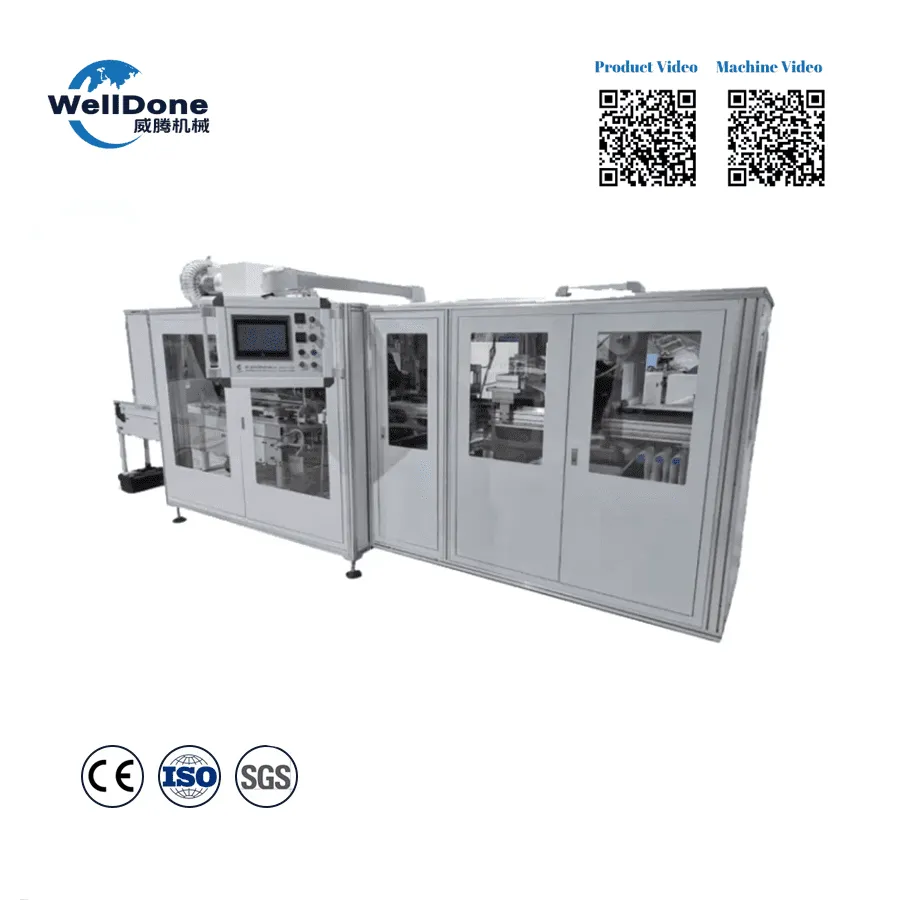
Buyers often assume that adding a new packaging machine means rebuilding the end of the line. In most retrofits it does not.
The packaging machine is configured to your existing discharge — conveyor height, product orientation, and output rate. What we need from you before quoting is the layout of your current line end and your actual output, not the theoretical rating of your converting machine.
One detail that matters specifically for India: standard configuration is three-phase 380V ±5%. Factories running 415V or dealing with grid fluctuation need servo drives specified with wider input tolerance and an appropriate stabiliser. That gets reviewed during technical consultation rather than discovered during commissioning.
The Mistake Buyers Make
I understand why the comparison usually starts with cost per bag. It is the number on the quotation, and it is easy to check.
But it answers a question that is not the one holding your factory back. The real question is what a pack format change costs you in weeks, not what a bag costs you in cents. A factory that can quote a new retail pack and ship it within a month is competing on a different axis from one that needs eight weeks of bag lead time before it can even sample.
A common mistake is treating the packaging section as the last item on the equipment list. It is the section that decides what your line is commercially allowed to produce.
Why Welldone
We have manufactured hygiene product machinery in Jinjiang, Fujian since 2008, and have delivered to more than 60 countries. Packaging machines are not a side product for us — they are supplied as part of complete lines for baby diapers, sanitary pads, adult diapers and underpads.
Configured, not catalogueInsert mode, bag size range and film width are set to your product and pack count at order time, not chosen from a fixed model list.
Verified componentsMitsubishi PLC and servo, Omron controls, SMC pneumatics, Schneider protection, NSK and NTN bearings, HIWIN guide rails. CE marked, ISO 9001.
Sign-off before shipmentVideo factory acceptance test at rated speed with your bag specification. You approve the machine running before it leaves our floor.
Related Machines
Conclusion
The packaging machine is where your production capability meets your commercial flexibility. Everything upstream determines how much you can make. This section determines what formats you are allowed to sell.
Moving bag forming inside your own factory removes a supplier's lead time from your product decisions. Whether that is worth it depends less on your current volume and more on how many pack formats you expect to be quoting two years from now.
So here is the question worth putting to your own team: over the last twelve months, how many pack formats did your sales team decline to quote because of bag lead time — and what was each of those worth?
Frequently Asked Questions
Can one machine handle different products, or do we need one per product line?
One machine covers multiple hygiene categories — baby diapers, adult diapers, sanitary pads and underpads — provided the pack dimensions stay within the configured range of 80-300mm length, 60-150mm seal width and 30-90mm depth. What is fixed at order time is the insert mechanism geometry, so tell us all the products you intend to run, not just the first one.
How long does a pack format changeover actually take?
Within the configured size range, a format change is a recipe selection on the HMI plus mechanical adjustment of the guides. Compare that against the alternative: ordering new pre-made bags at MOQ with six to eight weeks of lead time. That gap is the real value of in-line bag making, not the film cost per pack.
Do we have to modify our existing production line?
In most cases no. The machine is designed as an end-of-line solution and the conveyor interface is configured to match your current discharge height and product orientation. Send us your line end layout and current output before we quote — that is what determines the infeed configuration.
What speed can we actually expect in production?
Rated speed is 45-50 packs per minute with machine efficiency at or above 95% and a qualified product rate of at least 98%. Real output depends on how steady your infeed is. A packaging machine cannot run faster than the converting line feeds it, and an uneven product stack will cost you more than the rated speed difference between two machines.
What after-sales support is available outside China?
Remote diagnostic support by video within 24 hours, on-site engineer dispatch for critical issues, and spare parts shipped from our factory. Because the servo and control components are Mitsubishi, local distributor channels are available in most markets as a backup sourcing route. You can also review the full machine range on our products page or contact us directly.
Tell Us What You Make and How Much
Send your product type, daily output target and current packing method. We will come back with a configuration recommendation and quotation — including whether in-line bag making is actually the right call for your SKU mix, or whether pre-made bags still make more sense for you.
Request a Configuration Review