Why the Cheapest Hygiene Machine May Cost More in the Long Run

Buying a hygiene machine at the lowest possible price may feel like the safest choice, especially for a new factory. But in 2026, that kind of decision has become more complicated.
Global growth is expected to stay subdued this year, while trade is becoming more fragmented under geopolitical tension, shifting supply chains, green transition pressure, and tighter national rules. At the same time, the OECD says recent disruption in energy and commodity markets has pushed prices higher and made inflation more persistent in 2026. Reuters also reported that factories around the world faced soaring input costs and supply chain disruption in March, with logistics delays and higher price pressure affecting manufacturing recovery.
That broader environment matters because it changes how buyers should think about machinery investment. Actually, the cheapest machine is not always the cheapest decision. In a more volatile year, mistakes made at the purchasing stage can become much more expensive after the line starts running.
Table of Contents
- Why price-first decisions are riskier in 2026
- What the cheapest machine often hides
- Where long-term costs really come from
- A common mistake many new factories make
- How to compare hygiene machines the smarter way
- Why Welldone
- Related Machines
- FAQ
- Conclusion
Why Price-First Decisions Are Riskier in 2026
In a stable market, some buyers can afford to focus heavily on the quotation sheet. In a less stable market, that becomes dangerous.
UNCTAD says growth in 2026 is still positive but slower, and global trade is being reshaped by supply chain shifts, regulation, and geopolitical pressure. The OECD adds that higher energy prices are likely to keep costs elevated for longer. Reuters reported that in March 2026, manufacturers in multiple regions saw rising input costs and delivery disruption, while U.S. machinery manufacturers also said tariff policy changes were affecting total acquisition costs and sourcing decisions.
That means the wrong machine choice no longer hurts only once. It can hurt again through labor, waste, downtime, unstable output, and delayed adjustments.
For a new hygiene factory, that is a serious issue. A machine is not just a piece of equipment. It becomes part of your production logic, your staffing model, and your cost structure.
What the Cheapest Machine Often Hides
A low machine price may hide costs that only appear after startup.
These usually include:
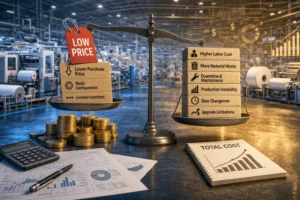
- higher labor dependence
- more difficult adjustment and changeover
- weaker production stability
- more material waste
- higher maintenance pressure
- limited upgrade flexibility
A machine may look affordable at the quotation stage but become expensive during daily operation.
More importantly, that extra cost often does not appear as one big number. It appears slowly, through repeated small losses: more operators, more stoppages, more rejected products, slower changeovers, and lower efficiency across the line.
That is why a cheaper quotation can still lead to a more expensive factory.
Where Long-Term Costs Really Come From
Most factories do not lose money when they place the order. They lose money after production begins.
Long-term cost usually comes from five areas:
1. Labor requirement
If the line needs more manual correction, more monitoring, or more operators to keep running smoothly, labor cost rises quickly.
2. Material waste
If the machine cannot maintain stable control or match raw materials well, waste increases. For hygiene products, small inefficiencies repeated every day can quietly become a large cost.
3. Downtime and maintenance
A machine that stops often does not only reduce output. It also creates pressure on delivery, labor scheduling, and customer confidence.
4. Changeover efficiency
If product size changes, adjustments, or setting corrections take too long, production flexibility becomes weaker.
5. Upgrade limitations
A machine that looks cheap today may become restrictive later if the factory wants to improve speed, quality consistency, or product range.
I believe this is where experienced buyers think differently. They do not ask only, “How much does the machine cost?” They also ask, “How much will this machine cost us after 12 months of real production?”
A Common Mistake Many New Factories Make
A common mistake is to compare hygiene machines only by initial price.
That comparison is too narrow.
The real issue is not whether one machine is cheaper to buy. The real issue is whether it is cheaper to own and operate.
This matters even more in 2026 because the wider manufacturing environment is already absorbing more cost pressure. Reuters reported that UK factories saw their biggest month-on-month jump in costs since 1992 in March, while euro zone factories also faced sharp input-cost increases and supply snags. Those reports are not about hygiene machinery specifically, but they point to the same reality: when outside costs are rising, internal inefficiency becomes even more expensive.
So a cheaper machine may save money once, but a better machine may protect money every day.
How to Compare Hygiene Machines the Smarter Way
A better comparison usually starts with these questions:
How stable is the output?
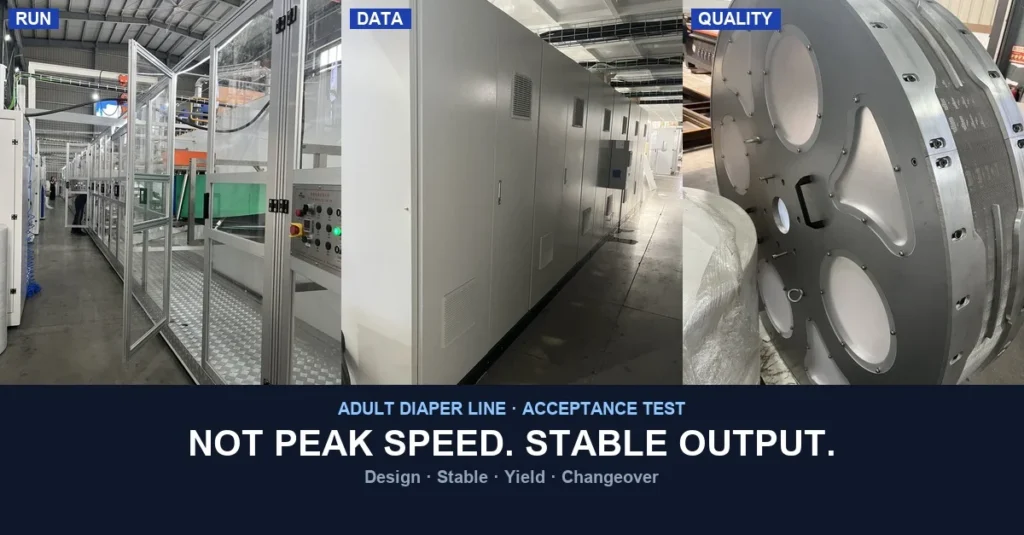
Stable output is often more valuable than headline speed.
How many operators will the line really need?
A lower purchase price can lose its advantage quickly if labor dependence is too high.
How well does the machine match the raw materials?
Machine and material should work together, not be treated as separate decisions.
How easy is it to adjust and maintain?
Time lost during operation becomes part of the true machine cost.
Can the line support future growth?
A factory should not be built only for today’s budget. It should also leave room for tomorrow’s expansion.
For many new factories, the wiser choice is not the cheapest machine. It is the machine that creates better control, lower waste, and stronger long-term operating logic.
That leads to the question buyers really need to ask:
Are you choosing the lowest quote, or are you choosing the lowest long-term cost?
Why Welldone
Welldone supports buyers from a long-term factory perspective, not only from the quotation stage.
We help customers think through:
- machine selection
- raw material matching
- factory layout suggestions
- installation and startup support
- engineer guidance
- long-term production stability
For buyers still comparing different product directions, this topic is closely related to your broader hygiene production plan, including baby care, female care, adult care, pet care, and paper or wet wipes machinery.
Related Machines
Depending on your project direction, this topic is especially relevant to:
- baby diaper machine
- pull-up diaper machine
- sanitary napkin machine
- panty liner machine
- adult diaper machine
- underpad machine
- pet pee pad machine
- wet wipes machine
- tissue machine
FAQ
Is the cheapest hygiene machine always a bad choice?
No. A lower-priced machine is not automatically a bad choice. But it should be evaluated by total operating logic, not by purchase price alone.
Why can a cheaper machine cost more later?
Because daily production may require more labor, create more waste, reduce stability, and increase downtime.
What matters more: machine price or long-term operating cost?
For most factories, long-term operating cost has a bigger impact on profitability.
Should new factories focus more on stability than headline speed?
In many cases, yes. Stable output usually creates more reliable long-term value.
Can Welldone help compare different machine options based on total factory cost?
Yes. Welldone can help buyers evaluate machine routes based on product type, budget, raw material planning, and long-term factory goals.
Conclusion
The cheapest hygiene machine may look attractive at the beginning, but low purchase price and low total cost are not the same thing.
In 2026, buyers are making decisions in a market shaped by slower growth, trade fragmentation, higher energy-related cost pressure, and more fragile supply conditions. In that environment, it makes less sense to buy only for quotation price and more sense to buy for long-term operating performance.
A serious factory decision should not be based only on what is cheapest today. It should be based on what will still be efficient, stable, and manageable after the factory starts running.