Wet Wipes Liquid Dosing Precision: The Spec That Predicts

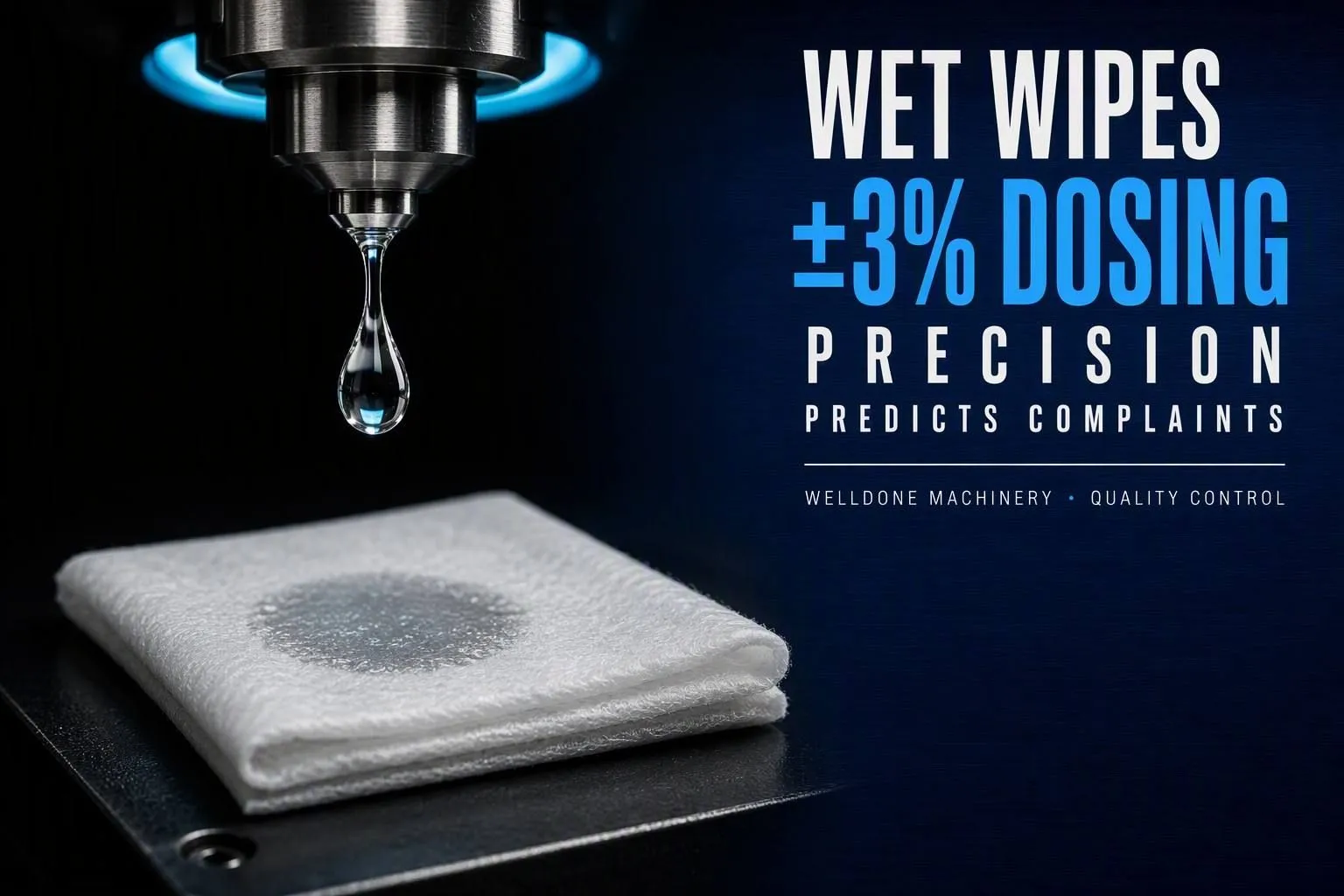
The One Wet Wipes Spec That Predicts Every Consumer Complaint Six Months Later
Every wet wipes machine RFQ optimizes around pieces per minute. Every consumer complaint file six months after shelf launch reports on a different specification: liquid dosing precision. This article — Part 2 of the wet wipes series — explains why ±3% is the ceiling, ±2% is the target, and anything wider than that shows up as returns before month four.
Part 1 of this wet wipes series walked through the sachet-versus-tub architecture decision — the choice that determines whether a line matches its private-label SKU book. This is Part 2: the single specification, hidden on every wet wipes machine datasheet, that decides whether your consumer buys the second pack. If Part 1 was about the machine you should have bought, Part 2 is about the specification that decides whether it earns back what you paid for it.
1 · A German retailer's Q1 complaint dashboard
A private-label wet wipes buyer from a large German drugstore chain forwarded me her Q1 consumer complaint dashboard last month. Baby wipes SKU — 80-count resealable tub, hand-and-face — return rate had jumped from 1.1% in Q4 to 3.4% in Q1. Same factory. Same SKU code. Same non-woven, same lotion formulation.
Every retailer runs consumer complaint text through NLP for pattern detection. Across 1,800 return tickets in that quarter, the complaint text was almost identical:
"The wipes feel dry."
"Not as wet as they used to be."
"The pack seems fine but the wipes are almost dry."
Same three sentences, 1,800 different consumers. The retailer opened the private-label supply agreement for review. That is the moment the factory manager called me.
What had changed six months earlier was routine — the factory had swapped their liquid dosing pump. Not for cost. For maintenance. Old pump, ±2% dosing precision. Replacement pump, same product family, different model — ±7% dosing precision. Nobody flagged the spec change at the parts requisition. Nobody re-audited the dosing tolerance at commissioning. The pump ran, the line hit throughput, everybody was happy for four months while the packs quietly under-saturated.
2 · Why dosing precision is the invisible spec
Line speed is the specification everyone in the RFQ conversation optimizes for. It is visible on the sales sheet, it is easy to benchmark against competitors, and it is the number that closes purchase orders. Dosing precision sits three pages deeper in the technical annex — usually in a table labeled "metering system" or "liquid injection tolerance" — and it is the number that opens complaint files.

The reason dosing precision matters more than any other specification: it is the only spec that consumers actually experience. A pack rated for 60 grams of liquid content that comes off the line with 56 grams will fail no incoming inspection at the retailer. It will pass every internal QC check that measures pack weight tolerance. It will trigger a complaint six weeks after shelf launch when consumers open the tub and pull out the third or fourth wipe.
Servo-metered dosing systems on modern lines can hold ±2% tolerance across shift, batch, and SKU changeover. Peristaltic and diaphragm-pump systems on legacy lines typically hold ±5-7%. That gap is not visible until you look for it — which is exactly why suppliers do not bring it to the RFQ.
3 · The physics of how ±7% becomes a consumer complaint
The complaint text does not come out of nowhere. The mechanism is straightforward:
Under-saturation cascades through the tub
An 80-count wet wipes tub is designed around a specific saturation profile — the wipes at the top of the stack are engineered slightly wetter than the ones at the bottom, because moisture migrates downward through the stack over 3-4 months of shelf life. When dosing runs 5-7% under target, the top wipes still feel adequately wet on first use. The bottom two-thirds of the tub, four months in, are unmistakably dry.
Consumer perception has an asymmetric threshold
Consumers can detect a 6% under-dose within one wipe. They cannot detect a 3% over-dose — over-dosed wipes just feel "normal." This asymmetry means dosing drift is only visible when it drifts down, and it is visible at a much finer resolution than the machine's own tolerance readout suggests.
The pack weight check does not catch it
Standard wet wipes pack weight checks operate at ±5% tolerance on total pack weight. A 6% dosing under-target on a 240g pack (60g liquid + 180g non-woven + 5g plastic) is a 14g drop — 5.8% of total pack weight. It falls exactly at the edge of the QC alarm threshold, meaning maybe half the affected packs get flagged, and the other half ship. The consumer complaint rate is what you get when the other half arrives at retail.
4 · Four misconceptions that hide dosing drift
Misconception 1: "Servo pumps always hold ±2%."
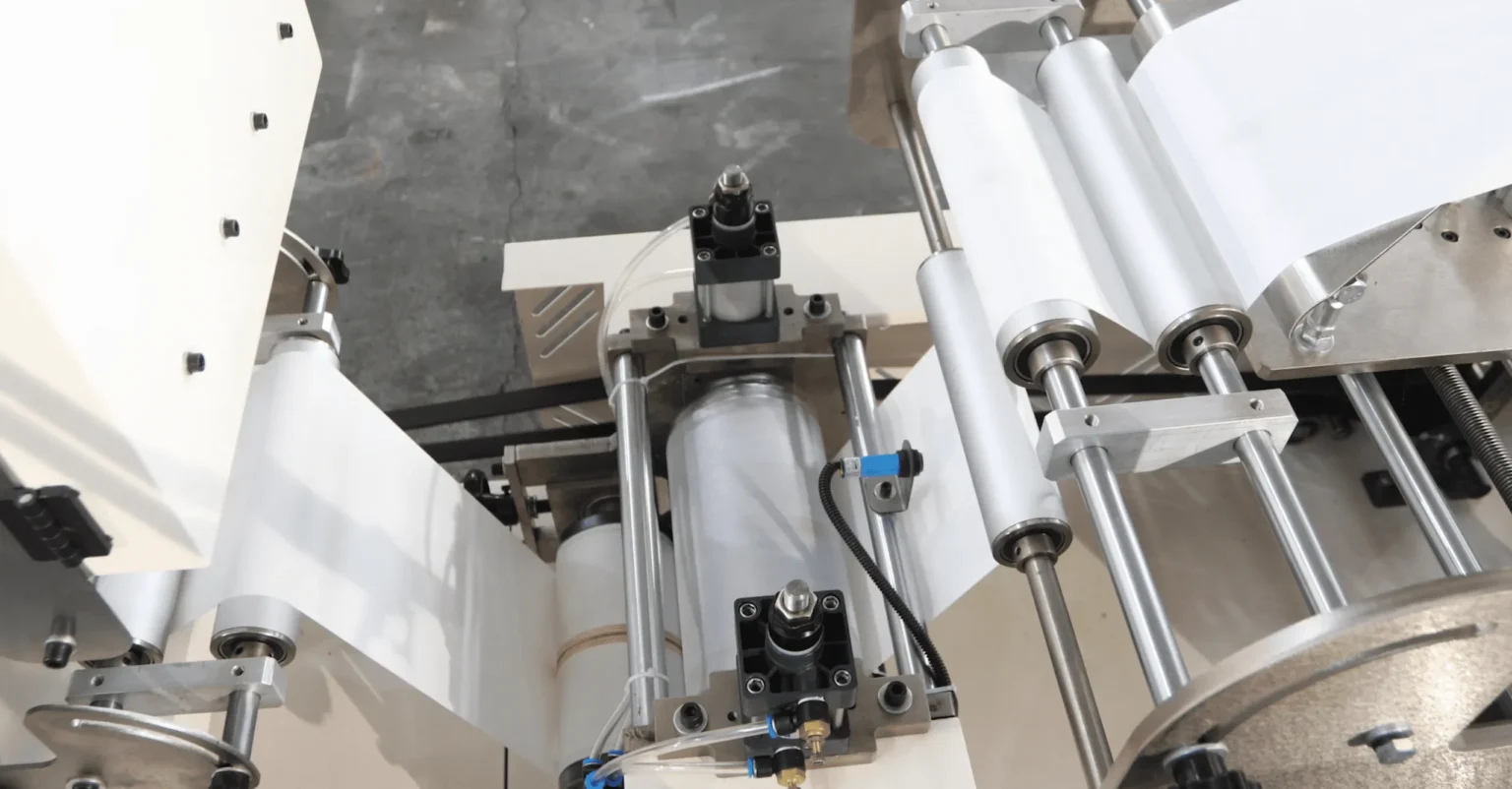
False. "Servo" is a category label. Within it, a stepper-servo peristaltic pump with a mechanical calibration loop holds ±4-5% in real production. A true servo-metered gear or piston pump with closed-loop electronic feedback holds ±2%. Suppliers who quote "servo dosing" without specifying the metering mechanism are marketing to the label, not to the specification.
Misconception 2: "The lotion formula is what drives complaint rate — not the machine."
Partially true, dangerously incomplete. Lotion formula sets the ceiling of consumer satisfaction. Dosing precision determines whether every consumer actually receives that formula at the target concentration. A world-class formula dispensed at ±7% is a mediocre product 15% of the time. A mediocre formula dispensed at ±2% is a consistent product every time.
The uncomfortable pattern: when a private-label wet wipes SKU starts losing shelf share, the reflex response from the brand owner is to reformulate the lotion. In roughly two-thirds of the cases I have seen, the lotion was fine — the dosing tolerance had drifted at the factory. Reformulation is expensive; recalibrating a dosing pump is not.
Misconception 3: "We measure dosing every shift, so we would catch drift."
Only if you measure with the right instrument. Most factory dosing checks are done gravimetrically — weigh a batch of finished packs, back-calculate liquid content. That method has its own ±3-4% measurement uncertainty. If the machine's true dosing is at ±5% and your measurement is at ±4%, you cannot statistically distinguish drift from noise. The dosing audit needs a flow meter on the injection line itself, calibrated quarterly.
Misconception 4: "Once a line is validated at SAT, dosing precision is fixed."
Dosing pumps drift over time. Elastomer seals harden, piston tolerances widen, viscosity of lotion changes seasonally. A line that passed SAT at ±2% will run at ±3.5% eight months in without maintenance and at ±5% eighteen months in. The maintenance schedule is not "when the pump fails" — it is "before the tolerance drifts past the consumer detection threshold." Most factories do not have this on their PM calendar.
5 · What to ask before you sign a wet wipes RFQ
Bring these five questions to every wet wipes machine RFQ, in this order — and make the supplier answer in writing before signature:
- What is the dosing metering mechanism — servo-piston, servo-gear, peristaltic, or diaphragm? The mechanism sets the ceiling of achievable precision. Anything other than servo-piston or servo-gear is a warning sign for private-label programs.
- What is the shift-to-shift dosing standard deviation on your reference site running my product's liquid formula? Not the machine's rated tolerance. Real measured standard deviation across a full production shift, on a formulation with a similar viscosity to yours.
- How often does the dosing pump need calibration to maintain the quoted tolerance? Weekly, monthly, or quarterly? A pump that needs weekly calibration to hold ±3% is a pump that will drift to ±6% on your factory's third-shift maintenance discipline.
- Is the dosing tolerance contractually written into SAT acceptance criteria? If it is only in the sales datasheet, it is not enforceable. Move it to the technical agreement.
- Show me 30 days of shift-level dosing data from a reference line running now. The same 30-day data request from earlier articles in this series — because it works for every specification, not just changeover time.
Red flag on any RFQ: the supplier quotes "±3% dosing tolerance" but cannot provide reference-site data showing that tolerance held across an actual shift on a similar formulation. That means the number is a design target, not a demonstrated result. On your factory floor, design targets become 1.5-2x wider in real operation.
6 · Why Welldone Machinery for private-label dosing precision
Welldone Machinery ships wet wipes lines with servo-metered liquid dosing as standard — and writes the tolerance into SAT acceptance criteria, not just the sales datasheet. The reference-site data we attach to every quote includes shift-level dosing standard deviation on a formulation comparable to yours.
01 · ±2% CONTRACTUAL
Dosing tolerance in SAT criteria
Servo-metered liquid injection holds ±2% precision across shift, batch, and SKU. Enforced at SAT, monitored through the line's own flow meter — not the gravimetric back-calculation retailers cannot audit.
02 · REFERENCE DATA
30-day shift-level tolerance logs
Every quote includes reference-site dosing standard deviation from a line running now — with a formulation comparable to yours, not a demo condition. The number your buyer will hold you to is the number we publish before the PO.
03 · PM DISCIPLINE
Calibration on the PM calendar
Dosing pump calibration schedule is documented in the equipment manual, tied to the seal wear curve, and pushed to the operator HMI as a scheduled task — so the tolerance you commissioned at is the tolerance you run at month 18.
8 · Conclusion
Consumer complaints on wet wipes are not random. They cluster around dosing precision, they follow a predictable timeline (peaks at month 4-6 after shelf launch), and they trigger the private-label review meeting that ends supply agreements. The specification that decides whether that meeting happens sits three pages deep in the technical annex, and gets four seconds of attention in most RFQ conversations.
The suppliers who understand this move dosing tolerance to the front of the discussion — because they know it is the number their reference customers get audited on. The suppliers who bury it either do not measure it, or have a reason to hope you do not.
An open question to take back to your QC team: on your current line, when was the last time anyone measured actual dosing precision with a flow meter on the injection line — not back-calculated from gravimetric pack weight? If the answer is "never" or "years ago," you have already found your next audit action item.
9 · Frequently asked questions
What dosing tolerance is achievable on a modern servo-metered wet wipes line?
±2% shift-to-shift standard deviation is achievable and can be written into SAT acceptance criteria on a Welldone servo line with piston or gear metering, closed-loop electronic feedback, and quarterly PM calibration. Anything wider than ±3% on a supposedly full-servo line points to a peristaltic pump masquerading under a servo label, or to a factory PM discipline that has let the pump drift.
How do I audit my current line's actual dosing precision?
Install a flow meter on the liquid injection line — not on the reservoir or the return loop. Log flow rate at 1-second resolution across a full production shift. Calculate the standard deviation of shot-to-shot volume. That number is your real dosing precision. If it is more than 1.5x your machine's rated tolerance, either the pump is out of spec or the calibration cycle has been missed. Both are fixable.
Does dosing precision matter for sachet lines the same way it matters for tubs?
Yes, but the failure mode is different. In sachets, ±7% dosing shows up as one in every fifteen sachets being visibly under-wet on opening — usually in single-use travel or hotel amenity contexts, where the consumer only opens one sachet at a time and cannot compare to others. Complaint rates are lower in absolute terms, but retention on the SKU drops just as fast because the affected consumer does not repeat purchase.
What is the typical dosing pump calibration interval on a wet wipes line?
Quarterly calibration is the industry standard for private-label programs, monthly for medical-grade or sensitive-skin formulations. The interval scales with lotion viscosity — thicker lotions abrade pump seals faster and require tighter PM discipline. A quoted calibration interval longer than 6 months on a private-label line is a red flag: either the pump tolerance is loose enough that drift does not matter, or the supplier has never audited it long enough to know.
Can Welldone Machinery retrofit servo-metered dosing onto an existing wet wipes line?
Depends on the base machine. If the existing line has a servo-driven main drive and a modular liquid injection subsystem, a servo dosing retrofit is typically 5-7 days of downtime and USD 40K-70K, including flow meter installation and SAT re-validation. If the base line has a purely mechanical injection subsystem, the retrofit becomes a full replacement of the injection module — closer to USD 90K-140K and 2-3 weeks. Send us your current line's spec sheet and we will quote the retrofit scope honestly.
Auditing dosing precision on your current wet wipes line — or specifying a new one?
Send us your product spec, lotion viscosity, and target private-label market. We return an engineered dosing tolerance specification, reference-site shift-level data, and — if you are diagnosing an existing line — a retrofit scope quote with real downtime numbers.