Packaging Machine Speed: Rated vs Actual Output Explained

Packaging Machine Speed: Why Rated Packs Per Minute Is Not What You Will Get
A buyer sent me three packaging machine quotations last month and asked which one was fastest. The rated speeds were 15, 45 and 60 packs per minute. He assumed he was comparing the same thing.
He was not. This article explains what the number on a packaging quotation actually measures, why the same machine platform delivers different output on different products, and how to work out which speed tier your line genuinely needs.
Packaging Machine Series · Part 2 of 3
Part 1 covered the bag itself: In-Line Bag Making vs Pre-Made Bags. This part covers speed. Part 3 will cover seal quality and pack integrity in export shipping.
Part 1 covered the bag itself: In-Line Bag Making vs Pre-Made Bags. This part covers speed. Part 3 will cover seal quality and pack integrity in export shipping.
Three Quotations, Three Speeds
Fifteen packs per minute. Forty-five. Sixty. Put those three numbers side by side on a comparison sheet and one machine looks four times better than another.
Then you look at what each machine packs.
The 15 packs/min machine handles wet wipes. The 60 packs/min machine handles sanitary napkins. They are not competing products. They are answers to different engineering problems that happen to share a category name on a website.
Here is the pattern I see almost every week: a buyer builds a comparison table with speed in the first column, and the table quietly compares machines that were never designed to do the same job.
Where the Rated Number Comes From
A rated speed is measured under one defined condition. One product. One pack count. One bag size. Continuous infeed with no interruption.
That condition is real, but it is a specific point, not a range. Change the pack from 10 pieces to 20 and the insertion stroke gets longer. Change the product from a thin panty liner to a bulky underpad and the stack takes more volume and more time to square up.
None of that is dishonest. It is simply what a single number can and cannot carry.
The rated figure tells you what the machine can do. It does not tell you what your product will let it do.
The Product Decides the Speed
Three product characteristics set the ceiling before the machine design is even considered.
Seal requirement
Wet wipes need a moisture-retaining seal. That seal has to be held under pressure long enough to be reliable, and no amount of servo control shortens the physics. A sanitary napkin pack does not carry that constraint, so its cycle can be much shorter.
Product bulk
A larger, thicker product means a taller stack, a longer insertion stroke, and more film per bag. Every one of those adds milliseconds that multiply across a shift.
Pack count
A 6-piece flat-insert pack and a 20-piece standing-insert pack are different mechanical events. The 20-piece pack has more product to group, square and push.
Speed by Product Category
| Product Type | Typical Rated Speed | What Sets the Limit |
|---|---|---|
| Wet wipes | 13-16 packs/min | Moisture-retaining seal held under pressure |
| Underpads / bed pads | 40-45 packs/min | Large product footprint, tall stack, long stroke |
| Baby / adult diapers | 45-50 packs/min | Bulk per piece, compression before insertion |
| Sanitary napkins | 55-60 packs/min | Thin, uniform product, fast stack formation |
| Tissue / bundled rolls | 30-60 bundles/min | Bundle size and whether film is roll-fed or pre-made |
Read that table as a range for planning, not as a promise. Your specific pack count and bag size sit somewhere inside each band, and where exactly depends on the configuration.
Same Platform, Different Output
The clearest way to see this is to hold the machine constant and change only the product.
One of our packing platforms runs 55-60 packs per minute on sanitary napkins. The same platform, same servo count, same control architecture, runs 40-45 packs per minute on underpads.
Nothing was downgraded. The underpad is simply a bigger object. It takes longer to collect, longer to square, and longer to insert. Roughly a quarter of the output disappears purely because of product geometry.
In most cases, when a buyer sees two speed figures from the same supplier and assumes one machine is inferior, this is what is actually going on.
The Infeed Sets the Ceiling
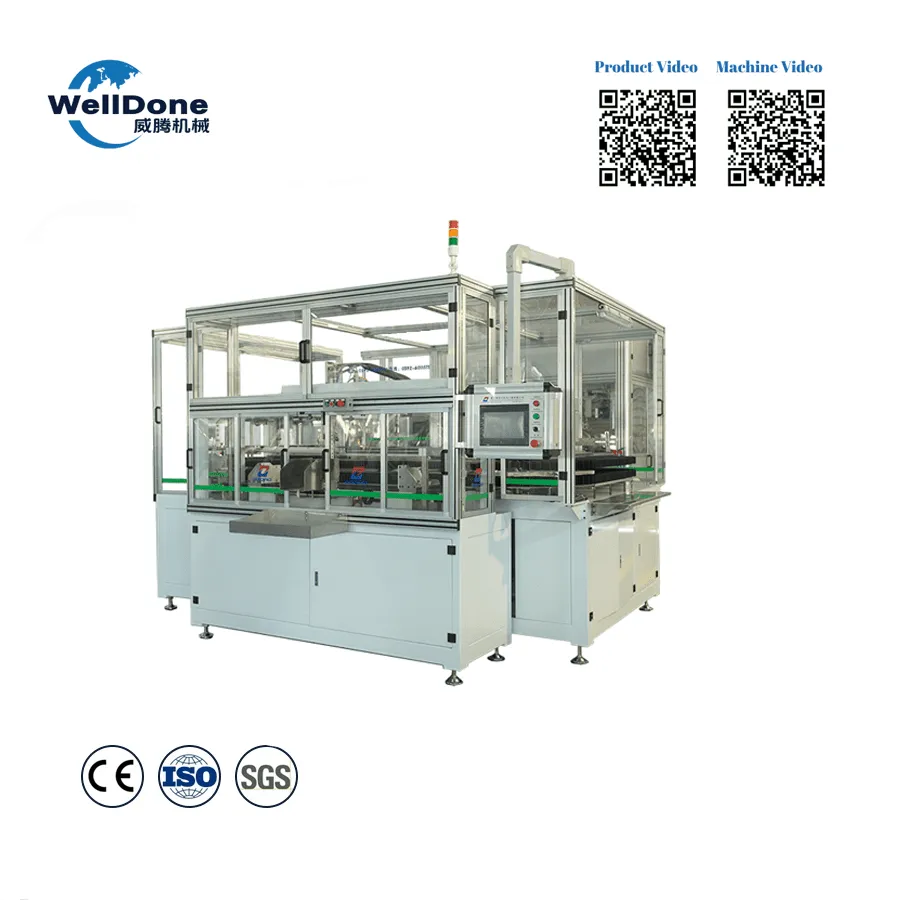
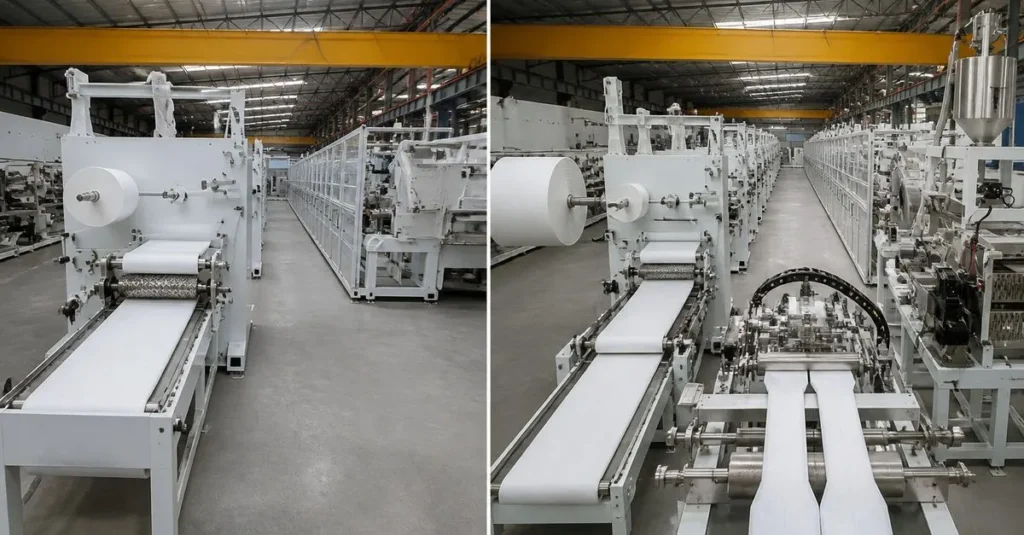
Here is the part that gets skipped in most comparisons: a packaging machine cannot run faster than your converting line feeds it.
If your sanitary pad line discharges 800 pieces per minute and you pack 10 pieces per bag, you need 80 bags per minute. A 60 packs/min machine will not keep up and product will accumulate. Buy a 60 packs/min machine for a line producing 400 pieces per minute in 10-piece packs, and you have bought 20 packs/min of capacity you will never use.
Neither situation is a machine fault. Both are specification faults.
What Actually Eats Your Shift
Assume the machine is correctly matched. Effective output still lands below rated speed, and the gap comes from a short list of routine events.
- Film roll change. A splice takes time, and on an in-line bag making machine it is a scheduled stop rather than an unexpected one.
- Format changeover. Even a recipe-based change needs guide adjustment and a few verification packs.
- Infeed gaps. When the converting line hiccups, the packaging machine idles. Those seconds are invisible individually and significant weekly.
- Uneven stacks. A poorly squared stack causes a reject or a jam. This is the one most factories underestimate.
- Startup and shutdown. The first minutes of a shift are never at rated speed.
This is why we state machine efficiency at or above 95% alongside the speed figure. Efficiency is the honest half of the specification, and it is the half buyers rarely ask about.
Rated Speed vs Effective Output
| Factor | Effect on Output | What to Ask the Supplier |
|---|---|---|
| Rated speed | Ceiling under one test condition | At which pack count and bag size was this measured? |
| Machine efficiency | Share of scheduled time actually running | What efficiency figure do you guarantee, and over what period? |
| Qualified rate | Share of packs that are saleable | What is the pass rate at rated speed, not at reduced speed? |
| Infeed match | Hard cap set by the converting line | Have you sized this against my actual line discharge? |
| Changeover time | Lost minutes per format switch | How long to move between my two most common pack formats? |
Our in-line bag making machine is rated at 45-50 packs per minute with machine efficiency at or above 95% and a qualified product rate of at least 98%. Those three numbers belong together. Any one of them on its own is close to meaningless.
Matching a Tier to Your Line
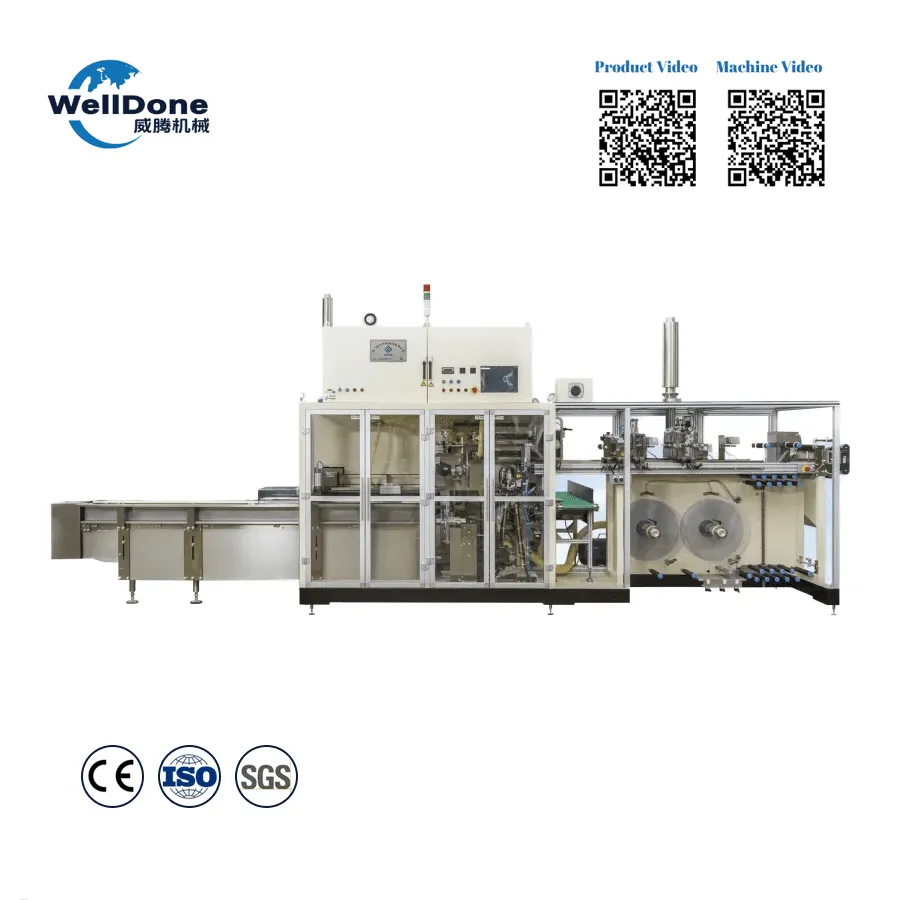
The calculation is simple arithmetic, and it takes two minutes.
Take your converting line's actual discharge in pieces per minute. Divide by your pack count. That is the bags per minute you need. Add roughly 15-20% headroom for efficiency losses and future pack-count changes. The result is the tier to specify.
A line producing 500 pieces per minute in 10-piece packs needs 50 bags per minute, so specify around 58-60 with headroom. The same line moving to 20-piece packs needs only 25 bags per minute — and suddenly the expensive high-speed machine is the wrong purchase.
Which is why we ask for pack counts you plan to run over the next three years, not just the one you sell today.
The Mistake Buyers Make
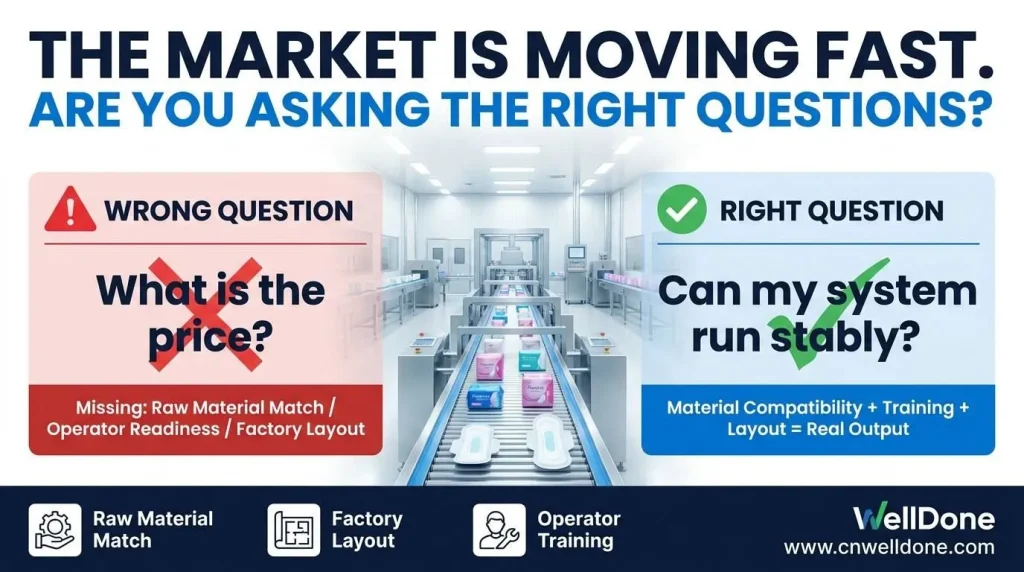
I understand why speed is the first column on the comparison sheet. It is a single number, it is on every quotation, and it feels objective.
But the number answers a question your factory is not asking. The real question is not how fast the machine can go — it is whether the packaging section can absorb what your line produces without becoming the constraint.
A common mistake is buying speed as insurance. The extra capacity sits idle, the capital is spent, and the actual bottleneck — an unsteady infeed or an uneven stack — is still there on Monday morning.
Why Welldone
We have manufactured hygiene product machinery in Jinjiang, Fujian since 2008 and delivered to more than 60 countries. Because we build both the converting lines and the packaging machines, we size the two against each other rather than quoting them in isolation.
Sized to your lineWe quote a speed tier based on your actual discharge rate and pack count, not the highest figure in our range.
Three numbers, not oneRated speed, machine efficiency at or above 95%, and qualified rate at or above 98% are stated together in every specification.
Verified before shipmentVideo factory acceptance test at rated speed using your bag specification and pack count, before the machine leaves our floor.
Related Machines
Conclusion
Packs per minute is a useful number once you know what it was measured against. On its own, at the top of a comparison sheet, it mostly encourages buying the wrong tier.
Your packaging section does not need to be fast. It needs to be faster than your converting line discharges, steady enough to hold that rate for a full shift, and accurate enough that the packs coming off it are saleable.
So before you compare quotations again, work out this one figure: what is your converting line's real discharge per minute, divided by your pack count? If your packaging machine is rated well above that number, ask what you are paying for.
Frequently Asked Questions
Why is a wet wipes packaging machine so much slower than a sanitary napkin one?
Because the seal is doing a different job. A wet wipes pack has to retain moisture, which means the seal must be held under pressure for a defined dwell time. That dwell cannot be shortened by adding servo axes. Sanitary napkin packs have no moisture barrier requirement, so the cycle is much shorter. It is a product constraint, not a machine limitation.
How do I calculate the speed tier I actually need?
Divide your converting line's real discharge in pieces per minute by your pack count to get bags per minute, then add 15-20% headroom for efficiency losses and future format changes. Use the line's actual sustained output, not its nameplate rating — the gap between those two is usually where sizing goes wrong.
Should I buy extra speed as insurance for future growth?
Only within reason. Some headroom is sensible. But if you plan to move to larger pack counts, your required bags-per-minute goes down, not up — a line switching from 10-piece to 20-piece packs halves the packaging demand. Tell us your three-year pack format plan and we will size accordingly rather than defaulting upward.
What is the difference between machine efficiency and qualified rate?
Machine efficiency is the share of scheduled time the machine is actually running — it accounts for roll changes, changeovers and infeed gaps. Qualified rate is the share of packs produced that are saleable. A machine can have high efficiency and a poor qualified rate, or the reverse. You need both figures, plus the rated speed, to know your real output.
Does the bag type affect speed?
Yes. Pre-made bags require pick-up and opening, which is a mechanical event that can fail. Roll-fed film forms the bag in-line, which removes that failure mode but adds a splice stop at roll change. The trade-off is covered in detail in Part 1 of this series on in-line bag making versus pre-made bags.
Send Us Your Line Output, Not Your Wish List
Tell us your product type, your converting line's actual discharge per minute, and the pack counts you intend to run. We will come back with the speed tier that fits — including telling you when a lower tier is the correct answer.
Request a Speed Sizing Review