T-Shape vs 3-Piece Pull-Up Diaper Machine: How to Choose

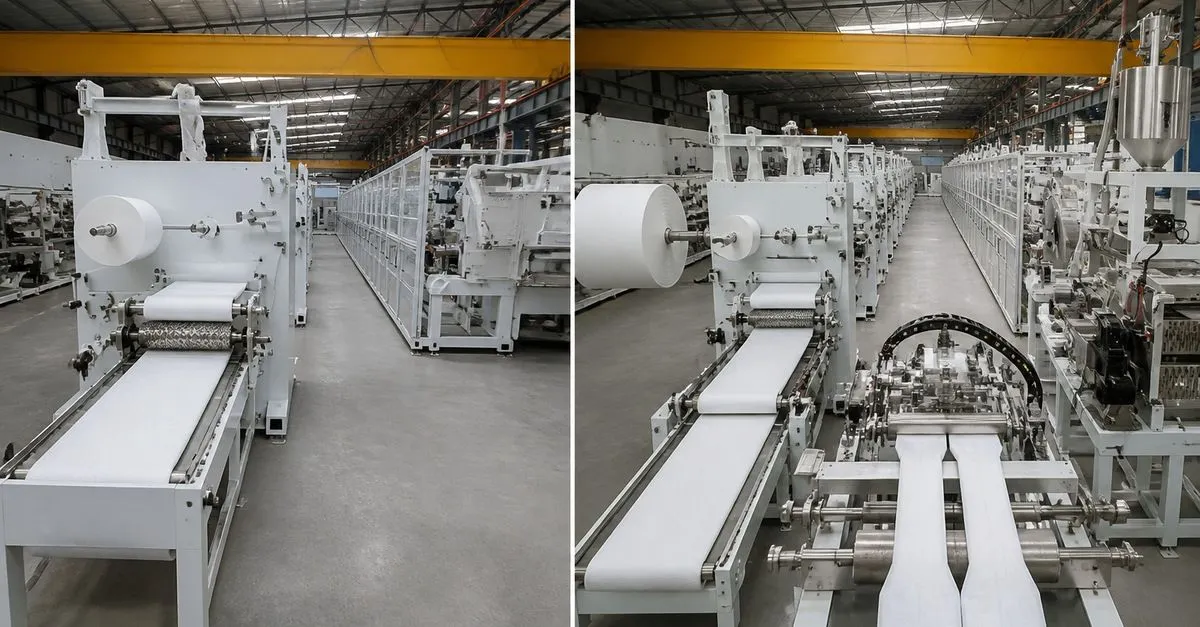
T-Shape vs 3-Piece Pull-Up Baby Diaper Machine: Choosing a Format, Not Just a Speed
A buyer sent me two quotations last week — a T-shape tape diaper line and a 3-piece pull-up pants line — with similar rated speeds and a similar price per unit of output. He asked which machine was better.
The speeds were comparable. What the quotations did not show was how much of that output would be saleable while his team was still learning the process. This article compares the two formats on process complexity, yield behaviour, SKU planning and market fit, so you can specify against your own situation rather than against a speed figure.
Two Quotations, One Wrong Question
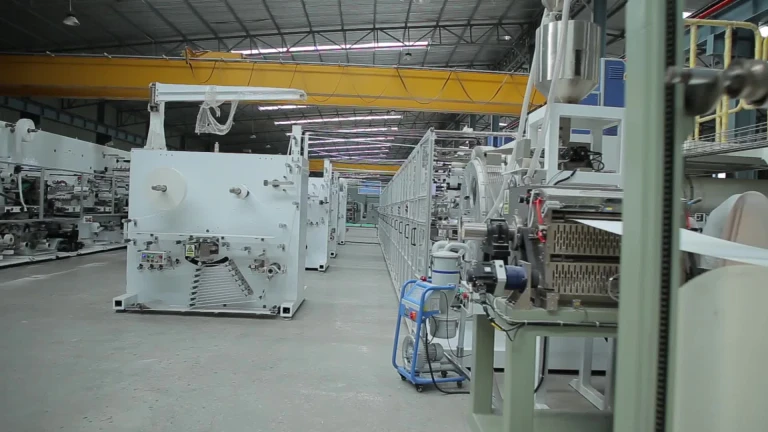
"Which machine is faster" is the easiest question to ask and the least useful one to answer, because both formats can be specified at similar rated speeds.
Rated speed describes what the machine can do under controlled conditions. It says nothing about how many of those pieces leave your factory in a sellable carton. That second figure is where the two formats genuinely separate, and it is not printed on any quotation.
You are not choosing between two speeds. You are choosing between two levels of process complexity — and complexity is paid for in yield, not in rated output.
What Each Line Actually Does
Start with what the two machines are asked to build, because the difference is structural rather than cosmetic.
T-shape tape diaper
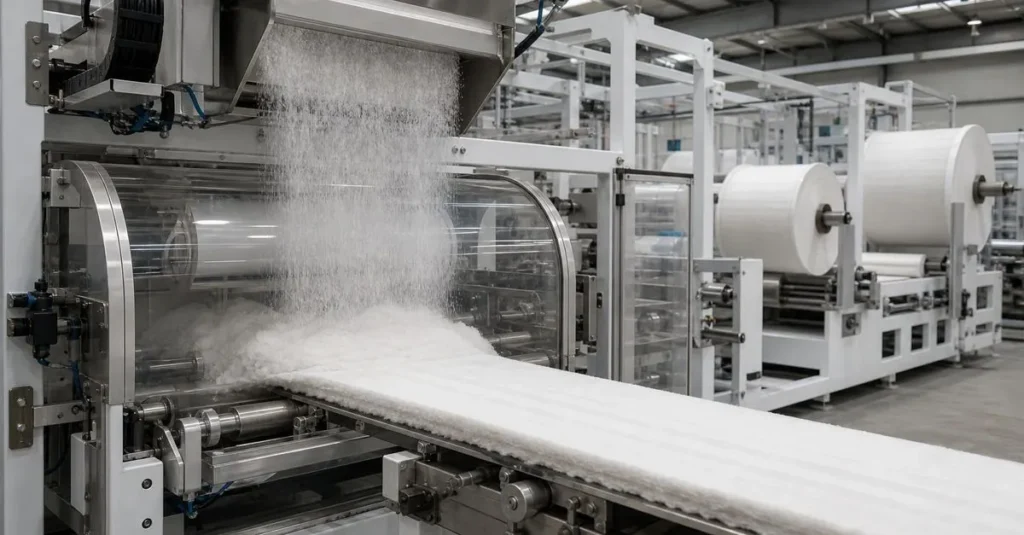
A continuous web receives the absorbent core, then the line applies elastic leg cuffs, standing leak guards, a wetness indicator, the frontal tape landing zone and the side tapes. The product is cut, folded and stacked. It leaves the line as a flat piece, and the caregiver closes it on the baby.
3-piece pull-up pants
Everything above still happens. Then the line joins a separate front panel, back panel and crotch section, applies waist elastics across the panels, and closes both side seams so the product leaves as a finished garment with a continuous waistband.
That is the whole comparison in one sentence: a pull-up line is a tape line plus a garment assembly section. Nothing is removed; several things are added.
The Stations That Make the Difference
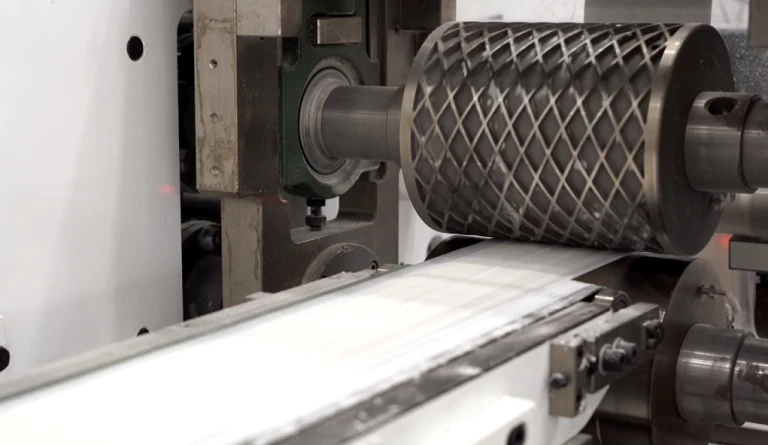
Three additions account for most of the extra difficulty on a pull-up line.
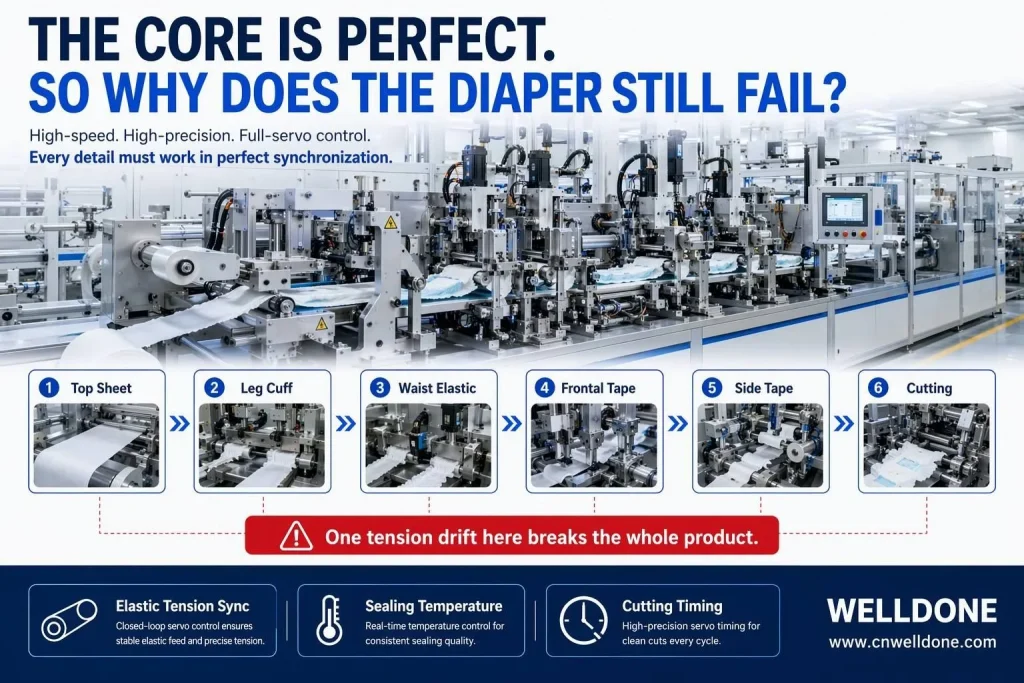
- Panel joining. Front and back panels are bonded to the chassis. The bond has to hold under the stretching a toddler applies while pulling the pant on, and the join must be positioned consistently or the finished garment sits crooked.
- Waist elastic application. Elastic strands are applied under tension across the panel width. Tension variation shows up as an uneven waistband — visible on the shelf and immediately noticed by retail buyers.
- Side seam welding. Both seams are closed, usually ultrasonically. The seam must be strong enough to survive pulling on, yet weak enough at the designed tear line if the product uses a tear-away side. That is a narrow process window.
None of these is exotic engineering. But each one is an additional station that has to stay in tolerance simultaneously with everything upstream, and they sit at the end of the line — so a fault there scraps a product that has already had all its material added.
Process Comparison
| Factor | T-Shape Tape Diaper | 3-Piece Pull-Up Pants |
|---|---|---|
| Output form | Flat piece, closed by caregiver | Finished garment with closed waistband |
| Core process | Core forming, cuffs, leak guards, indicator, tapes | All of the same, plus panels, waist elastics, side seams |
| Registration points | Fewer | More, and interdependent across panels |
| Where defects are costliest | Distributed along the line | Concentrated at the end, after full material cost is added |
| Size handling | Tape allows some fit tolerance per size | Fixed waist opening, so more sizes needed for the same age coverage |
| Typical shelf position | Volume backbone, price-sensitive | Premium tier, toddler and training segment |
| Learning curve | Shorter | Longer, concentrated in the assembly section |
Why Yield Diverges Early
Both formats can reach a high pass rate once a line is running properly. Our T-shape specification states a passing rate of at least 98% and waste below 2% under defined conditions. Comparable figures are achievable on pull-up lines.
The difference is not the ceiling. It is how long it takes to get there, and what a defect costs on the way.
On a tape line, a fault at the cuff station scraps a product that has consumed core material and non-woven. On a pull-up line, a fault at side seam welding scraps a product that has consumed all of that plus panels, waist elastics and the processing time of every station before it. The same defect rate carries a higher material cost.
In most cases the first months on a new pull-up line are spent narrowing the assembly-section window — seam energy, panel registration, elastic tension — rather than fighting the core forming section, which behaves much as it does on a tape line.
Worked Example: Yield vs Price
Illustrative example only. The figures below demonstrate a method of comparison. They are not Welldone customer data, not a price indication and not a performance guarantee. Substitute your own selling prices, material costs and measured yield.
A pull-up pant typically commands a higher shelf price than a tape diaper. The question is how much of that premium survives production reality during the ramp-up period.
| Step | How to Calculate |
|---|---|
| 1. Price premium per piece | Pull-up selling price − tape selling price, in your own market |
| 2. Material cost difference | Panels, waist elastics and any bonding materials the tape product does not use |
| 3. Gross premium | Step 1 − Step 2 |
| 4. Yield gap during ramp-up | Your realistic pull-up yield in months 1-6 minus your current tape yield |
| 5. Scrap cost of that gap | Yield gap × full material cost of a finished pull-up piece |
| 6. Net premium during ramp-up | Step 3 − Step 5 |
Two things usually surprise people running this calculation.
First, Step 5 uses the full material cost, not the incremental cost, because a piece scrapped at the seam station has consumed everything. Second, Step 4 is not a permanent penalty — it closes as the team gains competence. So the honest way to read the result is as a temporary cost of entry, not as a verdict on the format.
If Step 6 is comfortably positive even with a conservative yield assumption, the format decision is straightforward. If it is marginal, the decision depends on how quickly you expect to climb the curve, which depends more on your team than on the machine.
Material Behaviour Is Less Forgiving
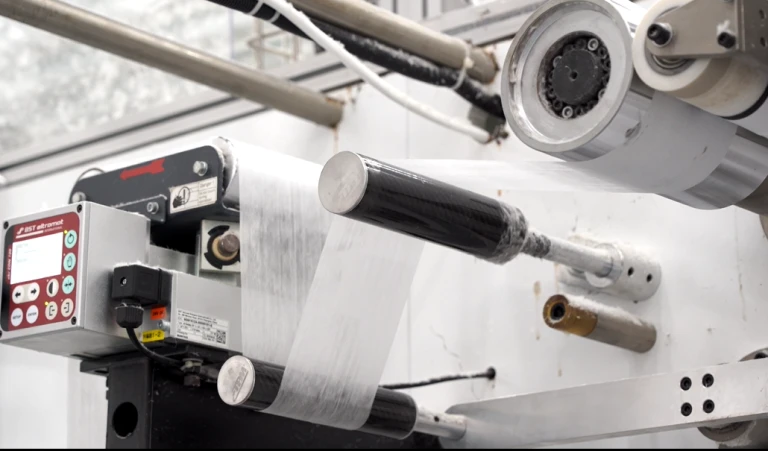
A point that rarely appears in machine discussions but shows up quickly in production: pull-up formats are less tolerant of incoming material variation.
Panel non-woven has to stretch predictably. Elastic strands have to behave consistently lot to lot, because tension is set as a process parameter and a different elastic modulus changes the finished waist dimension without anything on the machine having changed. Bonding behaviour varies with substrate.
Factories moving from tape to pull-up sometimes find that suppliers they were satisfied with become a problem — not because material quality dropped, but because the new process has a narrower tolerance for the same variation. Worth discussing lot-to-lot consistency with your suppliers before commissioning rather than after.
Size Range and SKU Planning
This one has commercial consequences that are easy to miss at specification stage.
A tape diaper accommodates a range of body sizes within one size code, because the caregiver adjusts the tape position. A pull-up has a fixed waist opening and relies on elastic stretch, so covering the same age range generally requires more size codes.
More size codes means more format changes, more finished goods SKUs, more packaging variants, and a more complex forecast. If your distribution is through many small retailers rather than a few large accounts, that multiplication is felt in the warehouse before it is felt on the line.
Decide your size ladder before you specify the machine, because the required size range affects the mechanical configuration.
Operators and Learning Curve
Our T-shape configuration is specified with 8-10 operators. A pull-up line is not dramatically different in headcount — the difference is in what those people need to know.
The assembly section introduces adjustment decisions that do not exist on a tape line: seam energy against material, panel registration against speed, elastic tension against finished dimension. These interact. An operator who changes one to fix a visible defect can create a less visible one somewhere else.
Where a factory has no prior pull-up experience, budget for a longer commissioning period and for training that covers why those parameters interact, not just where the buttons are. That is a scheduling and budgeting item, and it is more often underestimated than the machine cost itself.
Not sure which format fits your market and your team?
Send us your target retail segment, planned size ladder and current production experience. We will give you a straight assessment — including when starting with tape and adding pull-up later is the better sequence.
Let Your Market Decide
The machine question is downstream of a commercial question that only you can answer.
- Who is buying, and where? Pull-up pants generally sit in a premium tier and perform in the toddler and training segment. Tape diapers remain the volume backbone in many price-sensitive markets, particularly in Africa and South Asia.
- What does your channel reward? Modern retail chains often want the premium tier and the shelf presentation that goes with it. Traditional trade and wholesale distribution frequently move on price per piece.
- Can your price hold the premium? A pull-up costs more to make. If your market will not pay the difference, the added complexity has no commercial return.
- What is your competition already producing? Entering a segment already saturated with local pull-up production is a different proposition from being an early entrant.
The real question is not which product is more advanced. It is which one your team, your material supply and your customers are ready for at the same time.
The 2-Piece Middle Ground
The comparison is often framed as two options when there are three.
A 2-piece pull-up construction uses front and back panels without a separate crotch section. It still produces a finished pant with closed side seams, but with fewer joining operations than a 3-piece build.
For factories entering the pull-up segment for the first time, that reduction in assembly steps can be a sensible intermediate position — a genuine pant product on the shelf, with a shorter list of parameters to master. Whether it suits depends on the fit and appearance your target segment expects, which is worth checking against what is already selling in your market.
When T-Shape Is the Right Answer
It would be easy to present pull-up as the natural upgrade. That framing is wrong often enough to be worth stating plainly.
A T-shape tape line remains the better choice when:
- Your market is price-led. If per-piece price decides shelf placement in your channel, added production cost has nowhere to go.
- This is your first line. Establishing stable core forming, gluing and material handling with a shorter process is a reasonable way to build competence before adding assembly complexity.
- Newborn and small sizes dominate your mix. Tape products remain standard at the newborn end, where adjustability matters most.
- Your material supply is not yet consistent. A wider process tolerance is worth a great deal when incoming lots vary.
- Your distribution is fragmented. Fewer size codes and fewer SKUs are easier to manage across many small accounts.
Several manufacturers run both, starting with tape and adding a pull-up line once the tape business funds it and the team has depth. That sequence is often more robust than trying to learn both at once.
Why Welldone
We have manufactured hygiene product machinery in Jinjiang, Fujian since 2008 and delivered to more than 60 countries. We build both formats, which means we have no commercial reason to steer you toward the more complex one.
Format advice before machine adviceWe ask about your retail segment, size ladder and existing production experience before recommending a configuration — including when tape first and pull-up later is the better sequence.
Configured to your size ladderSize range affects mechanical configuration, so we set it from the sizes you plan to sell rather than from a standard catalogue range.
Verified before shipmentVideo factory acceptance test at rated speed using your material specification, so you see the line running your substrates before it leaves our floor.
Related Machines
Conclusion
The two formats are not two speeds. A pull-up line is a tape line with a garment assembly section added, and that section is where the yield, the training time and the material sensitivity live.
None of that argues against pull-up. It argues against choosing it from a specification sheet. The format that suits you follows from your retail segment, your size ladder, the consistency of your material supply and how much process depth your team already has.
So before comparing quotations again, answer this one first: if your yield in month three is meaningfully below your target, does your price premium still cover it — and if not, what would you need in place before it does?
Frequently Asked Questions
Can one machine produce both tape diapers and pull-up pants?
The two constructions require different assembly sections, so they are normally separate lines rather than one convertible machine. If you intend to produce both, tell us at enquiry stage — the sequencing of the investment, and how the two lines share space and material handling at the line end, is worth planning together rather than separately.
Is a pull-up line always slower than a tape line?
Not necessarily. Both can be specified at comparable rated speeds. The more useful comparison is sustained saleable output during your first months of production, because the assembly section takes longer to stabilise. Ask any supplier for the conditions under which their rated figure was measured, and whether it reflects a mature process or a commissioning benchmark.
What is the difference between 2-piece and 3-piece pull-up construction?
A 3-piece build joins a separate front panel, back panel and crotch section. A 2-piece build uses front and back panels without the separate crotch piece, which means fewer joining operations. Both produce a finished pant with closed side seams. The choice affects fit, appearance and process complexity, so it is worth checking against what already sells in your target market.
Do we need different raw materials for a pull-up line?
You need panel non-woven and waist elastics that a tape line does not use, and the process is generally less tolerant of lot-to-lot variation in stretch behaviour. Discuss consistency requirements with your suppliers before commissioning. Factories sometimes find an existing supplier becomes a problem after switching format, not because quality changed but because the new process window is narrower.
How many size codes should we plan for?
Generally more for pull-up than for tape covering the same age range, because a fixed waist opening offers less fit tolerance than an adjustable tape. Decide the size ladder before specifying the machine, since the required size range affects mechanical configuration and later changes are more expensive than getting it right at order stage.
What information do you need to recommend a format?
Target retail segment and price tier, planned size ladder, expected monthly volume, distribution channel type, your current production experience if any, available floor space, and your raw material sources. The last two determine what is physically and practically feasible; the first four determine what is commercially sensible.
Request a Format Assessment
Tell us about your market rather than asking for a speed figure, and we will tell you which format fits — including when the honest answer is to start with tape and add pull-up later. Please include:
- Target retail segment and price tier
- Planned size ladder
- Expected monthly volume
- Distribution channel type
- Current production experience
- Available floor space
- Raw material sources
- Country and target markets