Adult Pull-Up Line Back-End: Vision Inspection, Packaging & OEE — Welldone

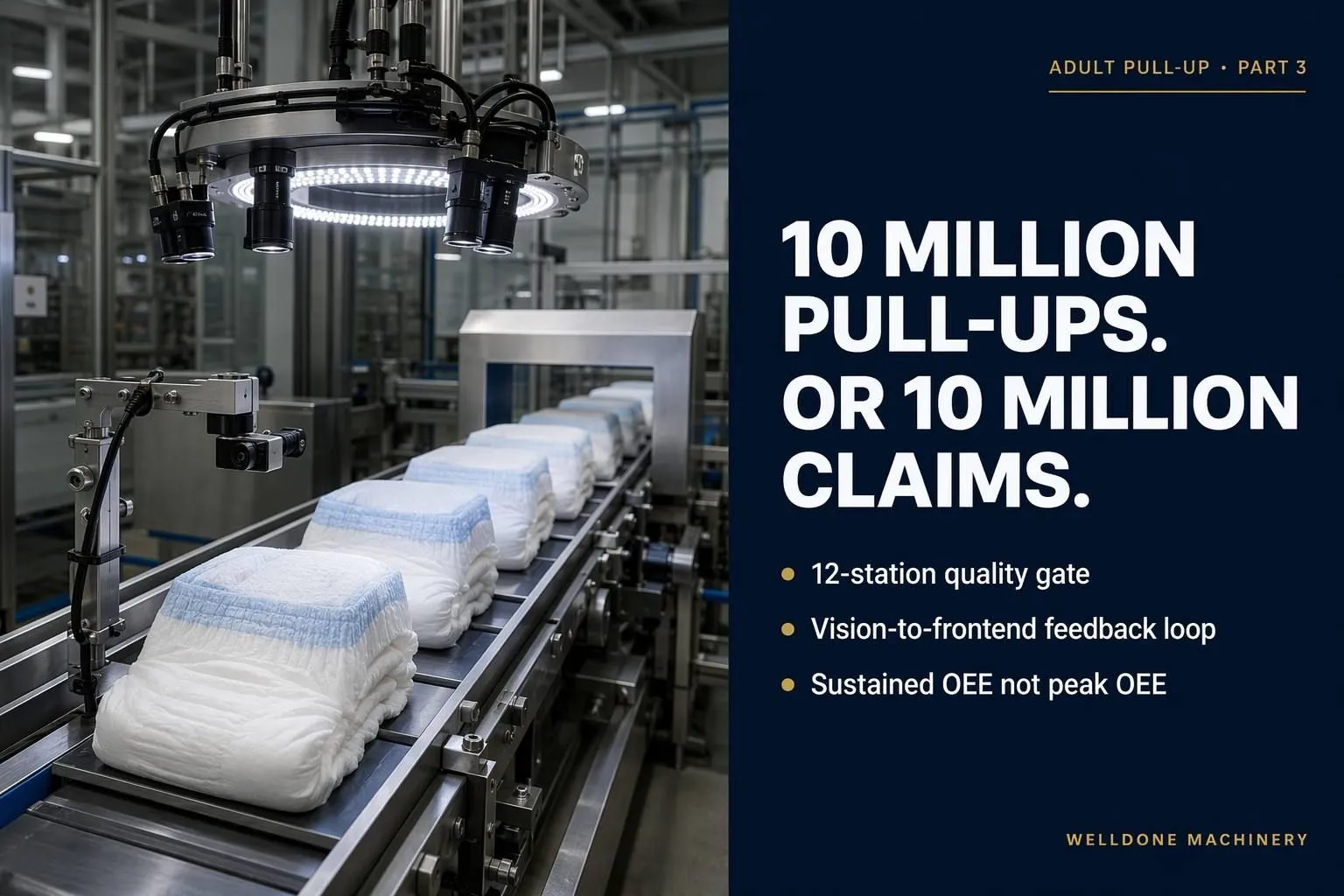
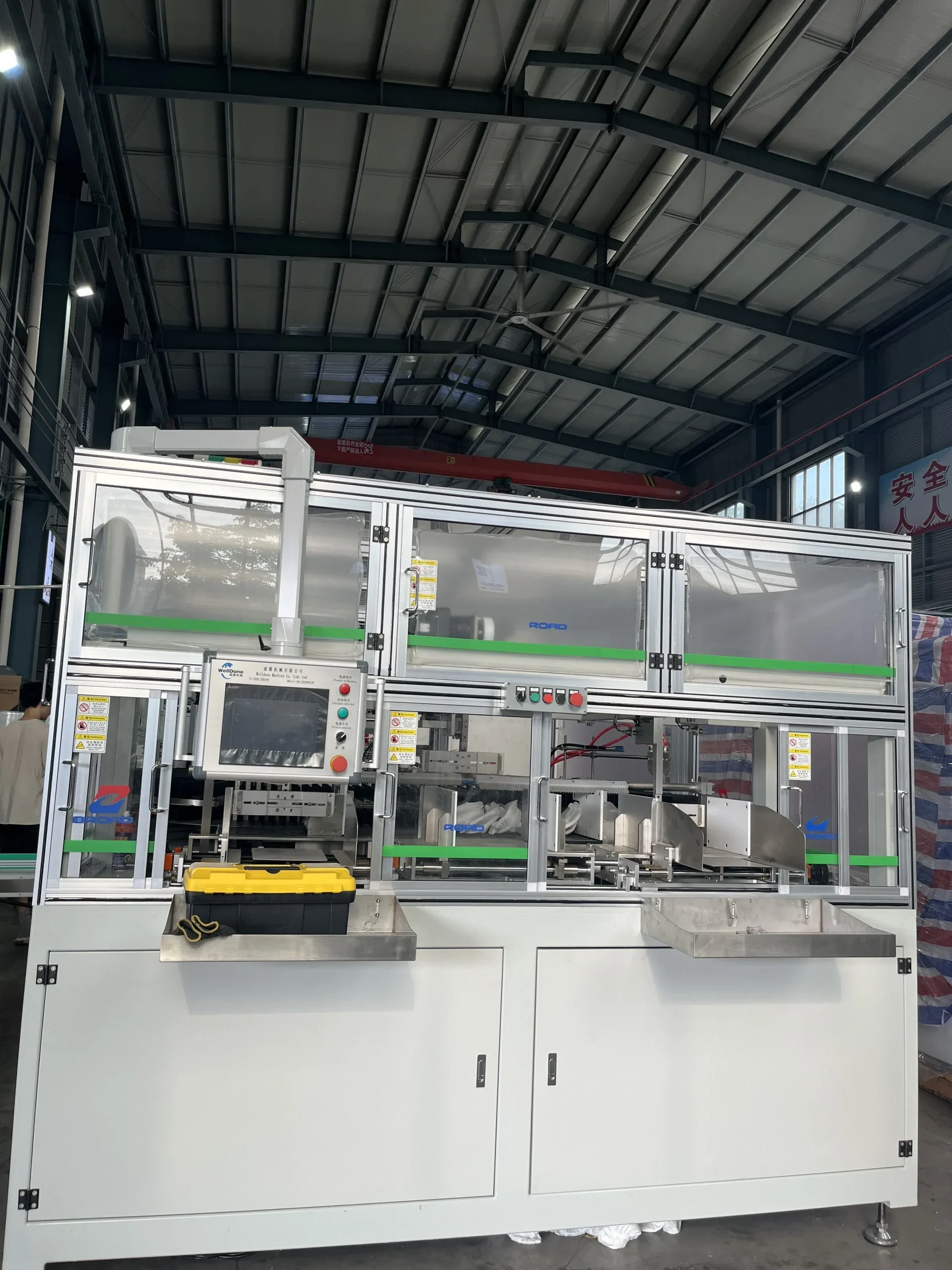
Adult Pull-Up Line Back-End: Why the Last 12 Stations Decide Your OEE — Not Your Peak Speed
Buyers spend 80% of the technical review on the forming system. The complaint file six months later says the money was lost in the last 12 stations. This is Part 3 of the adult pull-up trilogy — the back end, where good product either becomes a shipment or becomes a claim.
Part 1 walked the front-end forming system. Part 2 opened up the middle-section assembly — 3D leg cuff, topsheet-to-core meeting, waistband lamination, arc die cut. This is where the trilogy ends: stations 29 through 41, where 12 quiet stations decide whether 10 million pull-ups ship clean or 10 million claims come back.
1 · A €340K chargeback that started at the bagger
Last November I was walking a private-label buyer through an OEM audit in Poland. The line was rated at 750 pieces per minute. On the day of the audit it hit 780. Everyone in the room was impressed except the buyer's QC lead, who had brought the retailer's incoming inspection report from the first shipment.
Three pages. The summary was one line:
- 4 cartons short by 1 piece
- 2 cartons with smeared LOT codes
- 1 carton with a folded product where the leg cuff had been caught by the sealing jaw
Order value: €1.2 million. Chargeback plus relisting cost: €340,000. The forming system was actually excellent. What killed the shipment was that the back end had never been designed to catch what the front end drifted.
This is the pattern I keep running into on line audits. Buyers spec the forming system in exhausting detail — SAP loading tolerance, elastic stretch ratio, ultrasonic bonding energy — and then let the supplier "package however you package." Six months later, the complaint file explains why that clause was expensive.
2 · The back end is a 12-station quality gate, not a machine
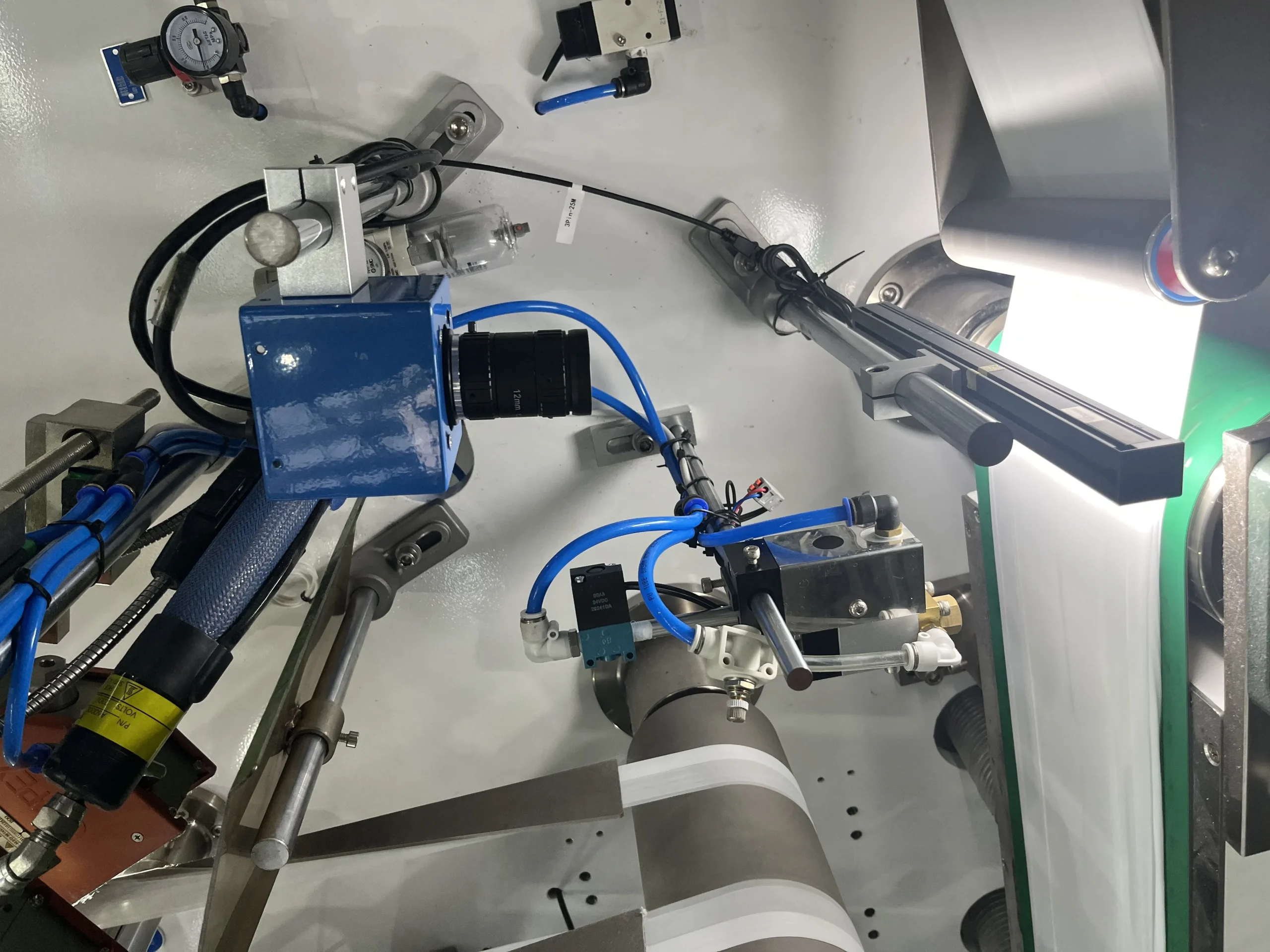
On a properly engineered adult pull-up line, the back end is 12 stations. Not one. If any of them runs open-loop — no data feedback to the master PLC — you have already capped your OEE ceiling, usually somewhere between 72% and 76%.
| Station | What it must do | Failure mode if open-loop |
|---|---|---|
| Heat-seal final inspection | Seal integrity, seal shift, burn-through | Field leakage claims |
| Vision #1 — product level | Leg opening symmetry, waistband alignment, print register | Cosmetic returns |
| Vision #2 — surface | Stains, tears, folded corners, contamination | Retailer QC failure |
| Auto-reject | Divert bad product within 2 cycles | Contaminated stack, whole bag scrapped |
| Folding & stacking | Z-fold or C-fold, precise count | Short-count claims (~80% originate here) |
| Compression | Bag height target without cracking SAP core | Leakage in warehouse humidity |
| Bagging | Film tension, seal temp, tear-notch position | Bag splits on retail shelf |
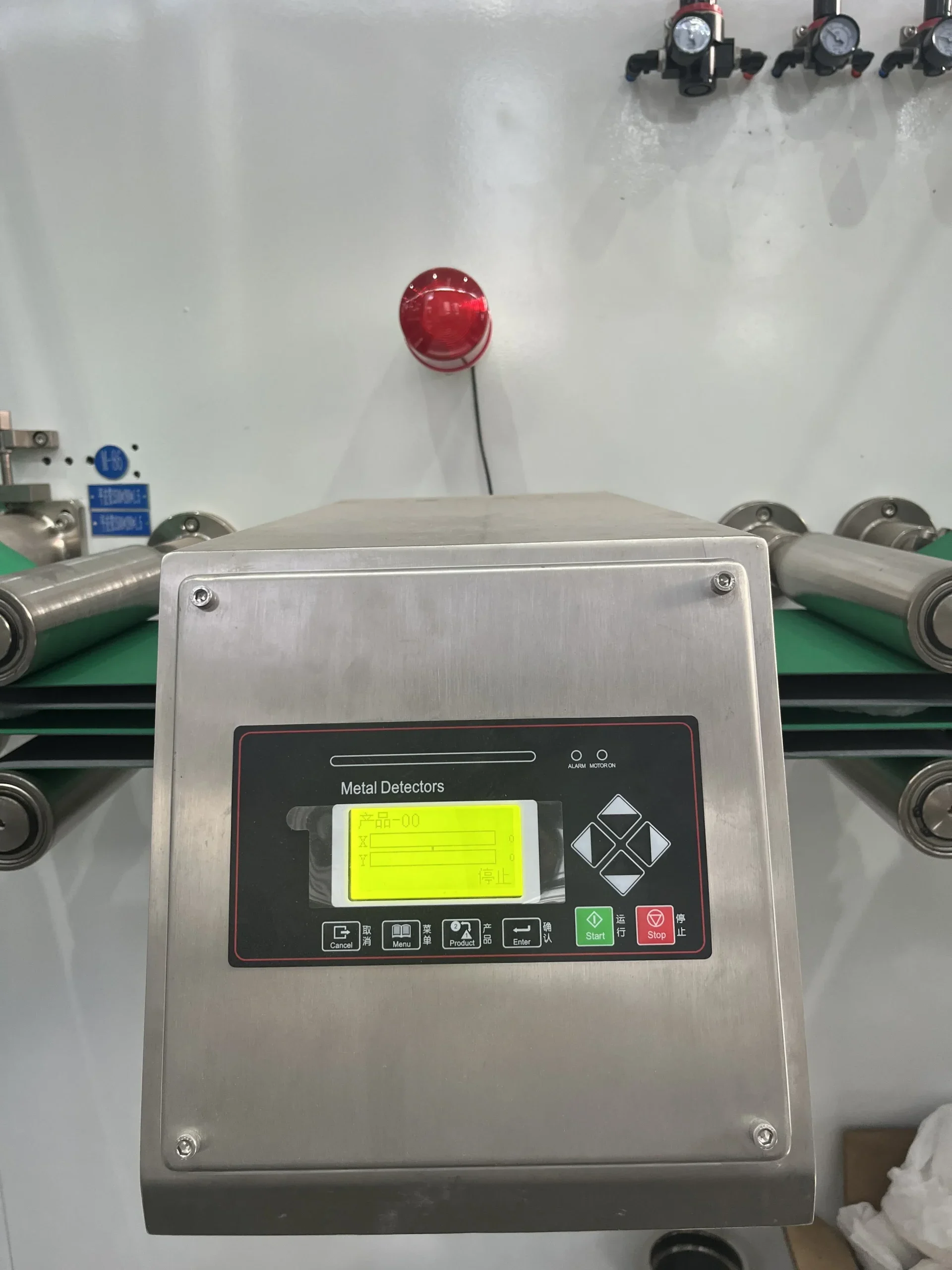
| Metal detection | Mandatory for EU / Japan retail | Deal-killer for private label |
| Weight check | Final count verification | Backup for stacking errors |
| Case packing | Pouch orientation, case seal integrity | Damage in transit |
| LOT / date code | Must survive 6-month warehouse humidity | Traceability failure |
| Palletizing interface | Handshake with downstream automation | Manual restacking = labor cost |
3 · Three misconceptions that cost buyers real money
After walking a lot of audits, three misconceptions come up again and again. All three sound reasonable in a sales meeting. All three show up in the complaint file later.
Misconception 1: "Buy the packaging machine separately, it is cheaper."
It is cheaper on the purchase order. It is three to five times more expensive on warranty, because the two suppliers will spend the first 90 days blaming each other for every reject. Integrated servo handshake between the main line and the bagger is not a luxury feature — it is what determines whether a jam on the bagger stops the main line in 200 milliseconds or in 4 seconds. That is the difference between one damaged pull-up and one damaged case.
Misconception 2: "The stricter the vision system, the better."
No. An over-strict vision system with no feedback loop just becomes an expensive rejector — throwing away 2% of good product to catch 0.3% of bad. The value of vision is not rejection rate. It is whether the defect trend feeds back into the front-end setpoints.
If your vision system detected 40 waistband-misalignment rejects in the last hour and nobody adjusted the ultrasonic bonder, you do not own a smart line. You own a smart trash can.
My take, after seeing dozens of these installations: the machine vision spec should never be evaluated on its own datasheet. It should be evaluated on what data it hands to the master PLC, and how fast. If the answer is "we export a CSV at end of shift" — that is a rejection machine with extra steps. If the answer is "defect category rates stream to the PLC every 60 seconds and trigger front-end setpoint suggestions" — that is a control loop, and it is worth what they are charging for it.
Misconception 3: "OEE 85% is world class."
For a mature adult pull-up line running one SKU for 8 hours straight, 85% is table stakes. World class is 90%+ sustained across SKU changeovers, and — more importantly — outgoing defect rate below 300 ppm.
The number to negotiate in your technical agreement is not peak OEE. It is sustained OEE at the 30-day mark, at the required quality level. Anyone can hit 90% for one shift with a fresh line and the best operator on staff. That number tells you almost nothing about what your line will do in month 8.
4 · Four disciplines that actually stabilize OEE
The boring answer buyers do not want to hear: it is not the machine. It is four disciplines the supplier either builds in from day one, or bolts on badly for the next three years.
Sub-alarm drift detection
The machine does not wait for a fault to throw an alarm. It watches for drift before the alarm threshold and pre-corrects. On a well-designed line, 60–70% of what would have been faults are silently corrected before they show up in the OEE numbers. On a poorly designed line, every alarm becomes a stop.
Frame-locked full servo
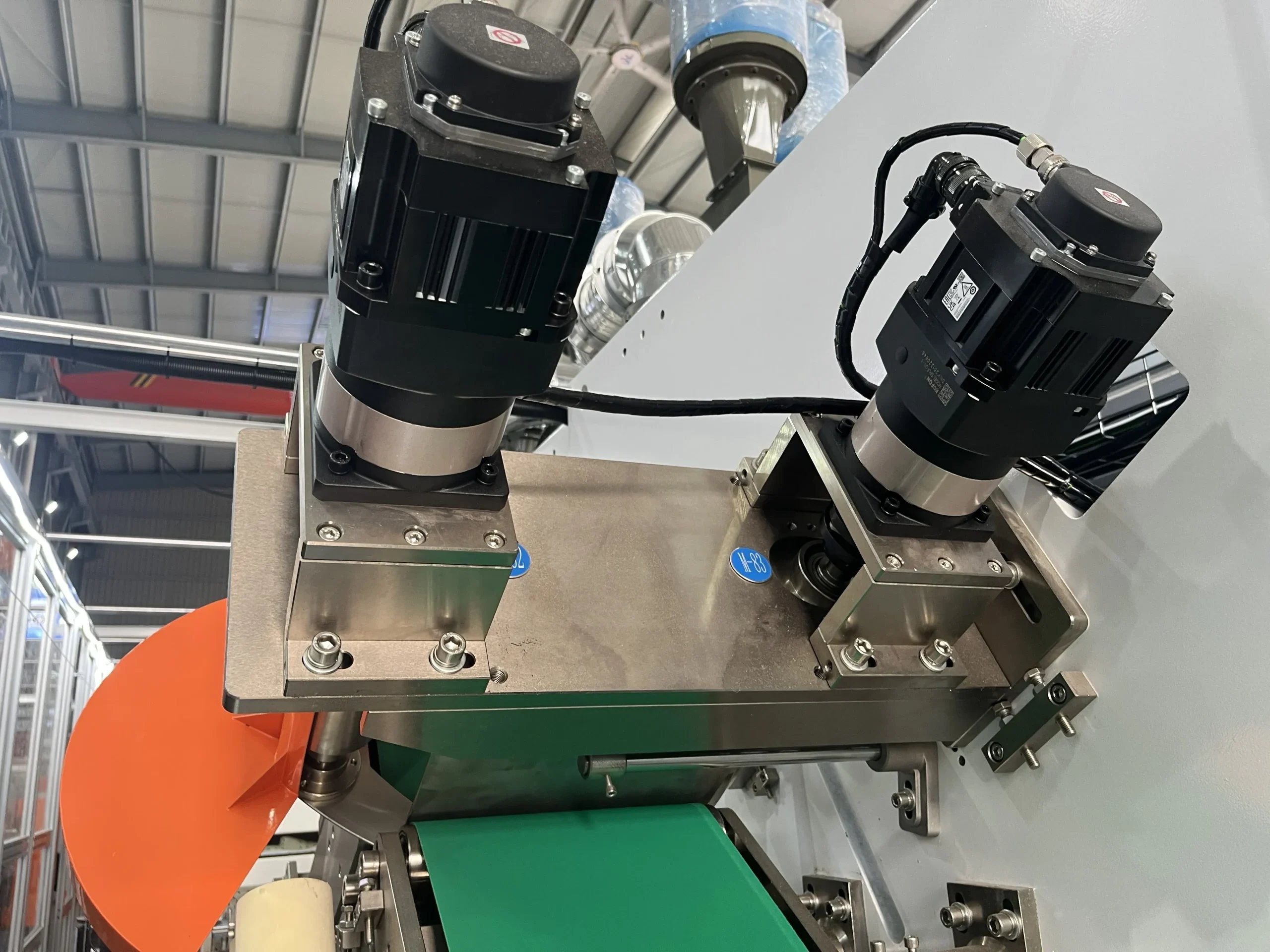
Every station is servo-driven and phase-locked to the master encoder. No mechanical cams. No belt slip. No "we will re-time it next shift." The moment any station runs on a mechanical cam, you have accepted a lifetime maintenance obligation.
Real-time tension compensation
Nonwoven, film, and elastic tension are read every cycle, not every hour. Adult pull-ups are unforgiving here — the elastic gauge is heavier than baby diapers, and small tension errors compound into visible waistband defects within minutes.
Vision-to-front-end feedback loop
The defects the back end catches must change what the front end does within minutes, not next Tuesday. If the loop takes a shift meeting to close, it is not a loop. It is a report.
What to look for on a reference-line visit: ask to see the master PLC HMI during a running shift. If you can watch defect trend data update in real time and see setpoint adjustments happen without a human touching the panel — you are looking at a control loop. If you are shown a spreadsheet the QC engineer fills in at break time — you are not.
5 · The question to take to your next supplier meeting
"What is your max speed?" stopped being a useful question in 2018. Every serious supplier can quote a number that looks good on paper. Try this instead:
"Show me your last 30 days of production data from a reference line, at the SKU I plan to run. Not peak. Not best week. The full 30 days — OEE by shift, changeover time, outgoing ppm defect rate, top three reject categories. If you cannot show me this, we should not be having a commercial discussion yet."
The suppliers who can answer that question are a short list. The suppliers who cannot — you already know how that first shipment will go.
A related question, which I ask about half the time on audits: "Is last-carton traceability written into your technical agreement?" If a retailer pulls a specific case number four months from now, can the supplier trace it back to the exact shift, master roll lot, and reject events during that hour? Most cannot. The ones that can tend to be the same ones with sub-500 ppm outgoing defect rates. It correlates for a reason.
6 · Closing the trilogy
Adult pull-ups are not baby diapers with a bigger elastic. The failure modes are different, the quality tolerances are tighter, and — this is the part most CAPEX plans get wrong — the money is made or lost in the last 12 stations, not the first 30.
Across three articles we have walked the full line: forming, assembly, and now packaging. If there is one thread running through all three, it is this: the specification you write before the PO is signed determines what you will be arguing about for the next five years. Everything after PO signature is either enforcement or damage control.
📚 The complete adult pull-up trilogy
Part 1 — Adult Pull-Up Diaper Machine: Why Retrofitting a Baby Line Fails (front-end core forming)
Part 2 — Adult Pull Up Diaper Machine Assembly & Cutting Guide (middle-section assembly)
Part 3 — You are here.
7 · Why Welldone for adult pull-up back-end integration
Buyers audit Welldone lines because the back-end integration is not an afterthought. We build the stacker, integrate the vision system, and hard-wire the servo handshake ourselves — so there is no supplier boundary running through the exact place where OEE gets stuck.
01 · CONTROL LOOP
Vision → PLC → front-end
Defect category rates stream to the master PLC every 60 seconds and generate front-end setpoint suggestions. Rejection is not a dead-end; it is a signal.
02 · REFERENCE DATA
30-day production reports
We publish OEE-by-shift, changeover time, and outgoing ppm defect rate from reference lines running today — not peak, not best week, the full 30 days.
03 · INTEGRATION
Turnkey, one throat to choke
Forming, assembly, and packaging come from one engineering team. Jam stops propagate in ~200ms. Warranty disputes across supplier boundaries stop existing.
9 · Conclusion
If you are specifying a new adult pull-up line, or trying to diagnose why the one you already have is stuck below 75% OEE, the answer is almost never in the forming system. It is in the last 12 stations — and specifically in whether those 12 stations talk to the master PLC at all.
An open question to take back to your team: when you evaluate your next adult pull-up line supplier, is "last-carton traceability" written into your technical agreement? If not — that is the single most valuable clause you can add before signing.
10 · Frequently asked questions
How long is the OEE ramp-up period on a new Welldone adult pull-up line?
Typical ramp is 30–60 days from mechanical acceptance to sustained target OEE, depending on operator experience and SKU complexity. We publish week-by-week ramp curves from three recent installations so buyers know what "normal" actually looks like before signing off on acceptance criteria.
Can you provide 30 days of production data from a reference line?
Yes. We provide OEE by shift, changeover time, outgoing ppm defect rate, and the top three reject categories from an existing reference line running the same or a comparable SKU. If a supplier cannot produce this, the commercial discussion is premature.
Do you support EU EN 15223-1 and Japan retail compliance out of the box?
Standard configuration includes metal detection, weight check, and durable LOT / date coding rated for 6-month warehouse humidity. For EU retail we also configure the vision system to include the required medical-packaging symbol verification. Compliance is a configuration item, not a custom project.
What is your typical lead time and installation timeline?
Standard adult pull-up line lead time is 120–150 days from PO to shipment, plus 30–45 days for on-site installation and commissioning. Timelines compress with SKU standardization and expand with heavy customization — we quote both scenarios up front so procurement planning is realistic.
Can Welldone integrate an existing third-party bagger or palletizer?
Yes, but we recommend against it. Integrating a third-party bagger means giving up the servo handshake that keeps jam propagation under 200 milliseconds. If the third-party unit is already installed, we provide a signal-level integration; if the line is new, we strongly recommend the fully integrated Welldone stacker for warranty and OEE reasons.
Building or upgrading an adult pull-up line?
If you are specifying a new line, or trying to figure out why your current line's OEE is stuck below 75%, we can walk you through a station-by-station audit based on real production data from lines running today.