Adult Incontinence Product Line Selection Guide | Welldone

On September 8, 2026
Comments Off on Adult Incontinence Product Line Selection Guide | Welldone
Adult Pull-Up vs Open-Type Diaper vs Underpad: Which Line Should You Start With?
A new adult-care factory often begins with the wrong question: which machine has the best specification? The decision should begin one step earlier. Which finished product will your customer buy, use, change, store and reorder?
Adult pull-ups, open-type adult diapers and underpads all use absorbent materials, but they solve different care tasks and require different converting structures. Buying one line because it appears faster or cheaper can lock the factory into the wrong product-market fit.
Planning an Adult Incontinence Products Factory · Pillar Article
This article establishes the product-line decision. The next articles will define the quotation brief, compare drive systems, plan utilities, write acceptance criteria and prepare an expansion path.
Related technical reading: adult pull-up core forming and adult pull-up assembly and cutting.
This article establishes the product-line decision. The next articles will define the quotation brief, compare drive systems, plan utilities, write acceptance criteria and prepare an expansion path.
Related technical reading: adult pull-up core forming and adult pull-up assembly and cutting.
Start with the finished product, not the machine
A machine quotation converts a product definition into mechanical scope. If the product definition is vague, every supplier prices a different assumption. The lowest quotation may exclude the exact forming, elastic or packaging functions your market expects.
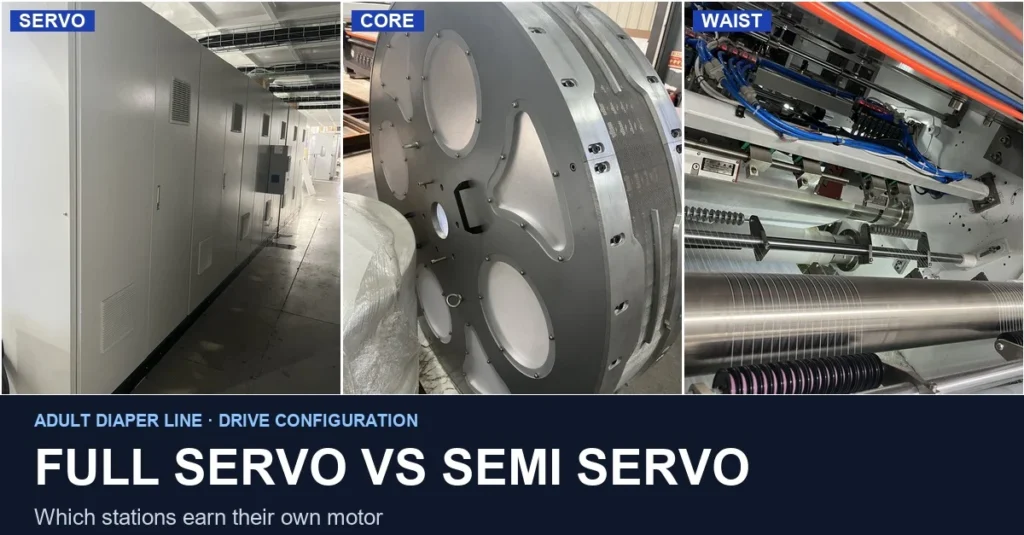
Actually, the first decision is not full servo versus semi servo. It is whether the factory will make a wearable pant, a tape-fastened diaper or a flat protective pad. Those formats change the web path, assembly stations, finished-product handling and packaging brief.
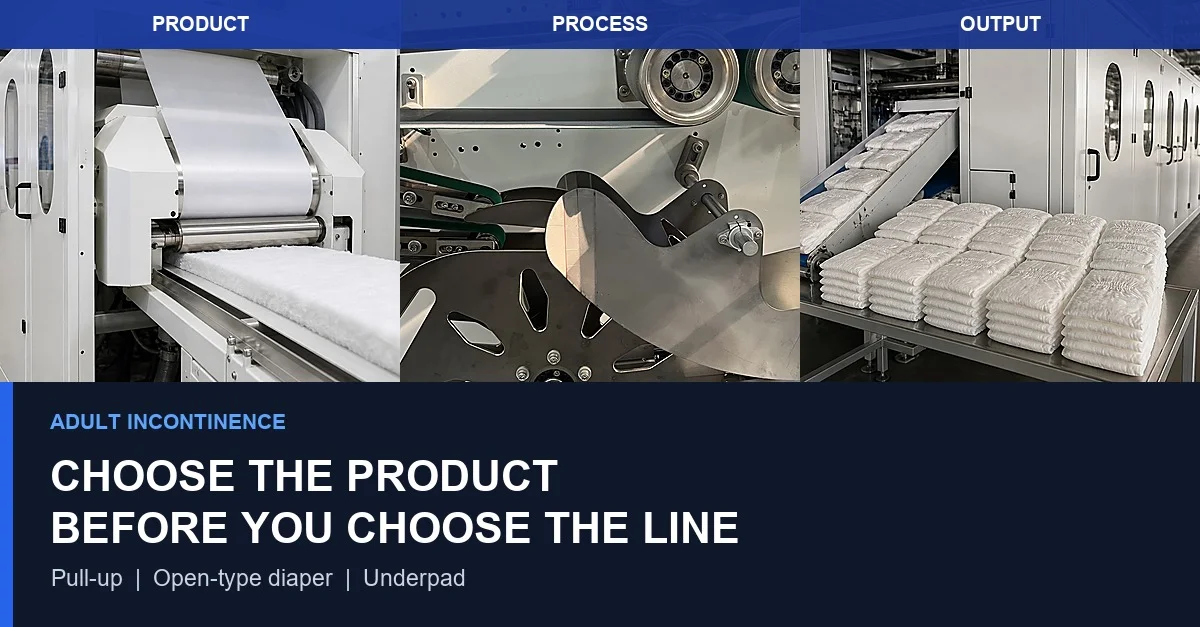
Choose the care task first. Choose the product format second. Only then compare production lines.
Three formats that should not be treated as substitutes
| Product format | Defining construction | Machine-planning consequence | Question to settle first |
|---|---|---|---|
| Adult pull-up | Closed pant format with an elastic waist structure | The line must form, laminate and control the waistband before producing an individual pant | Is independent dressing a central use case? |
| Open-type adult diaper | Open diaper body with a tape fastening system | Tape application, core placement and body alignment define the converting scope | Will caregivers change the product while the user is lying down? |
| Underpad | Flat pad; Welldone describes its 3-layer format as topsheet, absorbent core and backsheet | No wearable waist assembly; forming, embossing, cutting and stacking become the central process chain | Is the product protecting a bed, chair or other surface? |
The three products can appear in the same adult-care portfolio, but they are not three sizes of one machine. A pull-up line creates a closed wearable product. An open-type line creates a tape-fastened wearable product. An underpad line creates a flat absorbent product for surface protection.
Match the line to how the product will be used
The real question is who performs the change and under what conditions. A buyer targeting active users may prioritise a pant format that can be pulled on. A supplier to caregiver-led settings may need to evaluate open-type products because fastening and access work differently. A bed-protection programme needs a flat pad rather than a wearable substitute.
Do not turn these observations into a market-size claim without local evidence. Distributor requirements, reimbursement rules, pack sizes, product terminology and accepted absorbency tests vary by market. The correct action is to interview target buyers and convert their answers into a written product brief.
- Who uses the product and who changes it?
- Which sizes and pack counts will be sold first?
- Which product features are inspected by the buyer?
- Will the factory sell one standard SKU or several product tiers?
- Which packaging format is required after converting?
Build the product specification before requesting a quotation
A supplier cannot configure the right line from a product name alone. “Adult diaper” does not define the finished dimensions, core construction, elastic zones, fastening method, material widths, printing requirements or pack arrangement.
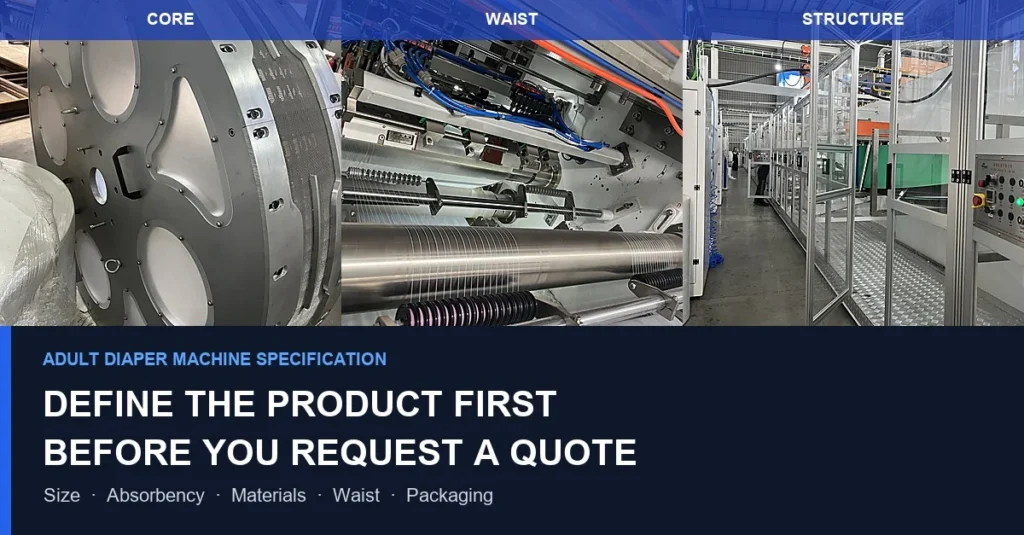
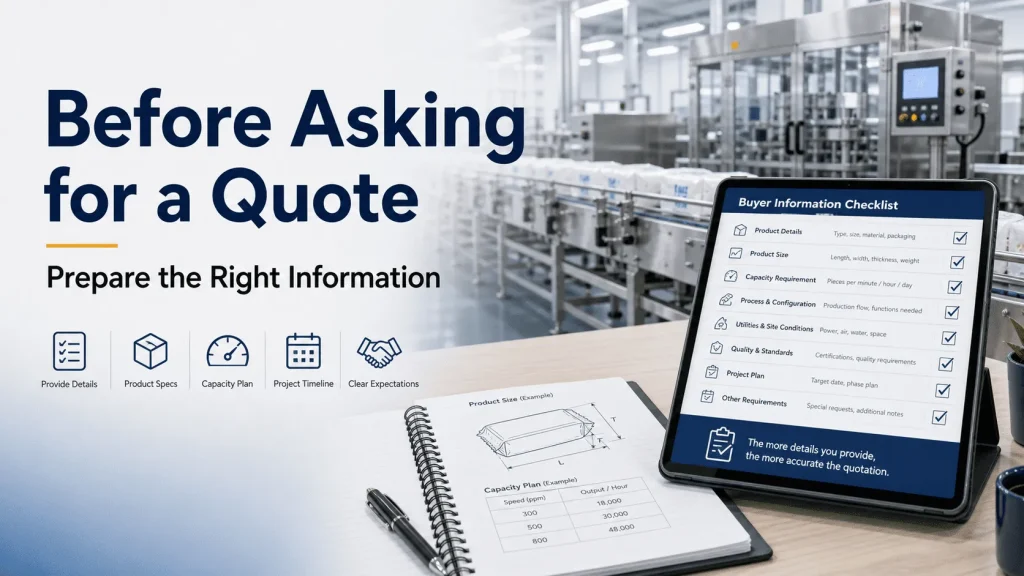
I believe a useful RFQ should begin with finished-product samples or an agreed product drawing. It should then state the required sizes, material layers, target packaging format, planned operating pattern and acceptance method. This lets competing quotations describe the same machine scope instead of competing assumptions.
| RFQ input | Why it changes the machine | Evidence to provide |
|---|---|---|
| Finished format and size range | Defines web width, tooling, cutting and change parts | Product drawing or physical sample |
| Material structure | Defines unwinding positions, dosing, lamination and tension zones | Bill of materials with confirmed specifications |
| Packaging format | Defines stack count, compression, bagging and line hand-off | Pack sample and required count |
| Acceptance target | Defines the test product, speed basis, test duration and pass criteria | Draft FAT or RFS protocol |
Do not compare speed figures until the units and product format match
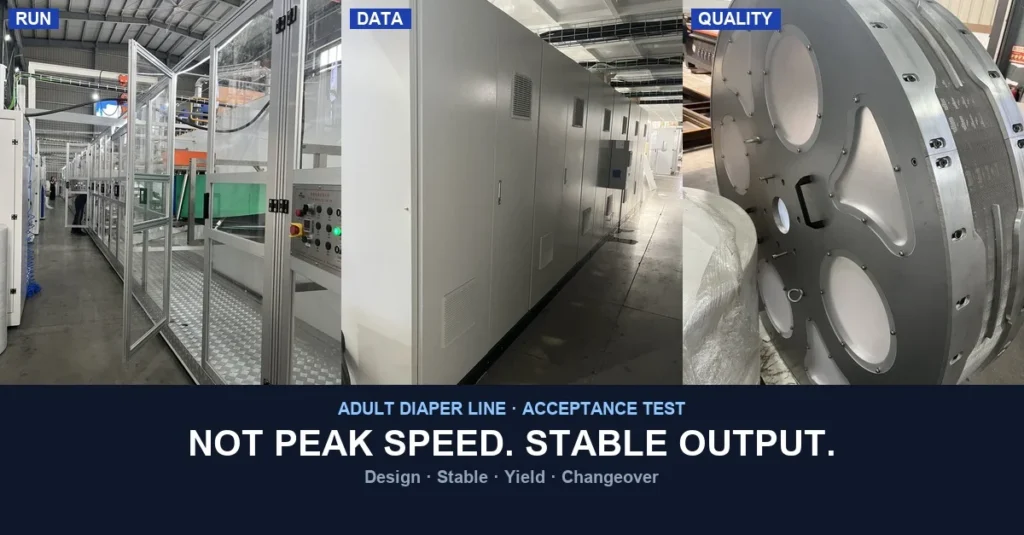
Welldone's adult-care overview lists adult open-type and pull-up lines at a design range of 250–300 pcs/min and a stable range of 200–260 pcs/min. The same overview lists underpad lines at 700–900 pcs/min design and 600–800 pcs/min stable. These are category-level ranges, not a promise for every model or SKU.
The figures should not be used to declare one business “faster” than another. A piece of underpad is not equivalent to a wearable adult diaper, and each product can change in dimensions, material structure and downstream packing requirements. Compare stable speed using your defined SKU and acceptance conditions.
Technical data caution: individual product pages contain inconsistent labels and units, including a page that states 300 m/min in its introduction and 300 pcs/min in its details table. This article uses the category overview ranges and does not silently convert or reconcile the conflicting page data.
The line choice changes the factory around it
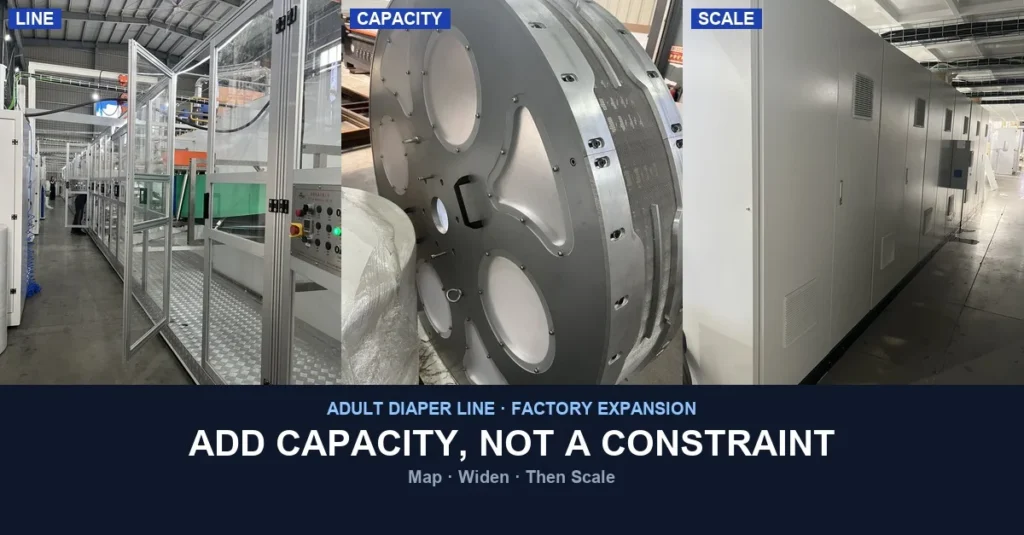
The adult-care overview gives a typical line footprint of 38 m × 8.0 m × 4.2 m, power of 450–650 kW depending on configuration, and compressed air of 0.6–0.8 MPa with flow of at least 4 m³/min. Treat these as early planning references only. The final utility schedule must come from the machine configuration approved for your product.
For factory planning, the drawing must include material movement, operator access, waste removal, maintenance aisles and the hand-off to packaging. A building that fits the machine envelope may still fail operationally if pulp, SAP, nonwoven rolls and finished packs cross the same aisle.
Welldone's design guidelines state maintenance aisles of at least 700 mm for adult lines and a transfer height of 900–1200 mm. These values help with early layout screening, but column positions, door openings and local electrical standards still require project-specific confirmation.
Plan the first line without pretending it must cover the whole portfolio
A first-time investor often asks for one machine that can make pull-ups, open-type diapers and underpads. The shared materials create the impression that the formats are interchangeable. They are not. The specialised assembly sections and product handling are different.
The safer path is usually to choose one anchor product, validate its sales channel and build the factory systems that can support a second line later. Shared capabilities may include material inspection, warehouse control, compressed air, quality procedures and selected raw-material relationships. The converting line itself remains product-specific.
An underpad can complement an adult diaper portfolio, but that does not mean it belongs on the same converting platform. Portfolio synergy happens at procurement, sales, warehousing and quality management—not by forcing incompatible product structures through one machine.
Ask suppliers for evidence that matches your decision stage
More importantly, a brochure proves only that a supplier has a page. It does not prove that the quoted configuration matches your product. Before comparing commercial offers, request a line layout, station list, utility list, supported product sizes, material assumptions and a written acceptance protocol.
- Confirm whether speed is design speed or stable speed.
- Confirm whether the unit is pcs/min, m/min or another basis.
- Confirm which product and size will be used during acceptance.
- Confirm whether packaging is included, optional or supplied by another company.
- Confirm which values are standard and which depend on the final configuration.
For deeper pull-up engineering, review the existing guides to the front-end core-forming system and the middle-section assembly and cutting system. They explain why a line category is only the first decision; station-level scope still determines what the factory can make reliably.
Why Welldone
Welldone provides adult-care line planning across pull-up diapers, open-type diapers and underpads. The project starts from the finished product and extends through equipment configuration, factory layout, material planning, installation, commissioning and operator training.
Product-led configuration
The line scope is built from the target product format, size range, material structure and packaging brief.
Category-level comparison
Pull-up, open-type and underpad options can be reviewed within one adult-care planning process without treating them as interchangeable.
Project support
Overseas engineer support is available for installation, commissioning and training, subject to the agreed project scope.
Related adult-care machines and technical guides
Pull-Up Adult Diaper MachineClosed pant-format adult-care production category.Review the category
Open-Type Adult Diaper MachineTape-fastened adult diaper production category.Review the category
Disposable Underpad MachineFlat absorbent pad equipment for adult-care applications.Review the category
3-Layer vs 5-Layer UnderpadHow layer structure changes product and machine decisions.Read the comparison
All Adult Care MachinesCategory overview, drive options, specifications and design guidelines.Explore adult care
Project Configuration ReviewSend the target product and factory requirements for a configuration discussion.Contact Welldone
Conclusion
An adult pull-up, an open-type adult diaper and an underpad may share absorbent materials, but they do not share the same user task or converting architecture. Start with the target user, care setting, product specification and sales channel. Then compare equipment.
If your first machine could make only one product for the next two years, which format has the clearest buyer, the clearest specification and the clearest reorder path in your market?
Frequently asked questions
Can one line make all three adult-care formats?
Do not assume so. The wearable formats require different assembly functions from a flat underpad, and pull-up waist construction differs from an open-type tape system. Request a station-by-station scope for the exact products you plan to sell.
Which product line is best for a first-time investor?
There is no universal answer. Choose the format with verified local demand, a defined product sample, an achievable raw-material supply chain and a clear distribution channel. Machine price alone cannot settle the decision.
Should I use design speed in the investment model?
Use the stable speed agreed for your product and acceptance conditions. Design speed is a machine capability reference; it is not automatically the sustained production output of your chosen SKU.
Can underpads be added later?
Yes, as a separate line and portfolio extension. Plan utilities, warehouse space, quality control and packaging capacity so the second line does not create a bottleneck elsewhere in the factory.
What should I send before asking for a quotation?
Send a product sample or drawing, size range, material specification, packaging format, target operating pattern and draft acceptance criteria. Welldone can then prepare a project-specific configuration rather than a generic quotation.