INDA Wipes & AHP Standards: Qualify Hygiene Lines | Welldone

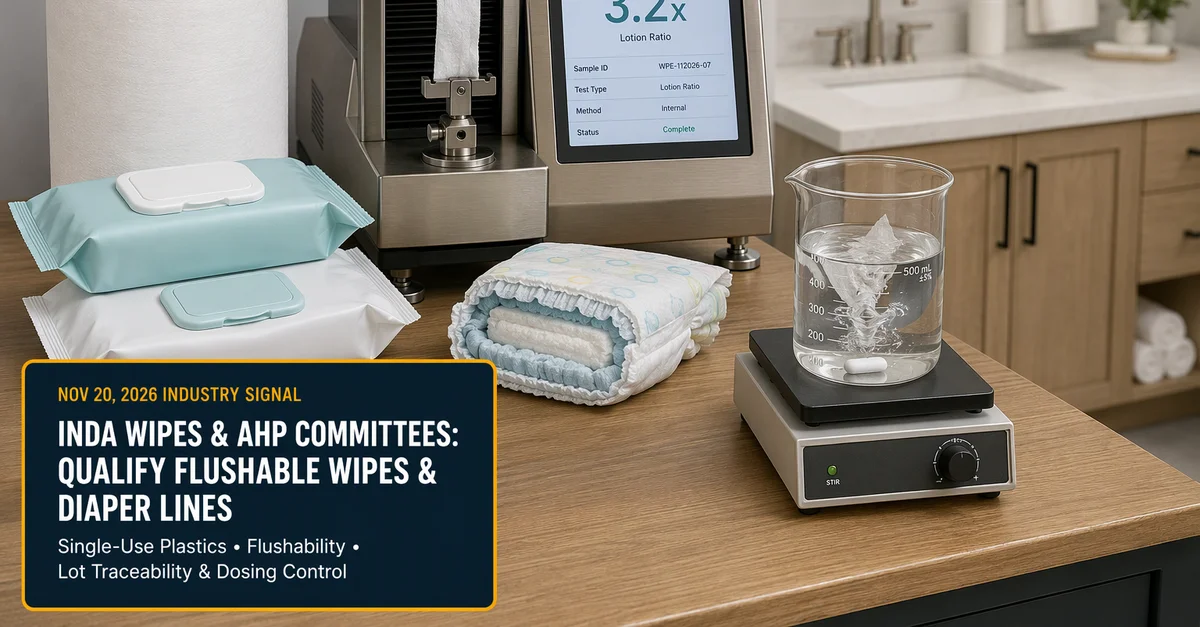
INDA Wet Wipes & AHP Committees: Qualify Plastic-Free Wipes & Traceable Hygiene Lines
Across North America, Europe, and Asia, wet wipes and absorbent hygiene manufacturers are moving from voluntary sustainability claims toward formal regulatory enforcement on flushability, single-use plastics, ingredient disclosure transparency, and audited plant quality assurance. Following its November 16, 2026 Board of Directors meeting, INDA (the Association of the Nonwoven Fabrics Industry) announced on November 19–20, 2026 plans to establish three product-specific advocacy committees covering Wet Wipes, Absorbent Hygiene Products (AHP), and Filtration. On November 20, 2026, ITMA Asia + CITME 2026 also opened across 180,000 square metres and seven halls at the National Exhibition and Convention Center in Shanghai, spotlighting intelligent inspection and automated nonwovens manufacturing. For B2B factory directors, this engineering guide translates these November 2026 policy and machinery benchmarks into actionable hardware specifications across wet wipes machines, paper and wet wipes packing machines, and pull-up adult diaper machines.
1. Nov 19–20, 2026 Signal: INDA Wipes/AHP Committees & ITMA Asia
Two international developments reported between November 19 and November 20, 2026 show how regulatory compliance and factory automation are converging across the hygiene converting sector:
- INDA Product-Specific Advocacy Committees (Nov 19–20, 2026, Cary, NC, USA): Following its Nov 16 Board of Directors meeting, INDA announced three committees via its official Nov 19 release and Nov 20 coverage in Nonwovens News, Nonwovens Industry, and TextileTechnology. INDA Executive Director Ben Muller noted: “Our members face increasingly complex policy and regulatory challenges that directly affect their products and markets.” The Wet Wipes Committee (first meeting targeted for January 2027) focuses on advancing flushability standards, addressing single-use plastics regulations, expanding consumer education, and strengthening collaboration with wastewater authorities. The Absorbent Hygiene Products Committee (launching in early 2027) focuses on promoting the Quality Assurance Program in the United States, advancing ingredient disclosure transparency, supporting consumer education, and engaging on state and federal regulations. A third Filtration Committee launches in mid-2027.
- ITMA Asia + CITME 2026 Opens in Shanghai (Nov 20–24, 2026, China): Reported by Nonwovens News (Nov 20, 2026) and official organizers CEMATEX, CCPIT TEX, CTMA, and CIEC, the 10th edition opened at the National Exhibition and Convention Center (Shanghai) across 180,000 square metres in seven halls (+10% space), spotlighting intelligent inspection technologies, digital twin commissioning, and automation of production processes.
The real question is how a B2B hygiene or wet wipes factory translates these policy and automation milestones into concrete machine specifications before ordering or upgrading a converting line. When retail buyers and regulators demand verified flushability, zero undeclared synthetic fibers, full ingredient disclosure, and documented U.S. Quality Assurance Program compliance, manual operator adjustments and open-loop dosing systems become direct commercial liabilities.
2. Confirmed Facts, Data Conflicts & Converting Line Scope
To support capital equipment selection and raw-material BOM qualification, we separate facts confirmed by November 2026 primary disclosures from Welldone's engineering analysis:
- Confirmed Facts from Primary Sources (Nov 16–20, 2026): Per INDA's official release (Nov 19, 2026) and trade reports (Nov 20, 2026), INDA's Board met on Nov 16, 2026 and approved three committees: Wet Wipes (Jan 2027; flushability, single-use plastics, wastewater utility collaboration), Absorbent Hygiene Products (early 2027; U.S. Quality Assurance Program, ingredient disclosure transparency, state/federal engagement), and Filtration (mid-2027), coordinated by INDA contacts Wes Fisher and Matt O'Sickey. Per Nonwovens News (Nov 20, 2026) and official releases, ITMA Asia + CITME 2026 runs Nov 20–24 in Shanghai across 180,000 sq m in seven halls.
- Welldone Engineering Analysis: Neither INDA nor ITMA Asia + CITME 2026 mentioned Welldone, and Welldone is not involved in their governance. All tension windows, dosing tolerances, metal detection thresholds, and auto-reject timings below represent Welldone's engineering guidance for buyers of wet wipes machines, paper and wet wipes packing machines, and pull-up adult diaper machines.
⚠ News Data Conflict Found (Cross-Source & Catalog Verification Disclosure)
- Conflict 1 — INDA Release vs. Media Dates: INDA's official release on
inda.orgis datelined November 19, 2026 (following the November 16, 2026 Board meeting), whereas Nonwovens News and TextileTechnology published their reports on November 20, 2026. Both dates are preserved side-by-side. - Conflict 2 — ITMA Asia Exhibitor Count: Official pre-show releases on
itmaasia.com(July 31, 2026) listed “more than 1,800 exhibiting companies”, whereas opening-day coverage in Nonwovens News (Nov 20, 2026) reported “more than 1,950 exhibitors” across 180,000 sq m in seven halls. - Conflict 3 — Welldone Wet Wipes Sub-Page Table Mismatch: On Welldone's category page (
/products/wet-wipes-machine), wet wipes lines are accurately specified as full-servo, semi-servo, or semi-automatic systems integrating nonwoven feeding, cutting, liquid dosing, folding, stacking, and sealing. However, on sub-pages/full-servo-wet-wipes-production-line-automaticand/high-speed-wet-wipes-production-line(WD-GR-015), the HTML parameter table contains a legacy copy-paste table from a toilet paper rewinder (WD-TPM011,1~3 layer, 14-30gsm, tissue paper,0-180m/min). Buyers must never merge toilet-paper roll specs into wet wipes quotations; quantitative parameters below are marked as Illustrative engineering examples subject to signed technical proposals.
3. 6-Layer Compliant Flushable Wipe & Barrier Pouch Architecture
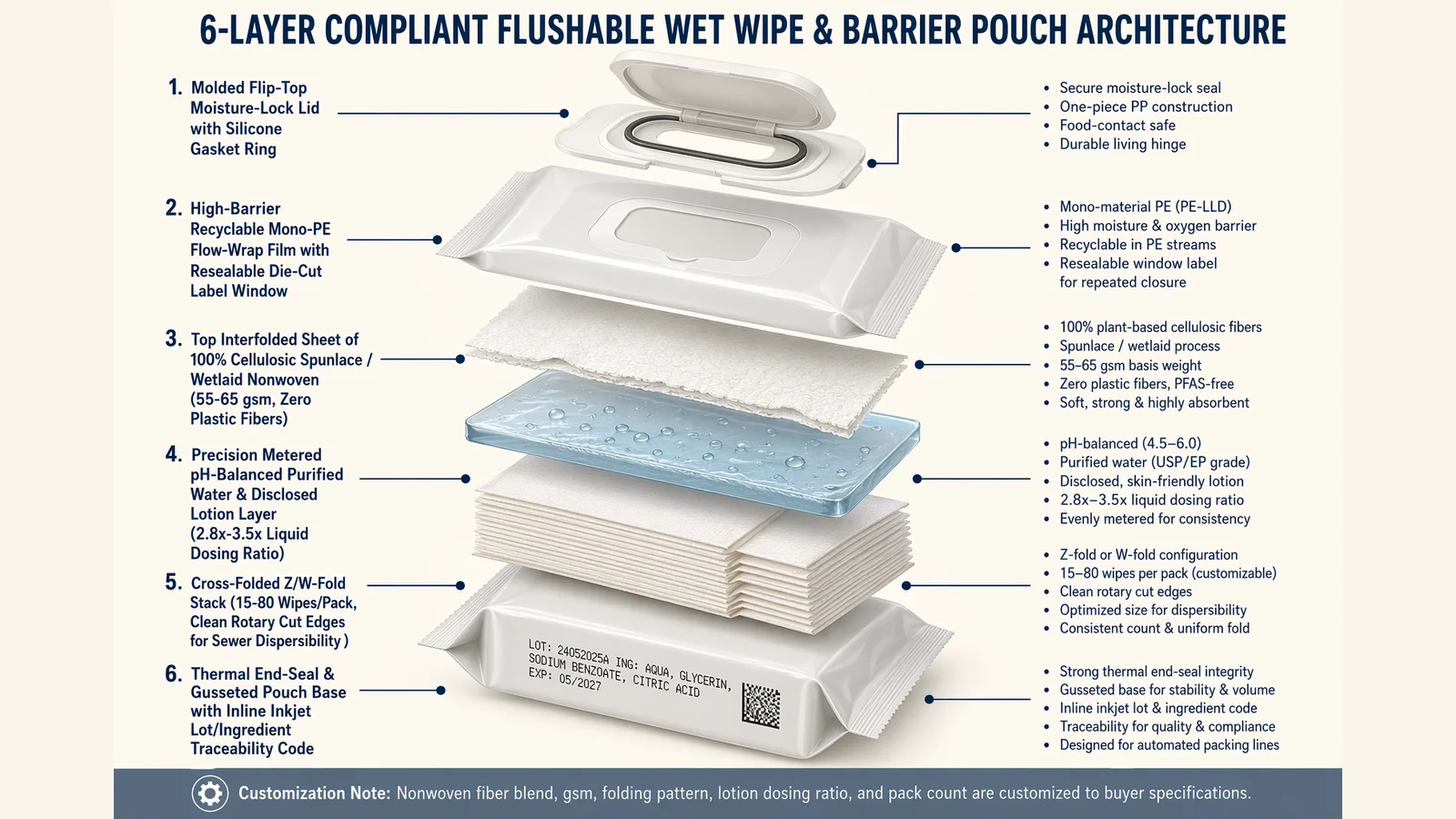
When the INDA Wet Wipes Committee prioritizes single-use plastics rules and flushability alongside the AHP Committee's focus on ingredient transparency, converters must engineer the wipe-and-pouch assembly as an integrated 6-layer system:
- Layer 1 — Molded Flip-Top Moisture-Lock Lid: Applied inline via servo/robotic placement using metered hot-melt adhesive for airtight resealing without glue stringing.
- Layer 2 — Recyclable Mono-PE Flow-Wrap Film (50–75 μm, Illustrative example only): Single-polymer polyethylene barrier web replacing multi-layer PET/PE laminates, paired with a resealable die-cut window label.
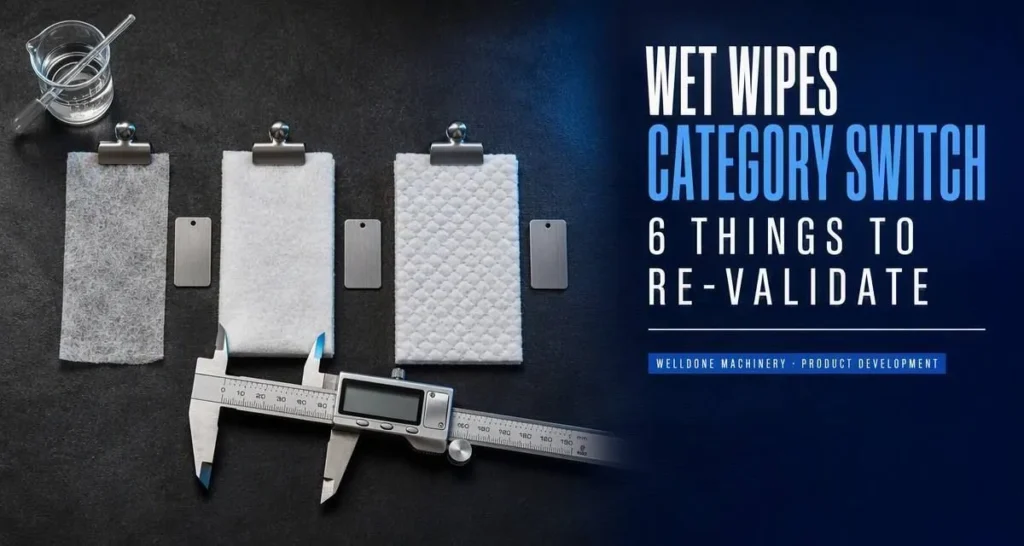
- Layer 3 — 100% Cellulosic Spunlace or Wetlaid Sheet (50–65 g/m²): Formulated from wood-pulp/lyocell or viscose/pulp fibers with zero synthetic polyester or polypropylene binders to pass wastewater slosh-box dispersion tests.
- Layer 4 — Metered Purified Water & Disclosed Lotion Layer (2.8×–3.5× Liquid Ratio): Injected via closed-loop dosing pumps synchronized to line speed so disclosed lotion ingredients remain within certified weight tolerances.
- Layer 5 — Cross-Folded Z-Fold or W-Fold Wipe Stack (15–80 Wipes/Pack): Rotary-cut and interfolded with clean, lint-free shear edges for single-sheet dispensing.
- Layer 6 — Gusseted Pouch Base & Inline Traceability Code: Sealed by box-motion end jaws and stamped with thermal-transfer or laser batch codes linking each pouch to nonwoven roll lots, lotion batches, and adhesive recipes.
4. Four Converting Risks Under Single-Use Plastics & QA Rules
Why do legacy wet wipes machines and older diaper lines struggle when factories upgrade to plastic-free substrates and stricter U.S. Quality Assurance Program audits? A common mistake is assuming that regulatory compliance is purely a raw-material purchasing task handled by swapping nonwoven rolls or printing a new ingredient list on the outer bag.
In plant operations, four mechanical failure modes appear when machine hardware is not co-qualified with compliant BOM materials:
- Wet-Modulus Elongation & Neck-In on 100% Cellulosic Webs: Unlike 30%–50% PET spunlace, 100% cellulosic hydroentangled or wetlaid webs lose machine-direction modulus sharply upon wetting. Mechanical friction brakes stretch wet webs 3%–5% longitudinally and cause 4–8 mm lateral neck-in (Illustrative example only), skewing folded stacks.
- Lotion Stratification & Seal Contamination Across Speed Ramps: Open-loop gravity drip bars or fixed-frequency pumps over-saturate wipes during splice slowdowns—squeezing lotion into transverse heat-seal jaws—while under-dosing wipes at peak speed.
- Untracked Hot-Melt Adhesive Overheating on AHP Lines: On baby diapers, sanitary pads, and pull-up adult diaper machines, unlogged glue melters overheating above 170°C char resin, alter chemical profiles, and fail U.S. Quality Assurance Program audits.
- Unverified Contaminant & Splice Ejection: Without phase-compensated metal detection and single-piece auto-reject gates, carding wire fragments or raw-material splice tapes can slip into retail multi-packs.
Field Engineering Takeaway: Readiness for 2027 INDA Wet Wipes and AHP standards requires closed-loop verification across four stations: low-tension servo unwinding/cutting, mass-flow liquid and hot-melt metering, inline metal/vision inspection, and deterministic single-piece auto-rejection.
5. Station I: Cellulosic Spunlace Unwinding, Folding & Rotary Cutting
Qualifying plastic-free flushable wet wipes on a wet wipes machine starts at the unwinding and longitudinal folding section. Because 100% wood-pulp/lyocell webs lack synthetic reinforcement, tension must be isolated between dry unwinding, folding plates, and wet stacking:
- Active Servo Unwinders with Load-Cell Feedback: Closed-loop AC servo unwinders hold tension within 12–22 N per lane (Illustrative example only), scaling torque continuously from full jumbo roll down to core splice so cellulosic fiber networks never pre-stretch.
- Electropolished SUS316L Folding Boards: Low-friction stainless-steel V-fold, Z-fold, or W-fold formers with micro-air lubrication prevent fiber linting and edge curling on textured flushable webs.
- Helical Hardened-Alloy Rotary Anvil Cutters: Precision helical shear rotary cutters with pneumatic pressure compensation deliver clean, lint-free cross cuts so individual sheets separate smoothly without failing wastewater dispersibility protocols.
6. Station II: Lotion Dosing Accuracy & Hot-Melt Adhesive Traceability
Both the INDA Wet Wipes Committee and the Absorbent Hygiene Products Committee emphasize chemical and material accountability—from wet wipe lotions to construction and elastic adhesives in diapers and adult incontinence pants. In most cases, factory audit findings trace back to manual valve adjustments that leave no digital batch record.
On modern Welldone converting lines, liquid and adhesive stations are engineered for recipe-locked repeatability:
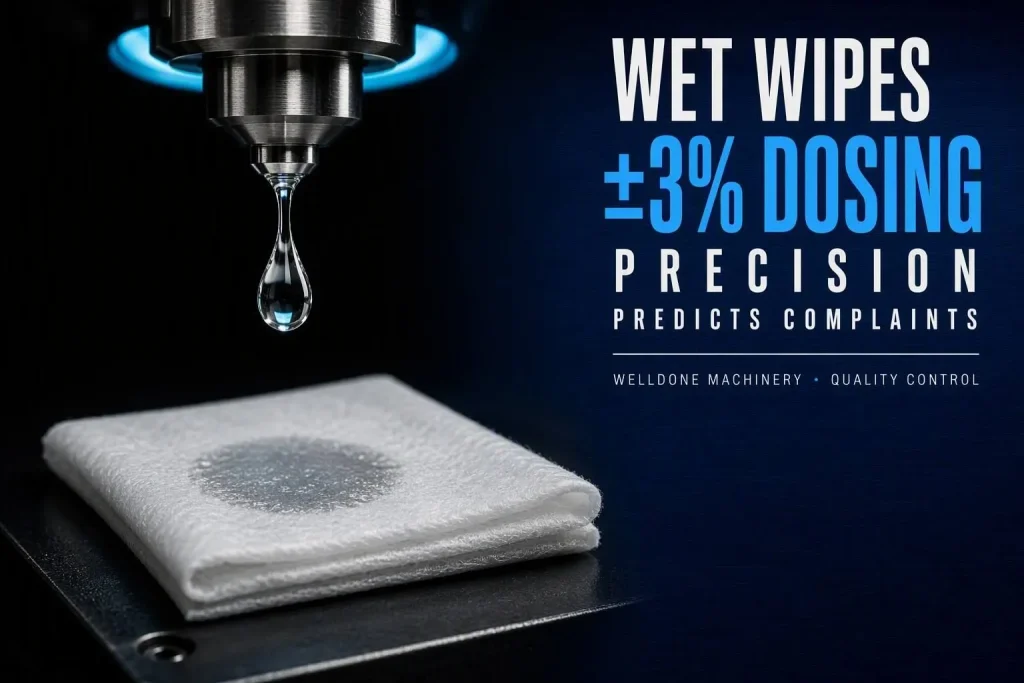
- Speed-Synchronized Mass-Flow Lotion Dosing (Wet Wipes Lines): Multi-manifold SUS316L injection bars paired with inline flowmeters scale pump RPM proportionally to cutter speed, holding liquid add-on within ±1.5% tolerance (Illustrative example only) across speed ramps.
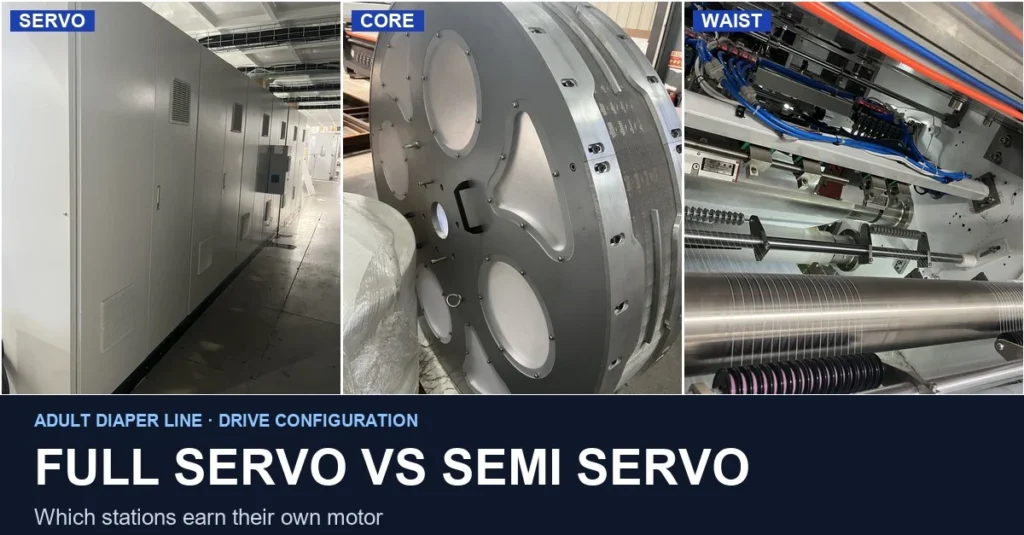
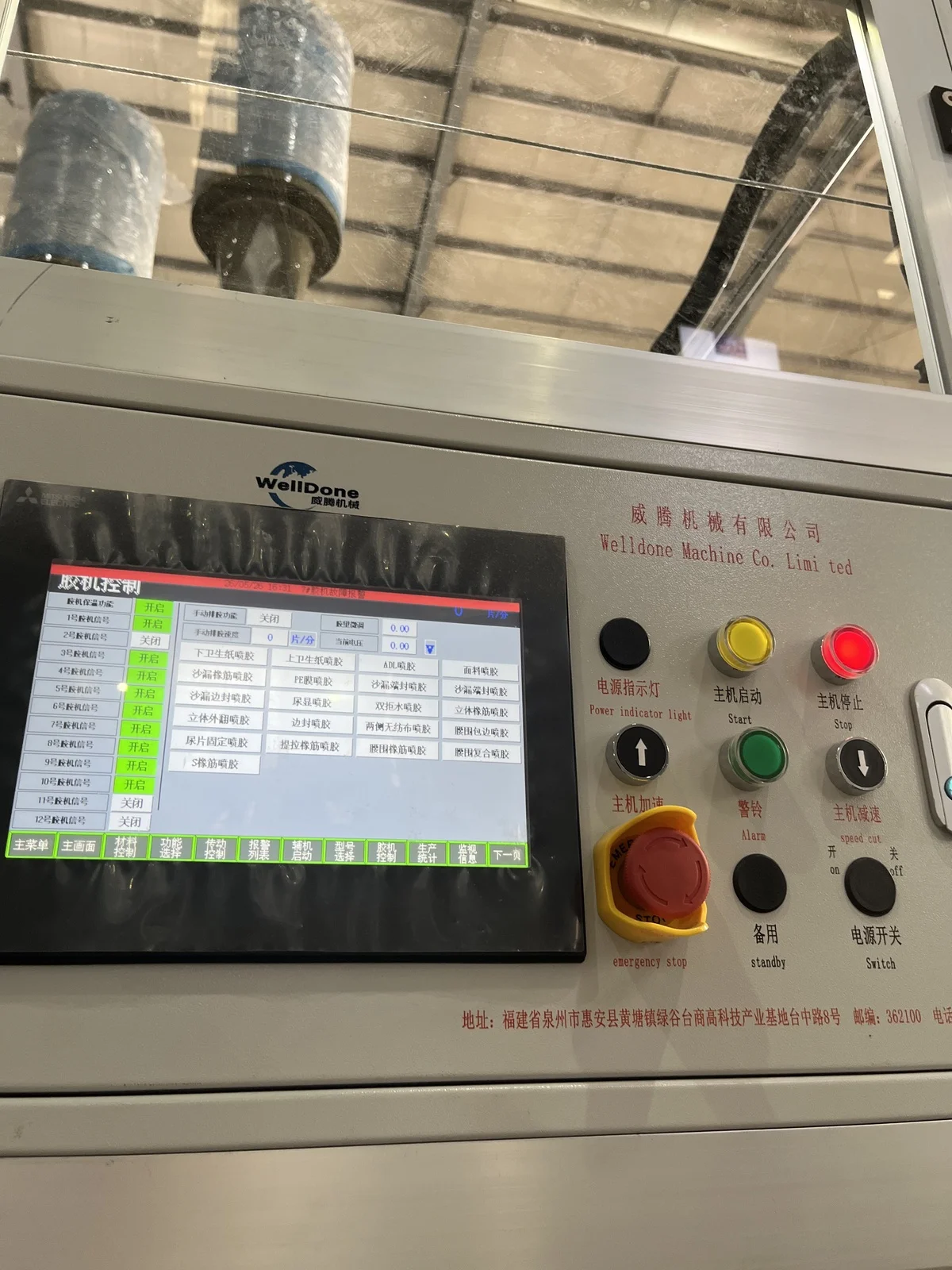
- Multi-Zone PID Hot-Melt Melter & Gear-Pump Control (AHP Lines): On pull-up adult diaper machines and baby diaper lines, touchscreen glue control panels lock tank, hose, and gun temperatures across all channels while closed-loop gear pumps meter exact gsm add-on and log alarms for QA traceability.
7. Station III: Inline Metal Detection & Quality Assurance Gates
Promoting the Quality Assurance Program in the United States is a core priority of the INDA Absorbent Hygiene Products Committee, while ITMA Asia + CITME 2026 in Shanghai highlights intelligent inspection across nonwovens lines. For contract converters supplying retail private labels, inline foreign-body detection is mandatory before packaging:
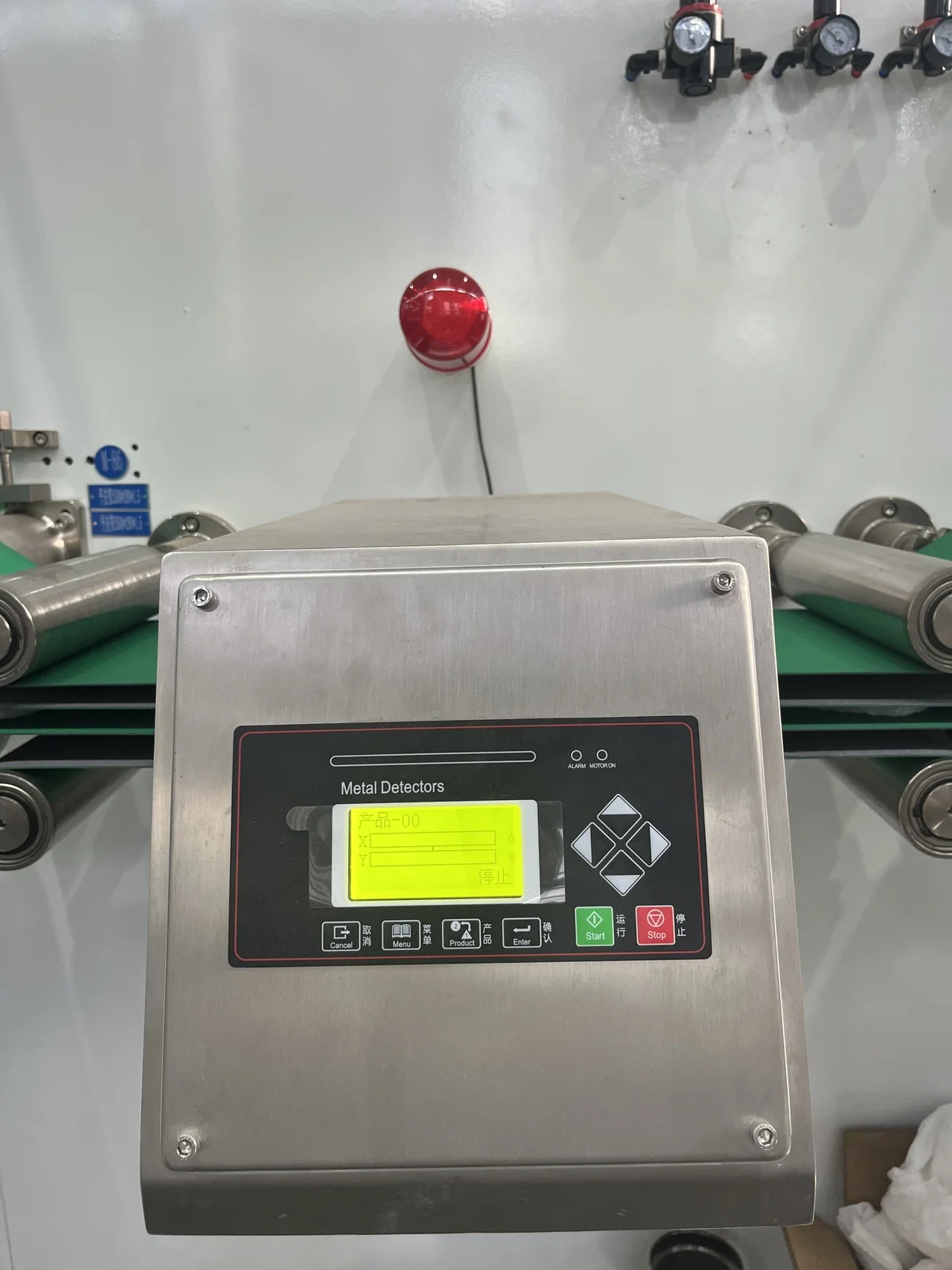
- Balanced-Coil Inline Metal Detection: Installed downstream of final rotary cutting and folding, a shielded tunnel detector scans every hygiene pad, diaper, or wipe stack at full speed. Phase-tracking signal processing compensates for moisture in wet wipes or SAP cores, detecting ferrous, non-ferrous, and stainless-steel contaminants down to 0.8–1.2 mm sphere equivalent (Illustrative example only).
- Synchronized Vision Defect Inspection: High-speed line-scan cameras verify dimensions, core symmetry, elastic alignment, and surface cleanliness, flagging stains or raw-material splice tape for downstream ejection.
8. Station IV: High-Speed Auto-Reject Sorting & Flow-Wrap Coding
Detecting a metal fragment, roll splice, or under-dosed startup wipe is ineffective if the defective unit still enters the stacker. The critical link between converting and paper and wet wipes packing machines is deterministic shift-register tracking and automated rejection:
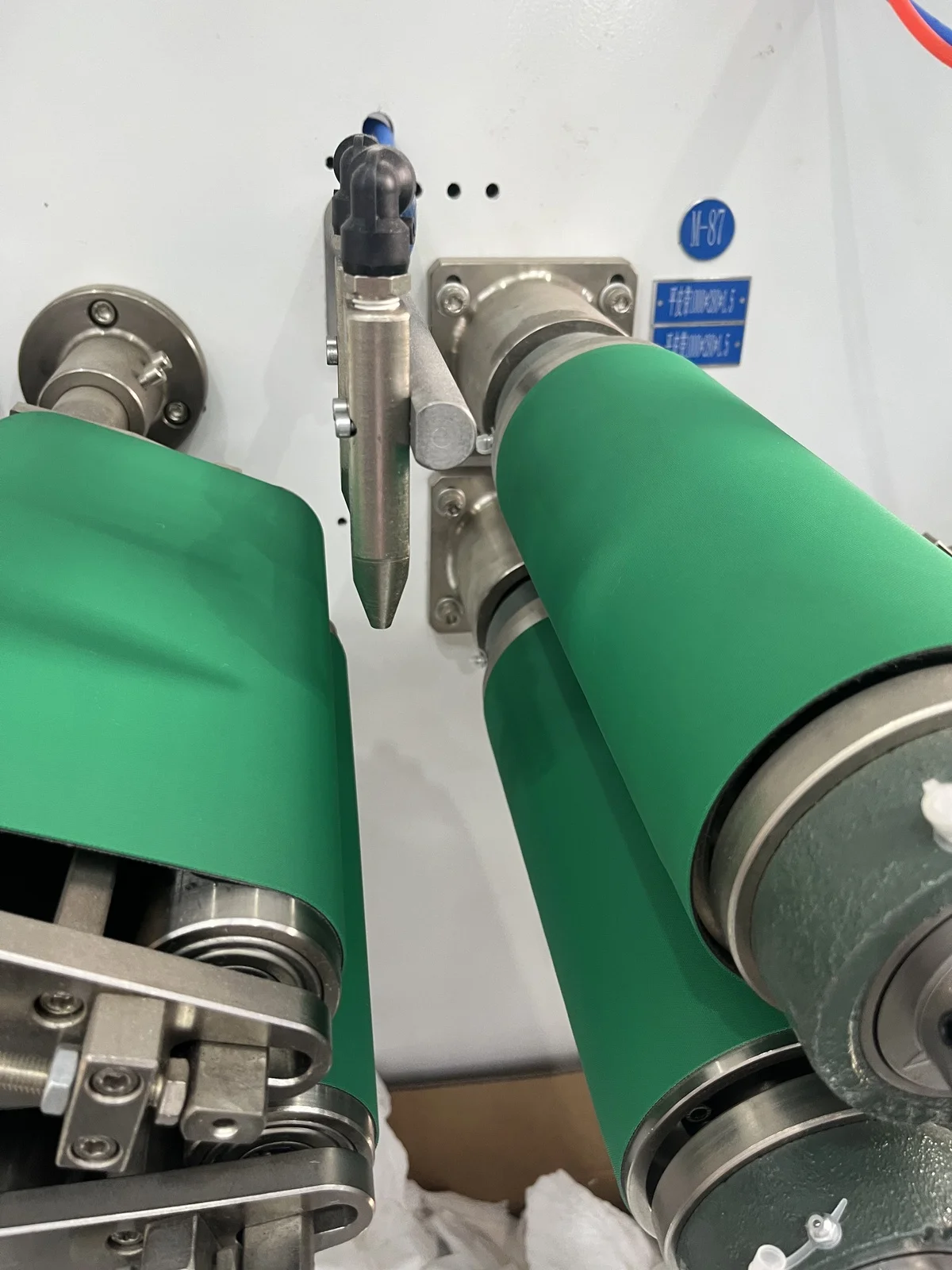
- Encoder-Tracked Pneumatic Auto-Reject Gate: Splice sensors, glue-pressure transmitters, vision cameras, and metal detectors feed a PLC shift register locked to the master encoder. When any station flags a fault—or during the first 5–10 pieces after a zero-speed splice—the pneumatic divert gate routes only the defective piece into a locked quarantine bin without slowing the main line.
- Mono-PE Flow-Wrapping & Batch Coding: Compliant stacks enter the servo flow-wrapper where box-motion end sealers seal recyclable mono-PE films at 125–140°C (Illustrative example only), while thermal-transfer printers stamp lot numbers, timestamps, and compliance codes on every pouch.
9. Engineering Matrix: Conventional Synthetic vs. Compliant Lines
Use the matrix below to evaluate machine upgrades and BOM specifications when transitioning to architectures aligned with 2027 INDA Wet Wipes and AHP priorities (Illustrative engineering reference ranges; exact settings follow signed project specs):
| Converting & QA Dimension | Legacy PET/PP Spunlace Wet Wipes Line | Compliant 100% Cellulosic Flushable Wipes Line | Conventional Open-Loop Diaper / AHP Line | QA-Audited & Ingredient-Traceable AHP Line |
|---|---|---|---|---|
| Substrate & Unwind Tension Control | 45–55 gsm PET/viscose blend; pneumatic brake at 30–45 N | 55–65 gsm 100% wood-pulp/lyocell; servo load-cell unwind at 12–22 N | Manual dancer spring tension; frequent splice web neck-in | Full-servo zero-speed splicers with recipe-locked tension curves |
| Liquid / Hot-Melt Dosing Accuracy | Fixed-frequency pump; ±8% moisture drift during speed ramps | Mass-flow closed-loop dosing; 2.8×–3.5× ratio held within ±1.5% | Manual pressure regulator; unlogged glue gsm fluctuations | Servo gear-pump gsm tracking + multi-zone PID overheat lock |
| Cutting & Folding Mechanics | Standard steel anvil cutter; painted carbon-steel folding plates | Helical tungsten-alloy shear cutter + electropolished SUS316L formers | Mechanical cam knife; manual gap shimming during size change | Electronic-cam servo rotary cutter with automatic splice relief |
| Inline Contaminant & Defect Inspection | End-of-shift manual pack weighing only | Moisture-compensated metal detector + inline checkweigher | Basic photo-eye missing-part sensor; manual sorting table | Balanced-coil metal detector (0.8–1.2 mm) + high-speed vision + auto-reject |
| Packaging Film & Lot Traceability | Multi-layer PET/PE film; simple date stamp without batch link | Recyclable mono-PE box-motion sealing + BOM lot & flushability coding | Manual polybag sealing; no digital link to raw-material roll lots | Automated stack bagging with PLC batch log for US QA Program audits |
10. How Welldone Supports Machinery, BOM Materials & Finished Goods
As INDA launches its Wet Wipes and Absorbent Hygiene Products committees in early 2027 and machinery builders advance intelligent inspection at ITMA Asia + CITME 2026, I believe hygiene manufacturers achieve the fastest compliance when converting machinery, BOM materials, and quality testing are engineered together.
Operating since 2008 and incorporated in 2013, JINJIANG WELLDONE MACHINE CO., LTD. supports global partners across three integrated scopes:
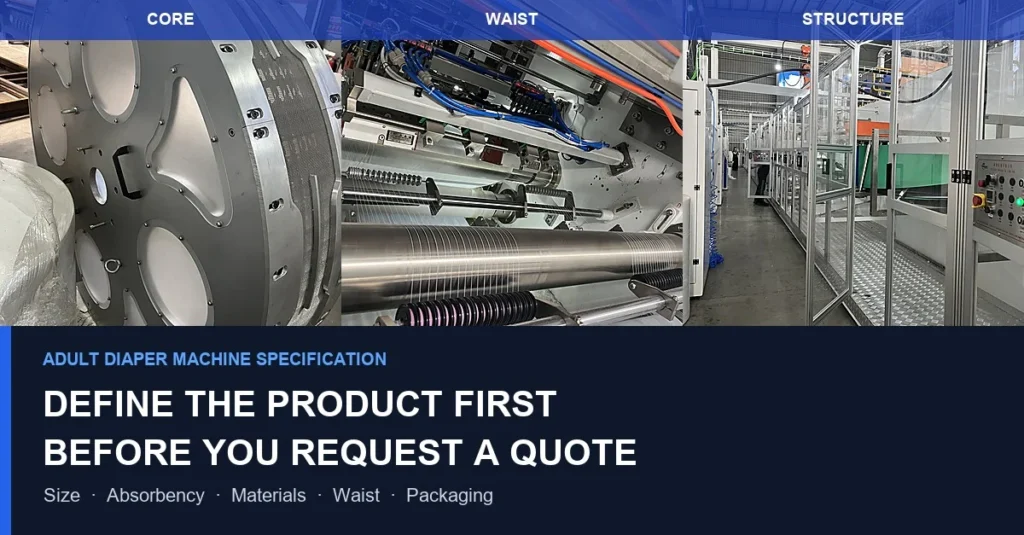
- Full-Servo Wet Wipes, Diaper, Feminine Care & Packing Machinery: We manufacture automated wet wipes machines, paper and wet wipes packing machines, pull-up adult diaper machines, baby diaper lines, sanitary pad lines, and testing equipment with closed-loop servo unwinding, mass-flow liquid and hot-melt dosing, inline metal/vision detection, and pneumatic auto-reject gates.
- Matched Hygiene Raw Material BOM Supply: Welldone supplies pre-verified BOM raw materials—including spunlace and airlaid nonwovens, ATB topsheets, fluff pulp, SAP, breathable PE backsheets, mono-PE flow-wrap films, flip-top lids, spandex, and hot-melt adhesives.
- Finished Wet Wipes & Absorbent Hygiene Products Supply: We also coordinate supply of finished wet wipes, baby diapers, adult incontinence products, sanitary napkins, and underpads. Exact specs, MOQs, and terms are confirmed via inquiry.
11. 8-Step Buyer & Factory FAT Qualification Checklist
Before ordering a wet wipes or absorbent hygiene converting line—or qualifying a plastic-free BOM for 2027 compliance—execute this 8-step FAT checklist:
- Separate Converting Specs from Tissue Rewinder Tables: Confirm wet wipes proposals specify nonwoven gsm (35–80 g/m²), folded dimensions, dosing ratio, and packs/min rather than generic tissue-roll rewinder tables.
- Run 100% Cellulosic Webs at Target Speed During FAT: Test your plastic-free wood-pulp/lyocell substrate on the wet wipes machine to verify ≤1.5 mm web wander and lint-free rotary cutting.
- Audit Closed-Loop Lotion Dosing Across Speed Ramps: Weigh stacks sampled at 50%, 75%, and 100% speed to confirm liquid add-on stays within ±1.5% without seal contamination.
- Lock Multi-Zone Hot-Melt PID & Grammage Alarms: Verify that the glue HMI logs tank, hose, and nozzle temperatures and alarms if gsm drifts outside disclosed bounds.
- Challenge the Inline Metal Detector with Test Pieces: Insert ferrous, non-ferrous, and stainless-steel test cards at full speed to confirm 100% detection and zero wet-product false triggers.
- Validate Single-Piece & Splice Auto-Rejection: Trigger a zero-speed splice and vision fault, confirming the pneumatic gate diverts every flagged piece into the quarantine chute.
- Test Mono-PE Film Sealing & Lid Placement: Run mono-PE flow-wrap film on the paper and wet wipes packing machine and verify airtight seals under vacuum testing.
- Verify Batch & Ingredient Traceability Coding: Confirm inline coders print legible lot numbers linking bags to nonwoven rolls, lotion batches, and adhesive lots via Welldone engineering support.
If a retail buyer audited your wet wipes or diaper line next quarter against INDA's 2027 flushability, single-use plastics, and U.S. Quality Assurance Program priorities, could your PLC logs prove every pack's fiber, lotion, adhesive, and metal-detection compliance?
12. Source & Date Verification
- Primary INDA Official Release (November 19, 2026 / Board Meeting November 16, 2026): Association of the Nonwoven Fabrics Industry (INDA, Cary, NC, USA) — INDA to Launch Product-Specific Committees to Strengthen Industry Advocacy and Member Engagement (Wet Wipes Committee targeting January 2027, Absorbent Hygiene Products Committee launching early 2027, Filtration Committee mid-2027; Executive Director Ben Muller).
- Primary Trade Media Coverage on INDA Committees (November 20, 2026): Nonwovens News (Haydn Davis) — INDA to create product-specific advocacy committees; Nonwovens Industry — INDA to Establish Product-Specific Committees; and TextileTechnology — INDA sets up product-specific advocacy committees.
- Primary Machinery Exhibition Source (November 20–24, 2026): Nonwovens News (November 20, 2026) — ITMA Asia + CITME 2026 opens in Shanghai (180,000 sq m across seven halls, 1,950+ exhibitors highlighting intelligent inspection and sustainable nonwovens manufacturing) & Official Portal ITMA ASIA + CITME 2026 Shanghai.
13. Frequently Asked Questions (FAQ)
1. Can one Welldone wet wipes line run both conventional spunlace and 100% cellulosic flushable substrates?
Yes. On Welldone full-servo wet wipes machines, operators switch between PET/viscose spunlace and 100% wood-pulp/lyocell flushable webs by selecting pre-saved PLC unwind tension, helical cutter pressure, and closed-loop lotion dosing recipes.
2. How do Welldone absorbent hygiene lines support the U.S. Quality Assurance Program and ingredient transparency?
Our baby diaper, sanitary pad, and pull-up adult diaper machines integrate multi-zone PID hot-melt adhesive metering, shielded inline metal detection, high-speed vision inspection, and encoder-tracked pneumatic auto-reject gates with batch coding.
3. Why should buyers check specification tables carefully when comparing wet wipes machine quotations?
Some online catalog sub-pages contain legacy tissue-roll rewinder tables (such as 14–30 gsm tissue paper at 0–180 m/min). Buyers should always verify wet wipes parameters—spunlace/airlaid gsm, folding pattern, liquid dosing ratio, and flow-wrap speed—in a formal technical proposal.
4. Does Welldone supply plastic-free nonwoven raw materials and finished wet wipes or diapers alongside machinery?
Yes. Alongside converting and paper and wet wipes packing machines, Welldone supplies matched BOM raw materials and finished hygiene products via our official contact page.
14. Request a Wet Wipes or Hygiene Line Compliance Audit
Planning to configure a plastic-free flushable wet wipes production line, upgrade an absorbent hygiene line with inline metal detection and traceable adhesive metering, or source matched BOM raw materials and finished hygiene products? Contact Welldone via our official contact page:
- Company: JINJIANG WELLDONE MACHINE CO., LTD. (Operating since 2008 • Incorporated 2013)
- Website: https://cnwelldone.com/contact-us
- Email: welldone@cnwelldone.com
- WhatsApp / Phone: +86-13655936189 / +86-18859710618