Operator Training for Hygiene Product Machines: Why a Good Machine Still Needs a Skilled Team

On July 2, 2026
Comments Off on Operator Training for Hygiene Product Machines: Why a Good Machine Still Needs a Skilled Team
Operator Training Guide
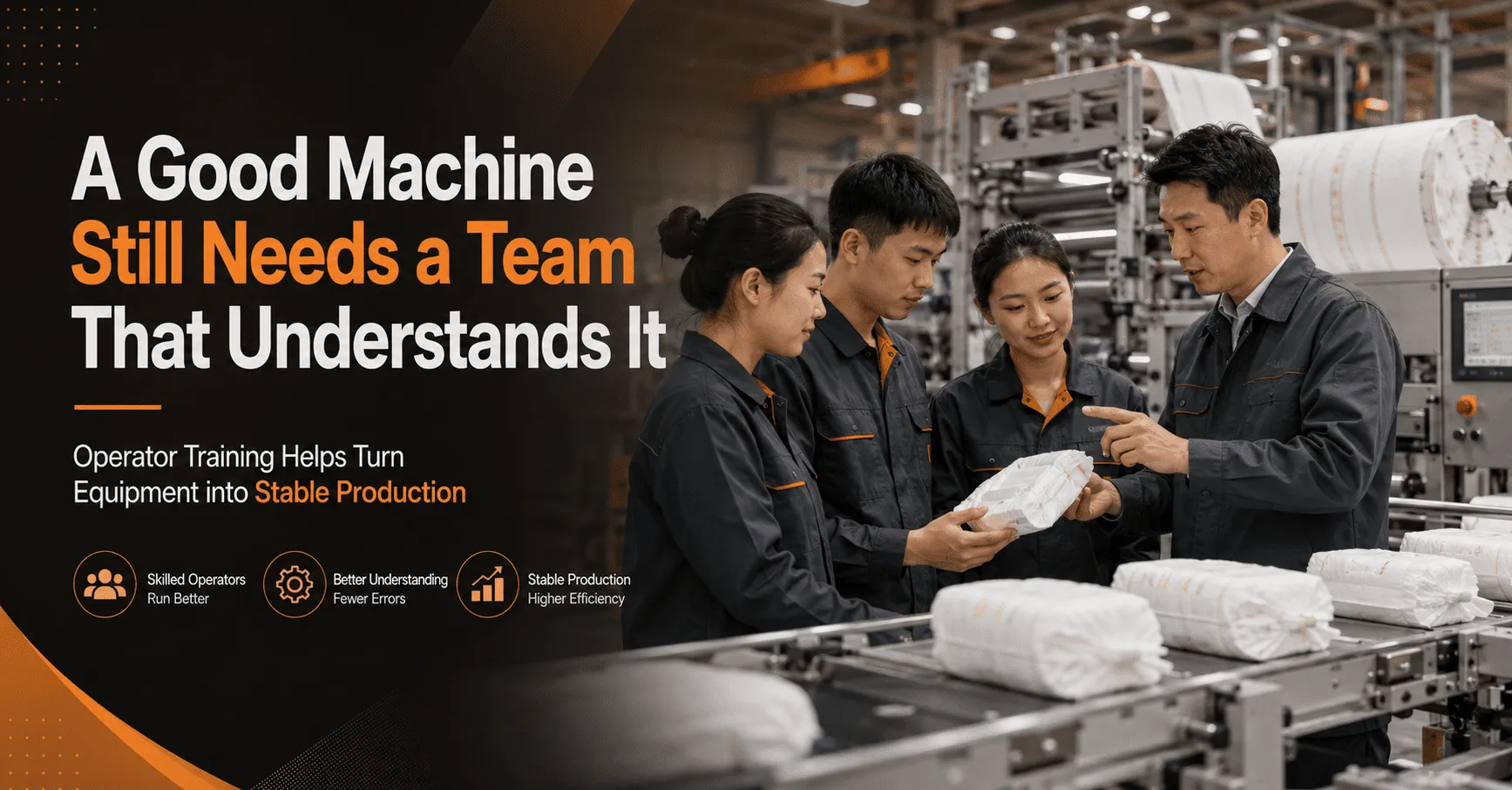
A Good Machine Still Needs a Team That Understands It
A strong hygiene product machine is important, but stable daily production also depends on the people who operate it. Operator training helps turn equipment into real production capability.
```
```
Why a Good Machine Alone Is Not Enough
Many buyers believe that once they choose a good hygiene product machine, production will naturally become stable.
This idea sounds reasonable. A strong machine should run well. A good configuration should support production. A reliable supplier should help the project start smoothly.
But in real factory operation, the machine is only one part of the story.
The people who run it matter just as much.
A baby diaper machine, sanitary napkin machine, adult diaper machine, underpad machine, pet pad machine, wet wipes machine, or tissue machine may have a strong structure and advanced configuration. It may use a full servo system. It may have a clear control interface. It may produce good samples during testing.
But after daily production starts, the real question becomes different: can the factory team keep the machine running well every day?
Operators prepare materials. Operators start the line. Operators check the product. Operators change rolls. Operators adjust settings. Operators respond to alarms. Operators notice abnormal conditions. Operators clean and maintain key parts.
If operators do not understand the machine, the factory cannot get the full value of the equipment.
A machine may be able to run at a certain speed, but the factory may not reach that speed in daily production. A machine may produce good samples, but product quality may become unstable during long running.
The machine is the foundation.
The team is what turns the machine into stable output.
The Difference Between Running a Machine and Understanding It
There is a big difference between an operator who can run a machine and an operator who understands a machine.
An operator who can run a machine may know how to press start, stop, reset, and change basic settings. This is useful, but not enough.
An operator who understands a machine knows the production logic behind the operation.
Material Flow
They know how raw materials move through the line and which feeding points affect product stability.
Tension & Cutting
They understand how tension affects cutting accuracy, folding, product shape, and product consistency.
Glue & Bonding
They know how glue temperature, glue amount, and material surface affect bonding quality.
Packing Flow
They understand how packing speed and finished product transfer affect the whole production rhythm.
This difference becomes very important during daily production. When something changes, the operator who only presses buttons may wait for help. But the operator who understands the machine can start checking possible causes step by step.
This saves time, reduces waste, and helps the factory solve small problems before they become serious problems.
Why Operator Training Matters in Hygiene Product Manufacturing
Hygiene product manufacturing is different from simple assembly work.
The machine must handle soft, thin, flexible, absorbent, elastic, or wet materials. These materials do not always behave in the same way.
- Nonwoven fabric may stretch.
- PE film may wrinkle.
- Elastic materials may shift.
- SAP distribution may affect product absorbency.
- Glue may behave differently depending on temperature.
- Wet wipes material may fold differently depending on moisture.
- Tissue paper may tear if tension is not controlled well.
This means operators need more than simple machine operation skills. They need to understand the relationship between machine settings, raw materials, product structure, product quality, and production stability.
Baby Diaper Production
Operators must pay attention to material feeding, elastic position, SAP distribution, waist structure, product size, and packing rhythm.
Sanitary Napkin Production
Operators need to watch sealing quality, core position, cutting accuracy, wing folding, and individual packaging.
Adult Care Production
Operators need to manage larger product sizes, higher material consumption, absorbency requirements, and smooth product transfer.
Wet Wipes & Tissue Production
Operators need to understand folding, cutting, counting, liquid control, stacking, and packing connection.
Small Operator Mistakes Can Become Big Daily Losses
In daily production, many losses do not come from one big failure.
They come from small repeated mistakes.
- A material roll is changed too slowly.
- A tension issue is noticed too late.
- A glue problem is adjusted in the wrong direction.
- A blade condition is ignored until product edges become poor.
- A size change takes too long because settings are not recorded.
- A product defect appears again and again because no one checks the root cause.
At first, these problems may seem small. But when they happen every day, they become real production cost.
They create more downtime, increase raw material waste, reduce sellable output, make quality control more difficult, create pressure for supervisors and managers, and may even delay delivery.
Training is not only about teaching people how to start the machine. Training is about reducing daily losses caused by misunderstanding, wrong habits, and slow reaction.
Material Changes Require Operators Who Understand Adjustment Logic
In hygiene product production, raw materials may change for many reasons.
The buyer may change suppliers. The supplier may provide a different batch. Material thickness may vary. Softness, strength, surface treatment, or tension behavior may be slightly different. Glue performance may change with temperature or storage condition.
When materials change, machine performance may also change. This does not always mean the machine has a problem. Sometimes, the machine only needs the right adjustment.
01
Material Changes
02
Machine Behavior Changes
03
Operator Observes
04
Correct Adjustment
- If nonwoven fabric becomes softer, the operator may need to check tension and feeding stability.
- If PE film wrinkles, the issue may be related to tension, alignment, temperature, or material quality.
- If sanitary napkin sealing becomes weak, the operator may need to check temperature, pressure, material thickness, or glue condition.
- If wet wipes folding becomes unstable, the operator may need to check material moisture, folding mechanism, cutting condition, and speed matching.
A trained operator does not guess randomly. They follow logic. They know where to check first, which adjustment may affect the product, and when to call for support with clear information.
Size Change Is a Test of Real Factory Skill
Many hygiene product factories need to produce more than one size or product style.
A baby diaper factory may produce newborn, S, M, L, XL, and other sizes. A sanitary napkin factory may produce different lengths, thicknesses, wing types, and packaging styles. An adult diaper factory may produce different waist sizes and absorbency levels.
Underpad and pet pad factories may produce different dimensions. Wet wipes and tissue factories may produce different folding, counting, and packing formats.
Every size change is a test. It tests the machine, the operators, and whether the factory has clear records and standard procedures.
Preparation
Operators should know how to prepare materials, parts, settings, and inspection tools before size change starts.
Adjustment
Operators should understand which sections and settings need to be changed for the new product size.
Testing
Operators should check product quality carefully after adjustment before returning to stable production.
Recording
Successful settings should be recorded so the next size change becomes faster and more stable.
If operators are not trained well, size change may create long downtime and high waste. The team may spend too much time finding the right settings, repeat the same mistakes, or depend too much on one experienced person.
Size change is not only a technical action.
It is a factory management ability.
Quality Control Starts with Operators on the Line
Many factories think quality control happens only in the inspection area.
But in real production, quality control starts on the machine.
Operators are the first people who see product changes. They see whether the product shape is stable, whether cutting is clean, whether folding is smooth, whether sealing looks strong, and whether packing flow is normal.
They also hear unusual sounds, notice abnormal vibration, and feel when the production rhythm changes.
If operators are trained to observe carefully, many quality problems can be found early.
If a problem is found after only a few products, the loss is small. If the same problem is found after thousands of products, the loss becomes serious.
- For diapers, operators should check product size, elastic position, core structure, absorbency-related material position, and appearance.
- For sanitary napkins, operators should check sealing, cutting, folding, core position, and individual packing.
- For underpads and pet pads, operators should check cutting accuracy, absorbent layer position, folding, stacking, and packing.
- For wet wipes and tissue products, operators should check folding, counting, cutting, moisture, stacking, and packaging.
When operators understand quality points, they become part of the quality control system.
Trained Operators Help Reduce Downtime and Waste
Downtime and waste are two major hidden costs in hygiene product manufacturing.
A machine stop may look like a technical issue. But the length of the stop often depends on operator ability.
A trained operator can describe the problem clearly, check basic causes, avoid wrong adjustments, restart production faster, reduce waste during adjustment, and prevent repeated mistakes.
- If operators know how to prepare materials before the current roll finishes, the machine does not need to wait.
- If they know how to clean key parts properly, small problems may not become serious.
- If they know how to record settings, the next size change becomes faster.
- If they understand product quality standards, defects can be found earlier.
- If they know how to communicate with technical support, problems can be solved more efficiently.
A trained team brings more stability to daily operation. The factory becomes less dependent on emergency troubleshooting. Production becomes easier to plan. Managers can trust the line more.
This is the real value of operator training: it turns daily operation into controllable production.
Why Training Should Happen During Installation and Trial Production
Operator training should not wait until mass production has already started.
The best time for training is during installation and trial production.
During installation, operators can understand the machine structure, main sections, electrical system, air system, material feeding route, safety points, and maintenance areas.
During trial production, operators can learn through real product running. They can see how materials behave on the line, understand how settings affect the product, practice checking quality, learn how to respond to alarms, participate in adjustment and troubleshooting, and ask questions while engineers are still on-site.
Trial production is a training classroom inside the factory.
The machine is running. The product is real. The materials are real. The problems are real. The solutions are practical.
This is why Welldone treats installation and trial production as important stages for knowledge transfer, not just machine handover.
What a Good Operator Training Process Should Include
A good operator training process should be practical and connected to daily production.
It should not only explain theory. It should help operators work better on the line.
1. Machine Structure Understanding
Operators should understand the main sections of the machine and what each section does. This helps them locate problems faster.
2. Safe Operation
Operators should know safe startup, shutdown, emergency stop, cleaning, and inspection procedures.
3. Material Preparation
Operators should learn how to prepare raw materials, check material direction, confirm roll position, and reduce waiting time.
4. Product Quality Checking
Operators should know the key quality points of the product, including size, weight, appearance, sealing, cutting, folding, absorbency-related structure, and packing.
5. Basic Adjustment Logic
Operators should understand how machine settings affect product quality and production stability.
6. Size Change Process
Operators should learn how to prepare, adjust, test, record, and return to stable production after size change.
7. Waste Control
Operators should understand where waste comes from and how to reduce it during startup, material change, size change, and troubleshooting.
8. Maintenance Routine
Operators should know which parts need cleaning, checking, lubrication, or regular replacement.
9. Problem Reporting
Operators should learn how to report problems clearly, including what happened, when it happened, what material was used, what settings changed, and what product defect appeared.
This kind of training helps the factory build real production ability.
Common Training Mistakes Buyers Should Avoid
Some factories invest in good machines but do not invest enough attention in operator training.
This creates avoidable problems.
1. Only Training One Person
If only one operator understands the machine, the factory becomes dependent on one person. More team members should understand the basic operation and production logic.
2. Treating Training as a Short Demonstration
A quick demonstration is not enough. Operators need hands-on practice during real production.
3. Ignoring Product Quality Logic
Operators should not only learn machine buttons. They should understand how product defects connect with machine sections and materials.
4. Not Recording Settings
Good settings and adjustment experience should be recorded. Without records, the factory may repeat the same learning process again and again.
5. Not Training for Size Change
If the factory produces multiple sizes, size change training is essential. Otherwise, downtime and waste may increase.
6. Depending Too Much on Supplier Support
Supplier support is important, but the factory team should also build its own ability to handle daily operation.
7. Waiting Until Problems Happen
Training should happen before mass production pressure becomes high. Early training prevents later losses.
How Welldone Supports Operator Training and Stable Production
At Welldone, we understand that a successful project is not only about delivering a machine.
It is about helping the customer build a team that can run the machine well.
Our support does not stop at installation. We help customers understand the full production logic behind the machine.
Before Machine Arrival
We help buyers prepare factory conditions, raw materials, layout, power supply, air supply, and production planning.
During Installation
We support machine assembly, commissioning, checking, safety understanding, and initial operation.
During Trial Production
We provide practical guidance on material feeding, machine adjustment, product quality checking, size change, waste control, and production rhythm.
Long-Term Support
We support customers with spare parts guidance, maintenance suggestions, technical communication, and production improvement advice.
For operator training, we focus on real factory operation. We help operators understand what each section does, how to observe product changes, how to respond to common problems, and how to communicate clearly when support is needed.
Welldone does not only want customers to run the machine. We want customers to run it with confidence.
Stable output does not come from equipment alone. It comes from a factory team that understands how to use the equipment well.
Related Machines
Operator training requirements are different for each hygiene product category. Welldone supports a wide range of hygiene product machines and helps buyers build stronger production teams.
Baby Care Machines
Baby diaper machines and baby pull-up diaper machines require trained operators who understand material feeding, elastic control, SAP distribution, size change, product checking, and packing coordination.
Learn MoreFemale Care Machines
Sanitary napkin machines, panty liner machines, and related female care production lines require careful operation for sealing quality, cutting accuracy, wing folding, product length, and individual packing.
Learn MoreAdult Care Machines
Adult diaper machines, adult pull-up diaper machines, and underpad machines need operators who understand larger product handling, material consumption, absorbency requirements, folding, stacking, and packing flow.
Learn MorePet Care Product Machines
Pet pad machines and pet diaper machines require stable material feeding, flexible size control, accurate cutting, absorbent structure control, and cost-conscious production operation.
Learn MorePaper & Wet Wipes Machines
Wet wipes machines, tissue machines, facial tissue machines, napkin machines, and related packing machines require operator understanding of folding, cutting, counting, liquid control, stacking, and packing connection.
Learn MoreConclusion
A good machine still needs a team that understands it.
In hygiene product manufacturing, stable production is not created by equipment alone. It comes from the cooperation between machine, materials, operators, quality control, packing flow, maintenance, and daily management.
Operators are the people closest to the production line. They see problems first. They respond first. They protect quality first.
This is why operator training is not a small part of installation. It is part of the factory’s long-term production capability.
A trained team helps the factory get more value from the machine. It helps production become more stable, quality become more consistent, and daily management become easier.
At Welldone, we believe a strong production line is built by both machine and people.
We do not only help customers start production. We help customers build the ability to keep production stable.
FAQ
1. Why is operator training important for hygiene product machines?
Operator training helps the factory reduce downtime, control waste, improve product quality, handle size changes, understand machine adjustment, and keep production stable.
2. Can a good machine run well without trained operators?
A good machine may produce good samples, but stable daily production still depends on trained operators. Operators need to understand materials, settings, product quality, and troubleshooting.
3. What should operators learn during training?
Operators should learn machine structure, safe operation, material preparation, product quality checking, basic adjustment logic, size change, waste control, maintenance routines, and problem reporting.
4. Why should operators understand production logic?
When operators understand production logic, they can find problems earlier, adjust more correctly, reduce repeated mistakes, and communicate technical issues more clearly.
5. How does operator training reduce waste?
Training helps operators prepare materials correctly, adjust the machine faster, control size change, identify defects early, and reduce unnecessary trial-and-error during production.
6. Why is size change training important?
Many hygiene product factories produce multiple sizes or styles. Without proper size change training, the factory may face long downtime, high waste, and unstable quality after each change.
7. Should training happen during installation or after mass production starts?
Training should begin during installation and trial production. This gives operators the chance to learn with real materials, real products, and real production conditions before mass production pressure becomes high.
8. How many operators should be trained?
It is better to train more than one operator. If only one person understands the machine, the factory becomes too dependent on that person.
9. Does Welldone provide operator training?
Yes. Welldone supports customers with installation, commissioning, trial production, operator training, product adjustment, material matching guidance, and long-term technical support.
10. What is the real value of operator training?
The real value is helping the factory turn equipment into stable production capability. A trained team can run the machine better, reduce losses, and produce qualified products with more confidence.
Build a Stronger Production Team with Welldone
A good machine is important, but a trained team helps the factory unlock its real value. Welldone supports hygiene product manufacturers with machine installation, trial production, operator training, and long-term stable production guidance.
Website: www.cnwelldone.com
Email: welldone@cnwelldone.com