Tissue Embossing and Lint: Why Deeper Patterns Shed More

Tissue Embossing and Lint: Why Deeper Patterns Shed More
Tissue Machinery Series · Part 3
Part 1: 400 vs 1,000 pcs/min — why tissue speed is quoted as a range — how fold type, ply count and paper weight place you inside the quoted range.
Part 2: Facial tissue, napkin, handkerchief — one line or three? — where the three product families share stations and where they split.
Part 3 — why the embossing pattern that wins the order can generate the complaint that follows it.
Part 1: 400 vs 1,000 pcs/min — why tissue speed is quoted as a range — how fold type, ply count and paper weight place you inside the quoted range.
Part 2: Facial tissue, napkin, handkerchief — one line or three? — where the three product families share stations and where they split.
Part 3 — why the embossing pattern that wins the order can generate the complaint that follows it.
The sample felt thin, so the customer asked for deeper embossing. You obliged. The pattern came out crisp, the sheet looked thicker on the shelf, and the order was confirmed.
Six weeks later the photographs arrive: fine paper dust in the bottom of the carton, on the retailer's shelf, on the end user's dark jacket. Nothing on the line broke. The machine ran to specification. And the cause is sitting in the pattern you were asked to deepen.
The complaint that arrives after the shipment
Lint is an awkward defect because it does not fail inspection at the factory. A freshly converted sheet looks clean. The dust appears after handling, after transport vibration, after the pack is opened and the sheets are pulled one at a time.
By then the container has landed. The conversation is no longer about machine settings; it is about who pays for the batch.
Embossing is the one process where the customer specifies the setting and the supplier absorbs the consequence.
What embossing actually does to the sheet
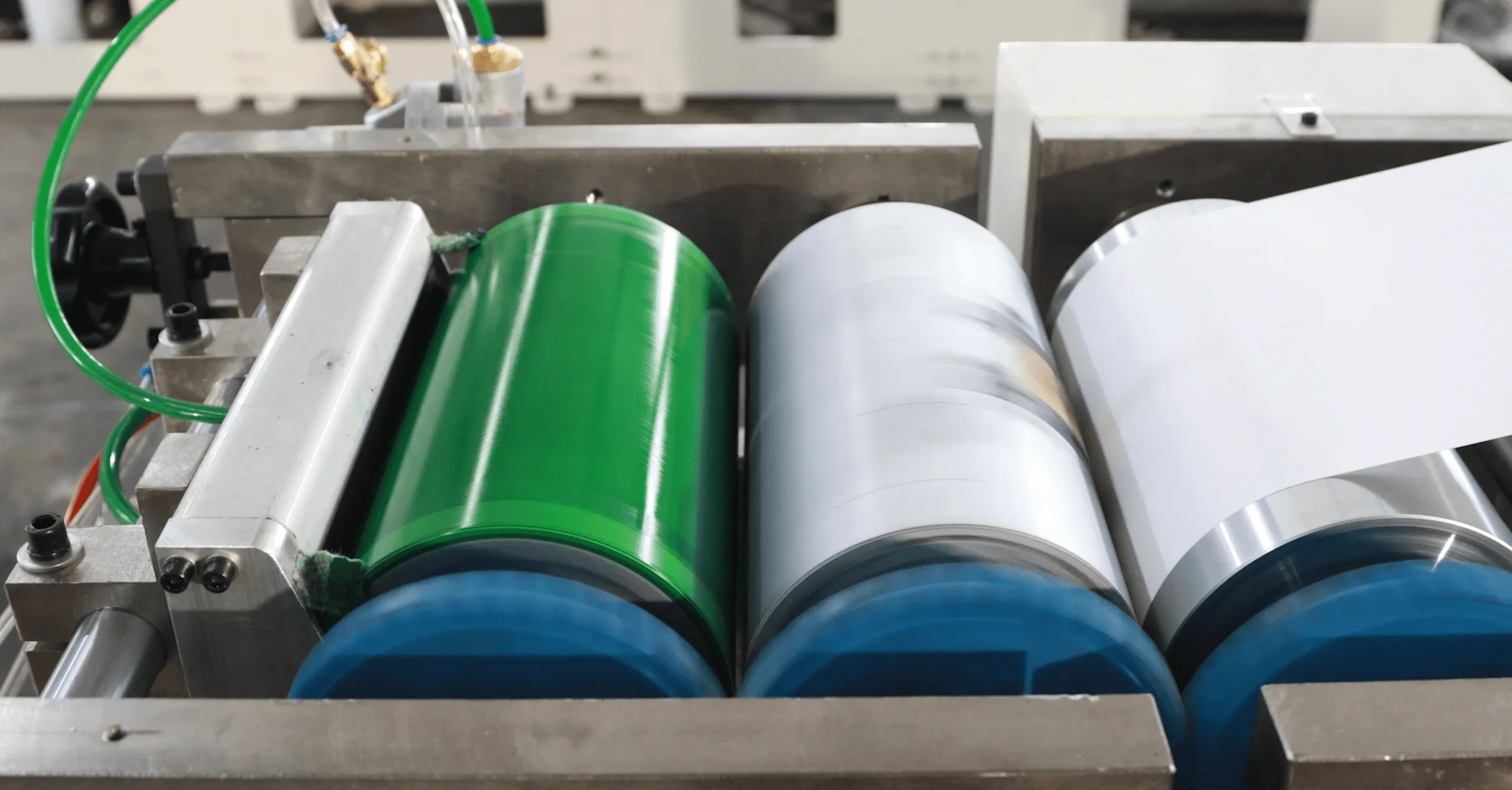
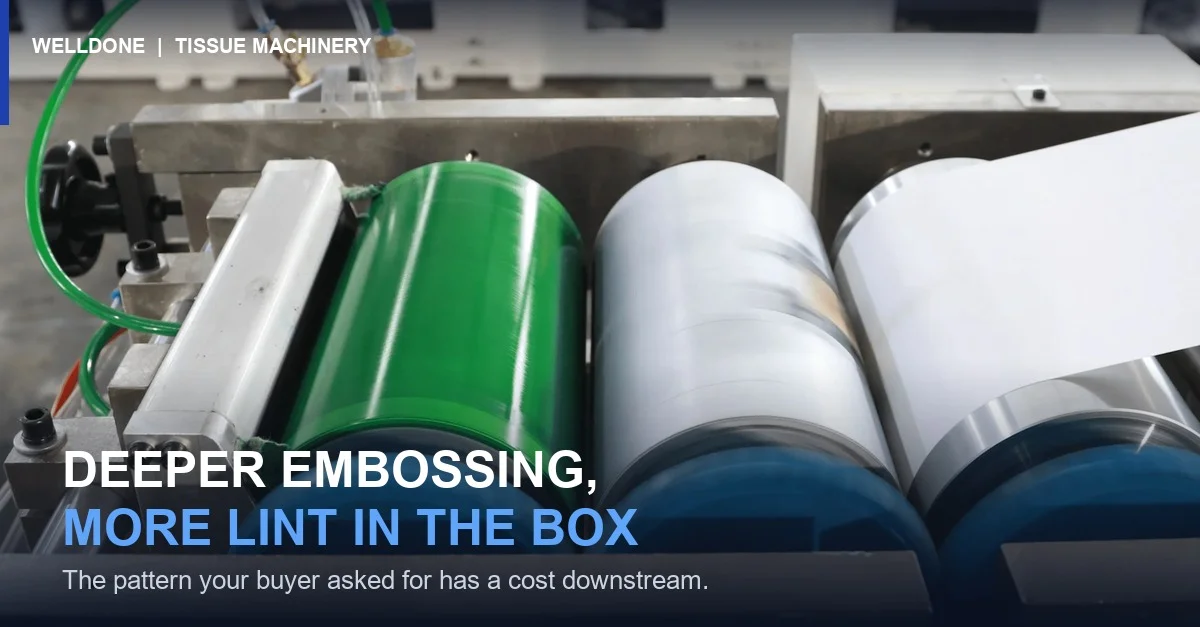
Our own description of the EMBOSSING MODULE is worth reading closely. It says the module creates soft textures, guiding patterns, and decorative embossing for tissue products, and that it delivers uniform pressure, stable absorbency, and clean pattern definition.
Notice which word carries the weight there: pressure. Embossing does not add material to the sheet. It presses the sheet into an engraved roller so that the paper takes a three-dimensional shape, which reads to the hand and the eye as a thicker, softer product.
That apparent bulk is deformation. The fibres in the pressed regions are compacted, stretched over the pattern edges, and displaced relative to their neighbours. Handled gently, the structure holds. Pushed too far, some of those fibres stop being part of the sheet.
Two modules, not one — and that is deliberate
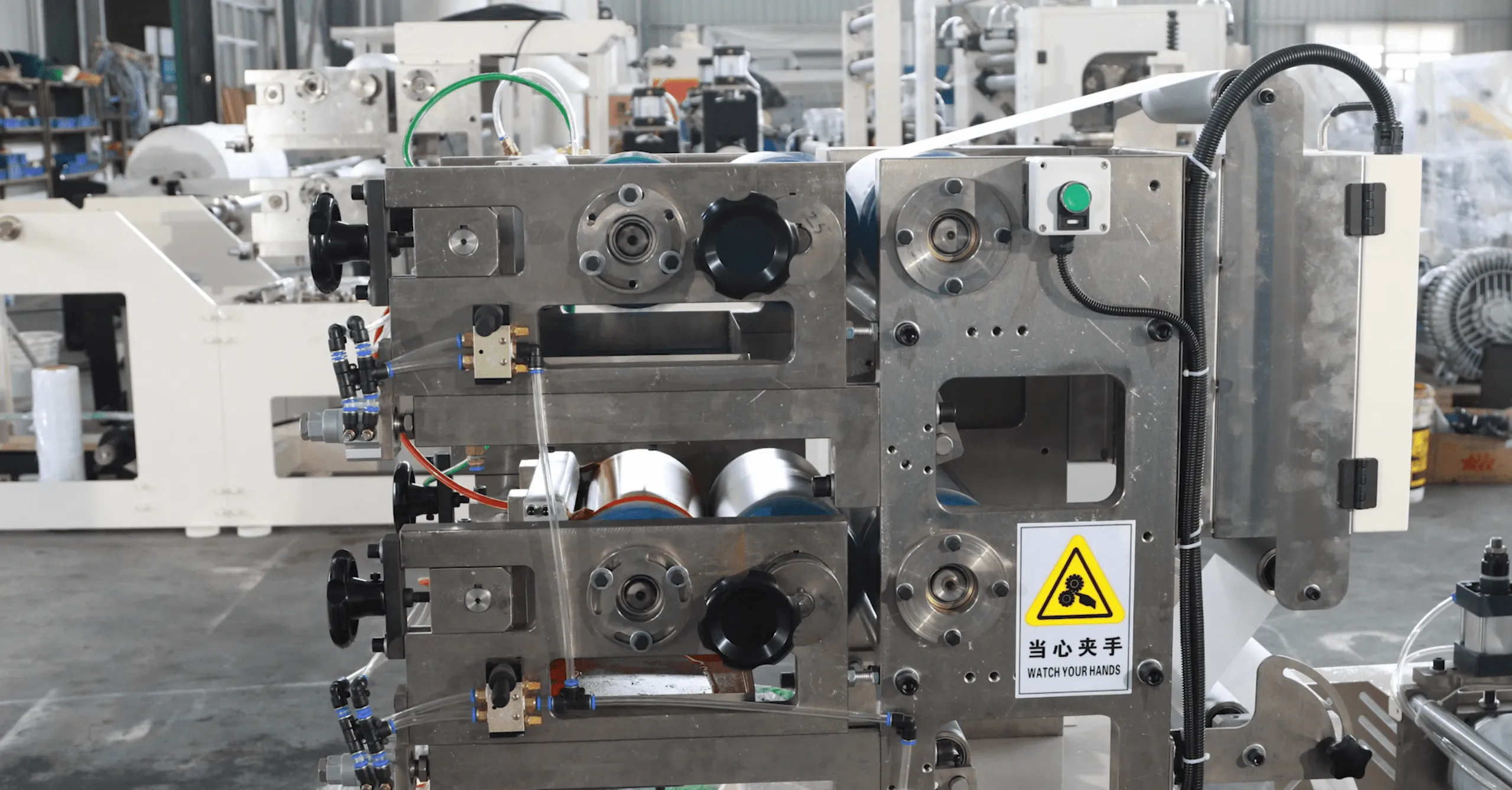
On our platform overview, embossing and lamination are listed as two distinct modules rather than one combined station. The LAMINATING & BONDING MODULE is described separately as handling multi-layer lamination of tissue, non-woven, and PE film combinations, maintaining precise tension, stable alignment, and consistent bonding thickness, and providing strong adhesion while preserving softness and flexibility.
Read those two descriptions together and the engineering logic becomes visible. One module deliberately deforms the sheet to create texture. The other has to hold the resulting structure together without flattening what was just created.
Those goals pull against each other. Actually that tension is the whole subject of this article — the deeper the first module goes, the more work the second has to do, and the narrower the settings window becomes for both.
Where the fibres give way
Tissue holds together through hydrogen bonding between cellulose fibres. There is no adhesive in the base sheet doing that job — the bonds form as the paper dries and they are what gives a light sheet its strength.
Embossing loads those bonds. At the edges of a pattern the sheet is forced to conform to a shape, and fibres either stretch, slip past each other, or break their bonds with neighbouring fibres. Fibres that break free are no longer part of the sheet structure. They stay physically trapped in the pattern until something dislodges them.
That is what lint is. Not contamination from outside, and not a hygiene failure. It is material from your own sheet that has stopped being attached to it.
Why it appears downstream rather than on the line
Loose fibres sit in the embossed pockets and stay there through counting, stacking and packing. Then the pack travels. Vibration in transit works them loose, and every sheet pulled from a box rubs against the one behind it.
In most cases the customer sees the problem before the producer does, which is exactly the wrong order. It also explains why lint complaints so often arrive attached to a photograph rather than a test report — by the time anyone notices, the evidence is in a carton on another continent.
Practical check before shipping: take a finished pack, pull twenty sheets in sequence over a dark surface and look at what collects. It is crude, but it reproduces the handling the product will actually get, which a visual inspection of a single fresh sheet does not.
The variables you control
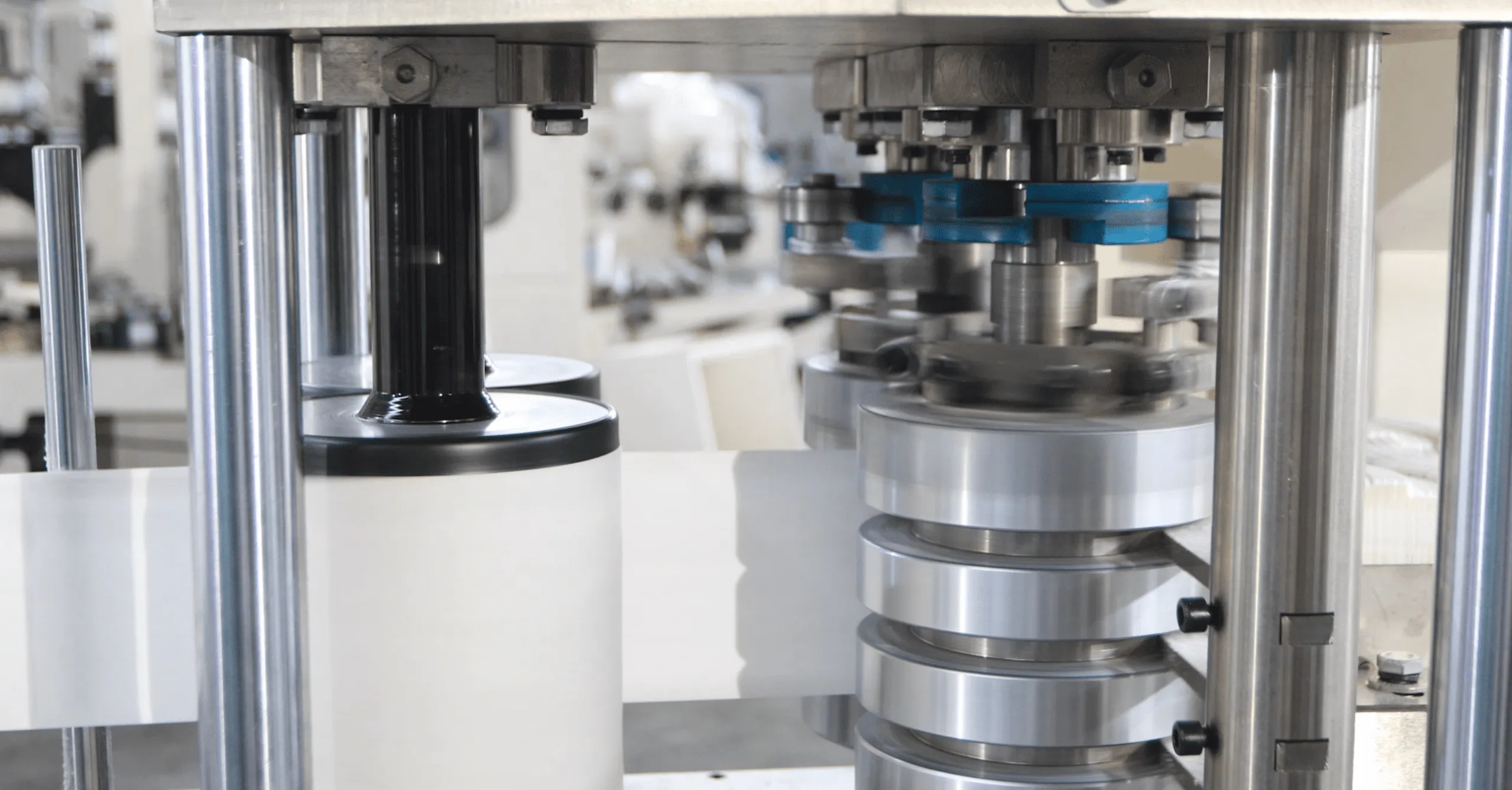
Four factors interact here, and only some of them are adjustable once the line is running.
- Pattern depth and edge profile. Fixed in the engraving. A sharp-edged deep pattern concentrates stress along a narrow line; a rounded shallower one distributes it. This is a tooling decision, not a machine setting.
- Nip pressure. Adjustable, and the first thing operators reach for when the pattern looks weak. Also the fastest way to turn a marginal setup into a shedding one.
- Base paper quality. Fibre length and bonding strength determine how much deformation the sheet tolerates. A cheaper grade with shorter fibres will shed at a depth that a better grade handles cleanly.
- Coverage area. A pattern covering most of the sheet stresses far more of it than a discrete motif, even at identical depth.
Sourcing note: our platform overview publishes positioning accuracy, speeds, footprint, power and air supply, but it does not publish embossing depth ranges, nip pressure values, roller temperatures or base paper grammage. Those figures are configuration-specific and are set during tooling design and commissioning. Any depth or pressure number quoted to you without reference to your specific paper grade and pattern should be treated as indicative only.
Finding your working window
There is no universal correct depth, because the acceptable depth depends on the paper you are running and the pattern you engraved. What exists is a window, and it has to be found empirically for each combination.
The sequence that works is unglamorous. Start shallower than the target and increase in steps, checking two things at each step: whether the pattern definition is commercially acceptable, and whether the twenty-sheet handling test produces visible shedding. The usable window is the range where the first is satisfied before the second appears.
More importantly, that window has to be re-established whenever the base paper changes. A grade substitution made in the purchasing department can move the limit without anyone telling production, and the first evidence will be a customer photograph.
Dust control is part of the answer, not all of it
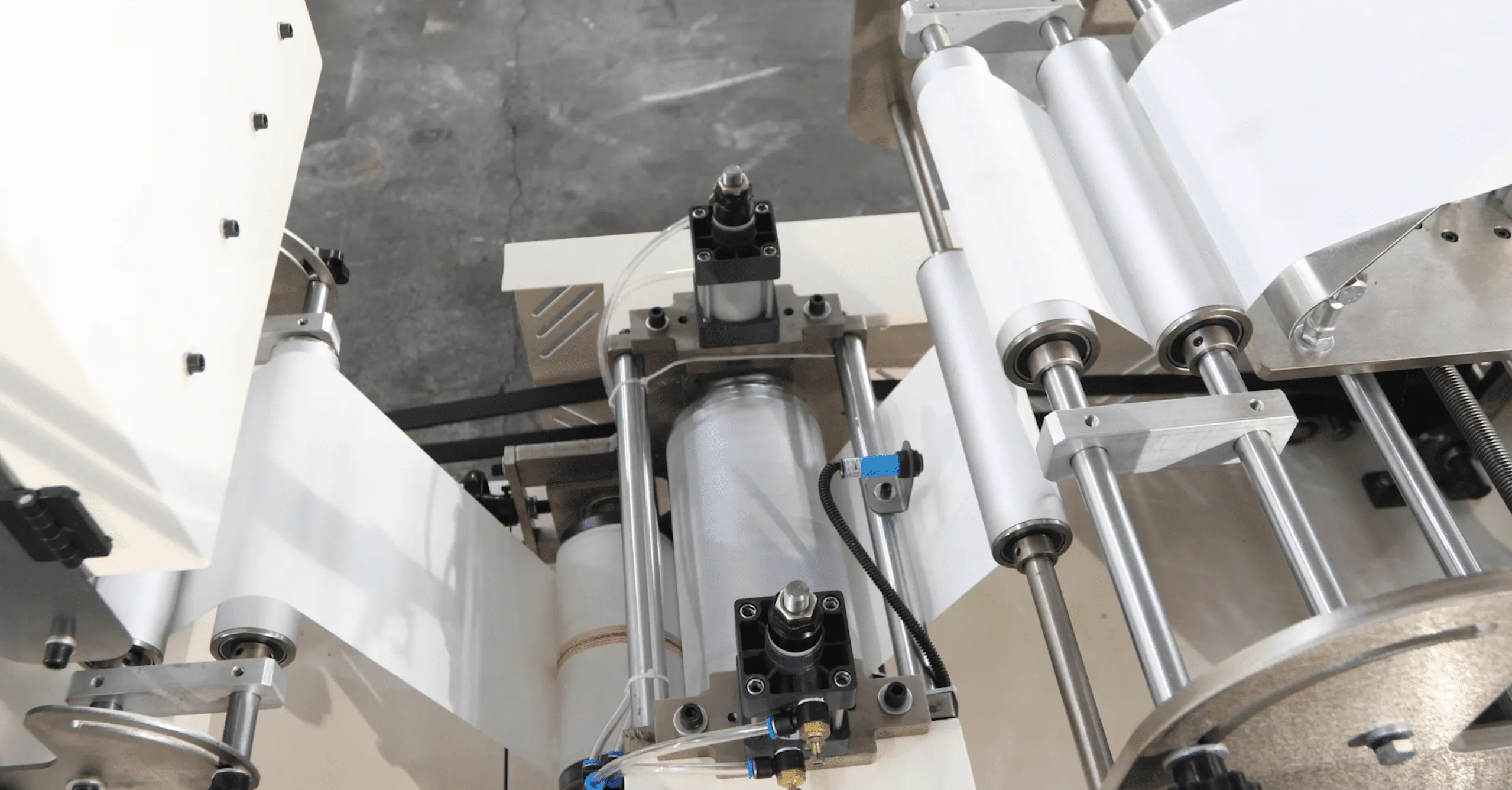
The Welldone design guidelines include a specific entry for Cleaning & Dust Control: air suction hoods and CIP-friendly structures; integrated dust-collection ducts to remove paper dust and lint, keeping folding and slitting sections clean and reducing downtime.
That is a genuine mitigation and it matters — for line cleanliness, for reject rates, and for the stoppages that accumulate when debris builds up on folding plates. What it cannot do is fix an embossing problem. Extraction removes loose fibres that are travelling through the machine; it does not reach fibres held inside the embossed pockets of a finished sheet.
The distinction is worth making explicitly, because dust control gets sold as a lint solution and it is not one. It is a housekeeping and uptime measure that happens to touch the same material.
The misconception that costs money
I believe the most expensive assumption in this category is that embossing depth is a free aesthetic choice — that if the buyer wants a deeper pattern, the only question is whether the tooling can produce it.
The tooling almost always can. That is precisely the problem. Nothing in the process objects at the moment the decision is made, and the consequence surfaces weeks later in someone else's warehouse.
Producers who handle this well change the conversation early. They present depth as a trade-off with a stated limit for the specified paper grade, agree the limit with the customer before tooling is engraved, and get it into the specification. That turns a future complaint into a documented decision — and it is far easier to have that discussion before the rollers are cut than after the container has shipped.
Questions to settle before the tooling is engraved
- Which base paper grade is this pattern designed for? If purchasing may switch grades on price, the pattern needs to survive the cheapest grade you would realistically buy.
- Is the depth specified, or only described? "Deep embossing" in an email is not a specification. A number tied to a paper grade is.
- Has a handling test been agreed as an acceptance criterion? If lint is not tested for, it will be discovered rather than measured.
- Who signs off a base paper substitution? If production is not told, the embossing window is being changed without anyone re-validating it.
Why Welldone
Welldone has manufactured hygiene converting equipment in Jinjiang, Fujian since 2008, incorporated in 2013, supplying tissue, wet wipes, baby care, female care, adult care and pet care lines to factories across Asia, Africa, the Middle East and Latin America.
Embossing and bonding as separate modules
Pattern forming and ply lamination are engineered as distinct stations, so depth and bonding can be tuned against each other rather than compromised in a single fixed unit.
Tooling designed to the paper
Roller engraving is specified against your intended base paper grade and pattern coverage rather than copied from a generic catalogue pattern.
Dust control in the design guidelines
Suction hoods and integrated dust-collection ducting are part of the standard line specification, keeping folding and slitting sections clean and reducing downtime.
Related machines
Conclusion
Deeper embossing is not a defect. It is a choice with a cost, and the cost is paid in fibre bonds that stop holding the sheet together.
The producers who avoid lint complaints are rarely the ones with better extraction. They are the ones who established a depth limit for their specific paper grade, wrote it into the specification, and re-validated it when the paper changed.
So before the next pattern gets engraved, ask one question of your own operation: if your base paper supplier substituted a shorter-fibre grade next month at the same price, would anyone check the embossing window before the batch shipped?
Frequently asked questions
What causes lint in embossed tissue?
Fibres that lose their bonds to neighbouring fibres during embossing. The pattern is formed by pressing the sheet into an engraved roller, which stresses fibre bonding at the pattern edges. Fibres that break free stay trapped in the embossed pockets until handling dislodges them.
Will better dust extraction solve a lint problem?
It helps line cleanliness and uptime, and the Welldone design guidelines include suction hoods and dust-collection ducts for exactly that reason. But extraction only captures debris travelling through the machine. It cannot reach fibres already detached inside a finished sheet, so it is a mitigation rather than a fix.
What embossing depth should I specify?
There is no universal figure, because the usable depth depends on your base paper grade, pattern geometry and coverage area. Establish it empirically by increasing depth in steps and testing for shedding at each step. Treat any depth number quoted without reference to your specific paper as indicative only.
Why are embossing and lamination separate modules?
Because they do opposing jobs. The EMBOSSING MODULE deforms the sheet to create texture; the LAMINATING & BONDING MODULE holds plies together with consistent bonding thickness while preserving softness. Keeping them separate lets each be tuned rather than forcing a compromise in one fixed unit.
Does embossing depth affect production speed?
Pattern complexity and depth influence how the sheet behaves through the converting section, which is one of the factors that places a line inside its quoted output range. Part 1 of this series covers how fold type, ply count and paper weight determine where you sit within the published 400–1,000 pcs/min design range.
Specifying an embossing pattern?
Send us your pattern reference, intended base paper grade and coverage area. We will tell you where the depth limit sits for that combination before the rollers are engraved.
Website: www.cnwelldone.com
Email: welldone@cnwelldone.com